Fresenius SE & Co. KGaA
Q3 FY2026 · Earnings Call TranscriptNovember 4, 2026
Operator
Good afternoon, and welcome to the conference call of Fresenius Investor Relations, which is now starting. May I hand you over to Nick Stone, Head of Investor Relations?
Nick Stone
Thanks, Valentina. Hello, everyone.
Welcome to our year-to-date and Q3 2026 earnings call and webcast. The presentation was emailed to our distribution list this morning and is available on fresenius.com.
On slide two of the presentation, you'll find the usual safe harbor statements. Unless stated otherwise, we'll discuss performance at constant exchange rates, and growth references will refer to organic growth.
I'm pleased to welcome Michael and Sara, who will take you through the results and what they mean for the continued delivery of #FutureFresenius. As usual, the call will last approximately one hour, with the presentation taking around 30 minutes, with remaining time for your questions.
To give everyone a chance to participate, please limit your questions to one to two, and we can always come back for a second round as needed. I'll now hand over to Michael to discuss our performance and the improved outlook.
Michael Sen
Thank you, Nick, and welcome to everyone joining us today. I'm very pleased to report another excellent quarter for Fresenius, one that reinforces the structural improvement in our performance.
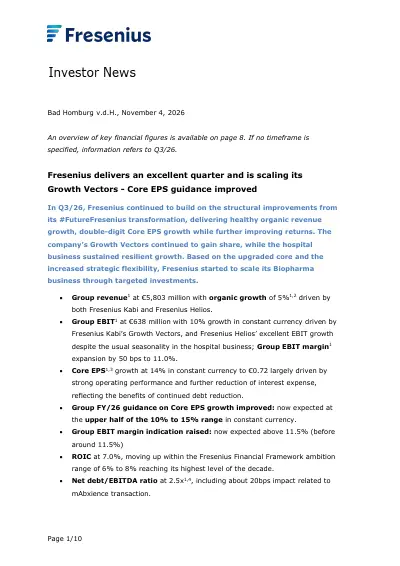
We continue to deliver healthy organic growth, double-digit core EPS growth, and strong operating cash generation while further improving our returns. From this position of operational strength, we are improving our full-year core EPS growth guidance and now expect to reach the upper half of 10% to 15% range at constant currency.
Sara and I will take you through the key operational and financial highlights in a moment. First, let me highlight what matters most about this quarter.
Fresenius continues to deliver. We're building on the structural improvements achieved through our transformation.
Q3 once again makes progress evident through a durable, higher-quality operational performance, resulting in strong earnings growth and improving returns. In fact, we achieved the highest ROIC in this decade.
Our growth vectors are increasingly driving revenue and earnings growth. This tectonic shift, which is testament to the success of our strategy, is strengthening the business for the long term.
We're now doubling down and are scaling our growth vectors decisively. Our stronger balance sheet provides us with both continued strategic flexibility and resilience, including after our recent biopharma transaction.
We're investing from a position of strength in attractive high-growth businesses while remaining disciplined and focused on returns. This is exactly what we said we're going to do: upgrade the core, scale our growth vectors for relevance without going against the balance sheet, and continuously improve operating performance.
We're now seeing the results in our earnings, profitability, and returns. Fresenius is stronger, more focused, and better positioned for its next phase of growth.
We're building a business that delivers for patients and health systems and creates sustainable value for shareholders at the same time. Q3 builds on our strong first-half performance with continued progress across all the businesses.
Earnings continue to grow faster than sales, reflecting durable, strong operating performance and continued focus on efficiency and profitable growth. Against the backdrop of a very strong year-to-date group EBIT margin of 11.7%, we're now raising our group margin indication, as we call it, to above 11.5%.
Cash generation also improved substantially, with free cash flow more than doubling year-over-year. Our disciplined focus on returns is paying off, with returns continuing to move higher.
Taking that all together, the improvement is really broad-based. Organic growth is healthy, earnings are outpacing revenues, and returns are moving higher.
This is the structural step-up in performance we set out to achieve. Now let's move to Fresenius Kabi.
Today I want to congratulate Marc Alexander in his new role as a board member responsible for our businesses within Kabi. Having worked closely with him in his previous role as President of Pharma and Nutrition, I look forward to working together with Marc as we advance #FutureFresenius.
Then on top of it, we want to strengthen the position of each and every business within Kabi to drive profitable and innovation-led growth. At the same time, I would like to thank Pierluigi for the collaboration and his passion, and obviously also the outcome over the past years.
He made a deeply personal decision to leave the company at this point in time, and I wish him all the very best for the future. Turning to our Q3 highlights, where the Kabi businesses delivered another quarter of broad-based growth.
In Nutrition, we have further advanced our innovation agenda and broadened our portfolio to address evolving patient needs. The launch of Nutrichef is an important step in expanding patient choice in enteral nutrition with a real food-based concept.
We have also strengthened our Fresubin portfolio with two new additions offering patients more tailored nutritional options. Beyond innovation, improving patient access to nutritional care is another important lever for growth.
In Germany, mandatory nutrition screening standards for hospitals are expected to be introduced by the end of 2027, with implementation expected from 2028. Systematic screening is a critical first step in identifying patients at nutritional risk and connecting them with appropriate treatment.
Turning to MedTech, the rollout of our Ivenix Infusion System in the US continues to accelerate, driven by very strong customer demand. This quarter, we secured a contract with a large multi-hospital system in Arizona, bringing our total installed base to now more than 30,000 units.
The buildout of the installed base will be the source of recurring revenue in the future. We're increasingly winning business through bundled offerings, for example, combining our pumps with solutions.
Also, we move from selling individual products to providing integrated infusion systems. Biopharma remains our standout growth engine, and we continue to strengthen this very platform across both commercial execution and manufacturing capabilities.
In the US, we have expanded direct-to-payer access to three competitively priced biosimilars through a new partnership with Waltz Health, supporting our efforts to broaden access to high-quality, affordable biological therapies through innovative commercial partnerships. In Brazil, the regulatory authority, ANVISA, has approved the technology transfer of Tyenne to our Guarulhos facility, marking further progress in expanding our manufacturing capabilities.
In Pharma, we continue to strengthen our manufacturing footprint with new IV product lines in Poland and Italy, expanding European capacity and supporting a more resilient healthcare supply chain in and for Europe. At the same time, we have further expanded our portfolio in the US with the launch of sugammadex in a prefilled syringe and nicardipine in a premix bag, bringing greater convenience to healthcare professionals.
Overall, Kabi is increasingly becoming what we envisioned when we launched Vision 2026: a higher-earning, quality healthcare platform driven by innovation-led growth and attractive opportunities. In Q3, our Biopharma business continued to strengthen its position as an increasingly important growth engine, reflecting strong commercial execution across our in-market portfolio.
Let me put the recent US formulary development for Tyenne into perspective. As expected following the UNH Optum formulary changes, Tyenne moved from preferred to non-preferred status.
This was part of the trade-off we faced between maintaining preferred status and ensuring we could reliably meet demand across the spectrum. Importantly, this does not change our view of Tyenne's underlying strength.
US demand continues to exceed our current supply. The market is growing dynamically, with volumes increasing by 45% year-over-year.
We have secured additional supply to meet this strong demand and are expanding capacity. Also, our biopharma strategy goes well beyond any single product.
We are building a broad, diversified, and globally balanced biosimilars portfolio across multiple molecules and therapeutic areas, creating a scalable and repeatable growth engine. Our exclusive development agreement with WuXi further accelerates this very ambition, securing option rights for up to 37 potential first-to-market biosimilar candidates.
This expands our portfolio from 29 marketed and pipeline molecules today to up to 66 over the next decade, targeting originator products with combined sales of more than $370 billion. We are already seeing the benefits of our broader portfolio in our growth.
Our denosumab and ustekinumab biosimilars continue to expand our presence across key markets. Fomyntra, our denosumab biosimilar for oncology, is seeing particularly strong uptake at PFS, supported by its differentiated product profile.
Overall, Biopharma is scaling across products and geographies, increasingly contributing to Fresenius's group earnings and reinforcing our confidence in raising our long-term ambitions for the business. Now let me briefly address our ongoing quality initiatives at Fresenius Kabi, including the latest developments at Melrose Park.
Quality is fundamental to Kabi and firmly embedded in how we operate. Under our new management, strengthening quality will remain as a key priority going forward.
As part of Rejuvenate, we are further enhancing quality management and continuously improving processes across our global manufacturing network. Digitization and AI are increasingly supporting these efforts, enabling greater standardization, transparency, and efficiency, including more streamlined batch release, robust workflows, and earlier risk detection.
Turning specifically to Melrose Park, we continue to work closely and constructively with the FDA, following the recent inspection. The facility remains fully operational, and we have no patient safety concerns arising from the observations.
Based on our current assessment, we continue to expect no material impact on production, supply, or full-year 2026 financial performance. Mitigation measures are already underway.
Furthermore, our broader US manufacturing network provides additional operational flexibility also going forward. Turning to our care provision businesses, Helios and Quirónsalud.
In Germany, the reimbursement environment continues to develop, if anything, more constructively. The DRG inflator of 4.85% for 2027 is an important element in this regard, while €450 million in additional funding provides additional, albeit small, support.
Beyond the constructive reimbursement environment, we see the ongoing structural transformation of the German hospital landscape as an opportunity for our system, Helios. As we have consistently emphasized, scale, quality, and operational excellence will become increasingly important, areas where Helios is very well positioned.
Our position at the intersection of healthcare and technology is also gaining further momentum. NVIDIA's planned investment in Avelios Medical, in which Fresenius is invested, represents a strong validation of the digital healthcare ecosystem we're building together with SAP and Avelios.
Turning to Spain, Quirónsalud continues to demonstrate how technology can translate into tangible improvements in healthcare delivery. Our in-house developed ambient AI solution, Scribe, has now been used in more than 10 million consultations.
Peer-reviewed research supports its potential to reduce the documentation burden while maintaining quality. This is a concrete example of how we're embedding AI directly into clinical workflows to improve productivity and free up clinicians' time to focus on what really matters, i.e., patients, without compromising our high standards of medical quality and, obviously, care.
Looking ahead, there are exciting developments across our hospital franchise. We will continue to strengthen operational performance, accelerate AI and digitization initiatives, and drive further improvements in quality, productivity, and efficiency across our network.
As I said at the beginning, the progress we have made over the past several years has created greater strategic as well as financial flexibility. We're now putting that flexibility to work, investing selectively in attractive opportunities where we see the potential to create sustainable, long-term value.
Biopharma is a prime example. Our acquisition of the remaining stake of mAbxience gives us now full ownership of a fully vertically integrated biopharma business with a scalable, cost-competitive development and manufacturing platform.
This strengthens our position and provides a solid foundation to scale the next wave of biosimilars. Now our exclusive development agreement with WuXi gives us access to capabilities in a market where speed and scale are critical.
It provides a scalable path to potentially triple our portfolio, while Fresenius retains strategic control, exclusive global commercialization rights, and the full economics of each product. The flexible fee-for-service model allows us to scale investment as selected programs advance and direct capital towards the most compelling opportunities.
This agreement is additive, almost like a new venture or almost like the next growth cycle, where we now deploy growth capital. Our 2030 ambition to double Biopharma revenue at an EBIT margin of around 20%, which relates to the existing marketed and late-stage portfolio, remains unchanged.
With the agreement, we're expanding the opportunity beyond 2030 and expect it to raise our long-term Biopharma ambition significantly, with the goal of becoming a top-three player in the very attractive biosimilar and biopharma market. Together, full ownership of mAbxience and the WuXi agreement gives us greater control over manufacturing, a scalable development model, and the flexibility to allocate capital to the most attractive programs while maintaining financial discipline.
Our focus on growth-oriented portfolio is increasingly visible in our results, with margins expanding as our growth vectors scale. Our strategy is working.
Businesses that were emerging opportunities only a few years ago are now making material contributions to growth and earnings. Innovation is an important part of this progress.
Over the last 12 months, new products generated roughly €850 million in revenue, demonstrating their contribution to our growth. Following the launch of Vision 2026, our growth vectors accounted for roughly 33% of Kabi's EBIT in 2023.
In the first nine months of 2026, that share had nearly doubled to 55%. They now also contribute roughly one-third of group EBIT.
This represents a fundamental shift in our earnings mix. Our growth vectors have moved beyond potential to become established drivers of earnings today, with attractive margins and structural growth opportunities.
The key point is that we are not starting from scratch. We're scaling businesses that have already demonstrated their ability to deliver.
Now over to Sara.
Sara Hennicken
Thank you, Michael, and warm welcome to everyone joining today's call. Fresenius has delivered another excellent quarter.
We continued to convert healthy organic growth into sustainable earnings strength. Organic revenue grew 5%, translating into double-digit EBIT growth at constant currency.
The group EBIT margin increased 50 basis points year on year to 11%, despite the usual third-quarter seasonality at Helios, particularly in Spain. Core EPS increased by an excellent 14% at constant currency, both in the quarter and year-to-date, reflecting the good performance and operating leverage.
Based on our stronger balance sheet, interest expense decreased year on year to €75 million, providing some additional support to our bottom-line performance. The tax rate was 25.5% in the quarter and 24.5% year-to-date, in line with our full-year indication of between 24% to 25%.
Operating cash flow was strong, and I will comment on this later. Importantly, leverage remained at 2.5 times despite the cash-out for the remaining stake in mAbxience, supported by strong operating cash flow and proceeds from FMC share sales.
Let's start with Kabi. Consistent organic revenue growth of 6% was in the upper half of the structural growth band and fully in line with our phasing assumptions for the year.
Our top contributors in the quarter included Tyenne, denosumab, and the continued rollout of Ivenix. This demonstrates once again how innovation-led growth is increasingly reshaping and strengthening Kabi's growth and earnings profile.
Overall, the growth vectors grew by 9%. Biopharma continued to stand out at 29% organic growth.
Performance was driven by Tyenne, but also reflects strong demand for denosumab. This underscores the increasing diversification of our biosimilar portfolio.
In MedTech, growth was driven, as mentioned, by Ivenix. Nutrition reflected temporary supply and procurement-related constraints in China.
An improved growth trajectory for Nutrition is expected for the fourth quarter. At Pharma, the organic revenue growth was 1%.
The strong performance in IV solutions and good US volumes were partially offset by price developments in the US market. Kabi's EBIT margin reached an excellent 17%, at the upper end of our 16.5% to 17% full-year indication.
The growth vectors continued to deliver substantial margin expansion. Their EBIT margin increased by 240 basis points year on year and was once again within Kabi's structural margin band.
Biopharma delivered record profitability despite lower milestone payments. The Q3 margin reached the level of our 2030 ambition, a truly remarkable achievement highlighting the potential of this important business.
However, it should not be treated as a quarterly run rate. As we advance additional pipeline candidates, R&D investments will increase ahead of their future revenue and profitability contributions.
Pharma performed fully in line with our expectations for the year, with an EBIT margin of 20% in Q3 and 21.1% year-to-date. Turning to Fresenius Helios.
Helios delivered strong organic revenue growth of 5%, in line with its structural growth band. The EBIT margin increased by an excellent 110 basis points to 8.7%, despite the usual seasonality.
In Germany, revenue grew by 5%, supported by pricing and solid volume development. EBIT increased by an outstanding 25% at constant currency, with the margin up 160 basis points year on year.
This included the benefits from the surcharge for publicly insured patients in Germany, alongside continued cost management and some positive phasing effects. Spain delivered strong organic revenue growth of 5% and expanded its margin by 40 basis points.
The performance reflected the mix between price, a strong operating performance in Spain, and reduced activity levels in Colombia, which we expect to ease in '27. Let's have a look at cash flow.
Operating cash flow was strong in Q3, supported by operating performance and disciplined working capital management, particularly at Kabi. Last 12 months free cash flow was €1.9 billion, including approximately €640 million of proceeds from FMC share sales.
Our last 12 months cash conversion rate remained above one. Please keep in mind the very strong Q4 in 2025, which benefited from year-end payer settlements at Helios and will no longer be included in the last 12 months view next quarter.
The approximately €720 million payment for the remaining stake in mAbxience is recorded in financing cash flow and is therefore not included in this free cash flow measure. As announced, we expect a further cash-out related to our mAbxience transaction of approximately €50 million.
The mAbxience acquisition and the recently announced WuXi Biologics development agreement demonstrate how we are putting our strategic and financial flexibility to work besides attractive opportunities. As Michael said, this is exactly what we told the market we would do.
From a position of strength, we are redeploying balance sheet capacity into disciplined, returns-focused growth. The WuXi fee-for-service model allows us to select and advance individual programs based on market potential, development risk, and expected returns.
It expands our development capacity without requiring us to commit capital to the full portfolio from the outset. Importantly, we retain the commercial economics of the products we choose to advance.
These investments are manageable within our existing capital allocation framework. Leverage stands at 2.5 times, and our self-imposed corridor of 2.5 to 3.0 times remains unchanged.
Balance sheet strength and disciplined capital allocation remain clear priorities. The deleveraging progress we have made also gives us resilience in an increasingly volatile macroeconomic environment.
We have strengthened Fresenius's earnings base while materially reducing debt. Last week's early refinancing of the €2 billion syndicated revolving credit facility on improved terms is another proof point of our strong credit profile and loan market access.
Let me conclude with our guidance and outlook. Based on the strong third quarter and broad-based operating performance, we now expect core EPS growth in the upper half of our 10% to 15% guidance range.
We are also increasing our group EBIT margin indication to above 11.5%. This is a strong signal of confidence.
It demonstrates Fresenius's ability to deliver consistently at higher earnings quality. We now expect full-year interest expense below €300 million, reflecting our lower debt position and successful refinancing activities.
If exchange rates remain at the spot rates of 30th September, we would expect no material impact on reported revenue, EBIT, or net income for the full year. The appendix to today's presentation contains our usual detailed phasing assumptions.
Let me highlight some points on Q4 phasing. First, at Kabi, we expect consistent top-line and EBIT development.
R&D investments will increase as we advance our Nutrition and Biopharma pipeline. Starting in Q4, this will also reflect the WuXi agreement.
Second, at Helios, the German surcharge for publicly insured patients expired at the end of October. Q4 will therefore include one month of EBIT benefits compared with the two months in the prior-year quarter.
Spain also faces a tough prior-year comparison following the strong fourth quarter in 2025, which included year-end payer settlements. In summary, Q3 results demonstrate continued execution across the group.
We delivered 5% organic revenue growth, expanded margins, and increased core EPS by 14% while investing in our growth vectors and maintaining leverage at 2.5 times. Based on this performance, we expect our core EPS growth to be in the upper half of the 10% to 15% guidance range.
With that, I hand back to Michael.
Michael Sen
Thank you, Sara. That all sounds like music into our ears.
Over the past years, we have fundamentally repositioned Fresenius. We have simplified the group, strengthened our balance sheet, improved operational performance, and sharpened our portfolio.
Today, the results of this transformation are increasingly evident. Rejuvenate is about more than improving performance.
It is about using the strategic and financial flexibility we have created to take the next step: scaling our growth vectors and accelerating innovation-led growth. We are already delivering on this ambition.
Our recent biopharma investment strengthened our position in an attractive growth market. At the same time, we're advancing our nutrition product launches, expanding the rollout of Ivenix infusion pumps, and reducing our stake in Fresenius Medical Care, sharpening our portfolio while maintaining disciplined capital allocation.
The direction is clear: we have upgraded the core, structurally improved performance, and now scaling the platforms that will drive our next phase of profitable growth. This is what #FutureFresenius is all about: stronger earnings, higher returns, and a sustainable long-term value creation.
We will continue to execute with the same discipline and consistency that has brought us thus far. With that, I'll hand it over to you, Nick.
Nick Stone
Thanks, Michael. Just briefly before we move to Q&A, we just want to obviously underscore and announce the fact that we will host our virtual Meet the Management event on the 10th of December.
Obviously, following last year's educational session on biopharma, I think it clearly makes good sense to take a closer look at Nutrition, a clear pillar of growth as we move forward. We'll obviously explore how our globally leading comprehensive portfolio positions us for future success and how innovation will drive that growth further, please do stay tuned.
With that, Valentina, please let's move to Q&A. If you could give the usual instructions, that would be much appreciated.
Operator
Thank you. We are now starting the question-and-answer session.
If you would like to ask a question, please press star, followed by one on your telephone. In case you wish to cancel your question, please press star, followed by two.
Back over to you, Nick, for the first question.
Nick Stone
Thanks, Valentina. Can we take the first question, please, from Graham Doyle at UBS?
Graham Doyle
Afternoon. Thanks a lot for taking my questions.
I've got one on WuXi for Michael, and one on growth for Sara. Michael, on WuXi, it looks like quite an all-encompassing deal rather than some of the smaller bit-by-bit deals your peers have done.
Could you just give us a sense as to what specifically you think WuXi bring to you that other partners potentially couldn't, and so why you chose them over some other partners? Then, Sara, just one on looking into next year, and it's not on a 2027 guidance, clearly too early for that, but when I look at where consensus lies today, it's got 5.5% constant-currency growth in EBIT next year, which is well within your mid-term cadence.
I'm just wondering is there anything we should be aware of in '27 that would put you off your mid-term cadence in terms of headwinds, or should we just assume that the mid-term cadence is a sensible starting point? Thank you.
Michael Sen
Thank you, Graham. Let me start with the WuXi one.
We agree, it is an all-encompassing deal. Yet, it also gives us the complete flexibility.
We call it fee-for-service, sometimes we also call it pay-as-you-go. It opens up a lot of opportunities.
Not only does it almost triple our molecules in numbers, it also spans out the therapeutic areas. We now go way beyond oncology and immunology.
There's neurology, there's nephrology, we have been putting our toes also in ophthalmology, derm, rheum, and many therapeutic areas. The third thing, it also gives us access beyond monoclonal antibodies.
Antibody drug conjugates, bispecifics, multispecifics, protein fusion. All of these new modalities, new technologies in biology, actually WuXi is capable of developing and then also manufacturing.
They have had a strong footprint, actually, in the originator market, which I think is the best test of validity if you can do it in the originator market. The second thing is they have a worldwide manufacturing network and also the size and therefore the capabilities to get to scale and speed concurrently.
We did screen the market. Our team, our biopharma team, was actually traveling the world, I've got to say, the east side of the world for roughly 2 months and has been screening a lot of companies.
The third thing is that WuXi is already a partner today. We are already working with them together, to some extent we also know the counterparty, which will not be a counterparty going forward, which will be a partner, because if we own the IP, particularly the master cell bank and then the commercialization rights, we need to also concurrently work collaboratively.
That means we concurrently enhance our own capabilities of developing.
Sara Hennicken
Now, in terms of looking into next year and appreciate the question. If you look at it, A, we see a great momentum currently.
We see direction of travel as a positive. I think we have also given you some kind of more details on Q2 on Helios, Helios Germany in specific, if you look to Spain.
There is positive trend. We maybe see somewhat stabilization around Colombia.
Again, there I think we have already given you some details. If I look at the Kabi business, what you can also see very clear is a very positive trajectory in terms of the growth vectors gaining share in terms of the overall in the Kabi, nice growth trajectory there.
Then obviously we will look for macro. We will watch the geopolitics.
We will watch any potential inflationary trends coming out of that. We will take a look at China.
It's fair to say the last two years has probably also not been silent in terms of macroeconomic, and we have always managed to deal with that in a very constructive and positive tonality and in an active tonality forward. We'll do our budget in November, and then we will get back to you in February with a detailed guidance for the full year.
Nick Stone
Super. Thanks, Sara.
Graham Doyle
Thanks, Graham.
Nick Stone
Valentina, can we come to you next, please? Good afternoon.
Hassan Al-Wakeel
Thank you for taking my questions. I have a couple, please.
Firstly, another on the WuXi agreement and the significant opportunity that lies ahead. How should we think about your strategy to position yourself and put capital to work to maximize share over the next decade?
How will you decide which assets you go after? Margins have been very strong in this business.
To what extent does this deal limit the upside potential to the 20% ambition over the medium term? Then secondly, if you could please talk to the pharma softness and pricing pressure here, your expectations into Q4, and the extent to which this and Melrose Park remediation, if at all, could weigh on margins in 2027, please?
Michael Sen
Good day, Hassan. Hi.
Let's start with the WuXi. I think if I understood the question correct, how do we want to deploy capital to then be a very, very relevant player going forward?
I think this framework gives us exactly that flexibility, because we have pre-screened the entire market according to market attractiveness, return profile, i.e., profit pool, what is the competitive landscape, how difficult it is to make either the monoclonal antibody or the ADC, and obviously what is the originator peak sales. We've discussed a couple of times that after waiving of phase 3 clinical trials, you can look at other molecules which have, let's say, a smaller originator peak sales profiles.
These are all the indicators we look at, and this is how we chose all the molecules. By the way, we could even go beyond that one.
Then we go molecule per molecule and decide individually as to how we go about it. Obviously, the costs attached to an individual molecule can differ.
It all starts not only with the patent litigation. You need to buy the originator product also, an oncology molecule is more expensive than other molecules.
Then we start the development. Once we start the development, we will let you know as we go and as the growth capital is deployed and work, we will tell you what it is being deployed for and also the progress where we are on the whole development stage, then hitting at some point in time the clinical phase, phase 1, phase 2, and how it progresses.
We have disclosed two molecules already with a press release. I would say next year in our own development, we have roughly a handful, maybe a little more than a handful, where we are working in our own pipeline.
The two which are already disclosed, and I would then say maybe another two. Now, you cannot average it out with only taking one number and saying a molecule costs X.
You need the integral per molecule and the ramp-up. We will give you the information as we move.
Obviously, we will not disclose the whole nine yards out of competitive reasons, and this is how it works. Now, I think we clearly stated that what we have already in our pipeline with what we showed you last year in December, that remains unchanged.
That is, for example, the handful which comes next year, and rituximab, which I didn't mention in the speech, but rituximab is coming next year for commercialization, which now we are awaiting the CHMP's call. That one, the doubling of revenue and the roughly 20% margin, that stands.
This now is a new cycle, almost like a new venture. The biosimilars industry is at an inflection point where 4 years ago we didn't know, nobody knew how this would evolve.
Now we see it's picking up. It's picking up in the US.
There's a very friendly regulatory environment trying to push affordable medicine, and therefore now it is the time to catch the new wave. Therefore, this is the, let's say, the second leg where we deploy growth capital, but you will get the transparency for what it is deployed for.
This is not a quarterly margin game. This is a value-creation game, because the value will be expanding as we narrow the funnel, getting closer to commercialization.
On the pharma, maybe the softness on the pharma, on the pricing side, particularly in the US, there is not much difference. The price it's always the same in every quarter, there is always price competition.
What we've been seeing here is rather volume, that we were lower on the volume. This is where when you talk about Q4 growth rate for Pharma, where we would expect higher volume to kick in, particularly with our lines in Europe, with Kutno and Italy, which we opened up.
This volume should cater to market, and that should then kick in the growth. Whilst on the margin for Q4, as you have seen also in Q3, we are obviously now investing and working on the quality and overall upgrading the manufacturing profit.
That's why I would expect it somewhere where it is right now. For '27, we'll get to '27, not picking out an individual item now when we get to the outlook.
What we tried to hint at, the 483 in Melrose Park is actually about launching things on Melrose Park New. We have a Melrose Park Old and a Melrose Park New.
Where it is an impediment is on launching on Melrose Park New. Now we can still navigate on several other lines while concurrently upgrading what we have.
How we navigate, what this means for Pharma in total, we will let you know in February. Don't forget, the US is a very important market, but we also have markets outside.
Also in Q3, we have seen that Europe, which almost half of that stuff is nicely growing. Capacity is also coming from infusion via Wilson if and when we do our homework.
Nick Stone
Super.
Hassan Al-Wakeel
Thank you, Michael. That's very clear.
Nick Stone
Thanks, Hassan. Can we take the next question, please, from Ollie Reinberg at Kepler Cheuvreux?
Ollie Reinberg
Good afternoon. Thanks so much for taking my questions.
Two if I may. Firstly on Kabi, obviously we have seen quite significant progress.
I just wonder if you can talk to a bit of the kind of composition of earnings growth drivers going forward. I guess the Pharma business is flattish margin and lower growth, basically it provides a kind of foundation.
With the kind of growth vector margins in Biopharma and probably also MedTech having advanced quite a bit, can you just provide any kind of color how you think about the kind of franchise that will add mostly to growth? Then second question, just doubling or double-clicking on Nutrition.
It's obviously a kind of very profitable, very impressive asset. Top-line growth has been towards the lower end of the band, just wondered if you can provide any kind of color if the kind of launches now of GLP-1-related offering, Fresenius Glytina in China can accelerate this growth profile going forward?
Thank you.
Michael Sen
Oliver, these are actually very good questions, because it gives us the opportunity where we believe that, if I take the Pharma business, and I'll come in a minute to the Nutrition business, where even though we have great numbers, we are, in brackets, still below potential. I.e., there is let's call it self-help in a way which is not cost-related or not cost-related only, but also growth-related, if and when we make our homework, then we should also see the benefit.
If you go through the growth vectors, and we touched MedTech a little bit, you have seen very nice growth there. Both of us have said, particularly through Ivenix, and we keep reiterating, the installed base is the key thing for a durable growth profile going forward.
The more the installed base grows, the more, and maybe a little even different to some other MedTech businesses, you not only sell software into that one, you also sell sets into that one. Sets are very much related to procedure growth.
That one should be the foundation. We're very happy to see that they're reaching their targets in installations and with very demanding customers.
The customer feedback is really outstanding. That being said, already the MedTech margin has improved materially over the course of the last 3 years.
Now going forward, if then we fuel further growth with an installed base-driven top-line growth, that should be a potential they can bank on if and when they do their homework on everything else, keeping the costs under control and everything. Nutrition, yes, you're right.
Q3 on the growth side has been, let's say, a little bit held back, this is how I would call it. There was soft comps if you look at Q3 last year.
The second is we were held back by a supplier topic which was holding back revenue recognition, and that supplier topic is solved. We already saw the first batches being released without any topics.
Nutrition on the top line wants to increase in Q4, and hence, if that supplier topic is solved, goes with a momentum into next year. Then on top of that, there will be launches, and then you will hear about that one during the Nutrition Day.
Even on the Q3 numbers, if I dissect PN and EN, EN was damn strong. EN was almost, or it was even, double-digit.
We got MedTech, we got Nutrition, Biopharma I think we mentioned, these are the three growth vectors.
Ollie Reinberg
Thanks so much.
Nick Stone
Thanks, Ollie. Can we take our next question, please, from Aisyah Noor at Morgan Stanley?
Aisyah Noor
Hi, good afternoon, Michael and Sara. Thanks for taking my question.
My first one is also on the WuXi agreement, particularly on the biopharma profitability. Very encouraging to see that you're already operating at the 20% EBIT margin ambition for 2030, well ahead of schedule.
Given the expected ramp in R&D spend, is it more realistic to think of the 20% EBIT margin as a target to achieve in 2030 with some margin dilution along the way, or do you believe you can sustain the margin, 20% every year while you fund the expanded pipeline? My second question, also a longer-term one on WuXi.
You've indicated the optionality to transfer commercial manufacturing of selected products to your mAbxience network. What sort of criteria would determine whether a product remains with the WuXi global network versus transferring to the mAbxience site in Spain and Argentina?
Thank you.
Michael Sen
Let's try to answer it from the back. Now that we have mAbxience, we wanted to have it because we wanted to capture the full value-creation potential going forward.
Also we have been saying that we will invest further. Actually, we have been doing exactly what we said when it was about M&A and not M&A.
Sara and I, we were always saying, we don't come from the balance sheet or whatever transaction it is, we come from first of all the opportunity and how money leaves the door. Money can go into R&D, money can go into CapEx, money can go into M&A, money can go into in-licensing, money can go into strategic deals like that which we even alluded to.
That is the first thing. That means on mAbxience we will also further invest, also into capacity extension.
Now, that is the beauty of that deal. Now, if you have capacity extension, and we look beyond, let's say, 4, 5 years, we need load.
We need the load on the capacity to then drive the operational leverage and scaling and everything. We in a way can invest into mAbxience even into, let's say, newer technology.
Already we are working there with HP on a digital twin, and so on and so forth. We can do these kind of things: upgrade what we have, go beyond the capacity we have, because we know we can guarantee a load.
This is actually a very smart thing. Then it depends, if you do the scheduling, on the entire molecules as to when will be something ready for manufacturing and/or when do we need to manufacturing already in the development?
Don't forget, in biosimilars you all also need to manufacture during development cycle for the development batches. This will be a question as to where capacity is available or not.
Maybe that answers the question. Last time we got the question, why does mAbxience, does it do a deal with someone else?
We explained that, but going forward, the capacity will be reserved for us. Now, on the profitability topic, once again, the way we look at it is these are two separate legs.
The one is the one which is running already predicated on everything we have in pipeline, and so on and so forth. Yes, we all are happy for the 20% in Q3, but that doesn't mean that we now take a ruler and take the 20.
This is more about continuous value creation. It stands for what we have, predicated to what we have in-house and already in the market, doubling and 20%.
The other one is a new cycle, a new venture. As this grows, we will let you know what the growth capital is for, what it will deliver, what we will intend to have as a yield, and so on and so forth.
Now, if you want to club this together, you can, but then at some point you need to club this together to get to Kabi, then you need to club this together to get to Fresenius, and then you get to we are managing the entire company, and then we'll give you an EPS growth guidance.
Nick Stone
Super. Thanks, Aisyah.
Hugo, can we come to you next, please, at BNP Paribas?
Hugo Solvet
Hi. Hello.
Thanks for taking my questions. I have a couple, please.
Just on capital allocation deployment. Michael, you mentioned that for biosimilars your team screened most of the assets out there.
Should we understand that the focus will now likely pivot to other Kabi businesses? Which business would you consider to scale next?
Which one you think is strong enough to support a deal as transformative as what you just did with WuXi for Biopharma, if that is the strategy? On MedTech in particular, congrats on the strong win for the pumps business.
I remember in the past you have had a couple hiccups in terms of scaling up manufacturings here. Can you confirm whether or not this has been fully resolved and your level of confidence that you will be able to scale that particular business further?
Thank you.
Michael Sen
Look, the beauty is that if you look at our business portfolio as it is, if we were to do nothing, it is already growing. Nothing means, obviously, organic, huh?
It would be growing by everybody having ideas on R&D or on launches in the Nutrition, but also on the Pharma business and even also on the hospital business where we said we want to catch a volume as the structure in Germany evolves and want to obviously be the leading player in Spain with what we do. Then come the growth vectors, and I think Sara nicely alluded to look, we have the leverage we have, even buying the €700 to €750 million depending on the milestone mAbxience, and nothing happened in the balance sheet, and even have a very strong cash flow now.
Now that means we will seize all the opportunities, and investments will go also in all businesses. There's a whole CapEx renewal program in the hospital business, for example, in Germany, because that also will drive efficiency, and then we will have the entire throughput.
There you will hear at the Nutrition Day that there are very interesting, let's say, adjacent segments. We saw and we just mentioned that EN has had a nice growth.
Maybe different to, let's say, 5, 10 years ago where people have been banking more on PN, and coming historically on the go-to-market customer relationship to hospital, we see that we can maybe make more inroads into EN by working better on channels and so on and so forth. Even on PN, we have this little business ramping up in the US, which is nicely.
There will be growth capital, if you so wish, which Sara alluded already, to R&D in Nutrition. MedTech, yes, there have been a few hiccups.
There can also be hiccups going forward, but by and large, this is all working. Don't forget, I'm so happy about this Ivenix story, because this came out of a venture-backed development.
Then it needed to be industrialized. That hiccups are only noise to the buildout of the installed base, the great customer feedback we have.
Then the strategy there now from the new leader we have for roughly 8 months now is that we go more into infusion systems, that we drive more data-driven things, are also putting algorithms in other, let's say, modalities we have, for example, on the Agilia pump. We just introduced a total control infusion feature in the Agilia pump, which is a software algorithm, it's not even AI, it's just data-driven, it's a software algorithm to help the nurse get to the right infusion dosage by having the gender, the weight, and some other data when you put the needle into the body.
This is more or less getting infusion systems and then scale and at some point in time also developing the platform maybe conquering other geographies with a smart pump other than only is the US. That, I think, was the MedTech question.
What else do we have?
Hugo Solvet
I think that was it.
Nick Stone
Thank you very much, Hugo. I think we've got four more individuals left, if we can work our way through that, take that as five now, thank you to somebody who just called in.
Veronika, can we come to you next at Citi, please?
Veronika Dubajova
Hello, team. Good afternoon.
Thank you for taking my questions. I will keep it to two, please.
They're both financial in nature. The first one is on the leverage corridor.
Obviously, we're at 2.5 times now, including the mAbxience transaction. Just curious how you are both thinking about potentially introducing a new range here, or whether you are comfortable at these levels, I guess the longer-term ambitions towards where the balance sheet should go or could go, that would be super helpful.
Then my second question, and Sara, you touched upon this in one of your earlier answers, but just curious kind of how you're thinking about the inflationary pressures across the businesses as we roll into 2027. It's definitely something that is coming up a lot more in conversations.
You touched upon energy, but I wonder if there are any other pieces that you're particularly watching closely at this point in time and whether we need to be thinking about them. Thank you, guys, so much.
Sara Hennicken
Sure, happy to take it. On the leverage, for us we still feel very comfortable with the 2.5 to 3.0 times net debt to EBITDA.
I think if you look at it from a variety of angles in terms of suitable net debt level for interest expense, suitable strategic flexibility to support what we are driving, i.e., growth-related improvements in the portfolio, I think all of that speaks for the 2.5 to 3.0 times. We feel it gives us the required or necessary strategic flexibility while at the same time keeps the interest rate manageable and to a good degree.
We feel comfortable. There is no reason to change.
If we in some quarters should dip below at some point, that's rather a luxury problem than a bad problem to have. In terms of your question on inflationary pressures, yes, if you look at it, CPI is notching up for the US and Europe.
You touched on energy. It's fair to say we're not in an energy-intensive environment, per se, or in an energy-intensive industry.
I think in some of the prior quarters we alluded to the fact that we also do rolling hedges. Those rolling hedges go well into 2027, as you can imagine.
Now, for us, the bigger bills are around material and personnel cost. There, obviously, we watch the inflationary trends pretty closely.
I think that is also related to, in particular, if you look at material prices, is related to what's happening in the Middle East on logistics, logistic prices, where the oil price settles. Let's see what geopolitics will give us in the next months and quarters to come.
Overall, I think this is the good thing. A, we also have commercial perspectives on inflationary trends and price-setting ability, and we have actively managed that in the past.
Then obviously, we will also have levers to mitigate inflationary pressures more on the cost side of things. I see it.
We monitor it. As of now, we feel comfortable in the environment we operate in.
It's also fair to say we have seen some price increases, in particular around the logistics in Q3, and we expect further kind of higher pricing levels around logistics and materials in Q4.
Nick Stone
Super. Thanks, Sara.
Thanks, Veronika. Can we come to you, please, next, Harry, at Berenberg?
Hi. Thank you very much for taking the question.
I'll keep it to one. You talked about securing additional Tyenne supply.
Could you maybe just touch on how quickly this extra capacity might ramp, and whether this gets you to a point of being supply unconstrained or some part of the way towards that point? Thank you.
Michael Sen
Thank you. That's a good one.
Now, look, when we went on a journey with Tyenne, this was still, in brackets, in the old world where we had also partners or contract manufacturers, in this case it is Merck in Germany. The contract was foreseeing that at some point in time this would end.
We just expanded that one, and they are constructive enough to keep the capacity and then provide us with that one. That is the securing the supply, instead of tech transferring, which is too complicated given the constraints we have.
We are still in constraints given that the market demand is so high. The annoying thing is if we had more, this is where we want to look forward with the whole deal with WuXi and everything, the market demand is so strong that we cannot cater it.
Nick Stone
Super. Thanks, Harry.
Can we take the next question from Oliver Demmert, please, at ODDO BHF?
Oliver Metzger
Yes, good afternoon. Thanks for taking my questions.
The first on Helios. I read some comments and interviews also of other hospital chains in Germany which specify some higher pressure coming from the GKV reform.
I did the rough math, and so on average I would say they specify a few millions headwind per hospital. I know about your positioning, your clustering structure, also your volume gains, but can you update us with your latest thoughts about the headwinds next year in Germany?
Second question is on Biopharma. Now with mAbxience in full control, your Biopharma offering runs at full steam, as you just said.
Could you provide some information about capacity? On the slide, you provide some overall capacity data, but would be great to hear some on utilization rates, and also a sub-question on the scalability.
Is it fair to say that the 2x 24k-liter bioreactors are more of legacy of mAbxience which brings the necessary scale for, example, adalimumab, but for other molecules and also going forward, you push stronger towards single use? Thank you.
Sara Hennicken
Happy to start with Helios. Look, I think we gave the indication in Q2, and that was with a view to, A, the surcharge falling away in October of this year, and being replaced with a smaller surcharge, to say.
Then also with the GKV reforms, which have passed. Since then, not a lot has happened, if at all.
I would say the tone around the reimbursement environment has become a little more constructive. We feel very well positioned for 2027.
As we communicated back then, we do expect that Helios overall as a segment, we see EBIT growth. With the network we have, network optimization, cluster, and also performance program, and I think we have demonstrated in 2025 that we are well capable of executing such programs, we feel in a good position also for '27 forward.
Michael Sen
Look, on the capacity, first of all, mAbxience is pretty much at capacity, yeah? That's why they are having also in their former life being a CDMO also for external partners.
You want to have your capacity. They are also busy with Biogen and pembro and the like.
What we have been alluding to next to the 2x 24 liters is that we want to maybe further invest into that one, and also into maybe newer technologies which may come up in the next couple of years. This is single-use technology which they have, which is highly competitive, also highly cost-competitive.
This was why we were banking on mAbxience in the first place, but it is then restricted in capacity. Now, there are other technologies out there with continuous manufacturing and perfusion and everything, which go beyond that one.
Then they may be more costly on the, let's say, per-unit calculation, and therefore you need the load. This is the whole game plan if and when we want to invest more into mAbxience, either upgrading it, for example, getting a bigger titer or a better titer or better yield, or capacity extension.
We have the load from WuXi potentially. As it stands, the capacity here is highly competitive.
Oliver Metzger
That's helpful. Thank you.
Nick Stone
Thanks, Ollie. Penultimate question, Falko Friedrichs at Deutsche Bank, please.
Falko Friedrichs
Thank you. Good afternoon.
I have two quick ones, please. The first one is on this €450 million additional funding to hospitals in Germany.
If this gets the final approval later this month, do you have a bit more color for us on how and when your fair share of that might reach you in '27, and would it come in portions or all at once? Then secondly, following the very strong Q3 margin in Helios Germany, can you help us how we should think about the exit margin for that business, and could Q4 show the lowest quarterly margin this year given the roll-off of the surcharge?
Thank you.
Sara Hennicken
Happy to take it. On the €450 million surcharge, that's for the hospitals outside the university hospital system.
I think that's the first point. Then it's around I don't know, €27, if I remember correctly, per treatment, which is added to the bill.
This goes per treatment and then reaches us as we do these treatments, planned from 1st of January '27 onwards. Thus, it will be similar to the current surcharge, but instead of a percentage on the overall, it's a flat rate fee, if you so wish, on that one.
In terms of the Q3 margin, absolutely correct. I think the Q3 margin in Helios Germany was a very strong margin.
As we commented on, it had the full surcharge, it had stringent cost management, and it also had some phasing effects which we only expected to happen in Q4 already happening in Q3. If I look for Q4, you will probably not see the Q3 as a run rate, as you would have expected.
I think if you also compare that to last year, where Q4 indeed was particularly strong with a margin in Germany above 9%, I think you will see that Q4 this year will be softer than Q3 or Q4 last year.
Michael Sen
Our expectation is that the surcharge...
Sara Hennicken
Exactly, what you will see is that the surcharge, it ended in October, right? It will not be there for November and December.
Last year, it was there in November and December. There is the surcharge effect, there's also some other phasing effect.
We have given you an indication in terms of Helios margin, and we are very confident that we are ending the year in that indication range, and that should give you some comfort for Q4.
Nick Stone
Thanks, Falko. Last question, Anna over at Bank of America.
Over to you, please.
Hi, thanks for taking the question. On Nutrition, I wanted to dig into that comment you made on double-digit growth in enteral nutrition, I guess weighed down by the supply issue in parenteral, which I think you mentioned was in China.
If that strength in enteral nutrition were to continue into Q4 while parenteral supply improves, with further support from the product launches, could there be double-digit growth in Nutrition in Q4, or am I getting ahead of myself? Then maybe just to ask my second question, Abbott, we saw in the quarter, predominantly enteral peer in nutrition, announce a spin-off to a standalone company and discuss being able to invest more in the business.
Obviously, that's not a change that happens overnight, but any thoughts on how this impacts your view on the competitive landscape or your view maybe over the super long term on the US enteral opportunity? Thanks again for the questions.
Michael Sen
Yes, hi, Anna. Let's start with the last one.
Usually, we don't comment on other companies, but, by and large, we're not that present in the US. When I think about it in general, out of my own experience, if people do a transaction, they're first of all busy with the transaction, while we will be busy on our customers and ultimately patients.
Then I could make it short and say yes. Yes was ahead of yourself.
The direction of travel is absolutely right. It was also a good quarter last year, little shy of 5%.
We do expect a step-up from what you've seen in Q3, sequentially, from Q3 to Q4, but maybe not to the extent which you have been alluding to.
Nick Stone
Super. With that, thank you as always, everyone, for participating.
We'll see many of you in the coming days and weeks. With that, Valentina, we'll close the call.
Operator
Thank you. We want to thank Fresenius and all the participants for taking part on this conference call.
Goodbye.