FTAI Aviation Ltd.
Q3 FY2026 · Earnings Call TranscriptOctober 29, 2026
Operator
Ladies and gentlemen, thank you for standing by. Welcome to the third quarter 2026 FTAI Aviation earnings conference call.
At this time, all participants are in a listen-only mode. After the speakers' presentation, there will be a question-and-answer session.
To ask a question during the session, you will need to press *11 on your telephone. You will then hear an automated message advising your hand is raised.
To withdraw your question, please press *11 again. Please be advised that today's conference is being recorded.
I would now like to turn the conference over to Charlie Arestia, Principal, Investor Relations. Please go ahead.
Charlie Arestia
Thank you, Michelle. I'd like to welcome you all to the FTAI Aviation third quarter 2026 earnings call, which is open to the public in listen-only mode and is being webcast.
Joining me here today are Joe Adams, our Chief Executive Officer; David Moreno, our President; Nicholas McAleese, our Chief Financial Officer; and Stacey Couppares, our Chief Operating Officer. We've posted an investor presentation and our press release on our website, which we encourage you to download if you have not already done so.
We will be discussing some non-GAAP financial measures during the call today, including adjusted EBITDA. The reconciliation of these measures to the most directly comparable GAAP measures can be found in the earnings supplement.
In addition, certain statements made today will be forward-looking statements, including regarding future earnings. These statements, by their nature, are uncertain and may differ materially from actual results.
We encourage you to review the disclaimers in our press release and investor presentation regarding non-GAAP financial measures and forward-looking statements, and to review the risk factors contained in our quarterly report filed with the SEC. Now, I would like to turn the call over to Joe.
Joe Adams
Thank you, Charlie. We have built FTAI around solving the problems our customers face.
Our solutions combine engineering and asset ownership to innovate around the turbine. In both aviation and power, customers want a partner that is flexible and thinks differently and creatively, now more than ever, and we are very well positioned to be the go-to partner in both of these markets.
Every business we have built at FTAI began with a challenge our customer faced. We built our MRE business originally to help airlines avoid costly engine maintenance and streamline their operations.
Today, with the challenges facing new generation engines and new aircraft sold out until 2032, we are helping our customers fly their 737NGs and A320ceo fleets longer by providing efficient ways to support their engine maintenance needs. In addition, with higher oil prices pressuring airline liquidity, predictable engine maintenance costs is more important than ever.
FTAI was built for exactly this environment. We keep mid-life fleets flying at lower costs through our Aerospace Products division, and we turn these fleets into liquidity for the airline through Strategic Capital, and we've started to offer flexible financing solutions for engines in partnership with institutional investors.
I'll touch on the high-level impacts, and David will walk you through how that is benefiting each of our businesses. Aerospace Products had its strongest quarter yet.
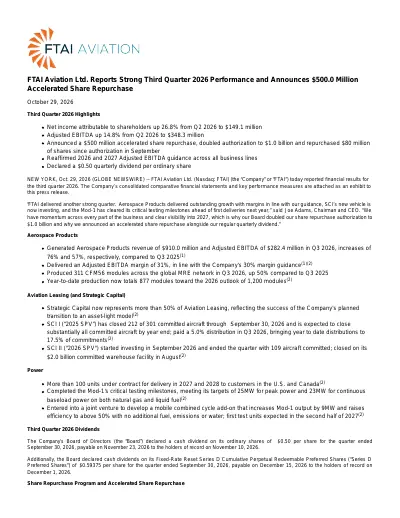
Adjusted EBITDA was $282.4 million, up 57% year-over-year at an EBITDA margin of 31%, in line with our guidance of 30%. We produced a record 311 CFM56 modules, and our market share reached approximately 15% this quarter.
The Strategic Capital ramp is accelerating, with 410 aircraft closed or under LOI across SCI 1 and SCI 2. Importantly, the second vehicle, SCI 2, started investing in September of this year and is off to a great start.
For Power, we reached two important milestones this quarter. First, we now have over 100 Mod 1 units under contract for 2027 and 2028, with a significant pipeline of customer demand behind that.
Second, we have completed all critical testing milestones, and the Mod 1 unit has produced 25 megawatts at peak output and 23 megawatts at ISO continuous output. Finally, capital allocation.
This morning, we announced a $500 million accelerated share repurchase program that will be complete by the end of this year, and was accompanied by an increase in overall authorization from $500 million to $1 billion. In addition, we've completed $80 million of share repurchases since our initial announcement in September, and this will leave us with $420 million of authorization available for one year after the ASR, or accelerated share repurchase program, has been completed.
I'll now hand it over to David.
David Moreno
Thanks, Joe. Expanding on Joe's comments, three things are shaping the market today.
First, mid-life aircraft and engines remain supply constrained. New 737 MAX and A320neo orders are unavailable until 2032 and beyond, and the LEAP and GTF still spend far more time in the shop than the CFM56 and the V2500s.
Airlines continue to extend leases and add mid-life aircraft as a result. Second, airlines are prioritizing liquidity.
Higher oil prices have made cash a top priority, and sale-leaseback interest has grown meaningfully. At FTAI, sale-leasebacks come with engine maintenance attached, it's both a liquidity lever and a cost-control tool, which makes these transactions even more attractive.
Third, financing solutions make our engine products more compelling. Whether an airline buys the engine outright or takes an operating or finance lease through our capital partners, FTAI builds the engine, sells it, and keeps the customer relationship.
WestJet shows what happens when these come together. The airline sold 27 Boeing 737-700, 17 on-lease aircraft went to SCI 2 via sale-leaseback, WestJet keeps operating them, and 10 off-lease aircraft went to Aerospace Products, where the engines become modules for the MRE network.
WestJet extends the life of a 737NG fleet and created liquidity for its balance sheet. Now to the quarter, starting with Aerospace Products, which delivered a record on every measure: $910 million of revenue, up 76% year-over-year, and $282.4 million of adjusted EBITDA, up 57% at a 31% margin, in line with guidance.
We produced a record of 311 CFM56 modules in the quarter, bringing year-to-date production to 877, and we remain on track for 1,200 in 2026 and 1,700 in 2027. Moving to Aviation Leasing, Strategic Capital is now more than half of the segment's EBITDA, exactly the asset-light transition we planned, and both SCI vehicles will continue to scale into year-end.
SCI 1 is fully committed at 301 aircraft. Since quarter-end, we closed a landmark $1 billion deal for 30 aircraft, and we expect to close substantially all 301 by December 31 for approximately $6 billion of total capital deployed.
The vehicle is returning capital as well. We have distributed 17.5% of commitment this year, and plan another 5% at year-end, supported by strong realizations on airframe and engines at redelivery.
SCI 2 started investing in September and is deploying quickly, with 109 aircraft committed and the first closings coming from WestJet. Across both vehicles, we have raised $5.5 billion of warehouse financing from 13 lenders in under two years, and with sale-leaseback activity rising, the pipeline is robust.
What remains on our balance sheet is a simpler business: 150 to 200 spare engines with a net book value of approximately $1 billion, earning $30 to $50 million of EBITDA per quarter with minimal aircraft. These engines are how we keep customers flying.
When an airline needs an engine immediately, they come to us, and that short-term lease often becomes an engine sale once we have built a replacement. Growth in the segment from here comes from our Strategic Capital.
Lastly, Power, where we hit two milestones this quarter. The Mod 1 critical testing is complete, meeting its target of 25 megawatts for peak power and 23.1 megawatts for continuous baseload power, with testing completed on both natural gas and liquid fuels.
Now we have more than 100 Mod 1 units under contracts across customer types in the U.S. and Canada extending into 2028.
We've also received $234 million of customer deposits during the quarter ahead of our future deliveries, partially offsetting our inventory investment for 2027 production. Production is ramping now, and at an expected full run rate of 10 to 15 per month by year-end 2027, we're well positioned to meet our 100-unit guidance for 2027.
Let me spend a moment on why customers are choosing the Mod 1. It comes down to three things they care about most: speed, scale, and cost.
On speed and scale, that is where the market is heading. Data centers are taking longer to build and require more capital, and the market needs power that installs quickly and can be delivered anywhere in the world.
Many GPU providers are moving to containerized compute with the goal of being operational on site in under two weeks. The Mod 1 is a modular unit that ships, installs, and stacks in the same timeline.
Modular power for modular compute. On cost, for behind-the-meter customer, equipment is the most important piece of the equation, and the best way to save on equipment is to need less of it.
A smaller, stackable unit means less capital tied up in redundancy because the increment you're protecting is 25 megawatts, not 300 megawatts. It also means less downtime.
Taking one unit offline takes a fraction of the site down rather than all of it, and a turbine exchange from our engine pool returns a unit into service in two days, not months. Combined cycle is the next lever on cost.
The joint venture we launched this quarter adds a fully mobile, trailer-mounted unit that will convert excess heat into 9 megawatts of additional output with no additional fuel, emissions, or water, taking efficiency to over 50% and lowering fuel costs per megawatt-hour over the life of the asset. First units begin testing in the second half of 2027.
I will now hand it to Nicholas.
Nicholas McAleese
Thanks, David. The key metric for us is adjusted EBITDA.
Adjusted EBITDA was $348.3 million for the quarter, up 15% from $303.5 million in the second quarter, and up 17% from $297.4 million in the third quarter of 2025. The $348.3 million EBITDA number was comprised of $282.4 million from our Aerospace Products segment, $104 million from our Aviation Leasing segment, and negative $38.1 million from corporate and other, including intersegment eliminations of negative $5.1 million and $4.6 million of FTAI Power start-up expenses associated with the Mod 1 build-out.
Aerospace Products delivered a record quarter with $282.4 million of EBITDA at an overall EBITDA margin of 31%. This was up 13% sequentially from $249.7 million in Q2 of 2026, and up 57% year-over-year compared to $180.4 million in Q3 of 2025, reflecting production growth, mix, and operating leverage.
Segment revenue of $910 million was up 76% year-over-year. Turning to Aviation Leasing, the segment generated $104 million of adjusted EBITDA in the third quarter, up 18% from $88.2 million in the second quarter.
This included $50 million of balance sheet leasing EBITDA, in line with the $30 million to $50 million quarterly run rate David described. Strategic Capital contributed $54 million, comprised of $7.4 million of servicing fees and $46.2 million of returns on our 19% co-investment in the 2025 SPV.
Net income attributable to shareholders was $149.1 million, or $1.45 per share, compared to $117.6 million in the second quarter. Turning to the balance sheet, we ended the quarter with total debt of approximately $3.5 billion, cash of $386 million, and net debt of approximately $3.1 billion.
Net debt to run rate adjusted EBITDA was 2.2 times, down from 2.6 times at the end of the second quarter, and below our target range of 2.5 to 3.0 times. Total liquidity was approximately $2.4 billion, including our undrawn revolver of approximately $2 billion.
Our senior notes carry a weighted average cost of 6.5%, and we have no corporate bond maturities until May of 2028. We remain strong Double B rated by all three of the bond rating agencies.
On the share repurchase and financing, under the $500 million program authorized on September 15th, we have repurchased to date $80 million of stock, and today, we are launching a new $500 million accelerated share repurchase, which will be completed by year-end. We intend to fund the ASR through a combination of our revolver and opportunistic access to the capital markets, and we expect for net debt to run rate adjusted EBITDA to remain below 3.0 times.
The remaining $420 million of the increased authorization is available for one year, and we expect to use it opportunistically through open market purchases. Next, free cash flow.
In the first nine months of the year, we generated $724 million of adjusted free cash flow before $285 million of growth initiatives, much of which is driven by our Power business. For the full year, we expect to generate $1.1 billion of free cash flow before growth initiatives, revised down by $61 million due to opportunistic engine acquisitions to support our Aerospace Products business.
For the year, we expect to be at $463 million of growth initiatives, up $173 million from our original target of $290 million, predominantly driven by Power R&D and spend in our FTAI facilities. These investments will allow us to scale at a faster pace as we produce Mod 1 turbines going into 2027.
We are also reaffirming our segment guidance for both 2026 and 2027 as the business continues to execute on plan. As a reminder, 2026 Aerospace Products adjusted EBITDA guidance is $1 billion and 50, and 2026 Aviation Leasing guidance of $475 million.
2027 adjusted EBITDA guidance of $2.3 billion, comprised of $1.4 billion from Aerospace Products, $450 to $750 million from FTAI Power, and $450 million from Aviation Leasing. With that, I'll hand it back over to Joe for final remarks.
Joe Adams
Thank you, Nicholas. To sum it up, airlines today need solutions providers that help them maintain their fleets at lower costs and provide liquidity through sale-leaseback or leasing.
FTAI is built around being able to deliver all three of these products. The FTAI model produced a record quarter in Aerospace Products and an accelerating ramp in Strategic Capital.
For Power, we're helping to fulfill the extraordinary demand for behind-the-meter solutions, and this unique combination is producing the excess capital that allowed us to raise our repurchase authorization to $1 billion while keeping leverage within our target range. We're also maintaining our quarterly dividend of 50 cents per share.
The dividend will be paid on November 23rd to shareholders of record as of November 10th. This marks our 45th dividend as a public company and our 61st consecutive dividend since inception.
We remain confident in both our 2026 and 2027 outlook, including our free cash flow expectations. As we close out 2026, our focus remains on building durable, scalable, and differentiated platforms that start with the customer and deliver value over the long term.
The investments we're making across Aerospace Products, Strategic Capital, and Power will continue to strengthen our competitive position, expand our addressable markets, and support sustainable growth for many, many years to come. As a final reminder, we'll be hosting an investor meeting in New York City on December 10th, and we're very excited and look forward to seeing many of you there.
With that, let me turn the call back over to Charlie.
Charlie Arestia
Thank you, Joe. Michelle, you may now open the call to Q&A.
Operator
Thank you. As a reminder, to ask a question, please press *11 on your telephone and wait for your name to be announced.
To withdraw your question, please press *11 again. The first question will come from Sheila Kahyaoglu with Jefferies.
Your line is now open.
Sheila Kahyaoglu
Thank you, and good morning, guys. Great execution during the quarter.
Perhaps my first question would be on Aerospace Products, just really great, solid progress with margins at the 31% mark in the quarter, production is up 50% year-on-year, and you're run-rating at about 15% market share. Can you maybe update us on the momentum you're seeing within Aerospace Products, and just given what's happening on a macro level, whether you're seeing any changes to customer behaviors, workscopes, or fleet planning, and maybe how that's showing up in lease rates as well?
Joe Adams
Sure, thanks. Thanks, Sheila.
First on margins, we indicated previously we think 30% margins is a good assumption for the next couple of years, and it's a nice target. It also is a representative mix, I think, across the entire industry.
Our ultimate goal is to provide engine exchanges for narrowbody engines to the entire industry such that, hopefully in many years to come, no one ever thinks about doing their own shop visits, they just come to us because we give them an immediate availability at a cost that's as good as or better than they could do on their own. When we think about that, why wouldn't everyone want to do that?
Nothing that we've seen in the current environment has changed our view about the ultimate customer acceptance. As a matter of fact, as we see stress put on airlines, airlines are always looking for ways to raise liquidity, but especially now.
Shop visit costs for engines are one of the biggest users, we can provide financing for shop visit, we can change the lease structure so that we can swap engines immediately and not have cash outflows, and we can do sale-leasebacks to generate immediate cash. I would say, in general, we're seeing probably an acceleration of our expectations about how we continue to pick up market share, and nothing has shaken that view.
Sheila Kahyaoglu
No, that's great to hear. Maybe one on Power, David, if you want to take this one.
You mentioned you have 100-plus Power units under contract, and the slide suggests that that 27 guide is 450 to 750 million, which I think is some nuance from last quarter. The production schedule from the slides was super helpful.
Maybe if you could just talk through the investment going on in Power, and how it translated to your 27 assumptions.
David Moreno
Yeah. We're very focused on the ramping of this business, we provided guidance on initial production, which we expect to be roughly 0 to 5 turbines per month, but being able to scale quite quickly to 10 to 15, where we expect to exit the year at.
Now as a reminder, we're using our existing infrastructure that we have today, we're starting off with Montreal, but we're planning to use our other facility as well for Power remanufacturing. We have the ability to scale that business really entirely.
We came into this quarter, obviously, accomplishing two really large milestones, right? They kind of go hand in hand.
The first is obviously on the testing side, we've completed all the testing on the liquid and natural gas side. On the customer side, we've achieved over 100 units under contract.
Really, when you think about the range, it comes out to really the ramp and our ability to execute on that ramp, which we feel good. We have visibility, and we feel good about 100 units for 2027.
Of course, we're working through each of the customer's requirement, and that's why you have that wide range. As we progress, we will continue to update you, and that range should tighten up as we progress throughout quarter-over-quarter.
Sheila Kahyaoglu
Awesome. Thank you.
Operator
Thank you. Our next question will come from Giuliano Bologna with Compass Point.
Your line is open.
Giuliano Bologna
Thanks for taking my questions, and congrats on a very solid quarter across the board. As a first question, obviously, it's very helpful to have that production ramp outlook for the Mod 1 units.
What I'd be curious about is when you start looking at the end of 27, you're obviously planning on ramping production capacity up to 10 to 15 units a month, which comes out to 120 to 180 annualized. I'm assuming that you wouldn't be planning for that production ramp unless you expected there to be the potential for orders and demand to fill that type of production requirement.
Is that a good way to think about it?
David Moreno
That's correct, Giuliano. I think our value prop is resonating with the market, really tailored around behind the meter, right?
You're seeing that today where folks are really focused on speed and scale, right? Data center building is taking a very long time, there's a lot of capital invested, and then there's a long period before you start generating returns on that, right?
You're kind of seeing this right now happening with industry where a lot of these GPU providers are offering containerized solutions, and we think on the Power side, our solution is containerized as well, and we can install it in less than two weeks. That's really resonating well.
On the cost side, we understand that's really the heart of our aviation business is lowering costs for our customers. We talk about redundancy and how we can be value-add there by the size and the stackability of our units, as well as the uptime with our exchange model on the turbines.
We also introduce, again, our combined cycle, which we think that's a big value-add and helps reduce costs for our customer as well. That's really resonated well.
Obviously, completing the testing and having that all come to place is a great accomplishment, and we expect to be able to add into backlogs in the future.
Giuliano Bologna
That's very helpful. Maybe as a follow-up, I'd be curious, when you look at the 100 units that you have under contract, is it fair to assume that that's fairly heavily weighted towards 27 versus 28?
Then, on a similar topic, obviously, having the combined cycle probably has a great impact on future demand. I'd be curious how things are shaping up in terms of discussions and if things are still very active, and if there's still a large pipeline of opportunities out there that you're negotiating.
David Moreno
Yep. It's mostly 27, so that is correct on your first question.
The way we're thinking about our product is just add-ons, right? You'll see that theme in the modular add-on.
Effectively today, you get the simple cycle version, and then you get the add-on with the combined cycle. That's really important when you think about how we can continue to deploy enhancements, because we're always thinking about product enhancements and product development.
Obviously, on the Power side, you have the ability to, let's say, create more quickly because, obviously on the aviation side, there is the regulatory piece. We're continuously focused on adding value, and that's resonated very well, and that's come across into increasing backlog.
Joe Adams
Also, any unit that is installed in 2027 could be upgraded with the combined cycle unit retroactively, you are not giving anything up. It's just a delay until that unit is available.
The customers are looking at that as a very, very positive long-term development for this product, in that you get another 9 megawatts out of it for essentially no additional fuel cost.
Giuliano Bologna
That's very helpful. That should obviously help with demand and kind of reselling and remonitizing the same customers.
That answers all my questions. I appreciate the time, and congrats on a great quarter.
I'll jump back in the queue.
Joe Adams
Thanks.
Operator
Thank you. Our next question is going come from Kristine Liwag with Morgan Stanley.
Your line's open.
Kristine Liwag
Hey, good morning, everyone. Maybe starting off on Aerospace Products, Joe, you mentioned that 30% EBITDA margin seems to be the right place for the next few years for that business.
I was wondering, when you look at the scale here, you want to do 1,700 modules next year, and the mix of customers, does that 30% assume you're going to maintain getting market share from Tier 1 airlines and doing more of those full service restorations? Or is that potentially, if you get more of those kinds of businesses, could you see pressure in that 30?
Also, you talked about financing engine shop visits. How do we think about that economically for FTAI?
Joe Adams
Sure. We think the 30% is representative of the entire market, and the mix that we're seeing now is large airlines, small airlines, heavy shop visits and light shop visits, and we don't see that mix changing.
We feel very good about the 30% for the next couple of years, given that our goal is to do business with the entire industry, and we're doing that now across the board. We feel very good about the stability of that in the outlook.
In terms of financing shop visits, when we describe the product originally, we said we go to the customer and said, we'll rebuild the engine for you, and you can either buy it outright, you can exchange it for a run-out engine, or you could lease it. The lease is really a financing option for the customer.
We're seeing probably an increase in leasing activity. As we indicated, airlines are looking for every source of liquidity today.
If we see increased leasing activity, what we've been able to do is to sell those leased assets to financial partners. In effect, from FTAI's point of view, it's the same as a sale, but from the customer's point of view, they're getting an additional value-add in that we arrange the financing for that whole engine purchase for them.
It's a complete product offering that the airlines are very, very receptive and happy with that really as far as we can tell, no one else can offer that product in the market.
Kristine Liwag
Super helpful. You guys talked about the test results for Mod 1 for Power.
I was wondering, when you look at the results for that turbine as it got converted to an aeroderivative, how does it perform you talked about thermal efficiency, start time, all that stuff, versus existing aeroderivatives? Also, I thought it was interesting that you've called out that you only need one spare out of 12 in service, one spare versus if you're doing a large turbine, you'd have a 1-to-1 on a spare-to-turbine ratio.
This seems pretty attractive. Are customers paying you the appropriate price that they don't have to have as much capital equipment in place to have that kind of coverage?
Also, when you look at the combined cycle that you plan to take on, how does that change your pricing power for this business per megawatt?
David Moreno
Yeah. On the first question and how testing's compared to other aeroderivatives, I would say it's in line, right?
Obviously, the CFM56, where we expect a lot of, let's say, value creation, is that the CFM56 is the most durable engine ever produced for aviation. We're expecting that to actually play out on the ground as well.
As far as what you mentioned, start time, efficiency, it's in line with other aeroderivatives. The next question as far as what the redundancy looks like, right?
We did put a page 17 out, where it's an illustrative example of what a customer would need if they have N+1, depending on the customer and their contract with the hyperscaler, right, they may have N+2, N+3. The whole point here is to say that smaller units that are stackable are going to be a lot more cost-efficient because you're going to tie up less capital costs in redundancy versus large units that in order to back those up, you would need to have very large units backing them up, right?
Of course, you don't have access to the grid, the only way to be able to do that is to have backup and be islanded. That's an important piece, and that's a big selling point, is we can effectively get you a lower capital cost up front.
Then combined cycle, when you think about that, obviously creates more value, right? The more value we can create, ultimately, that should translate to a higher price.
Obviously, you're creating additional megawatts. Typically, these things sell on a cost per megawatt, you could expect that to obviously increase.
I would say it's too early to talk about the exact numbers, we're still guiding 7 to 8, and I would think about the potential of combined cycle being upside.
Joe Adams
I would also just say our maintenance model for the Mod 1 is to be able to do turbine exchanges in the field on a 48-hour turnaround time, so that's something that no one else can offer on the aeroderivative side that we've been able to do, replicate from our aviation model, which is basically an engine exchange in the field. That quick turnaround time on turbines will also facilitate less downtime and less redundancy because you'll be back in service.
You don't take that unit out of service for months while the turbine is being overhauled.
Kristine Liwag
Sounds good. Thank you very much, guys.
Joe Adams
Thank you.
Operator
Our next question will come from Andre Madrid with US Bancorp. Your line is open.
Andre Madrid
Yep. Thanks, good morning, and appreciate you taking my question.
I want to start off first on the point of sale-leaseback, you guys are referencing it pretty frequently as a nice alternative option providing flexibility to your customers. Just to provide us with a reference point, can you maybe talk about how the mix of this sale-leaseback work has kind of increased across both SCI and AL?
David Moreno
We're seeing a lot more activity, as you would expect, on sale-leaseback because airlines are looking for liquidity. As a reminder, it's really two value-adds.
It's the liquidity day one, but it's also saving cost for the airlines on the shop visits, and we're really the only party out there that can do both. I would say on the first vehicle, on SCI 1, what we were sourcing about 80% of our aircraft from lessors, 20% via sale-leaseback.
I would say on the second vehicle, we're starting to see a significant uptick in sale-leaseback. Today, that's more like 40% from sale-leaseback, 60% from lessors, and I would expect that to continue to rise.
Obviously, it's early, and we have over 100 aircraft in SCI 2, so that's still to play out, but we're obviously starting to see a lot of activity, and we're in active discussions with many airlines.
Andre Madrid
No, that's really helpful, David. Thank you.
Maybe pivoting to a broader question. I feel like it's been a couple quarters since you announced any acquisitions.
Obviously, a lot of organic investments have been made across the business, both on the Power and for feedstock, but I'm trying to understand how are you prioritizing the two, and are there still attractive opportunities out there, especially in light of kind of the recent decline in valuations, broadly speaking?
Joe Adams
Yes. The M&A opportunity market set, I think, continues to grow.
As we've said previously for the last couple of years, our focus has been really on two areas. One is additional maintenance facilities to increase our production of modules.
Two, on more vertical integration in terms of repair capability or piece-part manufacturing for engines. Both of those areas, I would say, are pretty active.
Today, we did add additional investments. We now have six facilities on the CFM56 overhaul side, and we continue to look at adding to that.
We're also investing in those locations, and we called out some $50, $60 million of investments to increase production for facilities that we bought that needed more tooling and in the case of Rome, a test cell. It's both adding facilities as well as building out what we have.
There are more M&A opportunities out there, we'll continue to look at those. We've always said our priority in terms of capital allocation is number one is growth, and that remains the same today.
We're able to do the buyback and still keep our debt to EBITDA under three times, which gives us a lot of firepower and a lot of capability to take advantage of market dislocations.
Andre Madrid
That's awesome. I really appreciate the insight.
Thanks, Joe. I'll leave it there.
Thanks, everyone.
Joe Adams
Thank you.
Operator
Our next question comes from Ken Herbert with RBC Capital Markets. Your line is open.
Ken Herbert
Hi. Good morning, Joe and David.
Appreciate the time. Maybe just to look at a higher level, Joe, there's just a lot of concern in the marketplace about the impact on airline financials from the higher crude prices and their ability to continue to pass on higher fares, and ultimately, what it might do in the marketplace to travel.
Obviously, you're sounding very confident on 27, and I think I don't want to put words in your mouth, but I think a lot of the marketplace today plays into obviously what FTAI offers. Can you talk about what you're seeing from your customers today, how they're able to manage the elevated crude environment, and are there any risks we should be thinking about in 27 just from a broader macro perspective as a result of what we're seeing today?
Joe Adams
Sure, I'll start. Obviously, we're watching that carefully and talking to the customers all the time.
I would say on the positive side, the airline industry has seen an ability to raise fares that they probably were surprised that they had that much pricing power, and the demand has stayed very strong. In many parts of the world, all around the world, they're filling the planes, and they've raised fares, and they're seeing those fares stick.
Ultimately, that is the best answer to how do you manage your business, is if your costs go up, you raise your revenues and you continue to grow. When you think about that, that's the best answer, and from the customer's point of view, there's still very, very strong growth.
If you think about most of the concern around traffic growth has been focused on either U.S. or more mature markets, which don't grow as fast, but there's many parts of the world in Southeast Asia, Middle East, Africa, India that have very, very high traffic demand that's unsatisfied.
If you think about, you haven't been able to get a lot of new aircraft in those markets. They're undersupplied for the last 3 to 4 years because of the manufacturing and delivery delays.
From the airline point of view, they look at it and say, well, I can't get new aircraft quickly, I can raise my fares, there's tremendous demand out there, and I don't really want to give back aircraft too fast because I'm going to need those if I want to continue to grow. Across the board, we don't really see customers saying, I'm going to flip my fleet mix because of the pressure on fuel.
We see those airlines continuing to look to add capacity. We see extensions from airlines that we have leases to in the SCI vehicles, which is the most concrete form of confidence, is when an airline says, I'll extend my lease.
We're not seeing it, and we hope fuel prices do come down, which would alleviate some of the stress on the airline industry. We're planning for whatever the customer's going to need.
We're able to provide a solution.
Ken Herbert
Have you seen any downward movement on CFM56 or more broadly narrowbody lease rates this year that you would call out or you'd point to?
David Moreno
No, Ken, we're not seeing that. The CFM56 is a very durable engine, it's the most durable engine ever, and we're seeing tremendous demand for, as Joe mentioned, extensions, engine leasing.
We're not seeing that.
Ken Herbert
Thanks, David.
Operator
Thank you. Our next question will come from Brandon Oglenski with Barclays.
Your line is open.
Brandon Oglenski
Hi, good morning, and thanks for taking my questions. Joe, maybe we can follow up off that last question there, because I think you guys recently put out an enhanced agreement with United.
I guess my question is, historically, we've thought about this business as really benefiting smaller airlines with economies of scale on the maintenance side, but maybe you can talk to why you're seeing some of the larger airlines be core customers here as well.
Joe Adams
Sure. No, it's basically the pitch to anyone in the industry is that we can deliver the same or lower cost than the airline could do on their own, and we can provide an immediate availability with no downtime.
That removes all the costs of managing a shop visit, having spare engines, and the risk of a negative surprise. As we've said before, if you get airlines to start trying to and use the product, and then they realize, hey, it really is a better alternative, then you can convert anybody.
There's nobody out there that doesn't benefit when you say, I'll give you the same or better costs and I'll reduce a lot of your expenses, what don't you like about that? As we get people using it, even airlines that have their own maintenance facilities.
There's also some benefits on the expense side if you capitalize instead of expense costs. It's a pitch that we've never had anybody come back and say, oh, well, I don't like this about it, or I don't like that about it.
It's like, there's nothing not to like. We really do see over the next coming years, why shouldn't we have every airline in the world who owns CFM56 and V2500s do engine exchange with us?
It's only a question of how much of the fleet do they do with us.
Brandon Oglenski
Thank you, Joe. Then, David, I just want to clarify two things on the Power side.
I think, A, you have two prototypes up and running. Is that correct?
Because you said you're testing one with natural gas, one with liquid fuels. Then secondly, maybe more importantly, I think there was some concern around your JV partner, JERA, obviously, a Chinese company, and the recent executive order about on-grid power equipment being non-Chinese sourced.
Maybe you can speak to those concerns on the JV side, too. Thank you.
David Moreno
Sure, Brandon. On the testing, we've tested both with liquid, jet fuel, and with natural gas.
Obviously, our customers are predominantly wanting this through natural gas, but we've tested on multiple fuels, which is very important for us. On the executive order, we do not believe this has a big impact on the Mod 1.
Our understanding is the EO is really aimed at bulk power and is not intended to cover behind the meter. The Mod 1 is, as we mentioned, really focused on behind the meter and providing electricity where as is very political.
You have to bring your own power in order to actually build data centers. Specifically why we're not concerned is the Mod 1 is at the heart a GE and Safran engine, and we obviously do maintenance in North America.
Packaging is not exclusively in China, right? Our partner, which is a partner in this program, has facilities across the world: UAE, Houston, Canada, and that gives us multiple paths to delivery.
Then next is many of the balance of plant components are interchangeable, which JERA has the ability to source these parts from a diversified global supplier base rather than a single country. We think we have the ability to adapt, and that's kind of how we thought about this.
Obviously, we thought about the impact of China before getting into this joint venture. We're very happy to be partnering with JERA, and their ability to adapt should things change, but we're monitoring that closely.
Brandon Oglenski
Thank you.
Operator
Thank you. The next question will come from Jeff Kauffman with Citizens Bank.
Your line is open.
Jeff Kauffman
Thank you very much, and congratulations. Just terrific to see all this news.
Thank you also for the slide in the presentation showing net working capital you're anticipating in Power for 2026. I was wondering if you can give us an idea what that might look like based on your current expectations for 27, and kind of where does that peak, and when does working capital start to come down a little bit?
Nicholas McAleese
Thanks, Jeff. This is Nicholas.
I can take that. We've always really grown inventory very strategically in line with our financial and production targets, and we've always had a strong record on execution on this.
As a reminder, approximately two years ago, we had about half a billion of inventory in balance, and that preceded $1.9 billion in Aerospace Products revenue last year. Similarly last year, we had about just under $1 billion in inventory balance, and now we're on track in Aerospace Products to generate about $3.5 billion in 2026.
Looking ahead, the two benefits are, one is that there is large optionality now between FTAI Power and Aerospace Products. The CFM56 is ultimately the same original unit.
Then the fact that we also have economies of scale related to our facilities, as parts come off go into our MRE network and are recycled around, we can ultimately drive lower unit costs. We're looking ahead at approximately about two times in inventory turnover from a forward-looking basis, but we see upside beyond that.
Jeff Kauffman
That's my one. Thank you.
David Moreno
Thanks.
Operator
Thank you. The next question will come from Shannon Doherty with Deutsche Bank.
Your line's open.
Shannon Doherty
Oh, hey there. Congrats on the great results.
Just doing the math, the implied ramp in 4Q to about $435 million of consolidated EBITDA is pretty steep. Given the current operating backdrop and Strategic Capital ramp, what is your level of confidence here, and what will be the biggest driver to hitting the full-year target?
Is it getting to 323 modules? Is it closing on incremental SCI aircraft?
Any thoughts here would be great.
David Moreno
Shannon. The growth, right, that is going to take us to those numbers is around the Strategic Capital, right?
On the Aerospace Products, if you look at that, you can see that we're very well positioned. Where there's been some questions is around our leasing business and being able to have that big jump in Q4, right?
As we mentioned, really, the story here is Strategic Capital, right? As SCI 1, as of 9/30, we had $3.9 billion of invested capital, and we're going to go all the way to $6 billion by year-end.
We have extreme confidence in that because as an example, as I talked about earlier, we closed 30 aircraft in October for $1.1 billion. Today, we're sitting at $5.1 billion, we're executing on closing aircraft, and we have 55 aircraft left to close.
We have really strong visibility on SCI 1, and SCI 2 is starting to close aircraft as well, and you're going to see that ramp come across, mainly through SCI.
Shannon Doherty
Great. Thanks, David.
Maybe, Nicholas, one for you. I think that you mentioned that 2027 adjusted EBITDA guidance includes $450 to $750 million range for Power.
Wouldn't that imply that the new adjusted EBITDA target would be $2.3 to $2.6 billion? I understand you guys are probably being conservative at Power, but I just want to clarify what EBITDA number we should be modeling for 100 units ramping in production in 2027, and what is the timing lag from production to delivery?
Thanks for taking my questions.
Nicholas McAleese
Yep. I think I'll take the first half of that question.
That's correct. The range is 450 to 750, and then on the total, we're clarifying that on the lower end for conservative purposes with obviously, all related to FTAI Power's deliveries.
David Moreno
As far as the lag between production and delivery, right, we're meeting customer requirements. We're working hand in hand on the customer to be able to deliver to their site.
That should be rather quick. However, we want to make sure, again, this is the first year of ramping.
We want to make sure we have a wide range, we're able to execute on that.
Shannon Doherty
Great. Thanks.
Operator
Thank you. The next question will come from Myles Walton with Wolf Research.
Your line's open.
Lou Raffetto
Good morning. Lou Raffetto on for Myles.
Joe Adams
Thanks. Hey, Lou.
Lou Raffetto
I was hoping you guys could speak a bit more to the WestJet deal, and maybe so a little bit more broadly in what you're seeing more on the aircraft transaction market as opposed to sort of the other side, just given the fuel price and reduced flight hours that we're seeing. Then also, Nicholas, I think you mentioned the $61 million feedstock investment.
Is that the 10 aircraft that you guys bought from WestJet? I don't think that closed in 3Q, but I wanted to confirm.
David Moreno
On WestJet, it was two transactions, right? 17 aircraft went into SCI number two via sale-leaseback, right, so that allows the airline to continue to operate those aircraft and have flexibility.
10 of those aircraft were acquired by FTAI for Aerospace Products. Really, that shows how we're able to work with airlines and buy equipment outright or work with them through sale-leasebacks.
As we mentioned earlier, sale-leasebacks is really becoming a theme, really, raising liquidity and then saving on shop visits, right? Really, as these aircraft mature, the biggest cost is going to be around shop visits, and we provide a solution for these airlines.
We have very strong relationships, and we're expecting to execute on a lot of sale-leasebacks at SCI 2.
Nicholas McAleese
Yep. Just to follow on to David's point, the majority of those aircraft did close in Q3, and that's reflected in our guidance numbers and cash flow.
Lou Raffetto
I guess when I looked at the number of aircraft in leasing and the number of engines in leasing, they went down sequentially. Were sort of putting those into the leasing business, but we're then just taking them right out, I guess?
Nicholas McAleese
No. These were specifically for Aerospace Products.
Those engines are going to be harvested to ultimately be rebuilt and then sold on to customers. Then for the airframes, we plan on recycling capital for those.
This would not be reflective of leasing.
Lou Raffetto
We're doing this a little bit different than we've done in the past, I guess, just from the way it's worked, I guess, realistically.
Nicholas McAleese
Yeah. Ultimately, these are unserviceable, the initial 10 that David spoke of, we're not planning on sale-leasing back directly.
These are going to be used for Aerospace Products business.
Joe Adams
Which is the same as what we've done previously. If it's unserviceable, it goes into Aerospace Products.
We've always treated it that way.
Lou Raffetto
Okay. Thank you.
Joe Adams
Yep.
Operator
Thank you. The next question will come from Josh Sullivan with Jones Trading.
Your line's open.
Josh Sullivan
Hey, good morning.
Joe Adams
Good
Josh Sullivan
morning. You've an upcoming investor day here in December.
In the past, you've talked about FTAI reports financials may evolve. SCI is now more than 50% of leasing.
How should we think about the evolution of what accurately communicates your business to the Street? At one point, you were a K-1, and obviously, the business has evolved pretty substantially.
Any previews or perspectives you can provide going into the December event would be great.
Joe Adams
I think probably there's a couple of unifying themes. One is how we partner with customers and that we provide a comprehensive package of solutions.
That package of solutions sort of they all feed off and help each other. I think it would be that each of our business activities supports and helps the other business in a unifying way and in an additive way.
Really, as I've said for many years, we don't think of ourselves as a sum of the parts where we have businesses that don't interact with each other. We have businesses that are all supporting each other to ultimately provide the customer with a higher value-add.
This combination that we've built is unique. No one else has really been able to do this, and it's very, very powerful for the customer to be able to get these products together in a way that addresses their needs.
Josh Sullivan
Got it. Then just on Aerospace Products, the upper limit on the 3,000 module capacity currently, Joe, you've been pretty successful and creative in finding latent capacity globally.
What is the gating factor to that 3,000 limit or upwards? Is it the facilities, or is it really gated by something else like the ramp at SCI, parts, or engines?
Joe Adams
David's really been putting a lot of the facilities together. We've been surprised on the upside as to how many facilities exist around the world where people built and had a dream of building an engine maintenance facility, and they built a nice building with tooling, and then they couldn't get business to put in it.
We continue to find more locations like that where we have a very critical component, which is we can provide engines, and that solves the biggest problem that many of these locations have. We think that there's more out there.
We continue to source other new ideas. We don't see 3,000 as a cap in any way.
We're going to continue to grow that. In some ways, the opportunities get easier because we have a track record of having done this now five times where we've delivered.
We brought engines in, and we've increased employment. In Rome, for example, we went from 60 employees when we bought it to over 300 today.
All you have to do is say, call ADR in Rome and ask them about us. They will say, unbelievable.
It's amazing what they did, and they actually overperformed. We told them originally we were going to get to 200 employees, and we went to 300 in half the time.
This is a huge value. If you go to different parts of the world where they're looking for higher value, high-paying technical jobs, aviation is always very attractive.
If you can generate employment of these type of jobs in communities, you also then get an advantage for the local airline. The airlines are going to support their local production, and so that's another competitive advantage you can develop over others.
It really gets back to your original question, is all of these activities support and feed each other in a very, very positive way. It's all about helping the customer make their job easier, make their costs lower, make it so they have less capital to invest in things they don't want to, like engine maintenance, and they love you.
That's been our mission and our flywheel.
Josh Sullivan
Great. Thank you for the time.
Joe Adams
Thanks.
Operator
Thank you. The next question will come from Marni Lysaght with Macquarie Capital.
Your line's open.
Marni Lysaght
Good morning, team. Thanks for taking my question.
I just would like a bit more color on adjusted free cash flow further out. Appreciate at your prior print, you called out, kind of what your peers have been doing in that 60% to 70% range relative to EBITDA.
Just some color on that as you continue to execute on your growth and make requisite investments for that. If you could potentially provide any color of how analysts from the Street should be thinking about it relative to NOPAT?
Also, any timing or seasonality nuances you'd like to call out just to help us with our modeling for periods further out. Thank you.
Nicholas McAleese
Sure, I can take that, Marni. We've yet to provide formal 2027 free cash flow guidance, but we're very confident in the direction of free cash flow for next year.
Our guidance for adjusted EBITDA is a substantial step up from 2026, and this growth is also supported by a large portion of inventory we have on the balance sheet today. We have Power units already committed with deposits in hand, and we have an integrated supply chain built for scale.
This business model has significant operating leverage, so as we continue to grow, revenue will grow faster than our fixed cost base, and that will ultimately flow next year and beyond into greater margin and cash. We'll continue to benefit from economies of scale, and then the fact of sharing infrastructure between Power and Aerospace Products ultimately means that we will continue to see free cash flow conversion improve year-over-year.
Marni Lysaght
That's clear. I'll jump back in the queue.
Operator
Thank you. I am showing no further questions at this time.
I will now turn the call back to Charlie for closing remarks.
Charlie Arestia
Thank you all for participating in today's call. We look forward to updating you again after Q4.
Have a nice day.
Operator
This concludes today's conference call. Thank you for participating, and you may now disconnect.