Fortinet, Inc.
Q3 FY2026 · Earnings Call TranscriptOctober 28, 2026
Operator
Hello, and welcome to Fortinet's third quarter 2026 earnings conference call. At this time, all participants are in a listen-only mode.
After the speakers' presentation, we will conduct a question-and-answer session. Please be advised that this call is being recorded.
I would now like to hand the call over to Anthony Luskey, Vice President of Investor Relations. Please go ahead.
Anthony Luskey
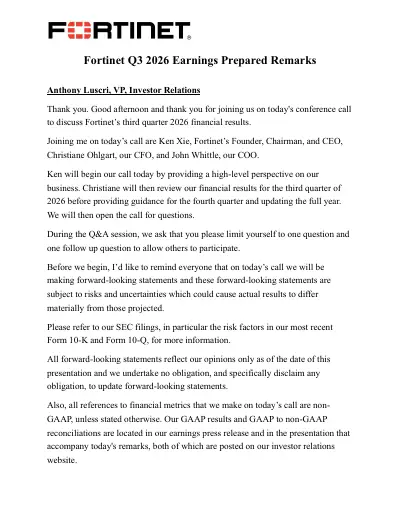
Thank you. Good afternoon, and thank you for joining us on today's conference call to discuss Fortinet's third quarter 2026 financial results.
Joining me on today's call are Ken Xie, Fortinet's Founder, Chairman, and CEO, Christiane Ohlgart, our CFO, and John Whittle, our COO. Ken will begin our call today by providing a high-level perspective on our business.
Christiane will then review our financial results for the third quarter of 2026 before providing guidance for the fourth quarter and updating the full year. We will then open the call for questions.
During the Q&A session, we ask that you please limit yourself to one question and one follow-up question to allow others to participate. Before we begin, I would like to remind everyone that on today's call, we will be making forward-looking statements, and these forward-looking statements are subject to risks and uncertainties which could cause actual results to differ materially from those projected.
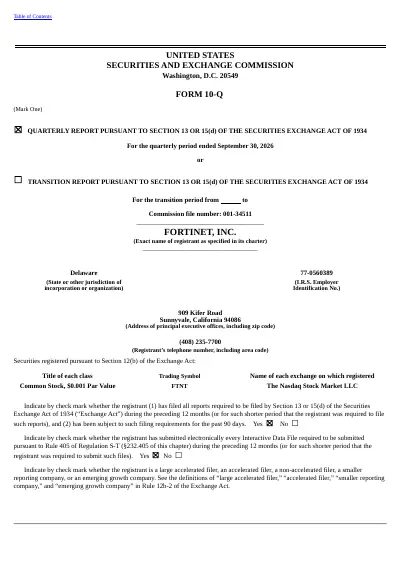
Please refer to our SEC filings and, in particular, the risk factors in our most recent Form 10-K and Form 10-Q for more information. All forward-looking statements reflect our opinions only as of the date of this presentation, and we undertake no obligation and specifically disclaim any obligation to update forward-looking statements.
Also, all references to financial metrics that we make on today's call are non-GAAP, unless stated otherwise. Our GAAP results and GAAP to non-GAAP reconciliations are located in our earnings press release and in the presentation that accompanied today's remarks, both of which are posted on our Investor Relations website.
As a reminder, this is a live call that will be available for replay via webcast on our Investor Relations website. The prepared remarks will also be posted on the quarterly earnings section of our Investor Relations website following today's call.
Lastly, all references to growth are on a year-over-year basis, unless noted otherwise. I will turn the call over to Ken.
Ken Xie
Thank you, Anthony, and thank you, everyone, for joining our call. We are pleased with our excellent third quarter results driven by strong execution and broad-based demand.
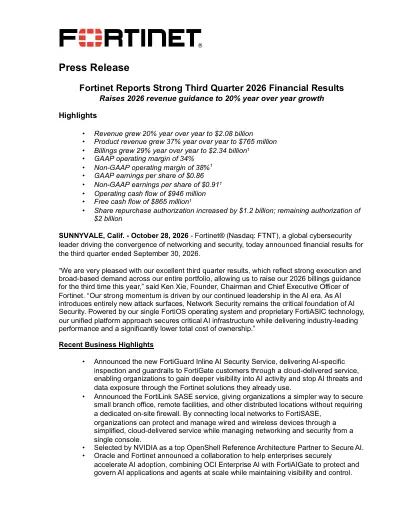
Billings grew 29%, while total revenue increased 20%, led by 37% growth in product revenue. Based on our continued strong momentum, we have raised our 2026 billings guidance for a third time this year.
With the rapid evolution of the AI landscape, Fortinet is leading the next frontier of cybersecurity by securing AI workflows and protecting against AI-discovered vulnerabilities in real time through our core strengths in network security. We believe that network security is the most critical foundation of AI security, with the firewall serving as the centralized point of inline enforcement across enterprise, operational technology, and hybrid cloud environments.
Fortinet's leadership in this space is driven by over 20 years of innovation, integration, and improvement, as shown on slide 7, while continually expanding our AI capability and functions in FortiOS and FortiGuard services. Fortinet secures four critical areas of infrastructure and AI security, as shown on slide 9.
First, at the network level, our SASE firewalls natively protect against vulnerabilities and stop intrusions, supporting shadow AI monitoring and access control to data and applications. To address growing demand, the newly launched FortiGuard inline AI security services this week transform every FortiGate into a real-time AI enforcement point.
Second, in the data center and AI factories, we offer FortiAI-Gate to secure GPU clusters and the RAM infrastructure, securing the massive growth in AI traffic that require high-performance protection across data center and hybrid cloud. Third, we extend AI security together with SASE to endpoint, defining, controlling, and integrating agent identity directly into access and the incident response life cycle.
Fourth, our SOC FortiAgent deliver a highly automated solution to solve the industry acute skills shortage and tool sprawling by enabling autonomous incident detection and response. Our SASE firewall pillar billings grew 31%, and we're the fastest-growing SASE firewall vendor and scale, growing at nearly double the market growth rate, as shown on slide 5.
Our leadership stems from our fundamental architectural advantage as we're the only vendor in the industry to build all the key SASE, firewall, and AI security components into a single and unified operating system, FortiOS. This new SASE firewall pillar represent a large, high-growth area, driving long-term growth.
Combined with our differentiated FortiASIC technology and owned global infrastructure, this allows Fortinet to deliver better performance and a significantly lower total cost of ownership, as shown on slide 14. We are also the only vendor offering an easily deployable on-premise sovereign SASE solution alongside cloud SASE, which we believe give us an addressable market two to three times larger than the cloud-only competitors.
To further capitalize on our large installed base, we recently launched FortiLink SASE services. This positions our FortiAP and FortiSwitch as a SASE hardware agent, allowing customer to easily overlay FortiSASE on top of their existing hardware, driving recurring service revenue.
As we look ahead, Fortinet's strong momentum is a result of our vision for the AI era, our platform integration, and a highly disciplined operation model. This combination positions Fortinet exceptionally well to drive strong cash generation, high recurring revenue, and consistent GAAP profitability while executing our shareholder-focused capital allocation strategy.
I would like to thank our employees, customers, partners, and suppliers worldwide for their continued support and hard work. I will now turn the call over to Christiane.
Christiane Ohlgart
Thank you, Ken, and good afternoon, everyone. We delivered another exceptional quarter, exceeding the midpoint of our guidance across our key growth and profitability metrics, including billings, revenue, operating margin, and earnings per share.
Based on our strong momentum, we've raised our 2026 billings and revenue guidance. Total billings grew 29% to $2.34 billion, reflecting broad-based demand and strong execution across customer segments, industry verticals, geographies, and our integrated and innovative portfolio of solutions, further validating the strength of our platform strategy.
AI, SASE, and network upgrades and expansions are key growth drivers as customers prepare for new threat environments. We saw strong demand in large enterprises, with the total value of deals greater than $1 million growing 51%, driven by an outsized contribution from our US large enterprise business.
SASE firewall billings grew 31%, as sustained FortiGate demand was driven by enterprise customers turning to our network security solutions to upgrade their infrastructure for the era of AI and extend their Fortinet security footprint into operational technology and AI data center use cases. Our OT billings grew nearly 40%, validating our leadership in protecting mission-critical infrastructure.
These achievements highlight our focus on leading growth and innovation in the durable demand drivers as we capture long-term expansion opportunities across emerging high-value use cases. Billings from AI-driven security operations grew 15%, driven by strong upsell momentum as our installed base increasingly consolidates point solutions onto our broader platform.
Turning to revenue, total revenue grew 20% to $2.08 billion, with product revenue increasing 37% to $765 million, even though we saw increasing lead times for certain components. Strong product demand persisted throughout the quarter.
As in the prior quarter, our product revenue benefited from customers shifting towards higher-performing models, lifting ASPs. Service revenue grew 13% to $1.31 billion and faced some headwinds from winning new large enterprise customers with ramped service activations and large new expansion deals that also consolidated various existing service arrangements into enterprise agreements.
We continue to believe the first quarter of 2026 marked the trough for our services revenue growth rate. As shown on slide 19, we have key leading indicators supporting a continued positive trajectory, specifically robust 26% service billings growth, 19% total deferred revenue growth, and a 14.5% increase in short-term deferred revenue, which represents our highest growth rate in five quarters.
In addition, we continue to roll out new AI security services, including the FortiGuard Inline AI Security Service announced this week. To put our overall performance in perspective, our sustained growth is being propelled by several fundamental shifts in how enterprises approach cybersecurity.
We are witnessing a transformed threat landscape where bad actors aggressively use artificial intelligence to orchestrate rapid, highly targeted attacks. This shift has elevated security from a back-office IT concern to a board-level enterprise risk management priority, accelerating investments.
Our third quarter results highlight our continued momentum and how our portfolio evolves with accelerated market shifts. Specifically, we are winning because of the convergence of networking and security, the urgent push to safeguard AI use and get ahead of increased threats enabled by AI, the merging of IT and OT domains, and the rising global demand for sovereign, compliant architectures.
Sovereignty is especially prominent throughout European enterprises and the global public sector, matching our long-standing market leadership in those markets. In this environment, as enterprises scale their AI projects and experience the increased threat environment, they face the massive challenge of safeguarding proprietary datasets.
This transition requires high-capacity security architectures that can inspect vast amounts of data-accelerating traffic flows without degrading performance. Rather than deploying disconnected point products that add friction, IT and security teams are actively looking for integrated platforms that offer centralized visibility and accelerated, automated responses.
Fortinet is strongly positioned to capture this demand by securing the physical AI data center, protecting distributed AI applications, and embedding AI directly into our security operations. For example, an AI company developing frontier models selected Fortinet for a seven-figure expansion to secure its rapidly growing AI workloads.
This strategic win builds on the successful deployment of the customer's first AI data center last year. Driven by that initial success, a deep, trusted relationship, and the strength of our technology, the customer has standardized on Fortinet, deploying our high-end data center firewalls across five additional data centers.
Our solution addresses the challenge of protecting high-value AI workloads while maintaining maximum performance, availability, and scalability as their infrastructure expands. This deal exemplifies the leading throughput and resilience of our platform, positioning Fortinet as a foundational security partner for the world's most demanding next-generation AI environments.
This fast-changing threat environment has turned high-performance security into a structural necessity. Because enterprises and governments are highly aware of AI-powered attack vectors and expanding regulatory oversight, they are directing investments towards SASE firewalls that can defend complex, decentralized environments.
To address these distinct operational and regulatory environments, Fortinet provides significant flexibility. By natively converging firewall, SASE, and hybrid mesh capabilities into a single OS, we deliver a seamless way to protect people, customers, applications, and sensitive assets across physical sites, cloud environments, and remote teams.
This flexible deployment model is a significant competitive advantage, allowing customers to build a SASE posture that matches their specific enterprise risks and regulatory requirements. Turning to operational technology, safeguarding the edge and industrial networks has become one of the most urgent issues discussed at board levels of our customers today.
Security boundaries have blurred, exposing critical supply chains, utility grids, and manufacturing systems to unprecedented risk. Manufacturing has been the single most targeted sector for five consecutive years.
Combined with escalating attacks on regional critical infrastructure, it is clear that historically underfunded OT environments are highly vulnerable. To mitigate this, organizations are rushing to segment their networks, shield unpatchable legacy machinery, and establish secure remote access.
With AI now arming attackers, these security decisions are being fast-tracked directly by corporate boards and leaders. Fortinet's FortiOS platform, enhanced by FortiGuard security subscriptions, gives enterprises complete, unified visibility over both their corporate IT and OT domains and a way to control the new attack surfaces AI creates.
This architectural advantage is driving sustained demand across our specialized industrial portfolio. To illustrate, a large transportation company selected Fortinet in an eight-figure competitive win to secure its mission-critical OT infrastructure.
The win was driven by the customer's need to modernize and secure its distributed environments through Fortinet's converged networking and security capabilities. By consolidating firewall, secure routing, 5G connectivity, and deep OT inspection into a single platform on one unified appliance, the customer is simplifying its overall network design while significantly improving operational resilience.
This significant deployment highlights our leading ability to protect highly specialized, demanding OT environments while delivering an optimized total cost of ownership and streamlined operational efficiency. Further proving our architectural advantage at the edge, a large US retailer selected Fortinet in an eight-figure deal to standardize and secure its footprint for 1,500 store locations.
The strategic win was driven by the customer's need to enhance network performance and digital resilience while wanting to offer an improved in-store customer experience. To support its distributed operations, the retailer required a simplified network design and architectural standardization that allowed them to scale seamlessly while dramatically reducing overall costs.
Fortinet's ability to deliver a comprehensive, unified security fabric managed centrally via FortiManager proved to be a key differentiator. The successful competitive win of this large rollout demonstrates also the invaluable role of Fortinet's highly trained and specialized partner network, whose deep technical expertise is essential in deploying complex, enterprise-grade solutions.
Our exceptional quarter highlights our relentless focus on the dynamic market themes shaping the cybersecurity industry. We believe Fortinet's integrated platform approach positions us well to capture share, deliver sustained growth, and maximize long-term shareholder value.
Turning to margins and cash flow, non-GAAP and GAAP gross margins were 79.6% and 79% respectively, and were impacted by the continuously high contribution of product demand. Non-GAAP operating margin of 38.2% was a third quarter record, up 130 basis points.
This performance exceeded the high end of our guidance, driven by stronger-than-expected revenue growth and disciplined cost management. Moreover, our GAAP operating margin of 33.9% continues to be one of the highest in the industry.
This strong operating performance translated to the bottom line. Non-GAAP earnings per share increased 23% to 91 cents, while GAAP earnings per share grew 39% to 86 cents, outpacing our top-line growth, reflecting high-quality earnings supported by our long-term focus on total shareholder returns.
Free cash flow grew 52% to $865 million in the third quarter, and 74% year to date to $2.84 billion, driven by higher billings and operating margin strength. Adjusted free cash flow was $912 million, representing an exceptional margin of 44%.
Our excellent execution and consistent cash generation continued to support our strong financial position. Reflecting the strength of our balance sheet and our ongoing commitment to delivering long-term shareholder value, our board of directors approved an approximately $1.2 billion increase to our authorized stock repurchase program.
This brings our remaining share repurchase authorization to $2 billion, giving us flexibility to continue returning capital to our shareholders while investing in our key growth pillars. Now moving on to guidance.
As a reminder, our fourth quarter and full-year outlooks, which are summarized on slides 24 and 25, are subject to the disclaimers regarding forward-looking information that was provided at the beginning of the call. Consistent with our disciplined and prudent approach to guidance, our strong performance through the first nine months support a higher full-year outlook.
We are raising our full-year guidance for billings and revenue, as well as operating margin and earnings per share. For the fourth quarter, we expect the following: billings in the range of $2.775 billion to $2.925 billion, which at the midpoint represents growth of 20%; revenue in the range of $2.155 billion to $2.245 billion, which at the midpoint represents growth of 15%; non-GAAP gross margin of 78% to 80%; non-GAAP operating margin of 35.5% to 37.5%; non-GAAP earnings per share of 93 to 95 cents, which assumes a share count between 741 and 745 million; infrastructure investments of $180 to $210 million; a non-GAAP tax rate of 18%; and cash taxes of $80 to $130 million.
For the full year, we expect: billings in the range of $9.568 billion to $9.718 billion, which at the midpoint represents growth of 28%; revenue in the range of $8.125 billion to $8.215 billion, which at the midpoint represents growth of 20%; service revenue in the range of $5.15 billion to $5.17 billion, which at the midpoint represents growth of 13%; non-GAAP gross margin of 79.7% to 80.3%; non-GAAP operating margin of 36.5% to 37.5%; non-GAAP earnings per share of $3.54 to $3.58, which assumes a share count of between 741 and 743 million; infrastructure investments of $390 to $420 million; non-GAAP tax rate of 18%; and cash taxes of $400 million to $450 million. Our current 2026 fiscal year guidance represents an increase for billings and revenue guidance by $1.14 billion and $570 million respectively, compared to our initial 2026 guide in February.
As we look ahead to 2027, we expect our total billings and revenue growth to outpace the growth of our overall addressable market. Our 2027 service revenue is expected to grow at a higher rate compared to 2026, as we consider short-term deferred revenue growth as a good indicator for future service revenue growth.
In addition, we see continued pipeline building for SASE firewall use cases, and expect that the new FortiGuard services will be highly relevant for existing and new customers. I will now hand the call back over to Anthony to begin the Q&A session.
Anthony Luskey
Thank you, Christiane. As a reminder, during the Q&A session, we ask that you please limit yourself to one question and one follow-up question to allow others to participate.
Operator, please open the line for questions.
Operator
Thank you. If you would like to ask a question, please click the raise hand button at the bottom of your screen.
When it is your turn, you will hear your name called and receive a message on your screen notifying you that you may unmute yourself. We will allow a moment for the queue to form.
Our first question is from Shaul Eyal from TD Cowen. Please unmute your line and ask your question.
Shaul Eyal
Thank you. Good afternoon, and congrats on the solid results all around.
One for Ken, one for Christiane. Ken, can you talk about the criticality of network security on SASE, firewall, SecOps, or in other words, the overall Fortinet platform in the age of AI specifically?
Where does Fortinet address AI use cases? How does this opportunity impact your growth rate and sustainability of demand?
Maybe for Christiane, can you maybe double-click on the service revenue? You're adding new services.
You provided an early view on improved growth in 2027. Talk about that.
Talk about it in the context of the third quarter. Is this more of a timing issue on revenue given the leading indicators?
All in all, look absolutely solid.
Ken Xie
Thank you, Shaul. It's a great question.
I actually prepared slides for that on the slides 4. You can see we're starting calling it a SASE firewall because we believe SASE is the function need to integrate with the traditional firewall OS, and the same for the AI security.
Like in my script, we believe network security is the most important part of AI security because they're the inline enforcer to a lot of AI traffic and also provide better visibility. With our kind of leadership in the global network security market, we have over half of the global unit deployment.
We believe we have a much better visibility, and that's give us a lot of data can train, make it better kind of SASE firewall model. The same time, kind of keep innovate, keep upgrade this technology plus investing like ASIC, that's where we have the confidence we can grow faster than the market.
That's why combine all these AI security, all the SASE, all the traditional security, we believe the total addressable market will grow about 16% in the current market growth rate, and we continue to grow faster. Last quarter, actually we almost double the market growth rate.
You've already become the biggest SASE firewall player in the space, and we continue grow faster than the market. We feel it's a super pretty big market, and we'll keep growing for long, long time.
Just like we did in the last 20, 30 years, I think network security in the market position to address the AI security concern.
Christiane Ohlgart
Let me follow up on your second question regarding services. As I mentioned in the prepared remarks, that we see strong services billings and, so, many of the indicators for service revenue improved.
It's really a timing issue, and the strength in our enterprise segment, I think, is part of the reason that we see some delays in the conversion because we sold a number of really nice big deals and that they have some ramped service activations. It's a lot of strength in the business, plus we continue to focus on services, and this is where the newer services and solutions play, of course, a critical role to continue to upsell our existing customers.
Of course, all our existing FortiGuard services are evolving, but the new FortiGuard Inline AI Service addresses some specific risks that are new with AI, and that require constant FortiGuard updates. It's going to be highly relevant to our customers.
Ken Xie
Thank you.
Operator
Thank you. Our next question is from Saket Kalia from Barclays.
Please unmute your line and ask your question.
Saket Kalia
Great. Hey, guys.
Thanks for taking the questions here. Ken and Christiane, maybe for both of you.
This has been a very strong year for the product line, and of course, that's sort of a combination of a variety of different things, whether it's pricing or mix shift or volume. Now, I realize it's early to talk about 2027, but based on what we see here in Q4, how should we sort of think about product growth next year given what is a very tough compare here in '26?
Ken Xie
I think probably still too much early to give the '27 guidance, but we do have a confidence we'll grow faster than the market, right? If you look at the SASE firewall market current growth rate 16%, and we do believe we're keeping gaining market share there.
Plus, we have pretty strong operation model. We kind of with our own ASIC chip, with all kind of manufacture and manage by ourself, plus operation directly.
We feel we have a more advantage in this supply chain issue compared to most other competitors. That's where we have a confidence we're keeping gaining market share in this space with the better technology, with a better operation and execution.
Saket Kalia
Got it. Very helpful.
Christiane Ohlgart
Let me add to what Ken said. If you look at the demand environment, the demand environment is pretty solid.
The AI attacks are happening, not only that the deployment of AI, it's also the threat environment that has increased quite significantly, and so that really drives the requirement for customers to upgrade their network security and, of course, new use cases as well. We're confident that we are well-positioned for 2027.
Saket Kalia
Got it. Maybe for my follow-up again for you, Ken.
One of the building blocks there that we hit on was pricing. I was wondering if you could just talk about your latest thoughts on pricing, right?
You've passed through the cost increases from memory, but maybe the question is, where are we in that journey? Of course, it's tough to have a crystal ball going into next year, but how do you think about that as a lever in 2027?
Ken Xie
I think the price so far has about 10% benefit on the top line. On the other side, you can look at the first half of the year, we do benefit from all kind of on-hand inventory, which we're keeping saying in a normal year, we keep about six months on-hand inventory.
That's where in the early phase of a supply chain, we kind of have a buffer we can benefit from. Now, starting from Q3, we see this become more normal.
That's where we have to continue to sourcing and like others, and at the same time, even we have a bigger quantity, we have more direct relation. We do see the lead time get longer.
I'd say the price probably stabilized, but not improved yet. I think the price increase kind of slowed down compared to the first one Q1, Q2.
Q3 kind of, I'd say stabilized, but kind of not improved yet, still kind of slowly increase, but it's difficult to forecast going forward. Our policy of strategy always we want to keep in the same gross margin, and if our costs go higher, we'll increase accordingly.
If our costs get lower, we also will decrease accordingly. That's why we want to maintain the same gross margin on the product side.
That's the company strategy in the last 20 years, actually.
Saket Kalia
Very helpful. Thanks, guys.
Ken Xie
Thank you.
Operator
Thank you. Our next question is from Gray Powell from BTIG.
Please unmute your line and ask your question.
Gray Powell
Great. Thanks for taking the question.
Can you hear me okay?
Ken Xie
Yep. All good.
Gray Powell
Excellent. Maybe just a higher-level question.
A lot of the investors that we speak with, they're just trying to compare the current spending environment that you're seeing this year to that of the post-COVID period like in 2021 and 2022. If I had to guess, the current AI-driven cycle is probably bigger, but the question is just, how does it feel on your side relative to post-COVID a few years back or even the post-Target era spending cycle that we saw in 2014 and 2015?
Do you think that this cycle is more durable than past cycles?
Ken Xie
I personally agree with you. I have to feel this time is bigger than 5, 6 years ago.
Also, that time is more kind of work from remotely, from home, drive some kind of supply chain, but now it's kind of AI build a lot of infrastructure, kind of things there. It's on the other side, AI also drive up the demand because now they in most recently, that the AI security become bigger concern, especially a lot of enterprise, how they use in the AI, and that's also drive up the demand.
That's where we have not seen demand slow down. Demand still were very strong in the last few quarter, and even in Q3, we have not seen any slowdown on the demand.
Supply, we mentioned the lead time get longer and also the price kind of not grow as fast as the Q1, Q2, but still kind of go up a little bit, but I would say it's stabilized somehow. That's probably more become normal, but we believe we have pretty strong operation and direct relation with all the component manufacturer, which we can negotiate kind of compared to small competitor, much small quantity.
That's why I feel we still have more advantage.
John Whittle
I think your point's also good that our business follows the threat. You mentioned the Target breach, COVID, etc.
This AI threat, no one has a crystal ball as somebody mentioned earlier, just seems a lot more durable and sustainable than some of those earlier kind of threat drivers. I think, it's feels like early days.
Like you said, our business does follow that threat and that threat environment is elevated, and it seems like it's durable.
Gray Powell
Okay. That's helpful.
Thank you.
Operator
Thank you. Our next question is from Rob Owens from Piper Sandler.
Please unmute your line and ask your question.
Rob Owens
Great. Thank you very much for taking my question.
Maybe dovetailing that last answer around the threat environment, obviously, headlines have been, somewhat scary, I guess, for the month of October relative to agentic and what's going on. Would just love to understand, I realize we're only one month into your fourth quarter here, but just how things are trending.
Have they picked up much over the last month? Is there anything you can quantify for us relative to, I guess, how the start of fourth quarter has looked given what's going on from a vulnerability perspective?
Thanks.
Ken Xie
The demand is still were very strong, and we don't see any slowdown. There's a definitely AI discover more vulnerability like all the PHP, some other, and we do believe all firewall in the best position to stop some of this attack, intrusion.
We do have the signature can block some of this vulnerability, which is very very effective way to help in a lot enterprise to defend it. Also we see kind of AI also accelerate some of the convergence.
We do see more high-end unit being deployed inside the company to do internal segmentation. Also we mentioned the sovereign AI, also we see pretty strong growth.
That's where, yeah, we do believe long term, the hybrid AI, both sovereign and also cloud combination will be the best solution for customer, which we feel we have a huge advantage. That's why the demand is still were very strong and no sign of slowdown.
Operator
Thank you. Our next question is from Meta Marshall from Morgan Stanley.
Please unmute your line and ask your question.
Meta Marshall
Great. Thank you.
A couple of questions for me. Noted kind of the strong OT billings, or OT security billings.
Just, are you seeing a broadening customer base there, any kind of contextualization of how you see of any major new customers there? Then a second question, just in terms of, are you running into your customers kind of having any issues of having the services or even the staff to kind of install a lot of the equipment?
Is there anything you can do with your own services organization to kind of help those customers out or align them better with additional services that can help them with the installation? Thanks.
Christiane Ohlgart
Meta, let me take your questions. On the OT side, I would say we've been strong in certain geos, and we are expanding that strength into other regions just because we have more and more customer references.
They see the benefits of our specialized devices that we have for that. It's a broadening of the strength and continued expansion, yeah, because it's also becoming more and more relevant with the attack surface expanding.
On the installation side, typically, Fortinet services are more on the configuration side, not necessarily on the racking and stacking. That's why we have an extensive reseller and partner channel that we qualify to do these things locally with our customers.
I've not really heard that there's a shortage in the ability to roll out. I think that's more it's not the channel capability or capacity.
It's more so, how quickly can the customers do that? That's always I think depending on the business you're in in Q4, probably a little bit more challenging because many get ready for year-end business, and so on, yeah.
If you're a calendar your company, you don't make major changes until the next year, yeah.
Ken Xie
Also, yeah, Fortinet kind of uniquely, we built our own kind of service infrastructure system, we call the FortiCare, which now like half of the FortiCare service kind of can use AI to help in improving there. That's also we starting more have the service personal local to customer, which also will be helpful to customer to understand the additional new service we're launching now.
That's also we feel that's what helping drive the additional service business going forward.
John Whittle
Meta, I think to your question, I just talked to a retailer who's considering rolling out our solution to 4,000 stores around the country. We're going to engage an MSP like Christiane mentioned, but at that scale, we are seeing demand where they want to work directly with us and so our service team can augment their service team and the MSP as well.
We are seeing large-scale rollouts where the customer wants to work directly with us in addition to working with a partner. Got it.
Meta Marshall
Great. Thank you.
Operator
Thank you. Our next question is from Adam Borg from Stifel.
Please unmute your line and ask your question.
Adam Borg
Awesome, and thanks so much for taking the question. Maybe just to take a step back, we just talked about the really strong demand environment, continued pricing tailwinds, albeit less than in the first half of the year.
Any more color on just what led to the growth deceleration in 3Q relative to 2Q's incredibly strong, but any color just what led to the deceleration across a number of the metrics? Thanks again.
Ken Xie
Like I said, the Q3, we see demand continue strong, probably even stronger than the first half of the year. The first half year, we do benefit from some kind of inventory we usually keep for six months.
That's where you see some strong product growth benefit from some of the inventory we have on hand. I think starting from Q3, we more treat as a normal now, the on-hand inventory advantage kind of starting disappear.
That's and also some of the component, we see a little bit longer lead time. It's the demanding side is still keep growing.
Adam Borg
Just to clarify, are you saying that you were somewhat supply constrained or you're saying that the new inventory is at higher prices and that's had an element? Thanks again.
Ken Xie
I'd say a little bit both. Also the lead time kind of got a little bit longer to get some of the component.
Adam Borg
Excellent. Thanks again.
Ken Xie
Yep.
Operator
Thank you. Our next question is from Joe Gallo from Jefferies.
Please unmute your line and ask your question.
Joe Gallo
Hey, guys. Thanks for the question.
I've got a two-parter on services. First, I understand the delayed ramp with some of these large ELAs, but when you remove that cohort, are you seeing the same attach rates as historical?
You obviously have a ton of product success right now, but is it fair to say that some of the networking strength and AI data center strength may be hurting the attach rates? Is there any reason to expect that to change?
Christiane Ohlgart
Of course, over the years, there has been a little bit of a product mix shift towards networking components that we've been very strong in, and part of the consolidation play, which have fewer attach rates. I think that's something that hasn't changed from Q2 to Q3.
What we've been seeing is really good FortiGate growth, so that will help us with attach rates. On the other hand, compared to, let's say, our success with sovereign deployments or sovereign solutions, they are a little bit more product-heavy compared to cloud SASE solutions, so that's impacting the overall kind of product service mix a little bit as well, yeah.
There's product mix, sovereign has less services because we are delivering more product that the customer has versus cloud solutions, and we believe that this will be structurally helping us with product long term because it's definitely an important trend. Then it's on us to attach more relevant FortiGuard security subscriptions, that's why it's so critical to roll these out, yeah.
Joe Gallo
That's really helpful. Then maybe just a follow-up.
Is there a discrete subscription selling motion, or is that entirely attached to hardware? The reason I ask is just as product is cyclical and decelerates, services is obviously more important.
I'm just curious if there's any other tailwinds to subscription as we go through this cycle.
Christiane Ohlgart
There is a separate services motion, yeah. I would say, the initial purchase always attaches certain services, most of the time it's FortiCare, and smaller customers buy services in a bundle.
With larger enterprise customers, it is more of an upsell motion to make sure they roll out the hardware first, and then we are upselling on relevant security subscriptions. That's why the focus, I think, is also on the increased threat environment because IPS, virtual patching, certain OT subscriptions are really critical for our customers to have the right level of intelligence circulating through the FortiGates all the time to be protected.
I think the motion will pick up quite significantly, yeah.
Joe Gallo
Thank you very much.
Operator
Thank you. Our next question is from Gabriela Borges from Goldman Sachs.
Please unmute your line and ask your question.
Gabriela Borges
Hi. Good afternoon.
Thank you. Christiane, I want to stay on this topic of large enterprise deals and the impact that they're having to services revenue.
Maybe just relative to your expectations, was US enterprise stronger than what you expected? Then did you go from expecting it not to be a ramp deal and then the customers asked for it to be a ramp deal?
Maybe just explain to us the dynamic that happened in 2Q. Large enterprise has been a growth driver for Fortinet for quite some time now.
I don't recall this specific ramp issue impacting services before, I'm just trying to understand what's different this time.
Christiane Ohlgart
I think Q3, as we reported, had a lot of not only large enterprise deals, which we had in the past, it had a lot of newer customers, that had truly expansion deals and not necessarily just refresh activity or also sometimes large customers may have big renewals. This is where as customers roll out their infrastructure, they may not want to pay services right away, and we had more of that in Q3, also consolidating different activities.
That's why I addressed it specifically in my prepared remarks.
Gabriela Borges
As it pertains to the 4Q guide, is it fair to say that you're also expecting the trend to continue? Give us some color on how the pipeline looks for those types of new customers and that type of cohort.
Do you think this services ramp dynamic is going to impact 4Q and maybe longer term as well?
Christiane Ohlgart
It definitely has some impact on Q4. This is why you see our revenue guidance and respective adjustment of the 2026 service revenue guide.
The good news is the customers are buying services, which you can see in deferred revenue, yeah, which you can see in service billings. There are more services to come.
We are actually happy with the strength in the business. It's just a little bit of a delay from when it gets recognized.
Gabriela Borges
Thank you for the color.
Operator
Thank you. Our next question is from Fatima Boolani from Citi.
Please unmute your line and ask your question.
Fatima Boolani
Good afternoon. Thank you so much for taking my questions.
Ken, one for you, and one for Christiane, please. Ken, in your comments earlier in response to a question around the product growth trajectory and some of what appears to be some supply-side constraints, and increasing supply-side constraints, but also sort of different and changing levels of inventory management, I'm wondering if at a high level you can comment on how customers are behaving with respect to asset sweating, sweating their appliances for a little bit longer in response to this or in anticipation of this, and why you are protecting or defending the business against that potential risk as all of us think about what the 2027 product growth trajectory is going to look like in the face of some of these bigger-picture macro factors?
Then a follow-up for Christiane, please.
Ken Xie
I think for the new security function, especially AI security, they need kind of more high-end, more computing power to run all these functions there. That's where we do see the move more towards the high-end, and also more computing power FortiGate system, and that's where the ASP also go higher.
We see usually the stretching side sometimes come from the some lower end of certain vertical like a retail, which they also kind of a better try to see, hey, whether they want to move to some kind of SASE or some other GTNA environment, or we do see some retail actually leading the change, but some other probably still try to hang on some of the product for longer. They also start realizing it's a new threat environment, and there's a lot of attack or vulnerability exposed by the AI.
That's where we feel probably customer more try to concern of this new vulnerability instead of try to stretching some of the current existing hardware, because if you're keeping the hardware 5, 7, 10 year longer, a lot of functions kind of difficult to run or kind of no longer supporting some of the new functions there. That's where we don't feel this stretching will be a trend going forward, and because it's a new threat and a new demand for all this function will drive the additional growth.
Right now we do see that the first wave is more come from the enterprise, and also especially some internal segmentation, and some of the data center, AI, and but once AI start getting more application, we do see there's additional demand will keep in drive the growth.
Fatima Boolani
Thank you, Ken. Christiane, I wanted to touch on the gross margin performance, that compression.
How do we reconcile the ASP uplift commentary, the commentary of customers trading up to higher-end models with presumably higher ASPs, why is that, essentially not following through into at least stable gross margins, because compression on the product side, in spite of those factors, was still pretty high? Wondering if you can kind of reconcile those two dynamics for us, and how this should trend over the next two to four quarters.
Thank you.
Christiane Ohlgart
On the product gross margin side, we definitely see the increase. We had the benefit in the first half year that we had inventory on hand, and so we had lower cost while we had already increased the prices, so that benefited our gross margin.
In the second half, you see that the costs are creeping up and then impacting the product gross margin. On the other hand, our service gross margin is picking up nicely, it's offsetting some of the impact.
You can only increase the prices so much, right, for your customers. They also have limited budgets, we are trading a balance between increase of price and gaining market share, and I think we've done this quite successfully this year.
The guidance for the overall gross margin remains at 80% for the full year, right, which was what we said at the beginning of the year.
Fatima Boolani
Thank you.
Operator
Thank you. Our next question is from Junaid Siddiqui from Truist.
Please unmute your line and ask your question.
Junaid Siddiqui
Great. Thank you for taking my question.
Just regarding open-weight models, does the shift towards open-weight models by enterprises structurally expand your opportunity by moving more AI security into customer-controlled infrastructure, and are you seeing that translate into incremental security demand yet?
Ken Xie
We do see more enterprise running whether some open-source, open-weight model internally, and that's also drive some additional demand for how to monitor, manage all this kind of AI model within enterprise. That's where there's more demanding for enterprise network security.
Like I said, it's kind of accelerating all this convergence of network and network security, and with all high-performance ASIC advantage, definitely we feel we're leading in this area for internal high-speed network security deployment for a lot of internal segmentation within the data center.
Junaid Siddiqui
Great. Thank you.
Just regarding the SASE bundles that you've rolled out, what are you seeing in early adoption, and what kind of pricing uplift are you seeing as customers move on to the bundle?
Christiane Ohlgart
The pricing uplift, I think, is so the question is how you define the pricing uplift, right? FortiCare and SD-WAN is priced as a percent of the hardware price, and so the question is, how much more are they buying?
We see some uptick, but some customers are still using SD-WAN, just what is provided through FortiCare versus the incremental subscriptions that we're offering. It's going to take a little bit longer to really get it adopted by all our SD-WAN customers.
Junaid Siddiqui
Great. Thank you so much.
Christiane Ohlgart
You see it more on new customers.
Operator
Thank you. Our next question is from Adam Tindle from Raymond James.
Please unmute your line and ask your question.
Adam Tindle
Thank you. Ken, I just wanted to ask a question thinking about the business bigger picture.
You're getting bigger customers like sovereign and neo-clouds that you talked about. Those are growing very, very fast and driving a ton of product growth, but disconnecting some of the services that we're talking about, and the stock's down a lot on this.
A two-parter for you. I wonder if you might just opine on the pros and cons of servicing that customer base in the first place.
Is that a good customer set to be servicing? Secondly, have you contemplated maybe even a different business model, almost like how chip companies serve that cohort, that might be just much higher-volume product and lower focus on service?
Ken Xie
Actually, a lot of this bigger enterprise and also neo-clouds, even some service provider, they probably need a little bit different service, and sometimes they also like offer some of their own service using our technology, we become the Tier 2, Tier 3 behind. Also, there's a ramp-up.
Like Christiane mentioned, a lot of this they first get hardware deployed, and then they gradually keep adding service because we have so many function, so many service in the FortiOS they can use, they can leverage. They do take time to ramp up different kind of service.
That's where we see that's what Christiane mentioned, sometimes the good news, we do get a lot of bigger customer, but the other side is really the service need some time to ramp up and gradually enable more and more service. Then there's also way how to recognize once we have they call enterprise agreement, sometimes a little bit slower to recognize some of the service.
We do see the trend is pretty healthy whether from the billings, from the short-term and the deferred revenue, so that's where we have the confidence. It's, yeah, this bigger customer also kind of give us a very strong feedback and what's the latest new kind of AI security needed, and that's kind of keep drive our innovation, keep in develop new technology, working closely to making the whole internet more secure.
Adam Tindle
If I could just a quick follow-up, Christiane, I imagine this might be the last question, I want to give you the floor. The key question tomorrow is going to be why go out with a services expectation in fiscal '27 on this call?
We're going to get a lot of questions on that. People are going to say, you told us that it was going to accelerate in the second half of this year, and obviously, we have not seen that materialize.
You're going even further out and talking about acceleration there. People are going to say that there're structural differences with the service attach rate and the new customers that you're seeing, a higher bar for fiscal '27.
Just want to give you the chance to take the floor here and give us some details on what's giving you confidence to talk about services acceleration in fiscal '27. Thanks, guys.
Christiane Ohlgart
I would say, I haven't used the word acceleration, I've used the word improved growth rates, yeah. I think we clearly see that the growth rates have bottomed in Q1.
The question is how quickly can we convert some of our service billings into revenue, right? That always takes a little bit of time, but we continue to be confident that we're selling relevant services to our customers and that they convert into revenue over the course of 2027 and continue to grow.
Adam Tindle
Thank you.
Operator
Thank you. Our final question is from Patrick Colville from Scotiabank.
Please unmute your line and ask your question.
Patrick Colville
Thank you for taking my question, and yeah, thanks for squeezing me in here. I guess I just want to tie some of the pieces together from the last hour.
The points you made about the large new customers in 3Q had service agreements that turn on slowly, than you'd expected when you guided three months ago, and that's what's caused the revenue miss, if I can call it this. The confidence that you have is and that's why you're feeling good about 4Q guidance and 2027.
Is that the message I interpreted correctly, or is there something else? Thanks.
Christiane Ohlgart
Patrick, you're a little bit hard to understand, but I think I got the question. Let me summarize.
Q3 was a good quarter. We had large new customers.
We had large new expansion deals that benefited us, but they also came with some of delayed service activation, which is actually typical, happens more often in large deals. Overall, that was one bigger factor that we may not have as anticipated.
There's, of course, a lot of different aspects that you see in the service line with the increase in prices. You see a little bit more discounting between hardware and services.
Then also, in the US, you definitely see a push towards hardware where because it's benefiting customers from the tax perspective to depreciate. There are different components that are not as prevalent in what happened in Q3, but there are trends that we've been seeing as we analyzed where it was coming from.
Patrick Colville
If I may, just a quick very tactical question about channel inventory and billings duration, would you mind just commenting on those two please?
Christiane Ohlgart
Duration is still pretty similar, didn't increase significantly. Our channel inventory is flat in percent of or down in percent of billings, yeah.
We continue to manage the inventory in a way that we want the channel to have enough for the run-rate business, but we don't want to over-allocate, we have dislocation of inventory when we need it in different places. That's where we are extremely diligent in managing how much we have in the channel.
Patrick Colville
Thank you.
Operator
Thank you. That was our final question.
I will now hand it back to Anthony Luskey for closing remarks.
Anthony Luskey
Thank you. One clarification to an earlier statement: our pricing increases had around a 10 percentage point impact to year-over-year billings growth, not top line.
Other than that, I'd like to thank everyone for joining today's call. We will be attending investor conferences hosted by BMO, UBS, and Barclays during the fourth quarter.
The fireside chat webcast links will be posted in the Events & Presentations section of our Investor Relations website. If you have any follow-up questions, please feel free to contact me or my team.
Have a great rest of your day.