Total Energy Services Inc.
Q3 FY2026 · Earnings Call TranscriptNovember 12, 2026
Operator
Thank you for standing by. My name is Jordan, and I'll be your conference operator today.
At this time, I'd like to welcome everyone to the Total Energy Services third quarter 2026 results conference call. All lines have been placed on mute to prevent any background noise.
After the speakers' remarks, there will be a question-and-answer session. If you'd like to ask a question during this time, simply press *, followed by the number 1 on your telephone keypad.
If you'd like to withdraw your question, press *1 again. Thank you.
I would now like to turn the call over to Daniel Halyk, President and CEO of Total Energy Services. Please go ahead.
Daniel Halyk
Thank you, and good morning and welcome to Total Energy Services' third quarter 2026 conference call. Present with me is Yulia Gorbach, Total's VP Finance and CFO.
We will review with you Total's financial and operating highlights for the three months ended September 30th, 2026. We will then provide an outlook for our business and open up the phone lines for any questions.
Yulia, please go ahead.
Yulia Gorbach
Thank you, Dan. During the course of this conference call, information may be provided containing forward-looking information concerning Total's projected operating results, anticipated capital expenditure trends, and projected activity in the oil and gas industry.
Actual events or results may differ materially from those reflected in Total's forward-looking statements due to a number of risks, uncertainties, and other factors affecting Total's businesses and the oil and gas service industry in general. These risks, uncertainties, and other factors are described under the heading Risk Factors and elsewhere in Total's most recently filed annual information form and other documents filed with Canadian provincial securities authorities that are available to the public at www.sedarplus.ca.
Our discussions during this conference call are qualified with reference to the notes to the financial highlights contained in the news release issued on Tuesday. Unless otherwise indicated, all financial information in this conference call is presented in Canadian dollars.
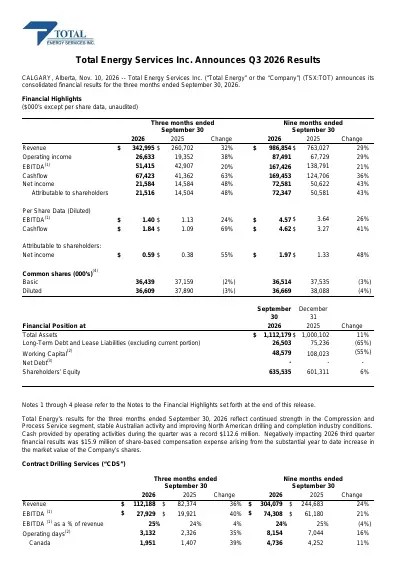
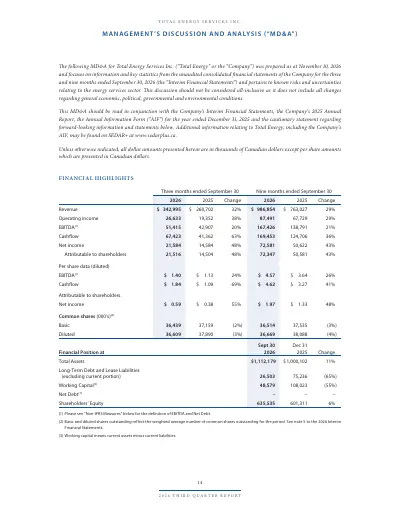
Total Energy's results for the three months ended September 30th, 2026 reflect continued strength in the Compression and Process Services segment, stable Australian activity, and improving North American drilling and completion industry conditions. While $15.9 million of share-based compensation expense arising from a substantial increase in Total's share price negatively impacted third quarter financial results, cash provided by operations during the quarter was a record $112.6 million, due in part to a $54.1 million quarterly increase in deferred revenue arising from deposits received on fabrication sales orders in the CPS segment.
On a year-over-year basis, consolidated third quarter revenue increased by 32%. Contributing to this increase was $44.7 million of increased CPS segment revenue, $29.8 million from CDS segment, and $5.9 million from well servicing, as well as $1.9 million from the RTS segment.
Third quarter EBITDA, adjusted to exclude share-based compensation expense, increased by $22.4 million, or 50% compared to 2025, driven by increased activity and improved fabrication margins in the CPS segment, the deployment of upgraded drilling rigs and service rigs at higher day rates in Australia and Canada, and increased Canadian market share in the CDS segment. Even without adjusting for share-based compensation expense, third quarter EBITDA increased 20% and cash flow 33% compared to 2025, with share buybacks amplifying these increases on a per share fully diluted basis.
Geographically, 49% of third quarter revenue was generated in Canada, 29% in United States, and 23% in Australia, as compared to the third quarter of 2025, when 48% of consolidated revenue was generated in Canada, 27% in United States, and 25% in Australia. By business segment, Compression and Process Services contributed 50% of third quarter consolidated revenue, followed by the CDS segment at 33%, well servicing at 11%, and RTS segment at 6%.
In comparison, for the third quarter of 2025, the Compression and Process Services segment generated 48% of third quarter consolidated revenue, followed by CDS at 32%, well servicing at 12%, and RTS segment at 8%. Third quarter consolidated margin was 23% in 2026, which was 106 basis points higher than 2025.
Contributing to this increase was a 111 basis point increase in CDS segment revenue contribution, as this business segment has relatively higher gross margin percentage, which was somewhat offset by 147 basis point increase in third quarter revenue contribution from CPS segment, which typically generates a lower gross margin percentage than other segments. Third quarter CDS segment revenue increased 36% compared to 2025.
A 35% year-over-year increase in operating days was further supported by 1% increase in segment revenue per operating day. Third quarter pricing increased compared to 2025, due primarily to increased pricing for upgraded rigs in Australia and Canada and stable pricing in the United States that was somewhat offset by change in the mix of equipment operating as lower spec rigs went back to work in Canada.
Third quarter CDS segment EBITDA increased by 40%, and segment EBITDA margin increased by 71 basis points compared to 2025, due to increased utilization and pricing. RTS segment revenue and EBITDA for the third quarter each increased by 9% compared to 2025.
This was a result of increased utilization of rental equipment that was somewhat offset by lower revenue per utilized piece of equipment, due to changes in the mix of equipment operating. Higher costs associated with the change in the mix of equipment operating, significant cost inflation that was not fully offset by price increases, and this segment's relatively high cost structure resulted in the RTS segment's EBITDA margin remaining consistent in Q2 Q3 of 2025 at 36%.
Third quarter CPS segment revenue increased 36% compared to 2025, driven by increased fabrication sales and higher parts and service activity. Year-over-year, third quarter CPS segment EBITDA increased by $5.9 million or 39%.
Despite a year-over-year decline in higher-margin compression rental revenue following by the sale of several active units in 2025, third quarter segment EBITDA margin was 33 basis points higher than 2025, primarily due to improved fabrication margins, a relative increase in higher-margin parts and services activity, and improved compression rental fleet utilization. The quarter-end fabrication sales backlog increased to $733.8 million, compared to $380.8 million backlog at September 30th, 2025.
Sequentially, quarter-end fabrication sales backlog increased by $179.3 million, compared to the $554.5 million backlog at June 30th, 2026. In Well Servicing, an 11% increase in revenue per service hour, combined with a 7% increase in service hours, resulted in a 19% year-over-year increase in third quarter segment revenue.
Increased Australian and Canadian activity was partially offset by a substantial decline in US activity, following the discontinuance of US well servicing operations in January of 2026. Higher pricing, increased fleet utilization, and the cost optimization following the upgrade of several rigs over the past year resulted in a substantial improvement in third quarter Australian operating income, which together with the cessation of operating losses in the United States, drove a substantial year-over-year improvement in both segment EBITDA and EBITDA margin.
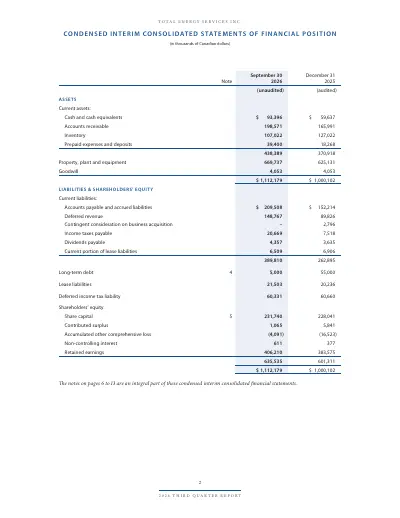
Total Energy's consolidated financial position remains very strong. At September 30th, 2026, Total Energy had $48.6 million of positive working capital, including $93.4 million of cash.
Cash on hand exceeded bank debt by $88.4 million at September 30th, 2026. Total Energy's bank covenants consist of maximum senior debt to trailing 12-month bank defined EBITDA of 3 times, and a minimum bank-defined EBITDA to interest expense of 3 times.
At September 30th, 2026, company senior bank debt to bank EBITDA ratio was -0.36 times, as Total was in a net cash position in and the bank interest coverage ratio was 171.64 times.
Daniel Halyk
Thank you, Yulia. We are pleased with our third quarter results.
Our CPS segment continued to execute well. Our Canadian drilling business continued to gain market share as upgraded rigs were deployed and market conditions warranted reactivating lower spec rigs.
Our Australian business remained stable and economies of scale were realized with the reactivation of several upgraded rigs over the past year. US drilling and completion activity continued to modestly recover from multi-year lows.
Our Compression and Process Services segment continues to see strong demand for its products and services. The fabrication sales backlog grew another 30% 32% during the third quarter to a record $733.8 million, and provides us with visibility well into 2028.
Despite recent market volatility, quoting activity remains vibrant. Expansion of our US fabrication capacity in Weirton, West Virginia, is on time and on budget, with facility construction scheduled to be completed by the first quarter of 2027.
Following the completion of construction, we expect US production will ramp up over several quarters as additional personnel are hired and long-lead major components received. The substantial investment made over the past two years to upgrade our Australian and Canadian drilling and service rig fleets continued to bear fruit during the third quarter, highlighted by a significant improvement in the financial performance of our Australian well servicing business and Canadian drilling rig market share gains.
The upgrade of a second idle Canadian mechanical double to a state-of-the-art AC triple drilling rig is on time and on budget. This rig was recently contracted to a major Canadian producer and will begin drilling when completed, which is expected to occur in early January of 2027.
The upgrade of three Canadian service rigs and one Australian drilling rig are also expected to be completed and the rigs deployed by January 2027. A new service rig being constructed for Australia is expected to commence operations during the second quarter of 2027.
During the first nine months of 2026, we have invested $97.5 million to maintain and grow our business. At the same time, we have returned $41.3 million to shareholders by way of dividends and share buybacks and reduced bank debt by $50 million.
Total exited the third quarter in a very strong financial position, with $93.4 million of cash on hand and $170 million of credit available under its $175 million of revolving bank credit facilities. Subsequent to quarter-end, the remaining $5 million of bank debt was repaid, such that we currently have no bank debt.
Our financial strength and flexibility ensures we are able to continue to fund attractive investments, while at the same time providing our owners with industry-leading shareholder returns through dividends and share buybacks. That said, we will remain disciplined in the deployment of our owners' capital, with current market volatility reminding us of the prudence in doing so.
Finally, I'm pleased to advise that this month Total Energy celebrates the 30th anniversary of its incorporation. We are proud of our industry and the benefits it provides to the world and the many communities in which we operate.
Our company has never been stronger and better positioned to seize the opportunities we will encounter. On behalf of the board of directors, I extend our sincere gratitude and appreciation to all of our past and present customers, directors, employees, shareholders, suppliers, and other stakeholders who have contributed to our growth and success over the past three decades.
We look forward to many more years of collaboration and mutual success. I would now like to open up the phone lines for any questions.
Operator?
Operator
As a reminder, if you'd like to ask a question, simply press *, followed by the number 1 on your telephone keypad. We'll take a brief moment to compile the Q&A roster.
Your first question comes from the line of Keith Mackey from RBC Capital Markets. Your line is live.
Keith Mackey
Hey, thanks, and good morning.
Daniel Halyk
Good morning, Keith.
Keith Mackey
Morning. Realize it might be a little bit early to start asking this question, but can you maybe just walk us through in general how you see 2027 unfolding from a market demand and therefore capital spend perspective?
Are you seeing market acceleration in some of your core segments that would require you to spend more capital, or or, or or are you going to, continue to to ramp down on spending as you finish some of the objectives that you've been working on this year?
Daniel Halyk
What I would say is within our CPS segment, obviously we will be completing the capital expenditure portion of our US expansion, by Q1. That part will ramp down.
Then that becomes a working capital game. Obviously, future rental compression demands, that's always a crap shoot, but we'll see where that goes.
I would say within Australia, we're probably pretty stable right now. We've spent a lot of money over the last two years upgrading.
I think there's still some I'd call them rifle shot upgrade opportunities, but likely not to the same extent as what we've invested over the past couple of years. Within Canada, our second AC triple will be going straight to work as soon as it's done.
Demand for that style of rig is very strong. Again, I'm not going to usurp the role of the board, but I would expect that'll be an area that will continue to see opportunities to deploy capital.
We'll be announcing our our 2027 preliminary capital budget in in January. We literally start at zero.
We have our maintenance capital every year. This year roughly $40 million, Yulia, in maintenance?
I'd have to go back and look, but you can you can pretty much assume that if things are flat, we'll be at that level. That's just to maintain our our existing operations.
Growth will depend on opportunities. Will it be zero?
I doubt it. We literally we start at zero and and go where circumstances take us.
First cut will be out in in kind of early January and then updates accordingly, but, given current market activity, I'd be surprised if we didn't have some growth opportunities next year, Keith.
Keith Mackey
Understood. Can you just take us through the situation in Australia with the potential legislation there?
You called that out as a an item in your a risk item in your disclosures there. Can you just sort of walk us through what what's happening, have you seen any change in activity in Australia yet, and maybe just what some of the goal goal posts are for for what might happen there as we go forward?
Daniel Halyk
I'm very poor at politics. I've learned that trying to anticipate what politicians do is is a mug's game.
What's happening there is you've got very high domestic and Asian LNG prices. Domestic gas prices are getting pulled up by a tight gas market.
The federal government has tried over the past few years to deal with that, first by attempting to put a price cap in place, which was revoked. Now what they're trying to do is is force fixed allocation of production to the domestic market, and there's a lot of domestic producer pushback on that.
I don't know where that's going to go. I don't vote on it.
I'm not really involved. I think if you want updates, Google it.
Producers have put out some pretty strong statements. We raise it as an issue because it could be an issue.
We'll see where this goes, but certainly it's, it's being talked about over there, whether producers react to it in terms of activity levels, we'll see. I suspect you may see some of that for various reasons, perhaps political.
The reality is all of this is happening in a high gas price market, and you don't fix high gas park- prices by reducing activity. I'm hoping that logic and and free market principles prevail because that's ultimately what will fix the problem, not trying to regulate it.
We'll see. Again, your guess is as good as mine.
Keith Mackey
Okay. Understood.
I'll leave it there. Thanks very much.
Daniel Halyk
Thanks, Keith.
Operator
Your next question comes from the line of Tim Monachello from ATB Cormark Capital Markets. Your line is live.
Tim Monachello
Hey, good morning.
Daniel Halyk
Morning, Tim.
Tim Monachello
I just wanted to touch on the CPS segment. Really strong backlog again this quarter, and you talk talk about robust or vibrant outlook there for demand.
The margins were a little bit lower quarter-over-quarter. I'm just curious if you can enlighten us as to what you're seeing in terms of backlog margins, and maybe if you could wager, I guess, on what the margin lift you might see in the US operations once you get the Weirton facility up and running?
Daniel Halyk
Sure. In terms of our our Q3 margins there, there was nothing that stood out to me in terms of unusual positive or negative.
I think on a normal scale, you get a bit of seasonality, what's flowing through the shop. Yulia, there's probably some FX impacts.
Yulia Gorbach
There's FX impact, there's product mix impact, because it all depends on the project on the floor.
Daniel Halyk
Nothing unusual there. Obviously, as you increase production and your fixed costs stay the same, your overhead absorptions get better.
As we ramp up in the US, I would expect margins to improve, subject to we've also been there's expenses both now and as we'll ramp up that will be expensed, not capitalized, as part of the ramp-up of production. There'll be some shorter-term impacts there.
Again, that's just part of the business. That'll play out over the course of 2027.
Like I said, I think we're quite confident that investment in expansion will be a very good one and we'll look to run it as efficiently as possible. There's nothing we're seeing that causes us to be uncomfortable about making that expansion decision.
Nothing. Like I said, every quarter, you get currency fluctuations.
We protect against that through currency purchases, contractual protections, but it's not perfect. One quarter, you may have a slight positive, the next a slight negative, but we kind of look at it over the course of time, not just quarter-to-quarter.
It's trending in the right direction.
Tim Monachello
The backlog margin, is that expanding given the tightness in the market?
Daniel Halyk
I think again, there's a lot of different components to that backlog. Certainly, where you have areas of tighter supply, you how do you allocate scarce resources versus, areas that are more competitive.
For example, electric drive, probably tighter margins on that. Really, part of the quarter-to-quarter change can depend on what we're actually building.
Obviously with these kind of activity levels, I would expect our sales group there to be, getting the best price they can, but it it remains a very competitive market. I like to see our people losing some bids, which they do, and we've got to compete and give a quality product.
If you don't, your backlog goes down, not up.
Tim Monachello
Absolutely. Then just in terms of demand, have you seen any changes in customer inquiries since the midterms in the US?
Where where do lead times stand now for somebody who looks a compression package today? Is that a '28 delivery?
Is there still some room to deliver in '27?
Daniel Halyk
We've seen no change in demand. I think we saw probably a few days of pause and things have resumed.
Again, I'm not going to speak to specifics, but when I look at our customer base there, it's blue-chip and it's distribution of gas. It's tied to the infrastructure build, not to specific end uses of gas.
It's getting gas whether it's to LNG plants, power plants, whatever. We really we're agnostic on where the gas is going.
I look at that and I go these are very large infrastructure players that are building a multi multi-year North American infrastructure, and I don't think one midterm election is going to change that. It may over time, but certainly there's a lot going on for its foreseeable future.
In terms of the in terms of lead times, they're still long. Depending on the piece of equipment, again, we're going to see If you wanted a a Cat engine, we always keep a little bit of dry powder, but there's not a lot there.
I think you're into 2028. We've got a few things in reserve that we keep for for special opportunities.
Electric drive, bit shorter, lots of retrofit activity, there's there's holes to fill. They'll get filled by different things.
This is for the big horsepower reciprocating engine orders, you're you're into 2028. Customers are booking for 2028.
Tim Monachello
Okay. Got got it.
Then, just in terms of, I guess, North American more traditional service lines, how are pricing dynamics shaping up into specifically the the Canadian winter drilling season? Are you seeing any pricing lift in the US?
Daniel Halyk
Canada, we're in the middle of kind of firming all that up. A lot of it's been contracted.
I don't want to jinx it other than to say I think day rates have room to go up. Some of the rates, in particularly the lower-spec equipment are are not they've come starting to come up, which is why we're starting to put some of that equipment to work.
US is lagging, but going in probably the right direction. We're such a small player there that I hate to give too much commentary.
We're just not not as wise to that market. I would say within our our RTS segment, again, similar story.
There's been a lot of attrition there over the past while. We're starting to see opportunities to move pricing, both sides of the border, particularly with respect to tighter equipment lines.
We don't comment on that for obvious reasons, but we would see some pricing momentum there. Again, I look at the pricing on some of the equipment, it's less than it was in 2014.
I can tell you our costs are not less than 2014, so that stuff has to has to move. I would say generally, there's upward bias for pricing in our drilling, rentals, and well servicing businesses.
In North America. Australia is static.
It's it's longer-term contracts, so.
Tim Monachello
Okay. I appreciate that.
I know my line questioning is going on, and Joseph might be asking a question here soon, but I'm going to sneak one more in. Just in terms of the M&A ambitions, I know because is he part of the company now, or not sure if he's still in the cube.
Anyways, in terms of M&A ambitions, has anything changed there relative to how you were looking at potential acquisitions in the past few quarters?
Daniel Halyk
Not at all. We're looking at lots and open to doing deals that are mutually beneficial.
Tim Monachello
Okay. Great.
I'll turn it back. Thanks.
Daniel Halyk
Thanks, Tim.
Operator
That concludes our question-and-answer session. I'll now turn the call back over to Mr.
Daniel Halyk for closing remarks.
Daniel Halyk
Thank you, everyone, for joining our Q3 call, and look forward to speaking with you with our year-end results. Have a good day.
Operator
This concludes today's meeting. You may now disconnect.