New Found Gold Corp
Q3 FY2026 · Earnings Call TranscriptNovember 12, 2026
Operator
Thank you for standing by and welcome to the New Found Gold Corp. third quarter 2026 results conference call.
All lines have been placed on mute to prevent any background noise. After the speakers' remarks, there will be a question and answer session.
If you'd like to ask a question during this time, simply press star followed by the number one on your telephone keypad. If you'd like to withdraw your question, press star one again.
Thank you. I'd now like to turn the call over to Fiona Childe, VP Communications and Corporate Development.
You may begin.
Fiona Childe
Thank you, operator. Good morning, everyone, and thank you for joining us to discuss New Found Gold's results for the third quarter of 2026.
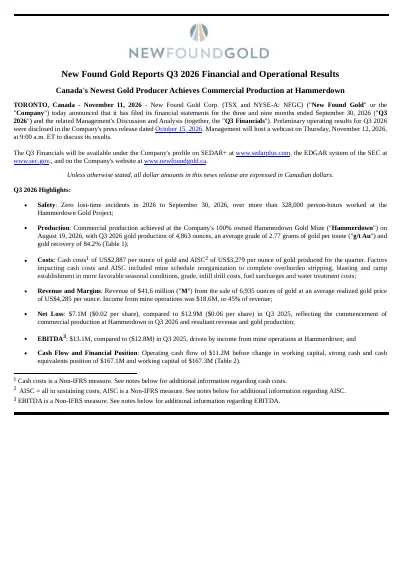
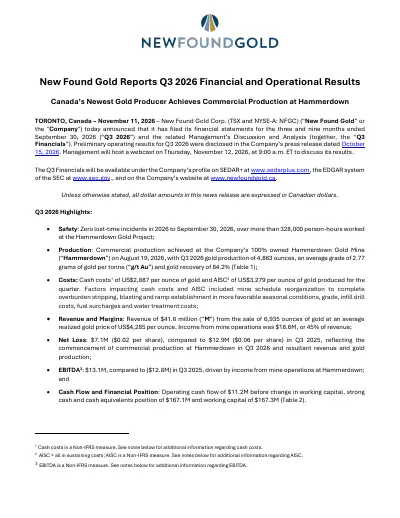
Our news release, financial statements, and MD&A for the quarter were released yesterday and are available on our website, on SEDAR+, and on EDGAR. A replay of this call will also be posted on our website shortly following this call.
Before we begin, please note that today's remarks include forward-looking statements, including statements about production, costs, the timing of permitting and development at Queensway, the Pine Cove conversion and expansion, and our future plans and objectives. These statements are based on current expectations and are subject to risks and uncertainties that could cause actual results to differ materially.
Please refer to cautionary language in our news release and MD&A and to the risk factors set out in our annual information form, and note that all financial numbers mentioned on this call have been rounded to the nearest million dollars. We will also refer to non-IFRS measures, including cash costs, all-in sustaining costs, average realized gold price, and EBITDA.
These measures do not have standardized meanings under IFRS. Definitions and reconciliations are in our MD&A.
Also, please note the Queensway Gold Project 2026 PEA is preliminary in nature. It includes inferred mineral resources that are considered too speculative geologically to have economic considerations applied to them that would enable them to be categorized as mineral reserves, and there's no certainty the PEA will be realized.
Mineral resources are not mineral reserves and do not have demonstrated economic viability. Unless otherwise noted, all dollar figures are in Canadian dollars.
On the call with me today are Keith Boyle, our Chief Executive Officer; Hashim Ahmed, our Chief Financial Officer; Gerard Saunders, our Vice President Sustainability; and Yelena Fried, General Counsel and Corporate Secretary. After our prepared remarks, we will open the line for questions.
With that, I'll turn the call over to Keith.
Keith Boyle
Thank you, Fiona, and good morning, everyone. Thank you all for joining us.
Third quarter 2026 was a transformational quarter for New Found Gold. In September, we announced commercial production at our 100% owned Hammerdown Gold Mine in central Newfoundland, Canada.
With that, New Found Gold is Canada's newest gold producer. Just under a year ago, we acquired the Hammerdown Gold Project and the Pine Cove mill, and in this time, Hammerdown has gone from a development-stage asset to a producing mine feeding the Pine Cove mill.
We now have a producing asset and, most importantly, permitted mill and tailings facilities at Pine Cove to rapidly advance our flagship Queensway Gold Project to production two to three years faster than building only a stand-alone mill at Queensway. Let me start, as always, with safety.
Through September 30th, 2026, our Hammerdown and Pine Cove teams worked more than 328,000 person-hours this year with zero lost-time incidents. I want to thank our employees and contractors for that result.
It's the foundation of everything we do. Turning to production, Hammerdown produced 4,863 ounces of gold in the third quarter, during which we had our first full month of commercial production.
We saw an average head grade of 2.77 grams per tonne and recovery of 84.2%. That brings us to 10,670 ounces year-to-date at the end of Q3.
Consistent with a ramp-up through the year, Q3 alone accounted for 46% of our production for the first nine months. We sold 6,935 ounces in the quarter at an average realized price of $4,285 US per ounce, generating revenue of $41.6 million.
Income from the mine and operations was $18.6 million, or 45% of revenue, and EBITDA was positive at $13.1 million. Operating costs were higher than anticipated, with cash costs at $2,887 US per ounce and all-in sustaining costs at $3,279 US per ounce.
During the quarter, we advanced overburden stripping and pioneering work in the Rumbillion pit, moving up the schedule from early 2027 into Q3 so it could be done in a better seasonal conditions. Grade, infill drilling, fuel surcharges, and water treatment also contributed.
I'll walk through the detail shortly, along with the steps we are taking to bring costs down. To confirm, we expect operating costs to come down in the long run.
On the corporate side, we also reached a milestone, strengthening our corporate profile through the commencement of trading on the Toronto Stock Exchange main board. Post quarter-end, we delivered two major milestones at Queensway.
In October, we released a revised PEA and updated mineral resource estimate. The PEA shows an after-tax NPV at a 5% discount rate of $1.73 billion and an after-tax internal rate of return of 126%, using a base case gold price of $3,600 US per ounce.
At the upside case of $4,100 US per ounce, these numbers rise to $2.225 billion and 164%, respectively. In addition, the measured and indicated resources grew by 38%.
Last week, we submitted the environmental preview report for Queensway Phase 1, a key step in provincial permitting, and expect a decision from the Minister of Environment, Conservation and Climate Change for the Province of Newfoundland and Labrador in late 2026 or early 2027. During the quarter, our balance sheet remained strong, and we ended the quarter with $167.1 million in cash and $167.3 million in working capital.
Queensway Phase 1 is fully funded, and we remain on schedule to deliver first Queensway mineralized material to Pine Cove in the fourth quarter of 2027. Let me now turn to the operations in more detail.
At Hammerdown, Q3 production was driven by higher mining and processing rates. We mined 97,000 tonnes of mineralized material and about 1.2 million tonnes of waste for total material movement of 1.3 million tonnes.
Pine Cove processed 66,000 tonnes of mineralized material during the quarter with a head grade of 2.77 grams per tonne gold, 31% above our year-to-date average of 2.12, but slightly below mine plan. Recovery of 84.2% was in line with the year-to-date average of 83.1%.
Ounces sold of 6,935 exceeded production as they included about 900 ounces delivered in July against customer prepayments we received in June. Third quarter all-in sustaining costs were $904 US per ounce above the 2026 Hammerdown PEA.
About $825 US per ounce of that gap is explained by five items. The largest was the strip ratio.
Our strip ratio was at 12.4 to 1, about 30% above the PEA's 9.6 to 1 number. That was because we started mining the Rumbillion pit in Q3.
This work lifts total material movement from 12,000 to 16,000 tonnes per day, as planned in the PEA for 20- 2027. We pulled it forward from the first quarter of 2027 so that overburden stripping and pioneering could be done before the winter.
That is the right call for the mine, but carries a cost in this quarter. This added approximately $350 an ounce US to the all-in sustaining costs for the quarter.
Next, the head grade was about 11% below the PEA. There was a trench commonly known as a goodbye cut taken out in the 1990s.
It was unexpectedly larger than what had been recorded, and therefore higher-grade ounces did not materialize. The grade reconciliation between actual to resource model is excellent at less than 5%.
Overall, the grade added about $135 US per ounce to the all-in sustaining costs for the quarter. Other items impacting operating costs were infill drilling of the inferred blocks in the stage two pit at about $180 US per ounce, fuel surcharges on external service contracts of about $85 US per ounce, higher mill labor costs about $45 per ounce, and extra water treatment at the Pine Cove, which is about US$30 an ounce.
We're now assessing how elevated fuel and water treatment costs affect our ability to reach PEA-level metrics and how to close this gap in future quarters. We have clear levers to bring costs down.
First, the permanent on-site crusher and sorter at Hammerdown. We expect substantial completion this quarter, with commissioning and ramp-up through the first half of 2027.
Sorting is expected to reduce crushing costs and send higher-grade material to the mill, improving both grade and unit costs. Second, the infill and location verification drilling at Hammerdown is complete, with 30,896 meters drilled in 340 holes.
Those infill costs decrease substantially, and the data will support an updated Hammerdown resource estimate in 2027. Third, the Pine Cove circuit conversion.
In July, we received the permit amendment to convert the Pine Cove from its current flotation leach and Merrill-Crowe circuit to a gravity carbon-in-leach. Recent test work suggests that this can lift Hammerdown recoveries from 87% to 92%.
The conversion is on schedule for completion in Q4 of 2027. We will apply separately for the permit to expand throughput to 1,400 tonnes per day as part of the Queensway permitting process subsequent to being released from the environmental process.
The conversion is an important part of our hub-and-spoke strategy. Pine Cove will become one processing hub serving both Hammerdown and Queensway Phase 1.
Our focus for Hammerdown and Pine Cove through the rest of 2026 and into 2027 is straightforward: steady-state production, the crusher-sorter implementation, completion of grade control drilling, and advancement of the off-site mill conversion. Turning to Queensway, our flagship project.
The revised 2026 PEA and updated mineral resource we released last month are the result of about 18 months of drilling, engineering, and technical work. At a base case gold price of $3,600 an ounce US, the PEA shows an after-tax net present value at 5% of $1.73 billion, more than double the previous study, and an after-tax internal rate of return of 126%.
At $4,100 per ounce, the NPV rises to $2.2 billion and the IRR to 164%. After-tax payback is under one year.
The mine plan assumes a 15-year mine life with a phased open pit underground operation producing 1.744 million ounces of gold. That is an average of about 116,000 ounces a year, peaking at about 190,000 ounces a year in 2032.
Life-of-mine cash costs are estimated at $985 US per ounce, with all-in sustaining costs of $1,375 US per ounce. Phase 1 starts with very high grades, averaging 13.41 grams per tonne against a life-of-mine average of 2.09 grams per tonne, and recovery of 91.5%.
Capital efficiency is a defining feature. Phase 1 initial capital is about $150 million, in line with the 2025 PEA.
Cash flow from Phase 1 is designed to fund Phase 2, and Phase 2 to fund Phase 3. Growth capital over the life of mine is $832 million, and sustaining capital is $971 million.
The revised mine plan keeps the phased approach of the 2025 PEA, but makes several key changes. Phase 1 now uses Pine Cove, expanded and converted to a gravity carbon-in-leach as its mill.
Mining starts with contractors in Phase 1 and moves to owner mining later in Phase 2. The mine plan adds zones from the AFZ peripheral area, including Dropcake.
Underground ounces rise 86%, and the underground mining moves up from Phase 3 to Phase 2, starting in 2030. The updated resource supports the revised 2026 PEA.
Measured and indicated resources grew 38% to 1.92 million ounces in 27.3 million tonnes grading 2.19 grams per tonne. Inferred resources total 606,000 ounces in 12.5 million tonnes at 1.51 grams per tonne.
The Dropcake zone, about 11 kilometers north of the AFZ core, contributed to that growth in its first inclusion in the mineral resource, and importantly, it speaks to the along-strike potential for growth at Queensway beyond the AFZ core area. We will be filing the technical report to support the revised PEA and updated MRE by early December, within 45 days of the release.
On the permitting front, we submitted the environmental preview report for Queensway Phase 1 on November 3rd, and it was subsequently registered by the Ministry of Environment, Conservation and Climate Change for the Province of Newfoundland and Labrador. The EPR responds to the information requests and feedback from government review, public comment, and our engagement activities, including an open house in the town of Appleton, central Newfoundland.
The EPR is now in a 35-day review by the environmental assessment committee and the public. Under provincial legislation, a decision is due within 45 days of submission, with a possible 14-day extension.
Based on this timeline, we expect a decision by the end of this year or early in 2027. After release from the environmental assessment, we will apply for the provincial and federal permits needed and work with the province on a surface and mining lease through mid-2027.
Subject to those permits, our key milestones are: contractor mobilization at Queensway in Q1 of 2027; early works in Q2 2027, including clearing, overburden removal, the sound berm, site roads, and water management structures; mining starting in Q3 2027, with the aim of building a stockpile for Phase 1 production; first Queensway mineralized material to an expanded 1,400-tonne-a-day Pine Cove mill in Q4 of 2027. Engineering continues under our EPCM contract with WSP Canada, alongside procurement of long-lead items and major contracts.
Turning to exploration and de-risking, at the end of Q3, we had four rigs active at Queensway and had completed 67,557 meters of diamond drilling in 439 holes. Our 2026 Queensway work program has focused on converting inferred to indicated resources in the Phase 2 pits and underground grade control drilling at Keats, geotechnical drilling for the Phase 2 pits, and continued drilling at Dropcake and regional targets.
Drilling was slower than planned this quarter due to contractor rig maintenance and deep directional drilling challenges in the underground portion of the AFZ core. In July, we also reported strong channel and infill results from the Lotto Zone in the AFZ core.
Highlights included 23.7 grams per tonne over 15.88 meters in channel sampling and 43.5 grams per tonne over 4.7 meters in infill drilling. Those results matched the resource block model well and support our Phase 2 open pit and underground mine planning.
Finally, I would like to say a few words of thanks to our employees, our contractors, and local communities, without which we would not be here today as Canada's newest gold producer. Throughout my career, I've worked across Canada and many other countries.
This is the best jurisdiction I've worked in, thanks in large part to the people. This company has a solid commitment to hire and source locally whenever possible.
Our workforce is over 90% from the province and over 60% from central Newfoundland. We are bringing responsible development along with economic benefits and new opportunities to the communities in which we operate, including the town of Appleton, right next door to Queensway; Glenwood; Gander; and the nearby communities in Springdale and in Kings Point near Hammerdown Gold Mine, and in Baie Verte and Ming's Bight near Pine Cove.
With that, I'll hand over to Hashim Ahmed to walk through the financials.
Hashim Ahmed
Thank you, Keith, and good morning, everyone. Q3 is the first quarter to include a period of commercial production at Hammerdown.
It is also the first quarter with depreciation and depletion of the Hammerdown and Pine Cove assets, which began on July 1st, 2026. Therefore, this quarter's results are not directly comparable with the third quarter of 2025, which predates the acquisition of Maritime Resources, or with earlier quarters of 2026.
Given this, revenue was $42 million, up from $16 million in Q2 2026 and $10 million in Q1 2026. We sold 6,935 ounces at an average realized price of $4,285 US or $5,996 Canadian per ounce.
Year-to-date revenue is $68 million at an average realized price of $4,459 US per ounce. Cost of sales was $23 million, which included $9 million of depreciation and depletion, up from about $0.1 million in Q2 as the company announced commercial production at Hammerdown.
Cash operating costs were driven mainly by contractor costs of $13 million. Income from mining operations was $19 million, or 45% of revenue, compared with $2 million in Q2.
Total cash costs during the quarter were $20 million, and all-in sustaining costs were $22 million, or $4,040 US and $5,588 Canadian per ounce. Exploration and evaluation spending was $15 million, which was flat compared to the second quarter and up 9% year-over-year, reflecting the expanded Queensway drilling program.
Queensway accounted for 92% of that spend. Corporate G&A was $3 million, essentially unchanged from Q3 2025.
Share-based compensation was $2 million, a non-cash item. With Hammerdown now profitable, we recorded a current income and mining tax expense of $2 million.
The net result was a loss of $7 million, or 2 cents per share, compared with $13 million, or 6 cents per share, a year ago and an $11 million loss in Q2 2026. Note that before taxes, we recorded income of $2 million this quarter.
I would also like to highlight EBITDA was a positive $13 million, compared with a negative $13 million in Q3 2025. Operating cash flow before working capital changes was $11 million, driven by Hammerdown's mine operating income and partly offset by Queensway's exploration and corporate costs.
Working capital used $18 million. That reflects lower payables, inventory build, and delivery of about 900 ounces against prepayment received in June.
As a result, cash used in operating activities was $7 million. We invested $19 million in property, plant, and equipment, mainly at Hammerdown, Pine Cove, and Queensway.
Financing activities used in net $1 million, mainly interest on the credit facility, partly offset by warrant exercises. We ended the quarter with a strong balance sheet and $167 million in cash, down from $194 million at June 30th, mainly due to increased capital spending.
Working capital was $167 million, and total assets were $706 million. On debt, we have drawn the $70 million first tranche of our $105 million Nebari facility at a fixed rate of 8.75%.
The $35 million second tranche remains available at our option until May 15th, 2027, subject to conditions precedent. We are in compliance with all covenants.
Taken together, our cash, the undrawn tranche, and growing Hammerdown cash flow give us a strong position to fund Queensway Phase 1 and our 2026 and 2027 priorities. With that, I'll turn the call back to Keith.
Keith Boyle
Thank you, Hashim. To sum up, Q3 was the quarter New Found Gold became Canada's newest gold producer.
Our priorities for the rest of 2026 and into 2027 are clear: keep Hammerdown steady-state production and commissioning the crusher and sorter to lower costs and lift grade to the mill; advance Queensway Phase 1 through permitting and engineering, targeting first mineralized material to Pine Cove in Q4 of 2027; file the Queensway technical report and continue the 2026 infill drill program; complete the Pine Cove conversion and begin exploring the Hammerdown Gold Project land package. We have a producing mine, a central mill, a fully funded Phase 1 mine plan for Queensway, and a strong balance sheet, all in Newfoundland and Labrador, a top mining jurisdiction.
That is a solid platform on our path to becoming Canada's next mid-tier gold producer. I want to thank our employees, contractors, communities, shareholders, including our cornerstone shareholder, Eric Sprott, for their continued support.
With that, operator, we're happy to take questions.
Operator
Thank you. We will now begin the question and answer session.
If you would like to ask a question, please press star one on your telephone keypad. To withdraw your question, simply press star one again.
If you are listening via the webcast and would like to ask a question, please type your question in the Q&A box on your screen. Your first audio question today comes from the line of Mike Niehuser from ROTH Capital Partners.
Please go ahead.
Mike Niehuser
Thanks for taking my call. Congratulations on commercial production and the technical report on Queensway.
As you transition, thinking ahead, don't want to be over my skis. Do you have any guidance on exploration drilling at Hammerdown and Queensway?
I know you've talked about a percentage between exploration and infill, but could you provide any thoughts on the next year?
Keith Boyle
Hi Mike, thanks for your question. For those that on the line there is Keith Boyle.
We're right in the middle of our budget process, you can expect some of that guidance in the future. We're transitioning to a producing company, and so, however, we have some very good targets that we do want to follow up on.
Mike Niehuser
I think you've got a lot of targets with both projects. You mentioned that in the past that Dropcake was open to expansion.
Do you think that we might see a updated MRE on Queensway later in 2027?
Keith Boyle
The short answer is yes, because the work we're doing now, the drilling and the infill drilling that we're doing now with some exploration is geared to provide or to move to a feasibility study next year.
Mike Niehuser
Okay. With regards to Pine Cove and the work at Hammerdown, I don't mean to put you on the spot, but I know that you're dedicating additional resources and that Hammerdown is really been uninvested as far as outside of the main deposit there that you're mining.
Do you think we might be able to see an updated MRE there as well?
Keith Boyle
We'll be providing an updated MRE for Hammerdown, especially given all the infill drilling that we did do. That infill drilling was below stage one pit, and we really did it to derisk the stage two pit, because it had previously been mined out underground.
We just wanted to make sure that the resource blocks that were adjacent to those old workings were in fact still there. That was the infill drilling that we did.
Mike Niehuser
As far as step-out drilling and some of the other targets to the south or in the periphery, are you still going to be following up on those in the new year?
Keith Boyle
That'll be part of the plan for the new year.
Mike Niehuser
Okay. I think you've both invested in a strong foundation for going into the winter and should come out strong next year, and best of luck.
Keith Boyle
Thanks, Mike.
Operator
Again, if you would like to ask an audio question, please press star one on your telephone keypad. We'll pause for just a moment before we move on to our web questions.
There are no further phone questions at this time. I will turn the call back over to Fiona for some web questions.
Fiona Childe
Yes, thank you very much, operator. We have a series of questions from Eleanor Magdzinski at SCP Capital.
We'll begin with the first question: What was the mined grade for the quarter? Keith?
Keith Boyle
The mined grade for the quarter, I don't have that one at the tip of my fingers. We'll search that one down and we'll get back to you.
Fiona Childe
Okay. The second question was, was any ore extracted at Rumbillion?
Keith Boyle
There was a minor part of the ore as we did the initial stripping, overburden stripping, and the first blasts, but very little.
Fiona Childe
The next question on Rumbillion again: Can you speak to splits on waste tonnes mined between the two areas?
Keith Boyle
Sorry, can you ask that question again?
Fiona Childe
Yes. She was asking about Rumbillion, if we can speak to splits on waste tonnes mined between the two areas.
Keith Boyle
I'll have to get back to you on that one, too, Eleanor. I've got just the total number.
Fiona Childe
Great. Next question from her is if we can speak to the reconciliation to date to the block model now that the infill program and results have been completed.
Keith Boyle
The results of the infill have not been included in the resource model as yet. That still has to be done.
We're still waiting on assays for that. I can tell you that the reconciliation to the block model to date is 3%, -3%.
Fiona Childe
All right, and then her last question, she's asking if there are any mine schedule changes with the new infill information that's expected to lift the grade profile ahead of the sorter being commissioned.
Keith Boyle
No, the mine plan right now is to continue. We're still too early in the pit to really have a lot of flexibility to change.
We did bring forward Rumbillion, we'll be able to then pick the highest grade that we do mine at any one time. Generally speaking, it's a very small pit, it doesn't have a lot of flexibility to change the mine plan that way.
Going back to the first question, Eleanor, the mined grade was 2.02, we did stockpile some lower grade material.
Fiona Childe
Great. Thank you.
That is the end of the questions that we have received. Oh wait, I'm sorry, another follow-up has come from Eleanor.
She's asking for the AISC if a 10% increase is safe to assume into next year, the implied lift from removing additional stripping and infilling that is now complete.
Keith Boyle
Yeah.
Fiona Childe
I think it's early stages to respond on that one, Eleanor, and we will be releasing guidance in due course. All right, and just checking back, it looks like those are all the questions that we've received from today.
We thank everyone who has dialed in for New Found Gold's first quarterly earnings call. Thank you very much, and goodbye.
Operator
This concludes today's conference call. Thank you for participating.
You may now disconnect.