Extendicare Inc.
Q3 FY2026 · Earnings Call TranscriptNovember 6, 2026
Operator
Thank you for standing by. This is the conference operator.
Welcome to Extendicare Inc. Third Quarter 2026 Analyst Conference Call.
As a reminder, all participants are in listen-only mode and the conference is being recorded. After the presentation, there will be an opportunity to ask questions.
To join the question queue, you may press star, then one on your telephone keypad. Should you need assistance during the conference call, you may signal an operator by pressing star, then zero.
I would now like to turn the conference over to Jillian Fountain, Vice President, Investor Relations. Please go ahead.
Jillian Fountain
Thank you, operator, and good morning, everyone. Welcome to Extendicare's 2026 third quarter results conference call.
Joining me today are Extendicare's President and CEO, Michael Guerriere, and Executive Vice President and CFO, David Bacon. Our Q3 results were released yesterday and are available on our website, as is a live audio webcast of today's call along with an accompanying slide presentation.
An archived recording will also be available on our website following the call today. As well, replay numbers and passcodes have been provided in our press release for those wishing to access an archived recording by phone until midnight on November 20th.
Before we get started, please be reminded that today's call may include forward-looking statements and non-GAAP and other financial measures. Such forward-looking statements involve known and unknown risks and uncertainties that may cause actual results to differ materially from those expressed or implied today.
We have identified such factors, as well as details of non-GAAP and other financial measures, in our public filings with the securities regulators and suggest that you refer to those filings. With that, I'll turn the call over to Michael.
Michael Guerriere
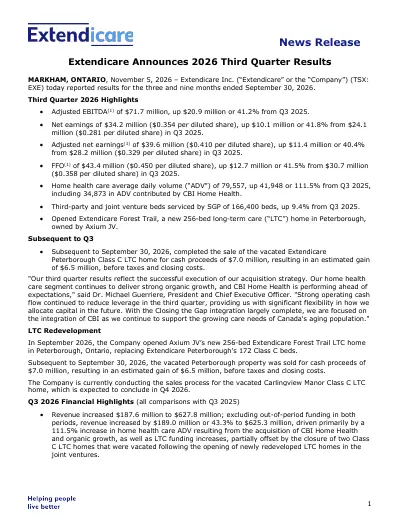
Thank you, Jillian, and good morning. Our third quarter results reflect the continued execution of our strategy, with acquisitions and organic growth delivering adjusted EBITDA of $71.7 million, up 41% from the prior year and ahead of consensus.
Net earnings of 35.4 cents per diluted share were up 26% over the prior year period. Our strong financial and operating results enabled us to pay down $53.7 million on our unsecured revolving credit facility this quarter, improving our pro forma net debt to EBITDA to 2.3 times.
We ended the quarter with $246 million in available liquidity, providing us with significant flexibility as we consider our options to allocate capital. Home health care delivered another strong quarter of organic growth.
Combined with the acquisitions, volumes increased 111.5% year over year. Excluding CBI, ADV increased 18.8% from the prior year, driven by strong underlying growth of the market.
NOI margins in our home health segment were 13.1% in Q3 after removing out-of-period revenue, up 20 basis points from Q2. As we noted last quarter, we invested in technology and back-office teams earlier this year to support the rapid growth in home care services.
These investments and the absence of a 2026 rate increase in Ontario contributed to a 50 basis point reduction in home health care NOI margins from the prior year. We continue to expect that underlying market growth will moderate over time to approximately 6% to 8% on an annualized basis, reflecting the 4% demographic growth trend and the unmet care needs driven by a shortfall in long-term care beds that is anticipated to persist for the foreseeable future.
We also expect that over time funding increases will substantially keep pace with inflation, supporting NOI margins. Long-term care occupancy remained strong and NOI margins were 11.8% for the quarter, adjusted to remove out-of-period funding.
This quarter we received retroactive rate increases in Alberta in both long-term care and home health, consistent with historical patterns that have seen funding increases keep pace with wage rate increases, ultimately supporting NOI margins. Our managed services segment continues its record of strong performance, including 9.4% year-over-year growth in the SGP customer base and NOI margins of 55.6%.
We continue to expect annualized margins of 50% to 55% for this segment. Driven by the strength of these results, our diluted FFO per share, excluding out-of-period items, increased to 43 cents per share, up 35% year over year, driving our payout ratio down to 34% on a trailing 12-month basis.
Turning to slide 4, our home health acquisitions continued to outperform our original underwriting. CBI delivered another strong quarter, contributing $153.3 million in revenue and $20.3 million in NOI.
In the first six months after close, CBI is tracking approximately 23% on adjusted EBITDA and 25% ahead on volumes relative to our original underwriting. We are on track to substantially complete the integration of Closing the Gap this year, and to complete the finance and enterprise IT systems integration for CBI by January 1st, 2027.
This establishes the requisite foundation for integration of frontline CBI care teams through 2027, using a phased approach similar to that used for CTG. We continue to expect annualized synergies to total approximately $7.4 million by the time CBI is fully integrated in 2028.
Turning to slide 5, we continue to advance our Ontario long-term care redevelopment program through our joint venture with Axium Infrastructure. At the end of September, we welcomed residents to Extendicare Forest Trail, the new 256-bed home in Peterborough that opened in the joint venture.
Subsequent to the quarter, we completed the sale of the vacated Peterborough Class C home for cash proceeds of $7 million, once again demonstrating the capital recycling advantages of our redevelopment partnership with Axium. We currently have five projects under construction, with plans to open four of these new homes in 2027, bringing a further 832 beds online in the JV.
We also continue to advance 17 additional projects at varying stages of planning and development under the Ontario Long-Term Care Home Capital Development Program, with our next construction start targeted for spring 2027. We are working to commence construction on additional new projects later next year, should conditions be favorable.
We remain actively engaged with the government on necessary funding and other elements required to fully realize our redevelopment agenda, and are closely monitoring construction costs and interest rates as we navigate a period of heightened economic uncertainty. I'll now turn to our CFO, David Bacon, to discuss our financial results in more detail.
David Bacon
Thanks, Michael. Before I review our consolidated and segment results for the quarter, I want to highlight that this quarter we introduced a new non-GAAP measure, adjusted net earnings and the related adjusted earnings per share.
Details of this reconciliation are included in the appendix to our Q3 results presentation and in our MD&A. This new measure is intended to present our net earnings and earnings per share on an adjusted basis to remove the impacts of items that are, by their nature, non-recurring and difficult to predict, which can create volatility in our quarterly results.
Gains and losses from our legacy C-bed home dispositions, gains on the sale of LTC redevelopment projects into the Axium joint ventures, and acquisition integration costs are just a few examples of recent items that have impacted our quarterly results that can make it challenging to develop a consensus view of our performance on a net earnings and earnings per share basis. In addition, we will also adjust for the amortization of acquired intangibles in this adjustment to report adjusted net earnings results that are more closely aligned with the cash flows of the company.
We believe this new measure provides additional insight into the underlying performance of the business and enhances comparability between reporting periods. Turning now to the consolidated results, our Q3 results were impacted by $1.4 million reduction in net out-of-period retroactive funding on a year-over-year basis, which is more fully outlined in the appendix and MD&A.
Excluding these out-of-period impacts, our consolidated Q3 revenue increased by 43.3% to $625.3 million, driven by the contribution of the CBI acquisition, which, combined with organic growth in ParaMed, drove 111.5% growth in home health volumes, long-term funding care increases, which were partially offset by the closure of two Class C long-term care homes following the opening of the newly developed homes in the joint venture. Our Q3 adjusted EBITDA, excluding out-of-period items, was $69.2 million, an increase of $22.3 million or 47.7% over the prior year, reflecting the CBI acquisition, which contributed $19.6 million, and strong underlying organic growth in our home health segment.
Net earnings were $34.2 million, up $10.1 million or 41.8% from the prior year. Adjusted net earnings were $39.6 million, up $11.4 million or 40.4% from the prior year, and on a diluted per share basis, were 41 cents, up 8 cents from the prior year.
Our diluted FFO and AFFO per share were both approximately 45 cents this quarter, with FFO growing nearly 26% year over year and AFFO increasing approximately 30%. The out-of-period items impacted both AFFO and FFO per share by approximately 2 cents.
Turning to our individual segments, home health care continues to deliver strong performance driven by the acquisition and our continued organic growth. We did receive a retroactive rate increase of 3% in Alberta for home health, resulting in a out-of-period revenue and NOI impact of approximately $500,000 recognized this quarter.
Excluding this out-of-period funding, our Q3 revenue increased by $186.3 million year over year, while NOI increased by $23.6 million or 92.8%. Turning to our long-term care segment, the Q3 results were impacted by out-of-period funding of $2 million from a retroactive rate increase in Alberta for long-term care.
In the prior year quarter, we recognized $3.9 million in out-of-period funding. Excluding these out-of-period amounts, revenue increased by $1.7 million and NOI increased by $200,000, driven primarily by funding increases and improved occupancy, net of the closure of the Carlingview Manor and Extendicare Peterborough C-bed homes, which were replaced by new homes in the JV.
NOI margins, excluding out-of-period items, were 11.8% for the quarter, unchanged from the prior year and in line with the trailing 12 months ended September 30th, 2026. Turning to our managed service segment, at the end of Q3, management contract beds in Extendicare Assist were modestly higher than the prior year, reflecting the opening of the two new homes in the joint venture in May and September of this year, partially offset by the expiry of two third-party Assist contracts earlier this year in Q2.
Together with 9.4% organic growth in SGP clients, our revenue increased by $1 million to $16.6 million, while NOI improved by $300,000 to $9.2 million. Turning to slide 11, we exited Q3 in a strong financial position, with $246 million in liquidity, comprised of $75 million cash on hand and $171 million available on our unsecured revolving facility.
Our pro forma debt to adjusted EBITDA ratio improved from Q2 to approximately 2.3 times, benefiting from the improved financial results and the $53.7 million reduction in our borrowing on our unsecured facilities. Our strong liquidity position, low payout ratio, and conservative leverage profile creates significant flexibility as we consider a range of capital allocation options, including further acquisitions, dividend policy, and, where appropriate, share buybacks.
With that, I'll pass it back to Michael for his closing remarks.
Michael Guerriere
Thank you, David. The strength of our platform was confirmed with another quarter of strong financial and operating performance.
Our acquisitions have outperformed and we continue to deliver strong organic growth in our home health care segment at a pace that exceeds our long-term expectations. We continue to be very confident about the potential of our home care and long-term care platforms, and our ability to expand access to care for the growing number of Canadians who depend on us.
As we enter the final quarter of 2026, we will maintain resolute focus on integrating CBI and executing our long-term care redevelopment program. We will be disciplined as we consider capital allocation options that build shareholder value.
Our prudent approach to managing our balance sheet provides us with significant flexibility in this regard, while also managing the risk inherent in a more volatile economic climate. We believe firmly in the opportunity ahead of us.
Short-term movements in the share price or variability in the alignment of funding and wage increases do not take away from the relentless demographic trend underpinning our business that will drive demand growth for years to come, both in home health care and long-term care. Of course, our first priority is always the quality imperative that is fundamental to the care we provide to thousands of people who rely on us every day.
Our scale, technology platform, and the flexibility of our capital structure position us to continue to build home health and long-term care capacity so more Canadians can access the care they need wherever they call home. My sincere thanks to our team members for their daily commitment to providing high-quality care and services for the residents, patients, and individuals we serve.
With that, we welcome any questions that you might have.
Operator
We will now begin the question-and-answer session. To join the question queue, you may press star, then one on your telephone keypad.
You will hear a tone acknowledging your request. If you are using a speakerphone, please pick up your handset before pressing the keys.
To withdraw your question, please press star, and then two. Our first question comes from Kyle McPhee with ATB Cormark Securities.
Please go ahead.
Kyle McPhee
Hello, everyone. Great quarter.
The moving pieces all seem strong and pretty straightforward. I just have one high-level question this quarter about what to do with all your excess capital you're generating.
I know you generally addressed it in your prepared remarks, but I'm specifically interested in whether or not you may shift to doing some of your remaining Class C redevelopment in-house versus using the JV playbook so you can keep all the cash flow in your long-term care segment, or if there's still really ample opportunities to use your excess capital for things that are better return on capital versus your own Class C redevelopment, things like more home health care M&A or maybe even buybacks at this current valuation.
David Bacon
No, Kyle, thanks for the question. I think a few things I'd say on that.
We do have flexibility, as we pointed out in the prepared remarks. We think we're in a very strong position from that perspective.
As we have said, we do think there is a significant opportunity in home care in particular on the roll-up there and continued M&A just given the fragmentation in that market. We'll continue to pursue those opportunities.
We have in the last two years increased the dividend, we'll be looking at that again early in the first quarter with our year-end results, and that's an expectation I think we've created and will follow through on. The question you asked about would we do C-bed redevelopment on our own balance sheet?
I think our first intent would be to always drive it through the joint venture and drive the managed service revenue in that and keep that capital-light model going. I'd say that it's not that we would never not do another project on our own balance sheet, but initially at the moment, I think we've got a good pipeline going, and certainly pushed through a lot of projects in partnership with Axium that have gone well.
I'd say that's our first priority to do development that way, but I wouldn't say it's an impossibility that we would consider it on our balance sheet. The last part on issuer bid and shares, I'd just say we've been active in the past when we felt the share price didn't reflect sort of the prospects of the business, and we wouldn't be afraid to do that again if we thought that there was a disconnect to the fundamentals with the share price.
Kyle McPhee
It sounds like more home health care M&A is still among the priorities here for your capital. Would you consider doing more before you're fully done the CBI integration, especially given your Closing the Gap integration is done pretty soon and you likely have more capacity to integrate another target at that point?
Kyle,
Michael Guerriere
we might consider that. We might consider an earlier acquisition.
We would want to be down the path in terms of the CBI integration. We've got a pretty good integration playbook.
I was very happy with the Closing the Gap integration. There were no service interruptions.
There was no increase in staff turnover. The whole thing went extremely smoothly, and we'll be using the same playbook for CBI.
Do want to acknowledge that CBI is eight times bigger, and so just want to be very careful that we're well down the path and we can see the end of that integration before we start taking on something else.
Kyle McPhee
Understood. That's it for me.
Thanks for the answers.
Operator
The next question comes from Lorne Kalmar with Desjardins. Please go ahead.
Lorne Kalmar
Thanks. Good morning, everyone.
Just wanted to talk a little bit more about the organic growth outlook for home health. I know you said it can't go on like this forever and I appreciate there's not a crystal ball.
Could you maybe give us a rough idea of sort of how long you think this can carry on for? Is it another year?
Is it two years? Just maybe to give us a bit better perspective on how we should be looking at this business over the next couple of years.
Michael Guerriere
Lorne, I have to caveat my answer by saying I've been wrong so many times in the past about this that, [laughter] I'm really not gaining confidence in my ability to predict. I talked about the 6% to 8% range that we continue to talk about, which is really what the demographics are suggesting.
The LTC bed growth is not keeping pace. The waiting list in Ontario, for instance, has been creeping up over the last while.
It shows that demand backlog is still there. It is very hard to quantify.
We really don't have good metrics around the sector to be able to tell us what to expect, how long to expect this. Part of it is because the growth that we're seeing is not just growth in the number of people we're serving, it's also growth in the number of hours that we're providing to those individuals.
We're seeing a higher-acuity group of patients, presumably the people that we would otherwise have been managing in a long-term care setting. You've got both a volume element in terms of the number of people that we're treating, but also a volume element in terms of the intensity of the needs of those individuals.
We really don't have a good crystal ball for being able to see when that'll slow down. Of course, there's no magic to the 6% to 8% either.
That's our conjecture. Perhaps that's an underestimate.
Lorne Kalmar
Okay. I guess you may alluded to it, but what do you think really needs to happen within the system for volumes to kind of normalize?
Is it the shortage of LTC beds abating? What do you think really needs to happen?
Michael Guerriere
I I think the best barometer of what's happening in the health care system is the emergency departments in the hospitals. Because they're they're the the entry point to acute care, which gives you a sense of whether people are able to exit acute care.
There's a lot of people that are in beds in hospitals that, belong in in other, in in, other parts of the system, but there's no place for them to go, particularly long-term care beds. Over the summer period, there were a lot of news reports that, the usual kind of lightening of load in emergency departments in hospitals in the summer didn't happen this year.
We do have some some anecdotal evidence that, the acute care part of the system is still under stress. So, I think that's probably the best place to look.
It's it's that whole hallway medicine issue in emergency departments that is the best measure of stress on the system.
Lorne Kalmar
That's that's very helpful. Thank you.
Then maybe just switching over to back to acquisitions. As you're evaluating targets, like what are the criteria you're looking at in acquiring?
Is it is it geographies? Is it, maybe services that you don't offer that that could enhance the ParaMed service offering?
How do you sort of weigh those, and and what are you looking for?
David Bacon
Lorne, on the the home care side, there's a few kind of key things that that we follow. One is, I think we've said and and demonstrated, I think, with the deals we've done, the two deals we've done to date, we're looking to buy growth platforms when we're looking to buy, we don't we're not just trying to pile volume into the same districts.
We're looking for platforms where we can bring our we're not there today, we can bring our back office and technology and scale to it. We are looking for, in the case of CBI and CTG, you saw us buy new geographic markets.
It's it it gave us a presence in the West with CBI, and Nova Scotia with CTG and CBI. With CBI, it gave us a new, market vertical with the the specialized commercial community service business.
That that group home business, it's it's new to us, that gave us another new kind of market way to come to market. We're looking for, areas where we don't service.
We if you you'll recall our business is really three kind of service levels. There's the PSW personal support work, there's nursing, and then there's the therapies or allied parts of the business.
We'll look for markets where perhaps we have a strong PSW presence, but we don't do any nursing, and we'll look for a regional player that has a good concentration of nursing and we fill it that, say in the Ontario context. Other markets, other geographies are of interest.
We are in Nova Scotia, but there's the Maritimes. We now have a strong presence in Alberta.
We have a toehold, back in Manitoba and and BC to to to think about. So, it's really geography, or service line augmentation, I'd call it, as opposed to just chasing volume in in sort of a a district or a region where we're we're already quite strong or have quite a lot of depth in a particular service type.
Lorne Kalmar
It sounds like there could be a lot of options out before you.
David Bacon
It's it's still very fragmented. We've spoken about that in the past.
Probably not another deal the size of CBI, but there's there's regional players that are would be that would look a lot like a a Closing the Gap size, and there's there's dozens and dozens of small players that have a niche that might fit nicely with us. Notwithstanding, Mike's earlier comments about, when will we next look at something, CBI and integration is is key, but, it takes a long time to get a get to a point where you're going to execute on a deal, and we do have a pipeline and we'll always be opportunistic, as well, in looking at what may come to market versus us seeking something out that we think would fit well.
Lorne Kalmar
Perfect. Thank you so much for all the color.
Operator
The next question comes from Jonathan Kelcher with TD Cowen. Please go ahead.
Jonathan Kelcher
Thanks. Good morning.
Just want to go back to the the organic growth in in home health care. Is is staffing still really the sticking point?
For example, if you could if you could grow your staffing levels by by 20%, you could just the demand would just be there for it?
Michael Guerriere
No, I I would say that, that the staffing constraint, really passed two or three years ago. So, for the most part, we are accepting all the referrals that are coming to us from government and able to fulfill them.
The exception to that is in certain rural and remote, parts of the the provinces that we serve, where, we have still, constraints on staffing in the north and, in in, in areas of the provinces where, it's not it's not an urban environment, our, our our, client population is very widely dispersed. Those constraints are are really not very material from a from a volume perspective.
Those are also areas of our business where the volumes tend to be quite low. Overall, I would say no, there's not a constraint from a health human resources perspective.
Um, it's, a matter of, the volume of referrals that are coming our way.
Jonathan Kelcher
The in in other words, the the referrals and and I guess just more hours per per patient are are really what's what's driving 18% year-over-year organic growth?
Michael Guerriere
Yeah. Our, our understanding of this, John, is that that the, that growth is the whole market growing.
We're not we're not taking market share from others. This is an expansion of the, overall, home care sector.
Jonathan Kelcher
That's that's helpful. Then just secondly, on the, the LTC redevelopments, in your prepared remarks, you made some some mention of just higher interest rates and and construction costs.
Have they increased enough that any of the projects you're looking at are are no longer really feasible?
David Bacon
Jonathan, I'd say it's yeah, I'd say it's just it's just we're just watching it, right? There's a lot of moving parts, over the last, few months with the the tariff and counter-tariff, now with the election results.
Like I'm not sure what happens, there. We were definitely starting to hear about the impact of those counter-tariffs increasing our structural steel and our kitchen equipment and HVAC equipment for new homes.
We all have a view, there's a different views out there on rate-increase environment. So, what I'd just I'd just say is that we're just watching it.
There's a lot of uncertainty right now. We'll see how the election thing, in the States may change the perspective, and, I think the the truth is we're advancing all of these projects, we're committed to doing the pipeline.
It may just happen at a different cadence if if perhaps some of these these factors were watching, had an impact. The reality is until, until you tender a project, you do not have your final answer.
You need to get the tender stage, we are committed to driving all of our projects through to what we call shovel-ready, and tender, and, I think we've said this in the past, the project that we started in Sudbury, last year or the or, that project, we had on the books for a few years and and we waited till the tender results, and the costs aligned where it made sense to proceed. We're just watching it, I think the sector's watching it.
It's hard for us all to know how, evolution of interest-rate environment and the cost side could could could, what that looks like over the next six to eight months. I think it's it's, there's a lot of uncertainty there, we're just watching it.
Jonathan Kelcher
Thanks. I'll turn it back.
Operator
The next question comes from Tom Callaghan with BMO Capital Markets. Please go ahead.
Tom Callaghan
Hi, guys. Thanks.
Maybe on the home health side, just kind of curious for your thoughts and perspectives. There's been a bit in the press over the last couple weeks just in terms of the federal government and provincial governments with respect to certain health care funding and transfers.
Just interested in any of your thoughts in terms of implications for kind of the home health business at a broad, kind of over medium-term basis on that piece.
Michael Guerriere
Sure. Happy to address that.
First, it's important to understand that Extendicare's contracts are all with the provinces. None of our funding comes from the federal government, nor are any of our contracts with the provinces contingent on federal funding.
Federal health transfers to the provinces are a regular feature of the federal-provincial political dynamic, and obviously receive wide attention because they're the largest transfer of funds between the levels of government. In theory, the magnitude of the transfers could affect the fiscal capacity of a provincial government to invest in health care, but the practical reality is that demand for services is really driven by demographics.
We remain the lowest cost option for meeting the needs of the aging population. That keeps us front center in terms of dealing with that demographic challenge.
I think any attempt to constrain the growth of community services would cause unmet demand to back up into hospitals, like I was talking about earlier, and so that's the highest cost and least politically palatable option for dealing with the aging population. All that said, I don't think that the federal-provincial negotiations around transfers are really, in any way, an indicator of the demand curve for Extendicare.
Tom Callaghan
Thanks. Appreciate that.
Maybe a bit of a housekeeping one on home health, but, David, nice to see the margins improve there on a sequential basis and kind of obviously talked about some of the reasons in Q2. How best to think about that cadence of recovery into 2027 on the margin front today?
David Bacon
I think, as we've said on margins, in Q2, I think we did talk about that we had put some extra costs and investment in the back office because of the significant demand. As we indicated, there's a bit of a step function that happens in that back office, we've put some costs back and resources in there.
It played out as expected. We had good sequential growth in the quarter, and you can see that when the growth comes, there's some margin.
I think, going forward, we do believe this a 13% margin business that has an opportunity to grow over time 50 to another 100 basis points. I think we've said that a number of times.
Obviously, the trajectory of that will be driven by the volume discussion we just had and sort of just trying to understand crystal ball kind of the volume growth. Over the medium-long term, rate increases keeping pace with wage inflation is key, but we firmly believe and demonstrated another example this quarter, Alberta gave us the rate increases, albeit later in the year, but they come.
The timing and quantum of rate increases can affect the patterns, but again over the medium to long term, believe this is a 13% margin business that has opportunities to grow both through organic growth and volumes, and there is the synergies coming when CBI is fully integrated. We've talked about those would be sort of more reflective in 2028 than in 2027, that's more of a when we get the full integration done.
All of that is the current picture, and we do expect to be active on the M&A front in home care in the future, which would augment that. We still firmly believe that that's the outlook.
I think, as we go into 2027, that 50 to 100 is that is not a 2027 thing, that's more of over the next couple of years, as we get the integration done, and, certainly in the Ontario context, we expect rate increases in the future. That will help as well.
So.
Tom Callaghan
Perfect. Thanks, guys.
I'll turn it back. Appreciate it.
Operator
The next question comes from Giuliano Thornhill with National Bank. Please go ahead.
Giuliano Thornhill
Hey, guys. Good morning, everyone.
I just wanted to stick with that question on the seasonality. I'm just wondering if that still does exist in your CBI markets, right?
Like Alberta, Nova Scotia, the kind of what you saw historically?
David Bacon
I'd say that the seasonality impact in CBI is much less pronounced than so to say the ParaMed CTG business. Most of the programs in the summer that are affected are in the nursing and allied service lines, which are much more prevalent in ParaMed and CTG versus CBI.
They're a bit more pronounced on the ParaMed side. Of course, as the integration happens and we won't be breaking out CBI anymore, that'll get a bit muted in the impact as well.
It is much more of a nursing allied programs that is more impactful on ParaMed's side.
Giuliano Thornhill
Just on that, I know the last this prior flu season was pretty tough. Historically, would you say that was more of a one-time event, when we're looking at the volume growth that you saw related to the hospital stress?
I'm trying I guess I'm just wondering, how much of a driver was the flu season on home care demand to relieve those hospital settings?
Michael Guerriere
The flu is a double-edged sword for home care. On the one hand, it can drive demand, as you pointed out, because it puts stress on hospitals, and so hospitals and various health care agencies are much more resolute in their efforts to get people out of hospital.
On the other hand, flu also affects our workforce. We'd have more sick time and absenteeism, which is a drag on volumes.
We kind of see it both ways. I don't really look at influenza as being a major impactor on volumes one way or the other.
Giuliano Thornhill
Thanks. Then just my last question just on, would you say your customers, the government, are they satisfied with the pace of growth in the sector or if they were able to do more, would that be an option?
Because I know, and as you mentioned, your referrals and acceptance rates are quite high, it seems like there could be capacity to do more. I'm just wondering if there was that case, do you think they would be able to do that?
Michael Guerriere
I wish I knew the answer to that question precisely. What I would say is that we've experienced really positive reactions when we bring forward innovative ways or approaches for treating groups that otherwise or in the past wouldn't have been able to manage in the community.
I think that's why we were so excited about specialized community services in CBI, because it's just a different way of dealing with a population that is difficult to manage in the community. CBI had developed that service line over a number of years and had quite a large following from various governments on that service.
I think governments and hospitals are looking for innovation, are looking for more close kind of integration of our services. What that means is we're communicating effectively with hospitals and doctors and they're communicating effectively with us, so that we're better coordinated.
That takes advantage of some of our technology platforms. I do think there's continued opportunities for adding service capabilities.
That said, we are, as I mentioned earlier, accepting the vast majority of referrals that come our way. I think the government is happy with our responsiveness to the demand that they're sending our way.
Giuliano Thornhill
All right. Thanks, Michael.
That'll be all.
Operator
The next question comes from Pammi Bir with RBC Capital Markets. Please go ahead.
Pammi Bir
Thanks. I just wanted to clarify the comments around seasonality in the margins for ParaMed.
Just looking back, typically we would see, I guess, a Q4 improvement in margins, although I think there has been some volatility with maybe prior-period funding. Is that how we would still think about that at this point, like a pickup in Q4 and then a drop in Q1?
David Bacon
I'd I'd say a drop in Q1 is quite common, and we've talked about that in the past, because you've got, we're just a bit over half, unionized in ParaMed. The non-unionized staff tend to get their their rate their wage increases on January 1st every year, but rate increases then don't come until April.
You also have the phenomenon of things like, employee wage benefits, like CPP and EI, kind of restarts the clock. There's always a a dip in Q1.
I would say it's uneven on Q4, Pammi. It's a function of of the weather.
It's a function of where the holidays fall. If, Christmas or Christmas Eve or New Year's fall on a weekday, it can have a bit more of an impact on volume, because you're displacing what otherwise would have been a full workday.
Whereas if those holidays fall on weekends, those tend to be lower lower daily volumes. It we have if you go like off the top of my head, if you went back and looked at every pattern over the last decade, I think sometimes Q Q4 can be a little bit better than Q3, because the seasonal summer dip comes back, and then, depending on where the holidays fall, weather has an impact, snowstorms, etc.
Q4 is a little hard from a trending. It's not always going to be in line, up, or down from Q3.
Definitely a Q4 to Q1 is is, I'd say Q1 goes down from Q4, and Q3 goes down from Q2 pretty reliably. Q4 is a little bit tougher.
Pammi Bir
Okay. All right, that that's helpful.
In terms of going back to the comments around the investments that were made in ParaMed, were were there any additional, costs incurred in Q3, and at this point, are you any change to the outlook, in terms of what you may need to spend?
David Bacon
No, I think I think nothing nothing substantive, sort of in Q3. Most of the activity around the the back office was was Q1 and in and into, later into Q1 into Q2.
At the moment, I think, we're focused more now on getting CBI integrated, which will then give us the opportunities to pursue the pursue the synergies that we've that we've flagged. That's kind of the next next order of focus.
Pammi Bir
Okay. I guess has there been any update, or any dialogue at all with the Ontario government for a bill rate increase?
Michael Guerriere
We're always in dialogue, sharing information, particularly, what the status is in terms of, wage rate inflation. Uh, so, we stay in in close touch with the government on that, so that they're aware of the cost structure.
We do that through industry association, it's a, it's a sector-wide, activity. But, we don't have insight into, the the, rate increase plans until until they're announced.
Pammi Bir
Okay. All right.
Then, maybe, Michael, for you, just same going back to your earlier comments about, patients in in hospitals in alternative care settings. Are are you seeing any changes maybe in the last couple of months that might suggest that that backlog, if you want to call it, is declining or, has it still been pretty elevated?
Michael Guerriere
I I would say it's it's quite elevated. What what what we look at is, typically the number of, two statistics really from acute hospitals: the number of people that are, ready to leave hospital, but but don't have an appropriate place to go.
In government parlance, they call that ALC, alternative level of care. They, periodically publish those those those statistics.
Then there's also the number of people that are admitted to hospital who do not have a bed. And, in in quite a number of places in the province, in Ottawa, in Sudbury, in Mississauga, these hospitals typically have, tens of patients that are admitted in hallways, and in, in in bureaucratic speak, in unconventional locations, in the hospitals, that that are waiting for a bed.
Those numbers are quite high, there really isn't much indication at the moment that that pressure is coming off.
Pammi Bir
Right. Okay.
Maybe last one, David, just on the new disclosure for the adjusted, net earnings. Are are you at some point going to stop or discontinue the FFO and AFFO, reporting?
David Bacon
I think, our our our thoughts there like the the long-term road map's going to be a focus on adjusted EBITDA, adjusted EPS, and a cash flow from operations measure. As I think I mentioned in Q2 and some of you, in our individual conversations, like there is a new accounting pronouncement coming for next year called IFRS 18.
It's going to cause everybody to represent their income statements in a slightly different way, and have some new subtotals and some changes on the cash flow statement presentation. Our thinking is, you'll you will see us introduce a cash flow measure in Q1 of next year, that's driven off of this new IFRS 18.
I expect you'll see us continue FFO and AFFO in parallel for a period of time till people get used to and get comfortable that the new cash flow measure, it's probably going to look and feel a lot like FFO. It'll that'll probably be the closest, proxy for it.
Over time, as people get comfortable with the the core three new measures of EBITDA, adjusted earnings per share, and a cash flow from ops, that will be, eventually those will be our three prime objectives. We will do it in kind of a transitionary fashion, people can get used to what the new cash flow measure looks like relative to the the sort of the, the traditional REIT metrics.
Pammi Bir
Got it. No, that's that's great to hear.
All right, I will, I'll turn it back.
Operator
The next question comes from Tania Armstrong-Whitworth with Canaccord Genuity. Please go ahead.
Tania Armstrong-Whitworth
Hi, guys. Most of my questions have been asked already, but maybe just commenting on the property redevelopment.
I noticed that Orléans flipped two quarters and costs rose about $4 million. Then I think the St.
Catharines and London each also moved back by a quarter. The MD&A also mentions something called like adjusted commissioning schedules for the first time.
I'm just wondering why these delays are happening. Is the issue construction, staffing, of the new homes, or ministry licensing timelines, and and those cost overruns, if they do increase, do they fall on the JV's equity, do they reduce the capital funding grant?
Any more color on those those items would be helpful.
David Bacon
Sure. On the I'll I'll hit them, sort of one at a time.
On the the timing issue, I'd say that the outside of Orléans, the other changes in timing, I know we report by quarter, not by month, but I would say some of these changes are really measured in weeks. It's just orchestrating us, the city inspectors, TSSA, the ministry inspection timing.
So, part of this is we're trying to get four opened in a fairly condensed time, so that puts pressure on on a bunch of, us and the ministry and and and, you know. I'd say as the timing tweaks to things like St.
Catharines, London are are really measured quite modestly in weeks and it's just because of the way we report quarterly. You notice that costs don't change on those projects.
We're still well within contingencies, really there is a little bit of coordination that goes on and there's a lot of different thing, different streams you need to bring forward. As you get closer to the end, it's really just refining the timing on what otherwise are two to three-year timing, on projects.
Orléans is different. Orléans, we have experienced some delays with the contractor, on that project, and just, working through the finishing stages of the project.
That, that is, that is, a I'd say a legitimate delay. I wouldn't say it's labor as much as just working through with the contractor.
The interesting thing on that project, while the costs have gone up as a result of that delay, it's actually in a in a strange circumstance there, it's the costs are now back closer to the original cost. There was some change in HST legislation and change in in the municipal regulations around development charges that actually that project was the beneficiary of.
We thought we had some savings coming on that project going back to the original pro forma, because of some changes on the development charges in HST. While the costs appear to be going up, they're actually sort of spending what we were hoping could have been an opportunistic savings on that project.
We're back to to the original kind of cost outlook there, and so tying in with leverage, etc. There is no sort of impact there.
It's just unfortunate sort of foregone opportunity where we could have come in under budget on that project. Then your last question is, what happens if there were an overrun, of over and above the original pro forma contingency, and and, these projects are all in the JV.
We are equity partners with Axium, we bear the risk of overruns 85/15. There's no disproportionate sort of impact to us or obligation on us.
It's, we are sharing in the risk of construction with our partner in our pro rata share. If, if there was an overrun over and beyond original cost contingencies and some equity had to be topped up, it would be our share of that would be 15%.
Tania Armstrong-Whitworth
Perfect. That's very helpful.
Then on home health care volumes, maybe excluding CBI, we did see volumes grow about I think it was 3% sequentially in Q3, but I saw that the MD&A language kind of moderated a little bit. We went from 'should demand growth moderate' to 'as demand growth moderates', which is I guess just a little bit more indicative of your expectations for the business.
Have you seen kind of a slow down in that growth and is it coming from anything in particular? Referrals from Ontario Health atHome or new bundled care models, your ability to staff the volume, etc.?
Michael Guerriere
We haven't seen any changes in referral volumes. We don't have any new constraints on volumes based on availability of health human resources.
At this point, we've experienced that kind of 18.8% year over year and we'll see what happens going forward. Nothing's happened that gives me kind of any more visibility to what might constitute a slowdown at this point.
I think that wording change is just happenstance. I don't think it was intended to signal anything.
[laughter]
Tania Armstrong-Whitworth
Just making sure. Perfect.
Thank you, Michael. That's all for me.
I'll leave it there.
Operator
The next question comes from Tal Woolley with CIBC Capital Markets. Please go ahead.
Tal Woolley
Hey, good morning. Michael, I was just wondering, you've seen two step-ups, significant step-ups from the Ontario government for home health care.
Do you have an idea of what's the scorecard they're using to measure the effectiveness?
Michael Guerriere
I think that ALC metric in hospitals is a key metric. There's quality measures and customer satisfaction measures as well that they use, but I think the ALC number is critical.
Remember that the referrals here come from hospitals and from doctor's offices, the demand is coming from health system operators themselves, and so the government is also monitoring whether we are meeting that demand by accepting the referrals in a reasonable amount of time. Coming out of the pandemic, there were actually long waiting lists for home care, but we've cleared those now across the province.
We are keeping up with the demand that's coming out of the hospitals and doctor's offices.
Tal Woolley
Okay. That's great.
Thanks very much.
Operator
This concludes our question-and-answer session. I would like to turn the conference back over to Jillian Fountain for any closing remarks.
Jillian Fountain
Thank you, operator. That concludes our call for today.
This presentation is available on our website along with a link to a replay of the call. Thank you all for joining us, and please don't hesitate to reach out if you have any further questions.
Operator
This concludes today's conference call. You may disconnect your lines.
Thank you for participating and have a pleasant day.