EVgo Inc.
Q4 FY2025 · Earnings Call TranscriptMarch 3, 2026
Operator
Thank you for standing by. My name is Darrell, and I will be your conference operator today.
At this time, I would like to welcome everyone to the EVgo Fourth Quarter and Full Year 2025 Earnings Call. All lines have been placed on mute to prevent any background noise.
After the speakers' remarks, there will be a question-and-answer session. If you would like to ask a question during this time, simply press star followed by the number one on your telephone keypad.
If you would like to withdraw your question, simply press star one again. I would now like to turn the conference over to Heather Davis, Vice President of Investor Relations.
You may begin.
Heather Davis
Good morning, and welcome to EVgo's Fourth Quarter and Full Year 2025 Earnings Call. My name is Heather Davis, and I am Vice President of Investor Relations at EVgo.
Joining me on today's call are Badar Khan, EVgo's Chief Executive Officer, and Keefer Lehner, EVgo's Chief Financial Officer. Today, we will be discussing EVgo's fourth quarter and full year 2025 financial results, followed by a Q&A session.
Today's call is being webcast and can be accessed on the investor section of our website at investors.evgo.com. The call will be archived and available there along with the company's earnings release and investor presentation after the conclusion of this call.
During the call, management will be making forward-looking statements that are subject to risks and uncertainties, including expectations about future performance. Factors that could cause actual results to differ materially from our expectations are detailed in our SEC filings, including in the Risk Factors section of our most recent annual report on Form 10-K and quarterly reports on Form 10-Q.
The company's SEC filings are available on the investor section of our website. These forward-looking statements apply as of today, and we undertake no obligation to update these statements after the call.
Also, please note that we will be referring to certain non-GAAP financial measures on this call. Information about these non-GAAP measures, including a reconciliation to the corresponding GAAP measures, can be found in the earnings materials available on the investor section of our website.
With that, I'll turn the call over to Badar Khan, EVgo's CEO.
Badar Khan
Thank you, Heather. When I first joined EVgo as CEO at the end of 2023, we set a goal to be adjusted EBITDA breakeven in 2025, and I am pleased to say we achieved that goal in the fourth quarter.
This significant milestone demonstrates the growth, scale, operating leverage, and durability of the EVgo business, and the dedication and hard work of our team. As I'll touch on later, we're now focused on our next milestone of achieving the real operating leverage inflection point, which will allow us to further accelerate adjusted EBITDA growth and margin expansion.
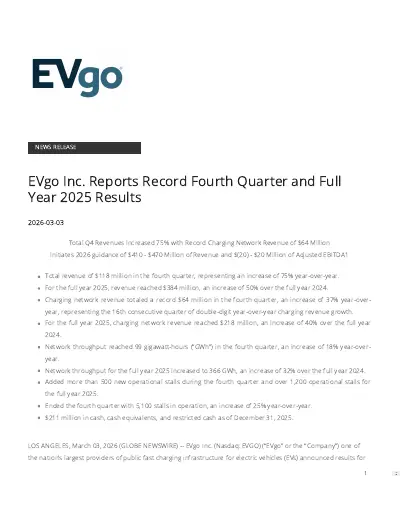
EVgo delivered another excellent year of results, with total revenue of $384 million, a 50% increase over last year, and record charging network revenues. We ended 2025 with 5,100 stalls in operation, following a very large stall deployment of 500 new stalls in the fourth quarter.
Total energy dispensed in our public network increased over 30%, which is more than our stall growth. Our pilot of approximately 100 J3400 connectors, also known as NACS, during 2025 was successful, and we'll be rolling out over 400 more NACS connectors in 2026, both at new sites and retrofits at existing sites, with a goal of effectively doubling our addressable market over time.
Given the returns we expect to generate from these stalls, we plan to increase our public stalls deployed by over 50%. This increased pace of deployment, significantly increasing the number of NACS connectors, and our next-generation charging architecture represent real investments in 2026 to drive longer-term value creation.
EVgo continues to offer drivers more choices on where to charge their EVs as our owned public network and eXtend network expands across the US. Today, drivers can find over 1,200 EVgo-operated stations across 47 states.
EVgo is the third-largest and second-fastest growing network in the US, serving all EV models with key OEM, rideshare, and site host partnerships. I look forward to expanding our network even further in 2026.
Our network stands at over 5,100 stalls and is one of the most highly used EV charging networks in the United States. While we know charging station deployments have grown significantly over the last several years, the reality is that the usage of America's EV network is disproportionately concentrated amongst three largest charge point operators, or CPOs: EVgo, Tesla, and Electrify America.
This is according to an independent third party. The concentration of consumer demand among these top three operators demonstrates the importance of network effect, an already established customer base, which in our case encompasses 1.6 million customers, and scale as a driving force behind this unmatched network utilization.
EVgo's fourth quarter utilization was 24%, which is higher than the average of the top three and nearly fivefold higher than the large group of subscale CPOs, most of whom see usage in the single digits. Per stall demand growth for EVgo's charging network continues to outpace the industry.
Since Q1 2024, EVgo's utilization has grown 4 percentage points, while the rest of the industry, excluding the top three, has actually declined by 2 percentage points. In other words, according to this third-party data, EVgo has emerged as a clear leader in the EV charging space in the United States, representing outsized consumer demand for our network as compared to the competition.
It's clear to me that EVgo has a strong competitive moat that is enduring and continues to strengthen over time. We've developed superior, AI-driven, and scalable site selection algorithms and host partnerships that allow us to build charging stations where drivers want to be, conveniently near where people shop, eat, and run their daily errands.
We continue to scale with strong grocery and retail partnerships, including an expanded partnership with Kroger, which we announced earlier this year. EVgo now has almost 14 times the average number of stalls of the rest of the industry outside the top three CPOs.
We have partnerships with rideshare companies such as Uber and Lyft, who we believe partner with EVgo in part because of our enormous scale advantage versus dozens of smaller operators, and the value drivers get with discounted rates on the EVgo network. As you may have seen recently in the news, EVgo and Uber are in discussions to expand our partnership to meet rising demand for our services from rideshare drivers.
We've developed and are continuing to deploy leading customer engagement tools and capabilities to enhance our customer experience. The investments we're able to make in our EVgo app and other technologies are only possible given we have the scale, network effect, talent, and capital to build the tech stack.
Of note is Autocharge+, where eligible drivers enroll their vehicle and payment method, and when they pull up to a charger, they simply plug in and charge. It's a seamless customer experience, and 30% of our sessions are now initiated with Autocharge+.
EVgo continues to deploy more 350-kilowatt or faster chargers that now make up the majority of our network, offering a full charge in under 15 minutes, compared to just 19% for the rest of the industry, excluding the top three. Our product and hardware teams work tirelessly to improve the charging experience, including ongoing maintenance campaigns targeted at improving reliability on our existing chargers and through our next-generation charging architecture.
Finally, unlike many in the industry, we have the non-dilutive financing in place to build at scale. This competitive advantage is not solely driven by EVgo's superior site selection, but rather the combination of all the factors I've described built over 15 years of doing what we do.
In the second half of 2026, we expect to reach a critical milestone in the evolution of the business, achieving a key operating leverage inflection with gross profit from our charging operations without any contribution from our non-charging business covering adjusted G&A. At the same time, we're intentionally investing in three key areas that we believe will strengthen the long-term competitiveness, resilience, and value of the EVgo platform.
We will build on our already significant scale advantage by ramping up our deployment teams to meet market demand, further separate ourselves from dozens of smaller operators, and significantly increase the number of new owned stalls we bring online in 2026, with even higher growth planned in 2027. We'll roll out more NACS connectors this year, doubling our addressable market in the long term.
This represents an investment in 2026 as we're trading highly productive CCS stalls with NACS stalls, where performance is lower than CCS initially, but growing over time as NACS drivers discover these stalls through our customer marketing campaign. Our investment in next-generation charging architecture improves the fundamentals of the business as we scale.
It simplifies the hardware, reduces failure points, improves reliability, and lowers operating costs over time, while also giving us the flexibility to support higher power vehicles and standards like NACS, and ultimately delivering a better customer experience. That combination is critical to sustaining high utilization and expanding margins as the EVgo network grows.
Over the last two years, we've deployed over 1,200 stalls on our network each year, including our eXtend network. In 2026, we expect this will increase to 1,400 to 1,650.
Importantly, we plan to increase the number of new owned and operated stalls deployed by over 50%. Approximately two-thirds of these stalls will be deployed in the second half of 2026.
We are targeting cash-on-cash paybacks of three to five years, with our highest-performing top 15% of stalls achieving paybacks in as little as one to two years. These strong returns support our ability to continue accelerating stall deployment, enabled by the non-dilutive financing we have in place that positions us to further scale our build-out in 2027 and beyond.
Our autonomous vehicle partnerships remain an important source of further growth and potential upside to these forecasts. As discussed before, new stalls from our existing eXtend partnerships are expected to wind down during 2027, allowing us to transfer build capacity to our owned and operated business.
The industry transition to NACS is an exciting opportunity for EVgo. Over half the EVs on the roads today have NACS inlets, mainly Teslas today, but new models from other OEMs are being launched with native NACS.
We expect to add over 400 NACS connectors to the EVgo network by the end of 2026, allowing drivers to charge at our stalls without an adapter, and effectively more than doubling our addressable market. In 2025, we deployed about 100 NACS connectors in our existing sites on a pilot basis, with the goals of validating the technology and determining how to grow NACS throughput as quickly as possible.
I'm pleased with how the NACS connectors are performing from a technology perspective, and I do want to thank our hardware team, who worked tirelessly to make these liquid-cooled cables happen for our fast chargers. EV drivers can find our NACS locations with the EVgo mobile app or from the distinctive yellow signage at these sites.
Throughput for NACS stalls is currently lower than our CCS stalls at the same site, but we are clearly seeing it grow, driven by increasing numbers of Tesla drivers charging at these stalls. Over the course of this year, we expect to grow NACS per stall usage through our customer communications efforts driving awareness.
This is an important medium- to long-term goal as native NACS vehicle share of overall VIO grows. I've highlighted a number of company-specific sources of competitive advantage, and now I want to turn to some of the industry-wide tailwinds we continue to see driving the share of public fast charging that EVgo also benefits from.
Today, we are beyond the early adopter phase of EVs, with almost 6 million EVs on the road. American drivers are choosing to go electric, and EV prices continue to fall relative to ICE vehicles, making EVs more affordable, which in turn makes EV ownership more accessible to more Americans, including to those that live in multifamily housing.
These drivers often don't have access to a garage or private driveway, and therefore are more reliant on public fast charging. In fact, they charge approximately 1.5 times more on the EVgo network than those drivers that live in single-family homes.
The electrification of rideshare is another key tailwind that has been and is continuing to drive the share of public fast charging. Rideshare drivers are adopting EVs five times faster than regular motorists, and are more likely to live in multifamily housing or otherwise not have access to home charging, and charge significantly more on EVgo's network than the average retail customer.
Companies like Uber and Lyft have their own targets and incentive programs to help rideshare drivers make the switch. On the policy side, New York City and California both have policies in place to encourage increased rideshare electrification each year through 2030, which other states, like Massachusetts, are also considering.
Over the last three years, commercial rideshare throughput as a percentage of total throughput on EVgo's network has almost doubled, and is roughly a quarter of EVgo's public network throughput today. We are pleased to have reached an initial agreement with Uber, where they will guarantee a minimum level of utilization that incentivizes EVgo to build a number of new, larger charging stations in key urban locations in San Francisco, LA, Boston, and the New York metro areas.
This expanded partnership with Uber is designed to address a key concern amongst electric rideshare drivers, which in turn we expect will continue to accelerate the electrification of rideshare. I'm excited to share more details of this expanded partnership once it's finalized.
More affordable vehicles, increasing number of drivers living in multifamily housing, accelerating rideshare electrification, together with faster vehicle charge rates, are all driving the growth of public fast charging, and we remain very focused on capitalizing on these exciting tailwinds to fuel EVgo's continued growth. Finally, EVgo is well-positioned to benefit from the growth in autonomous rideshare.
Autonomous vehicles are electric, and just like human-operated rideshare, vehicle downtime when an EV is charging is lost revenue. Fast charging is key to maximizing their utilization and revenue.
Given the amount of technology in these vehicles, they consume more kilowatt-hours per mile driven, and as a result, are even more reliant on fast charging. The AV market is poised for tremendous growth over the next five years, with a 20-fold increase in robotaxis expected by 2030.
EVgo has been operating dedicated charging stations for autonomous rideshare fleets since 2020. Today, we have 140 dedicated charging stalls for autonomous vehicle companies.
We're proud to be Waymo's charging partner in San Francisco and LA, and we operate charging sites for another AV company as well. While this is a small part of the EVgo business today, our track record, partnerships, competitive strengths position us well to support the rapid expansion of the AV market, which should in turn provide meaningful upside to our business plans over the medium and long term.
Before Keefer shares more detail on our fourth quarter and full year results, I want to take a moment to introduce him to our investors and analysts. We are thrilled with the nearly two decades of operational and financial expertise Keefer brings as a public company CFO, former investment banker, and private equity investor.
He's a great addition to the management team, and I look forward to partnering with him to drive shareholder value. Now, I'll turn over to Keefer.
Keefer Lehner
Thank you. Before I begin, I want to share how thrilled I am to be at EVgo as we build the infrastructure this country needs.
Since joining in mid-January, I've been working closely with Badar and team to transition into the role, and excited about the substantial organic growth runway in front of us. My focus is clear: building on the strength of our balance sheet to accelerate profitability as we continue to scale the business for accelerated long-term growth and value creation.
With that, let's jump into our fourth quarter and full year results. Operational stall growth is one of the key components of growing EVgo's revenue.
We ended Q4 with 5,100 stalls in operation, a 3x increase compared to the end of 2021. We added over 1,200 new stalls to the network in 2025, including 500 in just the fourth quarter, representing our largest stall deployment in a quarter ever.
Our customer base has grown almost fivefold over that same period, which contributes to the network effect, driving increased brand loyalty and usage across our ever-expanding network. We've grown the total energy dispensed on EVgo's network in 2025 to 366 gigawatt-hours, a 14-fold increase over that same period since 2021.
2025 revenues of $384 million have increased over 17 times from 2021 levels. Charging network gross profit margin expanded over 2,500 basis points from the mid-teens to the upper 30s, reflecting the meaningful operating leverage of fixed costs of sales on a per-stall basis as throughput and revenue per stall continue to rise.
Importantly, we again delivered improving profitability, with adjusted EBITDA growing at a meaningfully faster rate than revenue, and we achieved a positive adjusted EBITDA margin in 2025 for the first time in company history. Total throughput on the public network during the fourth quarter was 99 gigawatt-hours, an 18% increase compared to last year.
Revenue for Q4 was $118 million, which represents a 75% year-over-year increase, with growth in all three revenue categories. Total charging network revenue was $64 million, a 37% increase versus the prior year.
eXtend revenue was $24 million, delivering growth of 33% over the same period. Ancillary revenue of roughly $31 million was up about 9x.
Q4 ancillary revenue benefited from a $26 million contract buyout from a former AV partner that exited the space. Charging network gross profit and margin in the fourth quarter were $29 million and 46%, respectively, up 56% and 560 basis points, respectively.
This is slightly higher than our run rate given the higher-than-usual network OEM revenues resulting primarily from branding revenue associated with our GM contract and higher charging credit breakage. Since 2021, charging network gross profits have grown over 32 times.
Fourth quarter adjusted gross profit of $60 million was up over 2x versus the prior year. Adjusted gross margin was 51% in Q4, an increase of over 1,700 basis points over the same period.
Adjusted G&A for the quarter was $35 million, an increase of 14% compared to the prior year, but as a percentage of revenue improved from 46% in the fourth quarter of 2024 to 30% in Q4 of this year. Adjusted EBITDA was $25 million in the fourth quarter of 2025, a $33 million improvement versus the fourth quarter of 2024.
Importantly, if you exclude the impact of the $24 million ancillary contract buyout, we were still positive adjusted EBITDA for the fourth quarter. Moving to key highlights for full year 2025.
Total throughput on the public network in 2025 was 366 gigawatt-hours, a 32% increase compared to last year. Revenue for 2025 was $384 million, which represents a 50% year-over-year increase, with growth across all three revenue categories.
Total charging network revenue of $218 million, a 40% increase compared to 2024. eXtend revenue was $116 million, delivering growth of 34% compared to the prior year.
Ancillary revenues of $49 million were up 239% year-over-year, again benefiting from a $26 million contract buyout from a former AV partner that exited the space. Charging network gross profit and margin in 2025 were $86 million and 39%, respectively, up 46% and 170 basis points, respectively, versus the prior year.
2025 adjusted gross profit of $141 million was up 86% versus the prior year. Adjusted gross profit margin was 37% in 2025, an increase of over 700 basis points.
Adjusted G&A as a percentage of revenue also improved from 42% in 2024 to 34% this year, further demonstrating the scalability and operating leverage intrinsic to our model. Adjusted EBITDA was $12 million in 2025, a $44 million improvement versus the prior year.
Full-year net capital spending for 2025 was $76 million, a 64% increase versus the prior year. 61% of 2025 CapEx, net of capital offsets, was spent in Q4 as we deployed over 500 stalls in the quarter and began laying the groundwork for accelerated growth in 2026.
For our 2025 vintage, net CapEx per stall was approximately $70,000, a slight increase from 2024 vintage, which had an elevated amount of capital offsets. On the financing side, we also borrowed an additional $6 million under our commercial bank facility in December 2025.
As mentioned in last quarter's call, we received the latest DOE loan funding of $41 million in October 2025. In total, that brings our commercial bank and DOE loan balances as of December 31st, 2025, to $66 million and $141 million, respectively.
Turning to our outlook and guidance for 2026. As we've outlined earlier, we see an opportunity to build the top-tier charging network in the United States.
While EV sales in 2026 are expected to be flattish to slightly up from 2025, that still means at least 1.2 million new EVs will be on the road, and VIO is expected to expand 20%+ year-over-year, with new EV sales expected to account for less than 10% of our total 2026 revenue. We're investing in scale, density, and deepening our network advantage, all focused on capturing strong returns on capital deployment.
We expect to accelerate our deployment of EVgo public and dedicated stalls this year, with 1,050 to 1,250 new stalls being added in 2026, with the majority of these additions coming in the second half of 2026. In order to facilitate our accelerated future growth, we are making investments in G&A to support this growth engine.
Our expectation of the number of eXtend stalls operationalized this year is 350 to 400 stalls, which will get us through approximately 70% of the contract with the Pilot Company. We anticipate building the remaining eXtend stalls under this contract in 2027, at which point the contract will primarily be tied to operations and maintenance of Pilot's network.
Overall, we plan to deploy 1,400 to 1,650 total stalls in 2026, a significant step-up from 2025. We expect the rate of deployment to continue to increase as the company grows in 2027 and beyond.
For the full year 2026, we expect total revenues of $410 million to $470 million, with adjusted EBITDA in the range of -$20 million to +$20 million. We also expect significant shape and second-half weighting to the year, as approximately two-thirds of the 2026 stall deployments will go live in the second half of 2026.
The adjusted EBITDA range is informed by variability of expected throughput on our network. The incremental benefit of each kilowatt-hour sold has a big bottom-line impact.
Roughly 2.5 gigawatt-hours of retail throughput equates to approximately $1 million of adjusted EBITDA impact. We expect second half 2026 run rate to be well above full-year guidance, given the significant shape to the year.
We expect second half annualized adjusted EBITDA to be up to $40 million. We do anticipate Q1 and Q2 adjusted EBITDA will be negative, given the growth investments we are making and a second-half weighting of our new stall additions in 2026.
Charging network revenue should be around 70% of 2026 total revenue. Charging revenue is expected to increase each quarter on a year-over-year basis.
In the first quarter, growth is expected to be softer as our new stalls added in Q4 are still ramping up, and we had significant weather impacts from winter storms. eXtend revenues for 2026 are expected to be down on a year-over-year basis, as we are constructing fewer stalls under the program this year as we get closer to completing the contract with Pilot.
Beginning in 2028, this will drive lower revenue solely tied to O&M activity, which frees up our team to focus on further accelerating the expansion of our owned and operated network. Given our strong unit economics and paybacks, we are investing in G&A in 2026 for accelerated future stall deployment and improving the customer experience.
These near-term investments are expected to position EVgo to accelerate revenue and profit growth into the future. Adjusted G&A for 2026 is expected to be $150 million to $155 million for the full year, which is approximately 35% of 2026 revenue guidance.
This is largely in line with 2025 SG&A expense as a percentage of revenue, but on a full-year basis is burdened by the back-end growth of the 2026 plan. 2026 will be an exciting year of transition for EVgo as we augment our foundation to support sustained profitability and set the table for an accelerated go-forward growth trajectory, which should drive improved incremental margins and sustainable profitability on a go-forward basis.
With that, I'll hand it back over to Badar to dive deeper into EVgo's differentiated value proposition for our shareholders.
Badar Khan
Thank you, Keefer. Our unit economics we've shown over the last two years and the details for Q4 are in the appendix to our investor deck, highlighting the growth we are driving in cash flow per stall.
Throughput per stall growth results from EVgo's competitive moat and rising EV VIO. We believe our superior site selection, top-tier partnerships with OEMs, site hosts, rideshare, and AV companies, our leading customer engagement and customer experience offerings, including faster chargers, and our growing customer base that is now 1.6 million customers, all combined to create a moat around EVgo's business that is hard to replicate and one we've spent 15 years building.
This is what drives our recurring and ever-expanding cash flow per stall. Daily throughput per stall, whether for the average of the network or the top 15% of stalls, continues to rise.
Our 350-kilowatt stalls, that currently comprise over 60% of our network and will comprise around 90% of the network within a few years, are now generating almost 350 kilowatt-hours per stall per day. Annualized cash flow per stall for our entire network in Q4 was $21,000.
If you look at our 350-kilowatt chargers, that is $28,000, proof that our network will scale to our longer-term targets. The top 15% of our network was over $65,000, which represents a payback period of just over one year for new stalls performing at these levels.
The top 15% of stalls clearly shows the operating leverage within charging gross profit, where these stalls generated 54% charging gross margin, a full 8 percentage points higher than the average of the network due to the higher throughput per stall. EVgo reached a critical milestone this quarter, delivering positive adjusted EBITDA for the quarter and for the full year.
This achievement relied in part on our non-charging lines of business, eXtend and ancillary. Because of the growing number of owned and operated stalls and the growth in stall profitability due to rising throughput per stall, the real growth in the company comes from our charging business.
Revenue growth since our IPO is over 17-fold, and we've moved from adjusted EBITDA loss to a profit. As we've said before, nearly two-thirds of our total G&A is largely fixed, growing much slower than the growth in the charging business.
Therefore, the real operating leverage inflection, where the gross profit from our charging business alone, without any contribution from the non-charging businesses, covers our G&A, occurs in late 2026. From that point, we expect a significant increase in our already strong incremental margins, with a significant portion of our charging gross profit falling straight to the bottom line, further accelerating the growth in adjusted EBITDA and driving significant adjusted EBITDA margin expansion.
This is on top of the operating leverage that exists within charging gross profit that I just discussed earlier. Over the next four years, we are targeting charging network profits to grow at a CAGR of 50% to 60%, with adjusted G&A growing at a CAGR of approximately 15%.
This operating leverage results in 105% to 130% CAGR in adjusted EBITDA. We are confident that, over the course of the next few years, we'll have a business that goes from breakeven to triple-digit millions in adjusted EBITDA.
EVgo has spent the past 15 years building a business model and a competitive moat that is hard to replicate and benefits from a number of growing megatrends and tailwinds that have already translated into strong financial results and will deliver even stronger results over the coming years. EVgo operates a highly differentiated, industry-leading charging platform that has meaningfully higher utilization than almost every one of our peers.
This is not only driven by proprietary site selection capabilities, but also best-in-class customer experience and customer engagement to a large and growing customer base, combined with leading partnerships across the broader industry. Our ability to attract non-dilutive financing to accelerate our growth further separates us from our peers.
Our focus on owning and operating our network, especially in the high-density urban centers where drivers need fast charging the most, results in a business model with strong and growing unit economics with equally compelling operating leverage. All of this benefits from a compelling macro backdrop that will propel the business for many years to come.
Vehicles in operation are expected to more than double by 2029. The share of public fast charging continues to rise due to the electrification of rideshare, more affordable vehicles, and faster charge rates.
Standardized cables will double EVgo's addressable market over time. Of course, the rise of fully electric, autonomous vehicles that will need to charge at fast-charging locations will just add to the growth we expect to see in our network.
By the time we end 2029, we are targeting to have an enduring infrastructure business with over 12,500 public owned stalls, charging network revenues modeled to grow at 40% to 50%, with adjusted EBITDA margins in the 25% to 30%. This is a capital-efficient, accretive growth model that positions EVgo to compound intrinsic value as we continue to scale our network.
Taken together, our differentiated approach, the accelerating demand environment, and the strong returns of new investments gives us deep confidence in the long-term value creation opportunity ahead. Operator, we can now open the call for Q&A.
Operator
Thank you. The floor is now open for questions.
If you have dialed in and would like to ask a question, please press star one on your telephone keypad to raise your hand and join the queue. If you would like to withdraw your question, simply press star one again.
If you are called upon to ask a question and are listening via loudspeaker on your device, please pick up your handset and ensure that your phone is not on mute when asking your question. We do request for today's session that you please limit yourself to one question and one follow-up, and you may requeue for any further follow-up questions.
Your first question comes from the line of Stephen Gengaro of Stifel. Your line is open.
Badar Khan
Hi, Stephen.
Stephen Gengaro
Thanks. Thank you.
Good morning, everybody. Congrats on the progress.
This might be an odd question, but when you look at the customers I forgot the number you mentioned, but 1.3 or 1.5 million customers? Can you tell us or give us a sense for the percentage of usage that a certain piece of the customer base has?
If you have 1.6 million, I think was the number you gave, are 25% driving 75% of the business? How do those numbers look?
Stephen Gengaro
Yeah. Stephen, I've been saying on a pretty much regular basis over the last several quarters that around half
Badar Khan
of our usage comes from rideshare customers or from customers on subscription accounts. These are the customers that are using our network most frequently.
I think we've said rideshare is roughly a quarter. Rideshare alone is roughly a quarter of the business.
Then we've got the subscription accounts, and of course customers on the OEM charging programs. That's roughly what it is.
I think rideshare, in particular, as we've said over many quarters now, it's gone from roughly 10% four years ago to about a quarter. It's a really exciting part of the demand of the network.
Rideshare is electrifying. It's going to continue to electrify.
Companies like Uber and Lyft, cities like New York City, states like California are all focused on encouraging the electrification of rideshare. That's really a big component there.
Stephen Gengaro
Okay. Great.
Thank you. The other one was how do you participate and I know you mentioned this, on the autonomy side?
Are there folks at the EVgo charging station? How does that ultimately work, in your mind?
Badar Khan
Yeah. I think that, as we said on the call, I think the autonomous vehicle space is, I think, a very significant source of potential upside for the business.
We've got about 140 operational stalls that are dedicated to autonomous vehicle partners. We've had operating stalls for AV partners for years, actually five years now or more, since 2000 so since 2020.
We've been doing it for quite a while. We are adding maybe doubling the number of stalls.
It's still in readiness this year, in 2026, it's still pretty small. I do think that just like in human rideshare, EVgo will become the partner of choice for autonomous vehicle companies, just given our scale, our balance sheet, the emphasis on reliability, our significantly superior customer demand that we've shared from the third-party industry data.
These sites do have human operators who are plugging the cables in, they're cleaning the vehicles, if that was your question.
Stephen Gengaro
Great. No, that's helpful.
Okay. Thanks.
I'll get back in line. Thank you.
Operator
Your next question comes from the line of Laura Deng of RBC Capital Markets. Your line is open.
Badar Khan
Hi, Laura.
Laura Deng
Hi. Morning.
Thanks for taking my question. I think last quarter, you all mentioned those charger tech enhancements.
Just wanted to know if there's an update with that and when you expect to have that tech enhancement completed. Then I have a follow-up.
Yeah.
Badar Khan
We're thrilled, very pleased with the work that's going on actually with our supply chain partners. That's Signet and Delta.
We've been systematically requalifying, reinstalling the tech on each of these sets of equipment, and progress is going great. We completed that program with Signet, I want to say, over a year ago now.
The effort that we have with Delta continues through the course of this year. I expect that we'll be well past the majority of that program by the middle of the year.
Going really well.
Laura Deng
Got it. Thanks.
Then on NACS, what have you all seen with the initial performance on the connectors installed so far, and then what gives confidence to accelerate that deployment this year?
Badar Khan
Yeah. The throughput per stall on our NACS stalls has nearly doubled since the fall.
That's really giving us the confidence to accelerate the rollout this year. The throughput here on these NACS stalls are actually still well below CCS stalls, and that's because it just takes a little longer for Tesla drivers to kind of get used to charging at places other than Tesla Superchargers.
We do expect that, over time, through our engagement efforts, our customer communications, and really also because our charging stalls are faster, they're 350-kilowatt versus the Supercharger network at 250, they're closer to where drivers are, where they run errands, they live, they work, we'd expect to see that rise. That's really why we're really quite excited by this NACS deployment.
It effectively doubles our addressable market. There are many more NACS vehicles than there are CCS over time charge in our network without an adapter.
It is an investment in 2026 that I expect will pay off quite materially in the future. That's why we're talking about rolling out over 400 more NACS stalls over the course of this year.
Laura Deng
Great. Thank you.
Operator
Again, if you have a question, it is star one on your telephone keypad. Your next question comes from the line of Bill Peterson of JPMorgan.
Your line is open.
Badar Khan
Hi, Bill. Yeah.
Bill Peterson
Really appreciate all the color thus far on the call. First, it looks like you lowered your build schedule targets now through 2029.
Trying to get a better understanding of what's driving the revision. Is it higher CapEx per stall?
Less demand? Presumably it might be less demand.
Can you just define what your expectations are? I think you were talking about industry expectations of VIO doubling by 2029.
What if growth remains flat or even declines, implying a lower VIO? Would you subsequently lower your deployments?
Or do you feel confident in the revised guidance? I understand the value proposition of EVs, but the near-term growth projections are certainly far from rosy.
Badar Khan
Yeah. Bill, I think that as we look at our build plans for our owned stalls, which is really what we're focusing on here, let's start with 2026.
We are really stepping up the deployment of new stalls in 2026. We've been growing new stalls, owned stalls, roughly kind of 7 to 800 a year for about almost four years now.
What you can see for 2026 is, it's up to about 85% higher, 50-some to 85% higher. That's a very significant step-up.
We will incur those expenses this year in terms of deploying more stalls. 2027 is about 2.5 to threefold versus 2025 levels, it's another big step-up.
We will start incurring growth expenses for the '27 deployments towards the end of this year. I think, when I look at this deployment schedule, we're just being very disciplined around how we deploy capital.
That's what guides our decision-making. We're generating payback that's as fast as one to two years, top end of our network, top 15% of stalls.
We're targeting three- to five-year paybacks, we're getting something at the faster end of that range. As long as the returns that we're generating on this capital is at those levels, and frankly, it doesn't even need to be at those levels, we think it makes a ton of sense to deploy capital.
We balance a bunch of things. In the past, it's been the balance sheet.
The balance sheet, of course, is at the strongest place it's been in really many years now. We do think about in-year earnings.
We do think about the sequence of deploying our operational capacity. I think the Pilot contract deployments, reaching an end in 2027, does allow us to transfer some of that operational build capacity over to the owned fleet without causing too much disruption.
That's how we think about it in terms of the underlying VIO. Look.
You and I, we've seen these forecasts been slashed in the last couple of years. Yet, we say it's a muted demand environment, and yet it's still two or three times where we are today for 2030.
I don't know about these forecasts. I sometimes feel like they swing like a pendulum, going back and forth.
We're going to be focused on deploying capital in a way that makes sense for our shareholders. The good news is we can deploy faster or slower based on the returns that we're seeing.
Yeah.
Bill Peterson
Thanks for that color. I'd like to maybe double-click and unpack on the kind of relatively wide EBITDA guidance range.
Maybe understand better what drives it closer to the lower end of the range versus positive. You talked about a pretty significant ramp in the second half.
Is there anything else that we should be thinking about? For example, how much does the removal of the 30D EV tax credit have an impact?
Maybe the eXtend, how much shows up in '26 versus '27? Just anything you can do to help us better understand the guidance range.
Yeah.
Badar Khan
Good morning, Bill. This is Keefer.
I'll jump in on this one. To your point, we guided to an adjusted EBITDA range that at the midpoint is breakeven.
We did, also to your point, share color on both the shape of '26 as well as the exit rate represented by a second-half annualized number, which is really well above the full-year guidance range. The shape for the year is really driven by the deployment cadence of our 2026 capital spending, plus some near-term investments at the front end of the year from a G&A perspective, as we work to sort of make sure we have the foundation in place to support a more rapid build-out of our owned and operated network.
Those are really the key drivers there. I think the operating leverage around the charging business and our charging margin is really what drives that.
As operating leverage increases, through stall-dependent and throughput-dependent costs, that illustrates that operating leverage on a go-forward basis. Charging network gross profit accounts for roughly two-thirds of the range within the $110 to $140 million forecast that we showed in the slides.
Bill Peterson
Thanks, Keefer. Thanks, Badar.
Badar Khan
Thanks, Bill.
Operator
Your next question comes from the line of Craig Irwin of ROTH Capital. Your line is open.
Craig Irwin
Good morning, and thanks for taking my questions. Actually, my question is very very much on the same line of what the last person just asked.
I was hoping you could get a little bit more granular about incrementally how much G&A dollars you're investing in '26 versus '25. If you could maybe give us color on where you're spending these dollars, is this primarily rideshare support and multifamily, or is this in education and other things with used EV buyers?
There's many different ways you could approach organic growth on the network. If you could maybe just share with us a little bit about where you're spending the money.
Keefer Lehner
Craig. Great question, and thank you.
As you think about 2026, just total adjusted G&A, we're guiding to a range of $150 million to $155 million. At the midpoint there, that's up about 19% compared to full year 2025, and up about 8% from where we exited 2025 on a Q4 annualized basis.
G&A spending will be up year-over-year, albeit at a much more muted level than what we're expecting from a top-line and margin expansion standpoint. Our G&A remains kind of two-thirds fixed, as you think about the fixed and variable split.
Where we're really making investments in 2026 is around internal resources, as well as additional R&D support and resources as we work to build out and roll out latest generation hardware, software, and firmware over the course of 2026.
Badar Khan
Yeah. Craig, maybe if I just jump in here a little bit just to add a little more to that.
If you just take a step back, we are generating paybacks as fast as one to two years. We've got a network that's now 15 times larger, on average, than almost everybody else in this space.
The demand on our network on a per-stall basis is five times higher. Many of our top shareholders are actually keen for us to leverage this strength by growing faster.
Where Kiefer was talking about increased resources, it's really to grow faster. Grow faster, solidify that competitive advantage, really separate ourselves from the rest, which gets us to that triple-digit millions in adjusted EBITDA really in less time it took us to get from -80 to breakeven.
We could choose to not go that fast, and we might be $20, maybe $25 million better off in 2026 on adjusted EBITDA. I think that honestly seems to be a little short-sighted.
It wastes the moat that we've built. Not to mention, it results in a slower adjusted EBITDA ramp than if we go faster.
We're actually really excited about this year. I think it's a year of really ramping up, which we expect to pay off handsomely going forward.
Craig Irwin
Understood. That makes complete sense.
My next question is about the charging network gross margins, right? I definitely appreciate the detail that you've been sharing with us over the last several quarters.
600 basis point improvement year-over-year, that is fantastic. There's quite a lot of volatility out there around electricity prices and several investors have been asking me about your ability to pass through some of the short-term volatility that shows up in the market.
Many other large buyers of electricity actually this last quarter had contracting margins, and you've had expanding margins. Can you maybe just discuss how you purchase and make your commitments for electricity and your visibility on expanding these margins like you share for your top 15% of the network?
Badar Khan
Sure. Look.
Margins will expand just because of the operating leverage within charging gross profit, where roughly 30% of our costs are on a per-stall basis. I think, as you just mentioned, you see that when you look at the difference between the top 15% of our network and the average of our network every quarter.
When we report, every other quarter, we report a unit economics, you can see our charging gross margin is quite a bit higher. It was 8 percentage points higher for higher-usage stalls.
There is this embedded operating leverage as usage per stall rises. Craig, we know we've got real scale relative to everybody else in this industry, almost everybody else.
We've got real scale. We're able to engage in active energy cost management in certain deregulated markets.
As my background comes from that space. We've got more sophisticated dynamic pricing algorithms deployed across the network.
We deployed them through '24 and '25. We've got that next round of
Operator
Pardon the interruption. We seem to be experiencing technical difficulties.
I will place you back on music hold until we get this resolved. Thank you.
Badar Khan
Can you hear us? Hello?
Operator
We have the speakers back. Please go ahead.
Badar Khan
Okay. I will assume that you can hear us.
Look. Craig, just to summarize, we feel pretty excited about our pricing sophistication.
I will say that we are in the foothills of a multi-decade journey, and so, our long-term unit economic gross margins are really not different from where we are today. I think that might seem to be a conservative assumption.
Great. Congratulations on a healthy quarter there.
Thanks, Craig.
Operator
Your next question comes from the line of Chris Pierce of Needham. Your line is open.
Badar Khan
Hi, Chris.
Chris Pierce
Morning. First question, I guess, is, can you hear me?
After that, are we live?
Badar Khan
We can hear you. Yes.
Chris Pierce
Okay. Perfect.
You've talked about moving faster, you've talked about the network effect, network advantages. I guess if we think about this long tail of substandard operators, is there a chance for M&A to smooth some areas where it's a desirable geographic location and you've got a competitor there that is maybe a local-only competitor, and that would sort of grow the install base even faster?
Or is that not quite something that's possible given the DOE loan or how you guys think about installing and needed electricity for 350, etc.?
Badar Khan
At the highest level, Chris, we want to ensure that we are deploying capital that is generating the best returns. Deploying capital organically, as we can all clearly see, is generating very strong returns.
If we're able to deploy capital inorganically that can compete with that, then of course we will take a look at it. It is our view that our superior performance on demand in terms of that usage per stall is due to the site location, but also all the other things that you were just alluding to: our network effect, our investments in customer experience, customer engagement, the reliability, the charger speed.
If there may be a scenario where our sort of know-how on top of somebody else's assets, as long as they're in good locations, could generate much more attractive returns. These are all hypothetical.
At this point, we're just very focused on deploying capital organically.
Chris Pierce
Okay. Thank you, and good luck.
Badar Khan
Operator, are there
Operator
Yes. Your next question comes from the line of Andres Sheppard of Cantor Fitzgerald.
Your line is open.
Badar Khan
Hi, Andres.
Andres Sheppard
Hey, everyone. Good morning, and again, thanks for taking our questions, and congrats on the quarter.
I think a lot of our key questions have been asked. I wanted to maybe touch on autonomy and autonomous vehicles, since that's a big area of emphasis going forward.
Just curious how should we think about KPIs in that industry, and what would you recommend we look for in terms of seeing progress there? Should we expect a major increase in utilization rate?
Is it just an increase to the stall count, network throughput? What would be the key lever to focus there for autonomous vehicles?
Thank you.
Badar Khan
Andres. I think, as I said before, I think this is a space that's really very exciting and has a potentially very significant source of upside in the medium to longer term.
We do have 140 of the 5,100 stalls that are operational, 140 today that are dedicated to autonomous vehicle partners. We separated them out in our disclosure at the beginning of 2025.
We added 30 to that count last year. This year, it'll be maybe a bit double, it'll be kind of 50 to 75 stalls.
Maybe that's a metric to look at. I will say it is pretty early in the game in terms of the autonomous vehicle space.
Current contract structures are ones where we don't have any utilization exposure. In other words, we're just getting a fixed monthly fee for these stalls.
These are kind of like contracted cash flows over long term. We are still working out between our partners and ourselves, what are the best contract structures that make sense for everyone in the long term.
Just like in human rideshare, as I said, I expect that EVgo will become the partner of choice for these companies, just given the scale, the balance sheet, and the track record that we built here over the last many years. We've been serving AV partners for five years now.
Andres Sheppard
Got it. That's super helpful.
Appreciate all that color. Maybe just as a last and quick follow-up, can you maybe just remind us capital needs going forward, with roughly $211 million in liquidity, also have the DOE loan.
How are you thinking about capital needs and particularly if you're planning on being active in the M&A market? Thank you.
Badar Khan
Just to be clear, we are very focused on growing the company organically, Andres. If there are opportunities to deploy capital that compete with that, we'll look at it, but today we're very focused on growing organically.
I'll ask Kiefer just to comment on the capital needs, but we've got at this point, I think the strongest balance sheet we've had in my time certainly as CEO and prior to that. We've got this, I consider kind of superior and lower-cost access to non-dilutive financing through the DOE and the commercial bank facility, and so we feel very good about those facilities.
I'll ask maybe Kiefer just to comment on how you think about the capital needs this year.
Keefer Lehner
Sure. Good question.
To jump in on '26 capital spending, right now we're we're estimating a range and kind of the high $100 million up to approaching $200 million of of spend for '26. Approximately two-thirds of that would be earmarked for 2026 deployments.
The the wiggle room there is just related to to future capital spending and when that that hits from a timing perspective. On a net basis, that that was a gross number I just gave you, on a net basis, we're expecting offsets this year to be approximately 17%.
On a per stall basis, we we do believe we'll be able to drive down gross capital spending per stall somewhere in the low single digits on a year-over-year basis as we look from '25 to '26.
Andres Sheppard
Wonderful. Super helpful, as always.
Thanks so much, and congrats again on the quarter.
Badar Khan
Thanks, Andres. Thank you.
Operator
Your last question is a follow-up from the line of Stephen Gengaro of Stifel. Your line is open.
Stephen Gengaro
Thanks for taking the follow-up. This was in reference to the margins and the pricing side.
This came up a little bit in an earlier question, but how do you handle sort of the dynamic pricing model? How aware is the system of alternatives and how do you sort of adapt to changing environments with pricing?
Is that real time? Just could you give me an update on how you handle that?
Yeah.
Badar Khan
Stephen, we rolled out our first set of dynamic pricing algorithms back in 2020 late '24. They've been running now for 12 to 18 months.
It's usually algorithms that are optimizing pricing for us to maximize absolute gross margin. These algorithms are resulting in different prices certainly throughout the day over a 24-hour period, and across different locations, where prices might be going up or down.
We expect to roll out a new level of algorithms this spring. We were hoping to do that at the end of last year, but we had the record deployment of new stalls.
It was the largest deployment of new stalls in the company's history ever in Q4. We wanted to just sort of manage the operational bandwidth here.
Those new algorithms just take us to another level of sophistication in terms of frequency of change and sort of disaggregation in terms of pricing combinations across our entire network.
Stephen Gengaro
Great. Appreciate all the details again.
Badar Khan
Absolutely.
Operator
With no further questions, that concludes our Q&A session. I will now turn the conference back over to Badar Khan for closing remarks.
Badar Khan
Great. Thank you, everyone.
EVgo, as you can see, reached a critical milestone of adjusted EBITDA breakeven, and we had just a fantastic fourth quarter in terms of new stalls deployed. We can see from this third-party industry data that EVgo's competitive moat that we've spent 15 years building is really paying off with far superior customer demand versus almost everybody else on the network.
In 2026, we are choosing to leverage this position of strength and make investments that both secures this competitive advantage and results in adjusted EBITDA in the triple-digit millions within reach. I look forward to sharing our progress with you over the course of this coming year.
Thanks, all.
Operator
This concludes today's conference call. You may now disconnect.