Similarweb Ltd.
Q4 FY2025 · Earnings Call TranscriptFebruary 18, 2026
Operator
Please note this conference is being recorded. I will now turn the conference over to Rami Myerson, Vice President Investor Relations.
Thank you, you may begin.
Rami Myerson
Thank you, operator. Welcome, everyone, to our fourth quarter 2025 earnings conference call.
Joining me today are our CEO and Co-Founder, Or Offer, our Chief Financial Officer, Ran Vered, who started with us in late December 2025, and Maoz Lakovski, our Chief Business Officer, who is joining us as well. Yesterday, after market close, we released our results for the fourth quarter and published a discussion of our results in a letter to shareholders on our Investor Relations website at ir.similarweb.com.
Today's webcast will be accompanied by an earnings presentation, which is new and underscores our commitment to investor relations and transparent communication. The webcast can also be accessed from our Investor Relations website.
Certain statements made on the call today constitute forward-looking statements, which reflect management's best judgment based on the currently available information. These statements involve risks and uncertainties that may cause actual results to differ from our expectations.
Please refer to our earnings release and our most recent annual report filed on Form 20-F for more information on the risk factors that could cause actual results to differ from our forward-looking statements. Additionally, certain non-GAAP financial measures will be discussed on the call today.
Reconciliations to the most directly comparable GAAP financial measures are available in the earnings release and the earnings presentation. Today, Or and Ran will walk through our highlights of the quarter and the full year, review the progress we're making on our profitable growth strategy, and provide our initial outlook for 2026.
Following our prepared remarks, we will open up the call to questions from sell-side analysts. With that, I'll turn the call over to Or.
Or, please go ahead.
Or Offer
Thank you, Rami. Welcome, everyone, joining the call today, and a special welcome to Ran, who joined us as our new CFO in December 2025.
I will begin with our Q4 and full year 2025 highlights, then cover our strategy and the progress we made in 2025 rolling out our innovative solutions, and conclude with our 2026 priorities and goals. Now let's look at our Q4 2025 performance on slide 5.
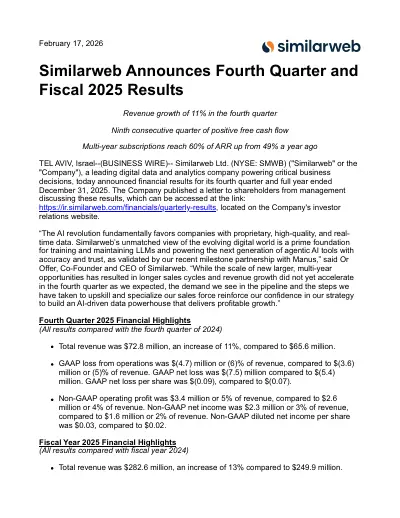
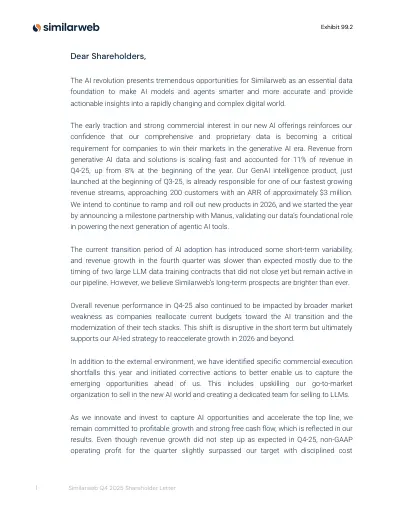
Revenue grew 11% year over year to $72.8 million. This was below our guidance, mostly due to the timing of two large LLM data training contracts that did not close yet, but remain active in our pipeline.
Given the size and complexity of those AI contracts, sales cycles can take longer to complete. That said, once closed, we expect them to represent a very big multiyear revenue opportunities with strong expansion potential.
We are working hard to close those deals. In addition, and despite the delay of those deals, we slightly exceeded the midpoint of our non-GAAP operating profit targets for the quarter through disciplined cost management.
Despite the low top-line performance, we delivered our ninth consecutive quarter of positive free cash flow and achieved our second consecutive year of positive operating profit. We generated approximately $30 million in free cash flow for the year, reinforcing our commitment to profitable and durable growth.
Net revenue retention for all clients was 98% and 103% for clients above $100,000. We are focused on driving improvement in these metrics in 2026 by executing our customer expansion playbook.
Later on, I will expand on the drivers behind that optimism and the action we are taking. Finally, customer demand for our AI offering continued to expand.
AI-related revenue reached 11% of sales in the fourth quarter, up from 8% at the end of the second quarter of 2025, driven by our portfolio of innovative AI solution, which we also will cover later in the presentation. Turning to slide 6 and our key messages.
First, 2025 was a build year. We built the platform to win in the AI era.
While the market was dynamic, we leaned into the opportunity forming around AI. We accelerated product innovation and launched new offering, such as App Intelligence, which was the fastest-growing product we had in 2025.
We introduced an Ad Intelligence, GenAI Intelligence, AI Agent, and MCP integrations, which is a new industry standard for AI systems to access our data. Most recently, we launched the AI Studio, which is an AI-powered chatbot interface that make it easier for more users to access our data and actionable insights and recommendations.
These are commercial products already gaining traction. As said, in Q4, 11% of our revenue came from AI-related use case.
We see AI as magnificent monetization tailwind going forward. Second, we demonstrated the strength and durability of our model.
We grew AI revenue 3x year over year and achieved our second consecutive year of positive operating profit and free cash flow. One important highlights is that 60% of ARR is now multiyear, up from 49% a year ago.
This is an important metric as it reflects deeper customer relationship, stronger alignment with our value proposition, and greater revenue visibility. Most importantly, it shows that our customer are choosing to commit to our data and products for longer period of time, which is a strong vote of confidence in the value we deliver.
In addition, 63% of ARR comes from customers generating over $100,000 annually, reinforcing how embedded we are in mission-critical use cases in the enterprise segment. Third, our data moat matters more than ever.
AI models and systems are only as strong as the data behind them. Our proprietary digital data now powers enterprises, LLM, and AI agents.
The quality of our data has been validated by both third parties and customers. For example, we expanded our integration within the Bloomberg Terminal.
This positions Similarweb as a premium alternative data provider for institutional investors and provide another proof point of the quality of the data we provide. Finally, 2026 is transformation year.
We are moving from building to scaling as AI become embedded into workflow and trusted digital data become a strategic asset. We believe Similarweb is well positioned to power the next generation of digital intelligence.
Let me walk you through how we are executing our strategy to build an AI-driven data powerhouse on slide 7. Our strategy is built on three pillars: strengthening our data moat, deepening enterprise relationship, and third, scaling AI-first integrated solutions.
Let's start with the first one, durable data moat. We are leader in the digital market data.
For more than a decade, we invest hundreds of millions of dollars in developing and deepening our data moat, building deep expertise in collecting and estimating digital behavior at global scale. We continue to invest in R&D to enhance the quality, accuracy, and the breadth of the datasets that power our digital intelligence.
We continue to expand coverage, accuracy, and freshness across web, app, search, ads, and now chat-based channels, staying at the forefront wherever digital traffic is shifting. This is a hard-to-replace asset with compounding advantage and significant long-term commercial potential.
AI depends on it. It does not replacing it.
Second, we are powering leading enterprise with our trusted digital data. Many of the world's largest and most sophisticated companies are already our customer.
We see significant opportunity to scale those relationships by applying our proven expansion playbooks, increasing multi-product adoption over time, and driving higher NRR. We already have two large tech customers generating over $10 million in ARR.
Those are broad, multi-use-case relationships across multiple teams and function. Both have expanded into data agreements that power their LLMs, positioning Similarweb as a critical building block within their AI stack.
Enterprise expansion will be a key focus area for us in 2026 and beyond. Third, we are doubling down on AI-first integrated solutions, and we will continue to expand our AI portfolio to establish ourselves as a winner in the AI transformation.
Our datasets are uniquely positioned to power both enterprise users and AI systems, a dual strategy built for people and for agents. Through ecosystem partnerships like Manus, our data is embedded directly into AI-native workflows, especially for research-driven use case.
Just as financial data become essential for research platforms, chatbots, we believe that digital market data can play a similar role across all platforms. We expect it become a meaningful commercial growth driver.
As we execute on our three pillars, we remain fully committed to operational excellence to drive durable, profitable, and cash-generative growth. As you can see on slide 8, we made significant steps forward on our strategy in 2025 as we build Similarweb for the next stage in our journey.
Starting with the data moat, in 2025, we launched a multiple new datasets to further extend our 360-degree visibility across the digital world and establish our leadership in digital data. We significantly expanded our coverage across app data, ad spend data, chatbot activity data, and GenAI visibility.
These datasets are very unique, and we believe we are uniquely positioned to provide a comprehensive view across web, app, search, e-commerce, advertising, and emerging AI-driven channels, uncovering the full digital journey across touchpoints. Moving to the enterprise pillar, we delivered a solid performance in 2025.
Our $100,000 customers grew 12% year over year and now represent 63% of ARR. Revenue from multiyear contracts increased significantly to 60% of ARR from 49% in 2024.
Lastly, on our AI-first solution, we launched our innovative offering: AI Studio, AI Agent embedded across our business solution to accelerate time to insight, GenAI Intelligence module which help brands measure their visibility and sentiment across generative AI platforms, and a new chatbot MCP integration including partnership like Manus, which open an exciting new distribution and monetization channel. Our partnership with Manus extends our datasets into agent-driven workflow where autonomous AI agents capable of performing complex tasks, activities execute marketing analysis, competitive assessment, and strategic planning.
Manus, which was recently acquired by Meta, is one of the fastest-scaling startup in history, and this collaboration offer us revenue opportunities to scale with it. Furthermore, Manus provide access to a much broader set of potential end users beyond our core subscribers base, expanding our TAM by empowering millions of users with our data.
This milestone partnership reinforce our value proposition as essential data layer for the next generation of agentic tools, and serves as a strategic blueprint for more integration to come. Those are some of the steps we took to strengthen our data moat, deepen enterprise relationship, and position Similarweb to win in the AI era.
Slide 9 capture our AI data and product strategy: how we power the ecosystem, build AI-first solution, and expand distribution at scale. First, we are powering LLM and AI agents.
We are seeing strong traction licensing our data directly to leading LLM companies for both pre- and post-training use case. This is a strategic priority for us, and we expected to become increasingly strong revenue stream for us over time.
At the same time, autonomous agent require trusted, structured digital intelligence to operate efficiently. That exactly what we provide.
Our data is built for both human and agent, and we see accelerating demand from both. Second, we are building our own AI-native solution.
With GenAI Intelligence, we are helping brands to improve their GenAI visibility and sentiment. We are seeing strong market validation on this front, including recognition of our leadership by G2 Crowd, and we have recently launch it in self-serve with adoption from hundreds of customers.
We believe our data provide an important competitive advantage in this new market, and we are on a journey to become a market leader in this category as well. We are also transforming our traditional software into an agent-first model, launching workflow-specific AI agents across marketing and sales use case.
This move customers from insights to action with faster time to value and stronger ROI. This effort is helping us to get to many more users, broad adoption, and TAM.
We are very excited about the potential of our own agentic strategy. Third, we are expanding distribution at scale.
Through partnership with leading LLM and agent platform such as Manus, and through MCP integration, we embedding Similarweb directly into AI ecosystems. Our MCP is already available in Claude and will soon be integrated into ChatGPT, enabling AI systems to seamlessly access our data so user can consume Similarweb insights directly within the workflows.
Those ecosystems partnership unlock new customer, expand our TAM, and position our digital data as a critical ingredient for AI-driven research and decision-making. We believe we are well positioned to be an AI winner with multiple commercial opportunities across data, products, and partnership, and we are excited about the potential.
I would like to spend a moment on the AI Studio on slide 10, because this is more than just a new product launch. AI Studio represent a huge shift in how users interact with Similarweb data.
Historically, our platform delivered a powerful data-driven insight, but often required technical expertise to extract value. AI Studio changed that.
With an AI-powered interface, user can ask business question in a plain language and in all languages, and instantly receive actionable insight. What used to take time and specialized skill can now happen quickly and easily.
This is a major step in democratizing access to our data across teams and workflows. AI Studio expand the number of users who can leverage Similarweb, increases engagement, enable faster and more seamless insight generation, and unlock new monetization opportunities.
The early feedback, both from beta customers and since launch, has been amazing. We see AI Studio as a core part of our product strategy, an important driver of future growth.
I encourage you to watch the demo video after the call via the link on the slide to see it in action. Let me close by reflecting back on 2025 and how it set up for 2026 on slide 11.
2025 was a pivotal year. We made real progress.
As I said, AI revenue grew 3x and now represent 11% of Q4 revenue. That is meaningful traction and clear validation that AI is already contributing to the business.
We also strengthened our durability of the model. $100,000 customers grew 12%, and 60% of ARR is now multiyear, up from 49% a year ago.
They give us better visibility and reinforce the depth of our enterprise relationship. At the same time, we acknowledged that 2025 was not without challenge.
Overall NRR stabilized at 98%, and we are not satisfied with that level. While NRR for our $100,000 customers was at 103%, we know we can execute better across the broader base.
We have taken action by sharpening our go-to-market strategy, upgrading talent, refining processes, and building scalable playbook to drive cross-sell and expansion. We see a clear opportunity to convert one-time AI evaluation deals into recurring revenues and to accelerate the adoption of our newer solution across the installed base.
That's why we have strong conviction in 2026. We are well positioned to capture long-term AI spend.
Our AI-first portfolio is scaling, ecosystem partnership are expanding, and we are targeting high-growth segment like LLM companies, large big tech players, and OEM with our own dedicated go-to-market team and focus. With Ran joining as a CFO, we'll also strength our financial discipline and public market execution.
So 2025 set the stage, 2026 is about disciplined execution and acceleration. With that, I will hand it over to Ran.
Ran Vered
Thanks, Or. It's a pleasure to be here with you.
I'll provide highlights of our financial performance and guidance for the first quarter and the full year of 2026. Before I do, let me first provide a short overview of my background, why I joined Similarweb, and what are my priorities as our CFO.
I'm on slide 13. I'm very excited to join Similarweb at this juncture in our journey.
Or and the team have built a digital data powerhouse, and as we have discussed today, this unique asset is poised to take advantage of emerging opportunities in the AI generative era. Similarweb is my fourth role as a tech company CFO over two decades.
Previously, I was CFO of two US-listed tech companies and most recently joined from Lusha, a B2B sales intelligence unicorn. I look forward to leveraging my experience and financial discipline to help execute our clear strategy to accelerate revenue growth to the next level while doubling down on our commitment to extend profitability and deliver durable free cash flow.
This is what I am committed to doing all while ensuring we remain disciplined capital allocators. I look forward to meeting you over the coming weeks and months.
Turning to slide 14 and our quarterly results. We generated $72.8 million of revenue, an 11% increase relative to the fourth quarter of 2024.
Revenue were lower than expected due to delayed closing of two major LLM-related agreements that were anticipated in the fourth quarter. As Or noted, we remain in active discussions.
Non-GAAP operating profit for the quarter was $3.4 million, reflecting a 5% margin compared to $2.6 million and a 4% margin in 2024. This was within our guidance range, thanks to disciplined cost control.
Turning to the full year financials on slide 15. I will not review each metric, but will highlight that despite lower revenue, operating profit came in ahead of our expectations at the beginning of the year due to our sustained focus on disciplined execution.
2025 was our second consecutive year of positive non-GAAP operating profit and free cash flow. We are committed to generating profitable growth going forward.
Good cash generation and a strong balance sheet are critical for a business in any stage of the cycle and become even more important in periods of volatility. On slide 16, you can see that we ended the year with $72 million of cash and cash equivalents and no debt.
We also have an available line of credit of $75 million. After nine consecutive quarters of positive free cash flow, the business has a solid core and the financial flexibility to weather market headwinds while staying focused on our long-term goals to maximize shareholders value.
Our capital allocation priorities over the coming years will be: first, to continue to invest in R&D at around 20% of revenues to improve our digital data and deepen our competitive moat; second, is to invest in M&A only when it meets our rigorous financial returns criteria and advances our strategic goals to improve our data assets and product portfolio. Over the last two years, we completed several bolt-on acquisitions, including 42matters, which boosted our App Intelligence capabilities, and AdMetrics, which enhanced Ad Intelligence.
The current market volatility is enriching the M&A pipeline. We remain committed to a strong balance sheet that provides us with financial and operational flexibility.
Turning to our outlook for 2026 on slide 17. For the full year 2026, we expect total revenue in the range of $305 million to $315 million, representing 10% year-over-year growth at the midpoint of the range.
In Q1 2026, we expect total revenue in the range of $72 million to $74 million, representing 9% year-over-year growth at the midpoint. For the full year, we expect our non-GAAP operating profits to be between $16 million and $19 million.
Non-GAAP operating profit for the first quarter of 2026 is expected to be in the range of $0.5 million to $2.5 million. As I provide guidance for the first time at Similarweb, we are taking a deliberately prudent approach.
We are assuming pockets of end-market weakness persist, and we are grounding the initial outlook in the high visibility of our core business drivers while we are encouraged by the strong demand in the pipeline for larger AI deals. After delivering the second year of solid revenue growth, non-GAAP operating profit, and positive free cash flow, we remain committed to building a more durable franchise in Similarweb.
With that, Or and I ready to answer your questions. Following Q&A, Or will share some closing remarks.
Operator, please open the line for questions.
Operator
Thank you. If you would like to ask a question, please press *1 on your telephone keypad.
A confirmation tone will indicate your line is in the question queue. You may press *2 if you would like to remove your question from the queue.
For participants using speaker equipment, it may be necessary to pick up your handset before pressing the star keys. Our first question is from Raimo Lenschow with Barclays.
Please proceed. Hey,
Raimo Lenschow
thank you. I had two questions and Ran, welcome to the team and all the best.
One for Or, if you think about the large LLM contracts that you're signing there, but then you also look at the large customer NRR actually just came down a little bit. Do we need to think about that as an addition or somewhat as a replacement that people using more LLMs going forward, that means they need to use less of their own and that kind of impacts the NRR numbers then?
Or, how are they not correlated? Could you speak to that dynamic going on there?
Then I had one follow-up for Ran.
Or Offer
I think that there's no correlation between the core business when we sell our regular software, when brands buying the Web Intelligence, App Intelligence to drive growth traffic online versus our motion of selling data for LLM use case. It's a different use case.
It's basically to train the LLM to be smarter, better about the world. I don't think it's come one on each other.
Raimo Lenschow
Perfect. Makes sense.
Then the one for you, Ran, obviously with these larger contracts coming through, as a CFO and as a new CFO, it's kind of difficult to guide. How do you think about your guidance philosophy, in terms of going forward, kind of if those big deals are in the pipeline, is it worth maybe taking them out and they become upside when they come through?
How do you think about that dynamic? Thank you.
Ran Vered
Hi, thanks for the question. Really happy to be on this call.
When we look on the guidance, we took a reasonable approach, and this is one of the reason we widened the range. In prior years, the range we guide to the streets was around $3 million.
Now because of that LLM deals and the big deals, we widened the range to $10 million, just because we see this deals in the pipeline, but the timing of them to land is not that clear. As we say in the prepared remarks, this is one of the main reasons we lost Q4.
When I look on it, some of it with percentage is baked already into the guidelines, but when we're going to land them, of course, we'll see how we adjust the guidance going forward.
Raimo Lenschow
Perfect. Thank you.
Good luck.
Ran Vered
Thanks.
Operator
Our next question is from Arjun Bhatia with William Blair. Please proceed.
Arjun Bhatia
Yep, perfect. Thank you.
Or, can we maybe just go back to the first question. I understand the two demand kind of drivers between LLMs and the core business are not correlated.
If I exclude your AI revenue, it seems like the core business is falling quite a bit. I'm curious if you can just help us understand what's happening there excluding your AI revenue, the core NRR obviously is down, what are the challenges there going forward and how do you sort of remediate that to get that core business back to a stronger growth?
Or Offer
Thank you, Arun, for the question. I think this quarter numbers, you can see that the core business is not falling.
It's still growing. You can see because you basically saw an example of a quarter when the big data deals didn't came, they slipped for another quarter, and you still see a growth in the revenue.
We do see growth in the core business, even without the data for LLM. The data for LLMs are very big deals and they're significant.
You think that in the regular business, we selling a deal between $20,000, $30,000 at land, and then expansion can be $50,000 to $60,000. Those data for LLMs is significant.
It's seven-figures deal sometimes. Then they behave very, very different and hard to predict and forecast as you can understand.
I hope this gives you some visibility. Maybe Maoz, our Chief Strategy Officer, maybe you have anything on that topic as well on your mind?
Maoz Lakovski
Yes, happy to help, and thanks for the question. We're seeing GR and renewal rates in very good traction.
When we have 60% of the book of business, which the majority of it is still non-AI, under multiyear, we're seeing the good durability of our core book of business. We need to work on the expansion path in order to increase NRR.
We are very optimistic about NRR going forward. We think that some of the LLM one-time deals push have affected the NRR, but going forward, we are working hard to improve it, mostly focusing on the expansion.
We have great product portfolio from App Intelligence, which is a very fast-growing product for us, Ad Intelligence, the GEO GenAI Intelligence that we are launching, and we're seeing good success with our clients. Overall, the core business of us is still growing and the renewal rates are solid.
Multiyear is there, great client feedback, and we are laser-focused on expanding it and increasing the NRR.
Arjun Bhatia
Understood. Then one for Ran.
Going back to the guidance range, I appreciate and I think it's helpful that at least it's a wider range given some of the uncertainty around the LLM customers and how lumpy they can be. Can you just touch on what you're expecting, what would have to materialize to hit the high end of the range versus low end?
What are the different scenarios that are contemplated in that wider guidance range?
Ran Vered
Hi, Arjun. Thanks for the question.
I think we need to land the big LLM deals. Probably this is what can drive the difference between the low end and the high end of the range.
Because those deals are really big, seven figures as Or also mentioned, and we see them in the pipeline and we see also the engagement with the customers. When I joined and I'm here talking with the people, see the pipeline, I really encourage by the pipeline and by the fact that we are delivering this deals to the larger LLM.
Again, I think it's mainly in terms of timing when they will end and what will be eventually the size of them. I think this is why the range is in the $10 million range.
Arjun Bhatia
That's helpful. Thank you.
Operator
Our next question is from Ken Wong with Oppenheimer and Company. Please proceed.
Ken Wong
Hi, thanks for taking my question. I just wanted to check as far as the miss in the quarter, was that $4 million fully from the large AI LLM deals?
Then how much of that is baked into the 1Q guide?
Or Offer
Thank you for the question. The majority of the miss is because of those two deals that were very, very big and been in the pipeline for a long time.
We thought and we hope to get them to the finish line. Looking now in Q1 guidance, we taking more cautious steps.
As we said, it's very hard to forecast them. One deal will probably become later in the year, and the other one was splitted into more small and small amounts, and one of them already came.
We have confidence that some of that will come at Q1, I think, hope this will answer the question.
Ken Wong
Got it. Then when I think about the growth rate, assuming some of it is in Q1, that kind of perhaps puts your core business or organic growth at high single digits.
Is that the right way to think about it until you guys get the go-to-market motions and the product sorted out for '26?
Or Offer
These big deals are taking a lot from our go-to-market as well. Think that even when you have sales force, sales people, and some of them know that there is those opportunity of very big deals, a lot of efforts are going into those directions.
It's part of the organic growth and taking attention from other stuff. They're big opportunity.
What we did this year in order to be more disciplined around it, we build a dedicated team to go and be focused only on those opportunity, to have a better forecast and execution, and also try to leverage even more upside as we have only single-digit customer right now in this LLM motion, but there's probably much more customers we can approach and onboard. Hope this dedicated team will give us better forecast and execution on that.
Ken Wong
Okay. Fantastic.
Thank you, guys.
Operator
Our next question is from Scott Berg with Needham and Company. Please proceed.
Lukas Metcalfe
Morning, Lucas Mckeff on for Scott Berg. Thanks for taking our questions.
First, you guys made some strong sales investments heading into fiscal 2025. We understand some sales cycles have elongated, but in general, I guess, could you guys just talk about the productivity kind of throughout the year of the new investments?
Then what type of additional sales investments does your fiscal 2026 guidance imply?
Or Offer
Thank you for the question, and I think it's a good question. We were not very happy with performance and the investment we did.
We were hoping to get better yields from the investment that we did in beginning of the year to try to accelerate growth. We did see the yield of the sales getting better every quarter.
The good news that we will not need to do any investment going into this year. We took some steps to optimize the go-to-market motion once we saw that we're not getting the outcome we were looking for.
We reduced layers of management and removed some low performance. Starting the year with a fully ramped team and with no more investment needed in order to drive the result we looking into this year.
Lukas Metcalfe
Got it. Thanks.
That's helpful. Then just one other question here kind of surrounding the net revenue retention compression.
Would you say is that primarily driven by lapping the larger AI contracts from late 2024 or just any other kind of underlying changes in gross retention or expansion trends that we should be thinking about?
Or Offer
I think it's an excellent question, and the answer is yes, you're right, because some of those big deals lapped into this year. It's impacting, of course, the NRR.
Also, if you think about last year and all this new data for LLM that is including sometimes one-time deals, they are not being reflected in the NRR, because those are one time. NRR is only recurring revenue, and this is why it's look like the NRR of the big accounts are dropping, but in reality, we had much more revenue because of the one time last year.
We expect the NRR metrics to get better going forward. Also as more those one-time trials of data for LLMs are mature into ARR, it's, of course, contribute and get better result over time.
Lukas Metcalfe
Got it. Thanks.
That's helpful.
Operator
Our next question is from Patrick Walravens with Citizens Bank. Please proceed.
Kincaid LaCorte
Oh, great. This is Kincaid on for Patrick.
Or, I just wanted to know if you could give us a little breakdown of that 11% of revenue coming from AI solutions. What are the components that drive that?
As well as I understand that two of these LLM deals slipped from this quarter. Can you give us any info on how many did close this quarter?
Or Offer
Yeah. The data for LLMs deals, there was I think one, I need to look, or two last quarter that was not as big as the one we expected that did close that's much more smaller with new players.
Overall, the AI revenue is a bucket that include few offerings, not only the data for LLMs. You have the GenAI module that we sell to brands that including there.
We have AI chatbot partnership like the one in Manus that it's the revenue of setting up this partnership, and then there is a usage-based component on top of that. There's few channels inside this 11%.
It's not only the data for LLMs. It's few streams that are kind of new for us that are starting the past 12 years because of the AI revolution, and we see those offering as a tailwind going into this year.
Kincaid LaCorte
Great. Thank you so much.
Operator
Our next question is from Luke Horton with Northland Securities. Please proceed.
Luke Horton
Hey guys, thanks for taking the questions. Just wanted to touch on some of the what you guys called commercial execution shortfalls.
I guess could you be a little bit more specific of this? Was this around the hiring ramp or pricing in the sales cycle, or I guess what kind of changes have you made to the go-to-market organization to improve these win rates and pipeline conversion in 2026?
Or Offer
In 2025, we increased our sellers all across the board trying to accelerate the revenue growth. There was a lot of noise adding a lot of people in a short time.
It took a long time to ramp them up. We didn't see the yield we were hoping, also on the enterprise side and in inside selling and then the expansion.
We had to optimize it and tweak it over the year. I think now, as I said before, we going into this year, we have the right talent in place.
I don't know, maybe Maoz, anything that you have to say around that as well?
Maoz Lakovski
I think the key for us is doubling down on growth opportunities. Or mentioned the team in the go-to-market investments we are making around AI, LLMs, OEM, where we see a lot of growth potential.
We're doubling down there. We are refining our go-to-market strategies.
We are seeing increase in yield overall, but we're also aware of the market dynamics and uncertainty in the markets. We think we're well set for 2026, with confidence in our ability to hit our guidance throughout the year.
We're seeing strong pipeline. We are optimistic about the pipeline, some large, meaningful deals.
We have the one time we need to convert into recurring deals and we are on it. Overall, we think we are in a good position.
Luke Horton
Got it. Then lastly, just want to go back to the AI Studio as this is a pretty significant product for you guys.
I guess could you give some clarity around the monetization of this, if this is sort of seat-based or consumption-based or premium tier pricing? Just any sort of information around that would be great.
Or Offer
Maoz, you're in charge of pricing, you can take it.
Maoz Lakovski
Yes, we are actually super excited about the AI Studio. Reason being is that we see this product as a mean to get to many more users within an organization.
It can help us cross the chasm and make the data and insights much more available. We are super bullish about this and we're seeing great demand and initial traction.
In terms of monetization, at this point, we are baking some of it within the enterprise plans, but the model is twofold. It's data access and then data consumption, which means that essentially you need to have access to the specific data you want to have queries on.
It could be a country, it could be a datasets, but we align it to the customer needs. Second is the consumption.
We give some level of consumption within the package, and then the clients could grow. We see it as a very strategic move for us, again, because we see us getting to many more users.
With that, in terms of our AI strategy, worth mentioning also the Manus partnership, which we are extremely, extremely optimistic about. We see this as a huge opportunity for us to get to non-typical users of Similarweb and monetize it.
We're seeing potential huge distribution and to unlock a lot of TAM for us. Between the AI Studio, which is a mean to grow TAM within our client base, to the Manus example with unlocking distribution for non-core users, we are very happy that we are able to monetize and get to many more users.
I hope it helps you understand.
Or Offer
I would add on top of that that some of our big enterprise customers, they have unlimited users package. We never been about seat-based approach.
We've been about more, as Maoz said, data access and data consumption. We hope that, for example, this AI Studio in those enterprise that really have big amount of users, we can increase adoption, because, as we said, you can talk to the AI Studio in any language, you remove the language barrier.
You don't need to be expert around our platform and where every one of the dataset is find. Everybody can easily go, ask his business pain, business questions, and get immediately the data he need and then be based on consumption.
It's very similar to concept pays for business outcome. You have a question and you get the answer, and you pay for that.
We hope this will drive a good adoption and success into this year.
Luke Horton
All right. Awesome.
That was super helpful. Thanks, guys.
Thanks for taking the questions.
Operator
As a reminder, it is *1 on your telephone keypad if you would like to ask a question. Our next question is from Adam Hotchkiss with Goldman Sachs.
Please proceed.
Adam Hotchkiss
Great. Thanks so much for taking the question.
Ran, nice to meet you in this forum. I wanted to just dig in on the sales cycle comments or what is it specifically about the sales cycles that have maybe been elongated to the extent you can share?
I guess I'm just trying to understand what I think needs to be done from your side to get those over the finish line. Thanks.
Or Offer
I think that the lesson learned that we try to add many sales people in one time, it was taking the distraction of the managers, and then it was increasing the sales cycle. We were trying to build an outbound motion for enterprise.
That was very long sales cycle, much longer that what we used to. We are very inbound-based business.
Every year, we're getting more than 100 million people visiting our website, and hundreds of thousands of people register to try our solution every month. It's a big volume.
This is usually what feeding the sales people. They used to a specific sales cycle.
Once we try to do more outbound on enterprise, it was tougher and was not fit with what the model that we used to. During the year, we shift everything more to land and expand, and decided to back off of this outbound enterprise approach because most of the enterprise already been familiar or using us or used in the past.
This is much more efficient and much more profitable for us to land through the inbound and then do the expansion, enterprise expansion play on the current book of business. All of those together, it's kind of a little bit changed the sales cycle during last year, all those testing that we were trying to do acceleration.
It did hurt the sales cycle and hurting the sales yields in few quarters, but as we change and adapted, it's got better and better by the end of the year.
Adam Hotchkiss
Great. Thanks for that, Or.
Then I just want to touch on I guess the broader competitive landscape and customer budget landscape. I think there's a lot been made of the GEO/AIO market, and it feels like there's a lot of funding going into that space.
It feels like incumbents are spending there. Is that where you're seeing most of customer attention and budgets go given what's happening on the LLM side?
I guess number one, is that true? Number two, how do you feel you're positioned in that space?
Thanks.
Or Offer
I think it's a great question, and let me help and maybe also Maoz have some thoughts as driving strategy. The GEO, AI, AEO, there's no straight name for this market, is a new market.
Of course it's a red ocean. There's a lot of small players there.
Happy to say that we launch a really amazing offering at that space that is doing well. We've already been recognized by G2.
It's one of the companies like Forrester for software that mapped the market as a leader, especially for the enterprise. It's a new motion.
A lot of attention go there, for sure. I don't know if this market is big.
I think it's still small and developing. I think what more interesting is that basically a lot of attention go there because a lot of brands are losing traffic now because search is declining.
Everybody is trying to understand what's going on, if it's going all to ChatGPT, if I need to invest there. In reality, there's much bigger movement happening.
Search is declining, brands trying to close this gap by investing more on paid channels, then paid goes up, and then they need to bring some of the traffic that went to the ChatGPTs. I think that in this environment, you need a much more holistic solution to help you manage all channels.
Okay? Because one channel is going down, the AI chatbot that is a new channel going up, and then you have the ad spend that is going out of control.
You need to control all of them as a CMO or the head of digital running businesses trying to win back your traffic. I think Similarweb is the only solution right now that can give you full visibility and optimization and insights across all channels.
I think with that, our GenAI offering is great. It's really good.
I would say that you need more than only GenAI solution. You need the Ad Intelligence solution, you need the SEO solution, and you need the benchmarking and competitive research solution.
Seeing all of them together, this is what Similarweb is offering. I don't know, Maoz, maybe you have any interesting stuff to say here?
Maoz Lakovski
I'm fully aligned, and that's what we're hearing from the market. I think the critical part here is we have the right to win.
We are helping leaders to navigate between web and GenAI. Every CMO, it's even a CEO discussion, publishers, e-commerce, whatever business model, everyone has these questions.
What should they be doing? How should they be balancing between the traditional kind of web and the new GenAI?
This is where we come in. This is one thing that we are unique from any other player in this market and we think we're going to win.
Second, we are a data company. We have a meaningful data moat also when it comes to GenAI visibility, and we are monetizing this.
We are selling it directly through our dedicated product, and it's picking up super nicely. Second, we are also feeding the ecosystem.
We also have an OEM play here, and we are bullish about this as well, and it's working very nicely for us. Last, we have the clients.
We have the CMOs, we have the head of digital marketing. They speak with us.
It seems like GEO, AIO is more than the traditional SEO, it gets more interest, because users are spending much more of their time within these engines, and they are coming to us. Honestly, there's a lot of market education and thought leadership.
We are playing in this game and we are very optimistic our ability to become a very meaningful player. The G2 recent recognition is just a kind of another one to show us that we are in the right direction.
Adam Hotchkiss
Great. Thank you both.
Operator
This does conclude our question-and-answer session. I would like to turn the conference back over to Or for closing remarks.
Or Offer
Before we conclude, I would like to highlight four key takeaways on slide 19. First, 2025 was a build year.
We deepened our data moat and positioned the company for the AI area. Second, we delivered solid growth.
AI revenue grew 3x year over year, multiyear ARR increased, and we extend our track record of profitability and free cash flow. Third, our leadership in digital data become even more valuable as AI adoption accelerates.
Fourth, 2026 is about disciplined execution and scaling what we build, and we have strong belief in the opportunity ahead. AI is a meaningful tailwind for data companies like us, and as I like to say, we are just getting started.
Thank you, everyone on the call, for your continued support. We look forward to speaking to you again over the coming weeks.
Operator
Thank you. This does conclude our conference.
You may disconnect at this time, and thank you for your participation.