Coherus Oncology, Inc.
Q2 FY2026 · Earnings Call TranscriptAugust 5, 2026
Operator
Good day, and thank you for standing by. Welcome to the Q2 2026 Coherus Oncology, Inc.
Earnings Conference Call. At this time, all participants are in a listen-only mode.
After the speakers' presentation, there will be a question-and-answer session. To ask a question during the session, you will need to press *1 1 on your telephone.
You will then hear an automated message advising your hand is raised. To withdraw your question, please press *1 1 again.
Please be advised that today's conference is being recorded. I would now like to hand the conference over to your speaker today, Carrie Graham.
Please go ahead.
Carrie Graham
Thank you, Heidi. Good afternoon, and welcome to Coherus Oncology's second quarter 2026 earnings conference call.
Joining me today to discuss our results are Denny Lanfear, Chief Executive Officer of Coherus; Dr. Rosh Dias, Chief Medical Officer; Dr.
Theresa LaVallee, Chief Scientific and Development Officer; Sameer Goregaoker, Chief Commercial Officer; and Bryan McMichael, Chief Financial Officer. Before we get started, I would like to remind you that today's call includes forward-looking statements regarding Coherus' current expectations about future events.
Actual results may vary significantly, and we undertake no duty to update or revise any forward-looking statements. Please see the press release that we issued today and our quarterly report on Form 10-Q for more information on risks and uncertainties.
Now I'll turn the call over to Denny.
Denny Lanfear
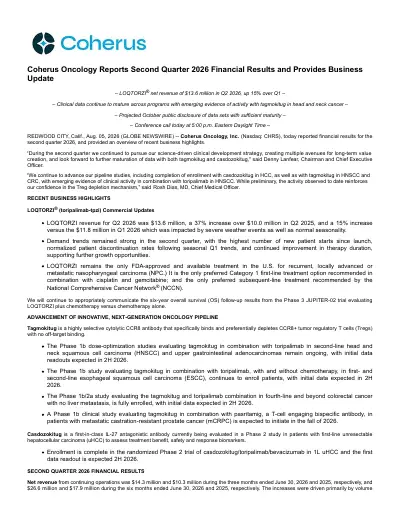
Thank you, Carrie, and thank you all for joining us this afternoon on our Q2 2026 quarterly call. As we are now in an exciting period of initial clinical data generation and readouts, not definitive data reporting, and we'd like to provide you with the available insights on how things look so far.
First, let me make a few remarks about the scientific focus on overcoming immune resistance in cancer to provide you with a lens through which to view our pipeline and our development strategy. A review of the data on immuno-oncology drugs and cancer reminds us that immunotherapy's benefit is primarily seen at the far end of the survival curve, where it matters most to both patients and regulators.
Additionally, the combination agents can make a substantial difference. A good example is the combination of chemotherapy and PD-1s, where PD-1s revolutionized cancer care by addressing immune evasion and showed some of the most pronounced survival benefits when used in combination with drugs that lead to tumor cell death.
It's essential to keep in mind that tagmokitug, as a Treg-depleting agent, is mechanistically positioned not as another response rate agent like chemo or ADCs, but as a horizontally enabling durability layer that removes the brake, Tregs, which potentially limit both depth and the durability of response with various active agents. This translates directly to our tagmokitug development program, which, first, represents a rational, scientific framework to evaluate Treg depletion across a number of cancers and various lines of therapy for response and duration.
Secondly, it is deliberately constructed to provide insights as to where Treg depletion is best positioned, with what combinations, and in what lines of therapy, and to identify the best patients for long-term survival benefit, the key approval criteria. Importantly, to elucidate the relationship of Treg depletion with immune context, T cells, and other factors necessary for efficacy.
Understanding the relationship between biomarkers and immune context factors and response duration requires a robust biomarker program for context and to provide the direction for future development. We have this in place and are in the process of analyzing this data.
Our immune resistance focus on survival and duration clinical benefit also translates to the casdozokitug program and the ongoing first-line HCC study in combination with toripalimab and bevacizumab, which follows the previous casdozokitug study and demonstrated improved survival and strong complete response data. Knowing both the duration and the depth of response took several months.
Again, we have the appropriate biomarker program in place and are in the process of analyzing this data now that CasLAIS study is fully enrolled. We previewed this for you on our last call.
Today, on this call, Dr. LaVallee, our Chief Scientific and Development Officer, will go further and discuss with you TIRI, our Tumor Immune Regulatory Index, in the context of our tagmokitug studies.
Theresa will be followed by our Chief Commercial Officer, Sameer Goregaoker, who will review the LOQTORZI business, and Bryan McMichael, our Chief Financial Officer, who will give you some color on our quarterly operational results and cash and balance sheet. First, let me hand things over to Dr.
Dias, our Chief Medical Officer, to provide you an update on the emerging data from the clinical studies. Rosh.
Rosh Dias
Thank you, Denny. I'm pleased to report that three of our studies have completed full enrollment, and I'm able to provide some initial color on emerging data sets.
In addition to our casdozo study in first-line HCC already being fully enrolled, our tagmo cohorts in both head and neck squamous cell and colorectal cancer are also now fully enrolled. However, other cohorts have yet to complete patient accrual.
This is important to keep in mind since, as we approach initial data readouts for our clinical program, the two key determinants of data timing will be the numbers of patients in study and also the numbers of scans that may be required to provide a meaningful indication of activity. In addition to providing information of response, having a sufficient number of scans provides valuable information on durability of activity for both response and stable disease.
This is particularly important as much of the benefit with IO has been seen in extending the tail of the curve, i.e., the durability of activity. We have two active protocols and one to initiate in the coming few months.
Let me take each pipeline program in turn, starting first with the Treg-Check program for tagmokitug, our highly selective CCR8 cytolytic antibody. Our first protocol is looking at tagmo in head and neck squamous cell carcinoma.
This is a 40-patient study investigating two doses of tagmo in combination with tori in a second-line head and neck squamous cell population, asking the very specific question of whether we're able to reverse PD-1 resistance in a second-line population. As mentioned, I'm pleased to report that this is now fully enrolled.
This study builds upon the prior data we've previously communicated at AACR last year, where in earlier stages of this same study, we demonstrated clear tumor remodeling with tagmo monotherapy and a partial response in a fourth-line patient with HPV-positive head and neck squamous cell out of seven patients who received the combination of tagmo and tori. The ongoing study is yet to have a sufficient number of patients reaching maturity of data that would trigger formal data cleaning.
I can make the following high-level comments based on emerging data from a subset of patients. Firstly, the combination of tagmo and tori has thus far shown an acceptable and manageable safety profile.
Secondly, we've seen evidence that the addition of tagmo to tori for the treatment of PD-1 resistance in this second-line head and neck population has shown activity with respect to response rates and treatment duration. In particular, in our analyses of baseline tumor samples, preliminary data from the early batches of samples indicates there may be an immune context that enriches for patient benefit.
Based on the small sample size of the data we have in the subset of patients with matched biomarker data, we're seeing greater activity in patients who are HPV-positive, an area where there remains a significant unmet medical need, and in patients who have a higher Tumor Immune Regulatory Index or TIRI score, a point on which Theresa will elaborate on momentarily. With the important caveat that these initial observations are based on data that is not yet fully mature, and importantly, the data that has not yet been formally cleaned and may therefore be subject to change, if these trends persist with further maturation of data, this may support an enriched strategy in head and neck squamous cell carcinoma.
I anticipate further maturation of the data over the coming months, including analysis of the remaining biomarker samples, and current projections indicate we're likely to have all patients having had sufficient follow-up and biomarker analyses to enable a formal disclosure in October. Moving on to our second protocol, which investigates tagmo in a selection of GI cancers.
Cohort A is a second-line upper GI adeno population, including gastric adenocarcinoma, esophageal adenocarcinoma, and GEJ cancers, with 40 patients, again, with two doses of tagmo in combination with tori. Whilst we are nearing completion of accrual, we have not yet done so, and therefore, it's too early to make any more detailed comments on this cohort.
In terms of our projections, we anticipate that the full complement of patients will have had a sufficient number of scans in the coming months, and therefore, we currently anticipate the ability to report data late this year. Cohorts B and C are investigating the tagmo-tori combination in second-line and first-line esophageal squamous cell carcinoma, respectively.
Enrollment continues in both cohorts. The second-line cohort is looking at 20 patients with the doublet combination, and the first-line cohort adds in chemo as well to the doublet as a safety cohort of 12 patients.
Thus far, we've seen an acceptable and manageable safety profile. Cohort D evaluates tagmo in combination with tori in colorectal carcinoma with 20 patients in a fourth-line plus MSS population, with initial focus on non-liver mets, and with an intention to expand to a potential additional 21 patients and also a liver mets population.
I'm very pleased to say that despite being the last cohort start, we've completed accrual of the initial 20 patients, which really is a clear recognition of the unmet medical need in colorectal carcinoma. Current projections indicate that all 20 patients should have had a sufficient number of scans in the next couple of months, and so we continue to anticipate initial data to be available later this year.
Finally, the third protocol, which is designed to accommodate tagmo combinations with novel agents, remains on track to initiate in the fall time frame with its first cohort of tagmo in combination with pasritamig, J&J's T-cell engager in metastatic castration-resistant prostate cancer. Let me end with casdozo in hepatocellular carcinoma.
This is a 72-patient study investigating the casdozo, tori, bev combination in the first-line HCC population and is designed to achieve three things: data to support both contribution of components and Project Optimus, and, of course, to further characterize efficacy and safety. As a reminder, this builds upon the encouraging data from the prior study where casdozo was added to the current standard of care, atezo and bev.
Despite completion of accrual in March, currently only around 50% of patients have had three scans. Thus, we have not, as yet, reached a sufficient level of data maturation to trigger a formal analysis.
Additionally, the ctDNA and baseline IL-27 level collection and analysis is still ongoing. With this in mind, we anticipate initial data availability in Q4 this year.
With that, I'll turn it over to Theresa. Theresa.
Theresa LaVallee
Thank you, Rosh. Good afternoon.
To further expand on what Rosh has mentioned on the Treg-Check study, early available data from a subset of patients with head and neck squamous cell carcinoma who were resistant to a PD-1 inhibitor therapy showed that tagmo can rescue PD-1 inhibitor anticancer activity. This signal may be enriched if the Tumor Immune Regulatory Index, or TIRI score, was detected.
We have described our Treg-Check clinical development program as one that is intentional and designed to determine the best immune context where patients will benefit from tagmokitug treatment. Why do we think this is important?
Because it has proven to contribute to the success of the PD-1 drugs. It is well understood that tumor PD-L1 expression can be required to enrich for patients who will benefit from PD-1 and PD-L1 targeted antibodies.
This is because it defines the immune context for when the treatment can reinvigorate the immune response in the tumor. The level of PD-L1 expression required for treatment varies across tumors types from a score of greater than 1, 10, 20, 50, and also varies whether the treatment is monotherapy or combination treatment.
Identifying a TIRI score as a Tumor Immune Regulatory Index that enriches for patients in the PD-1 resistant space to treat with tagmokitug and toripalimab has the potential to be informative. It's satisfying to see that we are observing a higher TIRI score in the HPV-positive tumors.
In an interim analysis in a subset of patients, we are seeing improved clinical benefit rate in head and neck cancer patients whose tumors are HPV-positive. We need to stress that this is early data.
Not only are the numbers small today, but this analysis is also retrospective. However, given that it is related to the target, CCR8-positive Tregs, we are encouraged and focused on building on these data as we consider development strategies.
In particular, HPV-positive head and neck cancer is a high unmet medical need, has a growing incidence, and limited treatment options. Now, the question that we will explore is whether the same TIRI score will enrich for clinical benefit in other tumor types or, in the first-line setting, with and without chemotherapies.
As I have just walked through, a focus of our clinical development program is to evaluate immune context and biomarker enrichment opportunities. A second aim is to explore which combinations are tolerated and significantly improve activity in combination with tagmokitug.
We continue to show tagmokitug and toripalimab are tolerated. We will report in the coming months on the full chemotherapy cohort and, additionally, expand to a new combination when we initiate the study with pasritamig, a T-cell engager.
Now to go back to head and neck cancer. We are aware of the rapidly emerging treatment landscape and the anticipated shifting standard of care.
The EGFR bispecifics and ADC have shown impressive overall response rate, but come with an appreciable level of toxicity and somewhat more frequent dosing schedules than IgG-based monoclonal antibodies. Some of these therapies may result in short-term responders that may not drive meaningful overall survival.
It is important to point out that there are distinct differences between immunotherapy and targeted therapy responses. Immunotherapy often has a lower overall response, as was seen in the KEYNOTE-048 Phase 3 study for pembrolizumab in head and neck cancer, but delivers durable clinical benefit and raises that tail on the survival curve.
The pembrolizumab monotherapy arm in KEYNOTE-048 had the lowest overall response rate among the three arms, but had a strong tail leading to an OS benefit that supported approval. For tagmokitug, we are focused on the tolerability profile, dosing schedule, and ability to deliver durable benefits.
Now, let me turn it over to Sameer, our Chief Commercial Officer.
Sameer Goregaoker
Thank you, Theresa. We're pleased with our commercial execution in Q2 as we continue to capitalize on the opportunity to establish LOQTORZI as the leader in NPC.
The brand has two powerful engines: compelling six-year data that demonstrates superior efficacy, and preferred NCCN guidelines that reinforce LOQTORZI as a clear treatment choice for NPC patients. Q2 net sales reached $13.6 million, representing a 15% quarter-over-quarter growth.
Importantly, demand rebounded to the 10% to 15% quarterly range following the seasonal slowdown earlier in the year. During the quarter, we also delivered our highest number of new patient starts since launch.
At the same time, patient discontinuations returned to the longer-term historical levels following the temporary increase we observed in Q1. We also continue to see gradual improvements in duration of therapy.
Taken together, these trends point to a healthy, durable revenue base, giving us giving us confidence that we will meet our long-term projections. As we look to the future, we see significant runway ahead of us.
Our expanded claims analysis shows meaningful opportunity to further reduce inferior chemotherapy alone, particularly in the community setting. In addition, we remain focused on displacing off-label IO use and supporting appropriate treatment duration for current patients.
To capture these opportunities, we have continued to invest in capabilities that enable us to identify, educate, and engage the right physician at the right time using physician-level claims data. We continue to make education on the six-year long-term survival data central to every customer interaction.
Recent advisory boards confirm that this data is very motivating and can drive meaningful physician behavior change. Additionally, an innovative pilot program with leading HCP AI platform is now live, further enabling timely physician education.
Looking ahead, we expect average quarterly growth in the 10% to 15% range, supported by broader adoption across segments. Importantly, our experience shows that once a physician gains experience with LOQTORZI, utilization deepens over time, thus reinforcing the durability of our growth opportunity.
In summary, we exited the quarter with renewed momentum and strong execution. We remain confident that LOQTORZI is well positioned to achieve a $15 million quarter in 2026, a $30 million quarter in 2027, and a peak market and a peak market share quarter by 2028, consistent with our prior projections.
With that, I'll now turn the call to Bryan McMichael, our Chief Financial Officer.
Bryan McMichael
Thanks, Sameer. Q2 2026 marked the one-year anniversary of the divestiture of the UDENYCA franchise, which allowed us to decrease our secured and convertible debt by over 90%, as well as reduce our overarching cost structure and core cash burn rate as we refocused the business.
The benefits have been positive and significant. R&D from continuing operations for Q2 '26 was $21.4 million, down from $26.3 million in the second quarter of the prior year.
The decrease was primarily due to savings from reduced headcount and lower clinical trial and R&D manufacturing costs. SG&A expense from continuing operations was $21.0 million in the second quarter, down from $26.0 million in Q2 2025.
The decrease was primarily due to savings from lower headcount and reduced operating costs following the exit from the biosimilar business. Q2 extends our streak to six quarters in a row with decreasing SG&A expense from continuing operations going back to Q4 2024.
For the full year 2026, we expect combined opex to be between $170 and $175 million. Furthermore, during Q2, we significantly reduced our liabilities from legacy biosimilar business.
We expect the remaining obligations to be substantially settled by the end of the year and thus cease to burn cash. Specifically, accrued rebates and reserves, which primarily comprise balances related to divested products, decreased from $28.8 million at the end of Q1 to $14.9 million at the end of Q2.
Importantly, this reduction came mostly from changes in estimates due to uncertainties being resolved favorably and not from the use of cash. Additionally, TSA payables and accrued liabilities decreased from $61.6 million at the end of the prior quarter to $22.7 million at the end of Q2.
As covered by Sameer, LOQTORZI net revenues continue to increase in line with expectations. For the full year 2026, we expect LOQTORZI revenue to be between $57 and $62 million.
Turning to the balance sheet. The total of cash, cash equivalents, and investments at the end of the second quarter was $105.3 million, down from $167 million at Q1.
As I mentioned earlier, about $39 million of this decrease was due to TSA obligations, and we expect that this use of cash will be substantially diminished as we head into 2027. We reiterate that we believe we are sufficiently funded through key data readouts in 2026 and 2027.
Q2 was the first in a series of four consecutive quarter milestone earnout periods from the UDENYCA divestiture. Based on buyer-reported results, the $37.5 million milestones were not achieved in Q2, but they remain eligible for achievement heading into Q3.
Achievement remains subject to finalization of the buyer's results, including any permitted adjustments under the asset purchase agreement. With that, I will hand it back over to Denny.
Denny Lanfear
Thank you, Bryan, and thank you all for joining us on our Q2 2026 call. As you have heard, we're in an exciting time of maturing data across the pipeline programs, with good financial results across sales, costs, and cash.
At the one-year mark post divestitures, we are building clear organizational momentum. I am particularly looking forward to the second half of this year and the projected public disclosure of sufficiently mature data sets in October.
We remain encouraged about the pipeline and the potential to advance tagmokitug and casdozokitug to overcome immune resistance for cancer patients. Heidi, we are now ready for the questions.
Operator
Thank you. We will now begin the question-and-answer session.
If you wish to ask a question, please press *1 1 on your telephone and wait for your name to be announced. We politely ask you to limit yourself to one question and one follow-up.
To withdraw your question, please press *1 1 again. We will take our first question.
The question comes from the line of Paul Jeng from Guggenheim. Please go ahead.
Your line is open. Oh,
Paul Jeng
great. Thanks for taking the question.
For tagmo, I thought your comments on the early data from the head and neck cohort and TIRI score were really interesting. Do you see any potential to prospectively enroll patients based on HPV status as the study progresses?
Have you also looked into oropharyngeal versus non-oropharyngeal as a possible stratification factor? I have a follow-up.
Denny Lanfear
Great. Paul, thanks for the question.
I'll let Dr. Dias answer that.
Rosh Dias
Thanks, Paul, for the question. I think the plan right now, Paul, is to continue accrual and to continue follow-up, most importantly, obviously, to the head and neck cohort.
We are still waiting for biomarker data samples to come in. I think that will really inform how we proceed.
I think we'll be ready in October, as I mentioned, to really communicate that data more formally. Your point about oropharyngeal carcinoma is well taken.
Obviously, that's where a lot of the HPV-positive disease is, so that'll be part of how we look at the data and we communicate it in the October time frame.
Denny Lanfear
What's your follow-up, Paul?
Paul Jeng
Yeah. Second question is on casdozo just for the Phase 2 study.
You mentioned the data might evolve with subsequent updates after the one coming up in the second half. Do you have any visibility into when you might be able to pull the trigger on a Phase 3?
Is it enough to see some mature response rates, or are you going to wait for overall survival on that study down the line? Thank you.
Rosh Dias
Thanks again, Paul. I think overall survival certainly will take some time to develop.
I don't envisage having to necessarily wait for an overall survival endpoint in order to proceed. I think again, we'll do some updates later this year.
We do anticipate with the data maturing as it is, we'll have something to say towards the end of this year. Then it's going to be subsequent follow-up in terms of the numbers of scans dependent and again, the durability question.
No, I don't envisage that we'll need to wait for formal overall survival analysis.
Paul Jeng
Got it. Very helpful.
Thank you very much.
Denny Lanfear
Thanks, Paul.
Operator
Thank you. We will take our next question.
The question comes from Brian Cheng from JPMorgan. Please go ahead.
Your line is open.
Brian Cheng
Hey guys, good afternoon. Thanks for taking our questions this afternoon.
Maybe just to start off on LOQTORZI, you guys have guided 10% to 15% quarterly growth here. I'm curious if you can give us a better sense of what is driving the improvement in duration of therapy here.
Are you seeing a greater shift from patients that are coming from first-line usage, particularly after your six-year JUPITER-02 data read? Then I have a quick follow-up.
Thank you.
Denny Lanfear
Okay. Sameer, you want to answer that for Brian?
Sameer Goregaoker
Sure. Yeah.
Thank you, Brian. Brian, I think what's driving our growth in this quarter is the same thing that's been driving it in previous quarters.
There's way too many patients who are receiving chemotherapy alone and off-label IOs. We're in the process of converting those physicians to start using the proven alternative, the proven preferred treatment of LOQTORZI.
As we did in previous quarters, we got more physicians using LOQTORZI for the first time, and we had more physicians using LOQTORZI for subsequent time. Secondly, regarding duration of treatment, we're seeing a gradual increase in duration of treatment, and that will continue, I believe, to be gradual because of our dual indication, where we also have the second- and third-line indication, which has pretty low duration of treatment.
We have headroom both on new patient starts as well as duration, which we'll continue to accomplish in the coming quarters.
Denny Lanfear
Brian, did you have a follow-up?
Brian Cheng
Maybe just one quick one to touch on tagmo heading into the head and neck data read later this year. I'm curious if you can talk through as we think about the data read, how do we get a better understanding of tagmo contribution on top of tori, right?
Are there any specific metrics or any biomarkers that you think investors really need to lean on? Whether, at the data read, you'll be able to establish that association of these changes you see in those biomarkers to the durability response clearly?
Thank you.
Denny Lanfear
Great question. Dr.
LaVallee.
Theresa LaVallee
Obviously incredibly topical given the recent discussion at the advisory committee. This is a PD-1 refractory population, these patients are progressing.
The patients enrolled have progressed on prior PD-1 therapy. We're looking closely at the time between progression and enrolling on our study.
Immediate progression and then enrolling would be they're not responding, the addition of tori plus tagmo has rescued that resistance. Having it associated with a metric that has within it the target, CCR8-positive Tregs, is also reassuring.
Of course, we have different biomarkers that we're looking at, as we always do in terms of showing the immune activation specifically of tagmo versus tori alone. That will be a robust conversation with the FDA, but we have a lot of plans to look at the contribution of effect robustly and early to save on patient numbers having to contribute to that.
Denny Lanfear
Thank you. Thank you, Brian.
Operator
Thank you. We will take our next question.
The question comes from Jay Olson from Oppenheimer. Please go ahead.
Your line is open.
Jay Olson
Oh, hey guys. Congrats on all the progress, and thanks for taking the question.
Since LOQTORZI continues to deliver strong growth, you had the highest number of new patient starts since launch and improving treatment duration, can you just comment on how you expect various LOQTORZI growth drivers to evolve over the long term, including continued penetration within NPC, longer duration of therapy, or combination opportunities for LOQTORZI across other tumor types? Then I had a follow-on, if I could, please.
Denny Lanfear
Please.
Sameer Goregaoker
Thank you, Jay, for the question. I think I'll start with long-range.
In the foreseeable future, we're not pursuing a combination in NPC at this point, but we have plenty of opportunities within the NPC current indication that we have. As I mentioned earlier, we're still seeing a pretty high level of chemotherapy use in the community setting, and we're just going practice by practice, physician by physician, talking about our six-year data, and that is having a significant impact.
As I mentioned in my prepared remarks, we did multiple ad boards, and we talked to physicians who had never seen this data. Upon seeing this data, they were completely overwhelmed by the strength of this data.
Really educating on this data and getting the non-users on board is our critical priority right now. The second priority, as I mentioned earlier, was duration of therapy is also important because there's two drivers in duration of therapy: one is getting more early-line patients on therapy, and we also see for first-time users some inappropriate dosing and discontinuations, focus on educating those physicians to kind of put a stop on that.
Those would be my priority drivers for LOQTORZI.
Denny Lanfear
Sameer, can you comment a little further on what we're seeing with respect to the breadth and the depth of adoption? Yeah.
Sameer Goregaoker
Breadth of adoption is really important because we're seeing our market share is growing, and we're seeing more than half of our breadth-level physicians have not used LOQTORZI, and it's purely because of an awareness issue. They don't see that many NPC patients, and when they do see an NPC patient, LOQTORZI is not top of mind.
We're growing our breadth every quarter. We're getting pretty high number of new accounts and new physicians using LOQTORZI.
That breadth is really important component. The second one is depth, right?
Because every time we get a physician converted to LOQTORZI, we want to make sure that they continue to use LOQTORZI for every single subsequent patient. We're making good progress there.
We're seeing a pretty good depth and repeat use of LOQTORZI in the current new physicians who are using LOQTORZI.
Jay Olson
Great. Thank you.
If I could sneak in a follow-up question on tagmo, based on the data you've seen so far, as we look ahead to your October data disclosure, what would you like investors to focus on, especially any metrics besides ORR that you think should be important to watch out for? Go ahead,
Denny Lanfear
Rosh.
Rosh Dias
Thanks, Jay. Great question.
I think we've always talked about the need to look at the totality of evidence, and that's what we will be focusing in on. As we approach the October disclosure, what we'll be looking at, obviously, as you mentioned, in addition to the overall response rate is also, very importantly, the clinical benefit rate.
That is the response rate, the stable disease, the durability of that stable disease and response as well. I think those will be very important measures in addition to, of course, the safety and tolerability.
We already spoke about the EGFRs and some of the toxicities there, I think this will be another important factor. Then we'll be looking at those same metrics within the different biomarker analyses as well.
Jay Olson
Super helpful. Thank you very much.
Denny Lanfear
Thank you.
Operator
Thank you. We will take our next question.
Your next question comes from the line of Colleen Kusy from Baird. Please go ahead.
Your line is open.
Hey guys, it's Nick on for Colleen. Thanks for taking the question.
Just had one on the casdozo program. Just with upcoming triple data in HCC, just wanted you to talk about the metrics you expect to show there.
Then just specifically, what results do you think you would need to show to come away with more confidence on the triplet in this indication? Particularly, is there anything else we should be paying attention to as OR was likely not be as high as it will be with more mature data?
Thanks.
Rosh Dias
Thanks for the question. Again, as I mentioned earlier, we'll be looking at the totality of data, right?
Yes, response rate. We'll be looking at the durability, the CBR, etc., etc., everything that I mentioned previously.
In addition, we're also looking at the ctDNA to guide how we think about the potential for response, durability, and survival. Then we'll also look at baseline IL-27 levels as well to see how those may correlate with what we are seeing.
We pointed this out previously, and one thing to bear in mind is that this data in HCC, in particular, does take some time to mature. If we look at the previous study, there was some time to get a baseline and then increase in response rate of baseline and then a deepening of the response.
That's kind of our expectation here as well. We'll be looking at all of those different metrics that I initially alluded to.
Great. Thank you.
Denny Lanfear
Thank you.
Operator
Thank you. Once again, if you wish to ask a question, please press *1 1 on your telephone.
We will take our next question. The question comes from Douglas Tsao from H.C.
Wainwright. Please go ahead.
Your line is open.
Douglas Tsao
Hi, good afternoon. Thanks for taking the questions.
Just, Sameer, you made a comment about needing to correct dosing with some clinicians. I was just curious if you could provide more detail in terms of what you're seeing or what is happening there.
Sameer Goregaoker
Yeah. I'll just touch upon it.
This is some early analysis that we've done this quarter where we found some opportunities. We have two indications.
Our frontline indication is a Q3 weekly dosing, and our late-line indication is Q2 weekly dosing. We have a suspicion that some physicians might not be dosing per the indication and doing a Q3-week dosing where it deserves to be Q2-week dosing.
That's an opportunity for us to address. Additionally, also our indication is to treat to progression and not for six cycles.
That's another area that we might have an opportunity to correct and drive appropriate dosing of the drug. Again, I would stress that that's a secondary opportunity.
Our biggest opportunity is to get the people who are not using LOQTORZI to get using LOQTORZI. We will also be driving appropriate dosing with our existing physicians.
Douglas Tsao
Sameer, understood that it's not the sort of primary initiative. I am curious, though, how material or if you can give us some sense of the scale of the problem, how much sort of revenues being left on the table because of some of these dynamics?
Sameer Goregaoker
I think I'll just say that we have significant opportunity on the duration upside. I can't put a number right now because this is all based on claims data, and we're just really digging a little deeper into it.
Give us a little bit of time to dig a little further. What I will say is we did see some signals of opportunity there.
Douglas Tsao
Sameer, if I can, just one follow-up on that. Have you engaged with clinicians and had the opportunity to sort of just interrogate then in terms of what might be happening?
Is it purely just a misunderstanding of the dosing, or do they have sort of some different perspective in how they want to use the drug?
Sameer Goregaoker
I think it's purely a misunderstanding of the dosing. Because remember, as I mentioned earlier, right, they're not treating NPC more than maybe once a year.
When they see it, unless we are in the office before they initiate the therapy and educate them exactly how to do it, there's an opportunity for misdosing, right? It's primarily an educational issue that we are trying to address.
Douglas Tsao
Great. Thank you so much.
Operator
Thank you. There seems to be no further questions.
I would like to hand back for closing remarks.
Denny Lanfear
Thank you, Heidi. Thank you all for joining us on our Q2 2026 call.
We're happy to give you our current updates on our clinical development program and our good progress with respect to the sales. Want to thank Sameer for the 15% increase.
Just want to remind you there'll be a number of investment conferences that we will attend in New York and environs in September, and we look forward to updating you on our clinical progress, very excitingly, in October. Thank you.
Operator
Goodbye. This concludes today's conference call.
Thank you for participating. You may now disconnect.