Facephi Biometria SA
Q2 FY2026 · Earnings Call TranscriptNovember 4, 2026
Hello, good morning everyone, and thank you for joining Facephi first-half 2026 earnings webcast. Let me start by saying that on this occasion, we are providing simultaneous translation.
If you want to hear this presentation in your own language, please go to the right vertical bar on the three dots, open it, and open interpretación. Sorry.
Having said that, once again, thank you for joining us. With me today is Aitor Doncel Tabarés, the company's CFO.
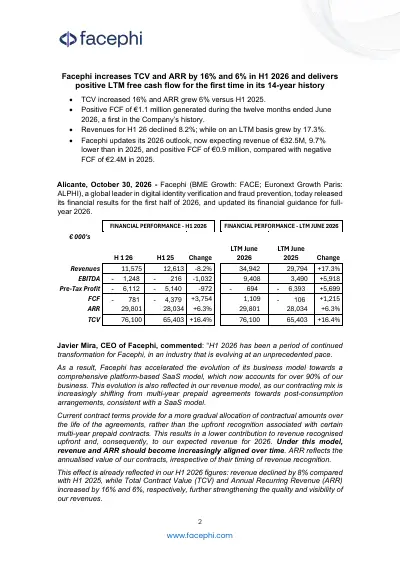
Let me start by saying that management is satisfied with the company's performance to June 2026. The company had solid growth in annual recurring revenue and total contract value, which increases the quality and visibility of its revenues, and more importantly, it delivered positive free cash flow over the past 12 months, a first in the company's history.
As a result, indebtedness came down, and the company's financial position significantly improved throughout the year. I will now pass the word on to Aitor to discuss this performance into more detail.
Aitor?
Aitor Doncel Tabarés
Yes, hello. Good morning everyone, and it's a great pleasure to share with all of you the presentation of our performance June year-to-date and in terms of last 12 months.
I don't know if due to the fact that we have introduced or we have put in place an eventual translator, I don't know if we can use this tool for more applicable presentation and then, well, I'm going to try to do it in Spanish with the translator simultaneously in parallel, okay? Antonio, yo no sé si esto funciona o no, pero bueno, lo hago en español y si no aparecen los subtítulos, pues
No, sí, lo probamos antes, debiera de funcionar y si no, pues se pueden hacer preguntas al respecto.
Aitor Doncel Tabarés
Okay.
Adelante.
Aitor Doncel Tabarés
Bueno, en esta primera diapositiva, lo que os mostramos es el desempeño de los principales indicadores, tanto de ingresos como de EBITDA y free cash flow, así como una estimación en lo que creemos que va a terminar las cifras este año en términos de año completo. La compañía ha estado creciendo a un ritmo promedio anual del 33% desde el año 2020 hasta el último periodo 12 meses de julio de 2025 a junio de 2026.
Ha tenido una cifra de negocio de 35 millones en los últimos 12 meses y un EBITDA de 9 de 9.4 millones con un free cash flow por encima de 1 millón de euros. Prevemos que la compañía cierre 2026 con una cifra de negocio de 32 millones y medio, un EBITDA en términos porcentuales de casi el 23 y un free cash flow que seguirá siendo positivo en línea con lo que hemos venido anunciando y con el cambio de tendencia que ha logrado la compañía, ¿no?
Bueno, siguiente diapositiva. Siguiente diapositiva os mostramos de nuevo los principales indicadores de ingresos, EBITDA, free cash flow, deuda bancaria bruta y su ratio frente a EBITDA.
En los últimos 12 meses de junio de julio de 2025 a junio de 2026, los ingresos, como hemos visto en la diapositiva anterior, han estado en niveles de 35 millones de euros, el EBITDA se ha situado en niveles de 9,4 millones, el free cash flow por encima de 1 millón de euros y la deuda bancaria bruta, pues como en los años anteriores, pues se ha venido reduciendo y se ha situado a niveles de 6 y medio, que son los niveles en los que estimamos acabaremos el año, ¿no? Niveles de 6,4, 6,5 millones de euros.
Esto supondrá, implicará que el ratio deuda bancaria bruta EBITDA se seguirá por debajo de una vez EBITDA como logramos en 2025, ¿no? Siguiente diapositiva.
Bueno, es otra manera de mostrar las cifras que hemos comentado. La evolución de la cifra de negocio, del revenue, expresada en el cierre semestral en términos de últimos 12 meses.
Lo mismo el cash flow, que se situó en valores positivos como ha venido produciéndose en los últimos años en esa tendencia positiva, y el nivel de inversión en I+D, que se mantiene sobre los 4 millones y medio de euros en términos anualizados, y que por consiguiente, el compromiso de la compañía sigue siendo el de invertir en I+D. Este importe, en todo caso, representa cada vez un porcentaje menor en términos de cifra negocio, por tanto el esfuerzo es menor, pero el compromiso se mantiene.
Siguiente diapositiva. Bueno, los indicadores referidos a la primera línea de la cuenta de resultados, a la cifra de negocio, a la izquierda; en medio el ARR y a la derecha tenemos el TCV.
Donde, bueno, mostramos cómo ha evolucionado la cifra de negocio en los últimos 3-4 ejercicios, con este cuarto ejercicio siendo un subperiodo julio-junio de este año. El ARR es un indicador que muestra la recurrencia de los ingresos anualizada, sigue creciendo y se aproxima a los niveles de 30 millones de euros, y nuestra cartera, nuestro valor total de cartera, que se ha situado en los últimos 12 meses en 76 millones de euros.
Este valor muestra los contratos en vigor con digamos la anualidad o plurianualidad en función de cómo sea el contrato con cada uno de los clientes. Y en esta diapositiva mostramos y señalamos y subrayamos de nuevo la buena evolución del free cash flow, que como veis abajo a la izquierda pues se ha situado en niveles positivos como ya hemos indicado en las diapositivas anteriores.
La deuda bancaria ha bajado y su ratio sobre EBITDA en consecuencia también, que se sitúa por debajo de una vez EBITDA como fue en el año 2025. Y nuestro compromiso es bueno pues mantener un nivel de deuda controlado por debajo de una vez EBITDA que nos permita mantener una caja mínima operativa y atender pues todas nuestras obligaciones de pago.
Aitor, perdón, mil disculpas. ¿Podrías ir nuevamente sobre esas láminas?
Aparentemente la traducción al inglés no está funcionando correctamente, entonces ¿te importaría volver a pasar sobre esas láminas y de forma muy resumida repetir las cosas más importantes en inglés, por favor?
Aitor Doncel Tabarés
Sí, perfecto. Sí.
¿No está funcionando entonces, no?
Bueno, me comentan vía chat que no está funcionando. Sorry for everyone, I just requested Aitor to do the same presentation in English in a very summarized way so everyone can understand, because apparently one of the participants cannot get the translation in English.
Sorry if we are repeating ourselves.
Aitor Doncel Tabarés
Okay. Sorry for that, and very quickly from the first one.
In terms of CAGR, the company has been growing at an annual average rate of 33%, okay, coming from 2020 to last 12 months, June year-to-date 2026, okay. Next one, because we have all the information in this second one.
We are showing the great evolution in all the significant main key financial indicators, okay. We are showing in this second one the expected 2026 in full years terms, what we are expecting.
The contraction in sales is due to the contractual terms with some of our customers we are expecting, with whom we have multiyear prepurchase contract that this year we will be closing with the billing, let's say, divided over the term of those contract over the next years, and this is why we are getting 32.5 million euros, but free cash flow will keep getting in positive terms, okay. Next one, we are showing also the same information, but in this bar chart, you can see the same.
The great evolution in terms of revenue, the great and amazing evolution in terms of free cash flow that is doing this, let's say, kind of J-effect in the evolution. The free cash flow, as you can see, has been over the last year increasingly negative, the typical evolution in a technological company, okay, but last year and coming from 2024, the company was creating this change of trend, okay, and in terms of last 12 months, June year-to-date speaking, we have got 1.1 million euros positive free cash flow, okay.
Next one very quickly, kind of the same, okay, with revenue, ARR, and TCV values, all of that related to the top of P&L figures, okay. In terms of revenue, with the usual revenue recognition methodology used, that is IFRS 16 15, excuse me.
ARR calculated by taking the recurring contract we have with our customers, okay, that is all the years growing, and TCV kind of the same, okay. Last slide, very quickly, just to highlight that the bank debt will decrease compared to 2025, okay, in line with what we have doing over the last years, okay.
In this slide, we highlight the importance of the remarkable evolution of the cash flow to positive levels coming from negative ones, okay, from 2022 or 2023 as maximum negative levels, okay. This trend is being consolidated in the current year 2026, okay.
The gross banking debt in terms of ratio to EBITDA is consolidated below 1 times EBITDA, okay, got in 2025 and is keeping also in 2026, and then we are very happy to get this consolidated levels, okay. I think that's all.
You are in mute, Antonio, excuse me. You are in mute.
Antonio
Thanks, Aitor. Now let me explain how this financial outlook is supported.
Identity market continues to evolve and Facephi, obviously, is evolving with it. Identity can no longer be addressed through isolated checks.
Now, it's not enough to verify who a person is during onboarding. It's not enough to authenticate a user when accessing an application, nor is it enough to analyze only a specific transaction.
Market is moving towards continuous model in which identity, behavior, account activity, and transactions are analyzed together throughout the customer journey. This is the principle behind the company's new proposition: Facephi Intelligence Platform.
Identity acts as an axis connecting four capabilities: identity verification, who is this person; behavioral intelligence, can we trust this interaction; account risk, what is this account and does it represent enough risk to alert; and anti-money laundering and transaction monitoring, is this transaction suspicious or noncompliant. By connecting these four signals, our platform can provide a broader and more continuous assessment of risk throughout the relationship with the user.
Based on this view, and on these products, our product portfolio in 2026 has evolved, and now we have two product propositions addressing different identity needs. On the left, you can see Facephi Intelligence Platform that was designed primarily for tier-one banks and regulated institutions, and it combines verification, session, account, and transaction through a central controller plane that can be deployed as SaaS, private cloud, or on-premise.
Our commercial strategy with this new solution is to enter through identity verification and expand progressively with our current clients by adding additional capabilities. On the right, you can see the second proposition, that is the IDV Suite, a SaaS solution designed for faster deployment.
It provides visual flows, templates, and low-code, no-code configuration, making it particularly suitable for fintechs and smaller companies seeking a plug-and-play solution. A lot of these smaller clients that couldn't attend before due to the higher cost of the services.
Together, these two propositions allow us to address different customer profiles while maintaining a common focus on identity and fraud prevention. To finalize the presentation, because I know that there is a lot of questions, let me conclude by saying that our investment case is supported by five main elements.
We are a leader in a growing industry, and the biometrics and digital identity markets has been growing at a CAGR of between 12 and 15% over the past several years and is expected to continue so until 2030, at the very least. We has been delivering growth above the industry's average; until June 2026, the compounded annual growth rate of the companies was in excess of 33%.
We offer a holistic platform that combines identity management, verification, fraud prevention, and regulatory compliance, and our strategy combines growth through organic and inorganic strategies, no? Lastly, we have established a position, a leading position I would say, in banking and LatAm, and there is great growth opportunities in the EMEA and APAC regions that we are planning to capture in the very short term.
We believe that these five elements, combined with stronger profitability, positive cash generation, and lower leverage, delivers a very strong value proposition. Now we have concluded the presentation, and we are happy to take your questions.
Let me start with the questions. Why the auditor change?
First half 2026 limited review has been carried by a worldwide before AGM approval for auditor change. Aitor, would you like to take this one?
Aitor Doncel Tabarés
Okay. Yes, the question, sorry, was
Antonio
The question is ¿por qué cambiamos lo que es auditor en la primera mitad del 2026?
Aitor Doncel Tabarés
Okay. Vale, I
Antonio
Si quieres responde en español y yo traduzco.
Aitor Doncel Tabarés
No, no, no, no, I don't see the question in the chat, and this is why, I. The change has been made due to the fact that the KPMG, the old auditor, was not understanding one of the main activities related to our business, and this is why, well, we have decided to change the auditor.
Antonio
Thanks, Aitor. Here there is
Aitor Doncel Tabarés
Just to be clear, also the old auditor KPMG, was not complying with the terms of issue in the auditor report, and then this is why, as all of you can recall, the auditor was issuing the audit report in the first days of May instead of April 30, and this is why, well, we decided to change, because in relation to the first semester, they were going to do the same.
Antonio
Okay. Gracias, Aitor.
I see here a couple of questions about Javier not being available. Please, my apologies.
I was supposed to start by sending Javier's apology. He took a plane this morning, but he got delayed.
He must be landing at any moment, and he may join for the Q&A part of this session. Once again, Javier was intending to participate in the webcast, but unfortunately, the plane got delayed, and he has not landed as of yet.
I see some questions on that regard, I will skip over them, and will concentrate on the financial and business ones. Aitor, can you see the question from David, or would you like me to read it?
Aitor Doncel Tabarés
I don't see it. Please, read it.
Antonio
Okay. Basically, he says, "On the 7.4 million full year 2026 formalized EBITDA guidance, could you quantify the contribution from capitalized expenses and tax lease?"
Aitor Doncel Tabarés
Yes, of course. Yes.
More questions, excuse me?
Antonio
No, básicamente la pregunta es si puedes cuantificarlo, si tienes lo que es la cifra.
Aitor Doncel Tabarés
No, no, la pregunta es si incluye, has dicho, ¿no? The question was if the EBITDA 7.4 million expected in full year 2026 is including capitalized and tax lease, no?
It was the question.
Antonio
Okay. Well,
Aitor Doncel Tabarés
The reply is yes.
Antonio
Okay. Another question, Aitor.
Following the reset to full year 2026 guidance, what should we expect for 2027 in terms of revenue growth and margins? If you want, I take this one, Aitor.
Basically, as you are aware, the company has not provide guidance for 2027. However, our strategy remains in place.
The company expects to maintain consistent revenue growth, with consistent cash flow generation. Although I cannot give you a specific figures, you should expect to see growth in 2027.
As a reference, I would encourage you to read the report from our sell-side analysts. Obviously, we work very closely with them in terms of adjusting their own estimates and projections, you could see expected growth for 2027 and beyond from the sell-side research from GVC Gaesco, Lighthouse, or Mabx.
If you want, they are available on our website, or I can send it directly to you after the webcast. A third question from David: "Could you provide an update on the refinancing process?"
Aitor?
Aitor Doncel Tabarés
Yes, of course. The updated status is that in parallel with the cancellation of the current debt, we are taking a new debt position that anyway and in any case will be accounting for less than 1 times EBITDA.
The old debt will be fully canceled by the end of 2026, and we will be getting a new one.
Antonio
Okay. Thank you, Aitor.
Aitor Doncel Tabarés
Okay.
Antonio
Okay. Here is a question from Álvaro.
It's basically asking why expectations versus reality have changed so much in 6 months. I guess that Álvaro refers to why we change our guidance, and basically, the answer is very simple.
Basically as we explained, this year there is a contractual mix. We are moving more aggressively into SaaS model, and so basically what you are seeing is that before we have a lot of upfront revenues that now will come more gradually throughout the year, we will have a more consistent revenue stream.
More importantly, you also have to remember the seasonality of the company's revenues. Around 65% of the revenues comes in the second half of the year.
It obviously takes a little bit longer to be able to fully quantify what is the impact of those changes in the company's expectations. Obviously, as soon as we were able to quantify, verify, and measure this impact, we announced it to the market.
Aitor Doncel Tabarés
More questions?
Antonio
I am seeing a lot of similar questions, let me look through them in order not to be overly repetitive. Here is a question from Mikel.
Basically, it is talking about the factoring line that we have for 4 million euros. Do we still have it?
Aitor Doncel Tabarés
Yes, absolutely. We are currently working with this line that is absolutely ready and willing to be used from our side, and it's a great financial facility that is for our disposal.
Antonio
Fantastic. Thank you, Aitor.
Aitor Doncel Tabarés
Okay.
Antonio
Another question from Mikel: "Out of the 76 million euros of total contract value, how many millions have already been invoiced, and how many of those were at the close of 2025?"
Aitor Doncel Tabarés
This let's say, bridge is from TCV to billing, and due to its complexity because it's not very easy to be explained right now, is due to the fact that the TCV is taking all the current contract that we have with all of our customers, but split over the last year and over the next years, okay? To some extent, the question should be in the following way: how much of this 76 million is pending to be invoiced, okay?
Then, well, I could say that around 20 million, more or less, okay, but in the rest of the year, together with 2027, with the renewals of the contract. It's not very easy to explain this bridge from TCV to billing, okay, but well, I'm willing to explain face-to-face to this shareholder if needed, okay?
Antonio
Fantastic, Aitor. Thank you very much.
Aitor Doncel Tabarés
You're welcome.
Antonio
There is another question from Álvaro. "I mean growth composition, how much of the revenue growth comes from new customers versus expansion of existing contracts?
Organic growth, how much of the reported CAGR is organic growth versus growth through acquisitions?" Okay.
Aitor Doncel Tabarés
It's full organic growth.
Antonio
Okay. Let me answer the first part of your questions.
Obviously, Álvaro, there has been a lot of upselling opportunities. You can see that basically in the higher percentage of revenues coming from Latin America, which continues to grow.
That in 2025, we increased our product offering, we have new solutions where we can build up and upsell on our current clients. Yes, obviously, we have continued to sell additional services and obtain additional revenues from our existing clients.
However, revenue concentration have not increased. As you probably saw in the full earnings presentation, you can see that the total number of clients that we currently have is over 400 versus 350 clients that we announced at the end of 2025.
Basically, the answer is a combination of both. We have a lot of upselling opportunities to existing clients, but we continue to capture new clients through this new product offering.
I referred that to what I mentioned a few minutes ago about this IDV Suite, that is a product that allows us to attend fintechs and a lot of smaller companies. It's a combination of existing clients and new ones.
As Aitor mentioned, in regards to the second part of your questions, all our growth is organic. However, it is also true that 2 years ago, we launched an strategy called the partner strategy, under which we can enter some new markets through some local companies that they do the commercial part of the process, but it's not inorganic growth in the essence of the word, we have not acquired any company, and in the short term, we are not looking to acquire one.
Another question from Álvaro. "Revenue versus ARR.
ARR increases slightly from 29.4 million in 2025 to 29.8 in last 12 months." It's not last 12 months, it's to June 2026.
"While revenue decreased from 36 million to 34.9 million. What explains the difference?"
The difference is explained in this chart. You can easily see how revenues, for example, in full year 2025 were 36 millions and ARR was 29.4.
At the same time, we have been mentioning that last year we had some multiannual contracts that were paid upfront. The difference between the 29.4 and the 36 million is 6.6 million euros in revenues that correspond to future years.
ARR only represents the annual recurring revenue. The 36 million euros represent the total amount of revenues registered for the full year, although some of the service might be provided in posterior years.
This question comes from Mikel: "If you have changed the criteria, and you are not longer registering multiannual contracts, ARR at the end of the year should grow a lot. Is that the case?"
No, absolutely not. It's important to highlight that this is not an accounting change, it's basically a change in the mix of contracts.
Before, we had several multiannual contracts that were paid upfront. They were prepaid contracts, no?
Now, we are moving more towards post-consumption contracts. As a result, ARR should not increase.
What is going to happen is that you should expect revenue and ARR to gradually align and to be similar going forward. Absolutely no, ARR just represents the annual revenue that is recurrent.
It's not going to change. It will obviously change and grow in line with the company's growth and evolution, but not as a result of this changes that, once again, it's not accounting, it's a change in the contract mix.
Aitor Doncel Tabarés
Yes, exactly. We have not changed the method for revenue recognition.
We are anyway recognizing under IFRS 15 rules. Where there are multiyear contracts in our revenue in terms of P&L, okay, but if you invoice and collect the full amount of a multiyear contract, you have to put all this amount in your P&L, okay?
In the contracts, the ARR is nothing more than an annualized figure that is calculated taking not only multiyear contract, but annual contracts, okay? There are two different things.
Antonio
Okay. Gracias, Aitor.
The next question comes from Romain: "Can you add more detail on the trade receivables movements year-on-year?"
Aitor Doncel Tabarés
More details on the trade receivable movement year-over-year. The change in trade receivables, in account receivables amount in balance sheet is changing due to the fact that in December, for example, at the end of the year, and due to the seasonality, you are invoicing the main sales you have in the year, okay?
In the contracts in June, for example, and due to the first semester seasonality, you are billing less invoices than what you have at the end of the year, and this is the reason of this change. It's nothing more than that.
Antonio
Okay. There is a second part to that question, Aitor: "Why did doubtful trade receivables double year-on-year?"
Aitor Doncel Tabarés
It's not double, it's from 5 million to 6 million. It's not double.
Antonio
Okay. Apparently, based on a conversation that I had with Aitor yesterday about this, Romain, the amount registered in the full year 2025 25 audit was incorrect, the change is much much lower.
I will be happy to discuss this with you after the call. Is that correct, Aitor?
Aitor Doncel Tabarés
Yes, exactly. It was a mistake in the KPMG tables in 2025, but in June 2026, we are showing the great table in the next page of the accounts, okay?
I don't know if you have had the opportunity to verify this point, but it's clear.
Antonio
Gracias, Aitor. Another question from Romain about the upcoming extraordinary shareholders meeting: "What is this fifth board resolution, remuneration of the board of directors in connection with a corporate transaction?
It is linked to a Facephi being acquired? Are there any potential buyers?
Can we have the details of this resolution, please?" No, absolutely not.
This remuneration is not linked to any specific kind of corporate action. As Javier has mentioned repeatedly over the past webcasts, Facephi has always been approached by different interested parties, but that doesn't mean that any acquisition might be imminent.
If that is the case, you know how the process work. A proposal would have to be sent to the board of directors, it would have to be approved, and then, and only then, it will be communicated to the market.
To answer your questions more specifically, no, it is not linked to any imminent, potential, short-term acquisition, although anything could change at any moment, and if that is the case, it will be communicated to the market.
Aitor Doncel Tabarés
Antonio, sorry. Just to related to the Romain question was before, the great table is in the page 49 in the semester accounts, okay?
Just for audit purposes. Page 49 is the right table in which you Mabx will be able to verify that it's not double, but only 1 million of difference in bad debt amount.
Antonio
Thank you, Aitor. Another question comes from Mikel: "Out of the 36 million euros of sales last year, how many were multiannual contracts pre-invoiced in 2026 and years after?
Out of the 11.6 million euros of revenues in the first half of I guess it says 2026, you mean 2026 instead of 2025." Aitor, would you like to take this one?
Aitor Doncel Tabarés
Okay. In the 36 million euros last year, how many contracts were multiyear contracts, is the question, no?
Antonio
Yes. Basically, what percentage of revenues in 2025 came from multiannual contracts?
Aitor Doncel Tabarés
Yes. I think around 10 million euros, around 10 million euros were behind this 36 million, and 0 million euros in our first semester 2026.
Antonio
Yes, that's correct. Let me get back to you to the slide that I am currently showing.
Basically, it's very easy to measure what percentage of revenues came from multiannual contracts, because ARR in 2025 was 29.4, revenues were 36 millions. The difference is 6.6 million.
If you consider that the average duration of those contracts is 3 years, that basically means that around 3.3 million revenues correspond to any given year. You register out of those 10 million, 3.3.
The remaining 6.6 is the difference. Looking at ARR, you could see the higher or lower contribution of multiannual contracts just comparing revenue with ARR, and it should give you a very exact number.
Here is another question from Miguel: "If I understood correctly, revised 2026 revenue guidance is due to higher weighting of SaaS cloud versus product on-premise. If you look at the revenue breakdown in first half of 2026, it is very similar to first half of 2025 and 2025.
Why the impact on revenues in 2026 if mix is not that different? Gracias."
I'll take this one, Aitor. Miguel, the chart that you are referring to is this one.
Here, let me specify that here the breakdown is we're talking about cloud, we're not talking of SaaS. When we are talking on-premise or cloud, it's basically refers to where the service is being provided, but it doesn't refer to the characteristics of the contract, the service, and the revenues coming from those clients.
What you have seen on previous year is the evolution from on-premise to cloud, but now, on cloud, there is an evolution towards SaaS. That is why those numbers are not a good basis for comparisons.
That transaction, as we have highlighted, has been taking place this year. The idea is to be more a SaaS company to have a more gradual and consistent revenue stream instead of receiving upfront prepaid contracts, like in previous year.
That doesn't mean that we might not have some multiannual contracts registered throughout the year. We are just saying that there is a change from prepaid contracts based on prepaid amounts with discounts to a post-consumption contract.
That's basically the difference. Aitor, would you like to add something to this?
Aitor Doncel Tabarés
No, it's correct. The change in our revised 2026 revenue guidance is due to this, exactly.
It's due to the contractual terms that we have with some of our customer with whom we have multiyear prepurchase contract that we are expecting to close this year with the billing divided over the next coming years. This is why under the same IFRS 15 rule in terms of revenue recognition methodology, but we have to put in P&L what we are to bill in the short term, okay?
Imagine, for example, just to put a very easy understandable example. If, for example, behind the 36 million euros, we were recognizing 10 million euros of multiyear contracts with the same IFRS 15 rule, in 32.
in 32 and a half million euros expected for 2026, we have not 10, but 12 million euros, but we are recognizing only 2 million, more or less, in terms of revenue in P&L, because the rest, 10 million, is distributed over the next years in terms of billing and cashing, okay? This is why we have the same, let's say, strength with customer in terms of TCV, in terms of current trading business, okay, but the different way to close the contracts with the customer with a progressive trend to post-consumption from prepurchase with upfront payments is what is behind and what is explaining this change, okay?
Not methodology, but the different way of commercializing, contractually speaking, with customers.
Antonio
Okay. Gracias, Aitor.
Aitor Doncel Tabarés
Okay.
Antonio
There is another question from Mikel: "The syndicated loan B has to be amortized during the second half of 2026. Has already been amortized most of it?
How it has been paid?"
Aitor Doncel Tabarés
Okay. This year we will be exactly we this year we will be paying the full 5 million euros as syndicated debt, okay, half of which have been already paid as of today, okay?
We have to to pay in November and December 2 million and a half, okay? In parallel with the cancellation of this current debt, we are taking a new debt one, obviously, that anyway will account for or will be less than 1 times EBITDA, okay?
For example, in October, we closed 2 million euros round of promissory notes, as many of you probably know, and between November and December, we are working and we are planning to to close another round of around 2 million euros additionally with short-term maturities, but which we we expect to to to be able to renew in the maturity dates, okay?
Antonio
Thank you, Aitor. Mikel, un favor, I don't understand the second part of your question.
Do we have the commitment not to capitalize and make more AK? If you could send me a quick chat to know exactly what you refer to, and we'll finish answering your questions.
Aitor, there is a third question coming from Mikel is, how much of the ICOs we have asked for?
Aitor Doncel Tabarés
ICOs mean ICO, Instituto Crédito Oficial?
Antonio
Me imagino, sí.
Aitor Doncel Tabarés
Probably, yes, no? Okay.
We have requested 6 million euros for long term, okay, for our investments.
Antonio
Gracias, Aitor.
Aitor Doncel Tabarés
You're welcome.
Antonio
There is another question from Mikel: "In the 2024 explanation, we highlighted that we have changed the criteria for registering the value of signed contracts. You continue registering some contracts on their totality.
Also in several webcasts and presentations, I asked, and you said that it was not the case." Mikel, once again, this is not an accounting change, it's a change in the contract mix from multiyear upfront prepaid contracts towards more post-consumption contracts.
It's not accounting, it's a change in the contract mix.
Aitor Doncel Tabarés
Probably, Antonio, is the person who is asking this question is Mikel, no?
Antonio
Correct.
Aitor Doncel Tabarés
Es Mikel. Mikel, si quieres te lo digo en castellano.
No, no se ha cambiado y excuse me, all the rest for speaking in Spanish, but is for the to to to give and to to share clarity with Mikel. Mikel, no se ha cambiado el método, el método sigue siendo IFRS 15, ¿vale?
Lo que lo que cambia en algunas ocasiones es el los términos contractuales con los que tú cierras una renovación o un nuevo contrato, ¿no? Tú puedes tener plurianualidad, pero si esa plurianualidad de un contrato tiene unos hitos de facturación y cobro en el corto plazo, la la norma contable, esa que hemos esa que hemos cumplido y seguimos cumpliendo y ningún auditor la la ha cuestionado, te permite reconocer todo ese TCV plurianual en el año porque tus hitos de facturación y cobro son en el corto plazo, dentro de 12 meses.
Pero si tú cierras un contrato plurianual con hitos de facturación y cobro distribuidos en la vigencia de ese contrato plurianual, tú solo puedes reconocerte el primer año. Y esto es lo que cambia el guidance a 32 y medio, ¿no?
Porque detrás hay plurianualidades cuyos hitos de facturaci��n y cobro, de haber sido como los que cerramos el año pasado, pues esos 32 y medio pues serían estarían por encima de 40 millones, ¿mhm?
Antonio
Just a quick translation for everyone. Basically, what is happening right now is that if we have a service that is delivered to the client, even if it's a multiannual contract or a service that is going to be provided through several years, in line with the IFRS 15 accounting rule, if that service has already been delivered, and it's going to be paid within the next 12 months, the revenue can be booked everything in advance.
Once again, it's not an accounting change, it's a change in the characteristics of the contracts. Another question from Mikel: "For many years, we has been talking that we are going to reduce the weight, the percentage of revenues coming from LatAm.
However, at the close of the first half of 2026, the diversification is lower. You are initially talking about receiving around 7% of your revenues coming from the EMEA region this year.
However, for the first half, it's just 1.6%." Let me answer that part, Mikel.
Yes, our expectations for the full year in regards to EMEA were around 6 to 8%, however, what we are seeing here is two things: as I mentioned, or I believe I mentioned during one of the answers, to the new product offerings, particularly the new product offerings launched in 2025 that have to do with mule account retention, behavioral biometrics, and so on, we had significant upselling opportunities for existing clients. It makes sense to get additional revenues from our existing, captive client base.
What you're seeing is our current existing clients obtaining more of our services. Also, in regards to the EMEA region, yes, it's true that is lower than our initial expectations, but we still have the second half of 2026 to see how this percentage evolve.
At this moment, we are obviously not providing any guidance or specific percentage of revenues expected from this region. We'll have to see how it evolved through the remaining of the year, no?
The same applies to Hong Kong, basically what you're talking about EMEA also applies to APAC.
Aitor Doncel Tabarés
Anyway, market penetration in EMEA is growing, but it's going, let's say, slower than expected. In absolute terms, it's true that is growing, as said, but in percentage terms, well, it still doesn't represent what we want to represent right now, but it's growing in absolute terms.
Antonio
Okay. However, Mikel, although obviously the geographic diversification is not yet reflected in the first half 2026 figures, you could see some diversification in terms of sector.
Banking went from 91% of revenues to 87, 87% of them. Some diversification is taking place, however, the speed of that diversification is taking a little bit longer than initially expected, no?
We are practically out of time, let me see if I can answer one additional questions. Many of the questions are repeating, let me check one that we have not.
Another question from Mikel is, "Out of the 46 million expected for 2026, how many million were supposed to come from multiannual contracts for 2027 and the next years?" In terms of 2027 and beyond, as I answered before, we have not any official guidance.
Whenever the company have any kind of update on their guidance or expectations, we obviously communicate that first to the market. In terms of 2026, Aitor, I don't know if you can answer that one.
Aitor Doncel Tabarés
Around 12 million, more or less, Mikel. Behind 46 million euros expected for 2026 in the last 2025 guidance, around 12 million were related to multiyear contracts fully recognized in 2026 because of the way of closing this multiyear contracts, okay?
Antonio
Gracias.
Aitor Doncel Tabarés
You're welcome.
Antonio
We are running out of time, Aitor. Would you like to take some additional questions?
Aitor Doncel Tabarés
Mhm.
Antonio
Let me see.
Aitor Doncel Tabarés
Si quieres respondo a la última. Yes, Mikel is asking if Nice & Green loan is going to pay back or capitalize as capital contribution, if we keep maintaining the commitment to not dilution.
I think it's one question Mikel has made several minutes ago.
Antonio
Okay. Gracias.
Aitor Doncel Tabarés
Yes, Nice & Green loan is going to be paid back, okay? In this way, no it's not expected to be capitalized, in spite of the fact that Nice & Green at the end has the right to be capitalized, okay?
It's not depending of the company, but it's depending on what Nice & Green want to do at the end, but a priori, it's going to be paid back.
Antonio
Gracias, Aitor. There is one additional question from Romain: "Why did we reiterate revenue guidance a month ago at the forum CF&D in Paris and change it a month later?"
Thank you for this question, Romain, it's a very important one. It's important to mention that it's not that we are reiterating a guidance.
That is the guidance that was published on October 30, 2025, and until the company doesn't decide to change that guidance, that is the same message that we continue delivering, because otherwise, it will be a selective disclosure of the expected performance on the company. However, as we also mentioning, the company did update the guidance once it had enough visibility and could reliably quantify the impact on the changes that we were having in the contract mix and the evolution from prepaid contract to post-consumption.
It is not a reiteration, it is just that that is the guidance that had been approved, that's the information that remains available for all the market, and as soon as the company had enough visibility of the impact of the changes, and also once it took into consideration that the seasonality on the second half of the year is very strong, with 65% of the revenues coming on the second half, once the company could quantify the impact, we basically came to the market and published it. I believe that is all of the questions.
In fact, we are past beyond the 60 minutes mark. If anyone have any additional questions, I will be more than happy to answer them.
If anyone would like to talk to Javier, I will be happy to arrange a call with him. Once again, he apologized for not being able to be here.
There was a delay in the plane, but as in previous occasions, he would have been more than happy to be here and to communicate directly his views and his expectations. Thank you once again for joining our webcast, and enjoy the rest of your day.
Thanks a lot. Bye.
Aitor Doncel Tabarés
Bye-bye.