Happen, Inc.
Q4 FY2025 · Earnings Call TranscriptJanuary 28, 2026
Operator
Ladies and gentlemen, thank you for joining us, and welcome to the LendingClub Q4 2025 earnings conference call. After today's prepared remarks, we will host a question-and-answer session.
If you would like to ask a question, please raise your hand. If you have dialed into today's call, please press star nine to raise your hand, and star six to unmute.
I will now hand the conference over to Artem Nalivayko, Head of Investor Relations. Please go ahead.
Artem Nalivayko
Thank you, and good afternoon. Welcome to LendingClub's fourth-quarter and full-year 2025 earnings conference call.
Joining me today to talk about our results are Scott Sanborn, CEO, and Drew LaBenne, CFO. You can find the presentation accompanying our earnings release on the Investor Relations section of our website.
On the call, in addition to questions from analysts, we will also be answering some of the questions that were submitted for consideration via email or through the Say Technologies platform. Our remarks today will include forward-looking statements, including with respect to our competitive advantages, demand for our loans and marketplace products, and future business and financial performance.
Our actual results may differ materially from those contemplated by these forward-looking statements. Factors that could cause these results to differ materially are described in today's press release and earnings presentation.
Any forward-looking statements that we make on this call are based on current expectations and assumptions, and we undertake no obligation to update these statements as a result of new information or future events. Our remarks also include non-GAAP measures relating to our performance, including tangible book value per common share, pre-provision net revenue, and return on tangible common equity.
You can find more information on our use of non-GAAP measures and a reconciliation to the most directly comparable GAAP measures in today's earnings release and presentation. Finally, please note, all financial comparisons in today's prepared remarks are to the prior-year period unless otherwise noted.
Now, I'd like to turn the call over to Scott.
Scott Sanborn
All right, thank you, Artem. Welcome, everyone.
We had a strong close to what was one of the best years in LendingClub's history. Our results are validating our strategy, and demonstrating our commitment to deliver a combination of growth, profitability, and shareholder returns.
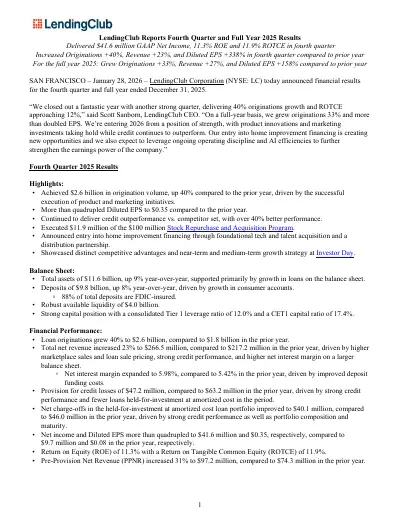
In the quarter, we grew originations 40% year-on-year to $2.6 billion, with all product lines contributing to the growth. We also more than tripled return on tangible common equity to almost 12%.
For the full year, we grew originations by 33% to nearly $10 billion, and more than doubled earnings per share. We are looking forward to building on our success.
Our substantial originations growth was driven by continued product innovation and marketing expansion, while also supported by improved marketplace pricing and sustained credit outperformance. Our discipline, combined with our advanced underwriting capabilities, delivered 40% to 50% better credit performance versus our competitive set, and we're seeing stable performance and consistency in our borrowers' behavior.
Strong credit performance continues to support loan investor demand, with marketplace revenue increasing 36% year-on-year, driven by higher marketplace volumes and loan sales pricing improving back towards our historical range. We introduced a rated structured certificate product in 2025, designed to meet the needs of insurance capital.
Insurance investors have a cost of funds and a risk appetite similar to banks, and so growth in this segment should further support the marketplace. In Q4, we initiated our first direct forward flow agreement with a top US insurance company, which is a nice addition to the previously announced agreements with BlackRock and Blue Owl.
Investors remain selective about who they choose as partners. Our depth of credit data, performance history, and stability as a bank positions LendingClub as a counterparty of choice.
Turning to our bank, our balance sheet is continuing to grow, with our loan portfolio driving net interest income up 14% year-over-year. Our funding is supported by our award-winning deposit products that deliver real value to customers, while also driving ongoing engagement with LendingClub, supporting efficient revenue growth over the long term.
LevelUp Savings, which rewards good savings behavior, is growing by double digits and driving 20% to 30% more logins per month than our legacy savings product. Personal loan borrowers account for over 15% of new accounts, and borrowers who have paid off their loans are using the product to build a financial cushion, accumulating average balances of over $15,000.
Our more recently launched LevelUp Checking is also growing by double digits, with 60% of new accounts coming from personal loan borrowers, 84% of whom say they are now more likely to consider a LendingClub loan in the future. This virtuous cycle is exactly how our engagement model is designed to work.
Importantly, we entered 2026 in a great position, with multiple competitive strengths. First is our unmatched underwriting advantage, enabled by proprietary models and informed by over 150 billion cells of data.
Second are our products that attract members for life by delivering instant, meaningful value. Third are our experiences that keep members coming back.
Fourth is our agile, scalable technology foundation, which is engineered for innovation. Fifth is our digital marketplace bank business model that combines the speed of a fintech and the resiliency of a bank, the best of both worlds.
These competitive strengths are driving success in our core personal loan debt consolidation use case and have application far beyond, opening additional vectors for growth. Our significant advantages in funding reliability, underwriting, and user experience are allowing us to win over the competition and expand our major purchase finance business.
Building on this momentum, last quarter we shared our planned entry into the $0.5 trillion home improvement financing market, an industry that aligns well with our capabilities. With our acquisition of foundational technology, hiring of leadership and key talent, and our first distribution partnership signed, we are well-positioned for growth over the medium term.
We are currently integrating the acquired codebase and remain on track to launch the partnership midyear. Our announced entry has also generated substantial inbound interest from additional partners, presenting potential opportunities to strengthen our trajectory.
We're excited about the year ahead, and expect our marketing investments to continue scaling, credit performance to remain best-in-class, and operating discipline and AI-driven efficiencies to help expand margins. We're also excited to launch our new brand later in the year to better reflect the scale of our ambition.
Before I turn it over to Drew, I want to take a moment to thank Hans Morris, who will be stepping down from our board in March after 13 years of extraordinary contributions. Hans has been instrumental to me and to LendingClub, from early investor to long-serving board chair, and his impact on the company is difficult to overstate.
I am deeply grateful for his leadership and support. We are very fortunate that Tim Mayopoulos, who's been a high-impact member of the LendingClub board for nearly a decade and who brings extensive experience in banking and fintech, will be assuming the role of Chairman.
With that, Drew, I'll turn it over to you.
Drew LaBenne
Thanks, Scott, and good afternoon, everyone. Scott already covered the high-level results that made 2025 a fantastic year.
Let's get into the details of our fourth quarter. Turning to page 10 of our earnings presentation, loan originations grew by 40% to $2.6 billion.
Borrower demand remained strong, as the value we are providing continues to be compelling. Loan investor demand also remained strong, as marketplace loan sales prices continued to increase in the quarter.
Our credit performance sets us apart from our competitive set, and is one of the reasons we have been able to sell these loans without any need to provide credit enhancements. Leveraging one of the benefits of being a bank, we grew our held-for-sale extended seasoning portfolio to $1.8 billion, consistent with our strategy to expand our balance sheet, while maintaining an inventory of seasoned loans for our marketplace buyers.
We also retained nearly $500 million of loans in our held-for-investment portfolio. Now let's turn to the two components of revenue on page 11.
Non-interest income grew 38% to $103 million, benefiting from higher marketplace sales volumes, improved loan sales prices, and continued strong credit performance. Net interest income increased 14% to $163 million, another all-time high, supported by a larger portfolio of interest-earning assets, and continued funding cost optimization.
Turning now to page 12, our net interest margin came in at 6%, up 56 basis points over the prior year. I'll note, we retained higher cash balances to enable accelerated growth in 2026, which resulted in a sequential decline in net interest margin.
If cash balances have been flat, net interest margin would have been 17 basis points higher, and nearly flat to the prior quarter. We expect the deployment of this liquidity to be supportive of net interest margin as we grow the loan portfolio, in line with what we shared at Investor Day.
On balance sheet funding, we ended the quarter at $9.8 billion in deposits, which was an increase of 8% compared to the prior year, and we continue to see healthy deposit trends across our product offerings. Turning to expenses on page 13, non-interest expense was $169 million, up 19% year-over-year.
The majority of the sequential and year-over-year rise was due to planned higher marketing spend, as we continue to invest in paid channels to unlock future growth. Now let's move on to credit, where performance remains excellent.
We continue to outperform the industry, with delinquency and charge-off metrics well below our competitive set. Provision for credit losses was $47 million, reflecting disciplined underwriting, and stable consumer credit performance.
I'd note this quarter, a higher percentage of our held-for-investment loans were from our major purchase finance business, which is a longer-duration asset, and therefore carries a higher day-one provision. In terms of net charge-off ratio, we experienced strong performance across all our vintages, and we were down 80 basis points over the prior year.
As we discussed on the last call, we saw the expected sequential increase as more recent vintages mature. On page 14, our expectation for lifetime losses on our held-for-investment portfolio under CECL are also stable to improving across all annual vintages, including 2025, which contains a higher level of qualitative reserves.
Going forward, given the stability of these metrics, and our move to fair value option for all new loan originations, we are no longer going to be updating this slide on a quarterly basis. Turning to the balance sheet, total assets grew to $11.6 billion, up 9% year-over-year.
Our balance sheet remains a competitive strength, allowing us to generate recurring revenue through retained loans, while maintaining the flexibility to scale up marketplace volume as loan investor demand grows. We ended the quarter well-capitalized with strong liquidity, and positioned to fund future growth.
I'd like to provide a brief update on the $100 million share repurchase and acquisition program we announced in November. In Q4, we deployed approximately $12 million at an average share price of $17.65, and expect to continue to deploy additional excess capital through the program to support our shareholders.
Moving to page 15, net income before taxes of $50 million more than quadrupled compared to a year ago. Taxes for the quarter were $8.5 million, reflecting an effective tax rate of 16.9%, and included a non-recurring benefit for research and development tax credits.
There were also some beneficial changes to California and Massachusetts tax law in the quarter. As a result, we expect a normalized effective tax rate of approximately 24% going forward, with some potential for variability due to the valuation of stock grants and other factors.
All of this translated to diluted earnings per share of 35 cents, and tangible book value per share of $12.30. Our ROTCE of 11.9% came in above the high end of our guidance range.
For the full year, we earned $136 million with diluted earnings per share of $1.16, and ROTCE of 10.2%. Now let's turn to our outlook.
Looking ahead, we remain encouraged by the underlying fundamentals of our business, and our guidance assumes a healthy economy with stable macroeconomic conditions throughout the year. Before I get into the guide, I'd like to spend a few minutes on our move to fair value option.
As we discussed at Investor Day, this change is about simplifying our financials by better aligning the timing of revenue recognition and losses, and creating a consistent accounting framework across our marketplace and bank businesses. As you can see on page 18, over time we expect this to result in a higher rate of return on invested capital by removing the front-loaded CECL impact we currently experience as we grow held-for-investment loans.
We recognize that many of you have questions around how this change flows through the financials, we've added a new section to this earnings presentation to walk through the mechanics in detail. This includes how fair value is established at origination, how revenue and credit flow through the P&L after day one, and how fair value adjustments will show up in non-interest income.
To make this tangible, page 21 provides an illustrative single-vintage example, showing both day-one and day-two economics, and page 22 shows the select financial measures of our current fair value portfolio over the last two quarters. As one-time support to help with first-quarter modeling, we are also providing estimates for both fair value adjustments and credit provisioning.
We expect total fair value adjustments in the first quarter to be roughly double fourth-quarter 2025 levels, due to three factors. First, there is more volume receiving a day-one fair value adjustment, as we are transitioning 100% of all new held-for-investment originations to fair value option.
Second, loans from the major purchase finance business have a longer duration and a higher discount rate, which will mean a higher day-one fair value adjustment. Third, day-two fair value adjustments will also be larger due to a higher average balance of loans carried under fair value during the quarter.
Separately, moving to fair value option means there will be no day-one provision for loan losses on new originations. We will still have CECL expense from the remaining legacy portfolio, which we currently estimate at approximately $10 million for the quarter, subject to quarterly variability.
Further, we will no longer defer loan origination fee revenue, nor marketing expense for held-for-investment loans, which means both line items should increase from Q4 2025 to Q1 2026, independent of any changes in origination volume. For Q1 2026, we expect to deliver loan originations of $2.55 to $2.65 billion, representing 28% to 33% year-over-year growth, with additional investments in marketing to fuel 2026 growth.
For the full-year 2026, we expect originations of $11.6 to $12.6 billion, up 21% to 31% year-over-year. On earnings for Q1 2026, we expect to deliver diluted earnings per share of 34 to 39 cents, a 240% to 290% increase year-over-year.
For the full-year 2026, we expect to deliver $1.65 to $1.80 earnings per share, consistent with the 13% to 15% near-term ROTCE target we shared at Investor Day, and up 42% to 55% year-over-year. With that, we'll open it up for Q&A.
Operator
Thank you. We will now begin the question-and-answer session.
Please limit yourself to one question and one follow-up. If you would like to ask a question, please raise your hand now.
If you have dialed into today's call, please press star nine to raise your hand, star six to unmute. Please stand by as we compile the Q&A roster.
Your first question comes from the line of Tim Switzer with KBW. Your line is open.
Please go ahead.
Timothy Switzer
Hey, good afternoon, guys. Thank you for taking my questions.
Scott Sanborn
Hey, Tim.
Drew LaBenne
Hey, Tim.
Timothy Switzer
The first one I have is on the expense trajectory here. There was a little bit of an increase across several line items this quarter.
The comp line was flattish, but then marketing was up quite a bit. Equipment went higher.
Other expenses seemed a little bit elevated. Is this kind of just some weird one-offs or is this indicative of a little bit higher investment cost you guys are putting into the company right now as you look to ramp up?
Scott Sanborn
Yeah. I'd say, first of all, I think marketing spend was the obvious one that increased quarter-over-quarter.
That was I think the vast majority of the increase. As we signaled last quarter and at Investor Day, we're continuing to invest in ramping our marketing channels, improving our capabilities, improving our modeling.
Really, a lot of this investment is to help 2026 performance. You could probably expect us to continue more of that as we go forward into Q1 as well.
The other expenses, I'd say, were largely noise in the quarter for the most part. Even having an Investor Day costs a little bit of money, you got to factor that in.
In all seriousness, I think as we go into Q1, other investments we'll look to expect to make would be ramping up our investment in people for the growth in the home improvement business. Then as we're looking to do the rebrand in the first half of 2026, there will be some expenses related to that as well.
All of that is included in the guide. I'd say, just to be clear, investment in the first half of '26, rollout back half of '26.
Yeah.
Timothy Switzer
You're saying the investment costs should start to moderate in the second half of the year?
Scott Sanborn
I'd say when we're through the transition, that's right. We're not being specific on the timing of that yet, but we're obviously starting the work now.
Timothy Switzer
Okay. Your comment on marketing, is the marketing required for targeted originations, is that higher than what you were maybe previously expecting?
Or what's the efficiency looking like so far?
Scott Sanborn
No. If you just go back what we talked about at Investor Day, one, all of our products categories were growing last year, and we're expecting future growth this year.
Not all of them are marketing driven in terms of their origination, the SBA program and our purchase finance, those are driven by different dynamics, as same with home improvement. Specific to PL, there's really three areas that we're pushing on for growth.
One is product innovation. We talked about how top-up has successfully driven increases in take rate and higher originations.
We have more ideas in the pipeline around the product innovation. There's funnel efficiency, as magic as our experience feels, there's still evolution possible to make it faster and more frictionless, and that'll be a growth driver.
Then the third is marketing. There, we shared there are certain things that are quite robust, and I'd say, close to very mature, like our partnership program, and I think we're getting there on direct mail, and we're well on our way with paid search, but there are other areas that we're still quite early innings at, having the right data models, the right attribution.
That's paid social, display, connected TV. I would say those are future growth vectors for us.
They're one of many drivers of origination growth. I think we gave at Investor Day that over the medium term, we think there's a couple billion dollars worth of originations to come from those added channels.
What you're seeing us do now is normally for, Tim, you've been following the business for a while, we normally don't push on new initiatives like this in Q4 and Q1. We usually wait till Q2 and Q3 because they are seasonally just a lot more forgiving and favorable.
Given the momentum in the business, we're pulling those in to Q4 and Q1, which means they are going to be test programs and I would call this R&D spend. They're always less efficient because it's a learning agenda as opposed to a volume agenda.
We're not driving much volume through it, but we are spending dollars. They'll be even less efficient when we pull them into less seasonally favorable quarters, because response rates and all that are lower.
We think the trade-off is worth it, because it sets us up for sustained growth later in the year and in the years beyond.
Timothy Switzer
Got it. That was all really helpful.
One last question and then I'll jump back in the queue. At the Investor Day, your slide deck kind of indicated you're looking for a lower efficiency ratio over time relative to '25, I think closer at the 55% to 60% range.
Given all the 2026 got a transition year, the accounting is changing a little bit. Is the efficiency ratio moving up in '26 and then it starts to move back down, as we get past the impact of the accounting and you guys start to get better scale?
Artem Nalivayko
You're precisely right. If you think about this transition from CECL to fair value early in '26 or now, basically, in this first quarter, there's a bit of a tailwind that's created, and we're using some of that tailwind to do these investments that we were just talking about, right, reinvesting, because once that tailwind fades, we want to make sure we continue to have momentum in growth top-line and bottom-line going forward.
We're using first part of the year to make those investments to accelerate the back half of the year. Once you get through 2026, that comparison point that impacts efficiency ratio in PP&R, basically is gone, and then your year-over-year comps will normalize at that point.
What's really important to note is you have these dynamics going on, but what we're getting is more pull-through by making this move, right? Even though you're having some of these impacts on revenue and expenses, what you're pulling through to the bottom line because of the offset in provision is higher.
Timothy Switzer
Got it. All right, that makes total sense.
I'll jump back in line.
Operator
Thank you. Your next question comes from the line of Vincent Caintic with BTIG.
Your line is open. Please go ahead.
Vincent Caintic
Hey, good afternoon. Thanks for taking my questions and thanks for all the detail on the accounting change.
I do want to focus on that. There's that very helpful slide, what slide 21.
Are these key drivers, sort of the discount rate, 7%? Is that sort of what we should be thinking about going forward?
I think in the prepared remarks, you kind of talked a bit about the major purchase finance and other things having higher discount rates and higher duration. As you launch new products, I'm wondering how these assumptions will evolve and if you can give us how we should think about the duration of these other products and the discount rates of these other products, and coupons as well.
That would be very helpful. Thank you.
Artem Nalivayko
Great. There's only a certain level of detail we're going to give just for competitive reasons, but it's a great question.
First thing I'd say is just it's right on there, but this is illustrative of one vintage coming in. The 7.3% discount rate in this illustration, we're actually at 7.1% discount rate for the quarter, we're a little lower than this illustration.
How that discount rate will move, if everything else remains equal, it will depend on the mix of loans that we're putting into fair value. Some of the businesses like major purchase finance that have longer duration and a less developed secondary market or marketplace, are going to have a higher discount rate.
Not necessarily all of that is true for home improvement, where there's a very developed secondary market and marketplace, but it also is longer duration. Net-net, you'll have some offsetting effects on an asset class like that.
Over time, it's going to depend on what the mix within our held-for-sale portfolio looks like, but you can expect that we're probably adding more diversification of those other product types coming into the portfolio.
Vincent Caintic
That's helpful. Thank you.
Then, I guess relatedly, now that the accounting is sort of making the held-for-investment loans look similar to the marketplace loans, at least from your income statement and balance sheet now, your thoughts on the mix between what you will sell, what you will maybe season and then sell, versus what you'd retain on the balance sheet?
Artem Nalivayko
Interesting that, and I'm glad you asked, because there's another point I want to make as well. We will continue to have an inventory of held-for-sale loans.
As we've said before, we found that program to be very helpful to onboard new investors, and to make opportunistic sales at maybe better prices than we would otherwise get. There's actually one new development in CECL accounting this quarter, which could be beneficial not for us, but for potential bank buyers.
I think one of the reasons that the bank pipeline has been slow to evolve is banks having to take that upfront CECL charge, and sometimes it's difficult to get over that hump before you start building a portfolio of purchase LendingClub loans. Under the new CECL guidance, if you buy loans seasoned more than 90 days, you no longer have that upfront impact as you would if you were originating loans or buying newly originated loans.
I'm not saying this is an immediate unlock and the bank pipeline is about to explode open, but I think net-net, it will be a positive for bank investors that are considering purchasing from us. For all the reasons I mentioned before and for that reason, we'll continue to hold a held-for-sale portfolio available for sale.
Vincent Caintic
Do you want to talk a little bit about the other part of the question, which was, now that they look the same in-period, aspirations for balance sheet growth? We gave some targets at Investor Day.
Artem Nalivayko
I think in terms of balance sheet growth and aspirations, nothing has changed from Investor Day regarding that. As far as our mix going forward in terms of structured certificate securities, and I'll just call it whole loans, which would be loans held for investment, loans held for sale, we'd say that distribution that we're at today probably roughly holds as we go forward in terms of our forecast.
Vincent Caintic
Great. Thanks very much.
Operator
Your next question comes from John Hecht of Jefferies. Your line is open.
Please go ahead.
John Hecht
Can you guys hear me?
Operator
Yes.
Scott Sanborn
Hey, John.
Drew LaBenne
Hey, John.
John Hecht
Hey, guys. How are you?
One question I have is, just on the fair value adjustment. You give the discount rate.
Is there some way we can take that and decipher what the kind of annualized loss rate might be, I guess, in your primary product?
Scott Sanborn
I don't know that you can exactly get to that. What we are going to do starting next year is we'll update our disclosures to include the charge-off, much like we do today just for the CECL portfolio.
We'll start to do that for the runoff CECL portfolio, and the held-for-sale portfolio combined. Currently, under our platform mix, we're still in that 4.5% to 5% loss rate estimate on an ANCL basis.
Then, as we add new products, we think they have similar profiles, but obviously, we might move around our mix that could have some minor adjustments to those numbers.
John Hecht
The general tenor of the credit is consistent with what you've been underwriting for the last several quarters?
Scott Sanborn
Yes. No major pivots.
Drew LaBenne
If you just think about, John, what we're doing is we're taking the capabilities what I think we've demonstrated that we're quite good at, appropriately assessing the risk, pricing the risk, and delivering value through the cycle from all the way through servicing. We're just applying it to different categories, but it is the same core skill set.
Different channels have slightly different skews, but the overall return profile, coupons, and all that are pretty similar. Like purchase finance, as an example, has a higher average FICO score, but the actual ROEs on that we expect to be similar and in line, and home improvement obviously skews heavily homeowners and slightly higher coupon.
John Hecht
Okay. Then just so I'm clear, the revenue yield on the loans is going to be more akin to the discount rate.
The net interest margin will be reflective of that lower yield, but the offset from the upfront fair value mark is bigger than that. Is that an accurate description?
Scott Sanborn
The coupon in the net interest margin table will be higher than the discount rate. Where the offset will be is in those fair value adjustments downward.
What you need to do is take the component of interest income, offset with the fair value adjustments from non-interest income, and that will get you the revenue yield equal to the discount rate.
John Hecht
Okay. Then from that, they also subtract charge-offs in the fair value marks.
Is that correct?
Scott Sanborn
Those are included in those adjustments.
John Hecht
Okay. Then final question is, it seems like a fairly good environment from the perspective of relatively stable credit.
I think the macro expectations are reasonably constructive, too. Then there's a lot of capital in the markets.
Maybe could you guys describe your thoughts on the operating market and the competitive environment within your subset of products?
Drew LaBenne
I'll start with the marketplace, and Scott can cover credit dynamics and competition. The marketplace is very healthy.
There is a, as you said, there is a lot of capital out there to be deployed. Very active environment.
The insurance capital that we're now starting to sell loans to and having more conversations, we think has been a great addition to our marketplace customers that we are working with now. As I mentioned, this change in CECL accounting hopefully can give a little more tailwind to opening up some more banks as well.
Scott Sanborn
On the competitive front, John, I'd say, I think we say this almost every call. This is a competitive market.
It has always been a competitive market. Who we are competing with at any point in the cycle changes.
This past quarter, we had fairly aggressive, ambitious, reasonably new entrant kind of pull out of the market, similar to Marcus's arrival with much fanfare, and then retraction. We had that, but that's offset by some of the direct fintech competition who are on balance being more aggressive given the availability of marketplace capital.
I'd say no real change in our view of how that's affecting what we do. We feel very good about our ability to compete.
We've shared multiple times statistics not only on the credit side, but also on our pull-through rate in our marketing and how we're able to convert the customers we want. We're just going to be very selective.
We agree, as you can see in our materials, our credit looks very stable, and that's because we're maintaining our discipline. It's not clear that we're seeing that across the full industry.
We'll be watching that.
John Hecht
Great. Thank you guys very much.
Operator
Your next question comes from Kyle Joseph of Stephens. Your line is open.
Please go ahead. A reminder, you may need to unmute.
Kyle Joseph
Sorry about that. You guys hear me all right?
Scott Sanborn
Yes.
Artem Nalivayko
Yep.
Kyle Joseph
Sorry about that. Anyway, yeah, kind of piggybacking on John's question on macro, just looking at your DQ curves on slide 9, anything you'd say about kind of the K-shaped economy and how you're thinking about 2026?
We've been reading a lot about elevated tax refunds, but yeah, just kind of a little bit deeper dive in terms of macro and how you're thinking about things.
Scott Sanborn
I think most important thing is post the inflationary period a few years ago, we did move upmarket, upmarket in terms of income, upmarket in terms of FICO. As you can see there, we're seeing stable results.
The customer we serve is who we call the motivated middle, we think represent a lot of TAM for us both immediately today, but also over time as we evolve the use cases and credit products we serve at. On tax refunds, we are expecting, right, or it is expected, it's not us, that this will be a larger-than-usual year.
That can have positive effect on payment and a temporarily downward effect on loan demand. All of that's factored into our guide.
Kyle Joseph
I got it. Then, not asking you guys to speculate any more than we can, but I think we'd be a little bit remiss if we didn't address the potential rate cap.
Obviously, given kind of your core product is on credit card refi, but just kind of want to get your initial thoughts and how you guys are thinking about everything that's out there.
Scott Sanborn
Obviously, there's not a lot of specifics on how this could actually take shape and what it could do. I think there's, at the moment, not a lot of confidence that, at least as initially articulated, anything like that would come through.
Our view is, there is an affordable alternative to credit cards available today, no government action required. That's LendingClub.
We're already saving people 700 basis points off of the cards, and no price controls needed.
Kyle Joseph
Got it. Fair enough.
Thanks for taking my questions.
Operator
Your next question comes from David Scharf of Citizens Capital Markets. Your line is open.
Please go ahead.
David Scharf
Hey, good afternoon. Thanks for taking my questions.
Most have been addressed, a couple things I just wanted to ask if you could clarify. One, actually just very near-term, on the Q1 origination outlook, did I hear you correctly that the guide kind of factors in a larger-than-normal refund season in paydown cycle?
Artem Nalivayko
What I'd say is I think that's pretty difficult to factor in with any degree of specificity, but our experience has been that larger-than-normal refund seasons, as I said, kind of flow through our business as I indicated, which is customer payment rates are higher, you see good DQ trends, but you can see maybe a different demand for credit temporarily. Wouldn't expect anything significant, but obviously, that'll be difficult to really predict.
We're not going to give intra-quarter guidance. Hard to measure the impact of that together with any other broader macro events going on.
We're very confident that we've got a lot of tools in the toolkit to deliver the outlook that we provided.
David Scharf
Got it. Fair enough.
Then, just digging back to the fair value assumptions, it sounds like on the next quarter Q1 call, we'll get kind of the, obviously, current-period losses and charge-off rate embedded in that net change in fair value line. I think John may have asked this, but is it fair to assume that embedded in your earnings guidance is sort of a flattish year-over-year loss rate in that fair value mark, or is there anything about the asset mix, there've been so many references to larger purchase, longer-duration loans, are there any nuances that might kind of raise the loss rate purely due to the asset mix?
Artem Nalivayko
No, I don't think so. I think we're obviously assuming a stable environment as we go through the year.
We will have an increase in duration because the major purchase finance business is growing and doing well, and home improvement will come on, duration will go up. In terms of the ANCLs, I'm not expecting a major shift in that.
Now, I think if you look at the net charge-off rate, there's seasonality, there's vintages, seasoning in there, there's a lot of portfolio mix. In terms of the annual loss rates, we're not assuming a major change in those numbers.
David Scharf
Got it. Regarding the vintages, obviously, we're laying to rest this slide where you give the sort of components of provisioning and reserving for amortized cost accounting.
Is there a way to translate that sort of most recent vintage macro layer, that 1%, 1.5% kind of conservative upfront provisioning, does that translate into certain number of basis points of discount on a day-one fair value mark going forward?
Artem Nalivayko
Under fair value, we're not explicitly layering in qualitative reserves as we do under CECL. It's a difference in methodology.
Now, if we see more stress coming through the portfolio, we may take that through the fair value marks in some manner, but we're not going to speculate on what's going to happen 2 years from now to the economy in terms of how we reserve, which I think has been, personally, one of the most frustrating parts of CECL accounting.
David Scharf
No, fair enough. I think you're about the seventh company we cover that's adopted the fair value option.
That's all I have. Thank you.
All right, thanks.
Operator
Your next question comes from Giuliano Bologna of Compass Point. Your line is open.
Please go ahead. A reminder that you may have to unmute.
Yep.
Giuliano Bologna
Thank you. Congrats on the another good quarter, and I appreciate all the new detail on the fair value disclosures.
One thing that I don't know if it's come up yet, but under fair value, there shouldn't be any more deferrals when it comes to marketing expenses. Is there a rough way to think about where your marketing expenses would be as a percentage of volume in the fourth quarter and third quarter, for example, just to get a rough sense of what your marketing costs would have translated to on a pro forma basis?
Artem Nalivayko
I think it would have been higher, obviously. We haven't disclosed the number.
I think, obviously, the offset to that is also higher origination fees, or origination fees are no longer deferred, and net-net, we're a net beneficiary of those two dynamics happening together, right? I think if you're thinking about the marketing spend deferral, then you probably got to think about the origination fee deferral as well.
Giuliano Bologna
Got it. I would say the net impact is positive, or significantly positive.
When I think about the outlook for volumes, or at least and then the guide for the year, it implies, especially after 1Q, that you kind of reaccelerate from a volume perspective, that they'll probably be flat to up slightly in the first quarter, but then you'd see a pretty good reacceleration in volumes to hit kind of the midpoint of the origination volume guidance. Is that a good way to think of it, that you should have a good step-up in 2Q, 3Q?
Artem Nalivayko
That's correct. Yep.
That's exactly right. Part of that is our normal seasonality, but obviously, we believe we're going to have more benefits beyond that from the newer business lines that we're launching and the investments in scaling marketing paying off.
Giuliano Bologna
That is very helpful. I appreciate all the enhanced disclosures, and I will jump back in the queue.
Thank you.
Operator
Next in the queue is Tim Switzer of KBW. Your line is open.
Please go ahead.
Timothy Switzer
Hey, guys. Thanks for taking my questions again.
One of the follow-ups I have is just on AI, I know you guys are using it quite a bit in the back office, but what areas that are a little bit more forward facing that is helping you with either growth or maybe getting a little bit better pricing and or demand? I know you guys had the Cushion acquisition a few years ago, and I think you've mentioned it's helped speed up the doc verification process as applications come through, but just wondering if you guys could update us on that.
Drew LaBenne
I'd say at this point, there's probably not a department in the company that is untouched in some way. I think we have over 60 initiatives underway across the company, and you're right, they range from operations efficiency, guiding agents on next best action to diverting customer contacts, whatsoever, to compliance, marketing material generation, audit, testing and generation.
Obviously, heavy use in the engineering group for code development and streamlining our QA efforts. On the growth side, you've hit the couple areas that we're really focused on.
There's obviously longer pole in the tent, marketing and credit, continued evolution of our efforts there, which we won't talk about too much because we view that as part of our secret sauce. Then within the customer experience, the Cushion acquisition, including the team, will be evolving the Debt IQ experience to bring more intelligence to evaluating pools, transactions, and history, and helping recommend actions to customers that improve their financial position.
The one you mentioned, we put into test in Q4 and are expanding across the board is, for the rare cases where we do need to require some kind of documentation that we can't get electronically, using AI to both assess whether the documents are what we asked for, whether or not they are real and not fraudulent, and then to extract that information, populate models, and render a decision is all reducing the friction in the funnel and improving our pull-through. There's just a ton of things happening across the company.
Timothy Switzer
Got it. Then the last question I have, it's a difficult one, but the guide for this year is the 13% to 15% near-term ROTCE guide you gave.
Can you kind of help us map out how we get to the 18% to 20% medium-term target over time, with this fair value accounting? Is it a gradual, steady build quarter-over-quarter as you guys continue to scale up?
Or is there a point, and I know this is very dependent on the pace of originations and the seasoning of the portfolio, but is there a point where maybe the ROTCE increase starts to slow down as the portfolio gets larger and that day-two impact on the fair value gets larger, or am I thinking about that a little bit wrong?
Scott Sanborn
I think our goal would be a steady increase up towards those medium-term targets. The dynamics of moving from CECL to fair value, I will say, by the time we're entering 2027, they should be largely behind us.
From there, we're continuing growth through all the steps we laid out at Investor Day, mainly growing originations, growing margin, expecting a little help from the Fed, obviously, but that's not the biggest component of it. Growing originations, yeah, growing the balance sheet, both are going to be accretive to the bottom line.
Yeah. Yep.
Timothy Switzer
I guess another way to think about it is the impact to profitability is relatively steady as long as you continue to grow the balance sheet at 25%. If you're growing it with, say, $4 billion of loans, or if you're growing it at $7 billion of loans, that doesn't impact the profitability, as long as you're still growing a similar level?
Is that the right way to think about it?
Scott Sanborn
The only growth headwind that we used to have was CECL, right? With that gone, we should have positive operating leverage from growth, or maybe I should say positive pull-through now from growth as we grow over these next 3 years.
The keys are really grow the business lines we have, the expansion, the home improvement, growing originations, growing the balance sheet, and then pulling it through to net income.
Timothy Switzer
Got it. Thanks for taking all my questions.
Scott Sanborn
All right, thanks.
Operator
There are no further questions online. I will now turn the call back to Artem Nalivayko for retail investor questions.
Artem Nalivayko
All right, thank you, Kevin. Scott and Drew, we have a couple questions here that were submitted by retail investors via Say Technologies and email.
The first question is on the rebrand. The question is, once a name change has been made, what are the marketing plans that you have in place?
Just a reminder, what's the intent of the rebrand? The initial LendingClub brand really was tied to our pioneering model of peer-to-peer lending, which is obviously no longer part of the model.
We're now a bank. We don't just do lending.
We've launched multiple consumer-facing savings products and checking, of which the name LendingClub on your debit card is quite strange. The rebrand is really meant to capture the broader ambition of the company, what we do for our customers beyond just lending.
Plan is to do that later this year. There could be a question of what do we do between now and then?
We're mapping out the literally thousands of touch points we have with our customers across email, mobile app, third-party sites and call center and all the rest, and making sure that we've got everything captured, make sure our equity translates from the old brand to the new brand. Then, yeah, we will be putting some weight behind the new brand.
I wouldn't expect we're not going to go from being a highly data-driven, efficient curve-oriented direct response marketer to getting stadium rights in 2026. You're not going to see a big step change in how we think about marketing.
This is absolutely the beginning of us moving further up the funnel, if you will, as our offering to consumers broadens and what we stand for broadens, the marketing tactics we can use can also get more broad. We do expect over time that you'll be seeing us beyond these direct response channels, just won't be immediate.
Great, thank you. The second question, saw a recent press release on a partnership with company called Wonder.
Can you please elaborate on that? If you recall, at Investor Day, we talked about how we're taking our capabilities in unsecured consumer, our largest use cases is debt consolidation, credit card refi, but those same capabilities apply that anyway you can use a personal loan, which is to finance any large purchase.
We've been seeing really great traction there. We think we fill a real need in the space, which is we've got the resilient, stable funding of a bank, but we've got the customer experience and the speed and the interaction model of a fintech.
We've been gaining distribution and growing that business. Our kind of core verticals that were in today, elective medical, dental, teeth implants, fertility, tutoring, a few others.
We're expanding into others: ophthalmology, wellness, and we're testing some purchase verticals. That's what that is.
These are all these and other things, some of which get announced and some of which we're just doing as part of our testing, are all meant to assess consumer demand in incremental verticals that will diversify our use case, diversify our acquisition channels, and provide future vectors for growth. Excited about it, seeing very solid traction in the business overall, and are excited to keep growing it.
All right, perfect.
Artem Nalivayko
Last question, just in terms of increasing shareholder value in the long term, how does leadership intend to drive shareholder value?
Artem Nalivayko
All right, well, always a great question, and thank you, retail investor, for that. Rather than me explaining it all again on this call, I'd say the number one thing investors should do is go watch our Investor Day that we did in November, because I think there is a lot of time dedicated to going through the strategy and how we expect it to evolve over the next several years.
Citing what we accomplished in 2025, a lot of which we already covered on the call, for the full year, we grew originations 33%, we grew revenue 27%, we grew diluted EPS by 158% year-over-year. I think 2025 was a great year, and if you look at our guide for 2026, we're looking to obviously improve upon performance again as we go into this year.
Then finally, we announced the share repurchase and acquisition program of $100 million, which we think is also beneficial to shareholders now and in the future. All right, thanks, Drew.
All right, with that, we'll wrap up our fourth-quarter and full-year 2025 earnings conference call. Thank you all for joining us today, and if you have any questions, please email us at [email protected].
Thank you.
Operator
This concludes today's call. Thank you for attending.
You may now disconnect.