BioHarvest Sciences, Inc.
GGETTEX:8MV0Q4 FY2025 · Earnings Call TranscriptMarch 31, 2026
Operator
I will now hand the call over to Justin Meiklem, Head of Investor Relations. Please go ahead.
Justin Meiklem
Greetings. With us on the call are Dr.
Zaki Rakib, Chairman, Ilan Sobel, Chief Executive Officer, and Bar Dichter, Chief Financial Officer. Before we begin, I'd like to remind you that management will be making projections and forward-looking statements on the call today regarding future events.
Any statements that are not historical facts are forward-looking statements. These statements are made pursuant to and within the meaning of the safe harbor provision of the Private Securities Litigation Reform Act of 1995.
We encourage you to review BioHarvest Sciences' SEC filings, including the company's most recent Form 40-F, which identify risks and uncertainties that may cause future actual results or events to differ materially. These filings can be found on the company website, as well as the SEC's website at www.sec.gov.
Please note that the forward-looking statements made during today's call speak only to the date they are made, and BioHarvest Sciences undertakes no obligation to update them. With that, I would like to now turn the call over to Ilan Sobel, Chief Executive Officer.
Ilan?
Ilan Sobel
Thank you. I want to thank you all for joining us on today's call.
For those of you who are new to our story, BioHarvest's North Star is to discover, develop, manufacture, and democratize life-changing compounds from plants that will positively impact the health and wellness of hundreds of millions of consumers and preserve the planet for generations to come. We are a leader in botanical synthesis, a process that utilizes our patented, non-GMO platform to produce plant-derived compounds with greater potency than the plant without having to grow the plant itself.
Importantly, we require the plant just once to be able to identify the cells in the plant that produce these critical phytonutrients. Utilizing these cells, we conduct hundreds of experiments with our technology, optimizing the environmental conditions and food that we feed the cells to be able to get the cells to mirror and magnify the levels of the phytonutrients they produce versus the plant.
We then scale the production and elicitation of these cells in industrial-scale bioreactors to produce highly soluble, bioavailable, and efficacious final material in a short period of time. Our technology allows us to improve nature with the power of our science and create innovative, unique, and active molecules and compounds that we can produce with unique consistency, economic viability, and commercial protection.
We can use these compounds in our own proprietary products or to partner with key customers which serve high-value markets in the pharmaceutical, nutraceutical, cosmetic and fragrance, and nutrition sectors. BioHarvest today operates through two distinct but highly complementary business units: our direct-to-consumer products division led by our flagship VINIA nutraceutical platform, and our CDMO services division, where we partner with third parties to develop novel, plant-based compounds using our proprietary botanical synthesis technology.
These two businesses represent the company's dual growth engines and provide BioHarvest with multiple pathways to revenue growth and long-term shareholder value creation. Given their different operating models, capital requirements, and stages of financial maturity, we are managing the business through a two-lens framework designed to optimize performance, capital allocation, and strategic execution across both divisions.
This structure reflects the way we have operated the company since late fourth quarter 2025. Beginning in 2026, our manufacturing Center of Excellence will be incorporated into the CDMO organization.
This will further align our manufacturing capabilities under a single platform serving both our direct-to-consumer products business and our external CDMO partners. Importantly, while both divisions are positioned as growth engines, they are at different points in their development.
We expect the D2C business to achieve profitability in 2026 while continuing to invest behind growth and customer acquisition. In parallel, we believe the CDMO business has the potential to accelerate meaningfully in 2026 and beyond, supported by continued investment in technology, capabilities, and commercial infrastructure to unlock its full value potential.
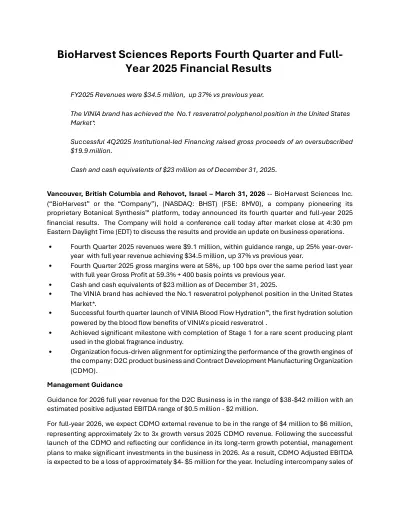
Now, turning to the fourth quarter, we are pleased to report that our fourth quarter revenues were $9.1 million, falling within our guidance range, up 25% year-over-year. This impressive result was due to a record number of sales orders that came in from our core consumer products business that generated over $3 million in sales just for the month of December 2025, a record month.
Revenues were $34.5 million for the year, up 37% from the previous year. Our gross margins were 58% for the fourth quarter, up 100 basis points compared to the same period last year, and 59% for the year, up 400 basis points compared to last year.
While the ongoing conflict in the Middle East has understandably raised concern, BioHarvest research and manufacturing operations are operating continuously without any interruptions. Recent airspace closures have affected commercial traffic, but cargo flights have gradually resumed, and we are meeting supply chain obligations and remain fully committed to meeting our product supply obligations to our partners.
However, as the situation is constantly fluctuating, we of course continue to monitor developments closely. Before I go deeper into defining our achievements and focus areas for 2026, I'm going to hand it over to Bar to share more details on the financial performance.
Over to you, Bar.
Bar Dichter
Thank you, Ilan. Good afternoon, everyone.
I will provide you with a succinct review of our financial results. A full breakdown is available in our SEC filings and in the press release that crossed the wire before market close today.
Please note that all figures are in US dollars unless stated otherwise. Revenues for the fourth quarter of 2025 increased 25% to $9.1 million, within management guidance.
The increase was largely attributed to the growth in the VINIA franchise, which exceeded 85,000 active users as of March 2026. Gross profit increased 27% to $5.2 million, or 58% of total revenues, in the fourth quarter of 2025 as compared to $4.1 million, or 57% of total revenues, in the same year-ago quarter.
The increase in gross margin was primarily driven by the benefits of revenue mix, increased manufacturing scale, and improved manufacturing yields. Total operating expenses for the fourth quarter totaled $6.3 million as compared to $5.8 million in the same year-ago quarter.
The increase in operating expenses was primarily due to an increased marketing spend and higher expenses from the CDMO service division. Total operating expenses shrank on a percentage of revenue to 70% as compared to 80% of revenues in the same year-ago quarter.
Net loss for the fourth quarter of 2025 totaled $2.2 million, or 10 cents per basic and diluted share, as compared to a net loss of $3 million, or 17 cents per basic and diluted share, for the same period last year. Adjusted EBITDA, a non-IFRS measure, totaled -$0.5 million as compared to an adjusted EBITDA loss of $1.8 million for the same year-ago quarter.
Cash and cash equivalents as of December 31st, 2025, totaled $23 million as compared to $2.4 million as of December 31st, 2024. I would like now to pass the call back to Ilan.
Ilan Sobel
Thank you, Bar. Let's now turn to talk about the performance of our VINIA business.
We continue to see strong growth in our core business with our website, vinia.com, continuing to do the heavy lifting and delivering approximately 80% of our revenues, with over 90% of these revenues being highly valuable subscription revenue. Amazon sales, which comprise approximately 20% of our sales revenue, continue to also be a strong contributor for growth in our business.
I'm also extremely proud to announce that given the full year revenues of $30.6 million for our D2C business in the USA, we have achieved the title position of being the number one resveratrol polyphenol brand in the United States of America, based on estimated market sizing utilizing NielsenIQ 2025 market projections for total USA for resveratrol nutritional supplements and beverages, and Amazon sales data for resveratrol nutritional supplements. This is a major achievement for us as a company, given the fact that we have achieved this major achievement in less than 5 years from entering the US market.
Today, collectively with Israel, we have more than 85,000 active users of the VINIA brand. VINIA's leadership position is driven by its clinically demonstrated ability to increase arterial dilation, improving blood flow and enabling enhanced delivery of oxygen and nutrients throughout the body.
This mechanism of action addresses what many medical experts increasingly recognize as one of the most foundational elements of human health and performance: efficient blood flow and oxygen delivery. Given the recognized importance today by medical experts of arterial health and blood flow and the inimitable characteristics of our VINIA compound, we believe that we have developed a best-in-class blood flow transportation system in the body to make other synergistic nutrients work harder.
This we are seeing as a major asset, which we will utilize in 2026 to accelerate the growth of our direct-to-consumer business. I want to turn our attention now to talk about one of our major focus areas for 2026: our VINIA Blood Flow Hydration launch, which we officially launched on December the 3rd to the US market with a very differentiated promise of providing American consumers with electrolytes powering cells through better blood flow delivery.
Let me explain for a moment how important that is. There are a myriad of electrolyte drinks that currently exist in the market today for hydration, but it's important to understand that water and electrolytes alone are not enough.
Without blood flow, the water and electrolytes have nowhere to go. VINIA significantly increases arterial dilation, enhancing blood flow and improving the delivery of fluids, electrolytes, and oxygen to our body, organs, tissues, and trillions of cells.
VINIA acts as an amazing blood flow transportation system across our 60,000 miles of arteries, veins, and capillaries for any nutritional ingredient—in this case, electrolytes—to better reach the body's trillions of cells due to its ability to increase blood flow and oxygen via increased arterial dilation. We have been very encouraged by the first 16 weeks of our Blood Flow Hydration launch.
Now I'd like to share some specific facts that highlight why we believe we have a category disruptor in our hands, given its category differentiation anchored in our core strategy of delivering superior science, superior efficacy, and superior taste. Since launch, our VINIA Blood Flow Hydration has achieved the following key results, which give us the confidence that we have a high-performing category disruptor in our hands which requires further investment to realize its true potential: One, VINIA Blood Flow Hydration is now the number two contributor to incremental new customer sales, with 15% of new customer revenue year-to-date on vinia.com ahead of all other categories except capsules.
Two, VINIA Blood Flow Hydration has achieved a verified rating of 4.8 out of 5 via vinia.com after more than 90 reviews. Three, VINIA Blood Flow Hydration has achieved a rating on Amazon of 4.9 out of 5 after approximately 50 Amazon reviews across all flavors and variety packs.
This is currently one of the highest ratings of any top 100 electrolytes products on Amazon. Given these very positive early signals over the past 16 weeks and the approximately 50% premium we have been able to command versus key market leaders, we will accelerate direct marketing dollars behind VINIA Blood Flow Hydration to capture our fair share of this $17 billion category in North America.
VINIA Blood Flow Hydration plays an important role for us to be able to broaden the age demographic of our core customer base. Today, our customer base is skewed towards our "super senior" consumers.
These are consumers who are above the age of 65. We have identified that VINIA Blood Flow Hydration is able to appeal to this consumer base, but also, importantly, has significant traction with our "super seeker" customer, aged 35 to 65, who is looking for better longevity options to support their aging process, and more specifically, our "super active" consumer who is aged 20 to 35, who are looking for a hydration solution that is more performance-based.
Accordingly, we have spent a large part of Q1 adjusting our marketing mix away from traditional TV aimed at our super senior consumer, which has been the lion's share of our marketing spend dollars in the past, and moved this to digital channels such as Facebook, Instagram, YouTube, and now we have recently opened our TikTok Shop so as to more effectively recruit our important younger super seeker and super active consumer segments. This shift to digital media channels also provides us with an opportunity to improve our cost of customer acquisition versus our previous heavy reliance on TV.
We are currently utilizing Q1 to best optimize our marketing mix to deliver the step-change in growth we expect in Q2, driven by scaling VINIA Blood Flow Hydration and its ability to appeal to a much broader consumer audience with the expectation to drive aggressively new customer acquisition in Q2 at a lower cost of acquisition. I want to talk now about our second major focus area, which I termed as a big bet during our previous quarterly update in November last year, and is also becoming a strategic asset for the company: our health professionals, or Health Pros channel.
This initiative, where we are acquiring critical health-driven opinion leaders with large social media followings to advocate and sell VINIA to their social media followers, is really starting to scale. The initiative has gained significant traction over the past 90 days, and we are starting to see the positive effects of scaling these opinion leaders.
Right now, we have partnered with 250 Health Pros, and we will be adding approximately 25 to 50 Health Pros per month. This channel, for example, in the month of March, has delivered more than 10% of incremental new customer revenue, and we expect it to be an important contributor to future new customer revenue as this marketing channel continues to scale.
Further, this month we kicked off a consumer challenge for our Blood Flow Hydration product on March 17th together with all our Health Pros, and as of today, more than 1,300 consumers have signed up to our 30-day Blood Flow Hydration Challenge, and we are seeing amazing results across social media with consumers posting their results every day, highlighting their increase in physical activity when partnering with VINIA Blood Flow Hydration. In 2026, we will continue to leverage this powerful fact that VINIA is a best-in-class nutrient delivery system for our cells, given its ability to significantly increase arterial dilation, improving blood flow and the delivery of targeted, synergistic, active ingredients to our body's organs, tissues, and cells.
Accordingly, our goals for this year are to leverage this insight to drive aggressive premiumization of our business by targeting relevant, multibillion-dollar synergistic revenue pools in the nutraceutical industry, where we believe our blood flow delivery advantage combined with high-performing, synergistic, active ingredients will be category disruptors and will enable us to increase key financial metrics such as revenue per month and gross profit margin delivery. These opportunities we are terming VINIA Plus opportunities, where we are considering entering multibillion-dollar categories combining VINIA with a synergistic nutraceutical ingredient and leveraging our consistent strategy of superior science, superior efficacy, and superior taste to bring meaningful, differentiated, premium products to the market to win consumer's choice in these categories.
VINIA Plus marketing categories that we are considering entering include the multibillion-dollar greens category focused on gut microbiome health, the cellular health category, and the omega-3 CoQ10 heart health category, as well as a number of other categories. The company will share more information about its plan to launch VINIA Plus premiumized products over the course of the next few months.
Let me now excitingly turn to our CDMO business. As a reminder, our contract development and manufacturing organization, or CDMO business, was formally created in Q2 of 2024.
Along with the consumer products side of the business, they form our two-growth-engine strategy that we believe warrants a two-lens approach. The distinction between our direct-to-consumer products business from our B2B CDMO business reflects the operational reality of how we manage the company today and has already resulted in a meaningful acceleration in the CDMO performance, as will be highlighted to you all shortly.
Under this model, the CDMO operates as a fully integrated business unit, including R&D, manufacturing, and business development. This organization alignment has significantly improved execution speed, focus, and accountability.
Investments in this unit can now be tracked more effectively in terms of ROI. Since its creation, the CDMO has evolved beyond the traditional model of service to what can be best described as forming strategic partnerships with each of its customers versus just more transactional R&D-based relationships.
This shift reflects the collaborative nature of our engagements, where we often participate in long-term value creation, including royalties, and in certain cases, ownership in developed compositions which we may in the future commercialize and bring to market using our direct-to-consumer e-commerce platform. It also reflects the additional set of skills added to the unit capabilities that include AI-driven molecule discovery.
From a financial perspective, the CDMO side of the business generated approximately $2 million in third-party revenue in 2025. If we also include internal manufacturing of VINIA powder supplied to our products business, total activity would have been approximately $9 million in revenue, demonstrating the scale of manufacturing infrastructure already in place.
As a reminder, our development program under the botanical synthesis process for new molecules or compounds ranges from $2 to $3 million and spans 18 to 27 months. It is divided into three stages, where the first stage, Stage 1, is the creation of the cell bank that is needed for the subsequent stages, Stage 2 and Stage 3.
In Stage 2 and 3, cells are propagated in small to large-scale liquid medium bioreactors. Stage 3's completion signifies the readiness for the industrial or commercial manufacturing.
Right now, we are working on multiple high-value projects on the CDMO side of our business. Specifically, we are advancing quickly four active development programs for third parties, each focused on a unique plant-based composition targeting multibillion-dollar end markets.
These are: One program in nutraceuticals with Saffron Tech, a pioneer in revolutionizing advanced cultivation methods for saffron, one of the world's most valuable and health-promoting botanicals, to develop saffron-derived botanical compound. Two programs in nutrition, including the previously announced collaboration with Tate & Lyle, a leader in natural sweeteners.
One program in the multibillion-dollar fragrance and scent market with a prominent UAE investment group to develop a plant-based fragrance compound derived from a plant that is under significant threat due to overharvesting and habitat losses. Whilst we have made strong progress across all four projects, I want to spend a little time highlighting the biological breakthroughs we have recently achieved in our fragrance program, which was announced earlier today.
Our CDMO division has successfully completed Stage 1 of a multi-stage development program for a rare scent-producing plant used in the global fragrance and scents industry. The program is being conducted under contract signed approximately one year ago with a prominent UAE-based investment group and represents what BioHarvest believes to be the first ever successful creation of a stable cell culture for this rare and endangered fragrance-related plant.
This milestone positions BioHarvest to enter the growing, particularly premium scent and fragrance segment estimated to represent a $12 billion market opportunity at least. This particular scent is widely regarded as one of the most valuable fragrance raw materials in the world, with premium grades commanding prices exceeding tens of thousands of dollars per kilogram, and demand is growing across the Middle East, Asia, and luxury Western perfume markets.
The development was achieved using BioHarvest proprietary botanical synthesis platform technology, which enables the production of rare, plant-derived fragrance compounds without the need to cultivate or harvest the original plant, which in fact is classified as an endangered species and typically grows only in highly specific regions of Southeast Asia. The rare molecules responsible for the scent and aroma of this particular plant, including sesquiterpenes and chromones, were successfully identified in the Stage 1 cell culture, with molecular profiles closely matching those found in the original plant.
This achievement demonstrates the ability of BioHarvest's platform to replicate highly complex plant-based fragrance compositions that include, but not limited to, the terpene family of molecules previously considered extremely difficult or impossible to reproduce sustainably. I want to reiterate that under the terms of the agreement, BioHarvest retains 20% ownership of the compositions developed through this multi-stage program, creating a long-term royalty-driven economic model as development advances towards commercialization.
This structure aligns with BioHarvest's evolution from a traditional CDMO to a partner development and manufacturing organization, or what we like to call a PDMO, where the company participates directly in downstream value creation. With the successful completion of Stage 1, we are ready to move to Stage 2, where cells stored in a proprietary cell bank will be propagated in liquid medium to generate significant biomass.
This biomass is expected to be available for pre-commercial testing within 6 to 9 months, with full development and industrial-scale manufacturing anticipated within 12 to 18 months. For the pharmaceutical program which commenced in 2024, and which the company announced Stage 1 completion in 2025, the company has completed the first step of the three steps within Stage 2.
Given the long cycles in the development of pharmaceutical programs, further research is being conducted to determine the optimal next steps within Stage 2 in order to best meet the customer's FDA-driven requirements. With our two-lens focus approach and the success that we are seeing in progressing our projects, we are heavily investing in improvements of further CDMO capabilities, including AI-driven development tools to optimize development timelines, improve success rates, and build a library of synthesizable plant-based molecules.
To further accelerate pipeline conversion, we added a new Vice President of Business Development in early March, strengthening our commercial capabilities and customer outreach, and we are proactively investing in the development of additional biological assets to expand our portfolio of opportunities for current and future partners. Independent of specific contracts, BioHarvest is advancing a pipeline of highly sought-after plant-based molecules through early and mid-stages of its proprietary botanical synthesis process, thereby de-risking and accelerating potential customer programs.
This growing portfolio already includes assets that have progressed beyond Stage 1, such as verbascoside, PGG derived from pomegranate, and selected polyphenols from blueberry, as well as emerging capabilities in plant-based extracellular vesicles, otherwise called exosomes. By building this library of partially developed biological assets, BioHarvest is positioning its CDMO to offer faster development times, lower risk profiles, and differentiated value propositions to partners across the nutraceutical, pharmaceutical, and cosmetic and fragrance markets.
Ladies and gentlemen, 2025 was a defining year for BioHarvest. We delivered strong execution across both of our growth engines, scaling our core consumer business, reinforcing VINIA's category leadership, and building meaningful momentum in our CDMO platform through strategic partnerships and important development milestones.
At the same time, we strengthened our balance sheet, expanded our customer base, and entered 2026 with the capital and capabilities and structure to support our next phase of growth. Looking ahead, we believe BioHarvest is exceptionally well-positioned.
The early performance of VINIA Blood Flow Hydration, our expansion into more efficient and diversified customer acquisition channels, and the growing strategic value of our CDMO platform give us increasing confidence in our ability to accelerate growth and create meaningful long-term value when using our two-lens model to optimize strategic decisions across our direct-to-consumer and CDMO business units. We are entering this next chapter with momentum, with focus, and a clear path to building a larger and stronger company.
With our platform, our products, our partnerships, and capital in place, we believe BioHarvest is entering 2026 in its strongest position yet. Thank you very much for your time.
We will now open the call to questions.
Operator
We will now begin the question and answer session. If you would like to ask a question, please press *1 to raise your hand.
To withdraw your question, press *1 again. We ask that you pick up your handset when asking a question to allow for optimum sound quality.
If you are muted locally, please remember to unmute your device. Please stand by while we compile the Q&A roster.
Our first question comes from the line of Anthony Vendetti with Maxim Group. Your line is open.
Please go ahead.
Anthony Vendetti
Thank you. It seems like the CDMO business is really starting to develop and with this new contract on the fragrance business, it seems like it's just adding to what you did in '25 on the pharmaceutical side and on the Tate & Lyle side.
Maybe, Ilan, if you could just give us a little more detail—you did mention a little bit about the pharma company—can you give us a little more detail around how the Tate & Lyle contract is going and expectations for that particular contract in '26?
Ilan Sobel
Sure, Anthony. I'm going to firstly just kind of take it up a level of abstraction to emphasize how happy Zaki and I are in the significant progress that we've made over the last 4 to 6 months in the CDMO.
A big part of that has been anchored in structuring the organization so that we're allocating resources in a way that those resources are fully dedicated to the respective business units. Now our R&D organization is 100% focused on working on the CDMO.
Boy, it's amazing to see what focus can do. Secondly, as we look at the two-lens model and really start to make conscious decisions, given the fact now that we're really running as two separate businesses and we're able to really understand the cost structure and the financial performance of these businesses, we're able to therefore ensure that we're allocating resources the right way and making the right investment decisions.
We've started that investment process towards the end of the fourth quarter, continued in the first quarter, and we're seeing major, major dividends with the team really knocking the ball out of the park with some of these milestones, where really we're breaking biological barriers and unlocking the ability to be able to capture value in multiple billion-dollar categories. I'm going to ask Zaki to go into a little bit more detail across some of the projects so that you understand the momentum that we have across this part of the business and why we're so eager to continue to lean in and invest more in this business in building critical capabilities, and specifically as well with the manufacturing organization now coming underneath the CDMO.
It makes perfect sense if you think about it, that the manufacturing business should be inextricably linked into the CDMO given, just the name, Contract Development and Manufacturing Organization. As a result of that synergy as well, we are seeing significant progress and are making the required investments in manufacturing, in AI, in ensuring computer vision, in developing an elicitation Center of Excellence, and these investments we're starting to see pay off and that will continue to pay off in 2026 and be able to drive really non-linear growth as we move into 2027.
Zaki, over to you to give a little bit more texture around the specific projects.
Zaki Rakib
Sure thing, Ilan. You've covered a lot of the ground already, I thank you for that.
Just wanted a little bit of background for you to be able to scope to answer your question is, how do you analyze the success we've had in the various projects that are undergone within the CDMO organization? Plant molecules can cover multiple industries.
The four industries we cover: nutrition industry, where we have two molecules currently in development; we have the fragrance, which is part of the overall cosmetics and beauty; and then we have the pharma, the project you mentioned earlier; and we have a nutraceutical project with the saffron. Those are the major projects that are going inside the CDMO organization.
Beside the assets we continue to build, we advance our own molecules so that when we go talk to a customer, we can offer them a more advanced stages. Ilan mentioned earlier during the call the three stages of development.
Each stage within itself is divided into various steps, and each stage carries a certain revenue target. As you try to model the overall project between 18 and 27 months, $2 to $3 million is the NRE, the revenue that we can see.
The beauty of the diversification across multiple industries is that it's the profile of risk-reward. Some of the projects like in pharma may take more time, but ultimately because of the high margins that they carry, would provide a lot of reward on the back end of the project, meaning the manufacturing stage where we expect to start even in latter part of 2027, the second half of 2027, we are expecting to start manufacturing some of the molecules or compounds that are currently in development.
Every time one process one stage and move to the next one, what you need to keep in mind is that it advances us and gets us closer to the commercialization, or from our end, that would be the manufacturing phase. If I want to give you a quick update on all the various projects: while we have already announced on the pharma side that we've crossed Stage 1 and we have actually recognized revenue associated with some elements of Stage 2, typical to pharma, there's this time where it's more research that is done on both ends, be it the customer, us, to try to make sure that adjustments are made to comply with all the FDA regulations and whatnot is required.
This is very typical. We're not surprised.
We expect to go through that. It may take some time.
That has been factored in as we look at the revenue projections both for 2025 and obviously for 2026 and beyond, as you will be seeing it later. I think it's included in our news release on what we're guiding for 2026.
When we look at the fragrance projects, what's really nice about it is that we completed Phase 1 at record time from the time we got the source material, although we signed the agreement earlier, usually the time starts from when we receive the source material from which we develop the cell culture. We expect it to be running much faster, and we expect it to reach within the next 6 months or so the second stage, which carries a higher revenue than Stage 1, subsequently Stage 2 and then Stage 3, and getting into production.
Ilan mentioned the unique breakthrough, first time ever anyone develops a stable culture big molecule like the sesquiterpenes and chromones and whatnot. We feel very, very happy about it.
On the saffron, we've also made a lot of progress. We're inching closer to the completion of Stage 1, and that also would be something that would move faster, and we expect to see some early production of it in the latter part of 2027.
On the nutrition side, we've also made a lot of progress, getting really closer to the completion of Stage 1. Stage 1 is also the riskier part because the ability to develop and store a cell bank of stable cell culture is representing the highest risk in the process, not the shortest time, but the highest risk in the process.
Basically what we're having is a 100% success in any molecules that we have really touched so far. That also brings a lot of internal confidence, and also as we display that confidence to our customers, we expect that more of what we look at in the pipeline to converge faster.
I hope that gave you a bit of an overview of where we stand with the various projects and what we expect especially in 2026 the progress that would be further made.
Anthony Vendetti
Thank you. That was helpful.
Appreciate it. I'll hop back in the queue.
Operator
Your next call comes from Matt Hewitt with the Craig-Hallum Capital Group. Your line is open.
Please go ahead.
Matt Hewitt
Good afternoon. Congratulations on the progress last year, and thanks for taking the questions.
Maybe first up, obviously a lot of updates on the CDMO side with your various partners there. What does the pipeline look like on that side?
Is that something that you expect to continue to build, or do you feel like now is a good time to maybe pause a little bit, focus on kind of helping shepherd some of those programs to the commercial stage or through the manufacturing stage before you start to build on that more?
Ilan Sobel
Why don't you go ahead, and I'll come in and lean in if I want to add anything.
Zaki Rakib
Sure. You'll get the answer once you analyze the financials and the guidance to understand that we are actually doing both.
We continue to invest in the infrastructure. We need an infrastructure to be able to address multiple projects simultaneously.
Even with the existing projects, what we found is that by improving the infrastructure we have, we can advance those projects faster, which is very important in our business: improving margins, improving execution time, getting the customer more engaged, more excited. Ultimately, customers want to see new ideas coming to fruition and getting commercialized much faster or faster cycles.
What will take place in 2026 is infrastructure continuing to build it, which, like I said, serves in both ability to absorb more projects, which means part of the work we expect to do in 2026 is work on the pipeline. Part of it is converging some of the projects that we have been in discussion with some of the candidates on the pipeline, and some of which is actually seeking new partners by the end of the year.
Between the various activities on the existing pipeline or expanding it, that's why we guided in the year 2026, we provided guidance of $4 to $6 million in revenue coming out from external customers. That would be doubling or actually between doubling and tripling the revenue.
That gives you an idea. When we came up with this number, it's a mix of projects that exist today that advance mostly to Stage 2, and then new projects coming in into Stage 1, all of which are going to be taking advantage of an improved infrastructure that we started focusing on in late last year as the R&D team that was in place was mostly busy completing all tasks relative to the product side and moving, transferring knowledge to the manufacturing organization so that they have the independence of working on the process for the manufacturing.
That's what's taking place right now. I'll
Ilan Sobel
just add to that, Matt, that we've made a really conscious decision in doubling down, leaning in as I call it, and investing heavily in the CDMO because we've seen really strong results in multiple areas, which unlock significant opportunities in multiple-billion-dollar categories. Now is the time to invest, and that investment we believe that we're going to be making in 2026—and you see it based on the adjusted EBITDA guidance that we've given—is going to pay big time dividends as we move into 2027 and 2028 because we've got to scale the infrastructure, and there are specific areas of competitive advantage that we believe are inimitable areas of competitive advantage that we layer on to our core botanical synthesis technology that we are super enthusiastic and excited about, and want to really build these Centers of Excellence so that we can increase the traffic, increase the success rate, and really start to scale the CDMO.
If you go back to the North Star of the company, we've always said that the direct-to-consumer business is really the validation of the power of the technology. As we look to build this business into a multibillion-dollar revenue business, it's the CDMO and the manufacturing scaling and the industrialization of plant cell biology which is going to build us to be that global leader in plant cell biology that we want to be, touching the lives of tens of millions or hundreds of millions of people ultimately.
This is the time to be courageous, and this is the time to lean in, and we're doing this, and we have full support of our board. Kudos to Zaki and his team and the R&D team, that have really given us the confidence to be able to double down and know that we're going to get a really strong ROI on that investment.
Matt Hewitt
Understood. Then maybe shifting gears with my second question, you noted in your prepared remarks that you've made a shift in your marketing for VINIA specifically, looking to expand into some of the younger cohorts.
I'm just curious, that started here this quarter, how long will it take for you to determine if some of those new changes are having the effect or the desired effect that you had hoped for? Thank you.
Ilan Sobel
Thanks, it's a great question. It's actually interesting.
When you look at Blood Flow Hydration, this is kind of like the ace in our hand because, as you saw in the chart that I shared during my prepared remarks, you see that Blood Flow Hydration has an ability to appeal to all three of our consumer segments or cohorts. We've already started to see, when we look at who our consumer is, that younger consumer come in, which has been driven by Blood Flow Hydration, but also Blood Flow Hydration is very well-accepted in that older cohort.
We've got this ace that allows us to kind bridge and an amazing product that has unique differentiation. What we're finding as well, it's very simple to understand the power of Blood Flow Hydration because when you say to consumers very clearly, without blood flow, hydration has nowhere to go.
Ultimately, what we're providing are electrolytes powering cells through better blood flow delivery. People get it.
They go, "Oh, okay, we realize electrolytes is not enough. Fluid is not enough.
It's how you transport those fluids and electrolytes to the entire body to be able to really go deep into your cells." This has given us the ability now to shift the mix out of TV, and it's not like we're stopping TV.
We're just starting this migration. Hydration is our ace, our catalyst to be able to do this.
We'll have more catalysts coming over the course of the next 3 to 6 months as part of our premiumization strategy. This is a product now, the Hydration is a product that we're starting to see great progress on TikTok.
We just started TikTok scaling, I would say, in the last couple of weeks, and we're seeing amazing videos being actually produced by TikTok influencers because they get it. People get it.
They're understanding the proposition, they understand that it's unique, and they understand it's relevant to a TikTok audience, which is a younger audience. Similarly for Facebook and Instagram as we go after those super seekers.
My expectation is the migration's going to take us, as we start to sharpen the messaging, optimize, and as my VP of sales, Jared, says, we're tuning YouTube, we're tuning Facebook, we're tuning Instagram and optimizing the mix so that we're getting to the best cost of acquisition. We've started to do it very significantly in the month of March, we'll continue in April, and I think by the end of the second quarter, we would have really started to be able to have optimized that marketing mix powered by Blood Flow Hydration, and you'll start to see a number of other products they're going to piggyback on top of that, they're going to help us scale their business towards that younger consumer base, and importantly, at a much higher revenue per month per customer, which is what we're going after.
Matt Hewitt
Excellent. Thank you.
Operator
Your next call comes from Sean McGowan with ROTH Capital Partners. Your line is open.
Please go ahead.
Sean McGowan
Thank you, guys. A couple of questions here.
What can you tell us about your expectations for phasing of revenue this year, per quarter, especially now on the last day of the first quarter, what can you tell us about how we should expect that to play out?
Ilan Sobel
I actually knew you were going to ask that question, Sean. I know you pretty well by now.
Look, basically we see revenue growth in 2026 being non-linear in order to achieve the guidance. For us Q1 is a critical quarter to make the required changes in the mix in line with our two-lens model.
Therefore, we see Q1 having more moderate growth versus previous year, and then we start to really accelerate the growth as we unlock the benefits of the incremental investments and capabilities that we're building, both on the direct-to-consumer business and on the CDMO business. Q2 and beyond, you'll start to see a bit of a multiplier effect as a result of the actions that we took in Q1.
You can kind of start to see how that build goes from Q1 to Q2 to Q3 and Q4. Again, it's not going to be totally linear.
You'll start to get a bit of a multiplier effect as you go into the second half of the year. Also when you layer on the additional activity, I talked about the premiumization strategy that we bring into market, and we're going to start to share more of that over the next, let's call it 90 days.
Once you start to understand the premiumization strategy, you'll start to see how the second half has significant activity in it, and that activity also is going to help to drive that multiplier effect as we move into Q3 and Q4 with a really, really strong end of the year.
Sean McGowan
Thank you, that's very helpful. A couple of other questions on guidance.
What can you tell us about your expectations for the gross margins in each of the segments compared to last year?
Ilan Sobel
Look, I think what we're going to see, I'll talk about the direct-to-consumer side of the business. From the direct-to-consumer side of the business, we're also investing heavily on the manufacturing side.
We're investing heavily in manufacturing efficiencies. Always Q4 and Q1 is a little bit more challenging because you've got seasonality challenges there, higher transportation costs.
My expectation is, similar to what I shared on revenue, you'll start to see basically gross profit margins continue to get better through the year with the benefits of scale, with the benefit of process optimization that we're driving. This will be a little bit more linear as opposed to the revenue.
We're anchoring now 59%, 60%, and we'll start to see that move up, let's call it half a point each, half a point to a point each quarter as we try and move up to the 64%, 65% mark as an aspiration. Obviously we're modeling and trying to be a little bit more conservative as we look to underpromise and overdeliver.
Then, obviously on the CDMO, you have a little bit more lumpiness just given the nature of deals and getting deals signed at end of quarters, beginning of quarters. I think the CDMO is a little bit more challenging to predict, but definitely, as Zaki said, we see a lot of deals moving from Q1 into Q—sorry, from Stage 1 into Stage 2, and that's going to be ultimately happening in second quarter and third quarter, you'll start to see the benefits of that plus new deals dropping in the second and third quarters, and the pipeline's looking really good.
Each time we make announcements like we made today on breakthrough capabilities, it's very hard for, I guess, the investor community to understand the magnitude of the breakthrough of the R&D team with what they've been able to do with these unique molecules, these sesquiterpenes plus the chromones. It's a major, major breakthrough, and what this does is it starts to now unlock many other opportunities which can really derive significant demand from the marketplace.
Bottom line is you'll start to see on the CDMO those benefits coming through, but it will continue to build in Q2, Q3, and Q4.
Sean McGowan
Okay. Then to dovetail on that comment about investments in CDMO, I would assume that you would like us to infer that these investments being made that result in the EBITDA losses are a sign of optimism for the future and not a problem, right?
100%.
Ilan Sobel
100%. As I said before, it's a conscious decision that we're making.
You'll see it just when you look at, and we'll talk about it more when we do our one-on-ones, and looking at the modeling from an R&D expense. These are expenses that are going in to build capability in critical areas that we have seen already the ability to win in, and we want to double down, build Centers of Excellence, and we know that these different Centers of Excellence, whether it's in AI, whether it's in process engineering on the manufacturing side, whether it's in computer vision that we'll be talking more about which we think is a real breakthrough for us, or a Center of Excellence that we're building in elicitation methods, which is such a critical part of our business, these are anchor capabilities that really help build a further moat around our botanical synthesis technology.
Ultimately we feel like now is the time. The team has done enough in the last 6 months to show us the potential and what we can do and the optionality that we can build for this business and for our investors.
Now's that time to double down and to seize the opportunity, and the investor community will see the benefits from this over the next 90 days, 180 days and beyond, because there's a lot going on.
Sean McGowan
Thank you very much.
Operator
Your next question comes from the line of Susan Anderson with Canaccord Genuity. Your line is open.
Please go ahead.
Susan Anderson
Hi, good evening. Thanks for taking my questions.
I was curious, I guess as you continue to roll out new products, how should we think about your marketing expense as a percent of sales, particularly as you move on TikTok and other social media platforms? I guess should we expect it to grow, or should we expect it to continue to be similar to what we saw this year?
Thanks.
Ilan Sobel
When you look at specifically on the direct-to-consumer business, Susan, we've been looking at basically total sales and marketing round about 46%, 47%. We should see similar levels.
There should be some efficiency coming quarter-on-quarter. Importantly, those efficiencies are going to come from basically mix.
For example, the Health Pros that we talked about a little bit earlier on the call really helps drive that mix because it's a very, very efficient way to be able to acquire customers. We've seen that now, we've spent 12 months building the infrastructure, the capabilities, the whole digitized system from onboarding a Health Pro all the way to paying them their commissions each month, educating them, and we've seen in this month of March, literally 10% of our incremental customer base came from Health Pros.
Those Health Pros are going to scale as we bring in more and more mega Health Pros and their communities. As we navigate and we drive a better mix through the different channels like Health Pros, that starts to drive greater marketing efficiencies, and we'll plow the majority of those efficiencies back into investing in marketing to continue to grow the business, because that's what our two-lens model is telling us to do: keep on growing the business, get to scale, increase the adjusted EBITDA.
This year is a start getting into positive adjusted EBITDA territory and then to continue to grow that. There will be efficiency benefits.
It's not going to be drastic, but they will be sharpening of the pencil efficiency benefits that we can use to drive more leverage to the bottom line.
Susan Anderson
Great. Then, I guess on the fragrance front, it sounds like the timing of a potential product is 12 to 18 months out per the release.
I guess so should we think about that as late 2027, early 2028? I guess the same thing with saffron.
Then, I guess in between that, think about continued VINIA rollouts such as the hydration and other products, and then also new CDMO products?
Ilan Sobel
Correct. When you think about catalysts, firstly on the manufacturing perspective with the specific fragrance that we've talked about plus saffron, and just as Zaki articulated, the amount of progress the team have made in a short period of time, basically second half of 2027 is realistic to actually start manufacturing and starting to move the revenue, getting into really the scaling and the major revenue component.
As we start to look at VINIA, the premiumization strategy, we will start to share more detail. Yes, there are a number of big bets that we're making going after major multibillion-dollar categories with uniquely differentiated propositions anchoring in the fact that we have the best nutrient delivery system in the world because of our ability to increase arterial dilation and basically that being the blood flow carrier of each of those nutrients to be able to actually perform better in the body.
As we selectively and surgically go after these categories in a way that drives premiumization for our business, you'll start to see a very clear growth strategy that can really take us from a business today that's looking, as we've discussed, 38 to, basically moving from 38 to 42 million on the D2C business, but really driving exponential growth as we go into 2027 because of the breadth of product line that we bring into the market across multiple categories.
Susan Anderson
Great. Thanks so much.
Good luck this year.
Ilan Sobel
Thank you.
Operator
There are no further questions at this time. I will now turn the call back to Ilan Sobel, CEO of BioHarvest Sciences, for closing remarks.
Ilan Sobel
Thank you, Cara, and thank you, everybody, for joining us today and for your continued support. I hope you feel after the discussion that we've had and the significant progress that we've demonstrated that we're entering 2026 with great momentum, with focus, and a very well-articulated strategy that we know how to execute and operationalize in order to drive growth across both of our business units.
We look forward to continuing to create value for our shareholders in the quarters ahead. I'd like to wish everybody a Happy Passover and a Happy Easter over the next couple weeks and safe travels.
Operator
That concludes today's call. Thank you for attending, and you may now disconnect.