SEALSQ Corp
Q2 FY2026 · Earnings Call TranscriptSeptember 15, 2026
Operator
Greetings, ladies and gentlemen, and welcome to the CLSK first half 2026 financial results earnings conference call. As a reminder, this conference call contains forward-looking statements.
Such statements involve certain known and unknown risks, uncertainties, and other factors which could cause actual results, financial condition, performance, or achievements of CLSK to be materially different from any future results, performance, or achievements expressed or implied by such forward-looking statements. CLSK is providing this communication as of this date and does not undertake to update any forward-looking statements contained herein as a result of new information, future events, or otherwise.
These risks are also discussed in our filings made with the Securities and Exchange Commission. Please be advised that CLSK's financial results release for the six months ended June 30th, 2026 was issued last week and can be found by visiting the Investor section of the CLSK website at investors.clsk.com.
At this time, all participants are in a listen-only mode. A brief question-and-answer session will follow the formal presentation.
If anyone requires operator assistance during the conference, please press star zero on your telephone keypad. As a reminder, this conference is being recorded.
It is now my pleasure to introduce Carlos Moreira, founder, chairman, and chief executive officer of CLSK. Mr.
Moreira, please go ahead.
Carlos Moreira
Thank you very much. Good morning in the United States and good afternoon in Europe.
Welcome to CLSK first half 2026 earning call. I am joined today by our chief financial officer, John O'Hara.
I will begin with our first half financial and operational highlights, followed by an update on the progress we are making in transforming CLSK into a global leader in post-quantum and quantum security. John will then review our financial results in greater detail, after which we will discuss our outlook and priorities for the remaining of 2026 and beyond.
The first half of 2026 was an important inflection point for CLSK. We delivered strong revenue growth, significantly improved gross margins, and advanced our post-quantum semiconductor roadmap, achieved important certification milestones, and integrated acquired businesses, and expanding our capability across secure semiconductors, trusted digital infrastructure, and quantum technology.
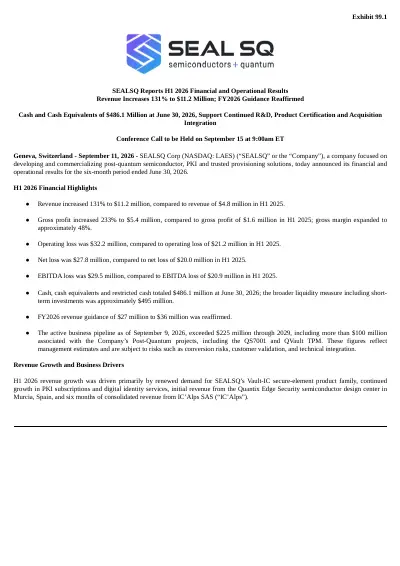
Revenue increased by 131% to $11.2 million compared to $4.8 million in the first half of 2025. Gross profit increased by 233% to $5.4 million from $1.6 million, while gross margin expanded to approximately 48%.
This growth was driven by renewed demand for our VaultIC secure element, expansion in PKI subscription and digital identity services, initial revenue from Quantix Edge Security Murcia Spain, and six months of contribution from IC-Alps. IC-Alps contributed approximately $2.5 million of first half revenue.
More importantly, the acquisition substantially strengthen our capabilities and capacities in custom ASIC design, secure semiconductor architecture, and advanced engineering services. These capabilities are increasingly important as customers seek integrated hardware-rooted security solutions rather than just standalone cryptographic software.
North America generated $5.6 million of revenue, representing 50% of the total. Europe and the Middle East and Africa generated $3.7 million, or 33%, while Asia-Pacific contributed $1.9 million, or 17%.
We believe this is the right moment to invest decisively in building a global leadership position in post-quantum and quantum security. The quantum transition is no longer a distant research topic.
Governments, defense organizations, critical infrastructure operators, financial institutions, and technology companies increasingly recognize that migration to post-quantum security require much more than a software updates. It requires secure semiconductor, hardware root of trust, quantum-resistant algorithms, trusted identities, secure key provisioning, certified manufacturing, sovereign infrastructure, and control over the complete technology supply chain.
CLSK is building capability across all these layers. As June 30, 2026, we had more than $486 million in cash, cash equivalents, and restricted cash.
This strong liquidity position gives us the flexibility to fund research and development, certifications, product industrialization, acquisitions, infrastructure, manufacturing, personalization, and other selective strategic opportunity. Our strategy is to convert CLSK from a secure semiconductor and digital trust company into a major quantum security platform, developing a sovereign vertical stack, what we call from root to qubit, and increasingly from root to space.
At the center of this transformation is what we call the quantum highway. The quantum highway is our architecture for security connecting the different layers of the emerging quantum economy.
It is designed to combine post-quantum semiconductors, quantum computers, quantum photonics interconnects, quantum secure communications, satellite, PKI, digital identity, trusted provisioning, artificial intelligent, and compliance. The objective is not simply to invest in separate quantum technology, it's to integrate them into a commercially deployable, sovereign, and interoperable infrastructure.
At the silicon and hardware root of trust layer, our QS7001 secure element and Q-Vault TPM remain central to our post-quantum commercialization strategy. During the first half, QS7001 achieved NIST SP 800-90B entropy secure source validation under ESV certificate E333.
Validated entropy is fundamental to secure key generation and cryptographic protection, particularly for systems operating in regulated defense and critical infrastructure environments. QS7001 also completed important Common Criteria fault injection and side-channel resistant testing.
This milestone brings us closer to the formal certification required by government agencies and major industrial customers before high-volume deployments. We also continue advancing Q-Vault TPM.
Customer sampling progressed, and engineering samples of the post-quantum Q-Vault TPM 1A5 became available. Our objective is to support the next generation of computers, servers, industrial systems, edge devices, and critical infrastructure with hardware-based protection against both classical and quantum-enabled threats.
As of June 30, more than 150 customers and prospects were engaging with our post-quantum technologies, with over 30 actively evaluating or integrating QS7001 and Q-Vault TPM. We expect initial QS7001 and Q-Vault TPM revenue late in the second half of 2026, with more meaningful contributions beginning in 2027 as customers complete integration, qualification, and product planning.
The precise timing remains subject to certification, customer validation, and procurement cycles. Since the end of the first half, we have continued to make significant progress.
Our VaultIC 408 secure element achieved the FIPS 140-3 validation under the NIST certificate number 5463. This is a major commercial and technology milestone.
FIPS 140-3 validation is widely required for cryptographic products used by governments, defense organizations, financial institutions, and operators of critical infrastructure. The certification strengthened our ability to address highly regulated markets and confirms that CLSK is building its quantum security platform on an already validated and trusted foundation.
We also achieved ISO/IEC 27001 recertification, reinforcing the security and governance framework supporting our semiconductors, PKI, digital identity, and post-quantum operations. Our active commercial pipeline exceeded $225 million in potential revenue opportunities through 2029 and as of September 9, 2026, including more than $100 million associated with post-quantum projects already.
This pipeline spans secure elements, custom ASIC, PKI, digital identity, trusted provisioning, post-quantum semiconductors, and critical infrastructure security. It is a management estimate rather than revenue guidance and remains subject to certification, customer validation, commercial negotiations, procurement decisions, and execution risks, but nevertheless, it demonstrates the scale and breadth of the opportunity we are pursuing.
We are also developing strategic relations with major semiconductors and technology companies. Our work with GlobalFoundries supports the migration of future secure and post-quantum designs to advanced manufacturing platforms.
Our collaboration with Lattice Semiconductor supports post-quantum security for FPGA-based systems, while our work with Parrot provide access to important drone, robotics, and sovereign technology applications for defense. We are also advancing major commercial opportunities for Q-Vault TPM, VaultIC 409, and our broader post-quantum roadmap, including potential applications in computing, industrial systems, connected devices, and critical infrastructure.
Beyond our core semiconductor roadmap, we have accelerated the development of SEAL Quantum, sovereign vertical stack, and its quantum highway architecture. At the semiconductor design layer, IC-Alps provides secure ASIC design and engineering capabilities.
At the quantum computing layer, our investment in CUBIC and E-ROQ provides two differentiated semiconductor-based quantum computing architectures. At the quantum interconnect layer, we completed the acquisition of Miraex.
Miraex brings quantum photonics interconnect technology that can help connect quantum processors, sensors, data centers, and communication systems. This is an essential component of the quantum highway, because quantum systems must eventually be interconnected, not operated as an isolated machines.
As the trusted data and compliance layer, we have increased our ownership in WISeKey to 55.5%, gaining control of the company. WISeKey strengthens our capability in AI-powered compliance, secure data exchange, trusted digital identity, and post-quantum ready financial infrastructure.
At the sovereign design, personalization, and provisioning layer, Quantix Edge Security Murcia generated initial first half year revenue. This approximately $40 million initiative is intended to support Europe-based semiconductor design, personalization, and secure provisioning in one centralized location.
We are now evaluating an expanded Quantix 2.0 vision that could bring together additional semiconductor, quantum AI, and satellite capability in Murcia. In India, we advanced the negotiations to build SEAL Kaynes initiative, which is intended to create localized post-quantum semiconductor capability and give CLSK access to one of the world's fastest growing semiconductor and digital technology market on which sovereignty is important.
At the space and quantum communication layer, our relation with WISeSat supports the development of post-quantum secure satellite and IoT connectivity and communications. The objective is to extend our hardware root of trust from terrestrial devices to satellite infrastructure, creating root-to-space security architecture.
Together, these capabilities form the basis of our quantum highway: secure ASIC design and engineering through IC-Alps; hardware root of trust through VaultIC, QS7001, and Q-Vault TPM; post-quantum PKI, digital identity, and secure provisioning; quantum computer technology through CUBIC and E-ROQ; quantum photonics interconnects through Miraex; AI-powered compliance and trusted data through WISeKey; sovereign semiconductor infrastructure through Quantix Edge and SEAL Kaynes; and post-quantum satellite communications through WISeSat. This is what we mean by sovereign vertical quantum stack: control over the essential layers required to generate, protect, process, transmit, and authenticate sensitive data in the quantum era.
During 2026, we increased the capital allocation to the SEAL Quantum sovereign vertical stack to $200 million. More than $60 million has already been committed across IC-Alps, Miraex, CUBIC, Quantix Edge, Colibri, E-ROQ, WISeSat, and WISeKey.
We are applying disciplined investment strategy focused on technologies that complement our semiconductor and security roadmap, create commercial synergies, and can ultimately become integrated component on the quantum highway. Our participation as a lead investor in CUBIC with a $150 million Series A financing and our increased commitment to E-ROQ reflect our conviction that secure semiconductors, post-quantum cryptography, and quantum computing and quantum communications will increasingly converge among themselves.
Our ambition is not to become a passive financial investor in quantum companies, obviously. Our objective is to assemble, integrate, and control a strategic technology that can generate products, intellectual property, customer, and required revenue for CLSK.
We have also continued to expand the commercial visibility of this strategy. Our collaboration with the BWT Alpine Formula One team has progressed beyond cybersecurity into quantum and multiphysics simulation.
Formula One offers an exceptional environment for demonstrating how quantum technologies can address highly complex industrial challenges involving aerodynamics, materials, energy optimization, and real-time decision-making. These applications are relevant far beyond motorsports.
The same capabilities can ultimately be applied to aerospace, defense, mobility, advanced manufacturing, energy, and defense. Looking ahead, our priorities are clear.
First, we complete the required certification and customer qualification for QS7001 and Q-Vault TPM and begin their commercial ramp. Second, we convert our growing post-quantum pipeline into production contracts and long-term customer relationships.
Third, we integrate IC-Alps, Miraex, and WISeKey into a unified product and technology roadmap. Fourth, expand sovereign semiconductor design, personalization, and provisioning capabilities in Europe, the United States, India, and the rest of Asia.
Fifth, connect our investment in quantum computing, photonics, AI, trusted data, and satellite communication through the quantum highway. Finally, continue deploying our capital selectively and strategically with the objective of creating a vertically integrated quantum security company with defensible technology, sovereign infrastructure, and global commercial reach.
CLSK entered 2026 primarily recognized as a secure semiconductor and post-quantum company. We intend to exit this transformation year as a broader quantum security leader, one capable of protecting the entire digital lifecycle from semiconductor root of trust to quantum computer and space-based communication.
We believe our financial strength, technology portfolio, certifications, partnerships, revenue, and strategic investments give us a differentiated position in this rapidly developing quantum market. The first half of 2026 established the foundation.
The next phase is focused on integration, certification, commercialization, and scale. I will now turn the call over John for a detailed review of our first half financial results.
Thank you very much.
John O'Hara
Thank you, Carlos, and hello to everybody joining us today. On the financials, CLSK reported first half revenue of $11.2 million, an increase of 131% from $4.8 million in the first half of 2025.
As Carlos has already explained, this growth was driven by renewed demand for our VaultIC secure element products, continued expansion in PKI subscriptions and digital identity services, initial revenue from the Quantix Edge Security joint venture, and approximately $2.5 million of revenue from IC-Alps in six months consolidation versus nothing in last year as this was pre-acquisition. From a geographic perspective, North America generated $5.6 million of revenue, representing 50% of the total; Europe, the Middle East, and Africa generated $3.7 million; and Asia-Pacific contributed $1.9 million, or 17%.
Our gross profit increased by 233% to $5.4 million compared with $1.6 million in the prior year, and gross margin expanded to approximately 48%. This improvement reflects a more favorable revenue mix, including ASIC design and engineering services, as well as continued contributions from secure elements, PKI, and digital identity.
Margins in the ASIC sector in particular are higher than our traditional semiconductor margins, and so these have had a positive impact on our margin, and this should continue as this revenue stream continues to grow. Other operating income was $1.4 million compared with $1.7 million in the first half of 2025, remaining relatively consistent year-on-year.
Turning to expenses, R&D expense was $8.7 million compared with $4.7 million in the prior-year period. The increase reflects the consolidation of IC-Alps, post-quantum product development, certification activities, acquisition-related amortization, and continued investment in our technology roadmap.
We continue to expect this to be an area of heavy investment in the future as we look to widen our product range and continue on the roadmap that Carlos set out before. Selling and marketing expense increased to $7.2 million from $6.0 million, reflecting expanded commercialization efforts, customer engagement, and market development.
General and administrative expense was $23.1 million compared with $13.8 million, and this was primarily due to acquired business consolidation, expanded corporate infrastructure, intangible asset amortization, and legal, audit, advisory, and transaction-related costs due to the activities undertaken in the first half of the year. In particular, the acquisition of IC-Alps, Miraex, and WISeKey contributed almost $3 million of additional G&A expenditure alongside $1.3 million of intangible asset amortization relating to these transactions.
As a result, operating loss was $32.2 million compared with $21.2 million in the first half of 2025, while the net loss was $27.8 million compared with $20 million in the prior year. Higher operating expenses were partly offset by the $3.8 million increase in gross profit and also higher interest income earned on our liquidity reserves.
Our EBITDA loss was $29.5 million compared with $20.9 million in the prior year period. The reconciliation includes approximately $0.4 million of depreciation expense and $2.3 million of amortization expense added back.
We end June 30th with $486 million in cash, cash equivalents, and restricted cash. Including short-term investments, total liquidity was approximately $488.5 million.
This strong liquidity position remains a significant advantage. It enables us to continue investing in R&D, certifications, infrastructure, manufacturing, secure personalization, integration, and selective strategic opportunities, while reducing our near-term dependence on external financing.
We will continue to allocate capital carefully toward commercialization, recurring revenue, strategic control, and long-term value creation. Turning to our outlook, we are reaffirming our previously announced fiscal 2026 revenue guidance of $27 million to $36 million.
This represents expected growth of approximately 50% to 100% over the audited 2025 revenue of $18.3 million. Our outlook is supported by the full-year consolidation of IC-Alps, continued demand for our VaultIC products, growth in recurring PKI and certificate management revenue, the initial commercialization of QS7001 and Q-Vault TPM, contributions from the Quantix Edge Security project, and potential custom post-quantum ASIC design programs.
As always, this outlook reflects our current expectations and remains subject to customer demand, qualification and certification timing, supply chain conditions, commercial execution, order timing, and other risks described in our SEC filings. I will now turn back to Carlos to discuss our growth opportunities and strategic priorities.
Carlos Moreira
Thank you, John. Looking ahead, our priorities for the remaining of 2026 and into 2027 are clear.
First, we are focused on commercializing QS7001 and Q-Vault TPM, as previously mentioned. The market is moving from awareness to implementation.
From defense, critical infrastructure, industrial systems, identity devices, secure communications, IoT, and autonomous technology, post-quantum security often requires a hardware-based root of trust. CLSK is well-positioned through our secure element, post-quantum cryptography, PKI, and secure provisioning, ASIC design capability through IC-Alps, and growing international infrastructure.
Second, we remain focused on certification. For regulated customers, certification is a critical conversion point.
Our QS7001 entropy validation and Common Criteria testing process are important steps, and we will continue working towards additional customer qualifications and certification milestones. Third, we are focusing on converting our pipeline into customer deployment and production commitments.
Our active pipeline exceeded $225 million as of September 9, including more than $100 million in post-quantum opportunities, which are going to be increased even further next year as there is a executive order by President Trump requiring PQC deployment and implementation in critical infrastructure in the United States. This is not only a revenue guidance, but it's also reflects the growing interest across our portfolio and the increased need for trusted post-quantum ready infrastructure and to follow the guidelines from the US government.
Fourth, we will execute the sovereign vertical stack strategy with discipline. We have allocated $200 million because we believe critical in technologies, secure semiconductor design, trusted personalization, quantum capabilities, and strategic supply chains will become increasingly valuable.
Every investment must strengthen our roadmap, technology position for commercial opportunities or time to market. Finally, our approximately $495 million liquidity position give us time and flexibility to execute.
We can continue developing products, advancing certifications, recruiting staff, integrating businesses, supporting partnerships, and building infrastructure needed to secure global customers. CLSK is building a platform for the intersection of semiconductor, secure post-quantum cryptography, trusted digital identity, and quantum technology.
We made meaningful progress in the first half. Revenue grew, gross margin expanded, product advanced through technical and certification milestones, and customer engagement increased, and strategic capabilities broadened.
The next phase is execution: converting technology investment into revenue, production commitments, recurring services, and long-term shareholder value. Thank you very much for your continued support and interest in CLSK.
Operator, we are now ready to take questions. Thank you very much.
Operator
Thank you. If you'd like to ask a question, please press star one on your telephone keypad.
A confirmation tone will indicate your line is in the question queue. You may press star two if you'd like to remove your question from the queue.
For participants using speaker equipment, it may be necessary to pick up your handset before pressing the star key. Our first question comes from the line of Matthew Galinko with Maxim Group.
Please proceed with your question.
Matthew Galinko
Hey, thanks for taking my questions, and congratulations on all the progress. Maybe, firstly, is there any way you could share what the pipeline looks like for the broader quantum stack?
I think the $225 million number's for the post-quantum security piece, but I'm curious for the other components like the quantum photonics interconnect, are you engaging with customers? Are there initial conversations happening?
I'm curious when you think that could be commercialized in the future.
Carlos Moreira
Hey, Matt. Thank you very much for your question.
The quantum ecosystem that we're building, companies like Miraex, they are generating initial revenue. As the quantum industry is not really revenue-rich, because these companies are not yet able to generate enough qubits that will justify anyone to pay the price to buy a quantum computer.
This is still very much science work and R&D work. It's essential, right?
Because as soon as this quantum companies start to generate a number of qubits, you can start to do multiple applications, like what we announce on Formula One, with bringing quantum to a sport, extreme sport, and redesign the penetration of the car into the air. All these things are new things that you can start to do with a limited number of qubits, developing new medical products, new materials.
The industry is around there, right? As even a lot of very large quantum-listed companies do not have revenue or very little revenue, or if they have revenue, it's not actually from quantum, but from fabs and another expanded facility.
What is very interesting in this industry is that because we have a quantum security technology and post-quantum semiconductors, very well established with amazing technology, this is allowing us to fully understand what is going to be the vertical on these technologies and they're going to start to accelerate revenue. This is why we invested in CUBIC.
CUBIC, as is a co-investment between us and STMicroelectronics. They are developing qubits at the silicon level, with CMOS technology.
We also invested in E-ROQ with a similar design. This company are advancing exponentially, right?
This is something that will diversify our revenue, while our QS7001, PQC revenue, PKI revenue, identity revenue is well established and will continue growing as soon as those certifications are finalized. You will see a new class of revenue adding to the company through what we call the SEAL Quantum ecosystem, right?
ASIC is another one. ASIC allows us to, and you can see already, that important amount of our revenue is coming up from the ASIC.
There are not many ASIC companies in the world, actually, that they have a trust model and cryptographic root key capability as we have. This is new applications and that they're coming.
For instance, design ASIC for the automobile industry or the medical industry, those are wins that they have done being already by IC-Alps. It is a hard-to-understand sector for the reason that we all know, because it's a very fragmented sector.
There are companies doing quantum sensing, they are companies doing quantum networking, they are quantum number generators, and those are kind of pieces, spare parts of a future vertical stack than we are building, right? Some of them belongs to us, IP-wise.
In others we have technology investment, but as it was in the case of CUBIC, right, we invested on them, but they also acquired $5 million technology from us because they understood that quantum security and verticalization was critical for them to sell the first quantum computers. Similar situations are happening in the United States with E-ROQ, and this is going to be more and more the case where quantum security will be generating revenue for quantum companies, and quantum companies will be acquiring more and more revenue from us.
Matthew Galinko
Got it. Thank you.
Maybe if we could also just expand a little bit on the Quantix Edge, just really the personalization opportunity beyond Spain. I think you've mentioned expansion within Europe potentially and India.
Maybe can you just go back over where you're seeing opportunities to build out those facilities and centers and just geographically, where do you think you can be a year, two years from now with that?
Carlos Moreira
Absolutely. As one of the big issues in quantum is sovereign vertical technology, because quantum computers the day that they're fully developed will be $100 or $200 million apiece, it's a very expensive hardware, which requires PhDs and a very specialized staff.
Obviously, not every company will have the resources to acquire their own quantum computer. What is happening is that the industry is coming with quantum-as-a-service type of model, where you have one quantum computer or several quantum computers in one specific territory, and this quantum computer will be acting as a vertical stack, in a sovereign way.
Obviously, the United States is a huge market, a lot of companies will afford to buy $100 million quantum computer, but in some countries, they will need to only have one or two hubs on where those quantum computers will operate. This is a bit the case of the project in Quantix.
Quantix, as is a joint venture between us and the Spanish government. It is a very interesting project because is expanding very fast.
We started with semiconductor, post-quantum, but we're also adding other elements, actually. In the technology roadmap will be adding the possibility of developing Neo Clouds.
This is a very big subject now, and they are secured by the cryptographic root key capabilities of WISeKey and using secure hardware, PQC secure hardware enabled for CLSK. We are a bit expanding those centers into what you call deep-tech centers, right?
We have one very very successful deployment. There was a €40 million deployment.
This is going to be expanded in the future. SETT has invested already $2 billion in Spain, the Spanish government, in creating sovereign infrastructure, and Murcia is the preferred hub for the entire country, right?
You will see a huge progression there, which will also contributes very substantially in our revenue generation and diversification. The beauty of that model is that we have the footprint on replicating that model anywhere in the world.
The good news is that countries, we go to the Middle East, we go to Asia, we go to South Korea, we go to India, all of them, they are telling us, 'This is actually the model we want. We want a vertical stack which is sovereign, that allows our country to be totally independent in the quantum computer era.'
Because a quantum computer is the one that will, due to the enormous compute capability, will accelerate AI. AI will become much more powerful with quantum computers.
Quantum computers will be able to completely revolutionize the medical sector. They don't want to have this technology outside the country, they want to have it in the country.
I think the angle which is very unique on us, we started from the quantum security, because that's where it's a concern now, with the new executive order in the United States, with President Trump saying, 'You guys needs to be by '29 post-quantum ready. Otherwise, you will not be able to participate in the future critical infrastructure in the United States, because you can be hacked, right?'
The harvest and decrypt now issue that everybody knows about it could happen as early as 2029, 2030. That means that countries needs to be ready.
In the United States, obviously, there's a lot of things are going to happen in the following months, because this executive order is accelerating the demand from big players on post-quantum technology, and there's no available post-quantum technology secure elements like the one we produce. It's no competition yet there, we will be able to accelerate revenue generation in the United States.
As we signed a partnership agreement with GlobalFoundries. GlobalFoundries is number three foundry in the world, which is now very interested.
They received, I think $350 million from the US government on quantum investments, and they are very interested to convert their foundry into quantum foundries as well, they can also develop the next-generation quantum chips. Very close relation with them, and this is helping us to slowly enter into the United States in a way that we will very likely replicate this personalization center in the US soil.
Matthew Galinko
Great. Thank you.
Operator
Thank you. Ladies and gentlemen, that concludes our question-and-answer session.
I'll turn the floor back to Mr. Moreira for final comments.
Carlos Moreira
Thank you very much, everybody, for joining us today. As I mentioned before, the first half of '26 demonstrated the progress CLSK is making across our core business and our long-term strategy.
We increased revenue by 131%. We are one of the quantum companies that generate revenue, the others they are not, and we are expanding our gross margin, advancing our post-quantum product and certification roadmap, and continued building our strategic ecosystem, and maintain at the same time, a very strong liquidity position.
We conclude that quantum security is no longer a distant theoretical issue. Governments, enterprises, critical infrastructure operators are increasingly preparing for the transition to post-quantum cryptography and trusted hardware-rooted services.
CLSK has the product, the engineering capability with over 200 engineers, the certification roadmap, the customer pipeline, the strategic partnerships, and capital position to participate meaningfully in this transition. To our employees, partners, customers, and shareholders, thank you for your continued commitment and support.
We look forward to updating you on our progress through the remaining of '26, and this concludes our today call. Thank you very much for your attention.
Thank you very much for the operator to organize this call.
Operator
Thank you. This concludes today's conference call.
You may disconnect your lines at this time. Thank you for your participation.