AMC Global Media Inc.
Q3 FY2026 · Earnings Call TranscriptNovember 9, 2026
Operator
As a reminder, today's program is being recorded. Now I'd like to introduce your host for today's program, Nicholas Seibert, Senior Vice President Corporate Development and Investor Relations.
Please go ahead, sir.
Nicholas Seibert
Thank you. Welcome to the AMC Global Media third quarter 2026 earnings conference call.
Joining us on the call today we have Kristin Dolan, Chief Executive Officer; Kim Kelleher, President and Chief Commercial Officer; Dan McDermott, Chief Content Officer and President of AMC Studios; and Hozefa Lokhandwala, Chief Financial Officer. We'll begin with prepared remarks, and then we'll open the call for questions.
Today's call may include certain forward-looking statements within the meaning of the Private Securities Litigation Reform Act of 1995. Any such forward-looking statements are not guarantees of future performance or results, and involve risks and uncertainties that could cause actual results to differ.
Please refer to our filings with the Securities and Exchange Commission for a discussion of risks and uncertainties. The company disclaims any obligation to update any forward-looking statements made today.
We will discuss certain non-GAAP financial measures on this call. The required definitions and reconciliations can be found in the press release we issued this afternoon, which is available on our website at amcglobalmedia.com.
With that, I'd like to turn the call over to Kristin.
Kristin Dolan
Thank you, Nick, and thanks, everyone, for joining us. We had another busy and productive quarter with meaningful progress across the key areas that drive our business.
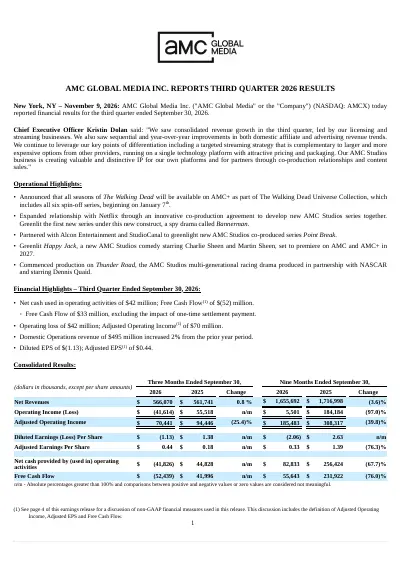
We saw consolidated revenue growth in the third quarter led by our licensing and streaming businesses. We also saw sequential and year-over-year improvements in both domestic affiliate and advertising revenue trends.
The third quarter included the settlement of nearly a decade of litigation related to The Walking Dead. We also completed a transaction to sell our ALLBLK streaming service to MACRO, a company we know well and have been investors in for nearly a decade.
MACRO founder and CEO Charles King and his team are well-positioned to develop and grow ALLBLK for years to come. Hozefa will cover both of these items in greater detail in his remarks.
With this sale, we now have six targeted streaming services, all built for fans of specific types of content. Our strategy is based on offering rich and highly curated experiences complementary to larger and more expensive general entertainment streaming offerings.
Operationally, our services run on a unified technology platform with predictable costs. Our programming investments are responsible and focused.
This approach gives us significant flexibility in the way we price and package our services. We're further able to improve our already strong rates of customer retention with attractive annual subscriptions and bundled offers, both direct-to-consumer and with partners.
Excluding ALLBLK for comparability purposes, retention in the third quarter was consistent with the prior year despite rate events in 2026 across each of our services. The entire media industry is focused on engagement for good reason, but there is a clear distinction between time spent and time well spent.
In a world of so many options, our targeted strategy delivers the right content to the right audiences, resulting in time well spent for passionate and engaged fan communities. In the third quarter, we saw sequential and year-over-year growth in average viewership hours per active user, and a double-digit increase sequentially in total hours watched across our portfolio of services, excluding ALLBLK.
On our last call, we announced a global co-exclusive licensing deal with Netflix for the entire Walking Dead Universe, making this franchise available to their large global audience. Importantly, this agreement lets us bring the original series to AMC+ for the first time ever.
Many successful TV franchises are finding new audiences in streaming, creating the next generation of fans and further enhancing the value of high-quality IP. On January 7th, we will launch the ultimate expression of the Walking Dead Universe on AMC+.
Fans, new and old, will have access to every episode of every series, exclusive specials, behind-the-scenes collections, cast diaries, and more. We recently announced another major development in our expanding partnership with Netflix, an innovative agreement to develop and co-produce new AMC Studios series.
Together, we will jointly fund and own these titles, and they'll be available on both of our platforms. The first show greenlit under this new construct is a spy drama called Bannerman.
Jeff Daniels just joined the cast in a leading role, and we expect to be in production this January with a premiere later in the year. Turning to advertising, we saw continued improvement in our advertising revenue trends in the third quarter.
We recently wrapped a successful upfront that underscored the strength of our programming and our ability to deliver impactful content integrations to our clients. We leveraged this competitive advantage to support premium pricing and secure firm investments across our networks.
The ad market is evolving. We're seeing an increasing portion of digital budgets shift outside of the traditional upfront window, creating a year-round buying environment.
Our early investments in programmatic, audience targeting, and data capabilities have positioned us to capture these additional advertising dollars outside of the traditional upfront window. We're also seeing significant category strength in political.
We have two upcoming series that have generated strong interest from a wide variety of top-tier advertisers: Thunder Road, a multi-generational racing drama starring Dennis Quaid that is currently in production in partnership with NASCAR; and Point Break, a series we are co-producing with Alcon Entertainment and StudioCanal based on the cult classic action film. We've already closed more than a dozen sponsorships and integrations for these shows, with more in the works.
I'd like to close by highlighting the importance of our successful and growing AMC Studios business. We've spent the last two decades nurturing creative relationships and building out our production capabilities and expertise.
The significance of strong talent relationships has been a topic of discussion in our industry lately. It is fundamental to who we are and what we've been able to achieve.
Our studio operation adds valuable IP to our library every year. It drives our linear channels, targeted streaming services, FAST channels, and high-impact sales to third parties, including Apple, Netflix, and other partners around the world.
We produce across the entire spectrum of rights, including fully owned originals, co-productions, and productions for third parties. Silo, which has gone on to become a huge hit for Apple TV, is just one example of our ability to develop and produce for other platforms.
More recently, Netflix bought The Headlands House, a new AMC Studios series in development starring Colman Domingo. We're having a very active fall with some other notable content highlights, including: Kill Jackie, starring Catherine Zeta-Jones; Yaga, starring Carrie-Anne Moss; and Heated Rivalry star Hudson Williams, which is already the biggest AMC+ exclusive series launch ever.
The 30th anniversary of Fear Fest, Acorn TV's An Autumn to Die For, another season of screams on Shudder. Best Christmas Ever, our biggest programming event of the year, is right around the corner.
The third season of Anne Rice's Mayfair Witches, which moves to Salem, Massachusetts, will premiere on December 30th. Rise of the Saints, produced with the NFL and Skydance Sports, arrives in February, along with a new unscripted series called Cursed Sports.
There's so much more to come in 2027. We appreciate your time and continued interest in AMC Global Media.
Now I'd like to turn the call over to Hozefa.
Hozefa Lokhandwala
Thank you, Kristin. Before I review our third quarter results, I'd like to briefly expand on a couple of recent developments that Kristin mentioned in her remarks.
First, we entered into a settlement agreement related to The Walking Dead as disclosed on our Form 8-K filed on September 8th. The $120 million settlement payment is comprised of two parts: first, an $85 million payment that was paid in the third quarter; second, a $35 million advance against future participations that will be paid in January.
The settlement payment has no impact to adjusted operating income. In the third quarter, we sold our ALLBLK streaming service to MACRO, a company we have been an investor in for many years.
The sale included a new multi-year content licensing agreement, which will continue to fuel the growth of ALLBLK under MACRO stewardship. ALLBLK represented approximately 600,000 streaming subscribers at the time of sale.
To accurately reflect core business trends in our results going forward, we intend to provide comparable growth rates reflecting the divestiture of ALLBLK where relevant. On to our consolidated results.
Consolidated revenue grew 1% in the third quarter. Consolidated AOI was $70 million, and free cash flow reflecting the impact of the $85 million litigation settlement was negative $52 million.
Excluding this one-time payment, free cash flow for the third quarter would have been $33 million. Moving to our segment results.
Domestic Operations revenue grew 2% in the third quarter. Subscription revenue decreased by 2%, which reflected streaming revenue growth of 4% and an 11% decrease in affiliate revenue.
Excluding the revenue contribution from ALLBLK, streaming revenue grew 7% on a comparable basis. Streaming revenue growth reflected price increases across all of our services.
We saw a meaningful improvement in our affiliate revenue rate of decline in the third quarter as new agreements and contractual changes took effect. Domestic Operations advertising revenue decreased 7% due to a softer advertising market, partially offset by continued digital advertising growth.
We are seeing continued healthy demand for our content. Third quarter content licensing revenue was $84 million and reflected the timing of content deliveries in the period.
In the third quarter, we started the co-exclusive license for the streaming rights to Fear the Walking Dead in the US. As a reminder, for the full year, we anticipate Domestic Operations content licensing revenue in the range of $460 million to $485 million.
The majority of that revenue will be recognized in the fourth quarter. Regarding adjusted operating income for the quarter, Domestic Operations AOI was $89 million with an 18% margin.
The decrease in AOI was primarily driven by increased technical and operating expenses. Moving to International.
International revenue decreased by 5% to $73 million for the third quarter. Excluding the impact of foreign currency translation, international revenue decreased by 4%.
International subscription revenue, excluding FX, decreased 3%, reflecting the impact of the previously disclosed wind-down of a joint venture that operated primarily in Poland and Africa. International advertising revenue, excluding FX, decreased 6%, reflecting a softer UK advertising market, partially offset by digital advertising growth.
International AOI for the third quarter was $11 million with a 14% margin. Turning to the balance sheet.
We ended the quarter with $440 million of cash on hand and net debt of approximately $1.3 billion. In October, we completed our previously announced $30 million accelerated share repurchase plan, under which we repurchased 2.8 million shares.
Now I'll briefly discuss our outlook for 2026. It is important to note that the scope of our outlook had previously contemplated a full year of ALLBLK and that we expect to achieve our guidance for the year despite no longer benefiting from the inclusion of ALLBLK's results going forward.
As such, for the full year 2026, we anticipate: consolidated revenue in the range of $2.4 billion to $2.45 billion, and adjusted operating income in the range of $410 million to $420 million. From where we sit today, we continue to anticipate free cash flow of approximately $150 million, including the after-tax impact of the one-time $85 million settlement payment I reviewed earlier in my remarks.
As we get closer to the end of the year, it is worth mentioning that the variability in the timing of cash payments and receipts can cause free cash flow to shift from one quarter to another in any given period. Before I close, I would like to echo Kristin's remarks regarding the power and impact of our content and studio.
We're building on decades of experience and momentum at AMC Studios to unlock new opportunities across the full spectrum of rights. Great content is at the core of this company.
Whether that's fully owned IP and beloved franchises, an innovative new approach to co-productions, or how we are just beginning to capitalize on the growing opportunity to produce for others, AMC Global Media is taking advantage of the competitive edge we have as a studio owner. We remain focused on the broad distribution and monetization of the compelling high-quality content that fuels our business.
We'll be prudent in balancing healthy free cash flow generation with the right programming investment levels to support the business. We'll be thoughtful and opportunistic when it comes to capital allocation, maintaining our focus towards the longer-term strength of the balance sheet and continuing to prioritize gross debt reduction over M&A and share repurchases.
With that, I'll now hand the call back to Nick and begin our Q&A.
Nicholas Seibert
Thanks, Hozefa. Operator, please open the line for Q&A.
Operator
Certainly. Our first question for today comes from the line of Steven Cahall from Wells Fargo.
Your question, please?
Steven Cahall
Thank you. Kristin, thank you for the comments on advertising improving.
I was wondering if you could just unpack that a little more. Is the advertising improvement coming from the impressions you're delivering?
You seeing some firmer pricing? I know you've worked hard on combining sort of linear and dynamic advertising, would just love to understand that bit of the portfolio better.
Then on the AOI guidance for the year, I'm not certain about this, but I think ALLBLK might have been losing a little bit of money, and I know you didn't change the AOI guidance for the year, at least I don't think you did, just wanted to check in if anything changed in the underlying performance of the business. Thank you.
Kristin Dolan
Great, thanks, Steven. The early investments that we did have in programmatic, addressable, and data capabilities are definitely helping us really be positioned to catch the shift from traditional to digital demand, and so we're seeing that, but at the same time, our ratings are continuing to be positive for particularly up on BBC America, IFC, and WE tv.
You have that and then digital growth, and then, I'll flip it to Kim just to talk about the overall trend improvements in third quarter.
Kim Kelleher
As Kristin was saying, Steven, it's worth highlighting that we were really early and aggressive with our investments in programmatic, audience targeting, and our data capabilities, and that's really now positioning us to capture the growing digital demand. We did see some early impact from Q3 political advertising that was very much in the digital space.
We were able to capitalize on that growth, which we will see into Q4 in October timing, due to the fact that we've made most of our linear impressions addressable. That flexibility with the digital flexibility that they were looking for, we were able to carry through to our linear inventory.
Then
Kristin Dolan
on your ALLBLK question, I would say, when we started the service, we began with 60,000 subscribers. We grew that tenfold to 600,000 subscribers.
We were really quite diligent and careful in our investment expense on programming, but really what we were seeing as we got further into it was that the unscripted content that we were putting on from WE tv was really driving a lot of the viewership, and then we launched ALL REALITY. With the MACRO team, they're very focused on this particular audience.
We think they can take it to the next level with more scripted series because they have the machine that can drive the real attention of the Black audience. As far as the actual accounting of it, I'm going to ask Hozefa, but—
Hozefa Lokhandwala
Thanks, Kristin. [clears throat] we haven't disclosed details on the transaction, but I'll say that ALLBLK was profitable, and, on sort of the underlying business, there's no change.
Steven Cahall
Thank you.
Hozefa Lokhandwala
Thank you.
Operator
Thank you. Our next question comes from the line of David Karnovsky from J.P.
Morgan. Your question, please?
Hi.
David Karnovsky
Maybe just following up on that advertising, Kristin. You kind of talked to I suppose this is within cable more of the market moving to scatter versus upfront.
Just maybe you can unpack the drivers. What does that mean over the medium term as you kind of repositioned to a full selling cycle throughout the year?
Then second question, just when you look at your streaming services, just what opportunity do you see right now to expand distribution as maybe some other platforms look to widen their channel offerings and then within that, their bundles?
Kristin Dolan
Can you say that again, David? We're having a little trouble hearing you.
Just the second question on streaming.
David Karnovsky
Sure. On streaming, it was just what opportunity do you see to expand distribution of your services as potentially others look to open channel stores or drop more bundles?
Kristin Dolan
All right, I'll answer the second one and then I'll let Kim speak to the advertising. We're constantly looking ways to expand our distribution.
We're big believers, as in the hard-bundled model with partners like Charter and Philo, but we're also in the process of relaunching our services with a more consistent front-end using the Deltatre capabilities that we augmented Shudder with last year, and now we're on the verge of relaunching AMC+ with more advanced capabilities. D2C becomes more interesting for us again because we have spent the last couple years getting a unified platform and a consistent cost to serve across the streaming services.
Then we're with every equipment manufacturer, all the big ones, on every retail platform that most people go to. We're on things like Peloton.
We're really constantly looking for any avenue, particularly because the targeted streaming services that we focus on versus the broad-based entertainment services really do have very specific audiences, we can help look for ways that might be non-traditional to partner and distribute the streaming services to those very specific targeted audiences. If there's anything you think we're missing as far as distribution partners, I'd love any inputs, but it's something we think about pretty much every day.
It's a good combination of wholesale, retail, and D2C as well as the bundles.
Kim Kelleher
On the first part of your question, I do think we're seeing scatter in a much more kind of robust way than we have for the last couple years, to be honest, David. A lot of it though is tied very specifically to the fact that we're in our Super Bowl period with Fear Fest and all our robust horror kind of programming right into Best Christmas Ever in Q4, we're looking to continue that on.
We're very pleased with the upfront results, but it's nice to see the robustness and the fill rates associated with the digital inventory continue on as strongly as they have. Thank you.
David Karnovsky
Thank you.
Operator
Thank you. As a reminder, ladies and gentlemen, if you do have a question at this time, please press star one one on your telephone.
Our next question comes from the line of Sean Diffley from Morgan Stanley. Your question, please?
Sean Diffley
Great, thanks very much. Two if I may.
First on the marketing plan for The Walking Dead coming to AMC+ in January. Curious what your go-to-market's going to be there.
Obviously people can still watch on Netflix, but how do you plan to attack people that maybe aren't on Netflix? Then second on affiliate, I was wondering if you could give us any breakdown in terms of the subscriber declines versus pricing.
Seems like pay-TV ecosystem sub declines maybe getting a little less bad from others. I'm curious if you guys are seeing the same.
Thanks very much.
Kristin Dolan
Great. I'll start with The Walking Dead.
Obviously it's huge for us to have all 377-about episodes for the series, for all the different iterations. We're definitely going to be pushing the tonnage equation, and we have a lot of tonnage just across a lot of the other series and content that we have.
The Walking Dead in particular is very, as closely associated with AMC and now with AMC+. Then we have a lot of extra content, from not just the regular spin-offs, but behind-the-scenes and a bunch of different studio content that we've recorded over the years.
That'll be included. Then obviously we'll have the final season of Daryl Dixon coming up, that we're going to put a lot of tonnage behind that as well.
I think there's a lot with this series around multi-generational viewing, around just the post-apocalyptic point of view that is still featured on a lot of shows. We feel like having a destination and then looking at opportunities for special offers like we just did earlier this year, a $29.99 annual for AMC+, like the combination of having this beloved franchise fully on air along with all of the other supplemental programming that we've done across the Anne Rice Universe and other places.
We're very excited about the first quarter this year, I'll say that. Dan, you want to add anything?
Dan McDermott
The only thing I'd say is The Walking Dead Universe is an evergreen franchise for us. The audience expands with every new generation that finds it, and we have lots of plans to keep new series coming in this universe well into the future.
Kristin Dolan
Go
Kim Kelleher
ahead. Sure.
It's affiliate. Oh.
Kristin Dolan
Sorry, Sean, what was the second question?
Sean Diffley
Just on the affiliate revenue trends. Maybe just any breakdown on subscriber declines versus rate, and I know you've had some renewals.
Are you seeing any plateauing in the pay-TV ecosystem? Fox, for example, has called out some improvement there.
Curious if you're seeing that as well.
Hozefa Lokhandwala
Maybe the only commentary I would give you there without getting into stuff that we don't disclose is that the 3Q rate of decline improved due to new agreements and contractual changes that we commented on. Then we expect the full-year rate of decline, as we talked about, to look similar to 2025.
Kim Kelleher
I would actually just add to that that our weighted agreement term length has not gone down, we're still averaging about four years term in our renewals. Great,
Sean Diffley
thank you very much.
Operator
Thank you. Our next question comes from the line of Charles Wilber from Guggenheim Securities.
Your question, please?
Charles Wilber
Hi, yes. I just was hoping you could expand upon the economics of the new co-production agreements that you announced and outlined there with Netflix and Alcon and StudioCanal.
Just kind of how you see those co-productions going forward and what changes from an economic sense versus your existing productions? Thank you.
Dan McDermott
There's lots of value we get out of partnering with various platforms and other studios around. I would say, just answering the Netflix question, we have a very attractive partner model with a great partner in Netflix that allows us to reduce our programming cash investment and support our core business while still allowing for that shared long-term upside.
The near-term monetization is across our own platforms, and the long-term licensing opportunity comes after both parties' initial license periods ends. Then revenue flows through waterfall, costs are recouped and profits are shared, so that's very appealing to us.
Then on the international co-production, like with Alcon and StudioCanal, again, the value of an international co-pro is that we share in the cost of creation of the asset, and then we monetize it in our respective territories and jointly own the asset in perpetuity. It's a significantly greater upside for us than if we just fully finance the show and then work to sell it off internationally piecemeal.
What we're seeing is multiple partners around the world want to join up with us and others. It's just an attractive business model that I think there's a lot of people that are engaging in, and we're doing it more and more.
Operator
Thank you. Our next question comes from the line of David Joyce from Seaport Research Partners.
Your question, please?
David Joyce
Thank you. In thinking about your international business, what are the pros and cons of maintaining the network infrastructure versus moving more to a licensing model?
Just wanted to see where you are on that and how things could be evolving given you've got these new streaming-related ingestions strategies and what have you.
Kristin Dolan
I'll give it a shot, David. The countries that we're very heavily focused on are predominantly Iberia, we're in Spain and Portugal there.
We have the 15 linear channels there. We're in the top few as far as most viewed within the country.
Spain and Portugal are a little bit different than the US in the sense that everybody overbuilds everybody, and Netflix is there and a few other streaming services are there, but it's not nearly as prevalent as it is in the US. The traditional business model still performs quite well for us, particularly because we have some of the most highly viewed channels in both of those countries.
Then when you move to Central Northern Europe, we're predominantly sports services there, Sport1 and Sport2 in the countries where we operate are the most popular and most viewed linear sports channels in those countries. There's very little streaming in Central Northern Europe, between our local channels in cooking and lifestyle on top of the sports that we do there, we feel confident that, again, it's probably 15 or 20 years different than what it was in the US when it comes to those markets.
The broadband is strong and the capabilities are strong, but the government subsidizes a lot of the content, you get a full cable bundle in those countries for 20 bucks a month, there's really not a lot of push to drive incremental content because you can get so much for your dollar. The UK I think everybody knows is a little bit of a hybrid.
There's a variety of things going on over there, but we like being on the ground and partnering with Sky and with ITV and some of the other folks in the UK, and we're going to continue to do that. Then LatAm is sort of the Wild Wild West, I think, for a lot of the companies in that it's a very high-growth marketplace.
There's a lot of eyeballs, a lot of advertising dollars to be made, but the theft situation in a lot of the larger countries like Brazil is still challenging, it makes it a hard business model, more because we can't guarantee that we're going to get paid for everything that we're doing because there's just a lot of theft in those marketplaces. We focus on the traditional business where it makes the most sense in these areas, and then luckily we have all the opportunistic things we've been doing in the US for the past five, eight years, we're able to learn from that and imbue our learnings from what's going on in the US to our strategies and use those to inform our go-forward plans in the other countries.
David Joyce
All right, thanks for the update.
Kristin Dolan
Sure.
Operator
Thank you. This does conclude the question-and-answer session of today's program.
I'd like to hand the program back to Nicholas Seibert for any further remarks.
Nicholas Seibert
Thank you all for joining us today. We appreciate your interest in AMC Global Media.
Have a nice day.
Operator
Thank you, ladies and gentlemen, for your participation in today's conference. This does conclude the program.
You may now disconnect. Good day.