Intercorp Financial Services Inc.
Q3 FY2026 · Earnings Call TranscriptNovember 10, 2026
Operator
Good morning, and welcome to the Intercorp Financial Services third quarter 2026 conference call. All lines have been placed on mute to prevent any background noise.
Please be advised that today's conference call is being recorded. After the presentation, we will open the floor for questions.
At that time, instructions will be given as to the procedure to follow if you would like to ask a question. Also, you can submit online questions at any time during today using the window on the webcast, and they will be answered after the presentation during the question-and-answer session.
Simply type your question in the box and click submit question. It is now my pleasure to turn the call over to Mr.
Ivan Peill of Inspire Group. Sir, you may begin.
Ivan Peill
Thank you, and good morning, everyone. On today's call, Intercorp Financial Services will discuss its third quarter 2026 earnings.
We are very pleased to have with us Mr. Luis Felipe Castellanos, Chief Executive Officer, Intercorp Financial Services; Ms.
Michela Casassa, Chief Financial Officer, Intercorp Financial Services; Mr. Carlos Tori, Chief Executive Officer, Interbank; Mr.
Gonzalo Basadre, Chief Executive Officer, Interseguro; and Mr. Bruno Ferreccio, Chief Executive Officer, Inteligo.
They will be discussing the results that were distributed by the company yesterday. There is also a webcast video presentation to accompany the discussion during this call.
If you didn't receive a copy of the presentation or the earnings report, they are now available on the company's website, ifs.com.pe. Otherwise, if you need any assistance today, please call Inspire Group in New York on 646-940-8843.
I would like to remind you that today's call is for investors and analysts only. Therefore, questions from the media will not be taken.
Please be advised that forward-looking statements may be made during this conference call. These do not account for future economic circumstances, industry conditions, the company's future performance, or financial results.
As such, statements made are based on several assumptions and factors that could change, causing actual results to materially differ from the current expectations. For a complete note on forward-looking statements, please refer to the earnings presentation and report issued yesterday.
It is now my pleasure to turn the call over to Mr. Luis Felipe Castellanos, Chief Executive Officer of Intercorp Financial Services, for his opening remarks.
Mr. Castellanos, please go ahead, sir.
Luis Felipe Castellanos
Thank you. Good morning, and thank you all for joining us on our third quarter 2026 earnings call.
Let me start with the macro environment. In the first half of 2026, private investment grew 15%, its fastest growth since 2012, and domestic demand grew almost 6%, which is the highest since 2013.
Exports have reached new historical records, and all of this has come with a prudent fiscal deficit and debt-to-GDP ratio. Business confidence is also at its highest level in recent years.
On the political front, we see the executive pushing forward its investment agenda, which is consistent with expectations for a stronger private investment and should help bring Peru back to its medium-term growth potential. All in all, we are optimistic about what lies ahead for Peru, and we believe the coming years should be positive.
In the short term, we are especially focused on the El Niño event, which we are now assuming that will be an extraordinary magnitude. We expect the impact to be temporary, mainly affecting primary sectors such as agriculture and fishing, and extending into the first half of 2027.
Depending on the strength of the rains, infrastructure, primarily in certain regions of the north, will be affected. Even so, we continue to expect GDP growth of around 3% next year.
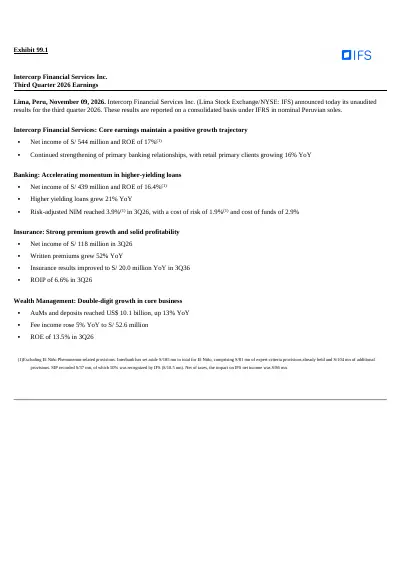
We believe the country is well positioned to return to its medium-term growth path once this effects fade. In this context, IFS net income was 457 million with an ROE of 14%.
These results mainly reflect the provisions that were booked in anticipation of El Niño at Interbank, and to a lower extent at SIP, in line with our prudent approach to risk management. Excluding these provisions, net income would have been 543 million, with an ROE of close to 17%.
As mentioned, we see the impact of El Niño as short term, while our medium-term view has actually improved. We see our medium-term ROE target to be up above 20% now.
At Interbank, the underlying business continued to show positive trends. Excluding El Niño provisions, risk-adjusted NIM expanded to 3.9% from 3.5% last quarter.
Loan growth accelerated in consumer and in small businesses, both higher-yielding segments, which is contributing to the NIM expansion. Asset quality is also performing very well, with a positive trend.
Year-to-date cost of risk, excluding El Niño provisions, is 1.8%, and NPLs is at 2%, reflecting the quality of our portfolio and our risk management capabilities. As a result, we believe the bank is better positioned as we enter this El Niño period as compared to the previous ones.
We continue to strengthen our payments ecosystem through Izipay and Plin. These platforms are important levers to deepen our relationships, increase engagement, and support the growth of low-cost funding.
Interseguro maintained strong momentum in its core business, while preserving its leadership in annuities. The business continues to leverage synergies with Inteligo and Interbank to advance more integrated solutions for our customers.
Inteligo continued to grow at double-digit rate, reaching a new record in assets under management, supported by healthy client engagement and strong advisory model. The investment portfolio had more moderate quarter, but this does not change the trend of its core business.
Overall, this quarter shows that we remain on track in terms of results and profitability, supported by a diversified platform, clear growth opportunities across businesses, and a disciplined execution of our model. El Niño event should be a short-term effect.
Our strategy remains focused on profitable growth, with the customer at the center of our decisions and continued investments in the capabilities that support long-term value creation, including digital solutions, data analytics, cybersecurity, and GenAI. Looking ahead, we believe IFS is well positioned to continue growing with discipline, while sustaining profitability and strengthening our leadership in Peru over the long term.
Now, let me pass it on to Michela, who will walk you through this quarter results in more detail. Thank you.
Michela Casassa
Thank you, Luis Felipe. Good morning, and welcome again, everybody, to Intercorp Financial Services third quarter 2026 earnings call.
I would like to begin with our key messages for the quarter. First, Peru remains resilient ahead of El Niño.
Even after incorporating a stronger El Niño, the Central Bank projects GDP growth of 3% for 2027. Second, core earnings maintain a positive growth trajectory.
Excluding El Niño-related provisions, net income was 544 million soles, with an ROE of around 17%. Third, accelerating momentum in higher-yielding loans, which grew 21% year-over-year and 10% in the quarter alone.
Fourth, NIM recovery on a better asset mix. NIM expanded 20 basis points to 5.1%, and risk-adjusted NIM, excluding El Niño provisions, improved 40 basis points quarter-over-quarter to 3.9%.
Finally, insurance and wealth management continue to deliver strong growth, with written premiums up 30% in the first nine months, and assets under management up 13% year-over-year. Let's start with our first key message, which is that Peru remains resilient ahead of El Niño.
On slide 4, let me update you on the macro environment. The economy is regaining speed.
GDP is tracking around 3.4% in the third quarter, based on data through August, up from 2.6% in the previous quarter. Non-primary sectors continue to support growth.
The Central Bank now expects GDP to grow 3.2% this year and 3% in 2027, below its previous estimates of 3.4% and 3.2%, as it incorporates a stronger El Niño. Growth remains supported by commerce, services, and construction, with exports at record levels.
Looking ahead to 2027, we expect a more challenging first half, as El Niño would weigh on activity during the summer months. However, we anticipate a significant recovery in the second half, supported by reconstruction spending and the fiscal response.
The impact will not be the same everywhere. The north, the most exposed region, would contract in the first half and rebound in the second, while other regions would be less affected, limiting the impact on overall annual growth.
Inflation reached 5.3% in October, remaining above the Central Bank's target range. Core inflation is lower, at 4.6%, and excluding transportation, which was affected by fuel prices increases, it would be close to 2%, consistent with the target range.
That said, the reference rate has remained at 4.25% over the past year, and a rate increase over the next six months cannot be ruled out. Overall, Peru continues to stand out for the strength of its macroeconomic fundamentals.
Public debt remains among the lowest in Latin America, country risk is one of the lowest in the region, and financing conditions remain favorable across the yield curve, supporting a constructive medium-term outlook. On slide 5, for a bank, what matters is whether this macro recovery translates into credit demand, and we are beginning to see clear signs that it does.
Business confidence rose to 69, its highest level in recent years, while consumer confidence reached 50 points. This improving sentiment is translating into stronger spending and investment decisions.
In fact, the Central Bank expects domestic demand to grow 6.2% this year and private investment 14%, one of its strongest expansions in more than a decade, with private investment remaining resilient at 8.5% in 2027. Supporting this outlook is a robust investment pipeline for 2026-2030, totaling $124 billion.
Mining represents 52% of the total, and infrastructure another 28%, led by projects such as Tía María, Trapiche, Pampa de Pongo, Anillo Vial Periférico, and Longitudinal de la Sierra Tramo 4. Beyond their direct impact, these projects should continue supporting employment, business activity, and financing needs across sectors.
We can already see this momentum in the financial system. As of September, loans grew 11.8% year-over-year, with retail expanding 13.8%.
We are seeing a similar trend in our own portfolio, which reinforces our view that renewed confidence is translating into stronger credit demand. On slide 6, before turning to the results, let me spend a moment on El Niño.
ENFEN's October update raised the probability of an extraordinary coastal El Niño in the first quarter of 2027 to 55% from 9% in June. We are facing the possibility of an extraordinary event, and therefore, we decided to provision in line with this scenario.
Around 11% of our loan portfolio is flagged as potentially exposed, with about 8% through direct exposure to agriculture and fishing, which we consider very low risk, and about 3% through consumer and small business loans in the affected zones, which we consider medium risk. The 8% is made up entirely of commercial clients with direct exposure, and all of them already have FEN clauses that allow them to refinance or defer payments, we do not expect the agriculture and fishing exposure to generate provisions for the bank.
On the 3%, retail clients do not have these clauses, which is why we see it as medium risk, but we are ready to support them through rescheduling programs allowed by the Superintendency. This quarter, Interbank set aside 185 million soles in total provisions for El Niño, comprising 81 million of already held under expert criteria, and 104 million soles of additional provisions.
SIP recorded 37 million soles as well, of which 50%, or 18.5 million soles, was recognized by IFS. Including our share of SIP, the after-tax impact on IFS net income was 86 million soles.
This provisioning reflects the scenario we see today, which assumes a stronger El Niño than previously expected, but we will reassess as the event evolves. We are already acting by tracking the exposed portfolio on a daily basis, tightening underwriting standards in the affected areas, and supporting our employees in those areas.
Once the event has passed, we will be there to support recovery in the affected regions. On the government side, the Ministry of Economy has announced a broad support package that includes additional fiscal funding, cash transfers to affected families, state-backed loan guarantees for SMEs, and accelerated public work programs.
Together with reconstruction spending, these measures should help mitigate the economic impact of El Niño and support a stronger recovery in the second half of 2027. Let's now turn to our second key message, which is that core earnings maintain a positive growth trajectory.
On slide 8, in the context of what we just discussed, our core earnings are on the right track. Excluding El Niño-related provisions, net income was 544 million, up 19% year-over-year, with an ROE of 16.6%.
Compared to last quarter, net income was down 7%, mainly because investment results at Inteligo and Interseguro normalized after a strong second quarter. Once we include the El Niño provisions at Interbank and SIP, reported net income was 457 million soles, with an ROE of 14%.
Overall, setting El Niño aside, the underlying trends remain solid year-over-year, and the bank is leading the way. At the bank, the net income excluding El Niño was 439 million soles, up 10% from last year and 9% from last quarter, with an ROE of 16.4%.
This was driven by higher loan income and lower funding cost, which are also behind the NIM recovery. At Interseguro, net income was 97 million soles, with an ROE above 30%.
That's below an exceptionally strong second quarter, but 2.6 times what we reported a year ago, when the results included a credit loss provision on financial investments. At Inteligo, net income was 38 million soles, with an ROE of 13.5%, as investments return normalized after a very good first half of the year.
Importantly, the recurring part of the business is on track, and fees and assets under management continue to grow. On slide 9, looking at the first nine months of the year, net income excluding El Niño was 1,731 million soles, up 17% year-over-year, with an ROE of 18.1%.
Including El Niño, reported net income was 1,644 million, up 11% year-over-year, with an ROE of 17.2%. The important point is that even after absorbing El Niño, we remain in line with our full-year ROE guidance of around 17%.
On slide 10, revenues grew 8% year-over-year to 2.1 billion soles, and flat versus the previous quarter. At the bank, the trend is encouraging.
Revenues were up 4% in the quarter and 8% year-over-year, with NIM recovering to 5.1%, in line with our strategy to grow in higher-yielding loans. We also benefited from lower funding costs, partly offset by lower FX results.
At Interseguro and Inteligo, revenues declined versus the previous quarter by 3% and 30%, respectively, due to investment results, which were very strong in the previous quarter. The underlying trend is moving in the right direction, as revenues grew 12% year-over-year at Interseguro, driven by the insurance result, and 8% at Inteligo.
On slide 11, expenses for the first nine months grew 10% year-over-year, and our cost-to-income ratio was 37.8%, compared with around 37% a year ago. The main driver was technology, up 15% versus last year, as we continue to invest in cybersecurity, infrastructure, and data and analytics.
Personnel expenses are up 14%, reflecting the expansion of Interseguro's sales force and key talent that we are adding across the platform. Now, let's turn to our third key message, which makes us most optimistic about the coming quarters.
On slide 13, our higher-yielding loans, consumer and small businesses, are accelerating, growing 21% year-over-year and 10% in the quarter, almost doubling the pace of the previous quarter. In consumer loans, the recovery we anticipated in our last two calls is now materializing.
Excess liquidity is normalizing, and activity is coming back, supported by better confidence. As a result, consumer loans are up 18% year-over-year and 10% in the quarter, outperforming the market and gaining 20 basis points of market share versus last quarter.
In September, cash loan disbursements grew 44% year-over-year, and credit card turnover 21%, and so far, we have not seen a pause due to El Niño. In small businesses, growth continues at an accelerated pace, with loans up 34% year-over-year, and disbursements up 63% in September.
Our business banking app, which brings together Interbank and Izipay, the acquiring business, strengthens our value proposition, and we still see room to continue gaining share. Together, these segments now represent 23% of the performing loan book, which supports NIM recovery.
That said, these segments are also the most sensitive to El Niño, we want to be very clear that we are growing conservatively. We are focusing our growth on zones that we do not expect to be affected by El Niño and on low-risk clients, and we have already tightened origination in the exposed areas.
On slide 14, our performing loan book grew at a double-digit pace, or 10% year-over-year, up from 6% last quarter. In the quarter alone, it grew 4%, with good momentum in both retail and commercial.
What we like about this growth is that it is broad-based and led by segments with attractive risk-adjusted returns. Starting with retail, we are growing more than 9% year-over-year.
Consumer, as previously mentioned, is leading with 18%, and mortgages continue to grow steadily at 8%. The good news is that now mass market is the fastest-growing segment at more than 10%, while the affluent segment is growing as well, but at a more moderate pace.
In commercial, we are growing 11%, led by small businesses at 34%, and I would also highlight mid-sized companies, which are growing more than 14%. Deepening our relationships and complementing our value proposition with Izipay is helping us grow both in small businesses and mid-sized companies.
Turning to our fourth key message, a NIM recovery on a better asset mix. On slide 16, the NIM story is positive, and it is driven by lower funding costs and a better asset mix, with a higher weight of loans that should keep building in the coming quarters.
NIM increased 20 basis points to 5.1%, with contributions from both assets and funding. On the asset side, the return on interest-earning assets rose 20 basis points to 7.7%.
Importantly, this came mainly from loan yields, which rose to 9.7%. This marks a change in trend, driven by the shift towards consumer and small business loans, which now represent 23% of the performing loan book.
At the same time, our asset mix is improving, with loans now representing close to 70% of interest-earning assets. Excluding El Niño provisions, risk-adjusted NIM was 3.9%, which is 40 basis points above last quarter, reflecting our strategy to grow in higher-yielding loans.
Including El Niño provisions, it was 3.4%. Looking ahead, we expect the shift in mix towards higher-yielding loans to become a larger driver of NIM, together with lower funding costs.
Given the possibility that the Central Bank raises rates, it is worth sharing our sensitivity. For every 100 basis points increase in the soles reference rate, we estimate a negative impact of around 7 basis points on NIM.
On slide 17, excluding El Niño, cost of risk was 1.9%, below the 2.1% of both last quarter and a year ago. Including it, cost of risk was 2.7%, El Niño explains the entire increase.
The underlying indicators all improved. Delinquencies are declining, mainly due to better payment behavior of customers, in line with stronger economic activity.
Our recent vintages are also performing well across the portfolio, even with the growth we mentioned in higher-yielding loans. In retail, excluding El Niño, cost of risk was 3.4%, slightly above the 3.3% of last quarter.
That increase reflects the growth of the portfolio. Commercial remained very low, at 0.5%, which, together with an NPL ratio of 1.3%, shows the portfolio is performing well.
El Niño provisions were booked based on expert judgment, as we decided to provision for the scenario we see today. We will reassess as the event evolves.
Excluding El Niño, we would expect a slight increase in line with portfolio growth in higher-yielding segments, while continuing to improve risk-adjusted returns. On slide 18, the improvement in funding is the other half of the NIM story.
Cost of funds fell 10 basis points in the quarter and 20 basis points from a year ago. This is a result of the mix, which is moving in the right direction, as low funding costs increased to 39% of total funding, reflecting our focus on the payments ecosystem, primary banking, and transactional deposits.
Retail and commercial deposits now represent 85% of funding, and the loan-to-deposit ratio is at 93%. On slide 19, our payments ecosystem connects directly with the funding trends we just discussed.
More transactional activity brings more low-cost deposits and creates cross-selling opportunities. In payments, flows from the Interbank-Izipay relationships grew 58% year-over-year, and Interbank's share of Izipay flows increased to 48%.
In small business, deposits grew 30%, alongside 34% growth in loans. Engagement continues to rise.
Plin transactions are up 43% year-over-year, and 86% of our retail customers are now digital, which is the engine behind our lower cost of funds. Plin also keeps expanding its use cases.
Plin TC, or Plin credit cards, which lets customers send money using their credit card line, has already surpassed 100,000 active customers. On WhatsApp, we cut transaction time by a third, and transactions per user increased by 17%, reflecting stronger customer engagement and higher recurrence.
We are also making the app more useful and safer, with tools like Modo Calle, which helps reduce fraud from phone theft. Clients are noticing, with retail NPS reaching 64 points.
We are growing while improving the customer experience, which makes that growth sustainable. Let's now turn to our fifth key message on insurance and wealth management, where growth remains healthy.
On slide 21, at Interseguro, the key metric is the contractual service margin, or CSM, which represents the stock of future profits from our long-term insurance business. It reached 1.2 billion soles, up 8% year-over-year, driven by annuities and individual life, and short-term insurance grew 10% year-over-year.
Investment results were 278 million soles, a 6.6% return, well above last year's 4%, when we recorded credit loss charges on financial investments. Compared with last quarter, the return is broadly stable, excluding inflation effects.
The 7.1% return in the second quarter would have been 6.7%, very much in line with this quarter. Overall, the business is performing well, as expected.
On slide 22, at Inteligo, assets under management, including deposits, reached $10.1 billion, up 13% year-over-year, supported by market performance and net inflows from clients. Fee income reached 53 million soles, up 5% year-over-year and 3% in the quarter.
This is the recurring part of the business, and it continues to grow alongside assets under management. Overall, wealth management continues to deliver resilient growth, supported by a strong advisory model and healthy demand for investment solutions.
On slide 23, we are bringing the same digital approach to insurance and wealth management. At Interseguro, direct digital sales grew 25% year-over-year to 40 million soles, and 74% of client interactions are now self-service, improving both customer experience and cost to serve.
At Interfondos, we are turning the app into a digital advisor. Digital users went from 30% to 42% of customers in a year, supported by accelerated app adoption, which added more than 11,000 new clients versus the same quarter last year.
Digital transactions now represent 64% of platform activity, up from 55% last year, while physical transactions continue to decline. A renewed website and richer content also strengthen our digital ecosystem.
Now, let me move to the final part of the presentation, where we bring everything together. On slide 25, let me bring together what we have discussed on growth.
Our growth is broad-based, with retail loans up 9% year-over-year and commercial loans up 11%. Within the bank, our focus is on consumer and small businesses, and this is where growth is accelerating, with consumer loans, excluding payroll-deductible loans, up 18%, and small business loans up 34% year-over-year.
Beyond the bank, long-term insurance and wealth management keep growing, with the CSM of insurance up 8%, and assets under management up 13% year-over-year. On slide 26, I'd like to close with our nine-month operating trends and how they compare with what we commented at the beginning of the year.
On profitability, ROE for the first nine months is 18.1% excluding El Niño, or 17.2% on a reported basis. We continue to expect a full-year ROE of around 17%, even after absorbing El Niño provisions.
On loans, growth is 10% year-over-year, a little bit above the high single-digit growth we expect for the full year. The acceleration in higher-yielding segments gives us confidence.
On efficiency, our cost-to-income ratio is around 37%, within our guidance range, even as we continue to invest for growth. Let me close the presentation with our key takeaways.
First, Peru remains resilient ahead of El Niño. Second, core earnings maintain a positive growth trajectory.
Third, we are accelerating, and we have a momentum in higher-yielding loans. Fourth, NIM recovery on a better asset mix.
Finally, insurance and wealth management continue to deliver strong growth. Thank you very much.
Now, we are ready, and welcome any questions you might have.
Operator
Thank you. At this time, we will open the floor for questions.
First, we will take the questions from the conference call, then the webcast questions. If you would like to ask a question, please press the star key followed by the one key on your telephone keypad.
Questions will be taken in the order which they are received. If at any time you would like to remove yourself from the questioning queue, please press star then two.
Again, to ask a question, please press star then one now. For the webcast viewers, simply type your question in the box and click submit questions.
We will pause momentarily to compile a list of questioners. The first audio question will come from Ernesto Gabilondo with Bank of America.
Please go ahead.
Ernesto Gabilondo
Thank you. Hi, good morning, Luis Felipe, Carlos, and Michela, and good morning to all your team, and thanks for the opportunity to ask questions.
My first question will be on El Niño. You mentioned that the total exposure to El Niño represents roughly 11% of your total loan book.
Just wondering how much additional provisions would you require in the fourth quarter and maybe in the first quarter of next year? Just wanted to have an idea on what should be the total provisions that you should consider to El Niño.
Hey,
Luis Felipe Castellanos
Ernesto. Thanks very much.
You're right. It's 11% is, as Michela mentioned, is potentially exposed, of which 8% is basically commercial loans targeted to fishing and agro-industry.
As Michela mentioned, that we consider low risk. Those are solid, experienced, well-capitalized corporations, we do not expect significant provisions coming there from El Niño.
The other 3% potentially exposed is more in consumer and SMEs, also mentioned by Michela. Based on the scenarios we're running, and as was mentioned, today we know it's going to be an extraordinary El Niño event.
That's what we are considering in our numbers. With the information that we have now, that's the level of provisions that we consider we will have.
As Michela mentioned, we need to continue monitoring, because news continue to change, no? If we do have an extraordinary El Niño as has been mentioned and analyzed during the last couple months by the analyst, this is what we should have.
If conditions change, maybe we overbooked provisions if it's not as strong, or if something happens that becomes stronger than extraordinary, probably have to reassess at that time, no? With the information we have now, that's what we think covers up, based on the exposure that we have.
Ernesto Gabilondo
Just to understand, I believe you have created provisions of 185 million soles to El Niño, and that you should not expect additional provisions in fourth quarter for the moment? You will have to evaluate how is El Niño evolving, but just want to double check these figures.
Luis Felipe Castellanos
That's correct. 185 million soles of provisions allocated to El Niño at Interbank, and around 37 million allocated to SIP, which, as has also a consumer book.
Ernesto Gabilondo
Perfect. Then just in terms of your cost of risk, your cost of risk if we consider the provisions related to El Niño, how should we think about your cost of risk guidance for this year?
Also, you mentioned that even with these impacts of El Niño, you expect an ROE of around 17% this year. Then how should we think about the ROE trajectory over the next years?
Luis Felipe Castellanos
Okay. I'm going to pass it on to Michela or Carlos for a deeper view on the cost of risk particularly, but yeah, you're right.
Even with the El Niño provisions that were unexpected that we have booked already, our expectation is that this year we'll continue to be at around 17%, we're not changing our views at the beginning of the year. As you saw, we were having an overperformance.
We knew El Niño was coming. At some time during the year, we figured that out, but we're not changing our view that we will be around 17% for this year.
As mentioned before, the trajectory of the profitability of IFS will be continuous recovery based on how fast we can rebuild what we've already seen during the second half of this year: the consumer book and the SMEs proportion of loans weighing more over the overall portfolio and maintaining the profitability of the other businesses as we have been doing during the last months, no? Now, maybe let me pass it on to Michela, she can walk you a little bit more in detail on the cost of risk evolution and expectations.
Michela Casassa
Thank you, Luis Felipe. Good morning, Ernesto.
Let me just comment, Ernesto, that cost of risk throughout the year, excluding, of course, this extraordinary provisions for El Niño, has been, below, no, our expectations. We had 2.1% in the last quarter, and it would have been 1.9% this quarter without El Niño.
Basically, what we have been looking at quarter by quarter is a better performance of the portfolio than expected, given the strong macro backdrop that we have. We commented in the past quarter that as long as the higher-yielding loans continue to represent a higher proportion of the total book, no, we should start to see that cost of risk to increase, no?
We never gave a guidance in terms of cost of risk, but we said, no, we should be getting closer to 2.5%, and in the medium term, maybe even above that, okay? Basically, we should see, no, excluding El Niño, a cost of risk that gradually increases to those levels during next quarter and most likely 2027, no?
That's the story, I think, we've been discussing in the past quarters. The positive surprise has been also this quarter that taking aside El Niño phenomenon, no, cost of risk did not increase, but it was even 20 basis points better than the previous quarter, which is good news because it means that we are, let's say, facing El Niño with a much healthier credit portfolio.
Ernesto Gabilondo
No, no, perfectly understood in terms of the cost of risk without El Niño. Just to forecast our estimates in the model, cost of risk including the provisions for El Niño was around 2.7% in this quarter.
For a full year, how should we think about it, including the provisions for El Niño?
Michela Casassa
I couldn't tell you a number, Ernesto, at this point, because we need to see what happens in the fourth quarter, no, both without El Niño and with El Niño.
Luis Felipe Castellanos
I guess if you just add those 185 million to your base number, you kind of have a good proxy of what the number could be, Ernesto.
Ernesto Gabilondo
No, perfect. Thank you so much.
Operator
The next question will come from Yuri Fernandes with JP Morgan. Please go ahead.
Yuri Fernandes
Hey, guys. Good morning.
Thank you for the opportunity of asking questions. Hi, Luis Felipe, Carlos, Michela, everyone.
I have a first one. I'll try to move away from El Niño, because it has been all the topic, and it's the most important topic, I'm pretty sure other analysts will also ask you more about this.
Just on funding, guys, your margins, they were good, but the funding cost, it was down, and it was not clear for me what is driving that. Not sure if it was the excess bonds you had in previous quarters, but the funding cost was down, and not that clear why.
If you can explain what happened, and if the funding cost for the bank is recurring or not. Then I have a question regarding capital, because I think this quarter there were some OCI headwinds.
You are accelerating loan growth, and your RWAs are following the loan growth, but your capital has been coming down, right? Your core capital is now at 11.6%.
If you can remind us how to think about capital, again, given El Niño, all this uncertainty, and I get it that you already did some provisions, but if you want to keep a higher capital position or not into El Niño or not. If yes, if we should see any change on dividends or any other policy, because I think you also did more buybacks this quarter.
First question, funding; the second question, what should we expect on capital? Thank you.
Luis Felipe Castellanos
Okay. Thank you, Yuri, for your questions.
I'm going to pass it on to Michela, and then maybe Carlos can complement. On funding, the quick, short answer is our strategy is working, no?
We've been discussing this for a while, but then Michela can give you a little bit of the detail.
Michela Casassa
Thank you, Luis Felipe. Yuri, talking about funding, no, as you see from the slide, cost of funds was down 10 basis points in the quarter, but also cost of deposits was 10 basis points below the previous quarter.
There are a number of reasons, but I would say that the main one is what Luis Felipe mentioned, no? We continue to grow faster on the low-cost funding elements on the funding base, which comes from retail deposits, transactional deposits, but also small business and mid-sized companies deposits, which are non-remunerated, no?
Those components are growing double-digit and faster than the rest of the funding base. There was also a small impact, no, because of the what you mentioned, the double carry of the bond that starting the full October, no, we don't have.
That also helped. I guess the more medium-term trend is what I mentioned about the strategy.
Now, of course, going forward, we have some pressure on cost of funds because of what is happening with rates, no? We are trying to balance those two, those two forces.
Now, talking about capital, you described the situation perfectly, and one of the things that kind of changed in the OCI is the non-realized losses that the previous quarter were non-realized gains on the portfolio of sovereign bonds that we have at the bank, okay? Now, just to remind you about our internal policy for both Common Equity Tier 1 and total capital ratio, there are new regulatory limits that go full in place December 2026, that for Interbank are around 9% Common Equity Tier 1 minimum capital ratio, and around 14.2% total capital ratio, okay?
With the levels that you see, we are okay, we are comfortable, and we are above our internal buffers. It is important to mention also that with this new regulation in place from the Superintendency, there is a much broader differentiation, if you want, in terms of the capital requirements for the different banks in the system.
That, I think, is important because as the systemic buffer is different among banks, you will also see minimum regulatory requirements which are very different between us and the other top banks in the country, okay? In our case, we are in the first bucket of that buffer, which is 50 basis points, but in the case of other banks, that goes up to 150 basis points and to 200 basis points.
I think it's important to consider that you will start to see different total capital ratios in the system, but also because the minimum regulatory requirements have a difference of around 150 basis points, okay? Now, in any case, no, we are growing faster than expected, we continue to assess our plan, our medium-term plan in terms of funding.
We have more space in the Common Equity Tier 1, as you can see. We are a little bit tighter in the total capital ratio, we are, of course, in any case, looking at our strategy for 2027.
Luis Felipe Castellanos
Just to round up, you're right, we completed our approved buyback program, I think at the beginning of last year or at some point last year. We completed that program.
We have purchased equivalent to around $200 million of IFS shares equivalent,
Yuri Fernandes
no? No, great.
Super clear the answers. If I may just a final follow-up on the buybacks, you completed the program.
Any plans of opening new programs on buybacks?
Luis Felipe Castellanos
That's being reviewed right now, Yuri. As we have a positive view on the potential evolution of the share, management is ready to recommend that, but we have to balance growth.
It's related to capital as well, no? That has not been defined yet, but it's an alternative that we will definitely evaluate at the right time,
Yuri Fernandes
no? Liquidity, right?
Sometimes people ask about the share liquidity as well. No, thank you very much, guys.
Thank you. Liquidity,
Luis Felipe Castellanos
the good thing is that liquidity has improved significantly, even after the buybacks, no? We used to trade, as I call it, by appointment, and today we see $10 million to $15 million of average daily trading volume in the NYSE.
That has come back a long way during the last, I'd say, three years. Sorry, Yuri.
Hi. Just wanted to complement Michela on the funding part.
She explained the reason for the growth, but what's behind it is a strategy with Izipay and Plin, no? As we grow the flows from Izipay, that brings funding, and the same with Plin, no?
We're growing 40%, 50% per year on Plin transactions, and that translates in more funding. That's kind of when we speak about the strategy is working, I think it does where it starts, and then obviously the NPS and everything that we're building in our app helps with the funding.
No,
Yuri Fernandes
no, thank you very much.
Luis Felipe Castellanos
Thank you.
Operator
The next question will come from Carlos Gómez-López with HSBC. Please go ahead.
Carlos Gómez-López
Hello. Good morning, and thank you for taking my question.
I have two, and like Yuri, I want to move beyond El Niño. The first one refers to Plin.
It's obvious that as a platform, it is running behind its competitor today. This can change in the future.
What can you do to make Plin more competitive in the market, and where do you see this line of business going forward? Second, and more generally, as a management team, you have a public profile, you write in the newspapers.
We have a new administration, we have the prospect of stability in government over the next five years. What is it that we should be looking for?
What are you excited about in terms of changes that we can see with this administration, and what could worry you if it doesn't happen? Thank you.
Sure.
Luis Felipe Castellanos
For your strategic question, I would like to pass it on to Carlos, who I'm sure can give you a little more detail on exactly how we see this.
Carlos Tori
Thank you, Luis Felipe. Hello, Carlos.
On Plin, the first thing that's important to understand is when you talk about the competitor, I'm assuming you're speaking about Yape, and it's very important to understand that we're not comparing apples to apples, right? Plin is a brand, and it's a, let's call it, a highway through which payments go through.
It's not an app, it's not a separate app, it's not a transaction. When we talk about Plin vis-à-vis Yape, most of the things that we do at Interbank, Plin helps all the other things that we do at Interbank.
For example, the microloans that Michela mentioned through Plin TC, that's not something that you're going to see when we speak about Plin, it's something that you see at the Interbank app, right? When we pay services, you see it in Interbank.
When we do digital loans, you see it in Interbank. What Plin has helped us with is a lot of engagement and growth in terms of transactions and the how deep our relationships with our clients are, but you don't see everything when we talk about Plin.
In terms of transactions, Yape has grown a lot, and they're definitely larger than Plin, but our growth over the last couple of years has been 40% in the last 12 months, and almost 100% the year before. We continue to grow, we continue to have deposits coming from this strategy, and we're looking to accelerate constantly, no?
Probably what's coming in from the Central Bank with TAP, which is somewhat similar to Pix, is going to be an accelerator, not necessarily for Plin, but for Interbank and new customers coming in and more transactions, no? For example, anything we do through TAP will not be Plin, but will be Interbank, it's the same customer.
I would say we are very bullish in terms of the next few quarters in terms of payments. We are waiting, no, TAP should come in line the first and second quarter of next year, and should accelerate.
That's a little bit of how we look at it: the way how we profit from Plin, and how much we invest in growing those transactions, no?" I don't know if that answers your question, Carlos.
No,
Carlos Gómez-López
no, and well, perhaps to follow up, obviously Plin you do together with the other banks. Are there any new initiatives or new way of doing the business going forward that is different from what you're doing today, or the way it is working with your partners is fine at the moment?
Carlos Tori
There's a lot of things that we're doing in our app, for example, security for our clients, no? We're doing Modo Calle, but that's just Interbank, it's not Plin.
I would look at Plin sort of when you talk about Visa, or Mastercard, or Amex. It's a rail, okay, through which you do the transaction.
Most of the innovation and the strategy and relationship goes through what we do in our app, and they're separation from that, no? Transactions are running smoother, we've cut steps to do the transactions, and we're building additional things to that engagement, not necessarily on Plin, okay?
Then, one thing that I forgot to mention, and it's very important, there's a lot of growth coming in from SIP, no? SIP is the other subsidiary for IFS, which has a different value proposition, which also uses Plin, they can send and receive money from Plin customers.
That's where probably most of that quick growth will come over the next couple of quarters, no? I don't see many new things coming on Plin, because at the end of the day, it is just a transaction rail.
There are a lot of things that we're building in our app that is better for our customers, and obviously improves our value proposition and helps us to grow at Interbank.
Carlos Gómez-López
Really complete answer. Thank you so much.
Luis Felipe Castellanos
Thank you, Carlos. Just to add, like probably based on what what Carlos was mentioning, it's more like a apples-to-apples view will be Yape to SIP than Yape to Plin, no?
We can go deeper over that in a different moment. In terms of our views of the political scenario, again, as mentioned before, we're we're positive.
I think that, first, it's a government that has a market-friendly view orientation. They're fostering investments, trying to trying to recoup Peru's growth potential as fast as possible, and reduce the poverty levels, understanding that there's lots of investments that need to be done both from the public and the private sector, and that growth is the way to go around the economy in order to to reduce the gaps that the the social landscape of Peru has, no?
That's kind of the overall understanding. We have a constructive view on on the way Congress is working now, with two chambers.
I think that's positive. That brings stability towards towards what we've seen compared to to what we've seen in in the last years.
That's also a positive. We do expect this government to remain to remain in place for the next five years, with Keiko Fujimori to remain in place over the next five years, given the the landscape now.
Again, we we we were hoping for some stability, no? It's it's tough when you have so many changes coming in.
This stability has resulted in increased business and and consumer confidence, which which translates into a a positive view towards more investments, and and unlock in Peru's growth potential, because we have many industries that have significant potential. We can discuss mining, we can discuss energy, we can discuss all industry, infrastructure that that is required.
There's always risks, obviously, but but we are on on the positive side. We're optimistic about what's to come.
There's lots of work to do. There's some reforms that need to pass, but overall, our sentiment, as expressed before, but also shown in the indicators of the business confidence and consumer confidence as mentioned, is positive, no?
I think we are on the right track, with lots of work to do for both the public and the and the private sector.
Carlos Gómez-López
Thank you so much.
Luis Felipe Castellanos
Thank you.
Operator
Again, if you have a question, please press star then one. Our next question will come from Andrés Soto with Santander.
Please go ahead.
Andrés Soto
Hello, everyone. Thank you for the presentation.
I have just one question. When I look at your loan book composition, consumer and SME loans now represent 23% of the total portfolio, and this has been an important driver for your NIM expansion recently, 20 bps this quarter, if I'm not wrong.
You had mentioned in this call that you are tightening your underwriting to El Niño-exposed regions and expect an impact in terms of loan growth in 2027. How much could this more cautious origination affect the pace of portfolio shift and NIM expansion?
What are your expectations, generally speaking, regarding NIM, also considering the potential for higher rates in 2027?
Luis Felipe Castellanos
Okay. Thank you very much for your question.
Just to sum up, I mentioned in the previous question, I mentioned a consumer and business confidence, but yesterday, Peru had a significant vote of confidence from investors as well, no, with the sovereign placed bonds, $4.5 billion, with a demand five to seven times that, no? That's another view on the confidence that the government is raising towards what we can do in the future.
In terms of the specific question about loan growth, NIM expansion, and what we see in SMEs and consumer, let me pass it on to Carlos.
Carlos Tori
Thank you, Luis Felipe. Hello, Andrés.
Thank you for your question. We're at 23%, and as Michela said it a little bit earlier, and we've been saying, we want to go above 25% in higher-yielding loans.
We have been growing over the last two or three months at the rates that we were aiming at, and being able to focus on regions that won't be affected, or higher-credit ratings. We should continue with the performance that we've had in terms of growth.
El Niño shouldn't affect. Obviously, we need to be very careful in how our models work and how our leads are developed, and stuff like that, but we've been doing that fairly well over the last couple of months, and that shouldn't change in the next few years.
In the next few months, our expectation is for NIM to continue to expand, and our growth to be as we have shown in the last couple of months. Short answer is, yes, we can continue to grow at this rate.
Luis Felipe Castellanos
Just as a matter of fact Andres, just as a matter of perspective,
Andrés Soto
no,
Luis Felipe Castellanos
this is on the backdrop of very solid economic performance of Peru. The last times we've had a strong El Niño, extraordinary El Niño, Peru close to recession.
This time, we do expect Peru will continue to grow at around 3% despite El Niño, no? The situation is very different.
We are being cautious, but we do see many avenues of potential growth.
Carlos Tori
In that same line, Luis Felipe, just to complement, sorry Andrés, is we're going into El Niño with a very strong portfolio, no, with very low cost of risk over the last couple of quarters. A very good portfolio as well, no, and that helps, compared to previous El Niños.
It's a strong backdrop from the country, but also for Interbank in specific. That will help as well.
Andrés Soto
Absolutely. Two follow-ups there.
The first one, based on this scenario, do you think a double-digit loan growth in 20- 2027 is doable given a strong macro backdrop? The second, once you reach this 25% participation of SME and consumer loans, do you have any idea of what is the NIM that Interbank or IFS should have?
Luis Felipe Castellanos
On your first question, obviously, this is not guidance, but the answer is, yeah, it's doable over strong GDP, no? We've always said the system should grow at between two and three times, and Interbank has always been focused and proven with results that we scratch market share overall.
Then on the second part, maybe let me pass it on to Michela, she can give you a little bit more on that.
Michela Casassa
Thank you, Luis Felipe. Just on the same line of not giving guidance yet, I will not be able to give you an exact NIM number, Andrés, but you have seen the first results of the NIM expansion this quarter, no?
As we have the full-year effect during 2027 of what we are building in the portfolio now, and we continue to outgrow, if you want, the rest of the credit loan book with the higher-yielding loans, we should continue to see an expansion of NIM. Even if, no, we don't expect a lot of contribution from cost of funds, given the trends of increase in interest rates, okay?
Given yield on loans and the overall return on the interest-earning assets, we should continue to see a NIM expansion. Even if we will also see an increase in cost of risk because of the loan mix, we should also see an expansion of risk-adjusted NIM.
Andrés Soto
That's very helpful. Thank you, Michela, Luis Felipe, and Carlos.
Michela Casassa
You're welcome.
Luis Felipe Castellanos
Cheers.
Operator
As there are no further audio questions, I would like to pass the call over to Mr. Peill for any webcast questions.
Ivan Peill
Thank you, operator. No questions have been submitted via the webcast, I'd like to turn the call back over to you.
Operator
Thank you, sir, and we will conclude the question-and-answer session today. We'll pass the call back over to Ms.
Casassa for closing remarks.
Michela Casassa
Thank you very much. Thank you, everybody, for joining our call.
We continue to be positive, no, on the backdrop of El Niño and the macro scenario, and we will see you again in the last quarter conference call in February. Thank you very much.
Operator
This concludes today's conference call. You may now disconnect.