NFI Group Inc.
Q3 FY2026 · Earnings Call TranscriptNovember 6, 2026
Operator
Good day, and thank you for standing by. Welcome to the NFI Group third quarter 2026 financial earnings results conference call.
At this time, all participants are in a listen-only mode. After the speakers' presentation, there will be a question-and-answer session.
To ask a question during the session, you will need to press star one one on your telephone. You will then hear an automated message advising your hand is raised.
To withdraw your question, please press star one one again. Please be advised that today's conference is being recorded.
I would now like to hand the conference over to your speaker today, Stephen King. Please go ahead.
Stephen King
Thank you, Gigi, and good morning, everyone, and welcome to our third quarter conference call. Joining me today are John Sapp, President and Chief Executive Officer, and Brian Dewsnup, Chief Financial Officer.
Today, we're pleased to recap a strong quarter of profitable growth, improved manufacturing economics, healthy aftermarket performance, and continued balance sheet progress. We will also discuss our updated 2026 guidance, an update on our battery recall campaign, and plans to monetize certain battery cells.
As Gigi mentioned, this call is being recorded, and a replay will be made available shortly on our website. We will refer to a presentation available in the financials and filings section of the NFI Group website.
As we move through the presentation, we will identify the relevant slide numbers. Slide 2 contains our cautionary or forward-looking statements.
Certain financial measures referenced today are not recognized measures under IFRS accounting standards and do not have standardized meanings. Please review our press release and public filings on SEDAR for additional information and reconciliations.
NFI reports in US dollars, and all amounts discussed today are in US dollars unless otherwise noted. Slides 3 and 4 provide an overview of NFI.
For new listeners, NFI is a manufacturer of buses and motor coaches with a broad propulsion-agnostic vehicle platform and a provider of comprehensive aftermarket parts and service solutions with leading positions in North America. I will now turn the call over to John.
John Sapp
Good morning, everyone, and thank you for joining us. I'm starting on slide 6.
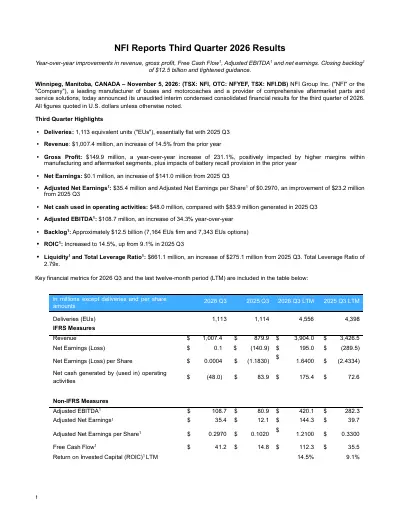
The third quarter marked another period of profitable growth and improved execution. Revenue increased 14.5% to approximately $1 billion, and adjusted EBITDA grew 34.3% to 108.7 million.
On an LTM basis, we achieved adjusted EBITDA of $420 million and the highest result in NFI's history. These results demonstrate the strength of NFI's platform, the quality of our backlog, and our continued operating momentum.
Our focus on production linearity drove more consistent North American deliveries throughout the first three quarters of 2026. This improved our fixed-cost leverage and also reduced our reliance on a disproportionately large fourth quarter.
Adjusted net earnings were 35.4 million, or 30 cents per share. We also strengthened our financial position through the completion of a Canadian bond issuance, increasing liquidity to $661 million.
Under the battery recall, we replaced batteries on 122 buses during the third quarter and another 39 in October. That brings total completions to 161 buses, or approximately 23% of the 700 buses expected to complete by the end of fiscal 2027.
Moving to slide 7, total new vehicle deliveries were 1,113 EUs, essentially flat from the prior year. Transit deliveries increased to 773 EUs, driven by higher North American production and sales, and partially offset by lower UK volumes.
Motor coach deliveries increased 50% to 270 EUs, reflecting stronger public and private motor coach activity. This stronger third quarter further reduced the execution and delivery requirements of a typically busier fourth quarter.
Medium-duty and low-floor cutaway deliveries declined by 84 units, reflecting record low-floor cutaway deliveries in 2025 and the timing of customer fleet replacements. Zero-emission deliveries were 196 EUs, or 17.6% of total deliveries.
The transition to zero-emission vehicles remains important, but customer adoption continues to be less linear, with some agencies emphasizing diesel, CNG, and hybrid vehicles in the near and medium term, and which is reflected in our new order activity. The benefits of our propulsion-agnostic strategy were on display in the quarter, as even with a lower percentage of ZEBs, we delivered a 160-basis-point improvement to adjusted EBITDA margins.
I'll now turn it over to Brian to review the financial results.
Brian Dewsnup
Thanks, John. Picking up on slide 8, manufacturing revenue increased 15.8% to 837 million with gross profit of 101 million, or 12.1% margin.
The nearly 200-basis-point margin improvement reflects conversion of our North American transit backlog and higher motor coach deliveries. Aftermarket revenue increased 8.7% to 171 million.
Aftermarket gross profit was 48.9 million, or 28.7% margin. The margin increased 220 basis points year over year, driven by sales growth, favorable product mix, effective pricing, and tariff management.
Total gross margin was approximately 150 million, or 14.9% of revenue. On slide 9, we look at segmented results.
Manufacturing adjusted EBITDA increased 46.8% to 78 million, representing a margin of 9.4%. Aftermarket adjusted EBITDA increased 23.9% to 35 million with a margin of 20.5%.
Corporate adjusted EBITDA was -$4.7 million, primarily reflecting higher SG&A and increased LTIP and share-based compensation costs. On slide 10, free cash flow increased to 41.2 million from 14.8 million in the prior year.
The improvement came from higher adjusted EBITDA and lower cash capital expenditures, offset by higher lease payments and tax expenses. Working capital days improved to 35, down from 38 in Q2 and 49 in the third quarter of last year.
Advance payments, milestone billings, and supplier terms supported the improvement. We did see some investment in working capital during the quarter, primarily reflecting higher accounts receivable balances and the impact of battery recall campaign spending.
Slide 11 summarizes the adjustments to net earnings. Net earnings were approximately break-even, while adjusted net earnings were 35.4 million.
The most significant adjustment was a 33.8 million non-cash impairment related to battery cells received under the 2025 battery settlement. During the third quarter, we engaged a brokerage firm to begin marketing those cells for sale.
Our decision to sell the battery cells reflects technology changes, updates to customer battery guidelines, and progress on our next-gen battery solution. We expect to sell those cells over the next 12 to 18 months.
We have not disclosed expected proceeds, but any funds received are intended to partially offset recall-related cash outflows. The decision does not change our 2026 guidance or long-term delivery outlook, as we are confident in our existing supply chain partners and are able to support ZEBs in the future.
A slide in the appendix provides additional details on the cash flow and working capital impacts of the battery recall and cell impairment. On slide 12, liquidity increased to 661 million, and total leverage is 2.79 times.
Proceeds from the Canadian bond issuance were used to repay our first-lien facility, and we expect to redraw funds in January of 2027 as we address a convertible debenture maturity. Leverage was in line with our expectations.
Reaching our target range of 1.5 times to 2.5 times remains a priority. Improvements in adjusted EBITDA combined with working capital discipline will drive our deleveraging.
Once we get into our target range, we will consider broader capital returns within the context of investments in the business and cash flow needs. ROIC increased to 14.5%, reflecting stronger LTM operating performance and lower average invested capital.
One additional item to note is income tax expense. The year-to-date effective tax rate was 55.8% and was higher than expected due to our dual-resident status in Canada and the US, plus the deferred tax asset status of our UK entities.
Tax treatment of the battery cell impairment also impacted the quarter. While the reported expense is included in Q3 for accounting purposes, the tax expense will be recognized when the cells are sold.
I'll remind listeners that tax rates can fluctuate from quarter to quarter, we recommend that tax rate be looked at on an annual or LTM basis. We continue to see our adjusted effective tax rate at 31%.
I'll now turn the call back to John to discuss demand and our outlook.
John Sapp
Thanks, Brian. I'm on slide 14.
Our strategic priorities remain consistent. We're focused on operational excellence, product quality, reliable supply, aftermarket support, and backlog conversion to achieve our goal of delivering an exceptional customer experience.
Q3's results show that our operating plan is translating into stronger earnings even with flat unit volumes. This operating progress is reflected in our updated guidance.
Our year-to-date performance has reduced reliance on the fourth quarter, as we have already delivered a large share of our full-year earnings expectations. This has allowed us to increase the low end of our 2026 adjusted EBITDA range to 395 million while maintaining the high end at 415 million.
We have maintained our revenue guidance of 4 to 4.2 billion. Fourth quarter sales mix may place revenue closer to the lower end of the range, and cash capital expenditure guidance remains unchanged at 55 to 65 million.
Our guidance range is assumed continued backlog conversion, expected fourth quarter vehicle deliveries, private coach and aftermarket activity, and effective management of known tariff impacts. Delivery timing, customer acceptance, supply chain performance, and product mix remain important variables.
Recall that last year in the fourth quarter, our results benefited from a significant catch-up in North America transit deliveries following supply disruption in the first three quarters of the year. In 2026, improved supplier performance and production linearity efforts have enabled more consistent deliveries throughout the year, resulting in less reliance on a fourth quarter catch-up.
This is important progress in efficiency and predictability in our operations and has been a key focus item for us in 2026. On slide 15, we briefly recap our outlook by end market.
In North America transit, demand remains strong, driven by fleet age and replacement needs. Our multi-year backlog supports our expectations for growth.
In the motor coach space, the overall North American private market saw some decline in the first half of the year, but the third quarter was busier, and MCI's volumes were very strong. We expect the fourth quarter to be the seasonally busiest period of the year even as customers navigate higher interest rates and the impact of tariffs.
In public motor coach, several anticipated agency procurements in 2027 are expected to drive greater activity in 2028. In the UK, market demands remain healthy, but competition remains high.
The benefit of our restructuring actions are progressing as we are focused on aligning capacity with the order book. We have also been strengthening customer relationships and improving the competitiveness of our electric buses.
From a broader UK policy perspective, the new Prime Minister has increased emphasis on the importance of local production and domestic supply chains, which may create additional opportunities for NFI. Finally, in medium-duty and low-floor cutaway, demand for cutaways has softened slightly following several years of elevated orders.
We view this as a temporary dynamic, with some larger fleet replacements expected again in 2028 that will drive future deliveries. Offsetting this reduction in low-floor cutaway is the medium-duty space, where we believe we can grow deliveries with our ARBOC product.
Slide 16 summarizes demand metrics in our largest market, North America transit. The environment remains healthy as we received 1,214 EUs of new orders in Q3 and converted 968 option EUs into firm orders.
During the quarter, our book-to-bill ratio was 182% and 133% on an LTM basis. Active bids increased to only almost 7,800 EUs.
This includes procurements where we have submitted responses and those we are actively working on. Forecast North American procurements over the next 5 years total 23,449 EUs.
Together with active bids, this represents a total bid universe of more than 31,000 EUs. This reflects the aging North American fleet and pent-up customer demand following several years of lower deliveries.
On slide 17, we look at the backlog, where firm orders now make up 50% of the total at 7,164 EUs. This is up from approximately 37% at the same time last year.
The increase in firm orders gives us greater visibility of our production over the next couple of years. On slide 18, we wanted to give a quick update on US on the US funding environment.
The IIJA was due to expire on September 30th, 2026, and a temporary extension was granted by the administration until December 11th, 2026. The extension was put in place while Congress continues to advance the next surface transportation bill.
As the chart shows, extensions of US funding legislation are common. While negotiations on the next bill continue, agencies can still utilize funding previously approved under the IIJA.
During this extension period, we have not seen a broad-based pause in customer activity, and fleet and fleet age and replacement requirements continue to support demand. To close on slide 19, here are 5 key takeaways from the quarter.
NFI delivered profitable growth with revenue up 15% and adjusted EBITDA up 34%, with earnings growth outpacing revenue growth. Manufacturing economics strengthened through backlog conversion, improved sales, and better operating leverage.
Aftermarket remained a durable earnings contributor, delivering growth in revenue and adjusted EBITDA with a 20.5% margin. Liquidity and cash generation support continued deleveraging, and we are well positioned to address the January convertible debenture maturity.
Finally, our strong year-to-date performance and execution supports our increased 2026 adjusted EBITDA guidance. NFI is extremely well positioned to capitalize on the opportunities in front of us.
With an improved supply chain, robust backlog, and a group-wide focus on operational excellence, we believe NFI has laid a foundation for multi-year growth that will support our deleveraging activities and generate shareholder value. We'll now open the call for questions.
Operator, please provide instructions to our callers.
Operator
Thank you. As a reminder, to ask a question, please press star one one on your telephone and wait for your name to be announced.
To withdraw your question, please press star one one again. Please stand by while we compile the Q&A roster.
Our first question comes from the line of Chris Murray from ATB Cormark Capital Markets.
Chris Murray
Thanks, folks. Good morning.
I guess starting with the guidance, if maybe we can talk a little bit about some of the performance in the quarter and how that plays into your thoughts around Q4. I guess a few things that struck us.
The manufacturing margin was very, very strong. I was just wondering if there's something unusual in that or if that's something we should potentially be thinking about.
Because I think as you've noted, you're expecting financial performance somewhere like Q3, but still feels like we'll have a bit of a step-up in deliveries, margins are better. I'm just trying to square how we get into guidance, cuz right now it looks like you're running a little bit hotter than that, but maybe you can explain how you're thinking about the guidance and how to think about Q4.
John Sapp
Thanks, Chris. It's a great question, and yeah, appreciate the opportunity here to talk through that point.
Obviously, it's been a really strong year for us here to date. We've been very focused around linearity, and I want to kind of lead in with this part of it because it's such an important part of what our focus has been this year.
We've been driving the necessary improvements from an operational execution standpoint that we really saw started to play through in terms of in Q2, and we anticipated that they would sustain in Q3. I'll talk a little bit more in terms of what those changes were in Q3.
At the same time, there was some pause, certainly, that we needed to assess and evaluate to ensure that, from a sustainability of those improvements, that they held. Frankly, what you're seeing in the results is exactly that.
Q3 was a really strong quarter for us, and it was really driven by the improvement that we've seen in linearity and driven heavily from our North America transit and the coach business. What that has done for us, of course, has allowed from a delivery standpoint where we have historically relied heavily on a Q4, right, to be able to have those deliveries in place not stacked up into the back half of the year, but instead deliver that linearity and achieve a much higher degree of efficiency as a result.
As last year, the Q4 was, and as we spoke to earlier, was a build-up of several quarters where we had issues in terms of supply chain and disruption, forced a lot of WIP and a lot of pent-up WIP that was then shipped in Q4, and it creates a challenging comp, certainly, as we look at it. As we look into Q4, we also see, as we're going to continue to maintain the linearity that we have.
We're anticipating very strong production, especially within our North America transit as well as the coach space that we historically see in terms of Q4. The guidance range that we have or that we're sharing here by bringing up the bottom half of that, I think is reflective of us anticipating continued linearity in terms of what we've done from a production standpoint.
Q4, we still anticipate to be one of our, if not most, strongest quarters, and at the same time, it's reflective of some important operational changes that we've done in the business to drive the linearity and get off the dependence of a constant strong end-of-year finish.
Chris Murray
Okay. I guess I'll leave it there.
Maybe if you wouldn't mind maybe spending some time about just maybe defining or explaining linearity, about how you're thinking about it. As we're thinking about kind of the cadence as we go from Q3 into Q4 and then into 2027, I know we're not going to get into guidance now, but how should we be thinking about this rate of improvement that we're seeing, the sustainability of it, and what does this do directionally into how we start thinking about '27, '28, '29 with the backlog that you've got to work with today?
John Sapp
No, it's a great question. Thanks again, Chris.
Let me start off on the linearity side, and then I'll talk a little bit around how this gives us and builds momentum for us going forward. The linearity focus, as I mentioned earlier, was one of our highest-priority strategic items for us as a business.
It was unhealthy for us to be dependent on a strong Q4 at the end of the year and strive to drive out all those sales. We've been very focused on the operational improvements that have enabled the successes that we've seen in terms of the first three quarters of this year.
What that means, right, is that means that we have material that's on time, our supply base is healthy, and that we have supplier on-time delivery that's supporting us in terms of the production rates and volumes, that when we release the bus to the floor, that the workforce has the parts they need to build the bus to completion, and that we don't have buses waiting outside for seats and other issues, right, to be resolved. That's what we talk about when we drive linearity.
It drives efficiency in our workforce. It allows for us to mitigate overtime impacts and other cost challenges that emerge as a result of it, and it ensures that we have consistent flow to our customers, which they highly appreciate.
It also improves quality. When the work is happening on time in a linear fashion, you have less rework activity, you have less snags as we describe quality issues that emerge, and it allows for an improved signature cycle, which is the customers when they come in, we're seeing much better signature efficiency, and therefore that's driving these improvements that we're seeing.
When we think about where NFI needs to be long-term, this is a high area of focus for us. It's why we're so positive around this Q3 and frankly what it means for us in terms of full year, the guidance update that we're sharing, and also to your question around how do we project forward into 2027.
We have key parts of our business that are going to continue to see key growth as we head into '27, and the changes that we have made position us to be able to go deliver that. In an inefficient state, that doesn't work.
Linearity is the efficiency that we've been pushing for. We're seeing success with it.
We've got more work to do, but overall, in terms of our supply health, our operational health, our customer satisfaction, we've made great strides here, and this quarter is a result of it, and it'll carry forward into '27. On the guidance question, yeah, we'll be looking to provide guidance early next year.
That's when you can anticipate it. We do expect the momentum to carry forward.
Chris Murray
I'll leave it there. Thanks, folks.
John Sapp
Thanks, Chris.
Operator
Thank you. One moment for our next question.
Our next question comes from the line of Daryl Young from Stifel.
Daryl Young
Hey, good morning, everyone. Just wanted to continue on the attempt to tease out some more about 2027.
With where the supply chain is operating today and the ramp-up is going, is 5,500 to 6,000 buses still a target that you would have out there, maybe not for '27, but is that a run rate of production you think you can get to in the next 12 to 24 months?
John Sapp
Thanks, Daryl, for the question. We're obviously really focused, and relative to the specific numbers of the run rate, we'll get to.
That's not historically something that I think that we'll provide, but what I will provide to you is, I think the underlying elements of your question around, do we continue to see growth in key areas? I'm going to talk about all the elements of our business to support your thoughts and considerations around it and certainly how we see as we flow into next year.
First, in terms of North America transit, what you noted there around supply health is been critically important as we've been continuing to ramp the volumes of North America transit in preparation for delivering the growth not only this year, but also in '27 that we continue to see. As I talked about relative to the linearity, that has played out very well for us.
The strategic actions that we've taken in terms of building and enhancing our supply chain team, the proactive approach in terms of rate readiness with our supply base is there. As we look at '27, we have high confidence in terms of the additional volume that we anticipate being able to get the North America transit space to next year.
On the coach front, the actions that we've taken in terms of our production, and you see this year's quarter year-over-year increase, we've seen a 50% increase in terms of coach. We've done a significant amount of work around our operations to ensure that we've got the volumes and the coach availability to be able to support our customer and customer needs.
That really played forward for us here in terms of Q3, and we're doing some important things as we prepare for '27 as well to ensure that we have the bus in a preferred availability for the customers that'll be looking, of course, for an MCI coach next year. Those volumes also look good, and we continue to anticipate growth on that front as well.
Overall in terms of internationals, we look at ADL, we are anticipating that we will continue to see growth, although be it subtle in terms of next year, but that will be another growth element for us. Then, ARBOC, as described, we're in one of those periods in between major acquisitions for a number of the agencies that the low-floor cutaway space has supported in the past.
We anticipate that returning at a higher number in '28. It's still good, and we anticipate it'll still be certainly strong in terms of '27, but we also have the Equess, which, obviously, we anticipate from a volume standpoint, is going to provide good support in terms of the ARBOC product line.
Then finally, aftermarket continues to be a low- to mid- single-digit growth, and we continue to see that growing going forward.
Daryl Young
Got it. That's great color.
One other question just around the free cash flow. Maybe a little bit weaker than I was expecting, and there continues to be a lot of sort of one-time and leaky, call them leaky items, impacting your cash generation.
How do we think about that relative to your deleveraging plans to 1.5 to 2.5 times in early 2027? Should we get to a more consistent free cash conversion from EBITDA?
Is there a big working capital influx planned for Q4 and Q1, or any additional color there would be great.
Brian Dewsnup
I'll take this one. From a cash flow standpoint, we've had a couple of kind of tax anomalies relative to the battery recall settlement.
As we mentioned a little bit earlier on the call, we've taken some charges that go through the income statement, but aren't tax-related that won't go through the tax statements, and so we've paid more taxes, and that's reflected in our year-to-date ETR. We've paid more taxes in '26 than we would expect, kind of given the financial profile of the company.
That'll come back the other way a little bit in '27 as we actually see the burn-down of the battery recall provision, and as we start selling the battery cells that we just had the write-down on. Just as a reminder, we also did some restructuring in the UK to get to a more competitive position, and so there were some cash outflows related to that restructuring, and we would anticipate that not to recur in 2000 and '27, in fact, we'll actually have a profitability pick-up there, so that should be additive to kind of cash flow.
Then we've said this over the last kind of number of quarters that we've been carrying a higher amount of working capital than we would like to have, and we've been burning that down over the last several quarters, and we would anticipate that we would continue to see modest improvements. It will fluctuate up and down a little bit kind of between the quarters, but overall, we think we'll have better kind of working capital utilization as we go forward.
Daryl Young
That's great. Thanks.
I'll turn it over.
Operator
Thank you. One moment for our next question.
Our next question comes from the line of Ty Collin from CIBC.
Ty Collin
Hey, good morning, everyone. Thanks for taking my questions.
Maybe just returning to the conversation around the very strong manufacturing margins this quarter, and maybe just asking things a little bit differently, can you just help us parse out, I guess, how much of that 190 basis points of manufacturing gross margin improvement would you attribute to mix versus price versus some of those more executional factors that you've been talking about?
Brian Dewsnup
I don't think we'll get into the details, but just talk kind of more broadly. I think in any kind of business such as ours, when you have supply chain health, it kind of helps everything.
It helps labor efficiencies. As John mentioned, this production linearity is really favorable, and there are a lot of positive contributors to financial statements through that production linearity and not having the disruption of supply during the course of the quarter.
From a pricing standpoint, we continue to benefit from kind of year-over-year pricing improvements, and you're seeing that come through in the financials. As we continue to build the backlog, we're building it with healthy margins.
I think we'll continue to see that roll into 2027. Then from an operational improvement standpoint, just adding volume helps with fixed-cost utilization, it helps with overhead absorption, and it kind of helps everywhere.
As John mentioned earlier, we do have a couple of areas that we're looking at that may be flat volume, but the bigger areas of our business, we do look to see some lift in 2027, and so we would expect that to continue.
Ty Collin
Great. That's helpful.
Then your ZEB mix is down pretty considerably. I understand on average that's going to mean a lower average selling price for you guys, but do you think that's something you can offset, I guess, with higher-volume throughput of diesel units, and is that something that you're kind of planning for as you think about 2027?
John Sapp
Hey, thanks, Ty. Thanks for the question.
We've obviously continued to move forward with our propulsion-agnostic strategy, and as a part of executing that strategy, we've also needed to ensure that, from a business standpoint, that we didn't find ourselves overly impacted by ZEB mix versus ICE, et cetera. As a result, right, we've been very focused on ensuring from a backlog standpoint that we continue to see the improvement that we need across the portfolio and regardless of that propulsion type.
The data from this year really continues to demonstrate that as you see that even with the ZEB reduction that you're noting, that we're continuing to see our per-bus economics gain traction, right, which is exactly where we need for that to be. As we project forward, of course, we'll watch closely to see where things happen relative to ZEB mix.
I think you'll note in this quarter, I think we saw 40% of the orders that we received in Q3 were actually of a ZEB variant, it's still remains to be very agency-dependent in terms of their pathway towards their ZEB transition timing. For us, in terms of the economics, I think how we're managing and executing that well, we're able to flex accordingly, we're able to drive efficiency, and we're able to deliver buses where the impact from a margin standpoint has largely been compensated for by the business overall.
Ty Collin
Great. Thanks.
If I could just sneak in one more question just about the kind of shifting political landscape in the US. Just curious to get your thoughts on how the progressive shift at the federal level could impact some of those discussions around transit funding.
Then, there's also a more progressive shift below the federal level at the state and more local levels. I'm wondering if you think that that's generally a positive outcome in terms of support for local transit programs.
John Sapp
It's a great question, Ty, and certainly one we've been engaged on heavily here this week and frankly leading into the election. What I would continue to point to is that transit funding remains and will remain a very bipartisan-supported requirement.
Even while the Republicans keep control of the House and Senate previously, we still saw strong, positive language towards the IIJA replacement and what that authorization bill was going to look like. Frankly, the House subcommittee had put something forward that certainly we felt very promising about in terms of what it was going to mean for us.
We also do sense that bipartisan support for us is going to remain. Agency requirements are both a red state, a blue state, and municipality need, and the agencies remain very vocal with their need for support as does the people that the new members of this new Congress for the US will represent.
Look, we feel very optimistic overall around funding. We feel that the bipartisan support is going to continue to carry forward, and we remain as optimistic as we would have before the election that this is going to land in a really good spot.
Stephen King
Ty, what I'll add to is obviously the IIJA was extended to December, and given the midterm election most likely scenario, we think is probably we see another extension as they work through, as John mentioned, taking that original House bill to kind of the next levels and go through those further negotiations. As we showed in the slides, it's not unusual for there to be these extension periods between bills.
I think John's exactly right. We fully expect there will be this next surface transportation bill, may just see some continued extensions in the near
Ty Collin
term. Appreciate those comments.
All the best.
Operator
Thank you. One moment for our next question.
Our next question comes from the line of Cameron Doerksen from National Bank.
Cameron Doerksen
Thanks. Good morning.
I guess my question's on the ADL business in the UK, and you talked a lot about the linearity changes and efficiencies you're getting in the North American transit business. I know the UK business has also historically been pretty skewed Q4.
Are you able to implement the same kinds of changes there? If so, what would that mean, I guess, for the kind of margin profile on that business as we look ahead into 2027?
John Sapp
Hey, thanks for the question, Cameron. A lot of work happening certainly with our UK business, and so happy to to share where things are at and how we're progressing.
Maybe I'll I'll start with, the actions that we've taken here to date and how that's going to play through and what that's doing to reset our operations, and then also from a market standpoint how we expect to see the UK market continue to develop here forward. First, obviously, at the start of the year, we made that really difficult decision to reset some of our operational footprint, and a difficult decision, of course, but it was the right one for us to do in terms of resetting our cost structure, but also to, improve our operating efficiency based on our footprint and getting to a truly an improved footprint optimization point.
That those efforts have been very important to play. They've continued to play through, and we anticipate beginning to see the benefits of those here in Q4 and definitely as we lead into 2027 in terms of EBITDA.
Also, what that means for us in terms of Alexander Dennis is through that reset period, it's been harder for us to drive that linearity piece quite yet that we've described, and we expect that to be more of a '27 play just because there's been that shift in where that had to occur as a result of the changes. The other thing I would note, too, is that the Alexander Dennis team has done a terrific job, through the course of this year in terms of working on that product piece.
While the the cost elements are being addressed to ensure this business can deliver the margins that we anticipate and need from it here as we go forward, it's also been critically important that as they have newer variants, new EVs that are out there competing against models that have been in service for 10 to 15 years, there is a learning curve element that they've had to work quickly through to be able to ensure that, from an a a customer standpoint, there's true product parity in terms of the AD versus the competitors that are out there, and the team's done an incredible job with that, great progress. Overall, as we look at the competitive elements of ADL, we see, truly in a position of improvement relative to that product parity piece as well as what it's done in terms of cost.
That gives us, reason for optimism here as we head into into 2027, certainly frankly confidence as we head into 2027 that ADL is going to to deliver what we need from it from a profitability standpoint. We're also very focused on what's happening in terms of the new administration.
It's been very promising news coming out of the new administration there, the new Prime Minister and his focus on local production and buy UK. That is not a part of our plan, of course.
We've built our plan based on what we know, but at the same time, we do anticipate some potential tailwinds. Should those the work that we've done in terms of resetting the operations here, back to your linearity point, we are going to see those tailwinds then play through in our ability to produce and produce at a higher rate, and we've got the agility within our factory setup now to be able to do that.
Cameron Doerksen
No, that's that that's great color. If I could just, add one quick question as well on the the battery cell sale.
Just, obviously didn't get into timeline over the next, kind of couple years, but do you have any general sense of whether this could be something that happens in 2027, or, is it is it all going to be sold at once or is it kind of going to be pieced out over a number of quarters? Just any, details you can provide on that.
John Sapp
Like our our focus is on ensuring that we move quickly on this. That's so how it'll play out, it I would expect it'll be over, targeting a 12- to 18-month-type cycle to to navigate through it.
We've obviously done some work here over the last quarter to evaluate what's out there, and and obviously, based on the decisions we made here, we do feel, confidence in our ability to to move with the, forward as described. I think timing-wise, we would expect it to be on the on the more near-term end than longer-term, and we definitely are looking for it to to be able to have impact before what would have been our timing for actually utilizing these in the in the 2028 to 2030 time
Stephen King
frame. Cameron, I think you'll probably see it in some tranches versus one bulk sale.
I think you'll probably see kind of a couple periods of of sales of those cells.
Cameron Doerksen
That that's helpful. I'll I'll pass the line.
Thanks very much.
John Sapp
Thanks, Cam.
Operator
Thank you. As a reminder, to ask a question, please press star one one on your telephone and wait for your name to be announced.
To withdraw your question, please press star one one again. Our next question comes from the line of Jonathan Goldman from Scotiabank.
Jonathan Goldman
Hey, good morning, team, and thanks for taking my questions. Maybe just a a housekeeping one to start.
Can you help us understand or think about your working capital expectations this year inclusive of outflows related to the battery recall?
Brian Dewsnup
Yeah. I think as you remember, we had we'd talked about the battery recall being executed over 2 years, both 2026 and 2027.
We are, well on our way in in 2026. As we always talked about, that, we would see, round figures a third of the expense happening in 2000 or that of the cash expense happening in 2026, and so that's a that's a big chunk of our of our working capital, and then, of course, the balance we'll see that in 2000 and and 2027.
Those are kind of cash headwinds in 2000 that we'll have in in those years.
Stephen King
Jonathan, just typically sorry, the fourth quarter typically being somewhat of a busier period, but I think to John's point, because of production linearity and that focus, we can sometimes see some unwind of inventory in Q4, but then it can be offset by receivables going up because of the sales. I think Brian touched on the key point, is yeah, kind of the battery recall.
John Sapp
I just add that, as we think about production linearity, that's really good for cash flow as well, and so it it, we don't, we we, release financial statements, quarterly, but even between the quarters, it helps with our cash flow, it helps with stability, and helps mitigate some of our interest expense. That shouldn't be lost on, on on ourselves and and for or for the, investing community.
Jonathan Goldman
Got it. Maybe just to follow up.
I think maybe a few quarters ago you were talking about kind of flat working capital investment year on year. Is that the right way to think about it, adding then the outflow from the battery recall in Q4?
Maybe negative for the year somewhere in the range of 30, $35 million-ish?
Brian Dewsnup
I think that's where that's that's still what we're projecting. We have some variability in in the fourth quarter, but that's that's what we would see.
That's what we would expect.
Jonathan Goldman
Perfect. That's helpful.
Then maybe just thinking about capital allocation, leverage kind of static this quarter. Obviously, some puts and takes there, but it does seem to be trending in the right direction.
I think you're on pace to get to kind of the the target range maybe by early '27, in the 1.5, 2.5 range. Maybe it's too early to look forward, but once deleveraging happens, how should we think about capital allocation thereafter?
John Sapp
It's a it's a great question, Jonathan, one certainly that we're discussing a lot, right? We see and we know our pathway and timing in terms of when we'll find ourselves in that right ratio position and have consideration for our an a strategy in place in terms of what our capital allocation approach is going to be.
I will say that that's, still very much a in discussion and something certainly that we will be looking forward to share with the with the investor community, at the appropriate time. You can imagine that it's inclusive of of of all things in terms of of the options that are out there, right?
Whether or not that, results in, dividends or buybacks or continued investment in areas of focus. What I will say on that last point is that will certainly be an area of high interest for us, which is, ensuring that as we continue to bus this business and its operational execution, that we're investing in the appropriate areas there to make sure that we position the business that way.
All of the all of the above in terms of under consideration as we go forward.
Jonathan Goldman
Got it. That's all I had.
I'll get back in queue.
Operator
Thank you. At this time, I would now like to turn the conference back over to Stephen King for closing remarks.
Stephen King
Thanks, Gigi, and thanks, everybody for joining us this morning and for your continued support and interest in NFI. As always, all of our information is available on our website, and we're really happy to report another strong quarter and a positive outlook for the remainder of 2026.
We look forward to meeting with some folks in person over the next couple of months, and so please do reach out if you're interested in taking a meeting or meeting with us virtually or in person. Thanks so much, and have a great day.
Operator
This concludes today's conference call. Thank you for participating.
You may now disconnect.