Addus HomeCare Corporation
Q3 FY2026 · Earnings Call TranscriptNovember 4, 2026
Operator
Good day, and welcome to the Addus HomeCare third quarter 2026 earnings conference call. All participants will be in listen-only mode.
Should you need assistance, please signal a conference specialist by pressing the star key followed by zero. After today's presentation, there will be an opportunity to ask questions.
To ask a question, you may press star and one on your telephone keypad. To withdraw your question, please press star then two.
Please note this event is being recorded. I would now like to hand the call over to Brandon Cox.
Please go ahead.
Brandon Cox
Good morning, and welcome to the Addus HomeCare Corporation third quarter 2026 earnings conference call. Today's call is being recorded.
To the extent any non-GAAP financial measure is discussed in today's call, you will also find a reconciliation of that measure to the most directly comparable financial measure calculated according to GAAP by going to the company's website then reviewing yesterday's news release. This conference call may also contain forward-looking statements within the meaning of the Private Securities Litigation Reform Act of 1995, including statements, among others, regarding Addus' expected quarterly and annual financial performance for 2026 or beyond.
For this purpose, any statements made during this call that are not statements of historical fact may be deemed to be forward-looking statements. Without limiting the foregoing, discussions of forecasts, estimates, targets, plans, beliefs, expectations, and the like are intended to identify forward-looking statements.
You are hereby cautioned that these statements may be affected by important factors, among others, set forth in Addus' filings with the Securities and Exchange Commission and its third quarter 2026 news release. Consequently, actual operations and results may differ materially from the results discussed in the forward-looking statements.
The company undertakes no obligation to update any forward-looking statements, whether as a result of new information, future events, or otherwise. I would like to now turn the call over to the company's Chairman and Chief Executive Officer, Mr.
Dirk Allison. Please go ahead, sir.
Dirk Allison
Thank you, Brandon. Good morning, and welcome to our 2026 third quarter earnings call.
With me today is Brian Poff, our Chief Financial Officer. As we do on each of our quarterly earnings calls, I will begin with a few overall comments, and then Brian will discuss the third quarter results in more detail.
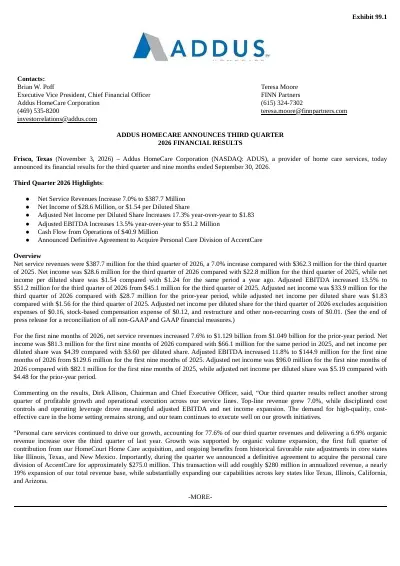
Following our comments, we will be happy to respond to any questions. As we announced yesterday afternoon, our total revenue for the third quarter of 2026 was $387.7 million, an increase of 7% as compared to $362.3 million for the third quarter of 2025.
This revenue growth resulted in adjusted earnings per share of $1.83 as compared to adjusted earnings per share for the third quarter of 2025 of $1.56, an increase of 17.3%. Our adjusted EBITDA was $51.2 million compared to $45.1 million for the third quarter of 2025, an increase of 13.5%.
For the third quarter of 2026, cash flow from operations was $40.9 million, with cash on hand on September 30 of just under $100 million. During the third quarter, we reduced our bank debt to $24.3 million, which provides us the financial flexibility to close on our previously announced AccentCare personal care service acquisition while still considering additional large acquisition opportunities as we continue to pursue expansion of our market reach and increase geographic density.
As we announced on September 14th, we signed a definitive agreement to acquire the personal care assets of AccentCare. This acquisition excludes AccentCare's New York operation and is expected to add approximately $280 million in annualized revenue.
It furthers our strategy of creating density in our current markets while also enhancing our private pay home care business. Last week, the federal antitrust review period for the transaction expired.
We are now waiting on additional customary regulatory approvals needed to complete the transaction. We anticipate closing on this acquisition in the first quarter of 2027.
On July 1 of this year, we received an approximate 4% rate increase from the state of New Mexico, our third-largest personal care market. This was an important development showing that states recognize supporting personal care services saves states money in caring for the elderly and disabled population covered by Medicaid.
We continue to have discussions with other states concerning potential rate increases for 2027 as part of their normal state budgeting processes. We still believe that we will see additional rate support from other states while also realizing that we are returning to a more balanced environment for same-store growth between rate and volume.
As we mentioned on our last quarterly call, CMS published the final fiscal 2027 hospice rate, which was effective on October 1st, 2026. This increase continues the consistent federal rate support we have seen for hospice services over the past few years.
Currently, we are awaiting the final home health rate announcement from CMS for 2027. Based on the preliminary rate announcement, which was made this summer, we expect to see a positive adjustment for our home health services, which would be an encouraging sign for this segment of our business considering the rate pressure the industry has experienced over the past three or four years.
During the third quarter of 2026, we continued to experience positive hiring trends in our personal care segment. Our number of hires per business day in the third quarter of 2026 was 105, up slightly from the prior period and within our target range.
Our team continues to do a nice job of producing higher hiring numbers at the level needed to meet our organic growth targets. As for clinical hiring, we continue to see a more normalized labor environment, as has been the case for the past couple of years.
Now let me discuss our same-store revenue growth for the third quarter of 2026. For our personal care segment, our same-store revenue growth was 6.9% compared to the third quarter of 2025.
During the third quarter of 2026, we saw personal care same-store hours increase by 1.6% compared to the same period in 2025, while our percentage of authorized hours served in the third quarter stayed in the mid-80s. While our same-store average daily census for PCS was down 0.4% over the prior period, in the third quarter, we saw seven of our 10 largest markets achieve positive year-over-year growth, with Texas and Illinois slightly negative for the quarter.
Based on what we see to date in the fourth quarter, we currently believe we can achieve flat to slightly positive census growth in this current quarter. The slight decline in our personal care census over the prior year has primarily been in our lower-hour cases, as our higher-hour cases have increased year-over-year.
This, along with the continued improvement in our service percentage, has contributed to our year-over-year increase in same-store personal care hours. Turning to our clinical operations, our hospice service same-store revenue increased 4.1% compared to the third quarter of 2025.
As discussed last year, our 2025 third quarter had a positive impact from implicit price concession, and excluding that input, our same-store hospice revenue growth for the quarter was 8.8%, at the high end of our targeted goal for hospice. We were pleased to see our same-store average daily census increase to 4,031 for the third quarter, up from 3,866 for the same period last year, an increase of 4.3%.
Our growth in hospice has continued in October, with our average daily census exceeding four— 4,100. For the third quarter of 2026, our hospice median length of stay was 25 days, as compared to 22 days for the third quarter of 2025 and 24 days sequentially.
Overall, our hospice segment has continued to generate consistent growth over the past several quarters. Our home health same-store revenue increased 2.5% when compared to the same quarter in 2025.
Also, same-store admissions in home health for the third quarter of 2026 grew 13.8% as compared to the third quarter of 2025. This is the first positive year-over-year revenue quarter we have had in a couple years for home health, as we are seeing the impact made by our new leadership team.
Importantly, we also saw sequential improvements in revenue and admissions. As you can see with our pending AccentCare and previous Gentiva acquisition, we continue to believe that creating size and scale are important in post-acute healthcare services.
This has been the long-term focus of our development strategy. Our development team continues to evaluate opportunities which will increase both the density and geographic coverage as we seek to further strengthen our relationships with states and managed care organizations.
Going forward, we anticipate being more aggressive in looking at various clinical opportunities, which we believe will present themselves over the next few quarters. While we will still actively pursue PCS opportunities, we believe it is time, with recent market changes, to consider adding more clinical acquisitions in both home health and hospice.
Before I turn the call over to Brian, I want to thank the Addus team for the care they are providing to our elderly and disabled consumers and patients. We all have come to understand that most of this population prefers to receive care at home, which not only remains one of the safest, but also the most cost-effective place to receive this care.
We believe the heightened awareness of the value of home-based care is proven to be favorable for our industry and will continue to be a growth opportunity for our company. We understand and appreciate that our operations and growth are dependent on both our dedicated caregivers and our other employees who work so incredibly hard providing outstanding care and support to our clients, patients, and their families.
With that, let me turn the call over to Brian.
Brian Poff
Thank you, Dirk, and good morning to everyone. Addus had a solid financial and operational performance in the third quarter of 2026.
We generated a 7% top-line increase in net service revenues to $387.7 million, compared with $362.3 million in the third quarter of 2025. Our focus on cost-disciplined operating leverage drove bottom-line growth to outpace revenue gains, driving a 13.5% year-over-year improvement in adjusted EBITDA to $51.2 million, up from $45.1 million in the prior year period.
Our personal care services segment remains the core driver of revenues, generating $301 million, or 77.6% of total net service revenues for the third quarter. The segment achieved a solid 6.9% organic revenue increase year-over-year.
Performance in this segment was anchored by steady organic volume gains, continued contributions from the integration of our Home Care acquisition, and ongoing benefits from historical favorable rate enhancements across key state markets, including Illinois, Texas, and New Mexico. We continue to see solid caregiver hiring momentum and year-over-year improvement in our service percentage, driven by the ongoing rollout and adoption of our internally developed caregiver app across our major markets.
Our hospice operations delivered continued steady performance, accounting for 17.8% of our revenue for the third quarter and a 4.1% organic revenue increase year-over-year. As Dirk mentioned, exclusive of the differences in the implicit price concession from the prior year, our organic revenue growth was 8.8%.
This steady growth was driven by two key factors: higher reimbursement per patient day and healthy volume gains in our organic average daily census, which rose 4.3% year-over-year. As anticipated, our ongoing focus on case mix kept Medicare cap exposure within normal limits for the third quarter, with no further cap adjustments recorded.
Looking ahead, the fiscal 2027 Medicare hospice reimbursement rate update has been finalized with an aggregate 2.3% net increase that became effective October 1st, 2026. We expect the benefit to our hospice business to be just under 2%, based on our geographic mix and related wage indices.
Our home health services represent our smallest segment and account for 4.6% of third quarter revenues. Home health continues to show positive momentum with solid clinical intake and admission trends, and an increase of 2.5% in organic revenue over the prior year quarter.
Maintaining all three levels of care remains an essential component of our value proposition, helping us deepen relationships with our managed care and value-based partners. In key overlapping markets such as New Mexico and Tennessee, our clinical bridge program continues to yield significant value, with over 25% of our hospice admissions originating directly from our home health operations.
We anticipate this program to have a positive impact in our Illinois market as we work to implement it in those operations. Looking at our financial position, we continue to generate strong cash flow from operations through the first nine months of 2026, which leaves us very well capitalized.
Our disciplined balance sheet management and low leverage profile provide us the financial flexibility to pursue targeted acquisitions designed to deepen market density and expand regional reach. In line with our strategic growth initiatives, during the quarter, we announced a definitive agreement to acquire the personal care division of AccentCare outside of New York for $275 million.
This acquisition aligns with our strategy to scale our core non-clinical platform in markets where we can leverage geographic coverage and density. The acquired operations will bring an average daily census of approximately 13,700 clients across a 10-state footprint and are expected to generate roughly $280 million in annualized personal care revenue, which represents an approximate 19% increase to our revenue base.
Importantly, this significantly deepens our market density across Texas, Illinois, California, and Arizona, while also adding operations in six additional markets. We intend to fund the purchase price through a combination of cash on hand and borrowings under our revolving credit facility.
Given the complementary operational footprint and financial profile, we expect the transaction to be accretive to our overall financial results while enhancing our collaborative capabilities with managed care organizations and value-based care partners. As Dirk noted, total net service revenues for the third quarter were $387.7 million.
The revenue breakdown is as follows: personal care revenues were $301 million, or 77.6% of revenue; hospice care revenues were $69 million, or 17.8% of revenue; home health revenues were $17.7 million, or 4.6% of revenue. Other financial results for the third quarter of 2026 include the following: our gross margin percentage was 32.1%, compared with 32.2% for the third quarter of 2025, and sequentially, our gross margin percentage stayed relatively stable, as was expected.
Looking forward to the fourth quarter of 2026, we anticipate our gross margin percentage to experience normal seasonality, with a benefit of approximately 50 to 60 basis points related primarily to the hospice reimbursement update and lower unemployment taxes. G&A expense was 20.7% of revenue, compared with 21.9% of revenue for the third quarter a year ago.
Adjusted G&A expense for the third quarter was 18.9%, compared with 19.8% a year ago, and down sequentially from 19.2% in the second quarter of 2026. Our continued leverage on our cost structure from our expanding revenue base has driven G&A efficiency across our operations and should continue to benefit us going forward.
The company's adjusted EBITDA for the third quarter of 2026 was $51.2 million, compared with $45.1 million a year ago, an increase of 13.5%. Adjusted EBITDA margin was 13.2%, compared with 12.5% for the third quarter of 2025, and up 20 basis points sequentially from 13% in the second quarter.
We now expect our full year adjusted EBITDA margin percentage to be in the 13% range. Adjusted net income per diluted share was $1.83, compared with $1.56 for the third quarter of 2025.
The adjusted per share results for the third quarter of 2026 exclude the following: acquisition expenses of 16 cents, non-cash stock-based compensation expense of 12 cents, and restructure and other non-recurring cost of 1 cent. The adjusted per share results for the third quarter of 2025 excluded the following: acquisition expenses of 8 cents, non-cash stock-based compensation expense of 18 cents, and restructure and other non-recurring costs of 6 cents.
Our tax rate for the third quarter of 2026 was 26.9%, as expected, and consistent with the second quarter of 2026. For full year 2026, we expect our tax rate to remain toward the upper 20% range.
DSOs were 39.3 days at the end of the third quarter of 2026, compared with 35.5 days at the end of the second quarter of 2026. We have continued to experience consistent cash collections from the majority of our payers.
Our DSOs for the Illinois Department on Aging for the third quarter were 48 days, compared with 26.8 days at the end of the second quarter of 2026, as we experienced normal timing differences in payment cycles from the state. Our net cash flow from operations was $40.9 million for the third quarter of 2026, continuing our strong performance this year.
As of September 30th, 2026, the company had cash of $98.5 million, with capacity and availability under our revolving credit facility of $650 million and $617.8 million, respectively. Total bank debt was $24.3 million at the end of the quarter, a reduction of $40 million from the second quarter of 2026.
We have also continued to reduce our revolver balance, with $10 million paid to date in the fourth quarter. Our capital structure and strong balance sheet continue to support our ability to invest in our business and pursue strategic growth initiatives, including targeted acquisitions.
Looking ahead as we prepare to fund and close the AccentCare transaction, we will continue to selectively pursue complementary acquisitions that align with our growth strategy, while maintaining disciplined capital allocation and managing our net leverage ratio through ongoing debt paydown. This concludes our prepared comments this morning, and thank you for being with us.
I'll now ask the operator to please open the line for questions.
Operator
We will now begin the question-and-answer session. To ask a question, you may press star then one on your telephone keypad.
If you are using a speakerphone, please pick up your handset before pressing the keys. To withdraw your question, please press star then two.
At this time, we will pause momentarily to assemble the roster. Our first question will come from Sean Dodge of BMO Capital Markets.
Please go ahead.
Sean Dodge
Thanks. Good morning.
Maybe just on the same-store billable census, Dirk, I know you said you were seeing strength in seven of your markets. Sounds like Texas and Illinois that continue to lag a little bit.
Just the confidence that those are rebounding and that metric will turn positive in Q4, have you seen inflections now in both of those markets? When did those happen?
What do you think are primarily driving that?
Dirk Allison
I think we had talked earlier last quarter when we had a conference call, we had seen through July and on into August, it was trending towards we were going to be flat to slightly positive in our census. We saw Texas and Illinois in September flatten out just a bit, and that is what really kept us from achieving that goal that we had set for ourselves for the third quarter.
I will say that today in the fourth quarter, it seems like both of those states have turned back around to what we were experiencing more in the July and August standpoint. No real reason why that may have happened in September, but it appears that we're back on track to where we'd like to be, which is really working towards driving, and again I want to say, appropriate ADC, appropriate census growth in that fourth quarter.
We're certainly looking to try to achieve that this year.
Sean Dodge
Maybe on that, the appropriate growth, the kind of the advances we've seen in average billable hours per census, what's the biggest contributor there? Is it kind of being a little bit more disciplined on what kind of referrals or patients you're accepting?
I know you're also making gains in fill rates with the caregiver app. How much of each of those are contributing?
How much kind of further do you think you can drive that metric, the average billable hours per census?
Dirk Allison
I think you hit it. There's really two things that we're looking at to try to continue to drive that number, and that is using our caregiver app, our technology, which has done a really good job in Illinois, moving into Texas, now we're moving into New Mexico.
We should continue to see some positive improvements in that metric, allowing us to serve more of the authorized hours that have been granted by the state. I think the other thing we're trying to do, we're just trying to be cautious and direct in trying to make sure that the census that we take are census that we can do the right job on.
When you take a very small-hour client on, it's very difficult to staff, because more and more caregivers, they want to get closer and closer to that 40-hour timeframe, and it's hard to piece together small-hour patients. What we're trying to do is just make sure we're looking at the patients that give us more hours.
We're trying to balance that with our referral sources to make sure that we're doing all things that are necessary. We'll still take [respite?]
patients. We're not saying that at all, but we're trying to do it in a methodology that realizes that we can staff them appropriately, and we can give the hours we want to give to our caregivers.
That's really what our focus has been over the last few quarters.
Sean Dodge
Great. That's helpful.
Thanks again.
Operator
The next question comes from Ben Hendrix of RBC Capital Markets. Please go ahead.
Ben Hendrix
Hey, thank you very much. I just wanted to follow up on some of Dirk's comments around the AccentCare acquisition, particularly the higher mix of private pay.
We tend to talk about PC purely in Medicaid terms, just wanted to kind of get some of the nuances of the private pay business, specifically kind of the rate profile, the demand backdrop for the private pay, and also kind of what you're seeing in terms of census mix dynamics in that business. Then also just what all that looks like on a pro forma basis for AccentCare.
Thanks.
Brian Poff
Hey, Ben, this is Brian. I think on that side, just a few of the kind of the numbers around that piece of that business.
I think we traditionally have run around 2% of our ADC has kind of been in kind of the private pay or direct pay constituency. I think looking at AccentCare, believe they're closer to the 7%, 8% of their business is going to be in that kind of private pay arena.
They've had a strategy over the last few years of actually pursuing de novo growth in the private pay business. If you look at some of the smaller states that we're getting in this transaction, that's actually what those offices are, just pure private pay offices.
They've had some success there. I think we like the private pay business.
Obviously, it's a little different business. You're not exposed to maybe some of the Medicaid reimbursement issues or pressures that we've seen over the last year or so, but it's market to market on kind of what the reimbursement looks like, and what folks are willing to bear from a competitive standpoint.
I think they've done very well, and I think there is a different constituency that you're serving in a private pay business, that folks that are not qualified for Medicaid, but still need the care at home to stay there rather than going to an institutional setting. I think we're excited about seeing a little bit of expansion in our overall portfolio, bringing them on board, and probably learning some things from them as well, and applying that to our business.
Ben Hendrix
Great, thanks. Can you talk a little bit about some of the census mix dynamics as they pertain to AccentCare's markets?
Thanks.
Brian Poff
Most of those markets, obviously, the bigger pieces here are the key four, really Texas, Illinois, and then you get into California, and then some in Arizona are really the big four states. Texas is going to be very similar to what we run, a large Medicaid population.
They do have a little more private pay, I think, in Texas than we do, and some VA business. Illinois is going to be very similar to ours as well, mostly Medicaid-focused.
You get into California, still again very similar to our business there, which is primarily VA or private pay. They do have a little bit of participation about, I think, about 10% of their overall business in California is through a CalAIM Medicaid program that they operate in that we do not, but it's a small piece of the business that we're getting with them.
Then Arizona is going to be similar as well, Medicaid-focused.
Ben Hendrix
Thank you.
Operator
The next question comes from Andrew Mok of Barclays. Please go ahead.
Andrew Mok
Hi, good morning. Can you help us understand what's going on with hospice revenue?
You noted that there were no further Medicare cap adjustments, but there was a $1.4 million add-back to organic revenue in addition to the $1.5 million price concessions. I guess, just taking a step back, how are you responding to the higher average length of stay to the extent that it is putting some pressure on some of these items operationally?
Would love to hear your thoughts on that. Thanks.
Brian Poff
Andrew, I think things that we were looking at, if you reference in kind of the reconciliation on the adjusted kind of same-store revenue, we had an implicit price concession benefit last year in Q3 that was really just related to collection on older AR that had some reserves associated with that. You compare that to what we experienced in that same implicit price concession this year, which was more in line with what we think we would probably typically see.
I think we also have in that reconciliation table, there was some acquisition that we did last year as well that had some hospice business up in Pennsylvania. There's some revenue based there that's part of that reconciliation.
I think on the cap side, we had no further adjustments this quarter. I think the things that we believe we've done to mitigate some of that expense that we took in Q2 in this cap year have been very helpful in that regard.
I think you look at the length of stay, our discharged length of stay, that was just a factor of those folks that left our service this quarter. I think we're fairly in line, we think, with the industry, kind of in that low 100-day range, but no impact there, no concern that we have around cap.
I think we still feel very confident going into the fourth quarter that we will have no further cap adjustments this year. In fact, I think we kind of look at the end of the cap year, let some of those folks discharge and see where we land.
Ultimately, we believe we'll probably see a little bit of benefit, actually, in our ultimate cap reserve for this year.
Andrew Mok
Great. Can you just help us understand your latest thinking around the 80/20 rule?
I think there was some expectation that it would get addressed this year. Does the changing of the congressional composition impact your view at all?
Thanks.
Dirk Allison
We were talking to our government relations folks this morning after the results of the election. We still have a belief that CMS plans on changing the 80/20, doing away with that portion of the rule, while they will probably keep other aspects of that rule, which we actually support.
We'll wait and see. We didn't expect, honestly, after the last four or five weeks, we were told it wouldn't be done till after the election.
Now that the election has happened, and obviously there is a big change in the dynamics of who will be in the House and the Senate, we will see on the timing, but we still do believe and expect by year-end, we'll see a movement on the 80/20 that it should come out of the rule.
Andrew Mok
Great. Thank you.
Operator
Our next question comes from Brian Tanquilut of Jefferies. Please go ahead.
Brian Tanquilut
Hey, good morning, guys. Maybe, Dirk, first, when we think of the work requirement for Medicaid that's going to get rolled out for 2027, how are you thinking about the impact on your business from that?
Maybe if you can share any insights from some of the states that have rolled out work requirements earlier where you operate.
Dirk Allison
Far, I think one or two states have rolled out the work requirement, and we've seen no effect on our business at this point in time. We never expected it to really hurt us from a revenue standpoint, because I think there's been some clarification around that particular work requirement that most of our folks that are receiving care are going to be qualified to avoid having to go to work.
I think the bigger aspect we were considering and were thinking may be helpful is, as states roll out work requirements, will there be opportunities for additional caregivers, folks that maybe are on Medicaid, they're now going to be required, they're younger, they're not disabled, they're going to be required to show a certain number of hours per week or per month. Can we help them meet that goal and remain on Medicaid?
We're still waiting to see that, and the couple states have rolled out, that hasn't occurred yet. Hasn't been a negative on labor, but it hasn't really been a positive.
The only other thing that I think we'll be watching, and when something you would expect, is to make sure that states, we're hopeful that states have had enough time to prepare for the monitoring of work requirements, and hopefully, that should not affect the rate at which we get new patients on board, because, again, it's going to be an additional burden on the state, but they've gone through this before with redetermination, we're hopeful that they have that experience, and they're going to be prepared for it.
Brian Tanquilut
Appreciate that. Then maybe, Brian, thanks for flagging the New Mexico rate increase.
When I think of 2027, if you could just walk us through, number one, how you're thinking about the blended rate profile given the different states' rate adjustments, and then just broadly speaking, how you're thinking about census growth as we think through 2027? Thanks.
Brian Poff
Brian, I think on the rate side, obviously, it was nice to see New Mexico come through with the rate increase this year. I know we talked last year.
They had a rate increase on the table, and with some of the OB3 conversations happening at the time, decided to hold flat, and we were hoping that they would look at this year, now that they kind of understood the landscape of what that really meant for them as a state, that they would look for a rate increase this year, and we were happy to see that come through. That's in our Q3 number.
I think looking ahead to next year, we still expect we're probably going to see some rate updates in some smaller states. Obviously, the bigger states move the needle more for us.
Texas and Illinois will be the two that we'll watch early when they get seated back and go back into session early next year. Will we see some additional movement from them?
We didn't get one from Illinois in the last session, does that mean maybe there's going to be some potential that we'll see something that would impact really 2028? If they give us something in their budget, they've typically been doing it mid-year for them, which is Jan 1 starts.
Our folks will be having those conversations. We expect we'll get support in the session as we usually do from the union in the state as well.
Then Texas, who only meets every two years, they've had nice rate increases the last couple of cycles. We still think there's some headroom ability for them to do some additional rate enhancement there, based on where the rates are and kind of what we pay in the state.
With some of the shifts in the Texas political landscape, we'll be interested to see how that plays into that process as well when they get seated early next year. I think the way we're looking at kind of just thinking about it from a same-store perspective, with some of the rate support in large states, we've been nicely above kind of the 3% to 5% target range for some time now.
We anticipate not having one from Illinois particularly that'll go into effect early next year, we'll probably be more in that 3% to 5% range the first half of next year. We get some rate support from either in Illinois or Texas or one of the other larger states, or even in New Mexico again next year, toward the back half of next year, you could see us go back to the top end of that 3% to 5%, if not above, but those are things that we'll be looking for.
Brian Tanquilut
Awesome. Thank you.
Operator
The next question comes from Joanna Gajuk of Bank of America. Please go ahead.
Joanna Gajuk
Hi, good morning. Actually, first one, I would just follow up on the question, because I don't think you answered that, the second part of the question.
When we think about next year in terms of the census growth, how we should think about that?
Dirk Allison
We expect that next year, certainly, we're moving as a team to try to get to the point where we're seeing low-percentage PCS same-store growth in census.
Brian Poff
I think, Joanna, just to add to that, we've talked about just on a hours basis, which is really the thing that we're more focused on, is, can we continue to stay kind of in that 2% to 2.5% same-store hours growth range? Census will be a piece of that, but we think there's still additional headroom.
I think we talked earlier about the caregiver app and the fill rate. We're still kind of in that mid-80% range, and we still think there's opportunity to increase our fill rate up into that upper 80% range, and we can see that come to fruition.
Like Dirk said, some consistent slight growth in the census as well. Hopefully, that puts us in a good spot going into next year.
Joanna Gajuk
Great. Thank you.
If I may, on a little bit different topic, in terms of your appetite for acquisitions. You mentioned on prior calls that there could be a couple of larger personal care deals out there in the market.
You just did one. With that deal, by taking, it sounds like 12 months, maybe longer, to fully integrate, would you be still willing to execute another transaction of similar size during that period, or should we expect more tuck-in acquisitions?
Brian Poff
I think we're still open. We get AccentCare closed, as we expect, in the first quarter, I think really, it won't be a 12-month integration.
I think we'll see some synergy opportunities over kind of the 12 months post-closing, but I think a lot of the systems conversions, our payroll system, our benefit programs, will happen very quickly. That's usually the larger lift from an integration perspective.
I think we still expect to be very active in M&A going into next year. I think we still, from a capital perspective, are in a great position to do larger deals still.
I think internal bandwidth is going to be there as well to allow us to do larger deals if they're available. We'll continue to look at some of the larger PCS acquisitions that we expect are still going to come to market.
As Dirk referenced earlier, we think there's going to be opportunities on the clinical side. If you look at kind of our footprint, particularly in home health, we've got a lot of green space in our portfolio where we could add operations there at probably good multiples.
Hospice will really kind of just depend on where multiples are next year. It feels like maybe there's some rationalization happening in the hospice area where maybe they'll be a little more affordable, and if that's the case, those are things we would like to be interested in or active in as well.
Joanna Gajuk
Great. If I may squeeze in on AccentCare, I appreciate the comment around the integration will be actually faster.
Can you help us maybe quantify the ultimate EBITDA margin target here? Because it sounds like that asset actually has higher private pay, higher margins.
Also, any color in terms of the magnitude of synergies that we should think about in terms of just realizing things in year one versus year two? Thank you.
Brian Poff
I think the way we've kind of talked about AccentCare, they operate today probably in a high single-digit percentage EBITDA range in their business in personal care, which is a little lower than what we would typically expect to see and what we see in our business. We think there's opportunity to get their operations up into that low double-digit range from an EBITDA perspective, primarily through G&A savings, to be fair.
I think the way we look at it over 12-plus months, we'll probably see rateable synergies as we go along. It won't be something that we see that will be back-loaded, but we'll probably make those changes over a period of time, as we don't want to negatively impact the business in any way if possible.
Joanna Gajuk
Great. Thank you so much.
Operator
The next question comes from A.J. Rice of UBS.
Please go ahead.
A.J. Rice
Hi, everybody. I know you have talked to some areas, but I just wanted to frame it a little better.
I know you're not giving formal 2027 guidance at this point, but when you think broadly about major puts and takes versus the baseline that you'll establish for this year, how would you describe thinking about the swing factors for 2027 at this point?
Brian Poff
A.J., I think the main thing for us really, if you look at it going into next year, mix is obviously going to be a play if you're thinking about this margin profile. With AccentCare coming on board, we're going to shift more toward personal care, which is a little lower profile than you see in hospice and home health.
We'll expect to see that have an impact. We think we'll finish this year, probably right at or very close to 13% EBITDA margins for the full year.
We expect to see that probably come down a little bit next year without any other acquisition activity just due to the mix from AccentCare. Outside of that, I think we expect to see kind of normal seasonal impacts in our margin profile overall.
To continue to see, hopefully, some additional leverage on G&A with our top-line growth, we kind of talked about it a little bit earlier, I think PCS next year is going to be probably more in that 3% to 5% or maybe not into that upper single-digit range like it's been, we won't get some of the earlier rate that we've gotten the last couple years. We still expect our hospice division to continue to run in that upper single-digit range from a growth perspective.
We're very pleased to see home health back to positive at 2.5% same-store this quarter. We'd like to see that continue momentum into next year as well.
Honestly, I think the other big thing will be how successful are we in M&A next year? Do we do some things on the clinical side that adjust that mix?
I think that will be probably a pretty big factor in kind of what you see for us next year.
A.J. Rice
Okay. I know Dirk, in the prepared remarks, referred to some of the pickup in same-store home health and hospice you attributed to the new management team there.
I wondered, thinking about from here forward, where is their focus? Where are the greatest opportunities to improve performance?
Is it just adding external referral sources and sales? Is it focusing on potential deals or their operational things that they're particularly focused on that could be an opportunity?
Dirk Allison
I think one of the things you're seeing is, again, because it has been our smallest division, it's one that probably didn't receive quite as much attention as others. Bringing on new management has allowed them to look at the overall aspect of our business, home health business, operationally and otherwise.
Focusing on sales, focusing on some of the operational improvements, recruiting, number of things that they're working on that you're starting to see have positive effect on our growth. Again, I want to be careful.
We are not a home health company per se today. We are a company that has a segment of home health, and we want to continue to grow that appropriately as we have opportunities.
I think what you'll see going forward, the biggest opportunity in home health will be, are we able to find some acquisitions that we can bring on board to strengthen our overall offering in the states in which we operate, especially in those states in which we have overlap between all three levels of care.
A.J. Rice
All right. Thanks so much.
Operator
The next question comes from Matthew Gillmor of KeyBanc. Please go ahead.
Matthew Gillmor
Hey, thanks for the question. On the same-store billable hour metric, I think you said it was 1.6% in the quarter.
That was a slight deceleration from where you've been. I was curious if there was anything to call out, maybe that's just normal fluctuation, but just wanted to see if there was any additional commentary you could provide.
Dirk Allison
No, there's nothing really to call out. As I said, we had a little bit of softening in September in Illinois and Texas.
Those are two big markets for us. Those have bounced back in October.
There's not really there. Again, it was a small decrease.
It fell below our target of 2% growth, but we think we'll be back to that.
Matthew Gillmor
Got it. Then on the New Mexico rate update, I think last call, we knew that the funds had been allocated, but it was a little unclear how it would work through the MCOs.
I was curious if you could provide some comments in terms of how that ultimately shook out, and what enabled you to get access to that funds through the MCOs?
Brian Poff
Matt, we actually had to go to the different MCOs that run the managed Medicaid business in the state and have those conversations with them directly. I think as you guys probably know, New Mexico is the one state we have where we actually do negotiate rate directly with the plans.
It's not a state-mandated rate. We had to go through that process, and our teams, I think, did a really good job of working with the MCOs there to effectuate the rate that kind of came back to, on an aggregate basis, kind of right at or just above kind of that 4%, which is what the state had allocated to the services as an increase.
I think we landed exactly where we would expect to.
Matthew Gillmor
Great. Thanks a lot.
Operator
Again, if you would like to ask a question, please press star then one. Please also note to take yourself off of speakerphone before asking your questions.
The next question will come from Raj Kumar of Stephens. Please go ahead.
Raj Kumar
Hi, good morning. Maybe just one on ARPA funds, and maybe just what was the utilization of those funds in the quarter?
Then would be helpful to kind of remind us on maybe the kind of the utilization dynamics in terms of the deadline of utilizing those funds for the remaining amounts that you guys have.
Brian Poff
Raj, really all the ARPA funds that we have left on the balance sheet are related to New Mexico. From a timing basis, they had a deadline in order to get those funds out to providers, but there's no deadline on utilization for us, we don't have a ticking clock on that.
We had a very low utilization this quarter. I think we've looked at using those in ways to continue to enhance opportunities in the state for us and our caregivers, from hiring bonuses, retention bonuses, things along those lines, some technology advancements that benefit the caregiver, that has allowed to be used in those funds as well, and we've done that historically.
I think where we sit today, we still have a pretty substantial balance on our balance sheet from New Mexico that we'll have access to over the next few years, but no ticking clock on that.
Raj Kumar
Got it. Then maybe kind of looking at home health and seeing inflection in volume there, also it seems like your other payer mix there is also seeing pretty substantial mix gains.
Would be helpful if, what's kind of driving that. Is it VA?
Then would be just also helpful on kind of how those reimbursements for those cases stand relative to fee-for-service?
Brian Poff
I think on the home health side, we've had a focus of trying to make sure that the cases that we take are at rates that make sense. I think there are a lot of folks in the industry have really, kind of drawn that line over the last couple years with some of the reimbursement pressure, particularly on the Medicare Advantage side.
I think we've been really no different. I would say, we've gotten some wins, I think, in some of our negotiations with those folks of either getting per-visit rate enhancement or actually moving to an episodic rate over the last couple years.
I think some of the leadership changes that we made early this year have paid some dividends as well. We brought in some folks that are very experienced and are very helpful in having those conversations, and I think that's benefited our home health business.
We've been probably relatively stable from a mix perspective, recently the last few quarters. Feels like some of the days of really just MA penetration have really slowed, but we'll continue to be focused on that and making sure that the business that we do and the growth that we see is in the right places.
Operator
The next question comes from Constantine Davides of Citizens. Please go ahead.
Constantine Davides
Thanks. Good morning.
Just a couple questions on Indiana. First, have you been able to close that second transaction yet?
Then, on a related note, can you talk about the decision in the state to implement a moratorium on new providers, and what you're expecting in terms of potential for other states to maybe follow suit?
Brian Poff
Constantine, I'll talk about the closing, and let Dirk talk a little bit about the moratorium. We haven't been able to get that second one done just yet through some of the regulatory approvals that we need inside of the state.
It's not necessarily related to the moratorium, but I think working through some of those back-channel approval processes is taking a little bit longer than we had anticipated. We still think we're going to get that one closed, hopefully, in the near future, but I'll let Dirk talk a little bit about the moratorium and impact there.
Dirk Allison
One of the things as a company and as an industry we talk about is an appropriate moratorium could make sense. One of the things with PCS, it's a business fairly easy to enter into, and so we've seen over the last two or three years a number of new folks come in the business with very limited hours, which causes the states to have a lot of additional work, whether it relates to fraud and abuse issues, supervisory visits, other things that they need to do to make sure that there are appropriate operations going on in the state.
We certainly have had discussions with various states talking to them about what we would term an appropriate moratorium, which should be beneficial to those of us that are in the state that are working hard to make sure that we're very compliant with the state, and we're following through with all the rules and regulations. It's something we'll continue to talk about, and we believe could be an effective opportunity for the industry, but certainly for Addus, if we're able to get some moratoriums through various states.
Then,
Constantine Davides
Dirk, in your prepared remarks, you used the word "density" a couple times, and I'm just wondering, sort of on a bigger-picture basis, based on where you sit today, which is having a PC presence in 24 states, how many more states do you think you'd ultimately find attractive to expand into? Aside from a rate versus wage dynamic, what are the other considerations when you look at the attractiveness of entering a new market?
Dirk Allison
If you look at our 24 states, we're right now really more focused on taking those states and giving more density into those markets. Now, it doesn't mean, just like we took the opportunity with Gentiva, they had a high market presence in Texas.
We were not in Texas. It allowed us into the state.
Now with AccentCare, we continue to get a much bigger in that market, and so we'll always look at opportunities that may be out there if it's in a market that we're not in, if we can enter with size to allow us to grow from there. I think the things we look at when you look at various new states, how supportive have they been in history to our-type program?
Are they fiscally responsible as a state? I think that's very important, because as being a Medicaid program, states have to also be a financial participant in that along with the federal government, it's important the state finances can support it.
Also, the growth in the elderly population, another big aspect we have to look at, because if you think in terms of our population, our average personal care client is in the mid-70s or above, and so, again, as you've seen baby boomers a few years ago start coming and growing, we're looking at those markets where those folks are now into their mid-70s and could be another impetus for growing the PCS market in that area. Those are really the two or three things we look at when we're looking to go into and enter into other states.
Constantine Davides
Thanks. That's that's helpful.
Then, last one for me, can you just update us update us on the latest and greatest with respect to the Homecare Homebase rollout? Thanks.
Dirk Allison
We are in the middle of our Homecare Homebase rollout. Excuse me, we've been pretty busy with it, sometimes we get a little tired.
We should have the majority of our states done by the end of this year. Now, the big state of Illinois, obviously a big market for us, will be first quarter of next year, and that will be followed right after that with New Mexico.
Probably by April or May of next year, we should have all of our major markets that we're converting to Homecare Homebase first off the old Horizon system, which we've been operating on for a number of years. The one other large state, Texas, that we have acquired, they're operating on a system that is still a system that is being supported and is not giving us pressure to convert.
That will flow into the end part of next year. By the time you get to December of 2027, we will hope to have all of the operations that we have on board today converted over to Homecare Homebase and on the PCS business so that then we'd have them all under one system.
Operator
The next question comes from Ryan Langston of TD Cowen. Please go ahead.
Ryan Langston
Great, thanks. Good morning.
On PCS census growth, Dirk, appreciate you saying Texas and Illinois in October moved back to July and August growth levels. Any insight into what October looked like for the non-Texas and Illinois markets?
Dirk Allison
We continue to experience growth. I think I had mentioned in my script that we had had seven out of of our 10 top states experienced growth in in PCS census.
We continue to see that. Realistically, if you think in terms of of of the appropriate census growth for us, you have all your markets are important, don't get me wrong, and it's good to see all of those growing.
Getting Illinois and Texas back to growing is is key for us, and that's been a real focus of our team. Again, in October, it's it's looking good, looks like they're back to what we said was July and August, and hopefully, we'll continue to see that.
We're coming up into those time, obviously, every year you have the holidays that come up, but our team is preparing for that, and hopefully, we'll be able to show, again, year-over-year growth as our target for next year—or for the fourth quarter, excuse me.
Ryan Langston
Got it. Then on the hours per census metric in PCS, can you remind us what that profile typically looks like on some of the smaller acquisitions you've completed recently?
Do you happen to have that KPI for what AccentCare is currently running at? Thank you.
Brian Poff
Ryan, I think most times when we do smaller acquisitions, typically those patients are going to be fairly comparable. There might be a little bit of mix shift in there as well, but it's going to be pretty in line with what we would see in our markets in the state.
As you can imagine, even within the 24 states that we operate in, there's some disparity, even within those states, on kind of what the averages are based on how that state treats authorizations. They're more clustered, I think, today, if you look at New York, which we were in a few years ago, was probably way outsized from an hours per client perspective, but I think we expected that that was probably going to be addressed and has obviously been addressed through some of the things that they're doing up there.
I think from an AccentCare profile, their Texas business, California business, Illinois businesses very similar to ours, it's going to be very comparable.
Ryan Langston
Great. Thanks.
Operator
Once again, if you would like to ask a question, please press star then one. The next question comes from Clarke Murphy of Truist.
Please go ahead.
Clarke Murphy
Morning, guys. Thanks for squeezing me in here.
Just had a question on home health. You guys have put together a couple of strong quarters, and I know that you've got a lot going on in terms of some of the leadership changes and other changes that you guys have made in the segment, but I can't help but notice that the strength has also kind of coincided with the Medicare moratorium that went into effect in May.
Just kind of wanted to see if that has had any positive impact on your business, and if you guys have any expectations given that that's slated to expire next week?
Dirk Allison
I don't think it's had a material impact on our improvement in home health. I think we really had some work to do internally to get home health where we wanted to be, and I feel our new leadership team has done a great job doing that.
Obviously, just like in PCS, we are not a de novo-based business. Most of the moratoriums that are out there do not really affect our growth profile or how we operate, as long as we can continue to look at certain acquisitions in the state, and as if they're not covered by the moratorium, then we should be fine.
Clarke Murphy
Perfect. Just my last question, the cash flow generation of this business continues to be really strong.
Can you just kind of talk to us about how you guys are thinking about cash flow in the fourth quarter and for the rest of the year, and if the cash flow generation profile of the business changes at all once AccentCare comes into the fold next year? Thanks.
Brian Poff
Clarke, I think this quarter was another strong quarter for us. I think we had just over $5 million in working cap benefit.
I think we're at $25 million year-to-date, which has been pretty nice to see, but I would expect some of that's just going to be some timing differences, I would expect a little bit of reversion back to kind of normal in Q4. I think we've been very consistent in our collections on the AR side, particularly on the PCS side, have been very consistent.
I think AccentCare coming on board, again, most of those payers and the business there is going to be very similar to ours. Our teams are very experienced in working with those payers and those billing processes.
The systems that they're on, while we won't convert them over to Homecare Homebase immediately, but the systems that they're on from an AR side are systems that our teams have worked in and are working in and know very well. We would not expect to see any real impact.
It should be very consistent with how we see our business and our cash flow velocity.
Operator
The next question comes from Andrew Cooper of Raymond James. Please go ahead.
Andrew Cooper
Hey, guys. A lot's been covered.
Thanks for squeezing me in. I'll maybe just ask one on M&A, as you talk about maybe being a little bit more aggressive on the clinical side.
As you think about the sort of need for scale and kind of the ability to digest a larger-scale asset any differently in the clinical side relative to PCS, where obviously you've got a little bit more kind of under your belt in terms of tucking those in and kind of doing so pretty seamlessly?
Dirk Allison
I think what you're wanting to know is if we would be willing to look at some of the larger, maybe, clinical acquisitions out there and our ability to tuck those in. Listen, one of the reason we kept our balance sheet as clean as we tried to do over the last few years is to be prepared for when larger opportunities come about.
You saw that with Gentiva, we've seen that now with AccentCare. We are currently looking at other large opportunities on the clinical side.
I think the big impediment to us over the last two or three years in looking at the clinical side is not because we didn't like the business, with the exception of home health rate needing to get that finalized a little bit from the federal government. It was the price of those transactions and the fact that it's difficult to get a return for our shareholders at that price.
It does seem that some of the price is moderating, and if that's the case, then we are in a prime position with our balance sheet to look at larger deals in the clinical side, and we'll be willing to do that, again, subject to the fact that we can get them at a price that makes sense from a return on investment calculation. Yes, we're going to be looking clinical, small and large, we're going to be looking at PCS, continue to look at that.
It's our goal to continue to be very active with our balance sheet in M&A over the next year or two.
Andrew Cooper
Great. I'll leave it there given the time.
Thank you.
Operator
This concludes our question-and-answer session. I'd like to turn the call back over to Dirk Allison for any closing remarks.
Dirk Allison
Thank you, Operator. I want to thank everyone for taking their time today to join us.
We hope you have a great week. Thank you.
Operator
The conference has now concluded. Thank you for attending today's presentation, and you may now disconnect.