Asana, Inc.
Q2 FY2027 · Earnings Call TranscriptSeptember 9, 2026
Steve Enders
Welcome, everybody, to day two of the Citi TMT Conference. I'm Steve Enders, part of the software research team here.
With us for the next session, we have the team from Asana, Dan Rogers and Aziz Megji. Want to thank you both for joining us today.
Dan Rogers
Thanks for having us.
Aziz Megji
Thanks for having us.
Steve Enders
Maybe just to start, Dan, I think it's been about a year since you took over as CEO. What have been maybe the biggest changes that you made since you've come in?
Aziz, maybe a similar question to you since you took over as CFO earlier this year, what have you kind of evolved maybe in the strategy since then? Dan, start with you.
Dan Rogers
Yeah. Just winding back the clock, Asana was founded about 17 years ago.
We were founded on the idea that as soon as you get more than two humans in a room, you have a collaboration challenge that you need to figure out who's doing what by when. Fast-forward to today, we became one of the most ubiquitous collaborative work management companies, 85% of the Fortune 500, about 300,000 companies around the world are using Asana.
The situation I arrived in is that the modern team is no longer just humans that need to collaborate with each other, but humans and agents that need to collaborate with each other. First mission really was to reimagine Asana as the human-agent operating system to account for the fact that the collaboration that needs to happen now is going to be between agents and humans and agents and agents.
The agents, in turn, need that collaboration strata to figure out what's the agent doing next. In fact, does the agent understand the company's goals?
Has the agent's work now handed over to the right human afterwards and to the next agent to pick up? This kind of task-centricity that we found with human-human collaboration is also the same thing.
Literally, it's the language of agents. They talk in the language of tasks.
Anyone that's used ChatGPT, you'll see the kind of task hierarchy as it goes through how it's processing. Or we literally run on the task hierarchy.
The work graph that underpins Asana is really a relationship between tasks, projects, goals, and humans, and now agents. Reimagining Asana for the new era, and so that means 100% of our engineers are building against the human-agent operating system.
Instead of collaborative work management now, we call it agentic work management, our core category we're pioneering. Along with that, launching new products.
Actually in the next couple of weeks, it's a big couple of weeks for us because a lot of the things we've been innovating on come to market. You'll see not just one product, our core product, but five new products, and that we'll have new products for each of our buying centers, whether that's IT, whether that's software development teams, whether that's professional services and client delivery teams, whether that's process architects and process builders.
We really have a solution, and then marketing operations team, which is our home base. We really have a solution for every team.
That's on the product side. Then, of course, go-to-market, we've been optimizing as well.
We brought in a new chief revenue officer, and we've been very focused on sales plays, very focused on our pipeline discipline. You see it in our numbers.
You see a nice uptick really every quarter since I've started, actually, both an uptick in our top-line growth and an uptick in our operating margin, and then an uptick in our NRR. It has been pretty consistent now, maybe it's three, four, four quarters.
Every single one has followed that same trend line. Obviously, if we continue in that vein, it will be a great story.
Steve Enders
Let's keep the trend going. Aziz?
Aziz Megji
When I started as CFO six months ago, it was corresponded with the start of our fiscal year, and the world has kind of dramatically changed since then. For me, it's really around how do we allocate our resources to the highest leverage areas to help drive this operating system that we're building and accelerate our growth.
We've made tremendous amount of investments that maybe we didn't anticipate in the planning cycle nine months ago around how do we invest in our R&D capabilities to build these new products, how do we bring on additional innovation? We acquired Stack AI and absorbed the dilution, and that's been a really exciting journey, early days, but kind of we're seeing great proof points.
How do we seed our customers with our AI capabilities? We've seen really strong momentum with our AI products.
Now we want to get them out to our full customer base. We're investing ahead of the financial benefits, how do we absorb that?
We've been able to have this rapid investment that will help drive future growth acceleration and also adhere to the financial commitments we made at the start of the year. That's been a real focus of mine is really around resource allocation, ensuring we're placing our bets in the highest leverage areas and adhering to our financial commitments while we do that.
Steve Enders
That's great to hear. I do want to dig in a little bit into the guidance, and then we'll dive much deeper on the product side, but maybe we can just talk through some of the moving parts here.
I think pretty good beat for the quarter, decided not to flow through the entire beat. Can you just maybe just walk through what went into the decision-making process for that, and maybe think through some of the moving pieces on the outlook?
Aziz Megji
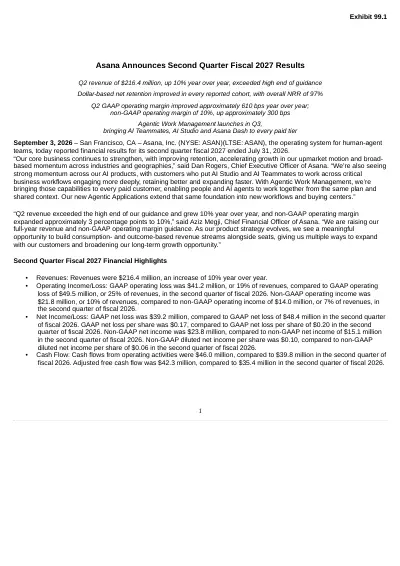
As Dan kind of alluded, we had a strong quarter. We grew 10% year-over-year.
It was our second straight quarter of growth acceleration. All the KPIs for the quarter were very strong, especially the NRR.
Every reported cohort improved. As we thought about the beat, we beat our midpoint of our guidance by $2.4 million.
We flowed through to the full year about $1.5 million. As we moved to agentic work management, which I'm sure you're going to unpack, there are some revenue recognition timing pushouts that are associated with that.
As part of our base becomes consumption, part of that revenue gets pushed out into future quarters. It's really only a Q3 phenomenon where we see that pushout because in subsequent quarters, you have the pull-in from the previous quarters.
That was about a $1.2 million impact. If you think about that together, $2.4 million beat, $1.5 million kind of flow-through of the beat, a $1.2 million impact, in absence of that impact, we would have been rolling the full beat and then slightly raising from there.
That's how we think of the puts and takes. Then as we transition to more of a consumption-based model in both the core package with AWM and then with teammates as companies expand with us, we're going to learn a lot about consumption.
We're going to learn about how quickly customers get from adopting these seeded credits to paid consumption. We're going to learn about consumption patterns and ramp.
Right now, with the data we have, we wanted to be a little bit more prudent in how we factor that into the guide, and so that was reflected in how we guided as well.
Steve Enders
That makes sense. Last question for me on guide, and then we're going to get into AWM.
Just on the product-led growth side of the business, that's been a, I think, recurring kind of headwind to it or to overall Asana growth. How do you kind of think through the headwind of that moving forward?
Kind of what are the things that you feel like you can tweak and you can control at least to a degree to try to mitigate that headwind? Then I guess, lastly, just on the guidance side of it, it does seem like the assumptions on that downticked, but you again flowed through the guide, which probably means that something offset that.
What was the positives that you kind of saw here, too?
Dan Rogers
I'll maybe hit the business piece, and then you can hear some of the financials around it. From a business perspective, I'll say, again, one of the beautiful things about Asana is a lot of our customers want to interact with us fully digitally or partially digitally.
It is a real advantage to have a PLG motion. Many of our existing large enterprises as an example come in through the door of having a trial experience, getting started digitally.
Whilst we have that advantage, it is true that the top of the funnel is changing constantly. Most recently, we've found that the top of the funnel has a lot of tire kickers who are not going to convert into paying customers, not going to enjoy the full richness of the product experience.
The challenge really is how do we fill the funnel with more of our ICP? Sometimes I think of it as some kind of entropy effect where all systems tend to complexity.
It's probably the same with all funnels. All funnels tend to getting clogged up over time, and so you have to put a lot of concerted effort into getting back to the core verticals that we're focused on, the core personas that we're focused on.
We made the pretty dramatic decision to change 100% of our marketing allocation to target verticals and target personas instead of some of the generic programs that you might do on paid search, etc. That's a big change.
The top-of-the-funnel mix should change quite dramatically. Then when they arrive, we've also done a lot on the product experience.
Instead of arriving now to just collaborative work management, they'll arrive to agentic work management, which includes teammates, but they'll also arrive to Asana Client Management, which is for those teams that are looking to do client delivery, well, now they'll find—and that's about almost a third of our customers, actually, they'll find that there's actually a dedicated product experience. The surface area of, I'd say, getting to the right product to the right folks has just increased fairly significantly.
We hope that that turn of the dial will change that profile quite significantly.
Aziz Megji
Then how we've factored in the guidance, if you think about the quarter, there's a couple of things that are really working well. One is the strength in the enterprise.
If you look at the metrics that kind of reflect our enterprise business, our cRPO, which is correlated to the bookings that we see in enterprise, if you back out the large customer that we renewed about a year ago, that growth accelerated from 7% last quarter to 11%. If you look at our $100K-plus customers on a customer-count and logo basis, those accelerated to 16% growth year-over-year from 12% last quarter.
We now see 25% of our $100K customers adopting AI, which is our AI products, which has led to strong improvement in NRR in the $100K-plus cohort. That cohort improved their NRR from 96% to 98%.
Enterprise really strong. We're seeing strong momentum in our AI products.
25% of our net new ARR was with our AI products this quarter. That is what's driving kind of the flow-through of the beat and the revenue growth equation.
Now, on the flip side, to your PLG question, we are seeing the impact that we called out at the start of the year that we were going to see two points of ARR headwind from the PLG business. That has increased in Q2.
Now it's around 2.5% impact, and the flow-through of that ARR impact, we're seeing more pronounced on a revenue basis in Q3 and Q4. The impact to our revenue growth is about 1% in Q3 and about 1.5% in Q4.
If you take those two things together, three things together: strong enterprise, strong AI product adoption, which is improving NRR in our larger cohorts, and then this continued headwind on self-serve PLG, which you're seeing actually in the NRR of our overall PLG base, which is muting a bit the improvements in the NRR in our larger customers, that's kind of the puts and takes. As Dan walked through the initiatives, it's a big focus of ours to get that business re-accelerated because as we do, it's an accelerant to both our revenue growth and our NRR.
Steve Enders
That's very clear there. All right, shifting gears now to AWM.
I think it really seems pretty interesting what you're doing here. Maybe we can dig a little bit into what is generally new in the product with AWM?
How does it maybe evolve what you're doing before with CWM instead of it just being a repackaging or a renaming of the prior solution set?
Dan Rogers
Great. Maybe I'll talk about what's happening in the real world.
In the real world, there's this AI productivity gap. AI productivity gap is people are experiencing a lot of personal productivity increase with working with the chat agents, with the LLMs, but companies in general haven't really translated that into their workflows, into their core productivity.
Company footprint of AI tends to be fairly low or single-player mode of multiple people now producing their documents better or doing their coding better. That makes it not a business process.
How do we more deeply engrain agents into what we call the agentic enterprise? The answer is through agentic work management.
What is agentic work management? The first idea is why don't we prepackage up some agents that can work alongside humans?
Unlike these single-player agents, let's make them multiplayer from the get-go. Let's make them, instead of you having to buy these things or find these things, let's make them raise their hands as you're doing your work.
So 30 prebuilt teammates. Of course, we've had 17 years of history of what people are trying to do at work, 30 teammates that actually cover the large part of what people are trying to do at work, and we've pre-skilled them, pre-trained them, and pre-contexted them on your work graph data.
What does that look like? Let's say in marketing, where we have five of these prebuilt agents, we do have a campaign planner in marketing that is pre-skilled and pre-trained on what it takes to build a marketing campaign.
It literally knows that every marketing campaign has these 16 steps, and you're probably going to need to have brand approvals, and you're probably going to need to link into your core brand assets. What it'll do is, if you're in Asana and you wake up, and just a couple of weeks' time, open up Asana, you might be working on a campaign, you might be writing a task, this thing's going to volunteer itself.
Say, "Hey, I'm your campaign manager agent. I got you.
What the heck is this thing? Let me click on this thing.
I know so much about what you're trying to do already because I've scanned the work graph and figured out who you work with, how you do this. By the way, I've actually pre-ordained from the people that have trained me what maketh a great campaign.
Here's what I think you're going to need to do next. Are you game?"
"Sure." You'll start working with the campaign planner, and it will then in turn say, "And I noticed that these are the 16 people that you work with on campaigns.
Do you want me to kind of tag them in, too?" "Okay, great."
The next thing, we're all working with that agent. This is a complete different paradigm shift.
We have millions of users, and in a couple of weeks' time, millions of users are going to each have two, three, four, five, six agents that they're working alongside that have volunteered themselves to help. Literally, we are going to go across the chasm in a massive leap to seed agents in the modern enterprise: prepackaged, pre-skilled, pre-trained, operating just like humans, and because they're in the same context as the rest of the humans, you can fully govern them, you can fully audit them, and you can fully scope them to work just as the rest of the human teammates.
That's thing one. Again, to your point, this is not a, "Oh, we've got some new AI feature.
We've got some new virtual chat assistant." This is actually germane to how you work.
It's deeply embedded in your workflow. It is a category-changing shift.
The second thing is we have developed a chief of staff that we call Dash. Dash will also be rather pleasing to any of our users because Dash will, again, be fully contexted in the work graph, be fully contexted in the teammates that can help, and just be able to pull not just on everything that's in Asana, but also everything that's in your email and everything that's in your chat with Slack, and everything that's in your calendar, and then actually infer—and oh, and everything that's in your meetings from every meeting transcripts—and infer the tasks that need to happen next and what you're due to do.
Actually, any of the tasks that you currently are working on, what new information that's in that peripheral system you need to be aware of that can be enriched in that task. Again, it's going to be a huge leap forward in what one can imagine an AI chief of staff should do.
Again, really pointing to Aziz's point about we've been busy. From an R&D perspective, the velocity of our engineering teams is probably 2.5x in the last 12 months.
We are shipping stuff that's game-changing. I think the big reveal is just a couple of weeks away, and I think people are going to be very surprised about the new Asana and what we've been up to.
Then workflows in general, both through our acquisition of Stack and then also through this thing called AI Studio, the ability to visualize processes and actually have those processes connect not just to agents, but also to third-party systems: if this, then this. For example, Citi's built their own virtual assistant called Skye.
Looks amazing. Got a preview of it last night.
In reality, when a customer has a discussion with Skye, it's probably going to end up forking into one of five paths that's going to need some other workflow that falls out of it or some other team that needs to get involved. That's really where Stack comes in: visualizing workflow, connecting to other systems.
It'll end up being the tapestry for the new enterprise, is the idea.
Steve Enders
Okay. It's really interesting.
I think kind of how it's evolving and how you're thinking about what the future of Asana looks like. I guess I maybe want to ask about the diffusion of AI into the enterprise, and how you see this spreading.
How much are you thinking about this being something that just gets surfaced naturally within the product set, and that is what's going to drive the end user to start using this versus this being kind of more of a sales-driven push and really trying to just get it in front of all the customers and needing to train the go-to-market team on that?
Dan Rogers
Yeah. I spend a lot of time with CIOs, and I kind of talk to CIOs about this great AI productivity gap, and what's the reason behind it.
Yes, there are security concerns and governance concerns, but actually the biggest one is discoverability. It's that teams just don't know how to use various agents or which agents they should be using.
There's a huge initial productivity or cold-start issue, which is don't know how to get started with said agents, don't know how to find them, don't know how to get started with them. That's the challenge we wanted to solve, and very deliberately.
We've had six months where we had these things called AI teammates that we were selling as an add-on, not discoverable and not germane to the core experience. That's fine, and we got, as Aziz was saying, 25% attach rate of our AI products.
What would 100% attach rate look like? That's really where in-product notification, in-product nudges, really being very contexted as someone is trying to work and something that will literally help them, and trying to do that in an unobtrusive way, I think we may have nailed it.
I suspect that most people will want to try these things. We've also been very thoughtful about making sure that there's not a billing event when they try those things, right?
How much do we give to get them to a point where they're delighted has been almost like a scientific endeavor, and I think we've found the right amount there, and the unit we're using is requests. We're going to seed requests for every user so that really you should feel like, why not?
Why wouldn't I give this agent a go? It's going to pass my company security requirements.
It's going to pass my governance requirements. It's there waiting to do work at my bidding, and it seems to know a heck of a lot about what I'm trying to do.
Let's give it a whirl. Because we've seeded five requests per user per month, we think that's enough for them to get to a point of joy and kind of saying, "Okay, we've got to get more of these teammates.
I've got to use this more. It's germane to my work."
Steve Enders
Okay. Then when you think about the monetization potential of this down the line, understanding you're trying to drive usage and seeding it out to customers, I guess what's the next step to when we start to see this hit revenue and the monetization path for you all?
Aziz Megji
What we've seen with the adoption of Studio and AI teammates has given us a lot of confidence that getting this to our fuller base, as Dan said, reducing the friction and the barriers to adoption and engagement will help drive that consumption path a lot quicker. It's not in our guidance.
We've been conservative and prudent in how we factored in, but as we think about our model, we've grown with customers primarily through headcount changes, right? As they grow headcount, we grow, right?
Now we have multiple ways, in addition to headcount changes, to grow with customers. We can grow with outcomes and the outcomes we drive, drive greater consumption and utilization of our products.
We can grow by the work being done and the output we're creating. I'm sure you'll touch upon with our new agentic apps and expanding buying centers, we can now move to different departments with outcomes as well.
It just enables these additional growth vectors that we've never had, and we're seeing that with expansion. Our NRR improvement, a lot of that is being driven by expansion, driven by our AI products, and we're seeing that with renewal activity.
We had a large customer that we called out in the quarter where they have less headcount than they did 3 years ago when they renewed with us. We piloted AI Studio and AI teammates with them several months ago.
They saw value in one production workflow in a marketing application. They saved about 30% of time on creating content for marketing campaigns.
That ultimately led to a renewal where we were able to offset a downgrade of seats with Studio and teammates and create an expansion outcome. This is a multimillion-dollar TCV type deal where our AI products are half of that.
Being able to expand with consumption and outcome-driven products, a year ago, that would have been a downgrade for us. Now it's an expansion with an opportunity to drive future expansion as they continue to leverage these products and drive more workflow through them.
These are exciting new levers to our story that just add additional growth factors in the long term.
Steve Enders
I'll
Dan Rogers
just say one other comment is, obviously, we're pioneering from a product innovation perspective, but we're pioneering from a business model perspective as well. This notion of literally across millions of users, multiple agents volunteering themselves, that doesn't exist.
How should one forecast that? Then we've got the conviction and confidence to do this based on kind of I'd say our run-up of the last 4 to 5 months, but we're taking a huge leap.
It's important to be prudent and conservative, but yeah, I think we're also being very pioneering.
Steve Enders
Okay. No, it's interesting.
Maybe this is a good point to ask about net retention. You saw a two-point jump this past quarter on the higher end of it.
I guess what do you need to see happen moving forward to get that number to 100% and potentially above that from here?
Aziz Megji
Yeah. If you think about our net retention as a rolling four-quarter metric, each of the quarters in that rolling four-quarter are improving.
We've had five straight quarters of improved NRR. Even if we just kept our in-quarter NRR where it is today, you will see sequential improvement.
To drive it to 100% or greater, which is the goal, it's really three things. We have two things that we are doing really well that continue to drive better net retention.
One, we're seeing the gross retention part of that equation improve quarter-over-quarter, our utilization of our underlying seats is improving, which that's highly correlated to net retention. That's number one on the gross retention.
Number two, we are seeing the customers, as they engage deeply with our AI products and drive better outcomes, we're seeing better seat dynamics, both in retention and expansion. Our AI customers are actually expanding much faster than our overall base.
Expansion is an important lever. A year ago was about pricing and seats as levers to expansion.
Now we have five products we can expand with, both seats and consumption and outcomes. That gives us just a lot more in our arsenal to expand with customers across additional buying centers.
That's the second. Then the third piece is back to the self-serve.
What's driving down our net retention, if you actually back into what the in-quarter would have been for the $100K and $5K, they look better than 98%. They're actually approaching 100%, and one of them is already above 100%.
It's really that sub-$5K cohort that's bringing that down to 97% on an aggregate. All the things that Dan outlined are all aimed at improving the lifetime value of those customers, having them land at higher ACVs, expand at greater rates, driving more value for them through having more personalized teammates and products, which will improve the retention.
It's continuing our gross retention, much more to sell, which will help accelerate expansion, and then as we get back that PLG and self-service piece, that NRR improvement will be a big tailwind to the NRR.
Steve Enders
That's good to hear. I think we only have a few minutes left here, but I want to make sure that we touch on some of the other new products you have, like Client Management, Service Management, and Command.
I guess maybe first of all, kind of what went into the decision-making to create a specific solution like those, and how do you kind of think about what that means in terms of augmenting the business or kind of expanding the TAM that Asana can go after?
Dan Rogers
First, maybe you have to understand a bit about my own history to understand that question. I guess my formative years were at ServiceNow and then at Rubrik.
I'd say, maybe get a page in the book or a chapter in the book at both of those companies on how you go from single product to multi-product. I was running a lot of the strategy teams at ServiceNow when I was CMO there as well.
Really, I guess my main task was, how do you go from being an IT service management company to being a multi-workflow platform? Similarly at Rubrik, how do you go from being a data protection vendor to a multi-product data security platform?
I'd say part of it is, this is what I do, and so that's maybe a bit of the history. Specifically to Asana, it was obvious to me that we were already serving all of those buying centers.
We were just doing so with a horizontal approach. Very nice correlation under the hood of, "Oh, wow, X percent of our teams that we're serving are IT teams, and Y percent are R&D teams, Z percent are marketing teams, foo percent is operations team."
It was a kind of a beautiful picture. Then when you saw what they were trying to do in the platform, where they were trying to push the platform, what their edges were of where they were trying to go, there were specific problems they wanted us to solve, and at a certain point, it's hard to do that in a horizontal canvas.
We said, "Well, why don't we keep the horizontal canvas, but be a lot more declarative from some of those vertical use cases?" That's what we've done.
We've set about creating these vertical products, but because they still sit on the same operating system for human-agent teams, the better-together story is actually amazing. It is, yes, you can have a teammate that still works across all of these other departments.
Our angle in is not, "Oh, let's take out the existing IT products. Let's take out the existing client management products.
Let's take out the existing R&D type products, Atlassian, etc." Those might be byproducts, but the reality is we're going to better serve everyone across the company by having better solutions for each.
The solutions will be amazing because they will be designed for the here and now. We're very lucky because we began R&D on all of these efforts I'd say post the Codex, Cursor revolution.
We got to build and imagine for the agentic future. Our approach to IT service management is as modern as it gets.
It literally was imagined nine months ago and shipped today. With all of the I'd say underpinnings of what that could look like, what real-time knowledge bases could look like, what self-learning agents could look like.
We believe no one has this kind of solution because they're all encumbered by the past way of solving it, but we've literally solved it for the next generation. Every one of those products, I think, will be quite mind-blowing when people see them.
Steve Enders
Okay. We're running up on time here, be a good time to plug the Work Innovation Summit coming up in a few weeks here.
I guess what should we expect coming out of that?
Dan Rogers
Aziz, do you want to take this? I feel like I've had a lot of airtime back.
Aziz Megji
It's more your domain, but—
Dan Rogers
I'll do it. Again, we have two Work Innovation Summits, and they're London and New York.
Basically, for us, they've become development milestones as well of things that we're going to release for each. You could think of it as kind of a summer release and a winter release, actually, for us, and increasingly, we're going to start describing that to the outside world.
Really, it's kind of our winter release or winter release preview. All of these products will be in market by then, and so you'll have a lot of customer stories about real customers that are doing it, that we've been very coy on.
We've had to be very coy on because they've been in this kind of design partner process. You'll see a lot of big brand names that have been using these products and getting to these agentic outcomes, delivering real productivity baked into their workflows.
I think it will be a rather grand unveiling of what it looks like to run a company that is an agentic enterprise.
Aziz Megji
Yep, and then we'll have investor and analyst fireside with Dan, myself, and our chief product officer, Arnab Bose, to kind of elaborate on the innovations and the customer stories and this business model and product transformation that we're undergoing. We're looking forward to that, and yeah, it should be some exciting announcements.
Steve Enders
Perfect. Definitely looking forward to that.
I think we're at time here, we'll leave it there. Dan, Aziz, want to thank you so much for being here today.
Dan Rogers
Thank you for the great questions.
Aziz Megji
Thanks, Steve. Appreciate it.