Volatus Aerospace Inc.
Q3 FY2026 · Earnings Call TranscriptNovember 10, 2026
Kristina Davis
...of Corporate Affairs, and I'm going to be your moderator for the call this afternoon. Before we get started, just a reminder that we welcome your questions, and we'll be having a Q&A session at the end of the presentation.
You're welcome to submit your questions at any time during the webinar by clicking on the Q&A box at the bottom of the screen and typing in your questions. If we are unable to answer your question today, we'll be happy to connect with you after the program.
This presentation will be recorded and made available on our investor website within 24 hours. I'd also like to take a moment to point out that certain information set forth in this presentation contains forward-looking information, including future-oriented financial information and financial outlook, and actual results may differ materially.
The risks, uncertainties, and other factors that could influence actual results are described in the presentation, in the press release, and in our MD&A filed with Canadian regulators. This presentation also includes non-IFRS measures, which are also outlined in the presentation.
There's a full disclosure on page 2, which you're seeing now, which we encourage you to read and can be found on our investor website at investor.volatusaerospace.com. The company considers the earnings call part of its routine disclosure to educate investors on information contained in the quarterly results and related MD&A.
If you have any questions, please feel free to contact the Volatus Aerospace IR team at [email protected]. Now with that, it's my pleasure to introduce Glen and Abhi, our CEO and CFO respectively, to kick off our presentation today.
Over to you, Glen.
Glen Lynch
Thanks, Kristina. Good afternoon, everyone, and thank you for joining us for the Volatus Aerospace Q3 business update and earnings call.
I'll begin with some highlights from the quarter and some important developments since quarter end. Abhi will then review our financial results, and I'll return with an update on the changing market environment and our priorities as we move towards 2027.
We'll finish with questions, let's kick off right away with the highlights. Looking at the quarter as a whole, we've made meaningful progress in positioning Volatus for its next stage of growth.
In September, we qualified across all five streams of the Defence Drone Initiative marketplace and secured our first Canadian Armed Forces contract. Shortly after quarter end, we completed the initial delivery of our NATO ally ISR training program, with the customer beginning to exercise options for additional systems now.
We also formally inaugurated our Mirabel manufacturing facility, where production of proprietary technologies is already underway. On the technical side, we achieved two important milestones: the initial flight testing of our VCortex AI, including navigation in GNSS-denied environment, and Transport Canada's acceptance of our Canary under the pre-validation declaration process, enabling much easier beyond visual line of sight in approved airspace.
Following quarter end, we completed the acquisition of Aistech, expanding our capabilities in advanced airborne sensors and mission software. Our strategic partnerships with Singular Aircraft and Crouzet Aerospace further broadened the aircraft technologies available to us, including opportunities developing in the wildfire response.
Throughout this period, our established commercial business continues to play an important role, particularly in energy, utilities, and infrastructure, where we have extensive operating experience and established customer relationships. Taken together, these developments strengthen our ability to develop, integrate, and deliver more complete solutions across both commercial and defense markets.
We're building on an established operational business while expanding the technology, manufacturing, and systems integration capabilities that support our future growth. Mirabel represents an important investment in our Canadian manufacturing and systems integration capability.
The facility provides approximately 53,000 ft.² of dedicated manufacturing space. Operations began in June, and we formally inaugurated the facility in September.
We're already producing docking stations, producing and deploying them, and other proprietary technologies, while we're preparing additional aircraft and systems for manufacturing. Our approach goes beyond producing individual drone models.
We're developing an adaptable, scalable manufacturing operation capable of supporting our own products, integrating technologies from strategic partners, and responding to customer requirements across commercial and defense markets. We believe this flexibility, combined with our ability to scale production efficiently, will become increasingly valuable as the demand for autonomous systems develops.
Our focus today is on advancing production readiness, strengthening our processes, and increasing our utilization as customer programs move forward. I should mention a bit of a side note there we are moving towards an aerospace quality management system with our first audit beginning in December, moving towards our security clearance, controlled access, Canadian controlled goods, and cybersecurity.
Our product roadmap reflects the breadth of our proprietary technology things that we're actually developing. SkyDra, our counter-UAS planning and simulation tour is ready.
Sentinel Dock is in production and delivering systems into commercial use. While our spectral shields, that's our electronic warfare intelligence, remains at the prototype stage.
VCortex, which is our proprietary flight control and autonomy technology, continues to advance following its initial GNSS-denied flight testing that happened in September. Looking towards 2027, our roadmap includes Swarm Autonomy, Nyx, the V-100, and the Condor, with development timelines subject to testing qualification and developing customer requirements.
An important part of our technology direction is the increasing value of software, autonomy, navigation, and sensing. Aircraft platforms will continue to evolve.
By developing the technologies that can be integrated across multiple platforms and mission requirements, we believe we can create greater flexibility and long-term value. This approach allows us to combine our own technologies with selected partner platforms to address opportunities that cross both commercial and defense applications.
On October 28th, we completed the acquisition of Aistech based in Lithuania. Aistech brings advanced airborne sensor technology, mission software, and an established European engineering capability into Volatus.
Its Helikx family of modular sensor pods allows customers to combine technologies such as lidar, optical, thermal, and gas detection within a single system. Approximately 50 systems have been sold across five continents, with installations approved on dozens of helicopter models.
The commercial fit is particularly attractive. Aistech serves markets including energy, utilities, pipeline inspection, forestry, and mapping, all sectors where Volatus already has significant operating experience and established and growing customer relationships.
We see opportunities to introduce these sensing and data processing capabilities into our existing services while also pursuing applications in defense, including intelligence, surveillance, and reconnaissance. The broader opportunity is in bringing aircraft operations, sensors, onboard processing, training, and mission software together to deliver a more complete aerial intelligence solution.
The acquisition strengthens our technology portfolio and creates opportunities on both sides of our business. With that, I'll turn things over to Abhi for the financial results.
Abhi Singhvi
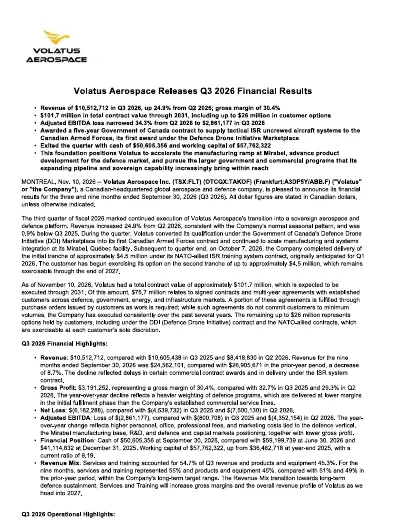
Thanks, Glen. We reported third quarter revenue of $10.5 million, in line with our analysts consensus.
The revenue was up 24.9% from Q2, consistent with our normal seasonal pattern. Our adjusted EBITDA loss was $2.9 million, better than the analyst expectation.
The loss narrowed 34% from Q2. Operating expenses came down 7.5% sequentially.
Year-over-year basis, our adjusted EBITDA loss widened, which reflected investments we have made ahead of our revenue, particularly in engineering and defense personnel, product development, software technology, Mirabel facility, much of which has already been built in place now. The path to adjusted EBITDA breakeven depends on growing revenue through the capacity we have built.
You can find the adjusted EBITDA reconciliation in the appendix and in our MD&A as well. On the next slide, through September, revenue was $24.6 million, and we can see consecutive three-quarter jumps in revenue now.
On the NATO-allied ISR training systems that was discussed last quarter, we completed delivery of the initial tranche on October 7th. The revenues were recognized along Q1 of this year till Q3 and some revenue coming in Q4.
The customer has already began exercising the options under the second tranche of up to $4.5 million. Services and training accounted for approximately 55% of our third-quarter revenue, with product and equipment making up remaining 45%.
Markets outside Canada contributed approximately 39% of revenue through September, including $7.3 million from UK and Europe and $2.3 million from the US. The timing on the revenue for both defense and commercial divisions matters here.
In the commercial business, a typical sales cycle runs three to six months. In defense, it can take years to get a contract award.
Canada's Defence Drone Initiative is moving faster than we have traditionally seen. We received our first Canadian Armed Forces contract through this initiative in September, and we expect it to support faster contract awards in Canada in the near term as well.
The total contract value through 2031 was $101.7 million, including up to $26 million in customer option. This is for the first time our contract backlog and total order backlog has crossed $100 million mark.
This slide highlights the gross margin of the company. The gross margin profile was 30.4%, up 110 basis points from Q2.
It was 32.7% third quarter of last year. The year-over-year change reflects a greater share of defense deliveries where margin in the initial fulfillment phase are lower than our established commercial service line.
Through September, gross margin was 31.1% compared to 32% last year. We look at margins over several quarters because of the mix that can shift depending on the individual equipment and product deliveries that takes place over the period of time.
Our long-term gross margin objective remains 35% to 40%. We expect larger production runs to help improve defense programs margin as volume builds and scale up.
We also expect proprietary platform launch and scale of our defense software technology that we just discussed and continued growth in the commercial segment to contribute higher gross margin over period of time. We ended up September with $15.6 million in cash and approximately $58 million in working capital.
Working capital was up $21.3 million from the year-end, and our current ratio was 9.19 times, well above the covenant requirement of 1.25. The cash change reflected cash used in operating activities and working capital needs, including inventory and deposits ahead of the contractual deliveries.
Borrowing were down to $9.4 million at quarter end, and we redeemed all the remaining preferred shares basically making our cap stack more streamlined. After the quarter ended, we closed the Aistech acquisition for $10 million headline valuation that comprised of $3 million in cash and $7.5 million in shares, which were allocated at 57 cents at an average price.
Our capital priorities are to ramp up production at Mirabel, advance our defense product development, continue scaling commercial division, integrate Aistech, and fund the working capital need for the larger contractual deliveries in the defense side. We'll continue to tie new investments to specific revenue opportunities.
Overall, Q3 was a good quarter. Our revenue grew nearly 25% over Q2.
Our adjusted EBITDA loss narrowed by a third, and we won the first Canadian Armed Forces defense contract. I'm excited about what comes next.
We have the capacity and the capital to deliver on the contracts we have won and where we are focused. With that, I will turn it back to Glen.
Glen Lynch
Thanks, Abhi. I'd like to turn now to the significant changes taking place in Canada's defense market.
Over the past year, we've seen the introduction of the Defence Industrial Strategy, the establishment of the Defence Investment Agency, the proposed procurement legislation, and a new National Security Strategy. Most recently, Budget 2026 proposes $2.3 billion over five years for the Defence Drone Initiative.
The budget also provides $7.6 billion over five years to extend and expand Canada's Operation Reassurance, reinforcing NATO commitment in Latvia and across Eastern Europe. This is particularly relevant to Volatus following our acquisition of Aistech, which gives us an established engineering and technology presence in Lithuania, strategically located to support potential Canadian and allied requirements in the Baltic region.
Taken together, these developments have signaled an important shift in Canada's approach to defense procurement, domestic industrial capacity, and allied cooperation. There's a growing emphasis on Canadian companies being able to develop, integrate, manufacture, and sustain critical technologies while working closely with trusted allies.
Uncrewed and autonomous systems are becoming increasingly important part of that discussion. What's particularly encouraging is that we're beginning to see this policy direction translate into procurement activity.
For companies with relevant technology, manufacturing, and operational experience, we believe this represents meaningful opportunity as the market continues to develop. The Defence Drone Initiative provides a good example of how Volatus is responding to this changing market.
In September, we qualified across all five streams of the Defence Drone Initiative marketplace. Within days, we secured our first Canadian Armed Forces contract.
Our approach is to match the solution to the customer's operational requirements. For immediate needs, that means delivering proven technologies, whether they're developed internally or sourced through strategic partners.
For emerging requirements, our engineering teams and our developing Volatus Forge provide the opportunity to develop and demonstrate new solutions. For our initial Canadian Armed Forces order, we're targeting the delivery of the first 100 systems in late November or early December, putting us materially ahead of our September 2027 delivery schedule.
We believe the ability to respond quickly and deliver reliably will be increasingly valuable as Canadian defense procurement activity expands. Our focus is on establishing a strong record of delivery, building the customer relationship needed to compete for larger programs.
Looking ahead, our focus is building on the progress we've made during 2026. In defense, our immediate priorities include delivering the initial Canadian Armed Forces order, advancing our NATO-allied ISR training program, and pursuing further opportunities under the Defence Drone Initiative.
In our commercial business, we're focused on expanding our presence in energy, utilities, and infrastructure, building on established customer relationships, and introducing technologies that can broaden our services. We're also advancing production readiness at Mirabel and integrating Aistech's sensor and mission-capable software capabilities into our broader operation.
As we move towards 2027, we're developing our corporate strategy around one integrated enterprise with two complementary growth engines, commercial and defense. Both will benefit from common investments in engineering, autonomy, manufacturing, and operational capabilities.
We see significant potential in the technologies that can serve multiple applications and in manufacturing and delivering systems that can adapt and scale with customer demand. Our priorities are to continue building revenue, improve utilization across the business, and strengthen financial performance.
We believe that the combination of our established commercial operation, growing defense opportunities, and expanding technology portfolio provides a strong foundation for the year ahead. Before we call for questions, I'd like to thank our employees for their contributions throughout the year.
We've made important progress in strengthening Volatus, expanding our capabilities, and positioning the company for the future. We have a clear direction and a strong focus on execution, customer delivery, and financial performance.
I also want to thank our shareholders for their continued confidence and support. Abhi and I'd be pleased now to take any questions.
Kristina Davis
Thanks, Glen. We're going to kick off with a two-parter.
The first of which is how much of the second tranche worth $4.5 million for the NATO ISR training opportunity has been exercised? What's the timing for delivery?
Then the second part of that question: what are the next milestones we should be looking for around the Canadian DDI opportunity?
Abhi Singhvi
I can take the first part, Kristina. Right now, approximately $3 million has already been exercised.
We have already been indicated that the remaining will be exercised as well. Everything needs to be delivered before March 31st, 2027, which is Q1 of next year.
Glen Lynch
Dealing with the additional DDI RFPs, yes, there have been, I believe, we submitted, if I'm not mistaken, two RFIs within the past week. Basically, the indications that we have right now is that they may have as many as 20 additional RFPs in the queue ready to be progressively released.
We've had I would say right now a pretty busy time responding to RFPs because they're short response windows and fairly detailed submissions. A lot of work going on in that front.
In terms of the industry reaction to the acquisition of Aistech, it's been quite positive. Realistically, what that does for us at the moment is it takes our capability right from the sensors, the sensor pod, on-board computing, data aggregation, and sensor fusion right through our own mission management system, our AERO'S platform, and into a visualization project that we'll be talking about in the days and weeks ahead.
We're quite excited by it. It's early days for us right now, but we're actually starting to organize our North American tour of the technology.
Kristina Davis
Great. Our next question: the $102 million contract value sounds like a backlog.
Can you tell us the mix of defense versus commercial in that? Can you describe how this value relates to the commercial $647 million pipeline?
Abhi Singhvi
Sure. We intentionally don't call it backlog.
We refer it to as committed orders because some items are subject to the POs, which are very standard and common in commercial sector. Approximately 20%, 25% of it is related to defense.
Remaining approximately $76 million entirely is related to commercial contracts and agreements, which have been executed over the multi-year. The pipeline of approximately $650 million is changing.
The $100 million is out of the wins we have from the overall pipeline we had shared previously. Our pipeline is changing, including both commercial and defense right now continuously.
The overall committed orders and contracts are also changing as the pipeline is evolving.
Kristina Davis
Great. We have some folks looking for a little bit more detail on the DDI.
Following delivery of the initial 100 drones, when would you expect to hear about potential for the further 4,900? This person is asking just to maybe help folks understand a little bit better the Canadian Armed Forces' testing process and the timelines that might be related to that.
Glen Lynch
I'll take that. Our understanding directly from the people involved is that as we deliver the technologies, they'll be moving them as quickly as possible out into the field so that we can potentially with our own people supporting them, determine exactly how they perform in the field and what ultimately they need us to adapt as time goes by.
It's unclear as to how fast they will expand that order. Our impression is that they're very aggressive right now, quoting the commander of the Army when he spoke to me directly some time ago.
It was, "We want to flood the Canadian Army with drones, and then ultimately, we want to equip our warfighters so that they can learn the use of the tool and provide feedback on how we can make the policies or make the tools more suitable to the Canadian military." That second half, by the way, was our interpretation.
The first half of flooding the Army, that's kind of a common understanding of what they're planning to do. We're expecting the equipment will perform as advertised.
The equipment that we've delivered to them is mature equipment. At the end of the day, we're quite confident with what that should do for us, and we're hopeful that the demand from there will ramp up fairly quickly to continue delivering.
At the end of the day, they're literally trying to come back to the concept of flood the Canadian Army with drones. I think it all depends on how quickly we deliver, how well they perform.
It's a little bit reading a crystal ball to see how fast they'll go. We get the impression that it's going to move quickly, but again, that's an impression at this point.
Kristina Davis
Great. Thanks, Glen.
Just shifting gears a little bit. Is swarm technology still at the concept stage, or is development already underway?
Glen Lynch
We've been working on swarm technology. I'm not in a position to comment on maturity.
That'll become more visible in the weeks ahead. It is an active development program for us.
Maybe I'll touch on that for a second. Typically, what happens is as we develop the software capabilities, we move it into a synthetic testing environment before we actually move and introduce it to small drones to actually test them.
In the case of swarm technologies, there's a whole bunch of different applications, but it'll be tested out on small quadcopters ahead of time.
Kristina Davis
Okay. Can you discuss any other RFPs that might be in the pipeline for military, utility, or cargo?
Also maybe give us a bit of an update on wildfire as well.
Glen Lynch
Wildfire, I'm in a better position to talk about than where we are with the flow of RFPs, because we actually have a team directly looking after that. I know about them as we go to submit them.
Wildfire is a bit of a different story. As we know, wildfires is becoming a federal problem, a national problem in Canada and many other countries around the world.
It's been raised as a major priority. The problem that tends to happen right now is that across Canada, it's become a national problem that's administered provincially.
We've also had a couple of the key provinces lately, that being Quebec and Alberta, that have been impaired from decision-making with the various referendums and elections that have been going on lately. It's tough to say how quickly that's going to progress.
We are actively engaged in presentations with various government bodies. There's a strong interest, but it's too early to say where that is.
Quite frankly, it always gets more difficult this time of the year to keep pushing the idea, because the forests aren't burning. Then in the spring when they're burning, everybody is so busy, it's difficult to have decision-making.
The secret for us right now is just to continue pushing, which is exactly what we're doing.
Kristina Davis
Great. Maybe you can just dive a little bit deeper into what industry's reaction has been to our acquisition of Aistech.
Maybe you can give us a little bit of an update on revenue synergies in both North America and in Europe.
Glen Lynch
I'll let Abhi touch on that one to start with, and I'll follow up at the end.
Abhi Singhvi
Sure. Thanks, Glen.
The overall reaction has been surprisingly way overboard than we had initially expected. It's been a good reaction specifically because we work with a lot of customers as well which Aistech supplies to.
It vertically integrates the technology framework. Now what's happening is we are using the technology and also providing our end-to-end collection services at the same time.
It's becoming a complete suite of offering to the customer instead of selling one piece of technology and have them find an operator to use those technology and collect information and data insights. That's one immediate I would say reaction from the industry we are seeing, which has been positive.
On the revenue synergies, we had anticipated that over a period of time, two years, there'll be $7 million to $12 million of revenue synergies coming in. We are already in discussion with certain customers right now to operate thousands of miles for them on the corridor inspection using the Aistech pods.
Our anticipation was next two years. Right now the way it's going is we anticipate that we'll be able to realize those synergies in much reduced time that we had initially anticipated.
Kristina Davis
Glen, did you Oh, sorry.
Abhi Singhvi
Oh, sorry. I was just asking same question, Kristina.
Glen [unclear], right?
Glen Lynch
Yeah. No, I think it's a key point right now is we had common customers with Aistech.
It's given us opportunity now not just to sell the pods, but also to provide the aircraft to carry the pods. That provides some significant vertical integration.
I would say customer reactions initially has been very strong, but we're two weeks in, it's pretty early to really go too far in terms of being able to really measure how the customers are going to accept it. Certainly, the kickoff has been very positive.
Kristina Davis
Great. Thank you.
Let's talk about Mirabel a little bit. Can you discuss your thoughts on how to allocate Mirabel's capacity?
Do you have demo units from the facility available for customer trials? Talk to us a little bit about where we are from a Mirabel perspective.
Glen Lynch
Mirabel, right now Mirabel's primary production is our docking station technologies, mostly because we're deploying them commercially already. What we're doing right now is working with a couple of key, large contractors to help us develop what we're calling an adaptable, scalable manufacturing system.
Our objective, I think most people that are Volatus investors know, the initial contracts that come out of DDI have that 5,000-unit possibility with often times a 100-unit opening order. It gives the government an off-ramp for companies that are developing technologies that maybe don't meet the requirements or they can't scale, they're not locked into contracts with companies that aren't delivering what they want or in the time that they need it.
The key point, though, is as we start scaling, some of the subsequent orders that we're looking at and RFQs have much higher production rates. Even looking at producing beyond the original order that's delivered to the government, what we have to be prepared to do is deliver at an accelerated pace.
This really is the secret of Mirabel. Mirabel, if you were to, and people have asked me, "What are the three things that you think are the most important investments in Volatus?"
Number one, software-defined defense. Number two, software-defined intelligence.
Number three, adaptable, scalable manufacturing as a sovereign capability. The key point here is this: we need to be able to produce drones at a rate that meets the kind of a stabilized customer requirement.
Let's turn around and say, I'm going to make up a number for illustration, 1,000 drones a month. The problem is we need to be able to 10x that production with the push of a button in the event of a crisis.
We're talking about building capacity and capability ahead of demand. There's a whole bunch of complexities in that, because at the end of the day, you need the government to buy in, because we're not building a 10x production with a 1x production rate.
There's a lot of complexity in terms of how we deal with the government investment, government contract programs. There's a few different ways for that to happen, and also the supply chain, which is a major issue.
Our objective with Mirabel is to recognize that we have developing technologies. Canada has an ecosystem of innovative companies, very small SMEs, handful of employees that are developing great technologies, but may not have either the capital or the experience to be able to go into a 10x production, right?
Move from 1,000 a month to 10,000 a month. That's really the capability that we're building there.
It's a capability that we have conceptualized with some industrial partners that are actually experts in that field that are helping us develop that system. What'll happen initially is the introduction of the autonomous manufacturing that can be demonstrated in a scalable work cell.
That's really where we're focused right now. In terms of the actual production that's happening, we always have demo units, but our intention for the most part is simply initial demonstrations.
After that, we prefer contractor-owned deployment. The strategy is that we'll accept the risk for our technologies and ultimately deliver whatever the desired outcome is as a service.
That's really kind of the strategy of how we tie the technology together with the industrial development at the factory and our commercialization of technologies.
Kristina Davis
Great. Thanks, Glen.
Jumping back to the DDI just for a second. Can you elaborate on your assessment of the DDI competitor landscape?
Glen Lynch
100%. I've had a couple of people come back and say, when we announced that the budget was $2.3 billion over the next five years for DDI procurement, somebody said, "Yeah, but there's 500 suppliers."
There's 397 right now. There's another tranche to just closed last week, and there's one more due in January.
Presumably, the number the the head count of approved companies is going to increase. For us, we spend a lot of time understanding what the competitive landscape is for a couple of reasons.
We've spent right now, we've spent a lot of time analyzing the 397 companies that qualified under the first tranche of Canada's DDI initiative. I think the composition of that helps tell a story.
First, it's important to recognize that these are not 397 companies competing to deliver the same capabilities. The markets marketplace itself spans five streams, including aircraft, counter-drone systems, communications, software, systems integration, testing, and innovation.
Our analysis although tells also tells us something about the maturity and scale of the supplier base. Of the companies with available employee information, approximately 62% of them report 25% employees or 25 employees or fewer, with a median workforce of just 15.
When we look at corporate maturity, 90 supplier records have founding dates in 2024 or later, including 45 in 2026 alone. Now, I'm not trying to suggest that any of those companies are not qualified to compete in that space.
We're really just talking about where they're competing, how they're competing, and their capabilities. It tells us that we're looking at a marketplace with a substantially smaller number or a substantial number of smaller and relatively new businesses alongside of established aerospace and defense companies.
That doesn't diminish their capability. Some of them are excellent with their technologies.
Smaller businesses often times lead in innovation. There's an important distinction between developing technology and having the engineering resources, operational experience, manufacturing capacity, and access to capital that's required to deliver and sustain large larger programs.
Our preliminary assessment has identified approximately 50 companies as potential direct competitors, although that number will evolve as we continue evaluating the marketplace. Many other participants are more appropriately viewed as specialized suppliers, technology partners, or companies whose capabilities are still being assessed.
For Volatus, it reinforces why we've been investing in an integrated business that combines technology, real-world operations, manufacturing, training, and long-term support. We ultimately believe the opportunity is significant, but ultimately, success won't be determined by the marketplace alone.
It'll be determined by the ability to execute and deliver reliable capabilities at scale.
Kristina Davis
Great. Thanks for that, Glen.
We're going to take two more questions. The first of which is: have you started manufacturing for the government of Canada's ISR UAS contract?
Glen Lynch
We have, not in Mirabel. The original plan, the technology that we presented and this is an important question.
There's a lot of noise out there about buying Canadian. We have to remember that the Defence Industrial Strategy, the name alone tells you something important.
Defense is the first word. The first objective right now is rearming our military.
Building a Canadian industrial base is the second priority, and the government focus is on shifting to 70% domestic procurement by the end of 2035. That's why they put forth $6 billion to invest through BDC, for example, in Canadian businesses and in the Canadian defense industrial base.
When we first introduce technologies to the government, recognizing that they need to be mature and there is virtually no mature technologies that are produced at scale in Canada. What happens is we're representing partner technologies where we have to deliver mature capabilities immediately, and the initial tranche is produced by our partner.
Now, what that does is it gives us time to establish the manufacturing system at the factory and transition. It's a process, right?
We start with 100 systems that are delivered, that are working, that are demonstrated. In that period of time, we start to train the workforce and configure the factory to be able to produce the subsequent orders.
Initially, that could very well be supplied with parts kits out of the foreign markets while we develop our Canadian ecosystem. Just give you an idea for a second when you think about it.
If we try to build 10,000 drones in a month, that's 40,000 electric motors, just talking if they're small attritable systems, attritable mass. That to build those motors, we need about 2 million rare earth magnets, if we're built in that.
There's a couple of different options that we're exploring, but that's it. The supply chain, we have to develop the Canadian supply chain.
Until then, we have to rely on allied, friendly partners, to speak, like-minded partners that already have that capability. In some cases, we have to draw from multiple locations.
That could be Germany, could be the United States, could be the UK, just by way of example. Ultimately, that's how those technologies will develop is progressively moving the manufacturing of those systems to Canada.
That's the way it's presented to the Armed Forces, and that's the way we're delivering mature technologies in a brand-new industry.
Kristina Davis
Great. Thank you.
This will be our last question for this afternoon. Any update on windmill or offshore traction, and the revenue model of docking stations and cargo?
Glen Lynch
Those I think there's three questions packed into that.
Kristina Davis
I think there's a few questions in there. Yeah.
Glen Lynch
Yeah.
Abhi Singhvi
I can take a hit, Glen, on some of those.
Glen Lynch
Go ahead. We
Abhi Singhvi
yes, we did ended up winning some of the contracts for the offshore wind turbine projects. Right now, we are just waiting for the regulatory approvals.
Once we have that clearance, I think the execution of that contract starts. On the revenue model of docking station, we are not intentionally disclosing that for competitive reason, but it is basically a SaaS model that has been built in, which basically becomes our competitive advantage.
It has been deployed in the industry, and right now, three docking stations are currently active and operational and generating revenue for us. Cargo projects are live as well.
These are not this includes smaller last-mile cargo deliveries as well in Canada. Customer name is undisclosed.
At the same time, it also includes some of the larger cargo deliveries that are taking place in the US right now. These are basically drones with almost 100 100 to 200 kg lift capacity.
Those contracts are also we have won. We have more demos happening in Q1 of next year, we expect much larger contracts when are expected as those demos become successful.
Glen Lynch
I'm going to add something to that, particularly when it comes to the offshore wind turbines and wind turbine cargo, where we're delivering to the top of turbines. The first part of that project was actually to deliver, autonomously being able to deliver to the top of a windmill platform while the wind turbine continued to turn and the head on the wind turbine continued to align with the wind.
We developed that capability at our test site north of Toronto. We actually built out the equivalent of a windmill deck, and perfected the precision delivery and pick up, or I would say, are still continuing to perfect that, but it's quite far along at this point.
As the regulatory approvals happen, much of which has to do with the operation of drones in international airspace, that's a current ICAO topic that we're working through, we expect that to scale. The technology that we've developed is not just for offshore.
It's also wind turbines in general. It's a quite a substantial marketplace that I would say we'll see some good traction or hopefully see some good traction in 2027.
Kristina Davis
Great. Thanks to you both.
Thank you as well to everyone for joining us for our earnings call today. Just a reminder that the presentation recording will be available on our investor site within 24 hours at investor.volatusaerospace.com.
If you have any additional questions, please reach out to us at [email protected]. Thank you for your time and enjoy the rest of your day.
See you later. Bye-bye.
Thanks, everyone. Take care.
Bye-bye. Thank you, everyone.
Bye. Bye.