Securitize Corp.
Q3 FY2026 · Earnings Call TranscriptNovember 9, 2026
Operator
Ladies and gentlemen, thank you for standing by and welcome to Securitize's Third Quarter 2026 Earnings Results. All participants are in listen-only mode and this call is being recorded.
Following the prepared remarks, we will hold a question-and-answer session. To ask a question, and if you have joined via the webinar, please use the raise hand icon which can be found at the bottom of your webinar application and be prepared to unmute your line when prompted.
I would now like to turn the call over to Sam Ross, Head of Investor Relations. Mr.
Ross, please go ahead.
Sam Ross
Thank you, Max. Good evening and thank you all for joining Securitize's Third Quarter 2026 earnings call.
For today's call, I am joined by our Chairman and Chief Executive Officer Carlos Domingo, our Chief Financial Officer Francisco Flores, and our President Brett Redfearn, who will be joining us for the Q&A portion of the call. I'd like to remind you that today's presentation, which is available for download on our Investor Relations website, investors.securitize.io, may contain forward-looking statements which are based on management's current expectations and are subject to risks, uncertainties, and changes in circumstances.
Actual results may differ materially from these statements due to a variety of factors, including those described in our earnings materials as well as in our SEC filings. With that, I'll turn the call over to Carlos.
Carlos Domingo
Thank you, Sam, and thank you, everyone, for joining us today. It's great to be with you as we report our third quarter results.
This was our first full quarter as a publicly traded company, and we made significant progress both financially and strategically. We delivered strong recurring revenue, continued to build and scale our platform, and advanced several initiatives that we believe will shape the next phase of tokenized capital markets.
Our mission, as is to tokenize the world, and it remains very simple. It means bringing real financial assets on-chain with the rights, protections, and infrastructure that institutions and investors expect from traditional capital markets, but with all the efficiencies provided by blockchains.
I'll begin with the financial and business highlights for the quarter, then spend some time on our progress in tokenized equities, fund tokenization, and strategic partnerships. I'll also discuss our planned acquisition of River One, which represents an important expansion into credit origination and asset-backed financing, and our additional regulatory capabilities.
After that, our CFO, Francisco, will walk you through the financial results and our outlook in more detail. Let me start with the highlights of the quarter.
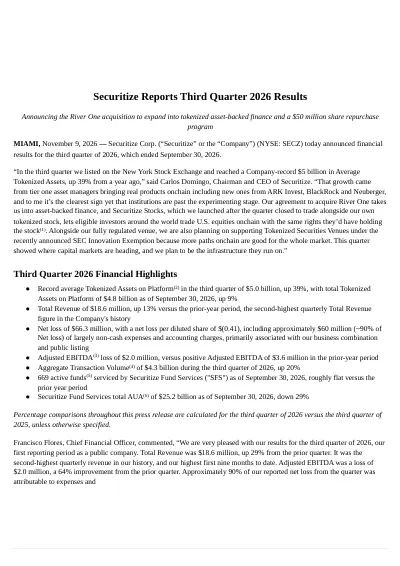
As many of our second quarter revenue came in below where we wanted. This quarter, we delivered a very strong $18.6 million of revenue, up 29% sequentially and 13% year-over-year.
That makes Q3 our second-highest revenue quarter on record, and through the first nine months of the year, we've generated a record $52.5 million in revenue. We also narrowed significantly our adjusted EBITDA loss to approximately $2 million, an improvement of about $3.5 million compared to the prior quarter.
Our GAAP results reflect accounting items which Francisco will explain in detail shortly after me. We achieved a record $5 billion in average tokenized assets in our platform.
Securitize Fund Services reached $25.2 billion in assets under administration, and we ended the quarter servicing 669 active funds. Aggregate transaction volume was $4.3 billion, up 20% year-over-year.
Taken together, these results show both improved quarterly execution and the growing scale of our platform. Beyond the financial results, we continue to expand the business in several important areas that we'll go into detail later.
In public equities, we tokenized our own stock, SECZ, when we listed in July at the New York Stock Exchange, and following the quarter end, we launched Securitize Stocks, which already has expanded to 25 US equities. In funds, we broadened our institutional offerings with Neuberger Berman's High Income Fund, the ARK Venture Fund, and additional work with BlackRock.
We expanded integration and distribution opportunities across decentralized finance, stablecoins, global markets, and institutional partners. Securitize Capital became an SEC-registered investment adviser, adding to our regulatory capabilities.
The common thread is that we're building much more than a token issuance service. We're building a regulatory infrastructure that can support the ownership, trading, servicing, and increasingly the financing of financial assets.
Let's go over with tokenized equities, which we believe represents one of the largest opportunities for bringing regulated financial markets on-chain. As we've mentioned before, the global equities market is enormous.
It's estimated to be $109 trillion, and a very, very small portion is today represented on-chain. That tells us just how early this market remains.
It's also important to recognize that not all tokenized equities are created equal. There are three fundamental, different approaches.
The first one is issuer-sponsored tokenization, where the token represents the actual share, and ownership is reflected in the issuer's shareholder registry. Second is what are called custodial security entitlements, where tokens that are backed 1-to-1 by underlying shares and holders have legally recognized entitlements.
These are regulated under Article 8 of the UCC and fully legal and compliant in the US. Third, there are synthetic products that provide exposure to asset price without the same ownership structure.
These are mostly offered offshore and, in their current structure, do not comply with US regulations. Our strategy focuses on the first two approaches: issuer-sponsored shares and backed security entitlements.
The differentiation is not just the blockchain technology; it's the legal rights and regulated infrastructure underneath. We bring together transfer agency, broker-dealer capabilities, trading infrastructure, and access to issuer relationships.
That's why we believe we're particularly well-positioned as this market develops. As we've mentioned before, tokenized stocks are at a very, very early stage.
There's about $4.6 billion in the market represented by this chart—we will go over the breakdown a little bit in a second—as of October 27th. That is roughly the level stablecoins reached in March 2020.
Since then, stablecoins grew substantially, 64 times, as their utility increased, and this analogy shows what early-stage adoption can look like. We're not predicting that tokenized stocks will follow the same path or grow at the same rate; the opportunity depends on real investor rights, trading access, liquidity, and practical use cases with tokenized assets.
When we went public in New York Stock Exchange on July 2nd, we decided to list our own shares on the Solana and Avalanche blockchains from day one. We were the first company doing this to showcase how tokenization is possible in the US in a regulated manner.
As of September 30th, at the end of the quarter and during most of Q3, SECZ was the largest individual tokenized stock, with approximately $278 million in value, roughly 2.6 times the next largest stock represented on this chart, which is a synthetic representation of another company. In our case, Continental, who is our transfer agent, provides the shareholder record infrastructure, and we provide the tokenization capabilities.
For the trading portion of it, Jump helps provide liquidity and extend our trading into the Solana ecosystem. We follow all regulations related to pricing for trading, providing always prices that are within the NBBO, or national best bid and offer, therefore providing on-chain the same pricing that you can have trading on a traditional broker-dealer, but on a blockchain.
SECZ is also accepted as collateral in an on-chain lending market, and we will be expanding that lending utility over time. We demonstrated that the issuer-sponsored model with our own publicly shares from first day of trading is possible in the US in a regulated way.
Subsequently, right after quarter end, we launched Securitize Stocks on October 8th with 12 US equities on Solana, and another 13 more on November 2nd, bringing the offering to 25 of the top and most traded US stocks on-chain. Each token is fully backed 1-to-1 by an underlying share held through a security entitlement under existing law, not a synthetic instrument.
The structure is designed to preserve the applicable dividends, voting rights, and economic benefits of the underlying shares. We also do not lend out the backing shares, and we will allow investors to the tokenized shares to lend themselves the shares, retaining most of the economics, as opposed to what happens today in traditional markets, where your shares are being lent out with broker-dealers retaining most of the economics.
We also think that for retail investors, being able to borrow against their shares is very important, and something not easily available in today's markets that DeFi markets and blockchain infrastructure can bring to market. Our convertible entitlement token model also creates a pathway for holders to convert into issuer-record shares when an issuer adopts a compatible structure in a seamless way without having to reissue the tokens or change anything on the investor end.
Let's summarize where we are in terms of 24/7. First, we already have a live US broker-dealer model for Securitize Stocks on Solana, with USDC instant settlement and extended trading hours.
Jump is the liquidity partner alongside infrastructure partners that support trading, clearing, custody, and collateral opportunities. Our objective is to expand distribution through additional venues, including the proposed New York Stock Exchange Digital ATS that is launching in Q4 and the OKX ICE JV Tokenized Securities Venue, or TSV, that is launching in the coming days.
Full 24/7 trading remains a goal, and the additional venues are subject to their respective launch and regulatory milestones. It's important to distinguish what is live from what is planned.
As trading moves on-chain, there may be multiple regulatory routes, and our existing business is built to work within today's rules. Another important regulatory milestone in this quarter was the long-awaited SEC innovation exemption that was published in September 17th and that provides conditional relief for trading stocks on-chain using permissioned automated market maker pools.
It includes safeguards around account and rights, issuer notice and objections, and limits on individual securities and trading volumes. We welcome responsible innovation in market structure.
Just as important, Securitize's existing regulated broker-dealer approach does not depend on this exemption, but we will be supporting multiple venues, including multiple TSVs. Given the bit of confusion in the market between the two models, we wanted to bring here a table to just explain how the regulated venues like the one we run differ from the TSVs under the innovation exemption.
First, from a regulatory framework perspective, we operate with a fully registered broker-dealer and ATS, and we have the licenses are permanent to be able to operate without any expiration date. The innovation exemption is an exchange exemption; it allows people to operate without an exchange license and expires in September 2031.
More important, what we do is fully regulated and therefore does not require issuer consent. It's not required for convertible entitlement tokens, and only for issuer-sponsored tokens that will require collaboration with the issuer and their transfer agent.
However, the innovation exemption requires a 30-day issuer opt-out given the exempt nature of the trading venue. You can see also here that there is another important thing in terms of the different execution paths that you can choose under fully regulated broker-dealer or under the innovation exemption, as well as how pricing works.
In our case, we have to follow the national best bid and offer pricing, and the innovation exemption TSVs are exempt from the order protection rule. We welcome additional innovation, and we will continue to build within the existing regulatory framework.
Let's move to fund tokenization, which remains foundational to our institutional business. As we mentioned in the previous earnings announcement, we continue working on unlocking opportunities across the yield curve.
This creates new types of opportunity to generate yield and also introduces underwriting credit and liquidity considerations that tokenization itself does not eliminate. What is especially exciting is the utility after issuance: how eligible holders can use tokenized assets as collateral or connect them with other on-chain services.
In Q3, in August, we released a new fund with Neuberger Berman for high income that is an illustration of this progression along the yield curve. Let's review a bit the fund.
This fund offers tokenized access to actively managed high-income credit strategies. The fund is launched on Avalanche, Ethereum, Solana, and Sui and supported by Securitize's broader regulated and servicing infrastructure.
Eligible holders can use HINC as collateral in the Loopscale USDG lending market and soon in the Aave market, where we have submitted for a governance proposal, which has already been approved. The fund has a 30-day yield of 7.13%, making it as a very attractive asset as for DeFi collateral markets.
Subsequently, we launched a new fund with ARK. It's the ARK Venture Fund with ARK Invest, which is an existing registered crossover investment product that we've put on-chain with a $500 minimum for eligible retail investors.
This is a retail product essentially. The fund provides a mix of private and public companies and contains a lot of the most desirable companies, both public and private out there, like SpaceX, Kalshi, OpenAI, Anthropic, Stripe, and very proudly it also includes equity in Securitize.
Let's move into tokenized treasuries. As and as we mentioned last quarter, tokenized treasuries have grown dramatically since we launched BlackRock's BUIDL in March 2024.
The market is approximately 14 times larger than it was at that launch. Securitize accounted for approximately 14% of the tokenized US treasury funds as of September 30th, and we are reflecting the position we built in the category alongside major institutional managers.
What matters most is that institutional cash and treasury products have demonstrated real demand for tokenized infrastructure, and we continue working to make those assets more useful for liquidity, settlement, and collateral. In Q3, we also deepened our partnership with BlackRock and continued expanding well beyond the initial BUIDL launch in March 2024.
During the quarter, we supported the launch of B-RESERVE, BlackRock's new registered money market fund designed to serve as a GENIUS-compliant reserve asset for eligible stablecoins. Securitize provides the tokenization and transfer agent infrastructure.
We also expanded BUIDL to Tempo, connecting an established institutional cash product with another blockchain ecosystem. We think Tempo is going to be one of the important players there given the support from Stripe, which is one of the largest FinTechs in the world.
We're also adding liquidity capabilities through atomic on- and off-ramps designed to allow eligible investors to move instantly between institutional share class of BUIDL and USDC, with Ethena as the liquidity provider. These initiatives show how tokenized funds and stablecoin infrastructure are becoming more closely connected, creating opportunities for greater liquidity and utility.
All right, let's move into partnerships and how we connect regulated securities infrastructure with distribution, payments, and on-chain utility. In Q3, we announced a very exciting partnership with a company called Socios.com, where we are exploring how regulated tokenized equity could open a new ownership opportunities around professional sports.
Socios.com is the largest fan engagement company where they issue fan tokens for fans of multiple professional sports teams, and they have now recognized that the fans want to move beyond owning fan tokens into owning ownership on the clubs that they support. Given that providing equity ownership is a regulated manner, Socios.com has partnered with Securitize to bring securities issuance, onboarding, and investing infrastructure to its sport relationship and fan engagement capabilities.
It's an example of how the addressable market beyond conventional funds and public equities. Also, stablecoins are one of the most important infrastructures for our products to be successful.
You want to have on-chain not just tokenized securities, but also tokenized dollars, things like redemptions, taking and settlement, trading, etc., can become more efficient. This quarter, we joined two partner networks supporting USDG and AUSD, bringing stablecoin infrastructure closer to our tokenized funds and securities.
USDG is already integrated in our platform and is used in the HINC collateral market on Loopscale. These stablecoin rails can support more efficient funding, settlement, and on-chain lending for eligible investors.
Beyond the operational benefits, the most important thing is that network participation can also create additional economics for Securitize when we mint and distribute a stablecoin rather than simply relying on third-party stable liquidity. By being a member of the network, we retain some of the economics of the underlying assets in the stablecoin.
The next area where we have signed two important partnerships is Korea. We're working with major Korean institutions to develop tokenized securities as the local regulatory framework evolves.
We think in the future Korea can become a very important market for us, we're setting the foundations and preparing for the upcoming regulatory changes. Our first collaboration is with KB Securities, one of the largest securities firms in Korea.
It combines institutional distribution and reach with Securitize's regulatory infrastructure. The initial focus is a tokenized money market fund for institutions on Optimism, with potential to expand in other investment strategies as securities rules permit in the country.
We also announced a memorandum of understanding with LG CNS, a very large Korean system integrator, to explore tokenized assets, stablecoins, and marketing infrastructure for financial institutions in Korea and across Asia. All right, let's move to the River One acquisition.
As we mentioned when we went public, one of the reasons we wanted to go public is because we think the market is going to consolidate, and we wanted to be in a position of being able to acquire companies, both with our cash in our balance sheet as well as our liquid equity. Today, we're announcing the first planned acquisition of a company called River One that represents our entry into credit and asset origination, creating opportunities beyond the tokenization and servicing business we've already built today.
We have spent years building the infrastructure to bring traditional financial assets on-chain, first through funds and more recently through public equities. We believe the next big opportunity is credit.
With our planned acquisition of River One, we're expanding into asset-backed finance, a large market where stablecoin capital and blockchain infrastructure could create meaningful new opportunities. This is not simply about financing assets we already tokenize.
It's about expanding into a new asset class and participating in new parts of the value chain, with the potential for additional revenue streams. Today, there are approximately $200 billion in stablecoin supply, but very little of it is actually used to finance activity in the real economy.
At the same time, the US asset-backed finance represents approximately $6 trillion market, projected to grow to $9 trillion in 2030. We see an opportunity to connect these two markets by directing capital towards appropriately underwriting credit assets that finance business and real economy activity.
This is natural next market for Securitize to pursue. Tokenization doesn't eliminate credit risk, but we believe it can help connect investors, originators, and funding sources in more efficient ways.
River One is a structured credit and asset-backed finance business that works with FinTechs, originators, and other capital-intensive companies, driving capital from the stablecoin economy. Its team brings specialized expertise in origination, structuring, underwriting using an AI engine, and managing credit facilities, including financing secured by receivables and other underlying assets in a programmatic way.
That's compelling for us because River One adds both a new capability and experienced team that would otherwise take significant time to build internally. What makes River One especially interesting is the combination of its credit expertise and its proprietary technology.
They have three modules in their platform. The first one, called Argo, supports underwriting and credit analysis using an in-house AI underwriting platform that the credit team uses.
The second one helps manage the financing facilities, monitor covenants, and track performance in a more efficient way, and replaces two to three days of spreadsheets reviews with on-chain infrastructure that is much more efficient and instant. Finally, Harbor provides a path to tokenize and distribute credit structures through Securitize's existing infrastructure capabilities.
Together, these capabilities could allow us to participate earlier in the life cycle of credit assets, from origination and structuring through financing with the stablecoins and on-chain distribution of the tokenized credit products. That creates opportunities for origination fees and participation in financing economics, with the potential for higher-value monetization as the business develops.
Just as important, we're gaining a team with deep expertise in asset-backed finance and crypto technology. The strategic rationale is very straightforward.
We've built the infrastructure to tokenize, service, and distribute assets. River One will expand our business into credit origination itself.
This acquisition remains subject to closing, and we are excited about the opportunities it could create for Securitize in the coming days when closing happens. Finally, let's talk a little bit about our new regulatory capabilities.
Regulation has been central to our strategy from the beginning. In Q3, Securitize Capital became an SEC-registered investment adviser, another important milestone in the development of our regulated platform.
As of September 30th, Securitize Capital had approximately $439 million in assets under management, exceeding the $150 million allowed for exempt advisers to operate. This registration gives us greater flexibility to scale our advisory business, develop additional institutional strategies, and pursue management fee opportunities.
It reinforces something that has differentiated Securitize from the very beginning. We're not simply a technology provider using tokenization.
We bring together transfer agent, a broker-dealer, an alternative trading system, investment advisory, and fund admin capabilities, with operation both in the US and Europe. That's the infrastructure institutions need as tokenization becomes an increasingly important part of our capital markets.
With this, I'd like to conclude my overview of our strategic progress, and I will turn over to Francisco for the financial results and outlook. Thank you.
Francisco Flores
Thank you, Carlos. Good evening.
For my prepared remarks today, all reference growth rates are on a year-over-year basis unless I indicate otherwise. Total revenue was $18.6 million in the quarter, up 13% versus the prior-year period, driven by higher tokenization revenue, partially offset by modestly lower asset servicing revenue.
On a sequential quarter basis, total revenue was up 29%. As Carlos mentioned, this was the second-highest quarter for total revenue in the company's history.
Total revenue for the first nine months of 2026 was $52.5 million, an increase of 15% versus the prior-year period and a record nine-month period for the company. Tokenization revenue was $11.5 million, an increase of 29% versus the prior-year period, largely due to the integration of new protocol, as well as higher distribution fees in the current period.
Asset servicing revenue was $7.2 million, a decrease of 6% versus the prior-year period, primarily driven by lower fund administration and accounting fees in the Securitize Fund Services business given the decline in assets under administration, partially offset by higher service fees in our transfer agent business. Turning to expenses, total operating costs and expenses were $42.2 million, an increase of $27.3 million, or 183%, predominantly driven by higher SG&A and higher compensation benefits, including expenses associated with the completion of our business combination.
While I'll discuss each one in greater detail momentarily, our total expenses this quarter included approximately $21 million of expenses which we would generally consider to be non-recurring in nature. Core operating expenses excluding these items was approximately $21 million.
Cost of revenue in the third quarter was $4.5 million, an increase of $1 million, or 29%, primarily due to higher software, systems, and market data costs and higher cost of revenue generating employees and contractors. As mentioned last quarter, cost of revenue consists largely of direct labor in our blockchain engineering and integration divisions, fund accounting, and client-facing personnel, and capitalized software amortization.
SG&A expenses were $20.8 million, an increase of $14.1 million versus the prior-year period. The increase was primarily driven by share-based expenses related to warrant obligations, higher legal, accounting, and consulting fees, including costs associated with operating as a public company, higher advertising, promotion, and public relation costs, and higher insurance costs.
These were partially offset by lower software and subscription expenses in the quarter. Compensation and benefits were $16.5 million, an increase of $12 million versus the prior-year period.
The increase was primarily driven by higher share-based compensation expense, including $5.3 million of non-cash earnout-related expenses in connection with the closing of the business combination, and higher headcount, including the hiring of corporate roles necessary to becoming a public company. Provision for credit losses was approximately $300,000 versus approximately $100,000 the prior-year period.
Turning to non-operating income and expenses in the third quarter, total other expense net was $42.6 million, driven by two notable items related to the business combination, partially offset by higher dividend income. Looking at these two notable non-operating items, they combined for $43.9 million of expenses in the quarter.
Before I get into the specifics of each, I'd importantly stress that both of these expenses were non-cash charges. First, we recognized a $20.6 million loss associated with the settlement of convertible instruments.
This was a one-time non-cash charge from converting our pre-closing convertible notes, SAFEs, and preferred stock options into equity at the close of the transaction, reflecting the difference between the value of the shares issued and the carrying value of those instruments. Given that this was related to finalizing the business combination, we do not anticipate any impact for these instruments in future periods.
Additionally, we recognized a $23.2 million charge for the change in fair value of earnout liabilities. If you recall, both Securitize and sponsor earnout shares were granted as part of the business combination.
Given that SECZ share price at September 30, 2026 was $14.59 versus $11.78 at the time of closing, accounting rules required us to recognize a corresponding expense. We'd note that this line item will fluctuate quarterly as it's entirely non-cash.
For example, if our share price at the year-end were at today's level, we would expect to report a meaningful non-cash gain in the fourth quarter. Separately, with other non-operating income and expenses, dividend income was $2 million, driven by the higher average balance of dividend-bearing investments, reflecting the investment of cash received in connection with the business combination.
However, given our intention to strategically leverage our balance sheet in a dynamic way, we would caution against assuming that we will generate this type of dividend income on a quarterly basis going forward. Looking at adjusted EBITDA, adjusted EBITDA was negative $2 million, compared to negative $5.5 million in the prior quarter, representing a sequential improvement of $3.5 million.
Compared to positive adjusted EBITDA of $3.6 million in the prior-year period, this represents a decrease of $5.6 million, driven by higher compensation and benefits as we continue to scale the business, higher SG&A expenses, including professional and consulting costs associated with becoming a public company, partially offset by the higher total revenue. For the third quarter of 2026, Securitize reported a GAAP net loss of $66.3 million, compared to net income of $4 million in the prior-year period, a decrease of $70.3 million.
The higher year-over-year net loss was driven by higher expenses, including headcount growth to support the expansion of our business and prepare for being a publicly traded company, and stock-based compensation, along with non-recurring costs associated with the company's business combination. The higher net loss also reflected losses on convertible instruments and change in fair value of earnout liabilities, both of which were related to the closing of our business combination in July 2026.
Net loss per diluted share in the third quarter was 41 cents. I would note that given the accounting rules around share count as a private company, there's no real meaningful earnings per share comparison to the prior-year period to highlight.
Again, I think it's important to put our results into context. While our reported GAAP net loss appears significant, approximately 90% of it, or roughly $60 million, was attributable to charges that were mostly non-cash in nature, including those associated with closing the business combination and the warrant-related expenses.
From a capital and balance sheet perspective, Securitize remains in a very strong position, with roughly $300 million in net cash and liquid securities on our balance sheet, with zero debt, a little bit less than $2 in net cash per share as of September 30, 2026. We will continue to leverage this balance sheet strength to grow our businesses both organically and inorganically, but will be disciplined around financial returns for these investments.
As you likely saw in our press release, our board of directors has approved a share repurchase program to repurchase up to $50 million of our common shares through the end of 2027. Given the volatility in our shares since being a public company, this authorization provides us the flexibility to be opportunistic when we see significant market dislocations.
This is just another tool in the toolkit that our strong balance sheet allows us to pursue. Now, before I turn to our outlook for 2026, I wanted to cover one small housekeeping item.
As it pertains to the River acquisition that Carlos discussed, we're not disclosing financial terms for that transaction today, but I'd note the deal was attractive to us from both a strategic and financial point of view. We also do not expect the acquisition to have a material financial impact on our fourth quarter 2026 results.
Now on to our financial outlook for the full year 2026. We're quite pleased with a strong third quarter and the momentum we're seeing in our businesses.
However, as previously discussed, the timing of revenue recognition for certain tokenization initiatives and on-chain integrations is influenced by project milestones and execution schedules, which can result in some variability between quarters. As a result, we continue to expect total revenue to be in a range of $70 to $80 million for the full year 2026.
Looking ahead to the fourth quarter, we expect improved core operating results, supported by continued revenue momentum and disciplined cost management, as we move beyond the significant transaction-related impacts of the business combination in Q3. I'll just wrap up my prepared remarks by saying how proud I am of our team and the financial results for our initial quarter as a public company.
We posted the second-best revenue quarter in our history today, and while there was some expected expense noise in the quarter from the closing of our business combination, we managed the business tightly and saw a modest $2 million adjusted EBITDA loss, significantly improving from previous quarter. We remain extremely excited about the opportunities ahead and our balance sheet strength, with approximately $300 million of cash on hand, positions Securitize well to capitalize on what we still see as the infancy of the secular trend towards tokenization.
With that, we'd be happy to take your questions. Operator, please go ahead and open the line for Q&A.
Operator
We will now move to our question-and-answer session. If you have joined via the webinar, please use the raise hand icon which can be found at the bottom of your webinar application.
When you are called on, please unmute your line and ask your question. We kindly ask that you limit yourself to one question and one follow-up.
We will now pause a moment to assemble the queue. Your first question comes from Devin Ryan with Citizens.
Devin, please unmute and ask your question.
Devin Ryan
Great. Hi Carlos, hi Francisco, and Sam as well.
How are you?
Carlos Domingo
Good. Continue.
Devin Ryan
Good to see you. A question on tokenized equities.
Obviously, I think a lot of us are tracking some of the public companies that have opted out of the OKX ICE tokenization pilot. I think that's also creating some confusion in the market around what the objections actually mean for kind of the broader tokenized equities market.
I'm curious from your perspective, are issuers rejecting tokenization itself, or are they just uncomfortable right now with this unaffiliated third party creating a tokenized version of their shares without the issuer and transfer agent being directly involved? I'm curious kind of what you're hearing from conversations, and then ultimately, the question is, does that push the market maybe more towards Securitize's more issuer-led model?
What do you think issuers would need to see before they become more comfortable participating directly?
Carlos Domingo
Thank you, Ryan. Definitely, all these offshore synthetics and the 10 different varieties is creating a lot of confusion for issuers, and you might have seen how some very public CEOs like the AMC CEO, they've been complaining about their shares being tokenized offshore without following US regulations.
I think that has created also the confusion when the OKX ICE TSV send a notification to issuers, which was just like sending a notification to the headquarter. In some cases, we've talked to some issuers, they don't even know who actually received the tokenization, and I've talked to the head of digital assets of two of the issuers that opt out, and they didn't even know who was the person opting out.
I think that first we need to clarify that for what we do, because we're fully regulated, we don't require any opt-out from the issuers. This is strictly for the TSV because of the exemption situation from the SEC.
I think that what is allowing this is we obviously have reached out to many of the issuers that have opted out, and as well as discuss with others, and has allowed us to actually have a conversation with them to be able to explain them between the different models: the offshore synthetics, the fully regulated US-based, the issuer-sponsored versus tokenizing their entitlements, as well as what the TSV is. This allowed us to have these conversations that otherwise would have been hard to have.
We still continue being very bullish about it. Innovations don't always start with incumbents on industry.
Personally, I don't know if going to the largest, most known companies in the world as the first step was kind of like the right decision, but we're very pleased to see, and you will see when the announcement of the final launch of the OKX ICE TSV comes in the coming days, that there's been a lot of other issuers that have positively approved for them to be tokenized and listed on the TSV, and I think we're going to have enough volume both in our regulated platform that, as I mentioned, does not require issuer opt-out, as well as on the OKX ICE TSV. Then remember that in Q4 also the New York Stock Exchange is launching the Digital ATS.
That's going to be another opportunity to talk to issuers to explain them about another regulated venue coming from the largest stock exchange in the world, etc. We just think that this is unfortunately part of the noise in the industry about the different tokenization models that we need to live with.
Overall, we don't think that this is a problem long-term on to moving into tokenized markets and issuers accepting to tokenize their shares because, as I mentioned many times, there is no publicly company CEO that doesn't want to reach out more investors, or have higher liquidity, or be able to identify and communicate and engage with their investors in a more direct way. Once you manage to explain those advantages, as well as why there's regulated venues and not regulated venues, and the difference between that, I think that that's when you start getting traction with them.
Brett Redfearn
This is Brett Redfearn. I just wanted to add one thing.
Devin, great question. Tokenization and TSVs are two different things, but just to put a fine point on what Carlos said, if somebody opts out of a TSV, it does not mean they are opting out of tokenization.
One is tokenization is the form in which a security is offered, the other one is sort of an innovative new market type. As you will see with all of these issuer opt-outs, we continue to launch tokenized stocks on a regulated platform, and we will continue to do so.
That's just a very different thing than opting out of a TSV.
Devin Ryan
Appreciate all that color. It's a question we get, and I think just getting some deeper context there is helpful.
Just as a follow-up, can you talk a little bit more about the pipeline of potential either new partners or new products on the asset management side, and just how that's been progressing? Obviously, you see the progress with BlackRock and Neuberger and others where it seems like you have partners that are finding product-market fit.
If you can give us any sense of how that's maybe igniting new conversations. Is there anything that also you're kind of watching for on the regulatory side that could drive more of an unlock with the asset management partners where you feel like either regulatory-wise or some type of capability that will bring more of them into the mix as they see some of the larger firms having success with obviously what you've done with them on the tokenization side?
Carlos Domingo
Without being able to disclose any specific names, what I can tell you, Ryan, is having been doing this for a long time, is that the last 12, 18 months, the amount of inbounds that we're getting from large asset managers, as well as large banks that some of them have asset management franchises, about figuring out how to get into tokenization space and tokenize some of their assets, it's the highest I've ever seen in the industry since I've been doing this for close to nine years now. It's very positive.
Those projects take time. With BlackRock, and I've mentioned that publicly many times, it took almost a year from the first conversations till the product actually launched.
When we engage with these very large organizations, in many instances, they have to go through internal kind of like procurement process, if you want, with an RFP that is very formal, that they invite dozens of companies to bid for the projects, etc. We're very positive that we're going to continue seeing Securitize dominating on the if you want tier-one asset management space, which I think is where we have our strength because of our regulatory capabilities, as you mentioned, and also because of the credibility that we have as a regulated entity by having worked already with some of the largest asset managers in the world.
Conversations take time. The process of being chosen as the tokenization partner and launching products, it's an enterprise sales-type process that takes time, but we're very positive about the space.
You will continue seeing some further announcements in Q4 and into Q1 with some names that you will recognize very well.
Brett Redfearn
This is Brett again, Devin. Just to address the part about the regulatory unlock, we remain in the most favorable regulatory environment we've ever seen in terms of what can be done with tokenization and products on the blockchain.
Even with the elections, we are in a world where people see that, people are building towards it, and that regulatory unlock continues unabated.
Devin Ryan
Great. I'd love to sit here and keep asking questions, there's a lot to talk about, but appreciate it, guys, and I'll hop back in the queue and pass it along.
Operator
Thank you. Your next question comes from the line of Gareth Gacetta with Cantor.
Gareth, please unmute and ask your question.
Gareth Gacetta
Hey guys, thanks for taking the question. Maybe just double-clicking on the last one and kind of the new fund launches you guys talked about.
I'm wondering if you could detail the difference in economic profile that comes with the different types of roles you guys are playing, maybe using the new BlackRock fund and ARKX as an example. Correct me if I'm wrong, but I think on BlackRock, you guys are the transfer agent and the token is actually the fund's share itself, and then on ARKX, the token is an entitlement to shares that Securitize Markets holds as a broker-dealer.
Could you just maybe walk through at a high level which one of those ends up contributing more to the Securitize top line, and then if there are any other types of involvement structures that you might have with other funds on the platform?
Carlos Domingo
Actually, we can use the three funds that we launched this quarter to kind of illustrate the three different models. On the B-RESERVE, as you mentioned, this is a BlackRock-managed fund that has been created specifically to be on-chain and tokenized, and we are their transfer agent and tokenization platform, we manage the shares of the fund.
As such, we take fees as service provider, which is a percentage of the fees that the asset manager charged. I would say this is model number one with BlackRock as well.
For BUIDL, for instance, we also have distribution fees because we act as a broker-dealer and as a distributor as well, which we're working to be for B-RESERVE as well. On the second model, which is the product that we launched with Neuberger, this is a fund that Securitize Capital, our registered investor adviser, manages, where we take all the fees that are on the fund, and you can see them on our presentation.
Then the actual underlyings of the fund are managed by Neuberger, it's a sub-adviser to the fund, we then share fees back to them. Those are the fees that we actually get on that fund.
The third model, which is the ARK VX with ARK Invest, this is an existing fund where we have just basically issue an entitlement against shares that we keep in custody, and then where the value accrues for us is on the distribution portion of it, not that much on the asset servicing side.
Gareth Gacetta
That's really helpful color. Thank you.
Then maybe just a higher-level one on the River One acquisition. Maybe just can you walk us through the deal from start to finish on who the actual borrower is, what the collateral is, and where the stablecoin capital might come from, and just the overall business model of River One?
Carlos Domingo
Sure. As we mentioned in the presentation, there is $220 billion in stablecoins out there.
If you look at how much of those are being lent out to earn a yield, it's around 10%, which is the stablecoins that are lent out on DeFi markets. The actual yields that you're getting there are pretty low, surprisingly.
You can go to Aave and other places to see some stablecoins have high yield because they're subsidized, but if you're an individual user holding stablecoins and you lend them out on markets, you're not going to get a very high yield. It could be 3%, 4%, fluctuates depending on where crypto lending is.
Then when you do that, you're actually basically taking protocol risk because you're lending into a DeFi market. You're also taking collateral risk because most of the collaterals on those markets tend to be other digital assets that they're volatile or also in some cases, as it has happened in the past, they're subject to hacks.
We think that there is an opportunity to basically enable stablecoin issuers, stablecoin holders to be able to kind of lend assets into better lending markets that are built out with a similar kind of structure. It's all controlled and managed on-chain, but against real-world assets that are used as collateral.
Then what those real assets are, we've listed some in our presentation, but this could be FinTechs, mobility, telecom, payment lenders, etc., that have assets that they need to borrow against them. The way it works is that the River One team has an AI underwriting platform that they use to underwrite the creditness of the lender.
Then with that we can create on-chain pools to be able to borrow from stablecoins, and then they have a full on-chain management facility for how the credits are managed and the loans. Then on top of that, we can tokenize the loans from the LPs.
The flow is very simple. We are approaching on one side, stablecoin either issuers or holders to be able to borrow from them, and then we're approaching people that need to borrow from, let's say, companies that do mortgages, or they do HELOCs, or they do auto bike fleets, or things like that, where they need to actually borrow from somebody.
Today they're borrowing from traditional finance, which is expensive and inefficient. They can then borrow from stablecoins and probably get a better interest rate, as well as a much more streamlined process where they can actually fund the deal faster and do it intraday even in some cases without having to go through a very lengthy manual processes, and that also results in efficiencies in how you manage those loans that create better interest rates.
We're very excited about it. This is a very emerging space in the industry.
I think Figure is probably the only company doing a little bit of that within themselves for their HELOC products, but as a broader space, is very unexplored, we believe. I think it's around $3 billion or something that are on-chain today from asset-backed finance, and if you see how big is the industry, it's a $6 trillion industry that is predicted to grow to $9 trillion.
Then because we there take the net interest margin, which is the spread between the borrower and the lender, the monetization opportunities for us are much higher than just simple originating or distributing assets. I think that this is from a take-rate perspective, this is going to be a higher business for us once we get it to scale.
Gareth Gacetta
Awesome. That's really great color, and thanks for the questions, and congrats on a good quarter.
Carlos Domingo
Thank you.
Operator
Your next question comes from the line of [Siddhant Shah?] with Rosenblatt Securities.
Please unmute your line and ask your question.
Siddhant Shah
Hi Carlos, Francisco, and Sam. Thank you for taking the question and congrats on the quarter.
Could you just spend some time talking about the revenue model for the various venues that are coming up, like the OKX ICE TSV venue and the NYSE ATS, and how that is going to affect the economics for the products you're offering?
Carlos Domingo
The OKX ICE TSV, we expect it to launch pretty soon. I don't want to disclose dates that have to be disclosed by them, but as we put on the deck, it's imminent.
There we are the provider of the tokens that will trade there. These will be some issuer-sponsored tokens as well as convertible entitlement tokens, and then we have an arrangement with them to share trading fees that we have not disclosed, but that's essentially will be based on volume.
On the New York Stock Exchange ATS, we play two roles as well. One is we are one of the transfer agents, the first one that was chosen to be able to supply tokens that will trade on their ATS.
From that perspective, we are one of the broker-dealers that will connect to the ATS. This ATS doesn't take retail flow directly.
Only broker-dealers connect, and the broker-dealers bring the retail flow. As a broker-dealer bringing retail flow, we'll be able to take commissions on trading from the retail people trading, not from the New York Stock Exchange ATS.
Overall, both you should think of it as trading volume being probably the main driver, same for the stocks that we're trading today in Solana with Jump as the main source of revenue growth. Then we're also working, as you might have seen, on enabling other interesting opportunities with lending of equities, tokenized equities, which is something that today is very hard to do for retail people.
If you have equities on a broker-dealer, you can take margin to trade more, but you cannot just borrow to buy a house or buy a car. This is for the ultra-high net worth is available, but not for everybody.
We think that lending markets are also going to be another interesting monetization opportunity for us there.
Siddhant Shah
Awesome. For the Socios.com sports team ownership partnership, is that very similar to the fund admin business?
Is that where it would show up? Is that the same revenue model?
Carlos Domingo
No, no, it's completely different. On that partnership, basically we're going to be the regulated entity basically distributing and eventually trading those tokens that represent equity.
We will have distribution fees, which we will share back with Socios.com because they're bringing the flow of the retail people that they already have on their platform for the fan engagement tokens. Then once those tokens also become liquid and they can trade, we have a fully regulated tokenized securities venue in Europe that we can trade.
I say Europe because we're going to start in Europe where these things are easier than in the US. In the US, there's a lot more regulations around retail ownership of professional sports teams, while in Europe this is a lot more common.
The drive was that we are a fully regulated entity in Europe, and we can actually help them leverage their retail base to move into tokens that represent equity, which is regulated, as you know. There it will be distribution fees and trading fees.
It will not be asset servicing. Asset servicing is more for funds and things like that that we manage as a transfer agent or a fund admin.
When it comes to equity, the revenue opportunities are distribution and trading, just as what happened with stocks as well.
Siddhant Shah
Awesome. Thank you for taking the question, and congrats on the quarter again.
Carlos Domingo
Thanks, Sid.
Operator
Your next question comes from the line of John Todaro with Needham & Company, apologies for that. John, please unmute and ask your question.
John Todaro
Hey guys, thanks for taking my question, and congrats on the progress this quarter and the good results. I have a broad one and then a little bit more in the weeds one, just kind of related to modeling.
On the broader side, number of different product segments you guys are launching now, where do you see kind of it evolving? Maybe what the near-term most impact and then maybe medium or longer-term most impact on the tokenization side benefiting the platform?
Is it single-name stocks? Is it some of the funds that you've found success in?
Just help kind of frame that landscape up for us, and then I have that follow-up modeling question.
Carlos Domingo
On the fund side, this is our bread and butter, is where the majority of our revenue today comes, and we definitely continue seeing big opportunities. We just launched three funds this quarter, we see those contributing significantly to future growth.
I think ARK is more about distribution and giving retail access to this product that's otherwise hard to invest, and we're going to be looking at potential trading opportunities in the future with them. Then on the Neuberger fund, it's more about people that want to use it as collateral for DeFi because it's a good source of collateral.
It's a high-quality asset, it was yielding at above 7%, you can borrow at a cheaper rate against it to either leverage it or create another trading strategy, etc. We see the driver as those integrations that we have started doing in Q3 for growth.
Then B-RESERVE is very specific for stablecoins. As stablecoins are proliferating, and unfortunately the last quarters stablecoins have been flat or declining a little bit, but we're still very bullish on the stablecoin space, and we think that more people, now especially with GENIUS becoming effective in Q1 next year, more companies will want to launch stablecoins, and many of them will want to actually have the reserve in tokenized form to be on-chain as well, and to provide visibility about the reserves.
Then we see the growth coming from capturing that stablecoin reserve market. Now, on the equity side, I think it is very early days, as we showed on the presentation.
There is very little equities on-chain, most of them are still synthetics, volumes are also very very small, but we're very bullish as a mid- to long-term opportunity because we think that a very small percentage of growth and volume could actually provide significant fee opportunities for us. You're going to see us continue making progress in Q4 in two directions.
First one is continue bringing more names. Second, supporting new venues where our stocks can trade.
If our stocks are the most liquid and the best price in the market, they will be the winning ones, we believe, and the most regulated. We'll be supporting the launch of New York Stock Exchange, the OKX TSV, but also enabling retail integrations with apps that can actually send retail flow to trade those stocks.
We're not a retail B2C company, we're not a retail company, we're a B2B2C, we're more of an infrastructure provider. We want to provide this trading infrastructure for other people to enable their customers to trade stocks on-chain.
Those are the direction of travel. I think that in Q4, you will still see fund tokenization being the main source of revenue for our company, but we hope that Q1 onwards, tokenized stocks start taking off and start becoming a significant portion of our future revenue.
John Todaro
That's great. Thank you for that.
Appreciate it. Then just on maybe SG&A spend, I know you're not going to comment on some of the River One financials, but just as that integration goes through, what is a good kind of run rate or framing for SG&A that we should be thinking about?
Francisco Flores
Hi, John. Thank you.
Thanks for asking me a question. I was starting to feel bored here.
As we mentioned, Q3 was affected by some of the business combination expenses, it's good to normalize the view. If we take a look at SG&A, we recognize expenses associated with the warrant expense, as well as some transaction-related expenses.
These are roughly $13.4 million that need to be adjusted. If we make the adjustment to normalize the number, we end up with roughly $4 $4.5 $5 million, which could be seen as a run rate, as most of the expenses are skewed towards the fixed side of the type of expenses.
You didn't ask, but I think it's also important to normalize compensation and benefit expenses. In that case, we also saw some entries that were related to compensation of share-based associated with the business combination.
If we also normalize that number, we end up with roughly $9.5 million. It is also a good reference going forward.
Just bear in mind that we will continue to increase headcount, probably not at a high pace, but we will continue making a few hires towards the end of the year to support the growth of the business. If you factor that part in, it could be a good baseline for the run rate.
John Todaro
Understood. Thank you.
Appreciate it, gentlemen.
Carlos Domingo
Keep in mind we are in an industry that is exploding, I think that we need to keep the balance between try to stay close to profitability as we did this quarter, but without losing growth opportunities. There's a lot of stuff out there, as I mentioned in one of the earlier calls.
Some of these projects are very intense if you have to go through an RFQ, an RFP with a very large bank that takes resources, and these are things that don't monetize until later. If you don't participate and you miss winning those projects, then you're not going to be there when it launches.
I think that it's important that we continue investing in the space, and do not miss growth opportunities in the future. As Francisco mentioned, our balance sheet is super large compared to the cash that we're consuming, I think we can afford continuing investing in the future of the business.
Operator
We will now take our final question from the line of Pete Christiansen with Citi. Pete, please unmute and ask your question.
Pete Christiansen
Good evening. Thanks for taking my question.
A couple of questions here. First, and maybe you can help reconcile this a little bit for us in the way of thinking maybe like a scenario over the next couple of quarters, but the relationship between tokenized AUM, also transaction growth versus tokenization revenue, I'm just curious how should we be thinking about that in the scenarios there underlying that, especially if we think about I guess tokenized revenue yield, I guess as percentage of AUM.
Does that skew differently over the next couple of quarters, months with equities or some other projects or pipeline items that you're considering?
Francisco Flores
I can take a first stab at this. Thanks, Pete.
As we mentioned before, tokenization revenue still pretty much driven by the integration of protocols. Still this portion represents the majority of the revenue, but we're pleased to say that AUM-based and transactional-based revenues is starting to pick up.
I will say that this quarter still not meaningful, but it's trending in the right direction. Going forward, as Carlos has already mentioned, we do believe that tokenization of equities will bring additional transactional revenue.
I see the integration of blockchains and protocols still to drive most of the results under this category, at least going through next year. Going forward, we believe that the combination of a faster pace in the growth of the other revenue streams, such as AUM-based and transactional-based, will surpass the on-chain integration revenue, and in the medium and long term will become the main driver of our revenue in general.
Carlos Domingo
On the AUM side as well, it's not linear. I think we've explained this before, but it's worth going over it again.
The AUM growth or decline, because it's not stable, it fluctuates over quarters, it doesn't directly correlate linearly with revenue because it depends on the AUM composition. We have some products that are bigger that fluctuate more, like let's say treasuries or BUIDL, that have a lower take rate, and we have other products that are smaller, but that we monetize more.
You might see that revenue goes up, AUM goes up, but revenue doesn't go up the same amount. You can also see that AUM sometimes declines a little bit and still revenue can continue growing.
It's not a straight line, one or the other, because it depends on the composition of the AUM, because as we mentioned in the other question that we were asked before, depending on how the product is being served by us, we monetize more or less, and also depending on the fees of the product itself. Some products like treasuries have lower fees, and some other products like let's say high-income products or credit have much higher fees.
It's not a correlated line. I think you could build a model because you can go to all the prospectuses of the different funds, and you can reverse engineer that if you wanted to.
I'm not going to do your job, but there's a model that you could be build based on there. Now, on the transaction side, as we mentioned, we put it as an indication of the health of the platform because we believe that if the platform is at stall, like some platforms out there where there's somebody investing and nothing happening, then you should suspect that maybe that is not an organic usage or adoption of the product.
Because people move money in and out depending on market conditions, depending on what they're doing with it, etc. We think that is a healthy metric to track how much inflows and outflows and other transactions that happen in the platform.
We're not monetizing that today except for a very, very small percentage. As things like equities take off, where transaction, as I mentioned before, is going to be one of the main metrics of how we monetize, and as we start enable bringing retail flow, launch of the trading venues, etc., that will become more meaningful and be monetized in the future.
Pete Christiansen
No, that's helpful. That's a good suggestion, too.
I think we're going to have to track these things individually. No, that's super helpful.
I think the River One acquisition is super interesting. I'm trying to understand it a little bit, as an enabler versus an adjacency, that kind of thing.
I guess it kind of comes down to why did you need to acquire them? Why not just partner with an existing private credit manager, that kind of thing?
Having River One in-house, what does that enable you to do to really get this specific use case, this specific market opportunity going?
Carlos Domingo
We already partner with private credit companies and we distribute private credit products. The reason to acquire River One, which is an originator, is precisely to move up in the value chain, if you want, from a monetization perspective, because that part of the business, it's much more profitable, if you want, or more higher take rate than just the pure, let's say, asset servicing of tokenization of an actual private credit business, which is something that we were already doing it.
The reason to acquire the platform is because it's very hard to find the combination of skills between there's two of the founders that have done more than 25 years in asset-backed finance, but that are very tech and crypto forward, and also Simon, the other founder, which has been doing on-chain infrastructure for stablecoin platforms, has worked on the Sky protocol and some of the startups like Obex, etc., and they have already the full platform built. They have the skills, they have the tech, the AI underwriting, etc.
Yes, we could have build that, but it was going to take us 18 to 24 months. At the same time, for them, being now part of Securitize, it gives them an opportunity to become more part of a larger, more institutional platform that will allow them to scale their business much faster than if they had to go and try to convince people to lend them money or people to borrow from them, which being an early-stage startup, it's more challenging, right?
From a credibility perspective. I think it's a good mix for both: for them, we give them a platform to scale their business much faster; for us, it give us an adjacency, as you said at the beginning, of engaging into another portion of the value chain that we didn't participate before that we believe long term will be higher revenue and more profitability.
Pete Christiansen
Do you think this is an example, like you're almost coaching the market on what on-chain lending downstream, what have you, is going to look like in the future? You're almost an example in this sense.
Do you see potentially other credit shops mimicking this type of model at some point?
Carlos Domingo
Once we have this infrastructure, because we'll be able to borrow and manage on-chain loans from stablecoin holders and providers, we hope that other credit platforms come to us, right? It's a platform, right?
We're not going to be neither the ones providing the loans, nor doing the lending only. You should think of this more as a marketplace in between.
As I mentioned, this is very early days. There's very few people doing this, but I think given the scale of the stablecoin economy, I think it's ripe for this type of approach to come now.
We have programmable money, but we don't have programmable credit. It makes no sense, right?
I think we're going to be the ones hopefully bridging the gap between programmable money, which is stablecoins, with programmable credit, and how you can then manage those loans and the lenders in a much more efficient way using on-chain infrastructure.
Pete Christiansen
Interesting thesis. Thanks for your thoughtful answers.
Operator
There are no more questions at this time. I would now like to turn the call over to Sam Ross, Head of Investor Relations, for closing remarks.
Sam Ross
Great. If there's no further questions, thanks for joining this evening's call, and we look forward to speaking with you all again soon.