GFL Environmental Inc. Subordinate voting shares, no par value
Q3 FY2026 · Earnings Call TranscriptOctober 29, 2026
Operator
Hello, everyone. Thank you for joining us, and welcome to the GFL Environmental Incorporated third quarter earnings call.
Before we begin, I would like to remind everyone that this call will include forward-looking statements within the meaning of applicable Canadian and US securities laws. These statements are subject to a number of risks and uncertainties, including those set out in GFL's filings with the Canadian and US securities regulators.
Forward-looking statements are not guarantees of future performance and actual results may differ materially from those expressed or implied in the forward-looking statements. These statements speak only as of today's date, and GFL does not assume any obligation to update these statements.
This call will also include a discussion of certain non-IFRS measures. A reconciliation of these measures can be found in GFL's filings with the Canadian and US securities regulators.
After today's prepared remarks, we will host a question-and-answer session. If you would like to ask a question, please press star one to raise your hand.
To withdraw your question, press star one again. I will now turn the call over to Mr.
Patrick Dovigi, Founder and CEO of GFL. Please go ahead, Mr.
Dovigi.
Patrick Dovigi
Thank you, operator. Good morning, everyone, and welcome to today's call.
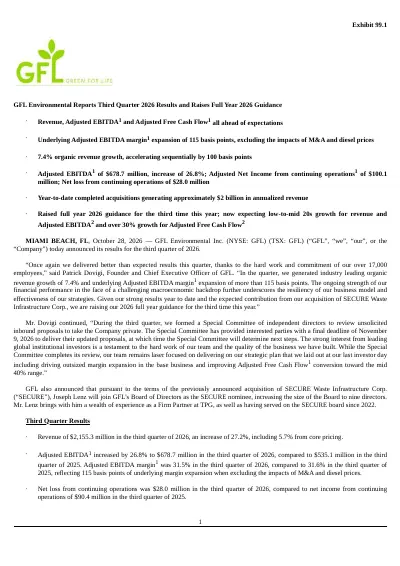
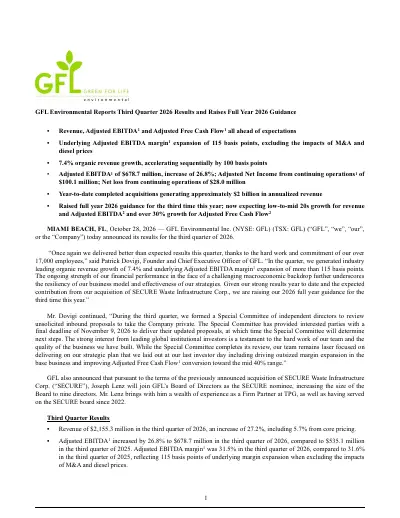
I'm joined this morning by Luke Pelosi and together we will be reviewing our results for the third quarter and updating our guidance for the year. The exceptional performance we delivered in the first half of the year continued through the third quarter, allowing for another top to bottom beat of financial expectations.
The ongoing quality and durability of our operational performance coupled with the closing of Secure allows us to raise our guidance for the third time this year and provides for an extremely compelling set up for 2027 and beyond. Organic revenue growth accelerated 100 basis points over the second quarter, driven by core pricing ahead of expectations and 50 basis point improvements in both volume and commodity prices.
Landfill volumes turned positive, including both C&D and special waste streams. Although we believe that construction, development, and expansionary manufacturing investment remains tempered, we remain well-positioned to participate in the eventual recovery of these activities.
Volatility in fuel prices continued to impact revenues, costs, and margins. Third quarter diesel prices accelerated another 10% over the second quarter and were over 60% higher than the prior year.
Our fuel surcharge mechanisms have proven effective at recovering the direct impact of higher diesel costs, although we are seeing a greater degree of indirect cost increases coming through transportation, spare parts, and other cost categories. Our industry-leading margin expansion would have been significantly greater if not for the impact of these fuel prices.
Non-fuel related cost of sales and SG&A cost intensity trended lower on a year-over-year basis for the seventh consecutive quarter and was achieved despite headwinds from M&A and higher landfill operating costs. This ongoing trend highlights the positive impacts from continued improvements in labor turnover and our ongoing focus on cost discipline.
These benefits are, in part, rising from process optimization along with the realization of self-help opportunities across our portfolio. Nowhere are these impacts more apparent than in our adjusted EBITDA margin, where we delivered an industry-leading 125 basis points of underlying adjusted EBITDA margin expansion.
To be able to raise our margin guidance for the second time this year despite the challenging macro environment and significant headwinds from fuel costs is a testament to the effectiveness of our strategies. The third quarter also saw us closing the Secure acquisition.
When we underwrote the acquisition, we were impressed with Secure's market-leading platform of a difficult-to-replicate critical waste infrastructure assets in the familiar and attractive Western Canadian market. The transaction was also highly financially compelling, accelerating the achievement of our multi-year financial targets we laid out at Investor Day and enhancing our balance sheet and free cash flow profile to allow for maximum capital deployment flexibility.
Since the time we announced the acquisition, we believe that the macro outlook for Secure's business and the markets in which it operates in has materially improved and should provide for further upside to our investment thesis over the medium and long term. Integration of the Secure business is well underway and we remain confident in the ability to achieve the $25 million of underwritten cost synergies in the near term, with opportunity for an incremental $25 million to $50 million of previously referenced synergies around disposal and cross-selling.
In addition to Secure's physical platform, we are equally excited about the people and talent that have joined our team. As previously announced, Allen Gransch was appointed to our COO on September 1st.
Allen brings a proven track record of operational excellence that directly complements our long-term growth strategy. Across his nearly 20 years at Secure, Allen was instrumental in establishing and implementing the company's strategic direction, including leading through transformational change, driving operational execution, and building high-performing teams.
Allen's proven leadership capabilities, extensive experience overseeing a large-scale diversified waste management platform, and his broad skill set will make him exceptionally well-suited to advance GFL's operational and growth goals. Furthermore, with Billy Safari staying on in a senior strategic advisor role, we will continue to get the benefit of his deep expertise as he remains actively involved in leading many of our corporate-wide value creation initiatives.
Before I pass the call over to Luke to walk through the quarter in more detail, I want to take a moment to discuss the ongoing strategic review. You would have read in the press release that the special committee has provided bidders with a final deadline of November 9th to deliver their updated proposals.
I will tell you that we have undergone a very thorough process. We always find it useful to have highly sophisticated third parties come in and take detailed looks under the hood of our business.
Fresh sets of eyes and critical to their perspectives of what they view, and while we have found that such processes are time-consuming and disruptive, the strong interest from globally recognized institutions is a testament to both our team and the platform we have built. Assets of this scale and quality have scarcity value.
The special committee, in conjunction with their financial advisors, are continuing to evaluate the best path forward for the company. We expect to have a decision very soon, and so stay tuned on that front.
However, regardless of the path forward, the confidence we have in absolute earnings growth year-over-year medium and long term should be a source of material equity value creation. While the committee completes its review, our team continues to remain focused on optimizing our proven operating model, including delivering on the Investor Day commitments of achieving low to mid-30% adjusted EBITDA margins and free cash flow conversion in the mid-40% range.
The quality of our base business has never been more solid. The risk-adjusted growth profile has never been better.
We have the right assets, we have the right people, we have the proven effectiveness of our execution, and we are going to continue to win, and we are going to keep fighting until we've done so. I'll now turn the call over to Luke to walk through the quarter and guidance for 2027.
Luke Pelosi
Thanks, Patrick. Good morning, everyone.
Looking at the details of the quarter, Q3 revenue grew 27% over the prior year, driven by a 5.7% price, a 50 basis point sequential improvement in volume, and incremental contribution from both surcharges and commodity prices. M&A added nearly 19%, mainly from the Frontier and Secure acquisitions.
Q3 volumes were nearly flat, or approximately $10 million better than the second quarter. At the beginning of the third quarter, the restructuring of a large multifaceted recycling contract in Western Canada removed our obligation to provide broker transportation services on a pass-through basis.
This resulted in a $13 million reduction in quarterly revenue, albeit with minimal impact to profitability. Excluding the impact of just this one contract, volumes for the quarter would have been positive 60 basis points.
As Patrick said, the volume performance was supported by the return to positive volumes of both C&D and special waste at our landfills. C&D landfill tons were up 4.5%, the first quarter of positive volumes since early 2025.
This result was helped by the one-time cleanup of a closed transfer station in Western Canada, but even absent that benefit, C&D volume was modestly positive. Roll-off pulls were flat in the quarter as activity remains tempered.
As a result, our volume outlook remains cautious. Q4 volumes are expected to decelerate on the lapping of EPR transition contracts in Canada and exiting certain ancillary services in the Midwest, with underlying base volumes remaining relatively flat to modestly down.
Third quarter cost of sales before depreciation, amortization, and integration costs as a percentage of revenue improved 70 basis points, excluding the impact of direct fuel costs, and over 100 basis points when factoring in indirect fuel costs as well. SG&A cost intensity also improved 70 basis points when excluding D&A and transaction costs.
The ongoing realization of efficiency in labor and R&M costs, as well as operating leverage on our corporate segment, continues to highlight the effectiveness of the cost optimization strategies we laid out at our Investor Day. As expected, fuel costs were a drag on operating costs and margins.
Average diesel costs were up over 60% in the quarter and spiked even higher in the first half of September, which resulted in a $5 million headwind to our original Q3 guide. We now expect the impact of elevated diesel prices to result in roughly $125 million of incremental cost for the year as compared to our original guidance.
Adjusted EBITDA margin for the quarter was 31.5%, 30 basis points higher than expectations and nearly flat with the prior year, which was the highest margin in our company's history despite the meaningful headwinds from fuel costs and M&A. Elevated landfill operating expenses, primarily tied to leachate transportation and disposal costs, were also a headwind to margins.
Excluding these headwinds and considering that improved commodity prices were a 20 basis point margin tailwind, underlying consolidated margins were up 125 basis points from the prior year. Adjusted free cash flow was $272.5 million, over 50% greater than the prior year.
This result was 15% better than guide, partially on account of the one-month contribution from Secure that was not previously contemplated. With the closing of Secure and the ongoing quality of our financial performance, we are once again increasing our guidance for the year.
Assuming current FX, commodity, and diesel prices, we now expect the following amounts for full year 2026: revenue of $8.055 to $8.075 billion, adjusted EBITDA of $2.49 to $2.495 billion, and adjusted free cash flow of $1.02 billion, inclusive of cash interest of $455 million and net capex of $910 million. Adjusted EBITDA margin increases 40 basis points over our previous guide to 30.9% despite the significant headwind from elevated diesel prices, which are assumed to continue for the balance of the year.
Absent the run-up in diesel prices, full year margin would have been over 31.5%, an increase of more than 150 basis points over the prior year. As always, the updated guidance does not include the contribution from any further M&A in the year.
Our latest guidance represents annual growth of over 20% in revenue, 25% in EBITDA, and 35% in adjusted free cash flow, industry-leading growth metrics by a material margin. Even more impressive is the fact that our setup exiting this year gives us a high degree of visibility to produce similar levels of industry-leading growth again in 2027.
I will now pass the call back to Patrick, who will provide some closing comments before Q&A.
Patrick Dovigi
Keeping the prepared comments intentionally short today, as we think the results speak for themselves. I will just reiterate that our focus is singular and our path forward is clear.
We already have a great setup for 2027 and any improvements to the macro environment will be incrementally additive. I will now turn the call over to the operator to open the line for Q&A.
Operator
We will now begin the question-and-answer session. Please limit yourself to one question and one follow-up.
If you would like to ask a question, please press star one to raise your hand. To withdraw your question, press star one again.
We ask that you pick up your handset when asking your question to allow for optimum sound quality. If you are muted locally, please remember to unmute your device.
Please stand by while we compile the Q&A roster. Your first question comes from the line of Sabahat Khan with RBC Capital Markets.
Your line is now open. Please go ahead.
Sabahat Khan
Great. Thanks and good morning, everyone.
I guess thanks for the comments on where the process stands. Maybe for you, Patrick, I guess ultimately sort of you founded the company, have a say in sort of how the process here evolves.
Maybe if you can share some thoughts on ultimately what do you kind of want to do here, what are your thoughts on the process that's going on? Thanks.
Patrick Dovigi
Good question. I think ultimately we want to keep winning and having fun, whether that's sort of publicly or privately.
I think when I look back, we're coming up on our 20th year anniversary and we were actually reminiscing the last few days just in terms of how the company was founded and went out to one of the original sites, and it's amazing, the same employees are there that were there 20 years ago when sort of acquired the first business, went back to the same scale house that I used to work at on the weekends and you look at what's been built here, it's an exceptional team and I've gone back and sort of scratched my head and looked at the original private equity partners and sort of Genunity and Healthcare Ontario Pension Plans and then Jeffrey Keenan and Neil Aaronson at Roark backed us, and then Scott French, Mark Rubenstein, Derek Cochrane backed us with the HPS team, which is now sort of at BlackRock, and then you had Ontario Teachers', GIC, and BC Partners backing us in sort of 2018 as private companies, and I look at the returns that were generated for private equity shareholders and us alone, and I think they believed in this management team and had the philosophy that winners win and winners will continue to win. Whether we do that publicly or privately, I think that ability is there for us to continue winning.
I look at us going public in sort of March of 2020, I had the tombstone on my desk, first trade was just over $17 and today we're roughly three times higher than we were in 2020. It's worked publicly as well.
I think the challenge in the public markets is sometimes you have to make unpopular decisions for the short term, and I look back to this year, Secure for some just not knowing what it was, was maybe an unpopular decision and we've had to do that over the last number of years, but over the long run, and I think if you look at the equity value that's been created for our shareholders, it's been substantial, and sometimes those unpopular decisions are unpopular in the short term, but over the long term we're going to continue to drive material equity value. Selfishly as a private company, us and the management team would make a lot more money and probably have to not manage the quarter-to-quarter movements.
If we had opportunity to spend a little bit more on capex because that was the right thing to do, or do a little bit more M&A and bring up leverage temporarily, that makes the business easier to run. The contra to that is the liquidity opportunities that exist in the public markets and I look back, it would have been very difficult for us to execute on Secure if we were a private company.
Those are the negatives of that. That being said, when prices get dislocated like they were for a long sort of period of time, listen, there's a lot of smart capital sitting on the sideline that identifies winning management teams with a winning business in a great industry that they don't get the opportunity to buy those often.
I think I look at the stock price today, when we give the sort of breadcrumbs for 2027, Luke was sort of mentioning we're going to get into, today the business is trading at somewhere between 12 and 12.5 times 2027. You just can't buy businesses of that size and scale for 12 to 12.5 times.
You look back to what we've done since 2020, even going public, when we went public, the business was roughly $950 million of EBITDA. Today the public company is about three, for 2027 is going to be about 3.125 to 3.150 in that sort of range.
You have our ES business today, which we look at sort of the budget for 2027, roughly a $675 million EBITDA business of which we own just under 40% of, and you have the GIP business today that's roughly for 2027 is going to be roughly $350 million of EBITDA. You put all those sum of those parts together, we took $950 million of EBITDA and grew it to almost $4 billion of EBITDA over the last 5.5 to 6 years, and tripled the stock price along the way in an environment we think the stock, from a multiple perspective, is materially undervalued.
Listen, I sit here, I said a lot, again, at the end of the day, this management team is going to continue winning and having fun, when I look at now the Secure platform that we've added and what's happening in Western Canada, what's happening all over Canada, we just have multiple levers that are going to drive incremental value over the coming years. Whether that's public or private, either way we're going to win.
When I look at free cash flow per share in a normal growth algorithm over the next five years, there's no path in which I don't think that free cash flow isn't close to a double. Free cash flow doubles over the next five years, what is that going to do to our sort of equity value if we remain a public company?
If we go private, and because that's the decision that the special committee makes to bring that to a shareholder vote, then, again, we've lived that world for 14-plus years as well, and we know what that entails. I think I'm fine either way.
I think there's been a lot of great shareholder engagement, which has been great. We have a lot of great shareholders, and albeit some have different perspectives, they're all very valuable input that they have, and you have a very core group of shareholders that obviously who may have a little longer-term thinking in the back of their head and again, see the path forward to that there's material equity value creation sitting in front of them, and then you have other shareholders that might be a little bit short-term that are prepared to take some capital at a lower price off the table and find the next opportunity.
The shareholder engagement we've had over the last couple months has been excellent. It's been enlightening and the best part is everybody's been very supportive.
We'll see how it unfolds over the next week, but from my perspective, either way is a win, some pros and cons on both sides, and we'll see where it goes. It's been a great exercise to go through anyways with these people sort of taking a deep dive in the business, we'll see what happens.
Sabahat Khan
Great. Thanks.
Then maybe just following on the last comment there, I guess with the new sort of fresh eyes that you alluded to taking a closer look at the business, has there been sort of anything uncovered in the business that you and the management have learned? Then maybe just on sort of the feedback from the shareholders, is that kind of the bigger buckets?
Could maybe just share a few additional color on what sort of the shareholders are coming back to you with as the process has gone on? Thanks.
I'll pass it.
Patrick Dovigi
Listen. I just look at again, when you have world-class investors that see businesses across multiple sectors, their input is valuable, right?
I just look at a couple of tools that were flagged to us just in terms of that, when they bring in, again, not mentioning names, but they bring in sort of a chief revenue officer of one of another strategics that is now working as a consultant and coming in and looking at our overlay charges there's significant pricing opportunity still within the base business. That again gives us a high degree of confidence that there's significantly more upside here, implementing tools like Harvey on contract management and keeping customers accountable to their contracts, etc.
We were just using it specifically on the legal side and picking other tools that'll just again, all things that are just additive and incremental to our business that will make our business better, and which again just gives us more confidence in terms of the operating plan sort of moving forward. Again going back six months, not to sort of harp on this, but the initial reaction when we bought Secure was negative from some of the shareholders that really didn't understand Western Canada or the Secure assets.
You had some of these organizations that were actually looking at that opportunity independently because they love the scarcity value of those assets in the business that was being built and the amount of organic opportunities that existed to put capital at high returns on invested capital, organically sort of in Western Canada. Again, sometimes in order to be good, you need to be lucky and we're a little bit lucky just given the timing of when we did the Secure acquisition, and then what's happened in the macroeconomic backdrop with the Middle East and Iran and now with, as everyone's seeing with our new Prime Minister in Canada, Carney's wants to make Canada an energy sort of superpower, and sort of break down the barriers of the red tape that we've historically had in Western Canada to be able to sort of expand that, and put Canada back on the map again.
That will create sort of incremental opportunity, again, for us that wasn't underwritten. All those things give us a high degree of confidence in the plan sort of moving forward.
I think again, going back to your point on shareholders, yes, you have top 10 shareholders, again, some longer-term thinkers and other shorter-term thinkers. I think shorter-term thinkers happy to take less money, and sort of move on and look for other opportunities versus some of our page one shareholders that have a perspective that GFL's worth sort of well into the $60s and if you're going to continue executing in our plan, which they have no reason to believe we won't given our track record over the last 20 years, both on the GFL side and now the recently acquired Secure, that's going to yield an exceptional result as well.
Again, free cash flow doubling over the next five years per share, again, you can do the math and what that does to the equity value. If we get the multiple expansion that we believe we deserve as we come out of this, potentially this AI trade that has affected the entire sector over the last sort of 12 months, I think you're going to have a winning successful public company as well.
I think it's been great to have the interaction with shareholders. It's been great to get new eyes on the company and have a lot of great discussions with new shareholders, both in sort of Canada, US, and Europe, as well as Asia and the Middle East.
We've had just a lot of great dialogue and it's great to get a lot of that out there and put GFL on the map for a lot of different investors, and I think listen, whichever way it goes, we're fine, but we want to bring the process to finality and sort of move on with whatever the decision that the committee and one of our largest shareholders decides to make, so.
Sabahat Khan
Great. Thanks for the thoughts.
Operator
Your next question comes from the line of Tyler Brown with Raymond James. Your line is now open.
Please go ahead.
Tyler Brown
Hey, good morning, guys.
Luke Pelosi
Hey, Tyler.
Tyler Brown
Hey, just curious on how we should think about pricing into next year. It sounds like you got some inflation creeping back in, particularly in indirect fuel, but how should we think about maybe pricing accelerating into next year?
Cuz if I read between the lines, Patrick, it seems that maybe the take-private diligence has increased your conviction on pricing opportunities longer term. Just any thoughts there would be helpful.
Patrick Dovigi
I think we have identified sort of incremental opportunity. As we like to under-promise and over-deliver, and I think that's just another lever for us to continue doing that.
Again, like I said, when we looked at the sort of value creation opportunities that we laid out at our previous Investor Day, I think as AI tools continue to come on, as incremental pricing opportunities continue to come on, again, that's just additive in sort of term of the long-term plan, and while what was going to wind down in sort of 2027, 2028, those initial equity value creation plans, maybe we can now extend them with some of these sort of incremental opportunity and some of these other incremental AI tools that will allow us to again have a deeper dive into our actual customer base, looking at what each customer contract has, what we're allowed to do under each one of those contracts, and summarizing it in a form that allows us to basically betterly manage our business. I think this is just relying on tools that are coming to the market.
Every day there's a new shiny object, but we're just trying to focus on the four or five things that will actually create that value, without a lot of disruption.
Luke Pelosi
Tyler, I'd just add sort of Patrick's comment. If you think about the upside incremental price we articulated originally, we said it was $40 million to $80 million that capture over the next sort of 3 or 4 years.
That's what we had said at Investor Day. I think what Patrick is suggesting and we're feeling highly confident in is that prize is something greater than that.
Now, the ultimate magnitude will sort of remains to be seen, but I think between '25 and '26 you're seeing our outperformance as we are realizing those what I call surcharge opportunities. Now, going into '27, you have to remember this year we're getting meaningful support at the price line from some of this EPR-related transition, right?
That you're going to lap in '27 and so I think you kind of got to back that out of your calculus. If our headline price this year is going to be a low-6 number, if you were to back out the EPR benefits, that'd be more a sort of low-5 to mid-5 number.
I think in a headline number you might not see acceleration, but underlying we continue to see an opportunity to take our normal-course algorithm of pricing at a spread above our cost inflation and then achieving something greater as we are catching up to parity with where our peers are. I just think the runway for keep adding something greater keeps sort of getting extended as we're sort of going out.
Tyler Brown
Yes, that is extremely helpful. Then, Luke, just in the release you guys reiterated your commitment on getting to that mid-40% free cash conversion that you guys laid out at Analyst Day.
If I look at your guide for '26, it looks like you're going to be around, let's call it 41%, and if I put the pieces together, it's a little bit scary, but if I do, maybe that's 43%, 44% next year. I don't know if you could confirm that.
When we talk about that mid-40s, is that more of 45%, 46%, 47% or what is the art of the possible in that number over the next few years? Thanks.
Luke Pelosi
It's a great question, Tyler, and you've always been good at math, and we think that is the sort of direction of travel. Now, I'll just caveat: this year's number of 41, you're getting the last 4 months contribution of Secure, which has working capital recovery and a little bit of sort of abnormality cuz it's not a full year, right?
I think if you're really to pro forma where we're at today, you're probably more at a 39%, 40% number exiting this year. Now we go into next year, we think there's going to be expansion on that.
Now, I will have a ramp in cash taxes as I'm becoming a larger cash taxpayer, but I see the path of next year being in that sort of 41% to 42.5%. I think that's what we had articulated pro forma for Secure to be, and we'll continue to grow from there.
If you think about the whole 2027 framework, this year's growth being 20% revenue, 25% EBITDA, 35% free cash, with the setup going into next year, you have the opportunity to almost sort of replicate that. You think about that.
The top-line growth organically is going to be mid-single digits. Now, the exact pricing number, exact volume number remains to be seen, but that's going to be a number greater than 5, right?
You think about the M&A rollover already in hand, you sort of have 15% in hand. You're entering '27 with a 20%-plus revenue number.
If our '26 guide is 8.055 to 8.065, 20% growth on that in the next year, that brings you to a $9.7 billion to $9.8 billion number, right? Now, if you look at the margin line, what we have said and continue to prove is we have industry-leading organic EBITDA margin expansion.
If the industry has been doing 30 to 40 basis points, we sort of do 2x that, putting you at a 50 to 60 basis point organic margin expansion. The rollover of impact of Secure should be roughly another 30 to 40 basis points.
You have already a setup for, call it 100 basis points of margin going into next year. That takes this year's 30.9% closer to 32% for next year.
If you take $9.7 billion to $9.8 billion of revenue at a 32%, that should be that $3.12 billion of EBITDA that Patrick sort of referenced in his sort of commentary. Then if you apply that sort of 41% to 42% free cash flow conversion, and that's just assuming the normal-course drags to EBITDA across capex, interest, etc., that puts you at a $1.3 billion-plus free cash flow number.
I think there's a high degree of conviction in that, and it just sort of grows from there. We're feeling very confident in that framework we previously laid out, and I think with the avenues of upside we keep speaking to as you get to '28 and beyond, I'm not ready to sort of cap what that ultimate free cash flow conversion number could be because I think there's runway to keep going north.
Tyler Brown
Extraordinarily helpful. Thank you, Luke.
Luke Pelosi
Thanks, Tyler.
Operator
Your next question comes from the line of Kevin Chiang with CIBC. Your line is now open.
Please go ahead.
Patrick Dovigi
Kevin, I'm not sure, we can't hear you. Maybe you're on mute.
Kevin Chiang
Can you hear me?
Patrick Dovigi
Now we can hear you.
Kevin Chiang
Oh, perfect. You've alluded to this a few times, just the upside to Secure given some of the opportunities in Western Canada.
Just wondering if you're able to frame that as you think of what that upside could be relative to what you thought at the time of acquisition. If you look at some of the projects being proposed and if all goes well, let's say you could have a 50% increase in kind of crude oil egress.
One, is there a way to frame that upside? Then two, how do you think about your own capacity within Secure to absorb that growth or does that require incremental investments as these development projects move forward?
Patrick Dovigi
I think it's a combination of both. Obviously, the waste assets we own can continue handling more volume, generally.
Again, that is just sort of all incremental upside. I think again, what Secure did very well, which I think was underappreciated by the public markets, was the amount of opportunity they had to deploy capital with a very high returns for their customer base.
As their customer base continues to expand operations, that affords the ability to deploy incremental capital into incremental opportunities at sort of high returns. Again, East-West pipelines, North-South pipelines, plus coupled together with some of these LNG projects and terminals, all of those are just going to drive incremental activity in Western Canada.
Can I quantify that exactly today? No.
Do I know for sure that that's going to drive incremental volumes? Yes.
We've seen this movie before, and not only does it help the Secure business, but it'll help all of the industry in Western Canada because just again, the macro sentiment in Western Canada, when it's positive, the floodgates open. I think from a macro perspective, you're going to see a lot of great activity not only around sort of our business, but even whether that's in the Lower Mainland or whether that's in Edmonton, Calgary, etc.
That is going to drive incremental volumes and activity throughout the entire sort of region. Again, that was never the thesis for doing the acquisition, because we liked it on its own, but I think sometimes, like I said, in order to be good, you've got to be lucky, and I think just given what's happened in the Middle East and some of that tension, and what's happened obviously with the US and tariffs and the Canadian government now looking to sort of focus inward versus outward, that is driving sort of incremental opportunity, and we're seeing some of these opportunities already.
I think the challenge for us is going back to being a public company, you go back to being a private company, public market is very prescriptive in terms of how much capex you can spend in a year, etc., growth versus maintenance, etc., but I think we have to look at these opportunities the same way we would look at an M&A transaction and what are the returns, what are the paybacks, and bucket some of these growth opportunities potentially as an M&A transaction, and maybe you dial back some of your M&A spends to deploy more capital into some of these organic opportunities that we see that ultimately will drive higher returns on invested capital. That's something worth thinking about and looking at as a company, and listen, we are going to continue doing what's best for shareholders and what's going to drive the sort of highest return for our shareholders, again, whether sort of public or private, but again, those opportunities are going to continue to persist not only in the Secure book that we acquired, but also within our existing book, particularly in Western Canada.
Luke Pelosi
Kevin, I'd just add, when we underwrite acquisitions, and maybe this comes out of our days of sort of higher leverage, while we look for upside cases, we really want to diligence downside cases, right? See what that could be in a really draconian negative scenario.
For Secure, while we very clearly articulated their performance has shown they not exposed to short-term volatility, the downside risk was if WTI went down below $50, $45 a barrel for extended periods of time, that would in time lead to sort of lower production and activity in that part of the world, which could in time degrade earnings. I think where we sit today, have the benefit of a very high degree of confidence that over the near, medium, and probably longer term, the opposite is going to be true, and the level of activity and production and therefore opportunity for disposal Secure assets is greater than otherwise.
To Patrick's point, quantifying what that upside looks like today is, we're not prepared to do it, but it's something greater than what our underwriting case was, and we were really happy with our underwriting case.
Patrick Dovigi
When Rene and Allen founded Secure back in 2007, the actual year we started, remember, they started with nothing as well,
Luke Pelosi
and
Patrick Dovigi
organically built that business. I think underappreciated how exceptional the team is there in looking at and identifying organic opportunities to build and scale that business.
Again, you will see over the long run that if you look at all the regions we're operating in today, both in the 10 provinces in Canada, 26 states in the US, we have a very unique ability here over the next number of years to really win, and I think you're going to continue seeing us deliver these type of results sort of year-over-year.
Kevin Chiang
That's helpful. Maybe just a follow-up, Luke and Patrick, you've highlighted a strong organic growth pipeline and levers as we exit 2026 here.
Just with the bigger EBITDA footprint, the step-up in free cash flow conversion, you painted, call it a normalized M&A year being roughly a billion dollars of capital deployment. Does that change next year just given the improved liquidity profile and given some of the acquisitions you've made in 2026?
Patrick Dovigi
Yeah. If we continue to be a public company, depending on the stock price, I think moving into '27, you now have the unique ability to add share buybacks into a more material way into the sort of capital allocation plan.
That's the beauty of the inflection point of where we are. If you look at the free cash flow growth and ramp, I think we have the ability to do a multitude of things just depending on where we are sort of in the cycle.
Yes, in theory, for sure, again, if we look at the M&A and the organic opportunities that we'll have in sort of Western Canada, we will have materially more capital to deploy with the free cash flow profile now of the added Secure business into the sort of portfolio, and as our business continues to grow, we'll sort of look at that. I think we have multiple levers available to us in order to pull depending on what the situation is at the time.
Luke Pelosi
Kevin, as you're well aware, but now with the enhanced size and scale, the leverage impact of capital deployment is far more muted than it was before. Just illustratively, all other things being equal, if you end '26 at mid-3s leverage, through EBITDA growth and free cash flow generation, you would delever sort of 30, 40 basis points going into next year and coming down to a sort of a lower-3s number.
If you deployed $1 billion into M&A at eight times, just for round numbers, that would impact leverage by 15 or 18 basis points. Just to say the balance sheet capacity to now do that incremental capital deployment has never been greater, and so, I think to Patrick's point, just providing us maximum flexibility in being able to execute on our strategies while very squarely adhering to the newer leverage philosophy that we adopted a couple years ago.
Kevin Chiang
That's super helpful. Thank you very much for taking my questions.
Luke Pelosi
Thanks, Kevin.
Operator
Your next question comes from the line of William Grippin with Barclays. Your line is now open.
Please go ahead.
William Grippin
Great. Good morning.
Appreciate the opportunity here. My first one, and I get this maybe difficult to address, but, Patrick, you've referenced in the past that sort of having visibility to kind of a path to monetizing this incremental equity value creation in the case of a take-private was kind of an important factor for you and I think the company.
I'm just curious, how are you thinking about the possible options and maybe how that could be structured now as this process seems like it's progressed a bit further?
Patrick Dovigi
Sorry, maybe I'm not understanding the question. Monetizing what, sorry?
William Grippin
Sort of realizing this incremental equity value creation, right? You had in the past talked about maybe potentially
Patrick Dovigi
re-IPOing
William Grippin
the business if it gets, right? Oh.
Patrick Dovigi
Yeah. Oh, I think that's the question.
I think if you go private, that's obviously a big question in terms of do you create all this value sort of over the next 4 to 5 years and then take the business back to market, and then public investors would miss out on that sort of value creation over the next 4 to 5 years, and then get the business back when it's probably 2x the size, right, if that's the path? Or, I think as these private vehicles get more sophisticated and it's more sort of long-dated, non-closed-end funds where it's sort of perpetual equity in continuation type vehicles where the money is just, there's no closed-ended fund nature, maybe the business actually never goes back to the market, right?
Then just given the amount of free cash flow that the business generates, you could find ways to continue selling down stakes to incremental LPs as they come in at sort of different times. I think that's always the challenge in a go-private, one of the negatives.
The liquidity is, like we talked about, is one of the positives of the public markets. The negative part of the private markets is there's less certainty on sort of liquidity at various points in time.
Now, that's a more of a Patrick issue. I think that is solved for employees in other ways.
We've done that for 14 years, this is not an employee issue. This is just like, hey, how do you monetize sort of your 28-plus million shares over time?
I'm not a seller, I'm 47 years old, I'm not looking for Freedom 55 or Freedom 65 yet. I think over time, you need to think about that in the event that I was, but I think there are products available that allows for that under these new constructs.
William Grippin
All right. Appreciate that color.
Thank you. My follow-up here, you referenced an increase in landfill operating costs in the prepared remarks.
It not the first time we're hearing about that this quarter. I'm just curious sort of what are the drivers there and how are you thinking about your ability to recover those through price and to the extent there's any lag, potential margin impact?
Luke Pelosi
Will. I think starting point, a lot of people talking about leachate, it was very wet in many areas, right?
That's just a quarter-over-quarter difference that Michigan had x inches more rain than last year, that can drive incremental leachate. That's part of it.
I think what you're also just sort of seeing is as leachate management, processing, etc. is becoming more front and center, people are getting more sophisticated with where leachate should be going, and sometimes that's incurring further transport costs to get it there, and the sort of like.
I think this quarter isn't necessarily reflective of a structural, material ongoing headwind. It was about $6 million in this quarter, maybe sort of 3/4 of that is I'd call it more sort of timing one-time, and a sort of 1/4 of that cost is just sort of incremental cost of trans and processing.
I think we have the benefit in an industry that we all sort of suffer the same fate, if you will, and that, as incremental regs or other reasons drive operating costs higher, we need to recover those, and you'll see us through our various pricing and other mechanisms ensure we're getting appropriately compensated for these sort of critical services that we're providing. I think longer term, like anything, incremental sort of costs will just add to the broader base of cost inflation on which we use to set our overall pricing, but in a given quarter, you can get some mismatch between that cost occurrence and subsequent price recovery.
In time, I wouldn't expect you to have the same sort of headwind that you had and you'd be pricing above your cost inflation as we do for all of our costs.
Operator
Your next question comes from the line of Trevor Romeo with William Blair. Your line is now open.
Please go ahead.
Trevor Romeo
Good morning. Thank you, guys, for taking the questions.
I had one on Secure, kind of the performance in the quarter. Was wondering if you could maybe talk about how much it contributed in terms of revenue and EBITDA and anything you can kind of say on the maybe volume/price split or just the core disposal business versus maybe some of the other businesses in the quarter?
Luke Pelosi
Yeah. Again, we have one month of Secure revenue contribution.
It was right around $150 million of revenue. It was just over $50 million of EBITDA, sort of, call it mid-30s-plus EBITDA margins.
You had $25 million to $30 million of free cash flow performance came from Secure. Now, sort of one month, I don't think is actually reflective, right, from a capex timing, working capital timing, etc.
I think Secure's profile for the year was they're going to do sort of $550 million of EBITDA and $1.5 billion of revenue, and I think they're very handily positioned to sort of being able to deliver that. The distribution of that revenue across their services is, as we've previously sort of articulated, you have a small sort of percentage of overall profitability coming from the sort of other lines of specialty chemical and energy infrastructure, but the majority of those revenues is their typical sort of waste and waste processing.
I'd say sort of right in line with expectations, the team's Q4 outlook is in line with expectations, and we're finalizing budgets into 2027, but everything is turning out as anticipated with the opportunity for upside that we were previously speaking about.
Trevor Romeo
Thank you, Luke, for that. Then maybe just a quick follow-up, I guess, on M&A looking into next year and beyond.
If we're kind of thinking about a higher interest rate world, just curious for your thoughts on maybe how that influences your kind of aggressiveness on M&A as well as maybe the willingness among targets to sell if that's another incremental headwind for them. Is that kind of an incremental positive for you with maybe more targets coming to market?
Patrick Dovigi
I don't think it's material enough that it really affects that much. Yes, there's been move in interest rates, but when I look at our borrowing costs, sort of in a worst case today, you're probably 100 100 to 125 basis points wider today than you were maybe 6, 8 months ago, but from our perspective, that's not a forever thing, and we have mechanisms that think can reduce that with swaps and other things, sort of longer-dated swaps.
Again, it's something to think about. I don't think it's sort of that material, and I think when I look at some of these larger recent sort of businesses that have come to market that have sold on sort of the ES side, you have ES businesses still continuing to trade at large size and scale between 13 and sort of 15 times depending on sort of the market.
I don't think it's really materially affected values all that much. Yes, something obviously keep in consideration, and I think if we think there's going to be perpetually higher rates for a long period of time, then that may factor into that.
Again, when we look at the running that model, we obviously when we're looking at our returns, we model in what the actual cost of capital is, it does get factored in, but we have to take a longer-term view on what we think rates are going to do. Yes, it factors in.
Trevor Romeo
All right, thank you, guys. Appreciate it.
Operator
Your next question comes from the line of Stephanie Moore with Jefferies. Your line is now open.
Please go ahead.
Stephanie Moore
Good morning. Thank you.
Maybe taking a step back and I appreciate all the color you provided us so far on this call, but let's just say if it does turn out where GFL ultimately remains public, I guess what should investors expect the next chapter of the company to look like? I guess thinking, what are the key strategic and financial priorities that you think can help drive the re-rating you believe I think the company deserves?
Thanks.
Luke Pelosi
Hey, Stephanie. It's a great question, and I think the reality is whether it's a sort of public vehicle or private vehicle, our path forward is relatively the same under both, and it's really executing on all that we articulated at the Investor Day, and more.
I say and more because today we've largely achieved those sort of three-year targets we've put out, we're just sort of resetting and going to higher levels from there. It starts, as I've said always, you think about the algorithm, it starts at the top line, and Patrick articulated this, but the industry has a very sound and stable top-line organic growth algorithm, and we believe we have an idiosyncratic opportunity to do better than that very attractive industry algorithm as we benefit from the self-help that's available to us.
Now, that's mostly from price, but you've also heard us say we believe our market selection should drive incremental volumetric opportunities as well as we benefit from the fact that in the Western Canada, what should be our passing there over the next sort of near and medium term, and then the US Southeast, where a preponderance of our businesses just has a demographic benefit of being a place where sort of people are moving to. We think top line have a right to sort of win there organically.
Now I'll speak all this organically before I talk M&A. Then you look at the EBITDA margin side.
If you think about our EBITDA margin performance over the past call it 5, 6 years that we've been public, or 10 years, if you want to take, we've continued to produce outsized EBITDA margin expansion as we've demonstrated the efficacy of our strategies, and we see runway to sort of keep doing that, right? You think about our results today, achieving, I just gave a guide for '27 or these breadcrumbs there too, you're very squarely past the low-30s and moving towards mid-30s, and we see a lot of runway to sort of keep going there.
The most exciting part of it for us is this inflection point that's been reached though at the free cash flow level, right? Really what that is is now that you're sort of past the deleveraging hump, if you will, as you go forward and you sort of effectively maintain an interest expense intensity on a relatively sort of flat basis to diminishing, you're getting significant idiosyncratic torque at the free cash flow line that is available for GFL and GFL alone.
You put that all together over the sort of next 3 to 5 years, as Patrick suggested in the prepared remarks, you don't need to believe a lot to see close to 2x in a free cash flow per share level over that sort of period of time, and that is really what the next chapter is. We've built the business together pro forma with Secure, we now have the balance sheet scale and the free cash flow profile to be able to very squarely execute capital deployment strategies without any longer having to be tempered by the sort of leverage considerations, and just doing more of the same, and now doing so with a sort of best-in-class asset base and a management team that has proven the effectiveness.
We welcomed Allen to the team that brings incremental horsepower, and we're just very excited and confident in the sort of go-forward opportunities to just keep doing all of the items that we've articulated.
Stephanie Moore
Thank you. Appreciate the time.
Operator
Your next question comes from the line of Bryan Burgmeier with CitiGroup. Your line is now open.
Please go ahead.
Bryan Burgmeier
Hey, good morning. Thanks for taking the question.
During the prepared remarks, you flagged $125 million, I think, in inflation from diesel. Just curious how much of that you expect to be kind of passed along effectively in 2026, and then if you see any kind of lingering catch-up in 2027?
Luke Pelosi
Bryan, great question. If you look at it, on direct diesel cost, we have about $105 million, $100 million to $105 million incremental cost, and then indirectly we calculate, and this is like third-party transport providers, etc., by another $20 million, $25 million.
You get about $125 million of cost. We're going to recover this year about $105 million, $110 million of that, you have this sort of $20 million, $25 million exposure, which is really a function of those quick ramps, right?
Because you take a month like September where diesel jumps up very quickly mid-month, you have that sort of exposure, you don't get to recover it and ultimately till it rolls over. We do feel confident in time when diesel rolls over, assuming that that happens, you will recover that incremental $20 million, $25 million.
If you think from a margin profile for the year, we estimate diesel cost and it's really that $25 million exposure plus the recovery of the other $105 million to be roughly a 75 basis point margin headwind this year. If we would have had full recovery, that would have been a 40, 45 basis point margin headwind.
I think that's consistent with what some of our peers have spoken about, and I think that's more reflection of the maturity of their recovery programs, and that's just more opportunity for us. We do feel confident that we will recover that when it rolls over, and as we continue to refine and mature our own surcharge programs, we'll be even sort of better protected as we go forward.
Ultimately diesel rolling over will be a margin tailwind for us.
Bryan Burgmeier
Got it. Appreciate that detail.
Then just maybe following up on Kevin's question, is there anything that you would like to highlight on growth capex for 2027, maybe for either legacy GFL or Secure? I know it's quite a bit early, no worries if you don't want to comment, but Secure, I think had been spending over $100 million per year, just curious if there's anything in the pipeline there.
Thank you. I'll turn it over.
Patrick Dovigi
I think we're still obviously looking through all the opportunities. I think legacy GFL probably has another $50 million to $75 million of the final ramp in sort of growth capex for sort of EPR and RNG, so that's winding down.
Then for Secure, again, putting all of the opportunities in a blender, I think that's probably a safe number to continue to use. Again, like I said before, we're going to think about the growth capex spends similar to the way we would think about an M&A transaction at Secure, and if there's high-growth opportunities with high returns on invested capital, we'll look at that exactly the same way we would look at an M&A transaction, and we'll bucket those spends together and when we think about how we allocate capital, we'll allocate that in that capital bucket.
Again, a lot of opportunity, still early days, but obviously when we come out in February when we report Q4 and give detailed guidance for 2027, we'll have a better handle on exactly what we want to do.
Operator
Your next question comes from the line of Konark Gupta with Scotia Capital. Your line is now open.
Please go ahead.
Konark Gupta
Thanks, operator, and good morning. I wanted to go back to the strategic review process, and in fact, I wanted to understand, in a simplified manner, I guess, what's the process looking like?
How will it unfold here? You have November 9th as a deadline by special committee, if you see the bids and the updates come through by that deadline, what's the next steps going to look like after that?
Then will there be any potential, I would say, ebbs and flows or hurdles with respect to bondholders and that process? Any color would be there.
Patrick Dovigi
I think these transactions are very complex. Again, we've done them multiple times.
Obviously, a little bit trickier as a public company. As I've said over and over again, I'm not a seller, I'm not really part of the process or the negotiation of whatever that is.
You have other potential insiders that would potentially look at selling a whole or part. Again, that comes with its own set of complexities, and then you have the special committee that needs to arrive at a place that they feel comfortable that they can stand behind with their advisor in terms of coming up with what they believe is a number that represents fair value.
All of those things sort of have to align. There's nothing more we can do as a company from a diligence perspective.
People just have to arrive now at an answer that works or doesn't work. Like I said, I'm conflicted because at the end of the day, I'm not selling.
It's in someone else's sort of hands and ultimately that decision will be made, but the process from my perspective has been very good on a multitude of fronts, as a public company or a private company. Learning more about our business is always good.
Having smart people look at your business is always good. We've had a significant amount of engagement with our public shareholders that we probably wouldn't have had if it weren't for this process, and we've had a lot of dialogue with new potential shareholders around the company.
Listen, it's been good. It's been a lot of work.
It's been time-consuming coupled together with everything else we've been working on, but no one in this organization shies away from hard work, and we're just going to continue doing the right things, and we'll see how the process unfolds over the next week. From my perspective, management's perspective, we just want to get on with it.
It's got to come to a conclusion, and we need to move on and sort of put the chapter behind us sort of one way or another. Hence the reason why sort of a deadline of November 9th.
I think it's not easy to get all these different groups together, and we've been in Toronto the last couple days where everyone can actually sit down and have fruitful discussions and real discussions about sort of where things are at and what needs to be done, and hence we put a pin in it, confident that by November 9th, we can put a pin in this one way or the other.
Konark Gupta
No, appreciate the color there. Thanks.
If I can just follow up, Luke, on the guidance bridge. We can see, your guidance has moved up on the back of recent acquisitions, obviously.
If I look at the incremental margin on the guidance change, it's 37% EBITDA margin and 59% cash flow conversion. I'm suspecting most of that is driven by Secure.
Is there anything outside of Secure that contributed to the guidance change for the full year?
Luke Pelosi
Konark. Thanks for the question.
Obviously a lot of moving pieces, from the original guidance, with where diesel has gone, FX has been bouncing around, the recovery from commodities. From the beginning of the year, if you think about the top line, originally revenue was supposed to grow just under 6%, 5.8% was original guide, and now we're saying it's 22%.
You effectively have 16% incremental revenue growth versus the original sort of guidance. Now, sort of 13% of that's coming from M&A and 7.5%, 8% of that 13, or just under 15%, is from Secure.
You have 180 basis points from FX sort of the Canadian dollar weakening, and that leaves you 120 basis points of what I call organic, right? Now, that's mostly diesel recovery and commodities, as price and volume are sort of a wash, right?
Price is 40, 50 bips better and volume's sort of 60, 70 bips negative, bit of a sort of wash there. That's really what's happening at the top line.
Now, if you flow that down to the EBITDA line versus our original guide, original guidance was just under 8% EBITDA growth, I think 7.8% EBITDA growth, and now we're saying 25% in change, right? You have roughly 17%, 17.5% incremental EBITDA growth.
Now again, sort of 14.5% of that is coming from M&A, and that is a large contribution from Secure. You have 180 basis points again of FX, and you have roughly 100 basis point benefit from the commodity price.
Now diesel, as I was saying to Bryan, it's about 125 basis point drag to EBITDA dollars for the year, and so again, that leaves roughly 100 basis points of just pure incremental organic EBITDA growth, and that's really the sort of margin piece that you have coming through. Obviously, Secure is driving a component of this and taking the margin profile up, but there's a lot of other sort of pieces, including the underlying just organic margin expansion from a bunch of the cost levers and other optimization that we've been talking about on this call and previously.
Konark Gupta
Great. That's great color.
Appreciate the time. Thank you.
Operator
Your next question comes from the line of Jerry Revich with Wells Fargo. Your line is now open.
Please go ahead.
Jake Kooyman
Hey, thanks for taking the question. This is Jake Kooyman on for Jerry.
On the RNG EBITDA, I was just wondering whether you could comment on where it sits relative to the $125 to $150 million range, and what are the in-service dates for the remaining facilities, and roughly how much RNG capex remains in 2027? Thank you.
Patrick Dovigi
I think we're again, like we said, somewhere between $50 and $75 million, some of that's EPR, but we probably have another $50 to $60 million depending on the structure of the RNG projects. We expect the in-service dates for those to sort of come on late '27 through '28, and we have about half of that RNG EBITDA contribution in the P&L today, and that other incremental half to come over the course of sort of on through late '27 and through early '28.
Luke Pelosi
I think the in-year, what we said, this year $50 million in-year EBITDA this year from RNG, that's roughly right, we're actually a little bit behind, but they're actually there. The next four projects that come on, to Patrick's point, they'll be on at the end of '27, probably no contribution in '27, just contribution in '28, that's another $40 million to $50 million of EBITDA.
Then the last four small projects is that remaining sort of $15 million to $25 million of EBITDA that comes on, in into in just 2028. As Patrick said, the capex for that has mostly been manifesting through contributions into JVs, but the exact capex spend in the form thereof will be clarified for '27 guidance.
Jake Kooyman
Great. Thank you.
Appreciate the color.
Operator
Your next question comes from the line of James Schumm with TD Cowen. Your line is now open.
Please go ahead.
James Schumm
Hey, good morning. If you guys go private and then double the size of the business over 4 to 5 years, can you talk about the challenges, if any, of going public again?
You went through that process, I don't know, 6 or 7 years ago. How onerous would that be to go through that IPO process again?
Patrick Dovigi
I always say it's very simple. It's, again, while you have to have an operating plan, you can look at a business, you can buy a business, you can put whatever plan you want on a piece of paper, but then you have to figure out actually how you're going to monetize that.
I think it's really just a function of how much leverage do you want to use as a private company. I just say that's the biggest impediment to sort of going public and going public at the right price.
We live that at the time when we went public with a $950 million EBITDA business when we went public in 2020, we had to do a very large IPO because we were operating the business 6.5, 7 turns leverage, we had to do a $3 billion IPO, which is a very large IPO today. Now, a large IPO 6 years ago to today, when you're talking about IPOs of $75 billion to $250 billion, maybe we're in a different market.
From my perspective, listen, if the public markets want to see leverage somewhere between 3.5 and 4 turns, right, initially out of the gate, you just have to backsolve for what that looks like in terms of an IPO. Again, you want to run the business at 6 turns leverage and then have to take out 2 turns leverage on an IPO when the business is, call it $6 billion of EBITDA, that means you have to do a $12 billion IPO to delever.
Or do you want to run the business with 4.5 or 5 turns leverage where you only have to do a $4 billion IPO to get into that zip code where investors want to see leverage for the longer term. Again, you can backsolve for that, you can underwrite that in your returns.
Do you have to run the business for 3.5 turns leverage? No.
I think as a private company, you wouldn't run the business with 5.5 to 6 turns leverage. I think you would keep leverage at 4.5-ish to 5 turns toggle between those as a private company, and then that sets up a very reasonable IPO if you want to re-IPO the business in 4 or 5 years.
The other thing is there is material free cash flow that comes off of this business, right? Ultimately a turn of leverage doesn't do much.
If you're thinking about an incremental turn of leverage, which is just call $3 billion today, to borrow an extra $3 billion at sort of an interest rate of sort of 5% to 6%, you're talking about only an incremental $150 million of interest cost to run that incremental turn of leverage. It's not a material number, and the business still spits off hundreds and hundreds of millions of dollars of free cash flow, which would afford you the ability to delever and grow at the same time as a private company.
Lots of different paths, but again, I think that's just the biggest impediment to anything that. Obviously, what you don't want is have a bunch of scorched earth public investors today that think they were slighted, and then the business comes back to the market at 2x the value.
Finding the fair value today would be a very important part because the last thing, I'm 47 years old, I have no interest in burning a bridge with public investors, although, I believe it's trading at a material discount today, but again, those same anchors that are our top 10 shareholders today would have to be our same 10 top 10 or top page one shareholders if you were going to re-IPO. I think that's an important thing to do and I'm cognizant of that if that is the path chosen.
That would be the only real impediment.
James Schumm
Great. You've actually answered my next question with that as well.
Maybe just going back to the M&A, sort of what you're seeing there, we're hearing that maybe there's more, and I'm talking about specifically solid waste M&A, are you seeing more competition for deals on the solid waste M&A space? Are you seeing more private equity competition, and is that sort of maybe driving up valuations?
Patrick Dovigi
I've seen more private equity around ES assets with their recent run-up over the last year and a half, two years and sort of Clean Harbors' execution and the fact that their multiple today is probably trading at a higher multiple than a bunch of the solid waste sector, which has driven confidence on the ES side, that maybe on the environmental services business things are where solid waste was maybe 15 to 20 years ago, consolidation opportunities has stepped up. Now, that being said, I've seen valuations in that business move up on large-scale assets.
I think if you think about businesses that are historically what we do is acquired businesses $1 million to $10 million of EBITDA, I haven't seen much of a change in that size of business. Where you've seen some changes, I think, is in the upper end of the range when you're talking about businesses that are $75 million to $100 million of EBITDA, where you've seen valuation step up because you have a private equity firm that could potentially get a management team and look to use that as a platform and then buy down that multiple with incremental less expensive M&A, right?
I think that's where you're seeing it. I don't really see it in terms of what our core business is and what we do sort of every day.
James Schumm
Got it. Very helpful.
Thank you.
Operator
Your next question comes from the line of Shlomo Rosenbaum with Stifel. Your line is now open.
Please go ahead.
Shlomo Rosenbaum
Hi. Good morning.
Thank you for taking my questions. Patrick, I wanted to ask you a little bit just about the impact of diesel more broadly.
You talked about some of the indirect costs in terms of transportation and some parts, but are you seeing any of that creeping into broader stuff like labor, and how are you thinking about that in terms of going into next year? We talked a little bit about pricing, maybe pricing coming down, and we've seen pricing come down since the last inflation run-up, but should we start to think that maybe that could start going the other direction in response to some potential inflation that's building because of this diesel?
Patrick Dovigi
Listen. I think again, quick movements in fuel, knee-jerks you're going to have to push through price.
I think going to Luke's point, annualized impact probably $125 million, we've recovered what we will recover $90 $95 to $100 of that, there's a little bit of a lag sort of on municipal contracts and other things. I think like other businesses that have a transportation component to their business, again, whether it's parts, whether it's long-haul trucking, again, they're going to need to recover that, those indirect costs will have to be recovered.
Depending on what happens with fuel, yeah, that could yield to incremental price that we need to put through in 2027 versus what we thought maybe 3 to 4 months ago. Again, the industry, whether it's Waste Connections, whether it's Waste Management, whether it's Republic, whether it's Casella, whether it's the large independents or the smaller independents, we're all in the same boat, and I think the industry has shown a very good discipline around pricing and having to price appropriately to cover our sort of internal cost of inflation.
You saw that through COVID, as internal cost of inflation declined, pricing came down. If inflation goes up, we will price accordingly and we will do so in a disciplined fashion.
No one is doing it in an egregious nature, and I think that's why people love waste. You look at the results, again, Waste Connections printed an exceptional quarter, Waste Management from my perspective printed an exceptional quarter.
The industry is doing exactly what it's supposed to do in the face of whatever challenges is being thrown at us. A couple years ago it was labor, and now this year it's fuel.
I think whatever gets thrown at us we can handle, we can adapt to as an industry, and that's what we'll do.
Shlomo Rosenbaum
Thank you. Just for a follow-up, maybe Luke, I think you talked about a $13 million contract that you exited in, and I was wondering if you could give a little bit more of a description as to what it was, and it seems like it wasn't providing much profitability, it sounded like it was someone empty calories, but is that the same type of impact of $13 million that we should expect or what's being incorporated in the guide for next quarter as well?
Luke Pelosi
That's right, Shlomo. It's a contract where we provide a whole host of broad-based recycling-related services.
We used to have a meaningful transportation component whereby we were coordinating third-party trans and effectively just passing that through, being a broker on that piece. As part of the restructuring the contract, we're no longer doing that component of it.
Although this $13 million of gross revenue is going away, the profitability of that was de minimis. You'll have that same impact in Q4 as well.
I think I said in prepared remarks that Q4 volumes will decelerate and will be negative, but a big component of that is, again, just that $13 million again. If you back that out and some other sort of puts and takes, you really have just this base underlying volume kind of being sort of flat-ish.
Shlomo Rosenbaum
All right, thank you.
Operator
Your next question comes from the line of Chris Murray with ATB Cormark Capital Markets. Your line is now open.
Please go ahead.
Chris Murray
Thanks. Good morning.
Maybe just turning to some of the subs, especially GIP. When we listen to you talk about the process you're going through right now, I wonder if it's changed your opinion of the infrastructure business, especially as we've seen multiples in the construction space move up, and just trying to get a sense of what you would think fair value is on that.
I know you guys mark to market the earnings, but just any thoughts around GIP or even the ES business would be helpful.
Patrick Dovigi
I think again, multiples, let's start with ES, the operating plan was very straightforward for that business. We had a five-year plan, carved that business out, was doing $475 to $500 million of EBITDA inside the public company.
Today that, over the last year and a half to two years, has grown to $675. Over five years, we had a plan to grow that business to roughly a billion dollars of EBITDA, and have roughly five turns of debt on that business.
Now, those businesses today are trading between 15 and 16 times. Do I want to do something with that business today?
Absolutely not. I think that would be very short-sighted given the operating plan and the plan we have for that business to continue growing that business over the next 2.5 to 3 years.
Again, you run that math, take $1 billion of EBITDA, put a 15 to 16 times multiple on that, it'll have roughly 5 to 5.5 turns of debt. There's, call it $10-plus billion of equity value sitting in there of which we own 40%.
If we buy it back at a fixed multiple of 1.8 times, right, that we would owe the existing shareholders in that, roughly you would have, again $5 billion of debt, you would owe those other shareholders roughly sort of $5 billion to $5.5 billion. You'd have $10 billion, you'd have $5 billion to $6 billion of equity value of that business in, call it 2.5 years.
GIP, again, we carved that business out just doing over $200 million of EBITDA. Today that's grown to $350 million of EBITDA, has a very robust acquisition pipeline, a very large organic pipeline given where we've specialized our work in.
We've won multiple projects that are coming online. We recently got a quarry permitted in Newfoundland that's going to supply a lot of the Northeast into the US all the way down to Florida, quarry that'll probably generate somewhere between $25 and $50 million of EBITDA depending on how much volume we bring out of that quarry.
There's just a lot of upside in that business. Again, plan is to grow that to sort of $500 to $550 million of EBITDA and then look to sort of, again, monetize a big chunk again.
Again, we're 2 to 2.5 years away from doing that on both of those businesses. Yes, you could do it sooner, but I don't see any reason why we would do that today and not continue executing that plan.
Again, we just have, again, like I said, I think between those two businesses over the next 2.5 years, you probably have in the neighborhood of $6 billion to $7 billion that'll come back to GFL shareholders, of value that will be created in those two businesses alone on top of the value that we create inside the public company. I'll leave it there.
Thanks, guys.
Operator
Your next question comes from the line of Adam Bubes with Goldman Sachs. Your line is now open.
Please go ahead.
Adam Bubes
Hi, good morning. Wondering if you could just talk about your assessment of runway for M&A in the US and relative attractiveness of the opportunities versus Canada.
Then without the public market scrutiny, how much M&A would you have the capacity and could you pursue based on the opportunity pipeline if you were private?
Patrick Dovigi
I think again, if you're going to stay within the normal algorithm, right, if I roll out to 2027, I think between organic capex spends and M&A spend, and again, share buybacks, you could probably today, back of the envelope math, probably deploy $1.3 to sort of $1.4 billion and stay within sort of the leverage targets that the public investors want. Over the next 3 to 4 years, as the business continues to grow, that number grows, right?
I think over the next 3 to 4 years, that number will grow to somewhere closer to $2 billion that you could deploy, right? I think as a private company if you had less of a focus on sort of leverage and maintaining those card targets, I think that $1.3 to $1.4 billion, you could actually deploy somewhere between $2 and $2.2 billion a year, and that number would grow as the business grows.
I think you basically have a $600 to $700 million a year delta versus what you could spend as a private company versus a public company if you didn't have the scrutiny of maintaining that sort of leverage target. I think that's really the real delta.
Over a five-year period, if you spent an extra $600 to $700 million, you're basically spending an incremental $3 billion over that period. Obviously as a private company, you wouldn't be spending any money on share buybacks, if share buybacks became a part of your capital allocation framework, you would be using that for growth projects versus share buybacks.
I think that's the real delta over the next five years.
Adam Bubes
Got it. That's clear.
Then, Luke, you talked about adjusted free cash flow conversion potentially getting above 40% next year. When we just think about the flow-through to discretionary free cash flow, how much of that $1.3 billion of adjusted free cash flow could you actually realize on sort of an unadjusted basis?
It sounds like there's $150, maybe plus million of capex, any other big moving pieces we should be thinking about on that bridge?
Luke Pelosi
Adam, we're going to have to wait to '27, as Patrick said, evaluating growth capex, that'd obviously be a piece of it within Secure as you think about that bridge. Otherwise, ex that, you have the normal-course items we've talked about before, right?
You have leases coming off of that, we will have some integration costs, etc. I think, I know there's been focus on the delta between unadjusted and adjusted.
This used to be a focus at our EBITDA line, and as our EBITDA grew, the relative impact of those adjustments staying flat on a degree of importance just diminishes. The same thing is happening at the free cash flow line now.
The overall lease and other costs that are a drag against that do not grow at the same rate as the free cash flow base and you're going to get operating leverage on that. You have to wait till '27 official guidance where we'll have the specific pieces.
Adam Bubes
Great. Thanks so much.
Operator
There are no further questions at this time. I will now turn the call back to Mr.
Dovigi for closing remarks.
Patrick Dovigi
Thank you, everyone, and look forward to connecting with our Q4 results.
Operator
This concludes today's call. Thank you for attending.
You may now disconnect.