Genmab A/S
Q3 FY2026 · Earnings Call TranscriptNovember 5, 2026
Operator
Hello, and welcome to the Genmab third quarter 2026 financial results conference call. As a reminder, this conference call is being recorded.
During this telephone conference, you may be presented with forward-looking statements that include words such as believes, anticipates, plans, or expects. Actual results may differ materially, for example, as a result of delayed or unsuccessful development projects.
Genmab is not under any obligation to update statements regarding the future, nor to confirm such statements in relations to actual results, unless this is required by law. Today's presentation will also include comments on certain non-IFRS financial measures, which management uses to describe the company's baseline performance, and which supplement, but do not substitute for, the comparable IFRS measures.
We encourage you to review our full financial statements and publicly filed reports, and not to rely on any single financial measure. Please also note that Genmab may hold your personal data, as indicated by you, as a part of our investor relations outreach activities in order to update you on Genmab going forward.
Please refer to our website for more information on Genmab and our privacy policy. I would now like to hand the conference over to our first speaker today, Jan van de Winkel.
Please go ahead.
Jan van de Winkel
Good to have you all with us, and welcome to Genmab's results call for the first 9 months of 2026. Joining me are our Chief Financial Officer, Anthony Pagano, and our Chief Commercial Officer, Brad Bailey.
Our Chief Medical Officer, Tahi Ahmadi, and Chief Development Officer, Judith Klimovsky, will both join us for the Q&A. As the operator said, we will be making forward-looking statements, please keep that in mind during the call.
This has been a landmark stretch for Genmab, and I am delighted to share it with you. Let's start with the numbers.
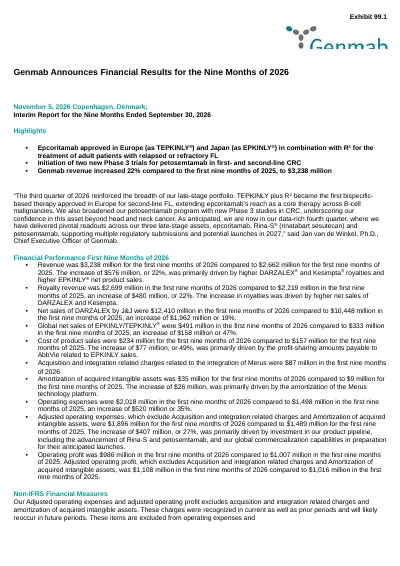
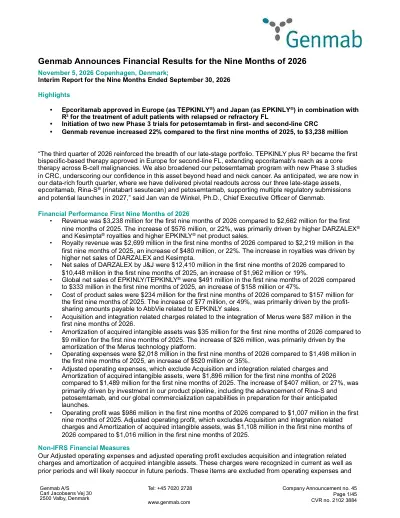
Our total revenue is up 22%, with growth coming from across all our portfolio. We have continued to manage our investments thoughtfully and strategically, allowing us to grow our adjusted operating profit by 9%.
Growth and profitability together are certainly a sign of a healthy, high-quality business. The product development news is what has me most energized.
October was a truly unprecedented month in our history, with three milestone Phase 3 readouts, all with the potential to change how patients are treated. Three strengths stand behind these results: our expertise in antibody science and oncology, our ability to evaluate innovation, and our speed of execution.
You can see all three in these programs. We acquired Rinatab in May 2024, when it was a single Phase 1/2 trial.
2.5 years later, it has a positive Phase 3 and a broad Phase 3 program across ovarian and endometrial cancers. We acquired petosemtamab last December, and less than 11 months after closing, it too has a positive Phase 3 and a growing Phase 3 program.
EPKINLY, an antibody created by Genmab and codeveloped with AbbVie, has delivered three Phase 3 readouts this year. We said these therapies had substantial promise, and the Phase 3 data have now confirmed it.
In each case, the Phase 3 result is consistent with the Phase 2 data that led us there. Let me turn to the next slide to remind you of this remarkable Phase 3 data and what it means for us going forward.
Last week, we held a call summarizing the important Phase 3 data sets that we announced in October. You can listen to a replay of that call through our website, I will keep this brief and focus on what it means for us.
First, EPKINLY. The EPCORE DLBCL-2 trial, which met its progression-free survival endpoint with a hazard ratio of 0.49, demonstrated that EPKINLY has the potential to change how frontline diffuse large B-cell lymphoma is treated, after more than two decades of R-CHOP as the standard.
Expanding into frontline supports EPKINLY's potential to become the core therapy in B-cell malignancies. Second, Rinatab.
Our ambition is for Rinatab to be the best, first, and broadest in class. The RAINFALL-02 trial, which met both its primary endpoint of progression-free survival, with a hazard ratio of 0.29 in the intent-to-treat population, and the key secondary endpoint of overall survival, supports that ambition with efficacy irrespective of folate receptor alpha expression level or previous mirvetuximab.
Platinum-resistant ovarian cancer is just our first potential launch. With our established global presence in recurrent or metastatic cervical cancer, the breadth of our Rinatab program across ovarian and endometrial cancers positions us well to lead innovation in the gynecologic oncology section.
Third, petosemtamab. The LYGHT-101 trial, which met its dual endpoints of overall survival, with a hazard ratio of 0.5, as well as objective response rate, anchors the program in frontline head and neck cancer.
This will be followed by our next milestone, the LYGHT-102 trial in the second- and third-line setting, which we expect in the first quarter of 2027. With two Phase 3 trials underway, we are already expanding into colorectal cancer, which is another area of significant unmet need.
Given the global capabilities that we have built, I have no doubt that we are well prepared to continue to maximize the potential of all three of these programs with successful commercialization if approved. Now let me pass on to Brad to talk more about this and how our currently commercialized medicines, EPKINLY and Tivdak, are doing in the market.
Brad, the floor is yours.
Brad Bailey
Thanks, Jan. Our proprietary medicines continue to perform extremely well, with EPKINLY and Tivdak reaching more patients around the world.
These results reflect the strength of our antibody science and effective execution by our teams to increase treatment adoption, broaden access, and expand to new markets. Together with the late-stage progress Jan shared earlier, this performance puts us in a strong position to close out 2026 and deliver on our next phase of growth.
EPKINLY is the most prescribed bispecific antibody in lymphoma globally, and we're building on that leadership. Sales grew to $491 million in the first 9 months, representing a 47% increase year over year.
In the US, EPKINLY continues to grow across indications and sites of care, particularly in the community, where its differentiated dual-indication profile is resonating with physicians. During the quarter, we increased the number of sites ordering EPKINLY and expanded adoption among existing accounts, with more than 97% of key customers now ordering from two or more sites.
We're especially pleased with the uptake of chemo-free, fixed-duration EPKINLY plus R2 in second-line FL, which is now considered the standard of care in this setting. This uptake is broadening physician experience with EPKINLY, driving increased utilization across both FL and DLBCL, and bringing bispecific-based treatment to sites closer to where patients live.
Outside the US, EPKINLY continues to perform very well. In Japan, the launch of EPKINLY plus R2 in second-line FL is off to an encouraging start, building on EPKINLY's established presence in the market.
Through our partner AbbVie, this combination is also approved in more than 40 countries, creating opportunities to reach more eligible patients. For the rest of this year, our focus is on maximizing these opportunities, particularly in the US and Japan, where we book sales, while preparing for anticipated launches in early lines of DLBCL as soon as next year.
Moving to Tivdak, sales totaled $131 million in the first 9 months, which is an increase of 9% year over year. This reflects strong, stable performance in the US and continued growth in our launch markets in Japan and Europe, driven by effective field execution and expanding site activation.
Tivdak is now approved and reimbursed in multiple countries, with additional reimbursement discussions underway. This expansion is bringing Tivdak to more patients while strengthening the local market knowledge, customer relationships, and access capabilities that will help drive our success with Rinatab and petosemtamab in the future.
Looking ahead, our focus is on translating progress in our late-stage portfolio into well-executed launches and access for patients. For EPKINLY, frontline DLBCL represents a substantial opportunity to reach patients at the start of treatment and potentially advance the standard of care.
The broad physician network and treatment experience we're building today in EPKINLY's approved indications, across sites of care, serves as strong foundations we prepare to expand into earlier lines of DLBCL. If approved, EPKINLY plus R-CHOP would significantly expand EPKINLY's role in lymphoma treatment and move us closer to our ambition of establishing EPKINLY as the core therapy in B-cell malignancies.
For Rinatab, the positive RAINFALL-02 results represent an important step forward for patients with platinum-resistant ovarian cancer who face limited options and poor outcomes. If approved, Rinatab would become our second medicine in gynecologic cancer and advance our ambition to become the recognized leader in this space.
Our proven experience with Tivdak gives us an established understanding of gynecologic cancer care and longstanding relationships with physicians and care teams, that set a strong foundation for our work with Rinatab in the future. Lastly, as Jan shared, LYGHT-101 was the first positive Phase 3 trial in frontline head and neck cancer in nearly a decade.
If approved, petosemtamab will broaden our solid tumor portfolio and could offer an important new treatment option for patients in a setting where progress has been long overdue. Over the last several years, we built a commercialization engine across key markets, designed to scale with our portfolio and support the growth ahead.
We're pairing deep antibody and oncology expertise with local market insights and data to differentiate our medicines, secure broad access, and drive successful launches. Our field teams bring these capabilities together with a highly coordinated and seamless engagement plan for care teams and customers, supporting broad uptake and utilization.
As we close out 2026 and look towards 2027, we're in a strong position: driving growth from our approved medicines, advancing readiness for anticipated launches next year, and turning the strength of our science into sustained growth and meaningful impact for more patients. With that, I'll turn it over to Anthony to walk you through the financials.
Anthony Pagano
Thanks, Brad. The first 9 months of 2026 demonstrated the continued strength of our business, with revenue growing 22% year over year.
I'd highlight two characteristics of our performance: first, the high level of the growth; and second, the broad-based nature of that growth. Starting with the high growth, DARZALEX increased 19% year over year, while worldwide EPKINLY net product sales increased 47%, reflecting continued commercial momentum and strong execution.
Beyond these two brands, the remainder of our portfolio increased 30% year over year. Turning to broad-based growth, approximately half of our year-over-year revenue growth came from DARZALEX.
Impressively, the other half was generated by EPKINLY and the remainder of our portfolio. Taken together, these results demonstrate that our business is becoming more diversified and more durable.
That evolution continues to strengthen the quality of our revenue base. This strength provides us with the financial flexibility to continue investing behind our highest-value growth opportunities.
This includes launch readiness for EPKINLY, Rinatab, and petosemtamab, as well as the ability to broaden the development for both of our wholly-owned programs. As we currently have nine ongoing Phase 3 trials for Rinatab and petosemtamab, with more announced or in development.
Even with this investment, we grew adjusted operating profit by 9%. Together, our results demonstrate that Genmab can increase investment while continuing to expand profitability.
Now, let me briefly comment on tax. Our effective tax rate for the first 9 months was 3.4%, primarily reflecting the ongoing integration of Merus and related recognition and utilization of deferred tax assets.
As we've previously discussed, our effective tax rate may continue to fluctuate as those integration activities progress. We expect our effective tax rate will normalize over the next 12 to 18 months.
With that, let me turn to our 2026 financial guidance. We remain on track to achieve our 2026 guidance, which we are maintaining, with strong revenue growth and strong profitability.
We expect our revenue to be in the range of around $4.325 billion to $4.525 billion, delivering a robust 19% growth at the midpoint. It's EPKINLY and the continued momentum in our royalty portfolio that's driving that growth.
Given our performance through the first 9 months, we now expect revenue to be in the upper part of that range. For operating expenses, our full-year investment plan has not changed.
We still expect to be in a range of around $2.81 billion to $2.95 billion, and we expect to be around that midpoint of $2.88 billion. We expect Q4 opex to step up significantly because we have substantial activity planned in the fourth quarter, including manufacturing, clinical development, and launch readiness for Rinatab and petosemtamab.
I would caution against taking down your 2026 opex figures as a result of our first 9 months. Putting all this together, we're planning for adjusted operating profit in a range between $1.065 billion to $1.35 billion, with the midpoint of our guidance amounting to over $1.2 billion.
With revenue in the upper part of the range and opex around the midpoint, we expect our operating profit to end above that midpoint. Our guidance highlights our continued strategic discipline, with revenue growth funding targeted investments in petosemtamab, Rinatab, and launch readiness, all while maintaining strong profitability.
Now, finally, before I conclude, I'd like to take a minute to look ahead to 2027. While of course, our guidance will be given in February next year, as I stand here today, 2027 consensus expectations for opex on Bloomberg and FactSet appear to be in a reasonable place, capturing our investment priorities.
Importantly, we remain confident that Genmab will deliver strong profitability both in 2026 and continued growth in 2027. In summary, our performance in the first 9 months of 2026 underscores our ability to produce high-quality revenue growth, advance our late-stage pipeline, and maintain strong profitability through disciplined execution.
Together, this positions us well to deliver sustained growth and long-term value creation. Jan, back over to you.
Jan van de Winkel
Thank you, Anthony. This brings us to our final slide.
It has already been a remarkable year for Genmab, both for our science and our financials. I can summarize this with three themes: The first is our sustained financial growth based on revenue from our portfolio, including significant contributions from EPKINLY.
The second is our high-potential late-stage pipeline, where we have had unprecedented Phase 3 readouts across EPKINLY, Rinatab, and petosemtamab, setting up potential launches in 2027 and multibillion-dollar peak sales potential. Finally, our disciplined capital allocation.
We are investing in our high-impact late-stage programs with broad clinical development and launch readiness, all while sticking to our goal of gross leverage below 3x by the end of next year. In short, we have three high-quality late-stage programs, a broadening revenue base, and more catalysts still to come.
All of this gives us real momentum as we head into the next decade. As we move forward to the end of the year, I could not be more energized about our future, both in 2027 and beyond.
That concludes our prepared remarks. Before we move to Q&A, I'm pleased to announce that we will hold our annual virtual R&D update and ASH data review event on December 16.
Details will be available on our website, and with over 20 accepted abstracts, including six oral presentations, we look forward to a lively event. With that, thank you for listening.
Operator, we are now ready for questions.
Operator
Thank you. Dear participants, as a reminder, if you wish to ask a question, please press *11 on your telephone keypad and wait for your name to be announced.
To withdraw a question, please press *1 and 1 again. Please stand by while we compile the Q&A roster.
This will take a few moments. Now we are going to take our first question.
It comes from the line of Benjamin Jackson from Jefferies. Your line is open.
Please ask your question.
Benjamin Jackson
Thanks for the question, guys. Can I just start on the ASH abstracts for DLBCL-4, please?
Just interested if there's any color you can add around what you're seeing or thinking about with regards to that OS hazard ratio that obviously shows no detriment to the patients. Is this something similar to what we saw in and around the DLBCL-1 trial, where we need to adjust for any COVID-related deaths or subsequent therapies?
How do you see this reading across to the frontline trial? Is it just a factor of the short or very short follow-up compared to the other trials that we see in this space?
Is this something that ultimately you will need to show a statistically significant OS benefit in one of these two trials to be confirmatory across the board? Any thoughts in and around the OS side of that as well?
Then also just as a follow-up, on the safety side, slight increase in that trial in and around Grade 5 events. Is there any color you can add here?
Is this COVID-related again, or is something else at play? Thank you.
Jan van de Winkel
Thanks, Ben. You very cleverly, I think, put three questions under the first one, that is the ASH abstracts, and then the safety one is an extra question.
We'll ask Tahi to start, and then Judith can chip in where you can add further color. Tahi?
Tahi Ahmadi
Thank you, Jan, and thank you, Benjamin. There are probably five questions in there, we're going to take them one at a time.
As relates to the OS for the 04 trial, I think you already alluded to it. Median follow-up on that trial, driven by the impressive hazard ratio on the PFS side that triggered the readout, was 10 months.
If you just think about the cross-comparison to 05 or the Glofit Genmab study, the follow-up there was more towards 28 to 30 months. From that, you can just already appreciate that this is totally immature, with very few events.
As relates to COVID, COVID is not necessarily an issue anymore. These trials were run post the COVID phase.
Of course, the availability of bispecifics and CAR-Ts, the next available lymphoma treatment, does to a degree play a role. We're still very confident that this has the potential to continue to actually improve and actually show a benefit for EPKINLY.
We will have to just wait for that follow-up. As it relates to confirmatory trial, I think it's fair to say at this point that the frontline diffuse large B-cell Phase 3, with an overwhelming positive PFS, from a regulatory point, it provides us our confirmatory trial.
That was the second question that you had. The third one was on safety.
You correctly noted that there were a few death events on the EPKINLY arm. There are also on the control arm.
There is really no isolated signal. This is really multifactorial, and it's a relatively small number of patients.
There are all kinds of different factors that play a role there. We stand behind the conclusion that really the trial didn't show any new safety signals, and I think that will be better appreciated when the data is actually presented in its totality at ASH.
I hope I touched on all of the questions.
Benjamin Jackson
Yes, that's brilliant. Thank you very much.
Jan van de Winkel
Thanks, Tahi. Thanks, Ben, for the question.
Let's move to the next question.
Operator
Yes, of course. Now we're going to take the question from the line of Charlie Haywood from Bank of America.
Your line is open. Please ask your question.
Charlie Haywood
Charlie Haywood, Bank of America. Thanks for taking the question.
I have two, please. The first one is just looking ahead to potential launches for these assets and on peto specifically, I think your prior commentary was a billion-dollar sales by '29.
Just wondering, obviously you've hit OS at interim, which I imagine was more of an upside scenario. How's that informed confidence to reach that status by '29?
Then the second question, just on your two Phase 3 readout, or your fileable readouts coming next year, peto second, third-line head and neck, and then Rinatab second-line endometrial. I guess both optically smaller ops than the recent anchor readouts you've had, but both, I get, broader halo potential for the assets you've got.
OS benefit for peto across potentially first-line, second-line, and third-line; and then Rinatab, ovarian and endometrial. How do you view the commercial importance and the potential halo effect of those two indications?
Thank you.
Jan van de Winkel
Thanks, Charlie. Brad, can you start off with both questions, and then Anthony can potentially chip in also as it relates to the sales in '29 to provide further color if needed.
Brad, maybe you can start.
Brad Bailey
Yeah. No, thanks, Jan, and thank you for the question.
As we look ahead, obviously the oncology in general is a data-driven market and a very competitive market, but also extremely data-driven. We're confident in the data that we've seen to date for all the assets, as you mentioned across your questions.
We're confident also in the capabilities we've built at this point to bring our medicines to markets. We've really built our commercialization capabilities with all of this in mind over the last few years, and certainly with this level of growth and expansion, looking to differentiate in these spaces.
We evaluate the markets with multiple sources overall and feel confident in the guidance we've provided thus far. As we get into the data further with the presentations as we've stated at an upcoming medical congress next year, we'll be able to provide further color on that as we move forward.
Jan van de Winkel
Thanks, Brad. Anthony, you want to give further color?
Anthony Pagano
Thanks, Charlie. Look, we've been super clear.
We had high conviction. Now I'm zooming in on petosemtamab.
We had high conviction in petosemtamab in October. We backed that up with the really super strong Phase 3 results, including the OS that you reference.
We stand fully behind the peak-year sales estimate for petosemtamab at multibillion, and we stand fully behind that $1 billion number for 2029. Really feel like on the heels of this data, Charlie, we're well positioned here moving forward.
Charlie Haywood
Great. Thank you.
Jan van de Winkel
Thanks, Charlie.
Operator
Now we're going to take our next question. The question comes from the line of Zain Ebrahim from J.P.
Morgan. Your line is open.
Please ask your question.
Zain Ebrahim
Hello. Thanks for taking the questions.
Zain Ebrahim, J.P. Morgan.
Two from me as well. First question is on peto, and just how we should think about the duration of treatment that you are expecting to see from a modeling perspective.
I think in the Phase 2, you showed median progression-free survival of about 9 months, but based on the Phase 3 results, you're effectively doubling overall survival. Could we see potentially longer duration of therapy than that progression-free survival 9-months point?
My second question is on EPKINLY and how we should think about the pace of the rollout in first-line DLBCL and second-line DLBCL, pending approval next year, given the strength of the data, particularly in first-line, could you see blockbuster sales for EPKINLY next year?
Jan van de Winkel
Thanks, Zain, for the questions. Maybe, Tahi, you can start with the peto duration of response question.
I don't know how much detail we can give here, but you can potentially give some perspective. Then Brad, maybe you can talk about the launches and the rollout of Epco in frontline DLBCL and further.
Tahi Ahmadi
Thank you, Jan, and thank you, Zain, for the question. Now, of course, as I'm sure you understand, we're not going to be able to get at this point into a nuanced discussion around duration of treatment and any kind of detailed discussion on the data until we have it in the public domain.
I think it's important to step back, though, as you also were alluding to in your question, to remind ourselves that from a pure odds ratio on response, and then particularly on the OS hazard ratio, what we're looking at is really a transformative study, and we're really excited to show the totality of the data in the context of the patients that were enrolled, and then we can have these nuanced discussions around modeling, duration of treatment, and these things.
Jan van de Winkel
Thanks, Tahi. Brad, maybe a bit on the rollout of EPKINLY in the different settings?
Brad Bailey
Yeah. No, thanks.
Thank you for the question. We've said for quite some time the largest opportunity is obviously as we move into earlier lines of therapy, specifically in frontline, and where the majority of the patients we know are treated in the community and intend of treatment is curative.
The market's already moving, I think as we know, from R-CHOP to these R-CHOP combinations, and we've also long stated that we believe bispecifics can really build on this R-CHOP and emerge as the new standard. The top-line data at this point validate this position and the role that EPKINLY plus R-CHOP can play.
We feel extremely confident again in the data for EPKINLY. We've built the capabilities all along to prepare for earlier lines of therapy as it relates to our infrastructure, and we expect strong uptake at launch, primarily with academics, and then certainly moving into the community as more sites gain experience, as we're already seeing, and a bit of a proof point with the second-line FL launch from around the same time last year.
That's driven the primary part of our uptake thus far. We expect strong uptake and look forward to sharing more as we move further.
Jan van de Winkel
Thank you, Brad. As you said before, data is the currency in oncology, Zain.
What we hope is that we can actually present the data of the frontline study with epcoritamab quite quickly and show how fantastic that data is, so that that launch will be even quicker once it's on the market.
Zain Ebrahim
Very clear. Thanks a lot.
Jan van de Winkel
Let's move to the next question, operator.
Operator
Yes, of course. The question comes from the line of Romy O'Connor from Van Lanschot Kempen.
Your line is open. Please ask your question.
Romy O'Connor
Hi, this is Romy. Thank you for taking my questions.
Maybe just following on to the previous one, with the potential long treatment duration that we might see with petosemtamab, just wondering how you're thinking of the subcutaneous formulation and how advanced along is that? Looking at the frontline DLBCL space, following the positive data that we saw, how should we be thinking about the positioning of EPKINLY in R-CHOP against, for example, Pola-R-CHP?
Do you anticipate more of a broad adoption, or could treatment decisions be dependent on risk characteristics, for example? Thank you.
Jan van de Winkel
Thanks, Romy. The first question can be on the subcu, maybe Tahi can start with that, and then also handle the second question on the competition and the positioning versus Pola-R-CHP in frontline diffuse large B-cell lymphoma.
Tahi, maybe you can start?
Tahi Ahmadi
On the peto question first, look, we obviously started, I think it will be evident, it was announced in the midst of the closure period of the acquisition of Merus, we've been working on subcu. We have always understood subcu to be an important life cycle management component.
That's probably where we will have to leave it at this point for a variety of reasons. On the EPKINLY question, yeah, this question comes up a lot, and I think it's good to step back for a moment.
First off, R-CHOP EPKINLY, hazard ratio 0.49. This word "unprecedented" that gets sometimes overused, but this is literally a trial at a scale of positivity that has not been seen in diffuse large B-cell for quarter of a century.
What that also means, even without having a discussion on the nuanced data, is that when you have an effect size of that scale, that probably will have an impact on a number of populations. You already can tell the difference in the hazard ratio between fit to fight was nonexistent, which basically means that the hazard ratio of 2 mimics the hazard ratio of the treat to fight population.
That in of itself is already a significant differentiator. Then there are other subgroup populations that you could think about as it relates to the original POLARIX CHP data set from POLARIX that led to the approval.
I think that's the first differentiator that's important. The second part that is important is, well, we're here today, and we have a Phase 3.
The Glofit POLARIX CHP study is going to read out sometime in the future. I think Roche has guided towards the end of next year.
There is a significant time advantage, and that's an important one. I think the third part that sometimes gets also not really appreciated is that from the beginning, what we discussed and Brad touched on this, the vast majority of these patients get treated in the community.
In the community, R-CHOP is the standard of care. That's something that physicians in the community are comfortable with for 25 years plus.
The subcu administration is a differentiator for the community. Dual indication is a good differentiator for in the community.
These things all are important aspects. Not to have two marketed products within a regimen plays a role in certain cost-conscious markets.
Then the last part is, if you actually look at the most recent ASH abstract that just got released by Roche, that's something that we also talked many, many years ago already, there might be actually a ceiling that is determined by CD3/CD20 that is then determining how high you can go in the efficacy in terms of CR, because there is really no difference between the R-CHOP glofit and R-CHP glofit. I think that kind of summarizes how we think about it.
We feel very comfortable with the positioning of where we are. We're super excited to share this data as soon as we get the opportunity to, and then we'll have more detailed conversations.
Jan van de Winkel
Thank you, Tahi. Thanks, Romy.
Very clear. Thank you.
Operator
Thank you. Now we're going to take our next question.
The question comes from the line of Asthika Goonewardene from Leerink. Your line is open.
Please ask your question.
Hi, everyone. This is Carina for Asthika.
Congrats on all the data. I had a question for Rinatab.
Sac-TMT, their Phase 3 data in endometrial showed meaningful PFS and OS benefits, but they also had 35% response rate and notable stomatitis. With Sac-TMT filed now, does Rinatab still have a shot at accelerated approval?
I have a follow-up.
Jan van de Winkel
Thank you, Carina. Judith, can you take this question?
Judith Klimovsky
Yes, thank you for the question. As for Rinatab in endometrial, we have a dual strategy.
We started with a single-arm, and in parallel, we opened a Phase 3 randomized study. Basically, aligned with what we did with peto.
The more likely scenario now is that the filing will be based on the Phase 3 results.
Jan van de Winkel
Thanks, Judith. Very clear.
Thanks, Carina.
I have a follow-up. For Rinatab, the ovarian cancer data you guys showed a strong OS hazard ratio.
There has been a lot of buzz generated at ESMO. Are you seeing any preliminary impact on patient recruitment to the other ongoing Phase 3 studies and also basket studies?
Jan van de Winkel
Judith, can you handle this one as well?
Judith Klimovsky
No, and thank you for the question. As you can appreciate, the unprecedented results of Rina in PROC are creating what we call an halo effect.
We expect recruitment on the other studies to be even more encouraged by these results being already made in public.
Jan van de Winkel
Thanks, Judith. Thanks, Carina.
We'll
Jan van de Winkel
move on to the next question. Thanks.
Operator
Thank you. Thank you.
Now we're going to take our next question, and it comes from the line of Gregory Renza from Truist. Your line is open.
Please ask your question.
Hi. Thanks so much for taking our question.
This is [unclear] on for Greg. Another one on Rinatab.
On the greater than $2 billion peak sales, how does that number split across platinum-resistant, platinum-sensitive, and endometrial cancers? What setting drives most of the value?
Thanks so much.
Jan van de Winkel
Thanks, Gregory, for the question. Anthony, you can handle this one for sure.
Anthony Pagano
Thanks, Greg. Really, it'll come back to the high conviction we've had in Rinatab, and again, now we've backed this up with the Phase 3 data that was released in October and really showing that strong OS data.
Really, our conviction is really backed up now, and based upon this data. Again, we stand fully behind that peak-year sales estimate.
Just remind everybody, for Rinatab, that's greater than $2 billion. That conviction comes from the data, but it also comes from the capabilities we've deliberately built.
It's how we develop the medicines, how we commercialize them, and you've seen again, remind everybody that strong execution with Tivdak and EPKINLY. That same engine is already doing the appropriate pre-launch work, particularly now zooming in on Rinatab and really leveraging all of the capabilities we've also built out in the gynecological oncology space.
I think we're very, very well positioned to deliver against that greater than $2 billion estimate for Rinatab. Gregory, at this stage, we're not breaking it down any further than that in terms of further breaking down ovarian or endometrial the split.
Really, I'd just have you focused on the capabilities in place, the data in place for us to now deliver against that greater than $2 billion target for Rinatab.
Jan van de Winkel
Thanks, Anthony. As a reminder, Gregory, we also have trials in lung cancer as well as in gastrointestinal cancers with Rinatab, it may have a far broader potential than just ovarian and endometrial.
Let's move to the next question, operator.
Operator
Yes, of course. Now we are going to take the question from Rajan Sharma from Goldman Sachs.
Your line is open. Please ask your question.
Rajan Sharma
Hi. Thanks for taking my questions.
I've got two as well. First one, just on EPKINLY dynamics.
It looks like sequential growth between 2Q and Q3 was relatively flat, could you just maybe talk about what you're seeing there, and is that sort of the run rate we should be expecting until the frontline approval comes through? Then secondly, maybe just following up on a question from the call last week, just now that you have the data in hand, how are you thinking about the shape of the top line and the bottom line of the company through your royalty expiration?
Are you confident that there's ability to grow through that or at least be flat? Thank you.
Jan van de Winkel
Thanks, Rajan. Very good questions.
Brad, can you handle the first one, EPKINLY growth dynamics and how to think of that going forward? Then Anthony, maybe you can start on the top line versus bottom line, and I can potentially jump in there as well.
Brad?
Brad Bailey
Yeah. No, thank you for the question.
We certainly continue to see kind of post the second-line FL launch, as well as removal of hospitalization, a strong growth specifically in the US with EPKINLY. As we look globally, expecting, as mentioned, we just launched in Japan with second-line FL as well.
We expect continued growth there also. We've said all along, the earlier lines of therapy is where the value is.
As we have just seen the data with frontline looking to continue to build on this strength that we have with our infrastructure, both our field teams, our market access, patient service teams in the field are ready to deliver from that perspective as well. I'll leave it there.
Jan van de Winkel
Thanks, Brad. Maybe Anthony, on the top line versus bottom line going forward?
Anthony Pagano
Happy to do so. Really, it's going to be reiterating some key messages we've been sharing with the markets here now for really the last year.
It's really starts with the strength, the quality, and the high conviction that we had and continue to have really across EPKINLY, Rinatab, and petosemtamab. Again, now we backed this up with this Phase 3 data here during the course of October, and again, we stand fully behind the peak sales estimates that we've previous communicated.
Just remind everybody, that's greater than 3 billion for EPKINLY, greater than 2 billion for Rinatab, and multibillion for petosemtamab. I would also then look to something we highlighted during our call today, when I talked about the characteristics of the growth that we're seeing ex-DARZALEX: EPKINLY up 47% compared to last year; the rest of the portfolio up 30%.
Supporting that all together, from a revenue perspective, we absolutely have the building blocks in place to see a overall very nice revenue growth trajectory here moving forward. Then sort of thinking about the investment, and ultimately the bottom-line, Rajan, I would really anchor you back to the important financial commitments that we've made to the market most recently when we acquired Merus in Q4 of last year or late Q3.
Really, three things that we said to you all: We said number one, we would deliver strong operating profit in 2026. Here, we're up year-to-date 9% on adjusted operating profit.
We also said when we thought about 2027, we committed to deliver operating profit growth and to delever to below 3x gross leverage. Based upon the strong performance of our brands coupled with focused and disciplined investment, we are very well positioned to deliver these important 2027 financial commitments.
If you sort of zoom out, Rajan, it's really thinking we have it from a revenue perspective the building blocks in place, very high-quality data we've seen here in October, and that real focus in leveraging that revenue to the extent possible to drive profits for Genmab. We're not a position today to give you any real specific medium-term guidance, but you really should take away from this that the building blocks are really in place here at Genmab from both a product perspective as well as a capability perspective.
Jan van de Winkel
Thanks, Anthony. I think very little to add.
It comes down to execution, execution, execution here, Rajan, and that's what we're pretty good at.
Operator
Thank you. Now we're going to take our next question.
The question comes from the line of Xian Deng from UBS. Your line is open.
Please ask your question.
Xian Deng
Hi. Thank you very much for taking my questions.
Two, please. One on petosemtamab in colorectal.
Just looking at the ESMO data you presented, just wondering, the ORR, of course, looks very high. The current standard of care in the frontline setting also looks pretty high.
My understanding is the duration is what really matters. Just wondering, given the public data we've seen is relatively early stage, and you've already started Phase 3, just wondering, what are your thoughts in terms of the duration and especially considering amivantamab is actually a lot ahead in terms of timeline, just wondering your confidence on duration, especially also versus amivantamab on that?
That's the first question. Second one is on Rinatab.
You are announcing the Phase 3 trial in frontline pMMR endometrial. Just wondering if that's trying to replace chemo in induction or more sort of to add during maintenance?
Sorry, this is a long second question, it's kind of a broader one on Rinatab. Is that you're also starting Phase 3 on maintenance and on PSOC as well as induction in PROC.
Historically, the maintenance in those settings, whether it's endometrial or ovarian, it tend to be monotherapy and no chemo. Just wondering, given the toxicity of chemo, but then, of course, this is ADC, just wondering what are your overall thoughts on potentially using ADCs in maintenance setting?
I'm asking because whether you can use it in maintenance setting actually matters a lot in peak sales. Thank you very much.
Jan van de Winkel
Thanks, Xian. Very good questions.
The first one, I think, can be handled by Tahi, and then Judith, you can take the Rinatab question, and then Tahi can potentially step in there as well.
Tahi Ahmadi
Let me start with the peto question, and then between Judith and me, we can certainly also answer the Rina questions. Let's start with the colorectal.
You're absolutely right that the follow-up for the frontline data set that we presented was relatively short. I think it was 5 months.
In the end, there are two data sets. There's also a second-line data set with a slightly longer follow-up, which is the same combination with chemotherapy, FOLFIRI or FOLFOX.
You can to a degree extrapolate from the second-line durability that is already, I think, better appreciated to the frontline durability. In the end, durability is a function of the mechanism, of course, the safety profile, and the treatment duration, and of course, the sensitivity of the disease.
This is at least how we think about it. We look at these data sets not in complete isolation; they also inform each other.
If you take them in totality, both with point estimates, higher response rate that have been described than any data set that has described before response rate in that data set in frontline obviously on the left side, and then in the second-line in the totality of patients, these data points gave us a confidence. Then the durability that we've seen on the second line emerged confirms that conviction.
Then, of course, by now, I think we have, broadly speaking, a pretty robust understanding of the safety of petosemtamab. That's particularly relevant also as you start getting into these thought exercises and comparing it to amivantamab.
I think we've talked about this also on the last call. There is a very clear distinction in the safety profile and the tolerability of peto versus amivantamab.
In system organ class, obviously, as an EGFR class, there are skin-related toxicities. The numerical, the degree, the Grade 3 and higher, and the complexity and even the locality of the affected skin areas is drastically different between these two assets.
If you then compare the safety that we have generated now repeatedly and also is in the Phase 3 obviously, to the available data sets with ami, and then you know that amivantamab achieved that safety profile with a very complex and involved mitigation strategy, then I think it's pretty obvious that there's a massive differentiation on safety. That definitely, in our mind, translates in durability.
I think that's my answer on the colorectal. We feel super excited about colorectal, and I think the data that we presented just at ESMO underwrites that excitement that of course already had motivated us to start these two Phase 3s.
Then I would say this: this would not be the first Phase 3 that we have started after the competition that read out before the competition. Then I give it to Judith on the Rina questions.
Judith Klimovsky
Thank you for your questions. For Rina, the endometrial cancer study that is in the public domain is the Phase 3 in the second/third-line.
The first-line is planned, we haven't provided specifics about the design or comparator. As you well alluded to, the standard of care is induction chemo plus a IO, followed by maintenance IO.
We haven't shared the specifics of the trial, but stay tuned. Will be shortly posted.
With regards to PSOC, we have a dual strategy, in fact, triple strategy. In PSOC second/third-line, we have two studies, study 04 and 07: one is maintenance post doublet chemo plus minus bev, and the other one is what we call replacement strategy.
We have the first-line PSOC posted recently in clinicaltrials.gov, which is not PSOC, but first-line maintenance, which is doublet chemo followed by bev versus doublet chemo followed by bev plus Rina. Basically, what we are doing is covering all the aspects to potentially unleash the full potential of Rina in the whole spectrum of the disease.
Tahi, you want to add anything?
Tahi Ahmadi
The only other thing is, in your question, you alluded to the idea of whether or not an ADC at all is a maintenance drug,
Judith Klimovsky
and
Tahi Ahmadi
I think there again, nuances matter. I think we've talked a lot about what we consider to be a differentiation for Rinatab, and that is that it is mainly hem toxicity.
They are mainly restricted to the first or second cycle, and then thereafter, it is actually a very well-tolerated drug with an extremely low discontinuation rate. Then if you have a drug that has a safety profile that is truly tolerable, meaning it doesn't have these discontinuations due to eye toxicity, new autotoxicity, interstitial lung disease, or any other form of cumulative toxicity, then it is actually indeed a very good maintenance drug.
Judith Klimovsky
Yeah. We presented data on Rina bev last year that speaks about that, the good tolerability in terms of patients staying on both drugs, bev and Rina, for a long period of time.
Jan van de Winkel
Thank you, Judith and Tahi. That, I think, is really, really a very good response to the question from Xian.
Operator
Thank you.
Jan van de Winkel
Let's move to the next question, operator.
Operator
Yes, of course. The next question comes from the line of Yaron Werber from TD Cowen.
Your line is open. Please ask your question.
Yaron Werber
Great. Thank you so much.
I have a couple of questions. The first one is on peto.
Would you file based on the first-line survival data that you just got, or would you wait to file and include the second-line survival data, which you're expecting early next year? Then secondly, and I think it's maybe a nuanced question relative to what was asked before, I think when many of us look at the guidance now, $3 billion and higher for EPKINLY, $2 [billion] for Rinatab, and billions for peto, they all look fairly conservative.
What would it take to update them? Thank you.
Jan van de Winkel
Thanks, Yaron, for the questions. The first one, Judith and Tahi can take that one, maybe Judith, and then Anthony, you can give more perspective on the guidance.
Judith Klimovsky
As we guided the street, when we shared the top-line results of LYGHT-101, we are actively planning engaging with health authorities for the potential filing based on the results that we already communicated.
Jan van de Winkel
Thanks, Judith. Anthony?
Anthony Pagano
Yaron, again sort of just at this stage, we're going to stand fully behind the previous peak-year sales estimates for the three brands. Again, reminder, it's greater than 3 billion for EPKINLY, greater than 2 billion for Rinatab.
Just want to clarify, I think you said a billion for petosemtamab. For petosemtamab, it's multibillion.
We had strong conviction in these estimates coming into the readouts that we saw in October, and we continue to have that high conviction. That's where I'm going to leave it for now.
Jan van de Winkel
Thanks, Anthony. Thanks, Yaron, for the two questions.
Operator
Thank you. Now we're going to take our next question.
It comes from the line of Victor Floc'h from BNP Paribas. Your line is open.
Please ask your question.
Victor Floc'h
Hi. Thanks very much for taking my question.
Maybe just first one, a quick follow-up on the subcu formulation. I noticed that you've added a new cohort to the Phase 2 colorectal study.
Just wondering whether it would be enough to support a subcu filing across indications, or would you still need a dedicated bridging study? The follow-up is on the commercial opportunity for peto.
I was wondering whether the subcu could become as important as a driver for peto that it has been for DARZALEX, and whether the subcu launch is already factored in your ambition to reach at least $1 billion in sales by 2029? Finally, more broadly, how does KEYTRUDA's expected loss of exclusivity towards the end of the decade shape your long-term expectations for peto?
Thank you very much.
Jan van de Winkel
Thanks, Victor, for the questions. Maybe Judith, you can actually take the peto subcu question.
Judith Klimovsky
I
Jan van de Winkel
Brad can follow up too, yeah.
Judith Klimovsky
Thank you. I would echo what Tahi answered with regard to the peto subcutaneous.
We already mentioned the partnership with Halozyme to start the development of the subcutaneous. It's part of our life cycle management, it's premature to highlight details of the specific plans that we will follow.
Jan van de Winkel
Thanks, Judith. Brad, maybe the subcu as a driver like DARZALEX subcu was driving the DARZALEX sales.
Maybe you can give a bit of perspective there.
Brad Bailey
Yeah. No, thank you for the question.
As already mentioned, the LYGHT-101 data show the potential for petosemtamab to be both first and best-in-class in frontline head and neck. We're confident in this potentially practice-changing data that we've just looked into and shared.
Any innovations certainly or updates would be assessed in the future, and we'll certainly update those as we move forward. Again, an extremely area of high unmet need right now, and very confident in the data that we've presented at this point.
Jan van de Winkel
Thanks, Brad. Thanks, Victor, for the questions.
Let's move on to the next one.
Operator
Yes, of course. Now we are going to take our final question for today.
Just give us a moment. It comes from the line of Sean Laaman from Morgan Stanley.
Your line is open. Please ask your question.
Sean Laaman
Hello, everyone. Congrats on the results.
Thanks for taking my number, and hope everyone's well. Two quick ones.
Strategic: given the significant strengthening you've observed in the late-stage pipeline, has your appetite for external business development changed, or is execution on internal assets now the highest-return use of capital is the first one. The second one is just on the two CRC programs.
What milestones should we expect over the, say, next 12 to 24 months? Given where you could position this in CRC, particularly with the differentiated safety profile you're pointing to, could the opportunity outsize what you observe in or expect in head and neck?
Thank you.
Jan van de Winkel
Thanks, Sean. I will take the first one myself, and then the CRC questions, Judith can handle.
BD, we are very active, Sean, and looking at interactions with other companies for potential combinations of our drugs. We already announced the Incyte Incyte partnership recently.
There will be more to come. We are currently focusing on really maximizing the potential of our late-stage programs.
Two of the three have been taken in via BD, via acquisitions. We also are working very strongly on our organic pipeline.
We don't talk a lot about it because we want you to focus on the late-stage programs. This year, we moved already four new programs, antibody-based programs into the clinic from our own pipeline: two bispecifics, two ADCs.
At least two more programs will be moved into the clinic between now and the end of the year. We are very actively working on organic pipeline, but it will be balanced.
Right now, the focus is clearly on maximizing the potential of the late-stage, what I call winning programs, Sean. Also we have of course a commitment, in addition to this expansion of these programs, to also lower the leverage basically by end of next year to less than 3-fold gross leverage, which we are focused on.
We have a very active BD team to really bring the outside landscape into great perspective for us so that we can strike again if needed in the future. Then maybe Judith, you can talk about the colorectal cancer setting.
Judith Klimovsky
Thank you. Unfortunately, CRC is a high unmet medical need and a larger opportunity potentially commercially than head and neck.
In first-line KRAS wild, the treatment paradigm is an EGFR antibody, usually cetuximab or panitumumab, plus FOLFOX or FOLFIRI. Unfortunately, the median PFS is only 12 months, and median overall survival around 2 years.
In the second-line, the unmet medical need is even more compelling, with best treatment in KRAS wild with cetuximab, panitumumab, or any other EGFR plus chemo, the response rate is only 30-40%, median PFS 6 months, and median survival of 1 year. A compelling unmet medical need where, as we highlighted or Tahi highlighted, in ESMO, we showed very strong, encouraging, although still early preliminary data.
We expect to have longer follow-up of this data set, which is pretty good for a Phase 2 proof of concept, and we will communicate this when the data is more mature.
Jan van de Winkel
Thank you, Judith. Thanks, Sean, for the question.
Thank you. I think this will end our Q&A.
Thank you all for your questions and for being with us today. As always, if you have additional questions, please reach out to our investor relations team.
Operator
This concludes today's conference call. Thank you for participating.
You may now all disconnect. Have a nice day.