BNP Paribas Bank Polska Spolka Akcyjna
Q3 FY2026 · Earnings Call TranscriptNovember 5, 2026
Przemysław Gdański
Good afternoon, a very warm welcome to yet another results conference of BNP Paribas Bank Polska. We're going to talk about the results for Q3 and for the results for all three quarters of 2026.
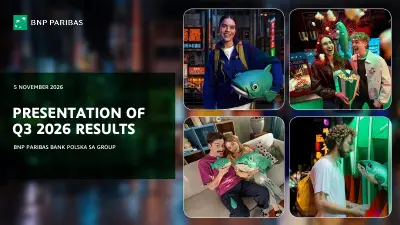
I would like to point out the images on slide one. You can see the fish that took the Polish banking market by storm.
We are going to talk about key information macroeconomically, we're going to talk about results, but also the prospects for the future, and of course, we're going to have time for Q&A. Let's now move to key information.
This was a good quarter for our bank, a quarter when we have confirmed that we are following the 2030 strategy, Accelerate 2030 as the strategy is known, a quarter that demonstrated clear growth trends, but we also maintained our costs, risk costs, and legal costs under control. Now more specifically, left to right, our profit increased by 15% quarter-to-quarter, 689 million zlotys.
This was almost exactly the same as in Q3 last year. What is good is the increase in revenue quarter-to-quarter, 3%.
This is mainly from interest, and we're going to come back to this. We have shown positive trends in terms of volumes, both in terms of deposits and loans, and the growth of our gross loans on a quarterly basis 3%, 9% year-on-year, and it's a solid growth, but we have to remember that the market is also growing dynamically.
I mentioned the net interest margin, the growth here. This is a significant achievement of the bank, in my opinion.
It demonstrates that we can effectively manage the liabilities side of the balance, the passive side of the balance, and we can attract revenues. As a result, our ROTE has improved by two percentage points to 15%, and cost-to-income ratio is below 41%.
What is very important, and we are going to talk about it in a moment, is effective acquisition of retail customers, higher activation, higher number of transactions, and a reversal of trends in SME banking. Now if we look at our key strategic goals and their achievement after three quarters, I'd like to put a lot of emphasis on acquisition of retail customers.
Our strategic goal is 1 million additional net retail customers in 2030. After three quarters of the first year of the implementation of the five-year strategy, attracted 200,000 customers net, and this is a positive trend in the context of past quarters.
What is particularly important is an improvement in acquisition of customers in remote channels, particularly mobile banking. We have been working on our app, and we have considerably improved the onboarding process.
We added mObywatel, the government app, as a mechanism for identification of customers, and this yielded very positive results in terms of acquisition of organic customers in the mobile channel. We hope that this trend will be sustained, particularly in the context of what we are preparing, the dedicated offer for Gen Z.
A very effective acquisition of new customers, considerable growth of loans in the corporate part. Here, our market share for institutional customers increased on a market that is moving very fast.
Historically, the bank was never a rally car in terms of loans. We were always rational, sensible, and this translates to the quality of our portfolio and traditionally low costs of risk.
In addition to our strategic pillar, the impact, new funding, sustainable funding, where we pledged to add 25 billion of new production to support sustainable development, after three quarters we've added 6 billion, it's a very good result, well above the planned trajectory. I'd like to point out a number of things now.
Apart from this friendly table, considerable growth of current accounts in retail and business banking, 14% growth, and it's highly advantageous. We're very happy with it.
What is also good is the external confirmation of the quality of our work, the first award in a competition organized by Newsweek, one of the more credible and established competition for remote channels. This is the Newsweek competition: call center, contact center, internet banking.
We're very happy with this award. It has brought a lot of good energy into the organization, and with our remote channels, we're going to work further on them.
I mentioned the reversal of a trend in SME banking. Here, we are rebuilding our position in loans, growth quarter-to-quarter above 5% is a very good harbinger for the future.
Q3, you can clearly see, was very intensive and very dynamic for us. Moving on, the graphic format of presentation of significant parameters and goals: sales of current accounts, very good dynamics, I talked about it, year-on-year, also quarter-to-quarter, very good result, and this translates to the acquisition of customers.
In terms of investment products, I spoke about it previously, we are focusing on balances and not on new sales exclusively. In terms of balances, the trend is positive, as you know very well.
The market of investment products was difficult. Here I also wanted to comment on mortgages because we can see clear drops here.
As experts, as professionals, you know very well that in the mortgage market we have a price war going on, something that has not happened before. The prices of loans are at a level that does not provide for an attractive ROI.
They are basically breakeven level. This is a product of dubious profitability.
We are selective, in a way, in terms of this product. We do not aspire to be the market leader.
We want to make sure that mortgages are valued sensibly, and we want to sell them to those customers who are going to stay with us for a long time and do all sorts of business and bank operations. The market is moving ahead.
The impact on the results of loans and mortgages is disputable, and this is our situation, as you can see it on the slide. I think that's it about this slide.
Moving on to the next one, let's take a look at our volumes. You can see a clear increase in terms of loans.
It is stronger in the corporate part. What is particularly relevant is that we have investment loans and operating loans.
In investment loans, the proportion is improving, and this is a positive development not just for the bank, but also for the entire economy. We see it reflected in investments that we've been waiting for for many years.
Increase in deposit volumes, what matters is that it comes more from retail. These are deposits more relevant from the point of view of liquidity indicators, very solid participation of current account balances without any interest.
In the corporate part as well, we have recorded growth. However, there we are very rational in terms of the cost of acquisition.
Then the number of customers, I spoke about it, it increased in every segment. The strategic objective is for retail customer primarily, the increase of 2,004 to 204,000 is a very good prognostic for the future.
The result of our operations, what I talked about, perhaps I missed something, is the increase of revenue, 3% quarter-on-quarter, almost 7% year-on-year, operating costs under control absolutely. The cost dynamic is something that we put a lot of emphasis on, and we are not going to compromise here.
Relatively low costs of legal risk related to CHF mortgages, low cost of risk because the quality of the portfolio, we're going to talk about it in a moment, higher gross profit and net profit as a result, plus 15% quarter-to-quarter in this last category. The cost-to-income ratio.
After the first nine months, the outcome is better than after the first two quarters. The cost of risk are stabilizing on the level of more or less three 30 basis points, and I think that's a normalized level that is fully acceptable.
A 12% basis point improvement of the net interest margin, that is a general achievement of banks, and the increase of return on equity for ROE and ROTE. That's it for my first intervention.
Thank you very much, and now over to Michał to talk about macroeconomic factors.
Michał Dybuła
Thank you. Good afternoon.
The quarter three in the economy, quite decent pace of growth, 3.5% to 4% more or less of economic growth, a little bit weaker than quarter two, but it does seem that several factors could come into play, perhaps some statistical storming, as weaker investments in quarter three, perhaps, and right now picking up in this quarter, this present quarter. Like I said, decent pace decent pace of growth and quite a good outcome for the upcoming months, it would seem, or quarters perhaps even.
The main driver of the growth is export, and it would seem that that's going to remain the case for a while to come, given the increased growth in the eurozone, predominantly Germany, and that's extremely important because they Germany is our main trade partner. The second driving force behind the growth is the end of the expenditure of RRF funds, and that should ensure quite solid growth of equity outlay at the end of this year and early next year.
The worst-case is perhaps scenario for the consumers, and why, and well, we know, because inflation is increasing. Energy is also becoming more expensive.
The news for quarter three, I think, has been the most important, and that is the initial MOU between USA and Iran never lasted, the energy prices increased significantly. What seems even more important is that not that just the current price, but also the futures contracts for oil, gas, coal are a lot higher than three or four months ago.
That obviously impacts inflation, and it's going to. On the one hand, that means a further decrease of indirect taxes on fuels that helped drive inflation down in October.
However, the indirect impact of expensive energy will become visible in the prices of other consumer goods and commodities in the months to come, most likely inflation is going to go above target or perhaps perhaps even the upper bandwidth for for a predominant part of next year. This means that the forecast of the National Polish Bank that we learned yesterday, the main figures are also indicative of the fact that the inflation is going to remain as a pressure factor for a while.
That, of course, arises another question, how the monetary policy should react. What about the percentage rates by the National Bank?
I remember that the market used to predict three increases in a year, but the central bank is perhaps a little bit more conservative in their outlook. Today's conference of the President, Chairman of the National Bank of Poland, perhaps will put some light, shed some light on the prospective for interest rates for the months to come.
It does seem that the probability of more restrictive monetary policy in the first semester of next year is becoming a probability. Something that might not perhaps directly impact the decision of the National Bank, but perhaps reflect the fact that there have been no increases so far, is the interest is the exchange rate: 4.20 to more about 4.40 of the euro.
I think that is fundamentally justifiable. On the one hand, yes, the increase in prices of of energy, trade deficit and current deficit are impacted by that, but on the other hand, there is growing pressure on inflation, and with the no increases of percentage of interest rates, the difference between the real and nominal interest rates between Poland and eurozone is becoming more and more visible, which means that the influx of the net capital is weaker and, therefore, the zloty is also suffering.
The exchange rates is an important context for that. Last but not least, the banking sector itself, it would seem that one thing is perhaps worth underlining: after many years, recently, the dynamic of loans for residents has reached the same level as the deposit growth in the segment, and that is a very important thing because it means that the loan-to-deposit ratio is not growing anymore.
Of course, it's still low, but at least for the time being, it is no longer decreasing, which is also very important. Of course, increase of loans as such.
Main market sectors are both enterprises, but consumer loans as well, and mortgages. They are growing more or less by 10% per annum.
That's a decent rate of growth, also against the backdrop of the last few years and the landscape that we observed. What's important also is the data about new sales of loans in those segments.
Seems to indicate that there is quite decent or high dynamic of volume growth, and that is going to last for a few months, looking forward. Thank you very much, and over to Mr.
Konieczny.
Piotr Konieczny
Good afternoon. Three out of 20 quarters of the strategy are behind us.
When we were announcing the strategy, we spoke about a new environment: lower interest rates, higher taxes, and our strategy was built around trying to sustain the growth of the scale of our operation and the dynamic of our operation in combination with sustained or increased margin. It's important to look at the figures from the point of view of what we saw in our operations model as important components to be able to rebuild the financial parameters in the new landscape and match them with the new landscape.
The three quarters that we have seen from the point of view of the scale and its growth, you can see it from the balance sheet point of view, but also the known dynamics, you can see it in the sources of financing for liabilities. There's been an additional job that we had to make use of the time of our strategy to improve the structure of our financing.
You can see that, too. The dynamic in retail is definitely better.
You can see that also in the number of clients acquired. That's also indicative of the scale of our growth.
The net interest margin is 75% of our revenue. It's growing gradually.
We're trying to sustain it. In the last two quarters, we have been able to even improve it slightly.
This year has also seen quite a lot of work in the area of equity. We have improved our position for equity ratios.
It's important because when we look at our strategies and the operations, we see dynamic growth both on the part of assets, but also customer pool, and that requires a good baseline of equity, and we make sure it's happening. If we look further into our loan activity, quarter three is a quarter where we have continued growing the loan portfolio.
This time, it was stronger impacted by corporate loans, institutional customers. For retail, for individual, I'm not going to repeat what was said earlier, we are continuing in general the consumption portfolio, good dynamic here and a good market position.
Now for mortgages, that's a difficult market. We want to be present on it.
We are operational, but this means we permanently have to adjust our margin policies, and that causes a fluctuation between quarters. Both ourselves and the market are testing the new minimum, the new low in terms of financing the customers in this segment.
Now looking at the mortgage portfolio for the Swiss franc, quarter three is the continuation of the narrative that we have had in quarter one and two. The number of Swiss franc lawsuits is dropping, there's a decreasing trend.
Our position for the cost of these cases is directly linked to the trends that we're seeing. Let me repeat what I always say: you should not really view it as the end of the Swiss franc saga, but what we are observing in the figures is that the intensity of the problem is gradually slowing down.
One important fact that I wanted to draw your attention to: if you look at the bottom right corner where you have the quarterly distribution, you will see that our characteristic feature is that quarter four is usually a corrective factor here, please beware of the dynamic and the values of write-offs for this Swiss franc portfolios. Customer deposits: it looks as though this is an important player in our business model.
What's very good news is that we have more retail customers and a marked change in the product structure. When we look at the long year-on-year perspective, we see an increasing share of funds accumulated on current accounts that in fact could be interpreted twofold.
On the one hand, they show that there is a growing number of customers that transact, that have funds in their accounts, but for the bank that also means that it's a very important element of support for the shape of our financing, and we will be continuing this trend. Hitherto, we believe that this year has seen very good work in the area of sources of financing.
What's worth noting is that in quarter three, while maintaining a disciplined price policy, we have noted a net growth of the overall liability. Investment products: we bet on further growth of the value of assets that the customers have entrusted with us, which does not mean that sales volumes are not meaningful, but what counts is the sum of funds that remain with us and that work for us from one quarter to another.
We're looking at a dynamic growth. We are also seeing the maintenance of the source of the products.
Our customers prefer debt instruments, and you can see that in the product structure that you see in the graph. I spoke a lot about net interest income.
That's a very important component. What is good news is that with significant market pressure on the valuation of loans and the loan operations in the market, just like in quarter two and one, the pressure continued throughout quarter three, but we are seeing quite a reasonable policy of managing sources of financing, and thanks to that, we can maintain the net interest income on the same level, or perhaps even slightly improved.
One technical remark is that our net CGEU ratio was at the level of 30 million zlotys in terms of costs, which impacted the NIM coefficient. Had we not continued that, we would have continued the growth throughout quarter two and three.
In terms of results for net fee and commission income, we have a contribution to revenues of the bank. In this quarter, we did not have one-off incidents, which due to the large scale of our investment activity happen from time to time.
It happened in Q2, but solid support in Q3 of our balance coming from fee and commission income. Net trading income, a similar narrative: a good, solid, normalized quarter in terms of contributions.
The key element of this activity are relations with customers. This was a combination of slightly better variability with the number of customer transactions.
It allowed us to support our results considerably in net trading income. The cost dynamic now: we are continuing our strategy, we announced that we will be keeping costs under solid control, and that's what's happening.
If you look at the quarterly dynamics, Q3, Q2, almost no movement. Year-on-year, the dynamic, excluding regulatory costs, is very close to the declared and estimated CAGRs that we assumed.
We're going to continue working this way. One technical element, but to understand individual dynamics: the cost basis will now include the modification of our flows with the dominating entity.
It is reflected in Q3, analyzing our numbers, you have to be aware of that. Now over to Wojciech.
Wojciech Kembłowski
Good afternoon. With regard to the loan portfolio quality, it is stable.
Impaired loans level 2.6%, a positive development, stable nominal value of such impaired loans, an increase of working portfolio, a very good trajectory, and we're going to maintain this level. All segments are behaving in a way that is correct.
In terms of portfolio quality, coverage in all phases are correct. I would only like to point out an increase in stage two.
It is related to short duration loans below one year. Coverage of stage two by provisions is lower than we had before.
I think we should have one more slide about the cost of risk. It's somewhere here at beginning.
The cost of risk for quarter, 22 basis points, incrementally 27, within 30 basis points, which is correct and desired. One-off events: provisions for the recalculation of parameters and dissolving of two corporate area provisions.
One is in the transport sector, and commercial real estate is the other one. Now on to Piotr.
Piotr Konieczny
Here, the key event of Q3 was yet another quarter of the implementation of our strategy, where we announced that we would be managing our capital actively, using the good situation in the market of securitization transactions. After Q3 and after the preparation in Q3, we have concluded a transaction on the corporate portfolio.
An interesting element here is that it has stabilization mechanisms, the transaction will stay with us for slightly longer than in the classic approach, where the depreciation profile is quite quick. Another element: the impact on the cycle of interest rates on the value of capital.
Here, we are sensitive 100 basis points to talk about this issue, 6 to 106 million zlotys, and this influenced the value of capital in Q3. Considering all the elements, as I said, the capital position is being progressively improved, and we're moving to support the accomplishment of business goals and growth in the magnitude of operations of the bank.
I think that's it for capital adequacy. Hence, we've arrived at the last slide before Q&A.
What are the plans and perspectives of the bank? The holistic approach is that we are following the roadmap of Accelerate 2030.
We have a number of strategic goals, we have a defined trajectory until 2030, and it is our ambition to follow this trajectory to accomplish both growth objectives and increased efficiency goals, and those that support sustainable growth. We're living in a world full of volatility that's very dynamic, unpredictable.
Every quarter this is raised, this unpredictability and volatility, we're getting used to it, I think, and I'm sure that our bank is ready to all sorts of scenarios. We can handle with agility and flexibility to the changing circumstances.
We recently said that we expect interest rates to drop, now they're going to go up. As an optimist, I think that the geopolitical situation will not lead to further worsening of military conflicts, and we are going to see a day when there would be a just and lasting peace behind our eastern border, which would be a pro-development impulse for the Polish economy, an impulse that would give more willingness to our business community to invest.
We'll be doing our thing, we'll be monitoring the situation around us, and we'll react adequately to the circumstances. We're going to continue growing organically, and we'll be implementing and delivering on the strategic goals.
That's it for this part, I think. Let's now move to the Q&A part.
In line with the tradition, we're going to pass the floor to those present in the room first.
Maciej Danielewicz
Good afternoon. Maciej Danielewicz, Subiektywnie o Finansach.
This is the last results conference this year before the OKI program is launched next year. What are your plans for OKI?
Przemysław Gdański
Thank you very much for this question. We're going to launch OKI in January as soon as possible, when it becomes possible.
Let me put it this way: it is an important solution, an important product. I'm not that euphoric that it's going to change the world and that it's going to be a tool to acquire new customers.
This is more, in our opinion, an addition to the offering for our customers. That's it for now.
Paweł Błasiński
Paweł Błasiński, Strefa Inwestorów. Two questions.
The first one is about what's happening in the mortgage market. What we heard late last year and at the beginning of this year that there is a lot of refinancing of mortgages.
Is it easing? Is the product having more sense as something that it's worth investing in?
The second question is about what is happening right now with regard to investment products. More and more banks are communicating that investment business matters.
From the point of view of OKI, is this an area that will be more and more relevant for the bank's finances?
Przemysław Gdański
With regard to mortgages, is this true that the extent of refinancing is going down, but still it is a market that has very high level of competition, mainly price competition. Is it a product that is promising in itself?
It is a product that the bank needs to have in its offering, it needs to offer it to its customers. If you look at it separately from all the rest, it is a very difficult product.
It would be very difficult to prove that it's attractive in terms of ROI. We are in this market in spite of lower sales of mortgages in Q3.
The balance has gone up, this shows that the scale of refinancing is going down, but we will be in the market, but we're not going to compete intensively. We'll not be looking to acquire mortgages at any price.
As for the second question, the management of liabilities in the balance is key. It's bigger than the loan part.
It has to have an attractive offering in terms of investments and deposits. We have this offering, we're growing it and expanding it.
To share a secret with you, in November we're going to launch our offering for Gen Z. We're going to have new investment products embedded and tailored to the proven needs of this population of our current and future customers.
We're absolutely very careful in terms of the selection of our products portfolio.
Paweł Błasiński
If I may add one more question?
Przemysław Gdański
If you still have the microphone, no problem.
Paweł Błasiński
There's the issue of new customers. You are attracting, acquiring new customers, but other banks are also informing the public about attracting new customers.
Where do these customers come from if all banks are acquiring new ones? Is it mainly the young generation, or is it also about customers moving from one bank to the other?
Przemysław Gdański
Thank you very much for this question. Let me put it this way: we're very happy with our acquisition after three quarters.
When we are comparing with our peers, we are very positive against the backdrop of our peers. I think there are three sources of acquiring customers.
The first one, customers who are changing their bank. It's difficult to get them because if you ask yourself what needs to happen to completely change the bank you're working with, well, the bank has to make the customer seriously angry, and then the customer would consider change.
The second category is those who are becoming a multi-bank customers, and this is a clear trend in Poland. In the past, retail customers had one bank.
Now they have two or three accounts or relationships with banks, to put it broadly, not counting FinTechs and other financial solutions. This is an addition to the existing relationship.
The third source are young people entering the market, opening their first bank account of their choice, or for the first time selecting the bank that they would like to work with for the long run. The offering, the image of the bank, the value of the bank matters here.
Hubert Bigdowski
Good afternoon. Hubert Bigdowski, WNP.
You said that we live in the world of ever-changing reality, there's an insecurity. Do you think that in the year of elections, even banks are doing quite well in terms of their performance, do you think that still there could be some temptation to perhaps further burden the sector because of the upcoming elections?
Przemysław Gdański
I think that the political and regulatory risk in general is quite high on our list, on the list of risks that banks should bring to their attention, should have on their radar. I am hopeful, though, that after the increase of the corporate income tax in the sector, and banks are a giant taxpayer, the effective tax rate is significantly higher than the nominal 30% this year.
I'm hoping that after this move has been made, the governing parties will not be further attempted to burden the banking sector, especially seeing that investments have launched and that the economy really needs the funding to be able to dynamically grow. Looking at the fact that as a matter of fact in Poland, well, practically the only source of financing is the banking sector, other than friends and family, right, or foreign investment for companies with international equity.
I am hopeful still that regardless of the fact that it's going to be the election year next year, banks will not be the bearer of the election fuel, but their role in the support of the economy will be overwhelming, still overriding in the opinion of reliable politicians.
Andrzej Powierża
Andrzej Powierża from Citi. I would like to congratulate you on the great results, and after the initial niceties, let me go with perhaps some asking you about a deeper comment about what's happening on the corporate loan market.
You are proud of quite a nice growth, but if I well remember the slide, I think your market share has dropped.
Przemysław Gdański
No, it has increased. I think by 12 basis points.
Andrzej Powierża
I cancel this part of my question. What do you see in terms of demand for loans, what we can expect next year, and also a macroeconomic question, what's going to happen with investments?
Perhaps a further outlook, is it going to be just as good as it is?
Przemysław Gdański
What I can see resonating from the clients I speak to, you can see the demand, you can see the preparedness for investment and the huge competition between banks. You can see the readiness to accept lower margins than even a few quarters back.
You can also see the inclination of some market players to accept loose structures of financing with more complex transactions. Those are not necessarily positive phenomena, but in order to be able to effectively compete on the market, you need to have a lot of competence both in terms of financing, specialized financing, and that is project financing, structured financing, property financing, commercial property financing, and also what's important is to be able to put on board important funds, big underwriting on the table, speaking in banking jargon, which we can do when we are joined by most our shareholders.
That the corporate banking relationships are all about people: good people, involved people. The outcome is that we are moving ahead strongly, the growth in corporate credits is higher than our preliminary assumptions at the end of last year.
The margin, however, is lower than we assumed, due to this very intense competition that we're seeing. However, I am an optimist, hopeful that the growth of this segment will advance also further next year, and that methodologically we can increase our share.
Now, attention, without accepting any compromise in terms of the risk profile from the point of view of the customer type and the structures in which a specific project should be financed. Michał, over to you.
Michał Dybuła
Willingly. Thank you.
The rate of growth of investment next year will be on average slightly weaker, most likely, than in the current year, mostly because the giant impulse and the record-high influx of EU funding is not going to be there. It's going to be smaller than in 2026.
That doesn't necessarily mean that the investment of the corporate sector will slow down significantly. That's a new story.
We have been looking at this since quarter two this year. The outlay has been growing quite fast.
Going back and looking at the previous investment cycles in corporations, well, it's never as if they end after one, two, or three quarters, do they? These are cycles that stand a chance of lasting a bit longer than that, which means that in this investment segment, the outlooks for next year are not quite so bleak.
The outlays or the projects are gaining momentum now, and they will be continued next year. The issue of financing here, the fact that there is demand for loans, higher than a few years back, even though the interest rates were lower back then, results from a few factors, I believe.
Undoubtedly, the profitability of enterprises is improving in general, but the results are not record high, not as much as they were in the previous years. When you invest in such entities, you are more likely to reach out for external equity, including banking loans.
Another important factor slightly related to the monetary policy that's currently in place by our central bank: Polish zloty loans in general or just loans taken in the Polish banking sectors are slightly more attractive than they used to be. Interest rates are growing in the eurozone, they have grown by 50 basis points.
This possibly is not the end. We will perhaps be catching up with that, but it's slightly delayed, and until that happens, the demand for investment loans here is going to remain quite strong.
That's, by the way, quite an interesting point when we analyze the sector. The last few months note a slowdown in consumer loans, but quite an increase in investment loans.
Now who is taking them out really? What we know, based on hard data from the first semester, what banks have been reporting in our capital adequacy reports, there is a distribution to the main sectors.
The picture is not quite so striking. There's an increase in loan volumes, especially in the industries that are linked to the Polish investments as main beneficiaries.
What I mean is the general energy sector or utilities, but also those industries that deliver the products or services that are components of the infrastructural projects, such as construction, some of the industrial processing, construction materials, structures, steel structures, machinery, devices, and other transport equipment. That is a reflection of what we see in the production data.
That another important thing is here that the investment impulse is not just happening in our country, the same is true for Germany that is now awakening, and they are reporting that there is a demand for these products: investment loans or from Poland, and that often requires increased production capacity or an adjustment in effectiveness of production. Possibly, some of these industries will continue to be the main driving force behind the loan demand.
Industry, heavy industry mostly. What's important against the backdrop of the previous growth cycles, economic cycle and loan cycles, also the service sector plays a role.
Energy is growing prices, the consumer demand is slightly weaker, but we're looking at industries that are not such high consumers of credit or energy, this goes well hand-in-hand with the demand for the loan in the enterprise sectors in our domestic banks being quite big and growing further.
Maciej Danielewicz
Maciej Danielewicz again. Let me go back to consumer loans, please.
According to your offices note, in the first quarter first three quarters, there's been a two-digit growth of consumer cash loans vis-à-vis last year. However, big is underlying that about 60% of the cash loans are consolidation loans.
Let me ask you whether you can see this as a trend, because that would mean that this is not new funding, but loans that serve the purpose of securitizing the previous loans. With reference to what was said earlier, how you acquire customers, could this be perhaps an idea to acquire an exclusivity for customers that are already customers of other banks, for example, or your idea of increasing market share in general?
Right,
Vova Radin
let me refer to your second question first. If we finance the consumption as such and use loans, I would like to refer to a different construct here because this is based on two projects: so the loan paid in installments and cash loan.
This model, due to the fact that we are quite well developed in the personal finance banking sector, for years BNP Group has had a strong product portfolio in that segment, and that is successfully led by means of quite a lot of partnerships with retailers. Consumer outlets were the customers acquired, and throughout the lifetime of this loan that's paid off in installments, the customer becomes more and more loyal to the bank by taking out other loans.
That's an element of our strategy, and in December last year we communicated that quite clearly through our system of partnerships and looking at this as our strength, we are going to continue reinforcing this sector. This is happening, in response to your question, this is what we're doing.
Now,
Michał Dybuła
when we talk about consolidation of loans as such, we have a very well developed instrument of transforming those loans. We don't need to use consolidation as our main tool for acquisition.
If that's the need of the customer, then of course we will offer that on the table. It's not as if this is our only idea for business in financing consumption.
I think that puts it really perfectly. All banks that are present on the market of consumer loans offer consolidation.
We sometimes consolidate someone, someone consolidates us sometimes, and that's the game, the show goes on. That's not the main motor of our acquisition exercise.
We have multiple partnerships for home appliances, for example, that's a very important channel, and mobility, financing vehicles in many ways, different types of vehicles.
Robert Maj
Good afternoon. Robert Maj.
I would like to ask about dividend next year. The dynamic is improving, perhaps it's not quite so good as it could be, but the capital position is quite good.
If the Financial Supervision Authority sustains its recommendation, 75%, would you be able or would you be willing to pay more than 50%? I know the strategy up to 2030, I'm aware of it, but what should we think about next year?
Piotr Konieczny
We want to follow through with our strategy, and from our perspective, we're looking long-term. The dynamic is good, we want it to be even better, and for that we need equity.
In our strategic plan, we have assumed that our profile for dividend payment will account for a period when we are sharing 50-50 with our shareholders. We're observing the situation.
When we were announcing our strategy, we said that if the conditions are favorable, the board will recommend an increase of the payout. However, this should be treated rather as an outlook for the second part of the strategic period rather than the second part of the year.
I don't think it's quite yet the time that we should be talking about significant changes in our dividend policy.
Robert Maj
Okay. The dynamic that you're seeing ahead of you is still high enough?
Piotr Konieczny
We have it put down and spread out over our strategy. I'm speaking about the products, well, the repayment in installments.
This allows you to attract customers and to widen your offering, but it could be unprofitable as a product.
Robert Maj
You could go underwater with these products. How do you spread your emphasis?
You mentioned mortgages is, well, that's a product you need to have on the portfolio, but on the other hand, the prices of mortgages last month, as far as I can recall, were 200 basis points, I think it's quite decent and it's quite well securitized. I was wondering, how do you spread out your emphasis here, and where do you see your growth could come from in the following quarters?
Przemysław Gdański
We have very advanced competence, both in Poland and globally at BNP Paribas for loans in installments. We've built up very valuable partnerships.
There is no other bank who is a partner of the biggest retailers and car brands. We're supporting the purchases of retail customers, and it's going to grow.
These are loans much shorter than mortgages, even with originally lower profitability, gives us they give us the opportunity to converse the customers because someone who takes a loan with us becomes our customer, and now we can expand. We've been developing this skill is to ensure conversion of the customer to higher yield product, more profitable, or the current account and full transactionability.
This is a long asset. With for this is this is true for mortgages, we're not going to exit this market, we'll be present on it with a typical market share, but we're not going to compete to be a champion in terms of scale of production or growth dynamics of mortgages.
If there are no more questions from the room, we now have online questions. Cashless: As part of the presentation of your strategy for the coming years, representatives of BNP Paribas talked extensively about the development of the mobile app of the bank.
It has to it it is to have an AI assistant and the app is to support cross-selling of products. What functionalities can we expect and will when will the AI assistant be implemented and for what will it be useful?
Whenever you mention AI, it generates emotions and healthy interest. We have been developing our AI our mobile app continuously.
It's not that we're doing it from time to time, it is a continuous process, we're adding new things to address the needs of customers. I talked about onboarding, I talked about mObywatel.
I did not mention funds management from the level of the app. I talked about what's coming up soon: a dedicated offering for Gen Z that is focused on the mobile app.
Very soon you're going to be able to experience it yourselves. Our AI assistant, it is a strategic vision, we're analyzing various options, but it's much too early when the agent will be embedded in the app and what roles it's going to have.
We are going to make sure that it's relevant for the customer, certainly. One more question about AI: PKO BP Securities: "No conference can take place without AI, what can we expect in 2027?"
I think we have this reluctance to talk about AI and our use cases. We have several dozen of use cases at the bank.
Maybe we do not like to share our ideas with the wider world, things that we're working on. We have a lot of things in the pipeline, a number of things are already helping us both on the cost and revenue side.
A code-in assistant is speeding up work in IT. We have implemented a solution that is AI-based, it's called Silent Aid, and it operates in an automated way, AI-driven, in AML.
We're going to have more and more things. What is relevant from my perspective is that we are well-organized around AI, we have clear governance, and we have great people working on it.
It's not that we're falling in love with AI blindly and we want to have it everywhere. Robert Lidtke, Bank.pl: "Is the bank going to introduce a model template of a mortgage?
If yes, then when?" The answer is positive.
Yes, we want to have key elements of the model contract to our contract with certain adjustments to the specificity of our systems. It's going to happen in November, when we're going to launch our new mortgage offering with POLSTR, which is the new benchmark.
It used to have a nicer name. Jaromir Szortyka, another question, a standard question: "The sensitivity of the change of NII by 100 bps?"
180 million zlotys, that's a standard answer. "And interest result, what is the perspective if interest rates remain unchanged?
What is the position of the management board?" We're moderately positive.
We expect several things to happen at the same time: increase and continuation of loan operations, lending. What we see that the pressure on the margins is going to stay with us in the coming quarters, that's one element.
We also see a new element that is going to feature next year: the POLSTR rate that is going to come to the market, and it generates certain doubts how it's going to impact loan margins next year. On the other hand, the bank will continue in an environment of high liquidity of the sector, which should allow us to stabilize sources of financing, and you can see that happening in individual quarters this year.
Then we're going to combine our activities related to margins with the growth of our business operations, and this allows us to be moderately positive in terms of our outlook on the NIM. The last question: "What is the desired annual dynamic of cost of operations in the coming quarters?"
The "desired" bit is particularly relevant. The answer here would probably be different if I stuck to "desired".
Our goal is for costs to rise lower than revenues next year. We are hoping that and assuming that revenues are going to grow faster than costs.
Costs will be single-digit growth, and personnel costs will go along with inflation. These are all the questions from online.
Thank you very much, ladies and gentlemen. I'd like to thank you for your presence, for your questions, for your interest in our results, and you are invited to the results of 2026 next year.
All the best.