Georgia Capital Plc
Q3 FY2026 · Earnings Call TranscriptOctober 28, 2026
Irakli Gilauri
Dear shareholders and and friends, I'm happy to report another great quarter for Georgia Capital. We'll be talking about Q3 and nine months results.
Our kind of timetable is is as follows. I'll talk about GCAP results overview and aggregate portfolio results.
Then our CEO of our large portfolio companies will talk in greater detail on the performance of their respective portfolio company. Our CFO Giorgi Alpaidze will talk about valuation, liquidity, and dividend income outlook, and then in the end I will do wrap-up and Q&A session as always.
Very much looking forward to your questions. You can raise your hand or or type in the chat.
We prefer for you to as a for interaction that you raise your hand and we do the we we discuss. On slide 3 we have a kind of highlights.
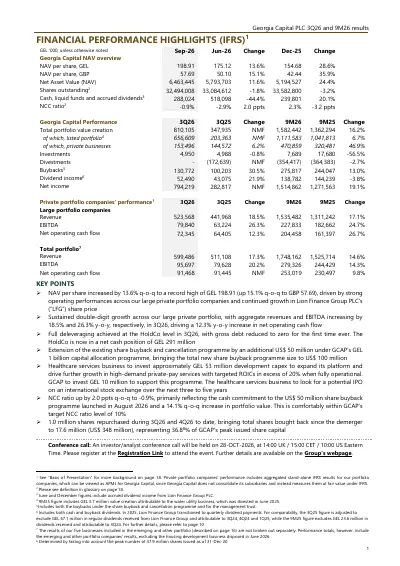
You see a great NAV performance, more than 13.6% Q-over-Q in Lari terms, and in in pound terms it's even greater at 15%. This is due to the appreciation of Lari.
We have a lot of pressure on Lari to appreciate as we have a huge FX inflows in the country, and then you see we will talk about the National Bank reserves growing. We have a very excellent growth in our private portfolio companies.
We have revenue grew 18.5%, and EBITDA grew 26.3% year-over-year. The operating cash flow also is growing nicely at 12.3% year-over-year.
We are I'm glad to report that we fully delevered. The HoldCo has a zero leverage right now as we speak.
We also announced the the new share buyback program of $50 million, this is this will bring the to $100 million under the new program. We we still see undervaluation on on GCAP stock.
We are trading at more than 25% NAV discount, we are happy to buy back more GCAP shares. We also announced the investment in our healthcare business.
We want to capture the lucrative parts of the business where the ROICs are 20% plus, and then we want to invest and grow and eventually our long-term vision is to to to relist this company because and we think that we will we will diversify further away from the state revenue and increase the share of the private revenue and generate a higher ROIC, especially on the back of the great performance by the management. We want to invest along with the high-performance management what we have and deliver superior return on invested capital.
NCC ratio you see we went to negative. It's first time in our history or we were before negative, I don't remember, but basically it's a it's a it's the lowest ever NCC NCC ratio.
We also the buyback program what we are doing in past 4 months we bought 1 million shares. We are happy to continue this buybacks.
Most pleasing is that nearly 37% of the GCAP share capital has been bought back in past years since inception, and we are really disciplined in our capital allocation strategy, and I'm really glad that we've been we kept this discipline in in all those years. Here is the movement in Q3 of our NAV per share.
Lion Finance Group was obviously the biggest contributor as share price rallied there, 11.3%, 2.4% we have private portfolio companies contributing, buybacks contributing 0.6, operating expense negative 0.2, and liquidity management, FX contributed negative 0.2, we ended up with 13.6% Q-over-Q NAV per share growth. Here on slide 5 we have the CAGR of since inception CAGR of the NAV per share, 21.4% over the inception since the inception, over more than eight years.
We have past five years 27%, past three years 37%. I think phenomenal track record of of the of GCAP, performance of NAV.
You see that in the beginning we were learning how to manage the investment company. We were fine-tuning our investment philosophy, and I think that we are on a on the right track now, and we are very laser-focused on allocating the capital and how we allocate the capital and how we want to allocate the capital in the future.
In US dollars and GBP terms the growth is even higher as as Lari has been appreciating over these years compared to the so-called strong currencies. On the 1 billion capital return program, you see that nearly 260 million Lari in total either is already committed or is has already been done, and for instance the repurchase and and cancellation of the shares, or we are on its way of doing it.
Therefore we are out of 740 million, sorry, out of 1 billion Lari around quarter is already either done or committed. I'm happy that we are progressing nicely.
Let me remind you that 1 billion Lari program runs until the end of 2029, it's a it's a long way to go. Hopefully we'll do this 1 billion capital allocation program earlier as always than the deadline of the end of 2029.
On next slide, slide 7, you have a share buyback how it was developing, and and you see the strong strong growth in in buybacks. We were at we started at around $36 million per annum, right now we are more than we will be probably close to $400 million this year in in buy- in share buybacks.
Now here's NCC ratio. We also restructured the company fully and delevered.
You see that we were at the peak we were at 42.7% of NCC ratio. We are were fully levered at HoldCo level.
Now we are negative, we have room for for for stepping up the capital allocations, investments in general. Here is the macro, which is important obviously in this equation.
The as you see the GDP growth is phenomenal. The seven sorry eight months GDP growth was 7.6%, last year was 7.7, year before was nearly 10, year before nearly 8, then 2022 11, it's a it's a huge growth of GDP per capita.
What I am very, really pleased that our current account deficit on the back of such a growth is shrinking. Our in first half our current account deficit shrank from 5.8% last year to 2.5.
Is it is it sustainable, or we have there are some one-offs, but over overall the current account deficit shrinkage is huge. You see in the in the FX reserves and interventions in Q3 $1.3 billion were bought back, in Q2 $1.6 billion.
Right now the National Bank reserves are are more than $8 billion, which is a all-time high. Now some aggregate results are also encouraging.
The Q2 we named it that that the growth is accelerating. In Q3 we thought what we are going to name this quarter.
I think it's acceleration doubled or acceleration squared. The growth is accelerating even in Q3.
You see that nine months EBITDA growth was under 25%, in Q3 EBITDA growth is 26%. Revenue is also growing.
Q3 revenue growth rate is higher than the nine months growth, is 18.5 versus 17.1, we are accelerating and accelerating. We are pleased with that, obviously.
Cash flow is also in a good shape. Q3 was not a big conversion.
We had a net operating cash flow only 12.3% growth, but over the nine months cash flow growth is higher than the EBITDA growth number. We had a 26.7% operating cash flow growth in nine months versus 24.7, 2 percentage point higher net operating cash flow growth in the in nine months.
That's also very very important metrics for us what we watch. Giorgi will talk about the new slide what we have right now, distributable capital, which is very interesting slide actually.
It shows us will show you how much cash our portfolio companies are generating which can be earmarked for the distribution. That's kind of a important new important KPI for our management.
Here is on slide 13 we have a leverage ratios for our portfolio companies. The pharmacy is under its kind of a cap of 1.5 times, it's a 0.8 times debt to EBITDA.
Healthcare services have been decreasing rapidly the leverage. Actually it was it's been increasing the EBITDA, and that's why it was decreasing the the leverage basically.
It's close to its three three times target, at 3.4 times. Insurance is obviously in negative territory.
It used some leverage to buy the Ardi, but it's it's retiring this debt pretty fast. Now I will let our CEO of our retail pharmacy business Tornike Nikolaishvili to talk about this great results.
I will switch off my camera before Tornike talks. Go ahead, Tornike.
Tornike Nikolaishvili
Thank you, Irakli, and hello everyone. I am pleased to walk you through a brief update on the performance of our retail pharmacy business for the third quarter and nine months of 2026, another quarter of strong momentum with solid results across our key financial and operating metrics.
Let me start with a few words about our business. In Georgia's retail pharmacy market, we hold around 34% market share in organized trade, based on 2024 figures.
Retail continues to be our core business, generating around 85% of total revenue. We operate two well-positioned pharmacy brands, GPC, focused on the high-end segment, and Pharmadepot, serving the mass market.
Alongside them, we run two franchise brands, The Body Shop and Alain Afflelou Optics, and have a presence in Armenia and Azerbaijan. In Q3 '26, we opened 12 new pharmacies, 10 in Georgia and 2 in Armenia, in strategically selected locations using cost-efficient formats that require limited capital investment.
As of September 2026, our network comprises of 476 pharmacies, 15 Body Shop, and 6 optic stores. Turning to performance, retail revenue increased by 16% year-over-year in Q3 and 13% in nine months.
The growth was driven by same-store revenue growth of 8.7 and 7.3% over the respective periods, which remained high even as we added 38 pharmacies over the past 12 months. The successful ramp-up of these new pharmacies also contributed to the strong performance of the retail business.
The revenue growth was further supported by 5% increase in the number of bills issued and 10% increase in average bill size, both in Q3. We see this as an encouraging trend as it reflects resilient consumer demand and solid execution at the store level.
In line with our strategic priorities, the wholesale business continued to expand, delivering revenue growth of 10% year-over-year in Q3 and 11% in nine months. The growth was mainly driven by an expanded product portfolio across distribution channels in Georgia, with gross profit of the distribution business increasing by 23% year-over-year in Q3.
In addition, we acquired a distributor of premium baby care brands for GEL 6 million in Q3 at an implied EV/EBITDA multiple of 3.5 times, strengthening our position in the mother and baby category and further expanding the wholesale platform. We also continued to expand our presence in Armenia, where total revenue increased by 42% year-over-year, reaching GEL 10 million in Q3 and growth of 35% to GEL 26 million in nine months '26.
This growth was driven by continued network expansion and the strengthening of the retail brand, alongside a broader wholesale product offering and higher revenue from state tenders. Turning to profitability of the overall business, alongside our revenue growth, we continue to deliver consistent gross profit margin improvement year-over-year, reaching 35.4% in Q3, up by 2 percentage points, and 34.5% in nine months, up by 1.7%, reflecting the initiatives we have undertaken to shift our sales mix toward higher-margin products and to secure improved supplier terms.
Moving to the next slide, let's see how this translated into very strong financial results marked by significant EBITDA growth and solid balance sheet position. Enhanced profitability translated into 34% year-over-year EBITDA growth in Q3 '26, alongside an EBITDA expansion by 1.8%, reaching to the 12.7% margin.
For nine months '26, EBITDA amounted to GEL 93 million, up by 26% year-over-year. On the cash side, EBITDA to cash conversion stood at 63% in Q3 and 87% in nine months.
This reflects the strong momentum in our revenue growth, which accelerated in the second half of the year, as well as our continued investment in building a higher-margin portfolio through new product launches and growing share of directly imported products in total sales. Together, EBITDA growth and cash generation kept our leverage position comfortable, with adjusted net debt to LTM EBITDA at 0.8 times as of September '26, down from 1.3 times at the end of last year and well below our target level of 1.5 times.
We also distributed GEL 15 million in dividends in the third quarter, bringing the nine months total to GEL 27 million, up from 20 million in the same period last year. Let me close with key takeaways on the final slide.
First, we are delivering sustained top-line growth, supported by same-store revenue growth and solid wholesale performance. Second, we are steadily enhancing profitability and delivering significant gross profit and EBITDA growth through margin expansion and consistent execution.
Third, we are maintaining a prudent level of leverage, supported by robust business performance and cash generation, which gives us flexibility for future investments and potential shareholder returns. Thank you all.
I look forward to your questions during the Q&A, and now I will hand over to Irakli Gogia.
Irakli Gogia
Thank you, Tornike, and good afternoon, everyone. I am pleased to share the results of another strong quarter.
Revenue was up 16%, while EBITDA grew 22% to GEL 26 million. EBITDA margin improved by 1 percentage point to 19.4%.
Cash generation was also strong. Operating cash flow more than doubled to GEL 25 million, with EBITDA to cash conversion of 95% in Q3.
We continue to strengthen our clinical teams and service offerings across the network. Our outpatient care once again was a key growth driver this quarter.
Net revenue from outpatient services grew 23%, supported by the fully renovated and expanded outpatient department at our largest hospital, which we opened in June. Outpatient services now account 48% of our net revenue, slightly up from 46% a year ago.
We continue to strengthen our clinical teams, onboarding new doctors across the network, with a particular focus on our in vitro fertilization direction, where we are building a strong team of reproductive medicine specialists. This quarter we launched our nursing program co-funded by USAID, which is a key part of how we develop the next generation of medical staff for our network, supporting their professional growth while building a strong pipeline of clinical talent for the long term.
Our polyclinics and diagnostics segment opened a new clinic in Tbilisi to meet growing demand, bringing the network to 17 clinics, with further growth planned. To capture growth opportunities ahead, we plan to invest 53 million GEL in capital expenditures over the next three years.
This investment will be directed at further expanding our outpatient services and scaling up our IVF direction, which is one of the fastest-growing healthcare segments in the country, and we see strong long-term potential in this area. Let's turn to our hospitals business slide.
Revenue grew by 15% and EBITDA by 22%, with the margin improving by 1.1 percentage points to 18.8%. Growth was supported by the expansion of outpatient services, which increased by 23%.
Operating cash flow was particularly strong, up 157% to GEL 21 million, with an EBITDA to cash conversion ratio 103% as state collections started to catch up. Moving to the next slide, in our polyclinics business, admissions increased by 11% and accelerated from the 6% growth we had in second quarter, while revenue and EBITDA grew by 16 and 18% respectively.
In diagnostics business, revenue grew by 25% on the back of 6.5% increase in number of tests performed, while EBITDA grew by 36%. This was driven by our continued focus on retail, the main profitability driver of this division, where revenue rose by an impressive 86%.
On a combined basis, polyclinics and diagnostics segment revenue rose 19% and EBITDA 23%, with the margin up by 0.7 percentage points to 20.5%. Moving on to our summary slide, we delivered strong top-line growth across all segments.
Cash generation was particularly strong as well. Looking ahead, our planned investment of 53 million GEL over the next three years will further strengthen our outpatient and IVF directions.
Alongside the financial results, we continued to build the long-term strength of the network, adding new services, investing in advanced equipment, and attracting top specialists. That concludes the healthcare side.
Now I will hand over to Giorgi who will take you through the results of the insurance business. Thank you.
Giorgi Baratashvili
Hello, ladies and gentlemen. I will overview the insurance business today.
Just a quick update that we divide our business in two main directions, it's property and casualty and medical. We had an outstanding Q3, and we are increasing our revenues and profitabilities continuously in Q3 also.
Our insurance revenues grew by 30% in Q3, and nine months over nine months it's the same as it was the same growth for 30%. Our profits grew by 19% in Q3 and 29% by nine months over nine months.
Just a quick reminder that we had a severe hailstorm in Q2 in our that affected our P&C ratio, taking it out, the growth would be 36% nine months over nine months. Our key operating metrics remained very strong.
Our net premium grew by 16% in Q3 and 15% over year-over-year in P&C. We had a renaissance, I would say, for the medical line.
We had 40% increase in Q3 and 58% year-over-year in our medical insurance. Total net premium grew by 25% in Q3 and 40% year-over-year nine months.
Let's deep dive in into in each business line. Moving to P&C, our P&C line shows an amazing performance.
We have a market share growth by 1 point, and it reached 36%. Our insurance revenues grew by 12% in Q3 and nine months over nine months grew by 12%.
Mainly the increase was driven by few factors. It's the expansion of our retail portfolio and the combine and the motor and and and the corporate corporate motor portfolio alongside with the higher prices, an update pricing strategy, plus the property plus the increase of the property portfolio revenue driven by expansion of our corporate segment, mainly in the corporate, plus the increase of the of the double-digit double-digit increase and segmentation in the in in the motor.
Lastly, we had a really good effect in our credit life insurance in Q3. In terms of profitability, we had a 12% growth in Q3 and 8% year-over-year.
Again, excluding the hailstorm in Q2, the nine months growth would have been 20%, we look at this as an abnormal event, we are showing you also the the the profitability growth and and and the metric without without the severe hailstorm. We paid more than 6 million in dividends in Q3 and 18 almost 18 million in nine months to GCAP.
Our key operating metrics remained very strong and healthy in P&C. Our net premium grew by 16% Q-over-Q and 15% year-over-year for nine months.
Our combined ratios remain still very strong and healthy, at 83%, that's in line with our medium-term strategy, and it's 83% year-over-year. Just to exclude the hailstorm in here also, we have an improvement of 1.1% in the combined ratio, bringing it down to 80 84%, 83.8% in nine months.
We have a very good performance in terms of the insureds. We have 10% growth in number of insureds in Q3 and the same number for the nine months.
Our number of written policies grew even more, by 14% in Q3 and 15% year-over-year, and we have a highest renewal ratio ever historically, at 81.5% in Q3 and more than 80% in in in in nine months. Going to medical insurance, as I said, we have a renaissance in medical insurance.
We have a 13% market growth in in medical insurance, and our market share in medical insurance reached 46%, with a 48% growth in Q3 in medical insurance and 45% in nine months. Mainly there are two components.
It was one of the component is the the state tenders that we secured with updated and updates pricing and higher margins, plus the growth in the retail health insurance that we launched lately and pushing in line with our retail strategy, and plus plus the policy pricing, double-digit policy growth in nine months in through all all all all segments of the of the health insurance. Going down to profitability, health medical insurance in Q3 showed amazing amazing growth in profitability, plus 31% Q3 over Q3 and 68% year-over-year nine months.
Key operating metrics remained very strong. In terms of the net premiums, net premiums in Q3 we had 30% increase in Q3 and almost 60% year-over-year.
Combined ratios still very healthy, at 91.7%, and still and and it's the same in for the for the whole year, for the nine months. We have 2.3% 2.3% improvement in combined ratio.
This is mainly driven by reflects lower loss ratio due to the robust revenue, it means with the with the same almost same operating costs, we're serving more revenue, and that's very very positive momentum. Few points about the findings about the medical insurance, about the medical insurance we about the medical Yeah, we have a serious growth in the as I said, in the retail, plus 40% in in in Q3 and 51% in nine months.
New mandatory line for the inward travelers was launched that contributes and diversifies our profitability in the medical insurance with the low severity. We have a double-digit growth in in terms of the pricing for the ticket size of the corporate health insurance policies, and I said we had with the updated pricing and and the updated underwriting.
We have a almost 70 million revenue in terms of the in in in our medical portfolio. Few things to remember about Q3 from our insurance business: we had a robust financial performance with 30% increase Q-over-Q and 19% growth in terms of the in terms of the profit, supported by strong contributions from both insurance lines.
Our P&C insurance business remains to be still very resilient and prudent to to in Q3 with the growth of 12% Q-over-Q, while disciplined underwriting and then the strong pricing continued to support our strong profitability. As I said, we are we have we are envisaging enormous performance, very good performance from our medical insurance line, with a 40% increase growth in the health retail insurance revenues, contributing to 31% year-over-year growth in in in Q3 in terms of the profitability.
We paid 1.8 million to dividends in in Q3 to GCAP, that comprised almost 20 million already paid dividends in nine months 2026. This is I will end with the insurance overview and pass the pass the floor to Giorgi to continue.
Thank you very much.
Giorgi Alpaidze
Thank you, Giorgi. Hello, everyone.
I will quickly take you through the portfolio valuations for the third quarter before we look at the new slide where we present the distributable capital generation by our portfolio companies towards the end. Starting with the breakdown of our portfolio values in the third quarter, as you probably know, we do valuations in-house based on the similar methodology and same principles applied as what our independent third-party valuation company applies every six months.
As we performed these valuations for the private portfolio companies, you can see the new values here. The multiples remained broadly stable, we will look at that later, but in general, Lion Finance Group had a very strong quarter, a remarkable close to 27% growth of the share price that resulted, as our shares broadly remained unchanged in Lion Finance Group in the third quarter, this resulted in the share of the Lion Finance Group growing to 51% of our portfolio value, gross portfolio value, at the end of the quarter, which was slightly up from the 47% that we had at the end of the second quarter.
Private portfolio companies across the board, including in the emerging and the other businesses, performed strongly, and they continue to be around 49% of our portfolio, with the retail pharmacy being the largest private portfolio company within our portfolio. On the next slide you see how the valuation multiples have changed during the quarter, and they have not materially changed.
They remained broadly similar to where they were at the end of six months. Most of the value creation that happened in the private businesses, which you see on the next slide, actually came from the growth in the EBITDA and the cash generation that resulted in lower net debt and the debt paydowns.
On the next slide you see how the portfolio value increased during the quarter. Lion Finance Group generated 657 million Lari valuation gains for us in the quarter, of which around 26 was realized in terms of the dividends or in terms of the participation in LFG's buybacks.
On the private side, the value creation was 153 million Lari, which translates roughly to 5% plus of the private portfolio value. We generated 5% plus in a single quarter within our private portfolio businesses.
Most of the value creation came from a very strong set of results that you saw from the retail pharmacy earlier, while healthcare services and the insurance also demonstrated strong performance and provided almost equal 35 to 40 million Lari value creation in the quarter. At the end, we had the portfolio value that was record high of 6.2 billion Lari at the end of the third quarter.
This summarizes our portfolio changes and how our portfolio increased by close to 800 million Lari in the third quarter. Now, as we move to the next slide, here you see for each individual business what were the valuation drivers, and as I said earlier, it was primarily the growth in the EBITDAs across retail pharmacy, healthcare services, and the insurance businesses.
They were the key drivers of the value creation, and on top it was the dividend payments or improvements in the net debt. As you saw, retail pharmacy business paid us 15 million Lari dividends, and the insurance business paid us 8 million Lari.
Across the board, this value creation was very sort of tangible and realized. Now we can move to the liquidity and the debt profile of Georgia Capital, and this is the first quarter where we are reporting no debt at the HoldCo level, as we previously announced we paid down our remaining $50 million debt during August, at the end of the quarter we had no debt.
On this slide you can see our journey from $365 million debt at the end of 2021 down to zero within five-year period, actually slightly less than a five-year period. We continue to have a strong liquidity, $111 million of liquid funds at the end of the September, and that follows the change from June after we paid that $50 million debt, which in fact was closer to 52 with the accrued coupon and the small premium that we had to pay on the call, and also the buybacks, close to $50 million buybacks that we did during the quarters.
We continue to have a very strong liquidity. Now we can move into the dividend income outlook, and this is an important slide.
As we go into the next slide, you see that dividends continue to come in, and they continue to be very strong. For the nine months, we generated 139 million Lari, and we continue to expect that for the full year dividends will be in 200 million Lari area.
One key thing to note here is as our portfolio companies are paying us dividends, especially in the retail pharmacy and the insurance space, on top they're paying down the debt. To give you a full picture of what is their capacity to distribute capital, on the next slide we present this new slide that provides a power that these businesses have to distribute capital to Georgia Capital in the future.
For the first nine months in the retail pharmacy business, you see that from the annual cash flow generation, post interest expense, post regular capex, how much cash there is left to pay dividends, to service debt, and to complete M&A using their own free cash flow generation. In this case that was 58 million Lari, and that was an increase of 36.6% 36.6% over the last year.
What this number also indicates is there is a very strong cash flow generation growth in the business, which here, with our approval, part of the cash was used to pay down the debt, the principal debt. In the future, as this business and the insurance business operate below the set leverage targets from our perspective, they will be able to pay these dividends to Georgia Capital.
With that in mind, we wanted to show you the full picture where you can measure this distributable capital across the large portfolio businesses. In the insurance, we had a similar, slightly higher growth of 38% because they continue to have very strong growth momentum that also translates into the cash generation and to the distributable capital generation.
Within the healthcare services space, in 2026 we don't expect them to have a distributable capital generation as this business is fully reinvesting for the growth, and this is something that we had communicated in the past, but from the next year, we do expect that they will be able to generate small, but distributable capital in 2027. Overall, you can see that even though we received dividends from the private portfolio businesses, and roughly 53 million Lari, their ability to pay us the dividends was in fact 88 million Lari.
This is the new metric that we think will be useful for the investors to look at going forward. We look at this internally, but we wanted to share this and bring it to your attention as well.
With that, I will hand it over back to Irakli for the wrap-up, and yep.
Irakli Gilauri
Thank you, Giorgi. To wrap up, basically NAV is strong, growing strong, and operating performance of the companies are accelerating.
We've fully delevered the HoldCo. We introduced another $50 million buyback program.
Total buyback numbers look impressive. We see a deleveraging bringing the NCC ratio to negative territory.
Economy is strong, we expect the operating performance to be strong going forward in foreseeable future. Let's move to Q&A session now, and please raise your hand or send Q&A through chat.
Anano Akhobadze
Thank you, Irakli. We have some incoming questions.
First, we have some participants who have raised their hands. Dmitry Vlasov wants to have some questions.
Dmitry, you can...
Dmitry Vlasov
Thank you very much. Congrats on strong set of results.
I have a few questions, please. The first one is on the potential IPO of healthcare business.
Which operating and financial milestones would you like to achieve before you believe the business will be ready for IPO? Particularly curious how much deleveraging is needed and which enterprise value you will be comfortable with before doing an IPO.
That's the first question. The second one is, beyond the potential healthcare IPO, which other private businesses are closest to exit?
The final one about Armenian pharmacy business. Congrats on very strong growth there.
My question is how much of that growth came from existing operations versus network expansion, and also what's the actual potential and in a way that how consolidated is Armenian pharmacy market, how many players are there, how fast the market grows in comparison to Georgia would be very curious. Thank you very much.
Irakli Gilauri
Thank you, Dmitry. Last question I'll let Tornike to answer.
On first two questions, basically we just on the IPO thing, it's too early to say obviously because we just wanted to flag the exit route which we are considering for the healthcare business because this in conjunction of the investments. Right now our thinking is on healthcare is to invest in highly ROIC-accretive business because there are a lot of good opportunities in private healthcare sector and diversify away from the government dependency and we see that we can grow it, and the exit route we consider as an IPO in we said three to five years' time.
We are looking at close to $100 million of EBITDA mark, maybe $80 million to $100 million EBITDA mark. That's where we would consider the listing the company.
Which thing that we will achieve is between three to five years. There could be some M&As not only in Georgia, but also Armenia and maybe other countries as well, what we are looking the opportunities basically.
What exits we consider for the large portfolio companies. Trades exit is always a good opportunity, but I think that we are not anywhere close on the exiting the insurance or retail business, and we are not considering, but if the good offer comes, we always consider obviously for trade sale.
That's kind of a for us exit is a usual, it's a bread and butter thing, we don't have a plan now to sell either of insurance or pharmacy or healthcare. Basically we have an exit route for the healthcare because we are investing now.
We want to step up investment in high-ROIC businesses in healthcare. That's why we showed you the exit route what we are considering.
We shared our thoughts on the exit route. Tornike, maybe you will answer questions about the network expansion in Armenia and opportunities, etc.
Don't say everything. [laughter]
Tornike Nikolaishvili
Thank you. Thank you for the question.
I would say that if we split the growth, with the existing infrastructure, including the existing outlets, including the developments in the wholesale business with the new brands, and also including the tenders we won, government tenders, it is a 75% of the growth, and 25% of the growth comes on the new open outlets and new infrastructure, including the Afflelou, our new Afflelou optic store in Armenia.
Irakli Gilauri
The question was also about the market structure and what your thoughts are on market.
Tornike Nikolaishvili
I would say that market is not mature. We believe that market will grow, and for us it's important to scale up in Armenian market.
Irakli Gilauri
There you go, Dmitri.
Dmitry Vlasov
Thank you very much. Very clear.
Maybe one quick follow-up on the Armenia pharmacy. How profitability compared to Georgian business in terms of gross margin, blending?
Tornike Nikolaishvili
Gross margin, in our case it's close to the Georgia. I would say that it is around 32% in retail, while we have around 35% in Georgia.
Because our mix is towards the parapharmacy, non-medication. In general on the market, Armenian market margins are lower than in Georgian market.
Dmitry Vlasov
Thank you very much.
Irakli Gilauri
Mainly because more expensive cost of goods sold in Armenia than in Georgia.
Tornike Nikolaishvili
Yes, and back margin and the power of the brand owners are much stronger than in Georgia.
Anano Akhobadze
Thank you, Dmitry, for the interesting questions. Next up, we have Ben Maher, who has questions.
Now, Ben, you can talk.
Ben Maher
Hi, can you hear me?
Irakli Gilauri
Hi, Ben.
Ben Maher
Hi. I just have two questions.
The first is on buybacks. Obviously with strong share price performance, the ROI on buybacks must be declining.
The fact that you're expanding, does this mean you're struggling to find M&A targets that offer better returns, or you just being patient? With the Armenian elections now behind us and you got no more debt at the HoldCo, should we expect greater activity in this area going forward?
Are there any sectors that you're particularly optimistic about? Sounds like Armenian pharmacies is one obvious one.
Then my second question is just on the dividend income outlook. I think Giorgi touched on it on the slide 36.
Obviously with the net debt to EBITDA of the private portfolio at record lows, this suggests that the dividend upstreaming potential of the private portfolio is only going to increase from here. Maybe it's too early to give hard numbers for 2027 dividend income, but just any kind of color around future outlook, that would be useful.
Thank you.
Irakli Gilauri
Thanks, Ben. About buybacks, basically I think that we look at buybacks not only on the discount, but also the growth outlook.
Discount is 25%, but growth outlook is 35%, then we are buying still very cheaply. I think that that's kind of our approach in buybacks.
We are not buying because 25% discount only. Another thing is that on the investments, I understand that it's exciting to make new investments, but for us the discipline is very, very important.
We guide you where we are looking at in terms of the market, etc., but I don't want to create the pressure that we have to invest. We don't have to invest.
The beauty of this Georgia Capital structure is that we are not private equity fund which has to invest in order to earn the fees for the managers. We don't have to invest, and I don't want to create the pressure of investment, and everybody's thinking that if we don't invest, we die.
We don't die. We continue of buying back shares cheaply, right now what we are doing, and we're buying very cheaply.
If we go into the premium, we may not buy, and we may not invest either. We are looking at good opportunities in Georgia, in Armenia.
Team is working very hard to look at the opportunities, but we do not want to be under pressure of investing. We don't.
Analysts are creating this pressure, and my job is to disseminate the pressure. The dividend income going forward, Giorgi, please show up on the screens, but for us we see a lot of deleveraging of our portfolio companies is happening, and dividends will be increased.
We showed you the dividend capacity, distributable capital. Maybe we need to show that slide again.
We cannot tell you the hard numbers right now, but we expect strong growth next year from our private portfolio companies in terms of dividend payments, because of deleveraging plus because the healthcare group will be also in position of paying the dividends, small one, but it will step up. Giorgi, please add.
Giorgi Alpaidze
Yes, 100% agreed. If you look at that distributable capital slide again, you will see that the large portfolio companies paid 53 million Lari dividends, and they paid down debt or made M&A acquisitions worth around 35 million Lari.
This 35 can easily become dividends paid to Georgia Capital next year or the year after. We do expect the growth in the dividend inflows.
This year we expect 200 million Lari. Next year we expect double-digit growth in terms of the percentage of the dividend income in 2027.
We will give you more accurate number when we publish the fourth quarter results because we are going through the next year budgets with the portfolio companies at the moment, but it will be in excess of 220 million Lari for the next year.
Ben Maher
Great, very helpful. Thank you.
Irakli Gilauri
Thanks, Ben. Now
Anano Akhobadze
Milosz has a question. Milosz, you can go ahead.
Milosz Papst
Yes, hi. Milosz Papst from Edison Group.
Congratulations on a strong set of results. I have a couple of questions.
Thank you for taking my questions. I would like to start with the cash conversion of the retail pharma and healthcare services business.
Let's maybe start with...
Irakli Gilauri
Pharma? Which one, sorry?
Milosz Papst
Healthcare services.
Irakli Gilauri
Healthcare services, okay.
Milosz Papst
Yeah. Let's maybe start with retail pharma.
Obviously you've highlighted that the cash conversion was somewhat impacted by, well, the overall expansion, and the investments in higher-margin products. I think the cash conversion was closer to 60, sorry, what was it, was it 63 or something around that?
Irakli Gilauri
Are you looking at quarter, or you're looking nine months?
Milosz Papst
Yes, just the quarter, 63.5.
Irakli Gilauri
I think you should look for the quarter. It's cash completely.
How does nine months look for you?
Milosz Papst
Yeah. Nine months of course 87%.
I just wanted to understand if it's a sensible annual run rate, let's say, you expect for the business. A similar question for the healthcare services business, right, where of course Q3 cash conversion was pretty strong, but this was because of the collection of delayed payments and there are still some outstanding.
Again, what would be a sensible assumption in terms of the cash conversion on an annualized basis? Is it already approaching your mid-term target of 85, at least 85%?
Irakli Gilauri
Irakli, can you...
Irakli Gogia
Hello. Thanks for the question.
In healthcare business, the Q3 cash conversion was close to 100%, but EBITDA to cash conversion and plus growth, it should be around 100%. If the growth is 15%, then the cash conversion should be 85.
It's a general assumption going forward.
Milosz Papst
Perfect.
Irakli Gilauri
Tornike, maybe you talk about the pharmacy cash conversion.
Tornike Nikolaishvili
Thank you for the question. Let me agree with Irakli's comment about the quarter, because it doesn't give us the picture for the whole year as we're having some shifts from quarter to quarter, mainly in payments.
It's the main reason for the quarter three. Still, let me say two things.
It's a acceleration of growth, together with the new launches, new brands, exclusive brands which are driving mix to the higher gross profit margin, and both, let's say, things, what I have described, needs extra additional investment in working capital. Let me give you a understanding for our expectations of the 2026 year-end.
It will be around 90% cash conversion.
Milosz Papst
Perfect. Thank you.
Okay. Then my final question would be on the expansion capex in the healthcare services business, right?
You said that 10 million will be provided by the holding company and 43 million Lari by the company itself. Presume based on your comment that you expect some distributable income from healthcare services from the next year, I presume that most of this expansion capex will be funded by operating cash flow.
Would you expect any moderate, incremental debt or should it be covered by...
Giorgi Alpaidze
Milosz, I think one thing you need to keep in mind is this is the investment that will happen over three years, this is not immediate. This will be phased in over the next three years, and we do expect that they will have sufficient cash on the balance sheet to cover it.
If they don't, then they might temporarily borrow from the lenders, but we think over the three years they will have enough cash generation.
Milosz Papst
Excellent. Thank you.
Giorgi Alpaidze
Thank you.
Irakli Gogia
Thanks.
Anano Akhobadze
Thanks, Milosz. We have also a question coming from Melker Samuelsson.
Melker, you can ask the question.
Melker Samuelsson
Hello, good afternoon. Congratulations to another strong set of numbers.
First, I wanted to ask quickly on the insurance businesses, how you think about maybe over the next few years more stabilized or normalized loss and combined ratios in both of the businesses. Obviously the medical side was partly impacted by the mix of state tenders, and on the P&C side there seems also to be a mix effect with maybe more motor and property, and how you think that sort of mix effect is going to influence the loss and combined ratios on both business lines.
Giorgi Baratashvili
Giorgi, I'll take the question. Thanks for the question.
Historically and going forward, our appetite is from 83 to 85% in terms of the P&C, supported by the balance reinsurance. We are in line in our medium-term combined ratios of 85.
Going down the road for few years, we'll looking to be in the range of 85% in terms of the P&C. As far for the health insurance, we are somewhere in 90 92%, even though in nine months in Q3 we had a little bit deterioration in medical for the combined, in terms of the nine months we had 1.1% improvement in.
Is in line with our budget, and it stabilized. I don't they are big fluctuations going down the road or looking historically for last five years.
Melker Samuelsson
Perfect. Thank you very much.
Maybe secondly, if I may quickly, you've now come to no-leverage position. How do you think about this?
Are you maybe, of course you hinted that you don't want to be pressured to invest, but are you considering alternative investments or increasing buybacks further or potentially revisiting your leverage targets?
Irakli Gilauri
No, I think our leverage targets are good. We are comfortable with 10% NCC ratio, but basically we'll go along.
We have this 1 billion Lari program, and in next couple of years we will be fulfilling this 1 billion Lari program. We'll see.
We may need to raise some debt for the acquisitions. We may or may not, and we would need to know how to retire this debt.
We want to have a flexibility in terms of the borrowing. We don't want to be fully delevered all the time.
For the acquisitions we may borrow some, but go towards the 10% area of NCC ratio, and then we retire that debt. That's how we want to move there, but basically as I said, we have a guidance for you how much capital will be returning till the end of 2029.
This includes the investments, this includes the buybacks, no more deleveraging now, but basically I think our investment philosophy or capital allocation philosophy is very clear, and our track record of being allocating capital in our framework of buying something which is better than the GCAP is very important. If we cannot buy better than GCAP, we buy GCAP.
Far we buy GCAP. Basically that's where we are.
Good thing, alongside we have a very strong operating performance of our private portfolio companies. Distributable capital is increasing and will increase significantly over the next year and next years basically.
We are in a comfortable position to be.
Melker Samuelsson
Great. Thank you.
Irakli Gilauri
Thanks.
Anano Akhobadze
Thanks, Melker. We have two more questions in the question and answer panel from Anton Berg.
First one relates to the dividend outlook for 2027, which we covered, I'm going to go to the second one: Can you please share the long-term opportunity for the retail pharma business in Armenia?
Irakli Gilauri
I think we covered that one a little, but Tornike, you want to talk about that, but basically for retail pharmacy we are looking for the acquisitions in Armenia, and that's how we want to expand. If not, we will be continuing expanding organically.
We like that market. We think that the market is underpenetrated, and we want to do more business there for sure.
Tornike, you want to add something?
Tornike Nikolaishvili
I fully agree.
Irakli Gilauri
Yeah. I think that I don't have any more questions.
Anano Akhobadze
No, we do not have any incoming questions as of now.
Irakli Gilauri
Very good. Thanks everybody.
Stay tuned, and very much looking forward to annual results to present you in February. Thank you.