Grandstand Limited
Q1 FY2026 · Earnings Call TranscriptMay 14, 2026
Operator
Good afternoon, ladies and gentlemen, and welcome to Gambling.com Group's First Quarter 2026 Earnings Conference Call. During the call, your lines will remain in a listen-only mode.
After the speakers' remarks, there will be a question-and-answer session. I would like to advise all parties that this conference call is being recorded.
Now I will turn things over to Peter McGough, the Senior VP of Investor Relations and Capital Markets. Thank you, and you may proceed, Peter.
Peter McGough
Good afternoon. Hello, everyone, and welcome to Gambling.com Group's First Quarter 2026 results call.
I'm Peter McGough, Senior VP of Investor Relations and Capital Markets, and I am joined by Kevin McCrystle, Co-Founder and incoming Chief Executive Officer; Charles Gillespie, Gambling.com Group's Co-Founder and current Chief Executive Officer; and Elias Mark, Chief Financial Officer. This call is being webcast live through the Investor Relations section of our website at gdcgroup.com/investors, and a downloadable version of the presentation is available there as well.
A webcast replay will be available on the website after the conclusion of this call. You may also contact Investor Relations support by emailing [email protected].
I would like to remind you that the information contained in this conference call, including any financial and related guidance to be provided, consists of forward-looking statements as defined by securities laws. These statements are based on information currently available to us and involve risks and uncertainties that could cause actual future results, performance, and business prospects and opportunities to differ materially from those expressed in or implied by these statements.
Some important factors that could cause such differences are discussed in the Risk Factors section of Gambling.com Group's filings with the Securities and Exchange Commission. Forward-looking statements speak only as to the date the statements are made, and the company assumes no obligation to update forward-looking statements to reflect actual results, changes in assumptions, or changes in other factors affecting forward-looking information, except to the extent required by applicable securities laws.
During the call, there will also be a discussion of non-IFRS financial measures. Description of these non-IFRS financial measures is included in the press release issued earlier this morning, and reconciliations of these non-IFRS financial measures to their most directly comparable IFRS measures are included in the appendix to the presentation and press release, both of which are available in the Investors tab of our website.
I'll now turn the call over to Kevin.
Kevin McCrystle
Good afternoon, everyone, and thank you for joining our 2026 first quarter conference call. Given that I will be formally taking over as CEO next week, I will also lead the call today.
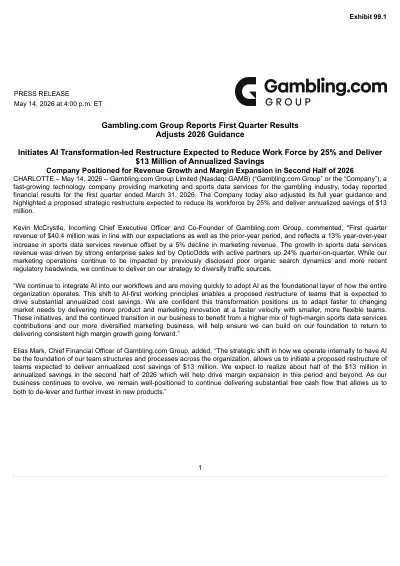
Elias will follow with a review of the first quarter results, and then Charles will offer some closing comments before we open it up for questions. First quarter revenue was $40.4 million, in line with last year, while adjusted EBITDA was $9 million.
Our sports data services business grew 13% year-over-year to $11.2 million and accounted for 28% of total revenue, the highest percentage yet. This growth was offset by a 5% revenue decline in our marketing business, which continues to be impacted by the previously discussed challenges with search rankings, as well as more recent regulatory headwinds we highlighted on our Q4 call.
Elias will provide more details on our first quarter financial results, but I do want to highlight that we generated attractive adjusted free cash flow in Q1 and expect revenue, adjusted EBITDA, and free cash flow to expand in the second half of the year. As I noted, sports data services revenue was up 13% year-over-year.
The year-on-year growth primarily reflects continued improvement on the enterprise side of the business, catching up to the consumer side. For the first time, revenue contributions were roughly equal for both offerings.
Our B2B OpticOdds business continues to be the catalyst of our strong sports data services performance. OpticOdds growth in Q1 was driven by 94% new deal growth compared to Q1 '25, including international partners up 178% year-over-year.
Total active partners were up 24% quarter-on-quarter. 86% of OpticOdds customers are now API customers rather than just traditional odds screen partners, which was the initial focus of the business.
A key driver of our ability to have the most innovative sports data enterprise solutions is our increasing integration with customer AI touchpoints. As an example, OpticOdds now has an MCP integration into Claude, allowing our enterprise customers to use Optic's data where they are already spending their workday.
By integrating with the number one enterprise AI tool in the world, our already incredibly sticky enterprise odds product is even stickier. More recently, OpticOdds entered into a partnership with Perplexity to be the odds data provider across their product suite, with an expected launch date before the end of Q2.
Turning now to our marketing business, revenue of $29.2 million in Q1 reflects the negative SEO trends we have been discussing for several quarters. There has been some bifurcation between smaller niche sites and larger brands within SEO, as some of our larger brands, such as RotoWire, are showing more positive rankings.
We are continuing to focus on a more concentrated portfolio of brands and diversifying revenue streams, marketing channels, and CRM re-engagement on these larger brands. There are two other impacts on the marketing business to call out.
First, the change in UK and Finland regulation we highlighted on the Q4 call had a modestly worse than expected impact on performance in Q1. Revenue from revenue share agreements was impacted by unfavorable outcomes in the quarter, causing a decline in the rev share hold percentage versus deposit.
We continue to make steady progress diversifying our marketing revenue away from SEO. In Q1, our non-SEO revenue exceeded SEO revenue for the second consecutive quarter, and we expect that trend to continue.
There's a near-term margin impact as these channels scale, but we do expect margins to begin gradually expanding in the second half of 2026 and into 2027. We've spent years building internal platforms to optimize engagement and monetization across our portfolio.
This audience monetization platform bundles our ad tech, bet tech, business intelligence, data. Over the past year, we have begun leveraging these tools and technology to help us more effectively monetize third-party audiences by allowing external partners to access our wide range of technology, commercial relationships, and know-how.
In a rapidly evolving digital ecosystem, we are diversifying how we market our owned and operated brands, but also developing a platform to engage and monetize users across a wide variety of partner assets and communities. Previous iterations of what we then called media partnerships had a narrower focus on SEO.
Partnership platform revenue was up 3x year-over-year for Q1. As part of our channel diversification initiative, this does have an impact on our cost of sales, but we can scale this platform with low opex requirements.
As we continue the R&D efforts to expand our technology capabilities on internal portfolio, it will open up new types of partners where we can leverage our technology to grow their business as we both share in the revenue. We've been focused on AI adoption for the past 18 months.
The work so far has proven the effectiveness of AI-first agentic workflows. Now we're taking the next step: moving from AI assisting our teams to making AI the foundational layer of how the entire organization operates.
That shift is significant, and it's driving real change in how we work. AI tools allow us to move faster, adapt more quickly, and deliver more product, marketing, and sales innovation, all while doing so with smaller, nimbler teams focused on building.
This way of working puts premium on human agency, with our people bringing their expertise and craft to direct what AI produces. We've already made significant progress, with 80% of new code being generated by AI today.
Alongside this, we are resetting our team structures, roles, and processes to fit an AI-first world. That means embracing context layers, skills, and agents across the company.
The result is a flatter organization, fewer management layers, and everyone from senior leadership down focused on building automations, products, and go-to-market campaigns that compress timelines and drive efficient growth. We're confident this transition to AI-first ways of working will allow us to move faster and with fewer people.
Highlighted in this afternoon's press release, we have proposed a strategic restructuring, which is expected to effect a reduction of approximately 25% of our workforce. The annualized savings will be approximately $13 million.
Given the timing of this streamlining of the organization, we expect that half of this amount will be realized this year, beginning in Q3, with the full amount realized in 2027. The $13 million of annualized savings is net of an increase in AI usage costs associated with our transition to an AI-first company.
This restructure resets the organization toward more effectively in an AI-first environment. With that, I'll turn the call over to Elias for a review of our Q1 financial results and detail our guidance for the year.
Elias Mark
Thank you, Kevin. First quarter revenue of $40.4 million was flat year-over-year and in line with expectations, with continued strong growth in data services of 13% offsetting a 5% decline in marketing services.
Data revenue was 28% of total revenue in the quarter, the highest proportion yet. Total recurring revenue, including subscription revenue and revenue share arrangements, was 49% of total revenue.
The 13% year-over-year growth in data services was driven by growth in enterprise services that, for the first time, was roughly of equal size with consumer data services. The 5% year-over-year decline in marketing revenue was driven by a continued impact from low-quality search results and the regulatory headwinds in the UK and Finland that were discussed on the fourth quarter call.
The proportion of revenue from traffic sources other than organic search was well over 50% and a bit higher than forecasted in the quarter, leading to increased resiliency, but lower contribution margins from marketing. As we continue to execute on the traffic diversification strategy for the marketing business, cost of sales grew year-over-year from $2.2 million to $6.1 million, and as a result, gross profit declined 11% to $34.4 million.
Gross profit margin was 85%, consistent with the fourth quarter and comparing to 94% in the year-ago period. Operating expenses, exclusive of non-cash amortization of acquired intangible assets, transaction bonuses, and other non-recurring costs, grew 12% year-over-year to $28.2 million, primarily driven by higher external marketing expenses related to traffic diversification strategies and higher subscription costs from increased AI usage.
Total headcount at the end of the period was down approximately 5% year-over-year before the restructure takes effect. Adjusted EBITDA in the first quarter was $9 million, and the adjusted EBITDA margin was 22%, compared to $15.9 million and 39% in the year-ago period.
The lower margin reflects the higher cost of sales and external marketing expenses associated with our traffic diversification strategy. Adjusted net income of $3.8 million and adjusted net income per share of 9 cents compared to $16.5 million and 46 cents in the year-ago period.
The decline reflects the lower adjusted EBITDA and higher interest expense and tax charges. It is worth noting that the year-ago period included finance income of $3.9 million related to foreign exchange movements, distorting comparability.
Adjusted free cash flow went to $3.9 million, compared to $10.3 million in the year-ago period, reflecting the lower adjusted EBITDA and slightly higher capital expenditures related to product development. During the quarter, we settled $6.2 million of deferred consideration and transaction bonuses related to the OddsJam acquisition, and we repaid $2.8 million on our term loan.
As of March 31st, we had total cash of $8.4 million, total liquidity inclusive of the undrawn revolver of $40.9 million, and we had $121 million outstanding on our credit facilities. As Kevin covered, we've initiated a group-wide restructure to support our move to AI-first working principles and a flatter organization.
The restructure is expected to reduce headcount by 25%, driving approximately $13 million of annualized cost savings. Given the timing of the restructure, we expect to realize around half of the $13 million in cost savings in the second half of 2026.
This would drive margin expansion and significantly grow adjusted EBITDA and free cash flow generation sequentially in the second half of 2026 and beyond. Our consistently strong free cash flow generation enables us the flexibility to both delever and continue to invest in organic growth.
Let me turn now to guidance. This afternoon, we updated our full year 2026 guidance for revenue to be in the range of $165 to $170 million and adjusted EBITDA to be in the range of $45 to $50 million.
The implied margin reflects the effects of mix shift in marketing revenue, largely offset by cost savings from the restructuring in the second half of the year. We expect margin expansion and significant sequential growth in revenue and adjusted EBITDA in the second half of the year.
With that, I'll hand it over to Charles for his closing remarks.
Charles Gillespie
Thanks, Elias. Given this is my last earnings call, I want to take the opportunity to say thank you to everyone who has supported me over the past 20 years.
It takes a village to build an enterprise like Gambling.com Group, and I am grateful to everyone in all corners of the world who has pitched in over the past two decades to help realize the vision Kevin and I shared for this business. Many sincere thanks to each and every one of you.
Going forward, I intend to remain active as Executive Chairman in the business, handling key strategic conversations and supporting Kevin as best I can. I remain the company's second-largest shareholder, and I have no intention of changing that.
I am thoroughly excited about the company's product pipeline, which includes additions to winning products like OpticOdds, growth opportunities for the marketing business, as well as new, innovative products which are in development. I have no doubt whatsoever that Kevin is best placed to lead the organization into its next chapter, commanding our product direction, talented team, and increasingly broad AI initiatives.
I've always been keen to zoom out and paint a big picture, especially on earnings calls, which are by definition very short. I will leave everyone with one more big-picture perspective on where the company is going.
I've been a student of the AI revolution from the beginning. I read Ray Kurzweil's The Singularity Is Near in 2008, and no book before or since has shaped my understanding of the future as profoundly as that one.
Nearly 18 years ago, his predictions for exponential technological advancement are bang on schedule and accelerating exactly as he said they would. With that backdrop in mind, Kevin and I have been making deliberate moves to ensure the AI revolution is a tailwind for GAM, not a headwind.
We diversified the marketing business away from sole reliance on SEO, we acquired a data business with arguably the most comprehensive odds database in the world, and we made a bet on live experiences with Spotlight.Vegas. These were not unrelated decisions.
They were part of a high-conviction strategy which includes our product pipeline that will ideally position GAM for enduring success in the age of AI. Thank you again.
Operator, we're ready to take questions.
Operator
Thank you. We will now be conducting a question-and-answer session.
If you would like to ask a question, please press star and then one on your telephone keypad. A confirmation tone will indicate your line is in the question queue.
You may press star and then two if you would like to remove your question from the queue. If I may just ask you, please limit your questions to one question and one follow-up question.
For participants using speaker equipment, it may be necessary for you to pick up your handset before pressing the star keys. One moment, please, while we poll for questions.
The first question comes from Ryan Sigdahl from Craig-Hallum Capital Markets. Please proceed with your questions, Ryan.
Ryan Sigdahl
Hey, good afternoon, and congrats, Charles and Kevin, on your new roles. Want to start with a regional question, or I guess both of them are probably going to be regional.
The UK and I revenue is down 30%, which directionally isn't all that surprising; the magnitude is. I guess, can you discuss what you're seeing from behavior in the market from players, as well as what you're hearing from ultimately your customers there during Q1, and then if anything has changed after the tax went effective in April?
Kevin McCrystle
Hey, Ryan. Look, the trends are really the same that we've talked about in the Q4 announcement.
LTVs are going down in the UK. A little bit of that was due to SEO, not just regulation.
There's still a high demand for traffic. There's no shortage of operators looking for deals.
It's still a robust marketplace. LTVs are moving down a bit, and traffic has been a little lower as well.
Ryan Sigdahl
Anything notable changed post-quarter, April, May?
Kevin McCrystle
What's notable for us is since the beginning of Q2 or mid-April, we've started to see some increase in green shoots on SEO traffic for Gambling.com specifically, which, with how unpredictable Google's been, we don't want to put into guidance right now. We see as the first kind of positive shift in Google since the middle of last year.
That does have an impact on the UK or would if it persists. The overall market itself in the UK is generally what we expected.
It was marginally worse in a couple of areas, but roughly the shape that we expected.
Ryan Sigdahl
On the US, if I look at some of the KPIs from the breakouts in the press release between marketing and data, and then North America versus other markets, pretty sure marketing in the US or in North America, I should say, was was nicely up in Q1. Curious if you're willing to comment on specifically marketing business in the US, and then the dynamics going on there.
I know we've heard from several operators arguing that CPAs have increased in Q1, but just curious any comments specific to the US marketing business?
Kevin McCrystle
We have seen an increase. We obviously report on North America, which includes US and Canada.
We've seen an increase in Q1 in marketing. Our growth there is not just sports data.
I mentioned RotoWire in the comments earlier, and that has seen some positive movement. This audience monetization platform is active in the US market and Canada as well and is growing.
NDCs are up I think about 60% from Q4 on that. That helps as well.
We're able to leverage our kind of scale in the marketplace and pricing power, plus all the tools we have to support a lot of these competitors that maybe have a small number of really high-value customers in their audience. We can help them monetize that audience with our platform.
A couple different things in the US, but it is a positive story for us.
Ryan Sigdahl
Great. Good luck, guys.
Thanks.
Operator
Thank you. The next question comes from Jeffrey Stantial from Stifel.
Please proceed with your questions, Jeff.
Jeffrey Stantial
Hey, good afternoon, guys. Thanks for taking our questions.
Starting off on the restructuring initiative, outside of this space specifically, there's been a bit of a debate in terms of how much human involvement is truly needed to manage the structure and the quality of the code that's being written with assistance from AI and that sort of risk of going too lean. I guess, Kevin, how did you think about sort of the risk from pushing too hard and too fast and risking potentially compromising content quality or speed when you structured this go-forward strategy?
Then as a housekeeping, apologies if I missed it, but, Elias, can you just quantify for us the one-time implementation costs? You want to take the implementation first, Elias?
Elias Mark
I can start with that. That first question, we didn't quantify that, but we anticipate the restructuring expense to be in the region of $2.5 million spread out.
Kevin McCrystle
In terms of how we think about transitioning to AI-first, it's not like we cut our development team by half. There was some there as well, but it was really across the entire business.
The software development gets a lot of the focus, but when we think about product development, what we see now is everybody is able to ship and build without necessarily having to run through the traditional processes of the design and build process. We're able to kind of get product out there a lot faster with these new systems.
It's all parts of the business. We have a lot of folks across the group that work say on SEO business that we still need writers and editors and humans creating content, but the production of that content can be a lot faster.
There's all sorts of pieces of that process that we're able to automate so that the humans involved have a lot of leverage and are able to kind of move faster, hopefully be more effective as well. Quality is key.
We're really focused on this idea of craft. Just because you can get an easy output from AI doesn't mean that's good enough.
You still need to really review the quality and make sure that's there, and you need to also review the direction in the first place, right? What if you can build anything, or if you can build everything, what are we going to build?
What does great look like? There's a strong focus on that right now.
There's a lot of tools which just allow things to happen faster, whether it's context layers, skills, agents, all those things combined. We can enable people to just generally be more productive.
Charles Gillespie
Jeff, I'd just add that I think there's more risk in not moving fast enough than moving too slow. We want to be at the forefront on this, and that means we need to be leaning in and very proactive.
This has been a shift for us for some time, and so not all parts of the group have caught up at equal pace. Where we are kind of ahead or we have been ahead with the AI adoption, the productivity is really noticeable.
I'm not as worried. You mentioned speed; if anything, this should only help speed.
Jeffrey Stantial
That's great. Thanks for all that color.
Then maybe just switching gears over to guidance. You hit on a lot of this already.
I think the main points were sort of the impact from the regulatory changes in the UK and Finland being a little bit worse than expected. Elias, can you, just to clarify, relative to the guidance that you put forth at Q4, what has changed incrementally?
Elias Mark
What's changed incrementally is a faster shift away from SEO channels that we had anticipated to see this shift, but it has happened a little bit faster than we expected. If we look at how that affects the numbers from how we initially guided, you will have a lowering of revenue expectations by around $5 million that comes from carrying forward the lower SEO run rate in the business.
You will have an increase in cost of sales of approximately $5 million, which comes from the mix shift, and that is offset by around $5 million of lower adjusted operating expenses. Within that, we expect to save around $6.5 million from the restructuring as discussed, which is partly offset by about $1.5 million of higher marketing expenses.
That's kind of the bridge if you like, but it's all driven by mix shift expectations.
Kevin McCrystle
It's important to think about this year in kind of two halves, right? H1 and H2.
The mix shift is accelerating. There's the SEO side, but there's also the non-SEO side of the marketing business, which is growing at a slightly different profile.
As we go into H2, we're going to have a significantly better cost base to match where revenue mix is at, and we expect revenue, EBITDA, and cash flow to accelerate in H2. We think the kind of second half of the year is going to be quite strong.
We're saying that, look, some of this impact is going to persist through Q2, but starting in Q3 then definitely in Q4, we'll be in a much stronger position.
Jeffrey Stantial
That's great. Thanks very much.
Operator
Thank you. The next question comes from Barry Jonas from Truist Securities.
Please proceed with your questions, Barry.
Hey, guys. This is Jeremy on for Barry.
Thanks for taking our questions. Can you just explain to us the timing for the management change announced, and is this a signal for any changes to your overall strategy?
Charles Gillespie
Hey, Jeremy. Charles here.
It's all racked up, and Kevin's more or less already operating as the group CEO. We wanted to present a very choreographed and planned transition.
We have our AGM next week, and at the conclusion of the AGM, we're going to have some new directors joining us and Kevin will be official next week.
Kevin McCrystle
In terms of the strategy, Charles and I are aligned on the group strategy. With the restructure and focus on AI-first workflows, I'll be changing how we operate the team to achieve the vision.
That is something we'd be doing with or without this succession taking place. Charles is a technologist and will continue supporting strategy and ideas around AI frontier opportunities.
We're focusing resources on opportunities that have the highest ROI. SEO is still a great business, albeit with lower growth opportunities, we're shifting resources to other areas and will continue to do so.
AI will also enable us to scale the business without having to continue growing the team. Even if revenue goes up substantially, we don't expect team size to match that.
Charles and I have been on the same page for a long time, and the strategy is roughly the same.
Got it. That's helpful.
Then how is your prediction market revenue been trending, and what's the level of growth you're seeing from those customers? Thanks.
Kevin McCrystle
Prediction market operators are keen to acquire customers. We are seeing the CPA offered are lower than we've seen some sportsbooks, both now and kind of at the peak.
On the data side, we've discussed Optic servicing network of traders and market makers that surround the prediction markets. That's continuing.
In Q1, we started to send affiliate traffic to prediction markets as well. We expect that to continue to ramp throughout the year.
It's an additive new type of partner for us, which is important. It's continuing.
It's not massively different than what we described in Q4, but there's positive momentum. Obviously, prediction markets are taking a lot of mindshare as well, we're trying to ride that.
Operator
Barry, do you have any further questions?
Thank you. That's it.
Operator
Okay. Ladies and gentlemen, just a reminder, if you'd like to ask a question, please press star and then one.
The next question comes from Chad Beynon from Macquarie. Please proceed with your questions, Chad.
Chad Beynon
Hi. Good afternoon, all.
Thanks for taking my question. Elias and team, sorry, I just wanted to go back to the guidance for a second.
Revs at the midpoint down by eight, EBITDA down by seven, and, Elias, I know you walked through some of the things, but with the $7 million of saves from the restructuring, what is going to be the bridge down from that adjusted number? What's the main impact?
Is it an investment in the marketing expenses? Because I feel like some of the other things you mentioned kind of netted out.
Just trying to get a sense of the margin guide down from, looks like 28% at the mid or, I'm sorry, 30% down to 28%, and when we'll see those increases in marketing expenses if that's what it is. Thank you.
Elias Mark
We've already seen some increases in marketing expense at the run rate basis. If we look at the cost side, we're expecting about $6.5 million of cost savings to come through in the second half of the year from the restructure, and we expect that to be largely offset by increases in marketing expenses of about $1.5 million and increases in cost of sales, which comes from the growth in the partner platform primarily, of around $5 million.
Kevin McCrystle
Kevin here, Chad. It's worth noting the broad strokes of the restructure driven and the cost cutting associated were partially anticipated in the guidance previously given.
We had been thinking about this for a while. We weren't quite ready to do it.
We are now, so that's why we made the decision. It's not a total savings from guidance; that was somewhat baked in.
Chad Beynon
Perfect. Thank you.
Then on the buyback or capital allocation here, I'm assuming just given the needs of the capital for the earn-out and current leverage, do you have much flexibility to buy back stock at these levels? I know you had repurchased some in the fourth quarter.
This quarter, you hadn't. What's your appetite with the stock at these levels and adjusted visibility on the cash flow side?
Kevin McCrystle
Our focus is on delevering the balance sheet. We're always interested in ways to grow the business, but we do not plan on doing buybacks in the short term.
Free cash flow and free cash flow conversion should improve over the second half. Could open opportunities, but right now we want to use our cash to delever, and that's the primary target.
Chad Beynon
Okay. Thanks, Kevin, and best of luck with everything, Charles.
Great to work with you.
Charles Gillespie
Thanks, Chad.
Operator
Thank you. The next question comes from Mike Hickey from StoneX.
Please proceed with your questions, Mike.
Mike Hickey
Thank you. Hey, Kevin, Charles, Elias, Pete, thanks for taking our questions.
Just two. First on marketing, trying not to be redundant here, but if you can sort of discuss maybe your non-SEO traffic diversification initiatives and how those are sort of balancing against the search pressure, obviously, that's been ongoing.
When you think the business sort of reaches a tipping point where SEO volatility starts to become less impactful in the near term. You may have said Q4 on that, but I wasn't 100% sure if that was just because of the cost reductions versus just the balancing of the mix within the segment.
Then, Kevin, I know you're guarded, but you have announced a new product initiatives as well, it'd be great to get an update there, and then we have a second question.
Kevin McCrystle
I'll answer the second part first. Going forward, we'll talk about new products when they're live in the market, not going to cover that today.
In terms of the non-SEO diversification, look, this is the second quarter where non-SEO was larger than SEO. It was close to 60% of the marketing business in Q1.
The non-SEO is growing rapidly across CRM, paid media, LLM referrals, and audience monetization platform. Non-SEO is a higher percentage of our marketing business in Q1 than Q4, and so I think we're nearing that tipping point, if not at that tipping point you mentioned, where non-SEO growth more than offsets SEO headwinds, and there's some encouraging trajectory that we're seeing here recently.
CRM is the most compelling opportunity there. It plays nicely with all the other channels, and it's fundamentally a re-engagement and conversion tool for audiences developed through every channel.
Paid media is a big space. We've been careful not to scale too fast given the payback's not immediate.
Apps and social communities are areas where we see significant opportunity to develop deep connections with key consumer cohorts. We're also just doing a lot of testing all over the place, and AI automation is opening up possibilities that would not have been feasible until very recently.
The partner audience monetization platform also diversifies us from SEO, it helps there as well. I think we pretty much are at that tipping point.
We've been talking about this mix shift for a while. It's moved even a little faster in Q1 than expected, and Q2 will be roughly similar.
That's part of this reset of the team. We'll better align resources where we see growth going forward.
Mike Hickey
Thank you. On the second question on data, continues to be a strong segment.
Can you just talk about maybe the biggest drivers behind the recent acceleration of OpticOdds partner growth, and how sustainable you think that enterprise demand can be for you? Then on the new customer wins, or these sounds like it's more than just traditional sportsbooks.
Sounds like prediction market, some AI engines here, media companies, but just I guess where you're seeing these new customers coming from beyond just traditional sportsbooks? Then I got a wild card.
Kevin McCrystle
I'll wait for the wild card. To start, we definitely see the growth to be consistent going forward.
It's one of the best parts about that business. The core strategy remains consistent with Q4.
We want to add new customers, especially by tapping into international markets and non-sportsbook partners. Customers were up 24% Q4 to Q1.
International penetration has gone from 15% to 28% of active customers over the past year. We're layering on new features which react to partner needs, and the multi-product adoption is accelerating across the platform.
The focus is on deeper LLM integration to help our partners maximize value. Claude integration has been a hit.
This Perplexity one is really interesting. That's not live yet; that'll be live soon.
Glad we can talk about it, though. It's just a way for people to engage with the data we have and the tools that they're using elsewhere.
Charles Gillespie
It gives the company direct exposure to the growth and user adoption on these next-generation AI platforms. It's exactly where we want to be with our products.
Kevin McCrystle
In terms of the non-sportsbook partners besides the kind of AI stuff, there's some of the prediction market ecosystem, traders and market makers. There's various media companies.
We sell data to sports teams, all kinds of stuff. On the operator side, though, we sell to everybody, and if you think about, there's more small and medium operators than large ones.
That actually creates potential for new deal pipeline. We have different solutions for each type, and the deal size is not necessarily correlate to operator size; it just depends on how much of the Optic stack they're integrating with.
We're continuing to innovate there and just reacting to what the market's looking for.
Mike Hickey
The wild card question, you guys, it just sort of occurred to us your name, Gambling.com, just doesn't seem to really represent who you are today and where your growth is in the future. Have you guys thought of sort of rebranding or changing your name?
Charles Gillespie
Charles here. Your spider-senses are pretty strong, Mike.
We are considering something, but of course we won't talk about that until it's ready to go. Gambling.com the product at this point is a smaller portion of Gambling.com Group the business's overall portfolio than it's probably ever been.
Thus, I would agree that there is some potential merit and logic to thinking about a different brand.
Mike Hickey
All right, guys. Thank you.
Best of luck. Charles, take care.
Hope to see you soon. Bye.
Kevin McCrystle
Cheers,
Charles Gillespie
Mike.
Operator
Thank you. The next question comes from Clark Lampen from BTIG.
Please proceed with your questions, Clark.
Clark Lampen
Thanks very much. Good evening, everybody.
I have two. The first one is on gross margin trajectory, just trying to think about, I guess, sort of medium-term direction.
It sounds like with the non-SEO business growing to represent more and more of the revenue mix, I know that there are a lot of different channels sort of bundled underneath, I guess, this sort of the non-SEO blanket term. I'm just curious, are there meaningfully different media costs associated with some of those different channels, such that we should think about gross margins in 2027 being meaningfully different than what we're seeing, I guess, in sort of 2026?
Second question that I have, and then I'll leave it there, is just on what you guys are seeing in terms of customer acquisition costs, maybe not so much in Q1, but in the early stages of Q2, and as we progress towards some of the bigger events over the balance of the year with World Cup and then the start of the NFL season. Some operators have called out very different trends from an acquisition cost standpoint, i.e., significant increases that have essentially priced them out of the market; others have said there's been some easing lately.
Just would be great to get your perspective on where we are now and where we're going. Thanks a lot.
Kevin McCrystle
Take the first one first on gross margin. That's primarily on the marketing business, though there's some elements on the consumer side of the sports data.
We have already seen a large uptick in that on the marketing business. The gross margins will continue to grow, but proportionally should not.
I think that's now at a level that makes sense. I wouldn't expect very significant shift there.
As the sports data B2B side grows, that's not really as dependent on gross margin. We expect that to stay relatively stable from where we're at now.
On acquisition costs, look, we're in a lot of different markets around the world, and I think it's a totally different picture in every market for every product type. The World Cup's coming.
We do see that historically these big events are pretty low LTV customers, and often that even means just rev share deals for us on those. We expect the World Cup to be more of an NDC opportunity than an immediate revenue opportunity.
The prediction markets are obviously starting to take some mindshare in the US, and we're starting to see competition change a little bit. The prediction market CPAs are quite low.
We're seeing a lot of the traditional operators in the US focus more on the casino side, where they kind of own the space a bit more, and those CPAs are holding up. We're not seeing big change there.
I think on the US side of the business, the operators are seeing their CPAs go up generally because of this new competition across all their channels, not necessarily affiliate. I think particularly on the branding side, it's a little bit more challenging for them to get in front of users with everybody referencing prediction market data in the media and social.
That's having an impact on them, but our rates are really not that different or it's just based on LTV, right? As long as we're providing a strong LTV, we can kind of work with them on finding the right value.
Charles Gillespie
Clark, I'll just give you a little more color on the non-SEO channel margin profile. If you think about CRM, the margins are enormous because there's no COGS per se; it's just our team running it.
Then you've also got paid media, which has very meaningful COGS. When you look at it all together, it blends down to a nice business, but there are very different margin profiles within those different non-SEO channels.
Kevin McCrystle
When we think about the business differently, just what's the contribution from each item, and if you look at some of the businesses, a content-driven business is really heavy on opex, less so on COGS. We have some other channels which may have more cost of sales, but the lower opex, and so we're just trying to kind of manage each of those individually and then blend together.
Again, I think the gross margin's not going to go back to where it was, but it shouldn't meaningfully change from here. Our overall margin should increase starting in H2.
We expect to be back in H2 to the 30s on margin.
Clark Lampen
Thanks, guys.
Charles Gillespie
EBITDA margin specifically, not gross margin.
Operator
Thank you. There are no further questions, and this does conclude today's conference.
Ladies and gentlemen, thank you very much for joining us today, and you may now disconnect your lines.