Lassonde Industries, Inc. Class A
Q3 FY2026 · Earnings Call TranscriptNovember 6, 2026
Operator
Good morning, ladies and gentlemen. Thank you for standing by.
Welcome to Lassonde Industries 2026 third quarter earnings conference call. The corporation's press release reporting its financial results was published yesterday after market close.
It can be found on its website at lassonde.com along with the MD&A and financial statements. These documents are available on SEDAR+ as well.
A presentation supporting this conference call was also posted on the website. At this time, all participants are in a listen-only mode.
Following the presentation, we will conduct a question-and-answer session. Instructions will be provided at that time for you to queue up for questions.
If anyone has any difficulties hearing the conference, please press star followed by 0 for operator assistance at any time. Before turning to management's pre-recorded remarks, please be advised that this conference call will contain statements that are forward-looking within the meaning of Canadian securities laws.
Forward-looking information is based on management's current expectations and assumptions and is subject to risks and uncertainties that could cause actual results to differ materially from those anticipated. For a discussion of key assumptions and risk factors, please refer to the Forward-Looking Statements section of the MD&A.
Also note that all figures expressed on today's call are in Canadian dollars, unless otherwise stated, and that most amounts have been rounded to ease the presentation. This call will also include certain non-IFRS financial measures and ratios that are not standardized under IFRS and may not be comparable to similar measures used by other issuers.
Reconciliations to the most directly comparable IFRS measures and related definitions are provided in the appendix to the presentation and in the corporation's MD&A. This conference call is being recorded on Friday, November 6, 2026.
I will now turn the call over to Vince Timpano, Chief Executive Officer.
Vince Timpano
Good morning, ladies and gentlemen. I am here with Francis Trudeau, our Chief Financial Officer.
We appreciate your time today as we review our results for the third quarter ended September 26, 2026. Please turn to slide 4.
Lassonde delivered another quarter of gross profit and EPS growth, despite a challenging operating environment. Externally, macroeconomic uncertainty continues to weigh on consumer sentiment, placing pressure on volumes across several segments of the agrifood sector, while inflationary pressures also impacted freight cost.
Internally, temporary production issues in our U.S. beverage network constrained our ability to meet certain growth opportunities and, to a lesser extent, increased conversion cost.
Despite these headwinds, the strength of our brands, continued disciplined revenue management, and the agility of our network enabled us to consolidate our position in key categories. Now let's turn to slide 5 for a closer look at our operations, beginning with beverage activities.
In our U.S. beverage business, commercial gains offset category softness, but supply constraints, driven by internal operational issues, led to a volume decline.
Disciplined pricing and promotions enabled us to remain competitive while delivering value amid evolving consumer purchasing behaviors. In private label, our performance was in line with the category, while brands outperformed, driven by distribution gains for Apple & Eve as it continued expanding with national retailers in U.S.
Midwest and West. The brand also gained incremental distribution in certain channels, driven by innovation in reduced sugar juice box formats.
Regarding the production issues noted earlier, certain mechanical problems on a North Carolina single-serve line resulted in a production shutdown of approximately 20 days, while managing end-of-life assets at our existing New Jersey facility caused temporary disruptions and suboptimal production levels. We quickly mitigated these disruptions by shifting productions to other facilities, including to Canada.
While these measures increased conversion and transportation cost, they also limited our ability to pursue certain growth opportunities, particularly in single-serve formats that continue to outperform the category. As for our new facility in New Jersey, we remain on track to begin the gradual transfer of production activities in the initial test runs near the end of the fourth quarter, with the transition continuing through most of 2027.
Turning to slide 6 for Canadian beverage activities. This quarter, we sustained our market leadership despite category volume declines, underscoring the strength of our Canadian beverage portfolio.
We also maintained disciplined pricing and promotional practices that preserved our competitiveness while adapting to shifts in consumer behavior. Our national brands were up against a strong prior-year comparison, but Oasis delivered further volume and market share gains in the chilled category, while shelf-stable volumes were affected by changes in retailers' promotional strategies.
Meanwhile, private label volumes remained soft, primarily reflecting changes in a major customer's go-to-market strategy, as well as our planned portfolio optimization actions, including the discontinuation of selected product lines. Moving on to foodservice on slide 7.
North America volume growth remained constrained, as macroeconomic pressures continued to weigh on away-from-home dining. Nevertheless, our overall volumes remained relatively steady, with new concentrate business from national accounts offsetting broader market softness.
As for bag-in-a-box, we continued ramping up volumes with a prominent Canadian-based QSR chain, meeting or exceeding expectations, and we are now introducing innovations to support seasonal menu items. We also launched a new offering with a U.S.
provider of automated beverage dispensing solutions using our aseptic packaging platform. Reflecting our growth presence in foodservice, I'm proud to share that we received two important industry honors.
First, we were named one of Sysco Canada's top 10 suppliers out of more than 1,500, and we were the only beverage supplier recognized. Second, Gordon Food Service recognized us through its 2026 VIP Awards, which honor key partners across North America.
These awards reflect our ability to meet the high standards of an industry where consistency, dependable service, and responsiveness to customer needs are essential. Now let's turn to specialty food on slide 8.
North American industry volumes remain soft across most of our product categories. At the same time, consumer demand became increasingly polarized, with some consumers trading up as an alternative to dining out and others prioritizing more affordable, value-oriented options.
That said, our core premium and super-premium pasta sauce subcategories continued to outperform the market, with third-party brands delivering volume growth in both the U.S. and Canada, supported by earlier distribution gains.
As for our brands, G. Hughes non-barbecue, better-for-you specialty sauces performed very well, delivering double-digit sales growth, driven by a new brand campaign and innovation in Asian-inspired sauces, while facing greater competitive pressure in the U.S.
barbecue sauce category. In Canada, G.
Hughes delivered strong performance as we continue to expand the brand's reach. It is now available at 10 of Canada's leading food retailers, and building G.
Hughes into a leading North America better-for-you brand remains a priority. I now turn the call over to Francis for a review of quarter three results.
Francis.
Francis Trudeau
Thank you, Vince. Good morning, everyone.
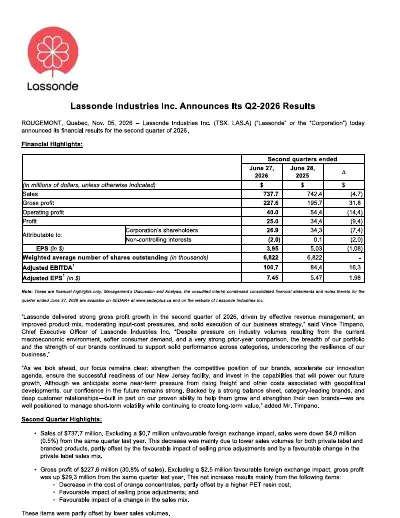
Let's turn to slide 9. Third quarter sales totaled $713 million versus $724 million last year.
Excluding a favorable foreign exchange effect, sales decreased by 2.3%. The reduction reflects the impact of the change in promotional strategies of certain retailers, the discontinuation of low-margin or non-strategic product lines at our Canadian beverage business, suboptimal production level at our New Jersey and North Carolina plants, and general category trends.
On the other hand, we benefited from a more favorable sales mix. Please move to slide 10.
Gross profit amounted to $206 million, up from $198 million a year ago. Excluding a favorable foreign exchange impact, it rose $5.4 million or 3%, reflecting a decrease in orange and apple commodity costs and a positive shift in the sales mix.
These factors were partly offset by higher conversion costs mainly due to the temporary equipment issues mentioned earlier, higher PET resin cost, and lower sales volumes. SG&A expenses were $149 million, up $9 million versus last year, mainly due to higher transportation cost to deliver products to clients and an increase in selling, marketing, and certain administrative expenses.
Excluding items impacting comparability, adjusted EBITDA was $84 million or 11.7% of sales, versus $86 million or 11.9% of sales last year. Turning to slide 11 for profit.
Excluding items impacting comparability, adjusted profit attributable to the corporation's shareholders totaled $41 million or $5.94 per share, up 2% from $40 million or $5.84 last year. Let's turn to working capital on slide 12.
At the end of Q3, the days of operating working capital ratio stood at 50 days versus 46 days 3 months earlier. While the ratio remained within our normal seasonal range, the sequential variation reflects lower days of payable outstanding.
Please note that we also expect year-end working capital to remain within historical range. Now onto slide 13 for cash flows.
Operating activities generated $63 million in Q3 2026, compared to $118 million last year. The variation comes from working capital requirements of $1.4 million this year, as opposed to $51 million released last year.
CAPEX totaled $55 million in the quarter, and they are still projected to reach up 7% of sales in 2026, including approximately US$87 million for the New Jersey project. Looking ahead to 2027, residual investment to complete the New Jersey facility should result in CAPEX being above historical range, but below 2026 as a percentage of sales.
Turning to our financial position on slide 14. Lassonde's net debt was $456 million at the end of the third quarter, relatively stable from $451 million 3 months earlier, as operating cash flow generation was offset by CAPEX and dividends.
As a result, the net debt to adjusted EBITDA ratio was 1.25:1 at the end of the quarter, compared to 1.22:1 3 months earlier. All things being equal, we expect the leverage ratio to remain well below our internal maximum threshold of 3.25:1.
As for our share repurchase program, since reinstating our normal course issuer bid in August, we have repurchased more than 68,000 shares to date for total consideration of $15.8 million. As a reminder, the program allows us to repurchase up to 200,000 shares over a 12-month period.
Before turning the call back to Vince, with less than 2 months remaining in fiscal 2026, we will provide an outlook extending into early 2027. Please turn to slide 15.
In the coming months, we expect consumer demand and volume to remain under pressure, as affordability concerns continue to influence purchasing behaviors. As a result, we reiterate our view that fiscal 2026 sales will be slightly below last year's level, excluding the impact of foreign exchange.
In addition, in relation with the asset impairment announced in the previous quarter, 2027 sales will reflect contractual changes with one important specialty food customer. We've already secured approximately 70% replacement volume for 2027 and remain in active discussion for the balance.
However, uncertainty remains about our ability to replace that volume at historical business terms. On the cost side, higher crude oil prices are expected to continue putting pressure on transportation and PET resins cost.
Partially offsetting these pressures, we continue to expect the benefit from favorable commodity costs. Moving to slide 16.
Conversion costs in our U.S. beverage network will also remain higher for the balance of 2026 and early 2027 for two main reasons.
First, managing end-of-life production asset at our existing facility in New Jersey may result in suboptimal production levels. Temporary disruption, similar to those experienced in Q3, may occur until the transfer of the new facility is complete.
Please note that as we begin transferring production later in the fourth quarter, we expect to incur usual start-up costs. We intend to classify these items impacting comparability between periods and exclude them from adjusted EBITDA and adjusted EPS.
Second, although the situation in North Carolina is improving, we continue to prudently operate a single-serve line at a reduced run rate. We have temporarily shifted some production to other facilities until we reach a normal cadence, but these mitigation measures are also resulting in higher freight costs.
That concludes my section. I turn the call back to Vince for the conclusion.
Vince?
Vince Timpano
Thank you, Francis. Please turn to slide 17.
Our performance to date in 2026 demonstrates the resilience of our business and the effectiveness of the actions we have taken to deliver sustainable profitability. While external pressures from a challenging macroeconomic and geopolitical environment may affect consumer spending, input costs, and supply dynamics, our focus remains clear: leverage the strength, depth, and breadth of our portfolio and execute on the levers within our control, including optimizing our commodity exposure through product innovation, maintaining price discipline, and implementing targeted cost initiatives to protect margins.
Turning to slide 18 for our priorities. Our immediate focus is on executing a successful production transfer in New Jersey.
We are very excited with the upcoming start of this facility that represents an important milestone in strengthening our manufacturing footprint and enhancing our competitive position in the U.S. market.
The other priority for our U.S. beverage business is to restore normal operations in North Carolina to capture growth opportunities in single-serve formats.
As for Canadian beverage business, our priority remains fortifying our leadership by stepping up our innovation agenda to stimulate growth in emerging beverage segments and strengthening execution across our core channels through disciplined revenue management and sustained investments in our brands. In foodservice, we will build on our recent gains to drive further volume growth with broadline distributors and national accounts.
Finally, in specialty food, we are focused on refining the positioning of our branded products and strengthening our position by further diversifying our customer base and product portfolio by backfilling available capacity following changes with one important customer. Notably, the majority of the replacement volume secured to date comes from new third-party relationships.
In closing, on slide 19, while we continue to navigate near-term challenges, Lassonde remains a strong organization built around passionate and innovative people. Supported by ongoing investments in our network, a diversified portfolio of leading brands, deep customer relationships, and disciplined execution, we are well positioned to capture medium and long-term opportunities to drive sustainable growth in the North American food and beverage market.
This concludes our prepared remarks. We are now pleased to answer your questions.
Operator
Thank you. We will now begin the question-and-answer session.
To join the question queue, you may press star then the number 1 on your telephone keypad. You will hear a tone acknowledging your request.
If you're using a speakerphone, please pick up your handset before pressing any keys. To withdraw your question, press star then 2.
We will pause for a moment as callers join the queue. The first question comes from Ahmed Abdullah with National Bank of Canada.
Please go ahead.
Ahmed Abdullah
Yes, good morning, and thanks for taking my question. Just touching on the plant disruption costs, is it possible to quantify the 3Q EBITDA impact from the North Carolina and New Jersey disruptions there, and how much of that should kind of linger into the fourth quarter?
Francis Trudeau
Hi, Ahmed. We don't disclose that.
However, I would lead you to our comments on what happened in the quarter. Conversion cost and freight's been the two main components.
Look at our margin impact there, and you could assume that that had a significant impact in the quarter.
Ahmed Abdullah
That's fair. Expect that to kind of --
Francis Trudeau
Is that going to continue in Q4? As we alluded in our outlook section, there's a risk there, and that's why we've put it there specifically, as we're working on solving the issue, we're still at suboptimal productions right now.
Ahmed Abdullah
That's fair. Thanks for the colour.
On the specialty food replacement economics that you touched on, with approximately 70% of the volume secured, how much of the associated earnings contributions have you replaced? Can you kind of give us a bit more colour as to the remaining risk that spills into the 2027 profitability?
Francis Trudeau
On that front, as in the last quarter, we said it was going to start having impact Q3, Q4 this year, which we started to see. That's number one.
We're doing a good job on the top line side, as in the last few months, replacing 70% as you said. The thing that we've put in our comments there, there's risk in terms of replacing at similar business terms the volume.
That's something right now that we see having an impact in Q4 and early 2027 as we said in our outlook section.
Ahmed Abdullah
Okay. Just finally just touching on private label demand, the weakness that we saw, can you perhaps give us a bit more colour between what drove that?
Is it the deliberate portfolio exits, customers changes, or the demand? Which components do you expect to kind of improve as the operations normalize?
Vince Timpano
Ahmed, it's Vince. The situation on private label is fairly similar whether you look at Canada or the United States.
The first thing is, clearly it's being impacted by the same category headwinds that the total categories is experiencing. When you look at the Canadian business, volumes are down about -5 on a total basis, and the U.S.
about -3. Category volume performance remains stubborn in this inflationary environment.
The other thing that's happening, though, is shifts in retailer strategies. I'll give you two perspectives on this.
More broadly speaking, what you're seeing, in particular in Canada, is a shift from promo high-low to EDLP. That's having some impact on performance, in particular when you face that off against brands looking at promotions as a means to deal with the issue of affordability.
Those are the things that I would say in Canada. From a U.S.
perspective, the additional thing that I would add to it is you're seeing consumers be much more selective in channels in which they participate. When you take a look at the makeup of the business and the importance of grocery, you are starting to see shifts away from the grocery channel into discount, for sure, but in the U.S.
you're looking at mass and club, which are more on the winning side as part of this. Yeah.
I would say that's how I would describe it, in terms of what you're seeing. The persistence to which that's going to continue, there's a question on just how persistent the category declines are going to be.
What I would assume is that some of the issues that were seen this year from a volume perspective tied to these retailer strategies, we should be able to cycle those when you come into 2027 looking over 2026.
Francis Trudeau
If I may add, in terms of your second question, in terms of what we're planning to improve, I think you saw in the quarter the sales mix having a positive impact. We've started in the last few months and last few years to work on our portfolio and innovation to be allowed to better meet customer demand and the change in customer habits.
That's something we are doing, so that shows positive results, and as we said in our results in this quarter that had a significant impact. On top of that, I would say in terms of distribution, our away-from-home segment is something that we're working on, and in terms of positioning ourselves also outside traditional retailers is also something we're working on to offset this trend in the market right now.
Ahmed Abdullah
Thanks for the colour. I'll queue back up.
Operator
Your next question comes from Martin Landry with Stifel. Please go ahead.
Martin Landry
Hi, good morning, guys. I was wondering if you could expand a little bit on as to what has happened in North Carolina.
I think you said that a 20-day downtime, which is pretty important. Is that the new line that was just established last year?
Vince Timpano
Martin, it's Vince. Yes, it is.
Was down for about 20 days. What I can say to you, though, is that it's an equipment challenge that we've been dealing with.
We see it as temporary. We're seeing improvements, but we're trying to be very prudent in the planning.
We've got redundancy in our network that we're continuing to leverage to make sure that we can still satisfy demand of our existing customer base. The real challenge for us is, to what extent does it sort of dampen our ability to pursue growth?
I think what's important here is we see it as temporary, we're seeing improvements in that at this stage. As Francis said, the challenge as well for us is this notion of, it comes at a cost, whether you're dealing with freight from other markets into the U.S.
marketplace when it's coming out of Canada, and overhead absorption challenges in North Carolina at the same time. It's an equipment challenge.
Francis Trudeau
I would add also, Vince, it comes at a cost of not being able to capture some growth opportunities. While we're very resilient and able to offload to other plants, it affects our ability to plan in advance, so that's also affected the results of the quarter.
Martin Landry
Okay. It would have been great to have a little bit of an idea of the magnitude of all this on revenues and earnings, but if it's something you don't want to share, that's fine.
Just to be clear, I understand that the New Jersey facility will be suboptimal heading into '27. Is the North Carolina situation, will that be resolved by year-end?
Francis Trudeau
Yes.
Martin Landry
Vince, you gave some interesting numbers. Industry volumes down 5 in Canada, down 3 in U.S.
Vince Timpano
Roughly.
Martin Landry
Yeah. Can you contrast that with your volumes, just to understand, it sounds like you have been gaining share, I'd just like to have a little bit more colour on that.
Vince Timpano
If you take a look at the U.S. market, I'll start there.
We are gaining share on our branded side. We've had real success with the Apple & Eve brand, in particular with a reduced sugar format.
Really pleased with what we're seeing on that front. I already shared with you sort of perspective from a private label view.
When you take a look at Canada volumes, it's the same messages that I delivered prior, which is category headwinds. There is an impact that I noted in my script in terms of a retailer strategy that is having an impact on performance, a real shift away from frequency of promotion as well as depth of promotion that we would have benefited from.
That's one of the things that the Canadian business is dealing with, and as I mentioned earlier, call it a reset, that reset is nearly complete and we'll be able to cycle that when we look into 2027. We are pleased with some of the performance that we are seeing in Canada, though, as well.
When you take a look at our share performance, solid performance in chilled, in particular over the last 4 weeks, really solid improvements that we're seeing in there. Obviously the team has been very, very focused on leveraging mix because of a really diversified portfolio to try to address some of these category headwinds.
Primarily speaking, I would draw it back to some of the things that we're seeing on the promotional front.
Martin Landry
Just to summarize, there's a lot in there. Just to summarize, are you gaining share in Canada?
Because you do say that you're gaining share for Oasis in chilled category, but are you gaining share for Oasis overall, or are you losing
Vince Timpano
share? What I would say to you, when you take a look at the total business, I would say, first of all, over the past short while, you would have seen a decline in share.
When you take a look at our share performance relative to 2024, it's above 2024 levels. You're clearly seeing some adjustments from that 2024 period because we had some one-time benefits in 2025.
Overall, I'm pleased with the performance of the business, and again, when I talk at the past 4 weeks, we're also seeing some improvements in our share position.
Martin Landry
Then in the U.S., you did say that you're seeing customers shifting away from traditional grocers and moving to mass and club. What is your exposure to mass and club in the U.S.?
Are you under-exposed, over-exposed? Can you benefit from that trend of customers shifting?
Vince Timpano
I would say we're fairly evenly exposed. Clearly what we're going to be doing is looking at what we do to maximize some of the shifts that are taking place in that market.
That's what we continue to do. We've got a diverse portfolio.
We're fairly well represented across all the channels. If consumers start to shift, we need to make sure that we're doing what we must be doing to participate in that shift, of which that's really where the focus is.
I would say evenly exposed.
Martin Landry
Perfect. Thank you and best of luck.
Vince Timpano
Thank you. Thank you.
Operator
Once again, if you have a question, please press star then 1. Your next question comes from Eric Zhu with Canaccord Genuity.
Please go ahead.
Eric Zhu
Thank you very much and good morning. This is Eric on for Luke Hannan.
Most of my questions have already been asked, but I wanted to maybe deep into the numbers. In your sales breakdown on slide 9, you said private label was down $21 million on volume, and considering you previously said that your SKU cut in private label was roughly $7 million to $8 million impact per quarter, is the $13 million balance mostly kind of due to the change in that one Canadian customer's go-to-market strategy?
Also wanted to ask about what's the nature of that?
Francis Trudeau
You get it, Eric. That's the main reason for it.
I would say on top of that, the discontinuation of selected product line that we announced in previous quarters also fits in that category of private label. Those are the two main elements that should be considered there.
Eric Zhu
Got it. Thank you very much.
Also, I wanted to just get your colour on the spread between private label and branded. Has that changed over the past few quarters from the last time that you look at it?
Vince Timpano
Can you repeat the question?
Eric Zhu
Oh, yeah. Sorry.
I wanted to ask about the value spread between private label and branded, considering the current consumer environment is very very value-seeking, and wanted to get your colour on that.
Vince Timpano
The spread primarily has not changed materially.
Eric Zhu
Okay. In your MD&A, you noted pasta sauce has been very good in Canada.
It's grown with single digits versus industry which has been declining. Is there anything that you wanted to highlight about that, why are you growing pasta sauce shares in Canada?
Vince Timpano
One of the things that you're seeing is there's growth in, call it, the premium to super-premium segment. Our participation in that with the brands that we pack for are performing exceptionally well.
We've got strong brands that we pack for, and like I said, it's participating in a category that is a segment within the category that is outpacing the category average, and that's really where we're seeing the growth that we're seeing there.
Eric Zhu
Got it. Thank you very much.
Finally, I wanted to ask about given the lags where you experience tailwinds and headwinds in raw material prices due to your hedging strategy, could you quantify kind of the benefit that you will be seeing due to lower orange and apple concentrates, maybe in Q4 or 2027?
Francis Trudeau
It's tough to quantify that, Eric, because it's been in the market for already a while. These things, there's always a lag in the market when low commodities get in, there's purchase price adjustment mechanisms that are in place right now.
Today, what we're seeing is difficult to predict because you cannot just look at in isolation like orange and apple concentrate. You need to look at versus other elements like freight and PET resin cost, which have suffered massive inflation since June last year.
The benefit on one side of commodity has been offset significantly by other elements. To quantify only one side is difficult.
That's the main element right now. You're right that we've been on the right side in terms of commodity cost for the last few months, and that's why we've put that elasticity and the commodity management is going to be important for us in terms of the outlook period that we announced.
Eric Zhu
That's great. Thank you very much for all of the colour.
Best of luck.
Francis Trudeau
Thanks a lot.
Operator
Your next question comes from Frederic Tremblay with Desjardins Securities. Please go ahead.
Frederic Tremblay
Thanks. Good morning.
Just given the disruptions in the existing New Jersey facility that you saw recently, do you think it would be worth considering an acceleration of the transfer to the new facility? Does your current timeline of the transition happening through most of 2027 does seem to present some risk of further disruptions over the next 12 months.
Perhaps operationally it's not feasible, or to accelerate that, but just wanted to see how you think about mitigating risk associated with the legacy facility there.
Francis Trudeau
Frederic, we would love to do it, and we're looking forward to transfer in our new facility. We're managing end-of-life equipment.
Unfortunately, it's not feasible as the plant is being built as we speak. As we said in previous quarter, and we're still on time on budget, we are going through test runs right now, and end of fiscal 2026 is going to be the period where we're going to start launching the new plant.
That's something that's happening. This transition is going to happen, as we said, towards most of 2027, as the multi-lines that's going to be transferred are going to be sequential from one plant to the other, and in some period of time, both plants will run in parallel.
Unfortunately, we cannot accelerate it, but right now we're on plan and everything is working well. The teams are looking forward to just move away from that, but it's not something we could do.
We're November we're November 6 today, we're coming at that point of time where we're going to start transitioning.
Vince Timpano
Hey, Frederic, it's Vince, and I'm just going to build on something Francis said. I know it doesn't really get to your question, which is can you accelerate.
The answer is no, even as much as we would like to do that. Having said that, I want to remind that this is a major investment, a $200 million U.S.
investment, and the project remains on track and on budget. Lines are there.
The team is getting ready to do first runs at the end of December, early January, and so we're quite pleased with the progress that this major project has taken. In the meantime, we're going to continue to manage as effectively as we can some of this end-of-life equipment challenges that we've dealt with in New Jersey, and continue to manage and leverage the existing network where we believe there's some redundancy to ensure that we can satisfy existing customer demand.
Frederic Tremblay
That's helpful. Thanks for that colour.
Last question for me would be just given the demand environment that we're seeing now that remains under pressure, curious to see, Vince, if from your experience, from an industry perspective, would you expect behaviors to be promotional over a prolonged period of time, or does margin discipline take priority generally? Just wanted to get your views on how you would expect the industry to react over the next few quarters.
Vince Timpano
It's a fair question, Frederic. I would say right now this is a very uncertain environment that we're still participating in.
You've got commodity gains that are offset by other fuel and freight cost as a result of the Middle East crisis. You have the uncertainty on tariffs.
The view is that until we feel more certain about the future, you would anticipate that what we're seeing is what we're going to continue to see, at least for the foreseeable future. What does that mean?
It does mean we've got to maintain pricing discipline. It's really important.
Recognizing the category declines, being really smart about how it is that we appeal to these shifts in consumer behaviors. I've always said that one of the real powers of Lassonde is the diversity of the portfolio and being able to leverage that portfolio, whether it's from a product pack or channel perspective, to be able to shift and participate, as I said in my prior answer, where the consumer is going.
Your question on promotions, yeah, my view is that there's going to continue to be a focus on smart promotions to be able to appeal to that value-seeking consumer. More in discount, more in mass, more in club, obviously doing the things that we need to do from a promotional perspective in grocery, but that's where I think the focus is going to be.
The additional thing as well is ensuring that not only we're managing that from a mix perspective, that we continue to introduce innovative products that add unique value that consumers are seeking out and are willing to pay for. That is a real focus for us, so as we move into 2027, you're going to hear us talk more about that as a means to stimulate category performance further.
Frederic Tremblay
Very helpful. Thank you.
Operator
This concludes the question-and-answer session. I would like to turn the conference back over to Vince Timpano for any closing remarks.
Vince Timpano
Thank you, operator, and thank you for joining us this morning. We look forward to speaking with you again at our next quarterly call.
Have a great day, and have a great weekend, everybody.
Operator
This concludes today's conference call. You may now disconnect your lines.
Thank you, and have a nice day.