PLUXEE N.V.
Q4 FY2026 · Earnings Call TranscriptOctober 29, 2026
Operator
Good morning, and thank you for standing by, and welcome to Pluxee Fiscal Results 2026 Presentation. After the presentation, there will be an opportunity to ask questions by pressing *1 at any time.
I advise you that this conference is being recorded. At this time, I would like to hand over the conference to Pauline Bireaud, Head of Investor Relations.
Please go ahead, madam.
Pauline Bireaud
Good morning everyone, and thank you for joining us today for Pluxee 2026 results. I'm Pauline, Head of Investor Relations at Pluxee, and I'm pleased to be here with you today to present our full-year performance.
Today, I'm joined by Aurélien, our CEO, and Stéphane, our CFO. Before we begin, let me walk you through today's agenda, which you can see on the next slide.
Aurélien will start with the highlights and key figures for Fiscal 2026, followed by a review of our strategic initiatives and key achievements of the year. Stéphane will then take you through our financial results in more detail.
Finally, Aurélien will come back to present our priorities from Fiscal 2027 onwards and conclude with our outlook before we open the floor to Q&A. With that, I will now hand over to Aurélien.
Aurélien Sonet
Thank you Pauline, and good morning everyone. Let me start with our financial performance.
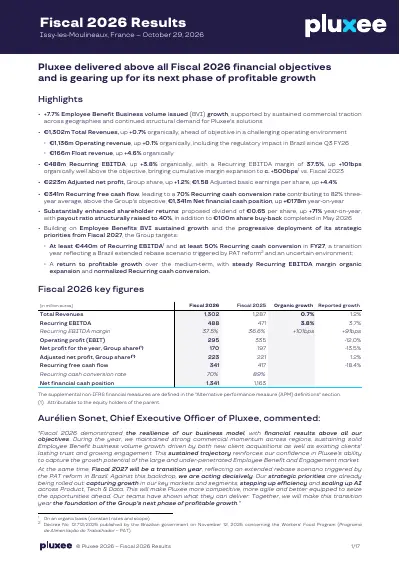
In Fiscal 2026, despite the challenging environment, we delivered ahead of all our financial objectives. Total revenues continued to increase slightly, while recurring EBITDA margin expanded organically by more than 100 basis points, and recurring cash conversion reached 70% for the year.
This demonstrates our ability to translate operational discipline into tangible results. Our strong commercial execution remained a key pillar of our performance.
First, new client wins generated €1.5 billion in annualized business volume, ahead of our objective for the year. Second, net retention stood at 99.4%.
It was supported by strong client loyalty, face value increases, and growing cross-selling, almost offsetting lower end-user volumes. All this allowed us to keep funding our development, both organically and through additional bolt-on acquisitions, while substantially enhancing shareholder returns, notably through a +71% increase in the proposed dividend per share.
Looking ahead, our ambition is clear: position the group for its next phase of profitable growth. To get there, we will focus on a set of strategic priorities to capture revenue momentum, drive further efficiency, and scale AI across product, tech, and data.
I will come back to each of them in more detail later. This translates into clear financial objectives, underpinned by sustained growth in employee benefits volume across our markets.
First, Fiscal 2027 will be a transition year, reflecting an extended rebase scenario triggered by the PAT reform, as we decided to equalize merchant terms across all our meal and food programs in Brazil. Against this backdrop, we are targeting to deliver at least €440 million of recurring EBITDA, and at least 50% recurring cash conversion.
Beyond Fiscal 2027, we expect to return to profitable growth over the medium term, sustained by steady recurring EBITDA margin expansion and recurring cash conversion back to normalized levels. Let's first turn to our key financial figures for Fiscal 2026, starting with total revenues, which amounted to €1.3 billion, up +0.7% organically.
This is slightly ahead of our objective of stable organic growth, despite the regulatory and macroeconomic headwinds that we faced during the fiscal year. Turning to profitability, recurring EBITDA reached €488 million.
The margin rose by +101 basis points organically to 37.5%, well ahead of our objective of slight organic margin expansion. Lastly, recurring free cash flow came in at €341 million, representing a recurring cash conversion rate of 70%.
This brings our three-year average to 82%, again above our objective of around 80%. This gives us the flexibility to keep investing in growth while rewarding our shareholders, and let's look at this on the next slide.
Adjusted net profit group share reached €223 million, and adjusted basic EPS was up +4.4% year-on-year to €1.58, reflecting both higher adjusted earnings and a portion of the accretive impact of our share buyback. Confident in the structural cash generation of our model, we have decided to significantly raise our payout ratio from 25% to 40%.
This translates into a dividend of €0.65 per share, up +71% year-on-year, subject to shareholder approval. This comes on top of the €100 million share buyback program completed in May 2026.
Stepping back, let me put this year's performance in the context of what we have delivered since the spinoff. Looking first at the top line, we delivered a three-year organic CAGR of +11.2% in total revenues, driven notably by high single-digit growth in employee benefits business volumes.
We combined this growth with a significant improvement in profitability. Recurring EBITDA grew at an organic CAGR of +17.9% over this period, and the margin expanded by around 500 basis points to reach 37.5% in Fiscal 2026, reflecting the benefits of scale and the efficiencies captured across the group.
This stronger earnings profile translated into substantial cash conversion, with €1.1 billion of recurring free cash flow generated over three years and an average recurring cash conversion rate of 82%. This enables us to maintain a strong net cash position, as reflected in Standard & Poor's reaffirmation of our investment grade rating.
Beyond the numbers, let me turn to the progress we've made on our strategic initiatives. In Fiscal 2026, we continued to move forward on all fronts: winning more clients, sharpening our value proposition, and intensifying on efficiency initiatives.
Let's start with new client development on slide 9. We delivered €1.5 billion in annualized business volumes of new client acquisitions, exceeding our objective of more than €1.3 billion, and demonstrating the strength of our commercial execution.
This performance was broad-based, with all regions and client segments contributing to growth. SME remained a key growth lever, accounting for more than 32% of new client development.
This strengthens our conviction in the significant potential of this still underpenetrated segment. Portugal is a good example of how we are broadening our value proposition to win new clients.
There, we have progressively evolved from a meal card provider into a leading multi-benefit platform, with more than 18 benefits now available through our Cobee by Pluxee offering. In May, we strengthened this further with a new distribution partnership with Sabseg, one of the largest independent insurance brokers in Portugal, with more than 200,000 clients.
This partnership opens up access to its large corporate client base and adds insurance and savings plans to our available product range. It is already paying off: large groups like Adecco are now placing their trust in us, with more than 9,000 employees to be progressively onboarded.
Winning new clients is one half of our commercial engine; the other half is retaining and developing our existing client base, as illustrated on slide 10. In Fiscal 2026, net retention stood at 99.4%.
Clients loyalty remained high across our markets, and we kept deepening these relationships through: first, further face value increases, which added €1.1 billion of business volume during the year, and over the past three years, the cumulative contribution reached €3.5 billion, half a billion euros above our objective. This underscores our ability to advise our clients in preserving their employees' purchasing power in a context of persistent inflation.
Second, cross-selling has gained traction, with a growing number of clients adopting our multi-benefit approach, broadening the range of employee needs that we address, and deepening our share of wallet with each client. Together, loyalty, face value increases, and cross-selling almost offset lower end-user volumes driven by a tougher economic, macro environment and a softer employment in some countries, especially in Continental Europe.
Our commercial performance is also built on an offering that we keep enriching for clients, consumers, and merchants, as we will see in the next slide. In Fiscal 2026, increasingly leveraging on data and AI, we continued to strengthen our value proposition for all our three main stakeholders, supporting deeper engagement and creating new avenues for growth.
For clients, we further enriched our range of solutions. Our integrated multi-benefit solutions are now available in 20 countries, underpinning the cross-selling momentum as mentioned earlier.
For consumers, we are building a unified, seamless digital experience that brings all their benefits together, making them easier to activate and use. This is driving increasingly stronger engagement.
In Spain, for example, employee opt-in reached more than 60% across migrated client portfolio. For merchants, we continue to expand the value generated through our ecosystem.
Business volumes benefiting small and medium-sized merchants reached €7.8 billion, up +36% compared to Fiscal 2023. We are also expanding digital solutions to boost their visibility and apport traffic to their stores alongside a growing range of complementary services.
Beyond these developments, we also made progress on our four sustainability commitments, which I will now cover in the next slide. First, responsible business conduct remains fundamental to how we operate, with 99% of our employees having completed the required training.
Second, on diversity, women now hold 45% of leadership positions, ahead of our 42% target. Lastly, alongside our SME merchant commitments that I have just mentioned, we are well on track on the environment.
Our Scope 1 and 2 greenhouse gas emissions are now 62% below Fiscal 2017 levels. All this progress is reflected in our ESG ratings, such as CDP and EcoVadis.
To close this section, let's look at the drivers behind the group's strong margin expansion. As already mentioned, recurring EBITDA margin increased organically by +101 basis points in Fiscal 2026.
Around three-quarters of this improvement came from, first, operating leverage: business volume growth, the scalability of our model, and synergies from acquisitions allowed us to grow with limited additional costs. Second, efficiency: by tightening cost discipline and accelerating optimization efforts, both in Brazil and increasingly across the group, as we begin adapting our cost base.
With that, I will hand over to Stéphane, who will go into this in more detail as he walks you through our financials for Fiscal 2026.
Stéphane Lhopiteau
Thank you Aurélien, and good morning everyone. I will now take you through our Fiscal 2026 financial results, starting with our business volume trajectory, a key indicator of Pluxee's underlying commercial momentum, on slide number 15.
Total business volume issued, or BVI, reached €26 billion in Fiscal 2026, up +4.5% organically. This positive trend was driven by employee benefits, which accounted for 79% of total BVI and which grew by +7.7% on an organic basis to €20.6 billion in Fiscal 2026.
Organic growth accelerated quarter after quarter, from +5.4% in Q1 to +11.2% in Q4, providing us with a healthy, solid exit rate as we enter Fiscal 2027. All three regions contributed positively, with double-digit growth delivered both in Latin America and Rest of the World.
Turning to other products and services, BVI declined organically by -6.1% down to €5.4 billion, reflecting the expected, natural scale-down or phasing of certain public benefit programs in Continental Europe, with base effects turning favorable from H2. Overall, excluding non-recurring impacts, our steady BVI trajectory throughout the year confirmed the strength of our commercial momentum even in a challenging regulatory and macroeconomic context.
Focusing a bit more on our main line of service, employee benefits, let's now look at how the growth in BVI was fueled on page number 16. In Fiscal 2026, employee benefits BVI growth was underpinned by: first, new client wins, which remained the primary growth driver, contributing approximately €1.5 billion of additional volumes on an organic basis.
Second, net retention had an almost neutral impact over the year. Strong client loyalty and active portfolio management almost fully offset lower end-user volumes in some markets going through a softer macroeconomic environment.
Lastly, scope and foreign exchange impact provided an additional positive contribution of approximately €0.4 billion, driven by a favorable currency impact from Brazil and Mexico, and, to a lesser extent, by the recent small bolt-on acquisitions. These business volume trends from employee benefits, together with those from other products and services, translated into total revenues, as shown on slide number 17.
Total revenues reached €1,302 million in Fiscal 2026, up +0.7% organically and +1.2% reported, slightly ahead of our full-year objective. This resilient performance was delivered despite the introduction of the 3.6% cap on merchant fees under the PAT reform in Brazil from Q3.
As a result, Q4 total revenues stood at €335 million, down -4.9% organically compared to -3.3% in Q3, reflecting the progressive implementation of the regulatory changes. Looking at the two components of total revenues, operating revenue reached €1,136 million, broadly stable at +0.1% organically and +1% reported.
This performance reflects varying macroeconomic and regulatory contexts across our markets, which I will detail in a moment. In Q4, operating revenue amounted to €293 million, down -6.2% organically and -3.2% reported.
Float revenue reached €166 million, up +4.6% organically and +2.1% reported, ahead of our expectations. Growth was supported by business volume development and, ultimately, by a slightly increasing investment yield year-on-year.
In Q4, float revenue reached €42 million, up +5.1% organically and +6.4% reported. Overall, total revenue's resilience reflected the strength of our diversified business model and geographical footprint, as business volume growth and float revenue largely mitigated the regulatory pressure on take rate.
Let's now look more closely at the underlying trends in operating revenue by line of service on page 18. As just mentioned, operating revenue reached €1,136 million in Fiscal 2026, up +0.1% organically, reflecting contrasting trends across our two lines of service.
Employee benefits operating revenue reached €991 million, up +1.7% organically and +3% reported. In Fiscal 2026, solid business volume growth across all regions compensated for the regulatory pressure on the take rate in Brazil.
Reflecting this, the group's employee benefits take rate stood at 4.8%, down -30 basis points year-on-year. In Q4, employee benefits operating revenue declined by -8.3% organically to €252 million, compared with -2.6% in Q3, slightly better than our expectations.
Other products and services generated €145 million of operating revenue, down -9.1% organically and -10.6% reported. It reflects the softer momentum in public benefit programs in Continental Europe, together with the ongoing business transformation in the UK and the US.
As expected, this line of service returned to growth in Q4, up +8.5% organically to €41 million, supported by an easier comparison basis year-on-year. Let's now move to the geographic mix and explore how such operating revenue evolved across regions on slide number 19.
Indeed, operating revenue performance varied across regions, reflecting a combination of strong commercial momentum and market-specific situations. First, Continental Europe, which now represents 44% of group operating revenue, reached €495 million, down -3.1% organically and -2% reported.
The region showed differentiated business momentum across countries, reflecting varying macroeconomic conditions and public sector spending trends. Excluding public benefits, the region was broadly stable at -0.3% organically over the year.
Second, Latin America, which represents 39% of group operating revenue, reached €449 million, up +1.1% organically and +4.6% reported, including a notably high comparison base in Q4 2025. This resilient performance was mainly led by better-than-expected H2 2026 dynamics in Brazil due to strong commercial performance and progressive implementation of the PAT reform.
Excluding this PAT impact in Brazil, Latin America operating revenue would have grown by +8.2% organically over the year. Lastly, Rest of the World, which represents 17% of group operating revenue, reached €192 million, up +6.7% organically and +1.1% reported.
This reflects strong commercial momentum in Türkiye and Asia-Pacific, notably in India by the end of Fiscal 2026. Excluding the UK and the US, where we are refocusing our business, operating revenue in Rest of the World would have grown by +18.9% organically.
After operating revenue, let's give a look at how float revenue contributed to growth on page number 20. Float revenue reached €166 million in Fiscal 2026, up +4.6% organically and +2.1% reported, including €42 million in Q4, up +5.1% organically and +6.4% reported.
This performance was driven by two factors: first, a positive volume effect, thanks to continued business volume growth, notably in Latin America and Rest of the World. Second, a slightly higher average investment yield on float of 6.2%, up +20 basis points year-on-year.
This was supported by elevated interest rates in Brazil and by the group's discipline and flexible investment strategy adapted to local market conditions. After business volumes and revenues, let's now see how recurring EBITDA was fueled, walking you through the related margin expansion on slide number 21.
Once again, in Fiscal 2026, profitability came in significantly above our initial objective. Recurring EBITDA reached €488 million, up +3.8% organically and +3.7% reported.
Recurring EBITDA margin stood at 37.5%, up +101 basis points organically and +91 basis points reported versus 36.6% in Fiscal 2025. On top of the float revenue contribution, this margin expansion was mainly driven by a +75 basis point organic improvement in recurring operating EBITDA margin, up to 28.4% reported.
This was supported by a combination of continued operating leverage from business volume growth and accelerated efficiency initiatives and tighter cost discipline, both in Brazil and progressively across the group, in response to the evolving regulatory environment. This performance provides clear evidence of our ability to execute, rapidly adapt our operations, and deliver meaningful cost efficiencies.
Looking now at how this recurring EBITDA growth translated into the full income statement down to net profit, on page number 22. Let's start below the third line disclosing recurring EBITDA, where D&A, depreciation and amortization, amounted to €128 million, up from €110 million last year, reflecting the impact of recent acquisitions and the commissioning of newly capitalized assets.
As a consequence, recurring operating profit, or recurring EBIT, was stable at €360 million. Other operating income and expenses amounted to -€65 million versus -€26 million in Fiscal 2025.
This €40 million increase in OIE costs is the result of additional contingency reserves for ongoing legal and tax proceedings, impairment charges, and restructuring costs. Consequently, operating profit, or EBIT, reached €295 million.
Financial income and expenses improved to -€6 million from -€17 million in Fiscal 2025, reflecting an increase in non-float-related interest income, driven by higher invested cash balances and by sustained interest rates in Brazil and Türkiye. Income tax expense amounted to €98 million, with an effective tax rate of 33.8% versus 31.4% in Fiscal 2025.
This increase in the ETR was fully due to the non-deductible other operating expenses. As a result, net profit group share reached €170 million, entirely explained by the specific one-offs in other operating expenses recorded below recurring EBITDA.
Adjusted net profit group share, which excludes these items, amounted to €223 million, and adjusted basic EPS reached €1.58 from €1.52 in Fiscal 2025, benefiting from a portion of the accretive effect of the share buyback program and subsequent share cancellation. After the income statement, let's review how our operational and financial performance translated into cash generation on slide number 23.
Recurring free cash flow reached €341 million in Fiscal 2026, compared to €417 million in Fiscal 2025, which, at the time, benefited from favorable working capital variances, notably related to public benefits business volumes. In more detail, in Fiscal 2026, recurring free cash flow was driven by: first, our recurring EBITDA growth and margin expansion.
Second, a disciplined investment policy, with capital expenditures reaching €99 million, stable year-on-year, and representing 7.6% of total revenues. Third, a positive contribution from change in working capital of +€72 million, demonstrating disciplined management despite headwinds on reimbursement terms in Brazil and softer business volumes trends in Continental Europe, especially related to public benefit programs.
As a result, recurring cash conversion reached 70% in Fiscal 2026, reflecting the high quality of our recurring earnings and bringing the three-year average to 82%, above our objective of around 80%. This strong cash generation enabled us to return more value to shareholders in Fiscal 2026, while still strengthening our sound balance sheet, as shown on page 24.
The group's net financial cash position stood at €1,341 million as of the end of Fiscal 2026, up +€178 million compared to the end of Fiscal 2025. Our strong recurring free cash flow of €341 million more than covered the cash-out, especially the ones related to the Fiscal 2025 dividends for €76 million, including minority interest, and the €100 million share buyback program completed in May 2026.
We also benefited from a favorable net currency translation effect of +€30 million over Fiscal 2026, related mainly to the appreciation of the Brazilian real and Mexican peso. This solid financial position, combined with our strong cash generation, gives us full flexibility to keep on investing in our business while continuing to deliver value to our shareholders.
With this in mind, I will now hand back to Aurélien, who will take you through our priorities and outlook for Fiscal 2027.
Aurélien Sonet
Thank you Stéphane. Before turning to our strategic priorities, let's take a step back and look at the structural trends shaping our market.
Valued at more than €1,000 billion with a penetration rate below 20%, the employee benefits and engagement market is vast and still largely untapped. It is also evolving quickly, with several megatrends reshaping the world of work and continuing to fuel structural market growth.
First, demographic shifts are creating talent shortages, pushing employers to find new ways to attract and retain their people, while AI is gradually transforming the way people work. Second, persistent inflation and interest rate fluctuations reinforce the need to support purchasing power.
In addition, climate change raises sustainability expectations, both for employers and employees. Talent retention, purchasing power, well-being at work, and sustainability: these are precisely the needs that our solutions address, making them even more relevant for employees across sectors and job categories.
At the same time, our competitive and regulatory environment evolves, requiring us to keep innovating and to adapt quickly, as we are doing in Brazil. This is exactly what our strategic priorities are designed for.
Building on the market fundamentals that I have just outlined, we have entered Fiscal 2027 with a clear objective: positioning Pluxee for the next phase of profitable growth. In a nutshell, we are stepping up our ambition on three fronts: first, capturing growth momentum.
We focus our commercial engine where the potential is greatest: our most attractive offerings and high-potential markets such as India, key European countries, but also Brazil, where the structural volume growth remains significant beyond the rebasing. At the same time, we are doubling down on SMEs by scaling our targeted model across countries, and on merchants, by making our value proposition even sharper, notably on complementary services.
Second, driving further efficiency. In a volatile environment, discipline matters more than ever.
We are stepping up our cost optimization efforts, already well underway, with a goal to progressively build a leaner, more agile cost structure, fit for our next phase of growth. Third, fostering our product, tech, and data ecosystem.
We are progressively scaling automation and agentic AI, strengthening cyber resilience, and delivering more personalized AI-powered solutions, enabling faster innovation and go-to-market. Finally, we'll keep seizing targeted opportunities through both M&A and strategic partnerships wherever they can strengthen our trajectory.
Taken together, these priorities reinforce one another and will make the group more competitive, more agile, and better equipped to seize the opportunities ahead. Let me now turn to how our capital allocation framework is supporting these priorities.
Our capital allocation framework has always balanced organic investment, M&A, and shareholder returns, with a constant focus on value creation and financial discipline. This approach will continue, with a few adjustments, starting with, first, organic investment.
We now expect annual capex to land between 8% and 9% of total revenues, to be focused on technology innovation, data, AI, and cybersecurity. As our model evolves, we are also gradually shifting part of this spending towards cloud and SaaS-based solutions.
Second, external growth. As mentioned, we will keep complementing organic investment with targeted acquisitions and partnerships.
Each of them will continue to be assessed against strict criteria: strategic fit, value creation, and integration. Third, shareholder returns.
As mentioned before, confident in the group's cash generation, we have structurally raised our dividend payout to 40%. Together, these three pillars continue to give us the flexibility to invest where we see the strongest returns and seize external opportunities selectively, while distributing a greater share of the value we create to our shareholders.
Let me now conclude this presentation with our financial objectives. From Fiscal 2027, we will continue to build on our sustained employee benefits business volumes momentum and on the progressive rollout of our strategic priorities.
That said, Fiscal Year 2027 will remain a transition year, reflecting an extended rebase scenario triggered by the PAT reform in Brazil, following the equalization of merchant terms across all our meal and food programs. In this context, we are targeting to deliver at least €440 million of recurring EBITDA at constant foreign currency and scope, and at least 50% recurring cash conversion in Fiscal 2027.
This coming year will be clearly shaped by the significant impact from the Brazil reset in the first semester, while we continue to expect an inflection point from H2, as we will see the initial benefits of the rollout of our strategic priorities flowing through. Beyond Fiscal 2027, with the Brazil rebasing behind us and our strategic priorities delivering their full effect, we plan to return to profitable growth over the medium term, supported by steady recurring EBITDA margin organic expansion and a return to normalized recurring cash conversion.
Let me now conclude the presentation before we open the floor to questions. Fiscal 2026 was another year of strong execution in a challenging environment.
Beyond Fiscal 2027 transition, we are confident in our return to profitable revenue growth, given the structural fundamentals of our market, the growing appeal of our solutions, and the disciplined execution of our strategic priorities. Before we take your questions, I would like to sincerely thank our teams around the world.
Their loyalty to Pluxee, their commitment to our clients, and their ability to adapt quickly made a real difference and contribute to the confidence that we have in the future. Thank you for your attention, and now Stéphane and I are ready to take your questions.
Operator
This is the conference operator. We will now begin the question-and-answer session.
Anyone who wishes to ask a question may press * and 1 on their touch-tone telephone. To remove yourself from the question queue, please press * and 2.
Please pick up the receiver when asking questions. In the interest of time, please limit yourself to a maximum of two questions each.
The first question comes from Zach Al-Qaryooti with Morgan Stanley. Please go ahead.
Zach Al-Qaryooti
Good morning. Two questions from me, please.
Firstly, just on the guidance for next year: can you help us bridge the organic EBITDA guidance relative to the 2026 level, particularly separating the incremental impact from the Brazil regulation from underlying growth, cost savings that you mentioned, and any other factors that you'd call out? Within that organic decline, how should we think about top-line performance versus the EBITDA margin?
Then second question, just again on Brazil: so you refer to this extended rebase scenario. What specifically has changed relative to your previous assumptions, and how confident are you that that headwind should dissipate by kind of the second half or late 2027?
Is there a risk that we'll still be talking about this headwind at the back end of next year? Thank you.
Aurélien Sonet
Thank you Zach. Stéphane, do you want to answer the first question, and...
Stéphane Lhopiteau
Yes, thank you. Good morning Zach.
Regarding your question on how we bridge the guidance of the at least €440 million EBITDA versus what we delivered in '26, with €488 million, which is a €48 million downside. The biggest impact, the big thing is this rebase and this extended rebase scenario that we currently have in Brazil.
During my comment on the organic growth by region for Fiscal '26, I explained what has been the impact in '26 for these changes happening in Brazil, and when you look at it, if you do the math, you will notice that for H2, because for us the impact started to materialize at the beginning of March, which is the beginning of our second semester, and the overall impact was €30 million. Overall, we have a pricing effect of €30 million hitting us in H2 of Fiscal '26.
With the current extended scenario we now have in mind for what is going to happen in Fiscal '26, the impact is going to accelerate in Fiscal Year '27, and overall are going to be approximately double the impact that we had in H2 of Fiscal '26. Instead of €30 million over six months, which is basically €5 million per month, it's going to ramp up to €11 million or even €12 million at the end of Fiscal Year '27 per month.
This is going to be the impact of the repricing effect. If you have in mind at the end of the reform an impact close to €12 million per month overall, this is 12 multiplied by 12 months, something close to €140 million, but we already had in Fiscal Year '26 an impact of €30 million, meaning that the difference between Fiscal Year '27 and Fiscal Year '26 is going to be €140 million less €30 million already recorded in '26, which is approximately €110 million.
Meaning that the pricing effect of the reform under our current extended scenario in Brazil is hitting the EBITDA for €110 million. Meaning that this is going to be partly offset by, as you raised it during your question, the business volume growth that we will still have in Brazil, because this country is remaining a priority country for us with significant organic growth in terms of business volume, then that will be the growth in other countries all around the world, and we have all our efficiency measures, as they were introduced by Aurélien, that are going to help us to compensate.
Overall, this €50 million, a little bit lower than €50 million hit on the EBITDA comes from a pricing effect of €110 million from Brazil, which is partly offset by the growth which is still going to be delivered by the group, plus efficiency measures.
Aurélien Sonet
To complete, because your answer was covering almost both the two questions of Zach, but maybe to complete regarding the impact of the extension. We made the decision a couple of weeks ago, this is already implemented.
The impact, it's a future fully-year impact, the extension of our commercial terms to our merchants, for both the PAT program and the food allowance program. Thank you Zach.
Operator
The next question comes from Hannes Leitner with Jefferies. Please go ahead.
Hannes Leitner
Thanks. Maybe just to double-click on Brazil.
I have in front of me your November '25 guidance cut, which had from originally high single digit to stable total revenue growth. That was at the time around €80 million, or €90 million.
Now you report that Brazil was just €30 million. Maybe you can kind of bridge what you just have said in terms of phasing of that repricing with customers and general dynamic, also what your expectations are given the president is returning or is confirmed in his seat.
Then the second question: maybe just thinking about the macro comments you gave, could you maybe focus there more where do you see that? Is that a general unemployment arise, and where, in which region?
Or is this rather more competitive dynamic? Thank you.
Thanks,
Aurélien Sonet
thank you Hannes. Stéphane, do you want to start?
Stéphane Lhopiteau
Regarding the difference between the way we guided beginning of our Fiscal Year '26 and what we end up with in terms of impact from the Brazilian reform: beginning of our fiscal year, and even if you remember, just a few days after our release of Fiscal Year '25 results that we had this reform announced in Brazil in mid-November. At that time, and because the reform is a reform that is applicable on the PAT program, we had delivered some guidance regarding a worst-case scenario of hitting only the PAT program.
Then, it happened that the rollout of this reform, its implementation, came, as we said at the time, with, of course, some challenges for the industry to adapt, to align, and the ramp-up has been, indeed, but as we also had shared it, the ramp-up has been slower compared to what was initially targeted, but fully theoretically. Then, we now have this new scenario further to the discussion that were engaged, further to the way that all the players on the market decided to adapt, that the reform is going to be extended to all programs.
In Fiscal Year '26, what happened overall to answer in a few words your question, the ramp-up of the reform has been slower compared to the initial timeline. Again, we had drawn your attention to the fact that there was an initial timeline, and for us, our ability, the ability for all the players to adapt was very challenging.
Aurélien Sonet
Maybe to complement and to give a broader view on what happened in Brazil over the past almost 12 months now, first, I think it's worth mentioning that we delivered a very strong performance in business volume. We are talking about double-digit growth in terms of BVI, and this is a combination of the strength of our commercial engine, the success of our multi-benefit strategy as well, with the acquisition we made with Benefício Certo, the integration of our new employee mobility benefits, and also the good contribution of the partnership with Santander.
We are still delivering a very strong performance in BVI growth, even stronger what we initially expected back in November 2025. Now, if I continue just to give you more a bit for detail, but again, I think it's important, from an operating standpoint, our 4C solution is now live as we shared with you back to November last, and is very well received by the market.
We are also currently working with acquirers to accelerate the deployment of our open arrangement payment. In the meantime, we keep, as mentioned by Stéphane, we keep on exchanging with government to get clarification and to see how we can improve the system with, again, this shared goal to accelerate the benefit system and the adoption by more companies of the system.
Could be the PAT, or could be the food allowance. In the meantime, we are also still running our legal actions to seek for clarification.
Indeed, more recently, we made the decision to equalize our commercial terms. Linking it with your comment on the re-election of Lula, I think it's this re-election brings even more clarity, or it bring further clarity, at least for the coming months or even the coming years.
That's why we embedded this scenario in our Fiscal '27 EBITDA guidance. Regarding your second question, there was another question from Hannes regarding the macroeconomic context and indeed the fact that we mentioned it that it remains uncertain.
It's fair to say that when we look at Q4, Continental Europe continued to be soft, and that reflected the combination of macroeconomic factors, but also some as mentioned by Stéphane, specific portfolio dynamics and public benefits phasing effect. From a macro standpoint, we continue to see a cautious environment in several markets with clients remaining prudent on hiring, and in some cases on the employee benefits budget increases.
We were still suffering on Q4 from a reduction of the end-user portfolio. This has weighed on our business volume growth in Europe.
Having said this, on Q4, we start seeing an acceleration of our BVI growth in Europe close to high single digit. That's why we say it's uncertain.
We have some good signs on a way, and on the other hand, we remain cautious because it's fair to say that the overall geopolitical and macroeconomic environment remains complex.
Operator
The next question comes from Estelle Weingrod with JPMorgan. Please go ahead.
Estelle Weingrod
Hi, good morning. Thanks for taking my questions.
On Brazil again: how are operations evolving there since May specifically with the open loop arrangements? Could you just explain to us the new dynamic with the bank acquirers now participating to the ecosystem in terms of perhaps, I don't know, increased competitiveness?
I'm interested to see what may have changed lately. A second one: you typically provide an element of revenue guidance, which is not the case this year.
How should we think about it? Should operating revenue move in line with EBITDA, or are we looking at a margin rebasing?
Thank you.
Aurélien Sonet
Stéphane, do you want to answer the second question, and I will answer regarding Brazil?
Stéphane Lhopiteau
Okay. Regarding the the absence of of guidance on on the top line, as as we said it during the presentation, and Aurélien insisted on this, Fiscal Year '27 for us is is going to be a transition year, and we really want the teams to focus on preserving the mass of EBITDA, whatever happened to the top line.
We currently have a scenario in Brazil, and this is really an important for all the team to to focus on on protecting this this mass of EBITDA. In terms of of meaning of EBITDA margin, first of all, no, I should say that indeed, and I think it's quite clear, that we are going to degrow in Fiscal Year '27.
So '27 is going to come with a degrowth, the top line will be lower compared to, unless there are good surprise with, new things happening in Brazil, but otherwise, because of this very significant impact, as I disclosed it, a bit more than €100 million pricing effect, we will degrow. In terms of EBITDA margin, I think you should keep in mind that as I as I explained it, breaking down this this impact of Brazil by months, the hit in H1 is going to be much stronger compared to to H2.
Overall, and including as well the momentum that Aurélien introduced on Continental Europe, we're going to have quite a big hit on the EBITDA margin in H1, while we expect to even improve a little bit the EBITDA margin in H2 compared to what it has been in in this Fiscal Year '26. Fiscal Year for Fiscal Year '27, the EBITDA margin in H1 will be lower compared to the EBITDA margin of H1 '26, but slightly better in H2 compared to what it was in H2 of '26.
This is going to be the result of all these efficiency measures that we are implementing, and that we started to implement as well in Fiscal Year '26, we we did not go into some details on on how we have been able to deliver this strong EBITDA margin in Fiscal Year '26. If there are some questions, I will be happy to go through the details, but this is just to tell you that this is not something that we are starting right now.
We're going to accelerate, but we have already, and as we said it during the presentation, we have already accumulated some significant experience in the way to to to sustain some EBITDA margin expansion even in a challenging environment.
Aurélien Sonet
Thank you Stéphane. Regarding the situation in Brazil and the discussion with acquirers.
When you deploy your open arrangement scheme, you need to issue a list of technical specifications, which are the prerequisite for acquirers to connect to your system. This was done back to May, as per as per our obligation, and since then, we've been working and so discussing, negotiating with the different acquirers locally.
You can have small one, you can have the large one, you have also the digital native one. With each and every acquirers, we are running those discussions as we speak, and the phasing of somehow the connection of those acquirers to our open arrangement scheme has been modeled in our projection.
It's under progress, I would say. It will take a bit of time, but the team is really on it.
Really on it. Thank you Estelle.
Operator
The next question comes from Justin Forsythe with UBS. Please go ahead.
Justin Forsythe
Hey, good morning Aurélien and Stéphane. Thank you for the questions.
First, just maybe you could just help us out a little bit with the 4Q bridge on getting to the ex-Brazil impact organic growth. You gave the €30 million in terms of the full half.
I'm not sure we have the precise phasing there, but it just implies to me quite a big step-down in the ex-Brazil organic growth sequentially from maybe something closer to high single digit to something closer to low single digit. I just wonder if you could help us understand that math, or maybe there's something incorrect that we're putting through the numbers.
That would be super helpful. Then just further, again, if we think about the broader dichotomy between business volume and then the ex-Brazil growth in 4Q, is there something going on kind of excluding Brazil relating to the pricing as well, where you're seeing a little bit of take rate compression, either in employee benefits or the broader business?
Thanks.
Aurélien Sonet
Stéphane, do you want to start?
Stéphane Lhopiteau
Yes,
Aurélien Sonet
thank you.
Stéphane Lhopiteau
Good morning Justin. I think it's mindful keeping in mind that Brazil for us is really a strategic country, and therefore looking at the growth of the group excluding Brazil would not make sense for us.
It's really we really rely on this diversified portfolio, large geographical footprint, which provides the group with some resilience. What maybe I can share with you in order to help you have maybe an even more detailed view on how Fiscal Year '27 is going to be delivered: so I said that overall the full year is going to be with degrowth, and you refer to the exit rate of Fiscal Year '26 in Q4 of '26, the degrowth in the quarter because of what is happening in Brazil was -4.9%.
I said it during the presentation, overall let's say -5%. The degrowth in H1, overall at group level, all in all included, with the impact I shared regarding Brazil, is going to be even higher than this.
Then in H2, we will trend, overall with the growth coming from all other countries, and despite the hit in H2, because there will be a remaining hit from Brazil in H2 in terms of organic growth, even though the comparison basis with H2 of '26 will be a little bit lower because we had the early effect of the Brazilian reform in H2 of '26, but overall, we will trend to something that is going to be negative, we will be heading to something that is going to be stable in the second half of the year, despite the impact of Brazil. This is just to tell you that without the degrowth in Brazil, because in Brazil it's going to be a significant degrowth all along the year, the rest of the group is growing.
The rest of the group is growing, and we will see it's too early to guide precisely on where we will land for H2, but H2 will be maybe still a bit negative or close to stable, the rest of the group will compensate everything that will still be happening in Brazil that will degrow. The numbers from Brazil are simple: if you look at our books in Fiscal Year '26, because we have this disclosure in note number 5, where you will see that the revenue from Brazil is in Fiscal Year '26 €404 million.
The €110 million impact that I shared, this is meaning that the top line in Brazil is going to be reduced by 25% overall Fiscal Year '27. This is what is going to happen based on the current scenario we have.
Then there will be, of course, all the rest of the group that will keep on growing, and with an inflection, as Aurélien said, in H2, where the growth will be higher compared to H1. H1 will come overall with a degrowth which will be higher than the exit rate of Q4 '26, but then in H2, significant inflection.
Aurélien Sonet
To connect with your second question, Justin: the Q4 we shared with you that we indeed delivered a much stronger growth in BVI, for employee benefits. We expect this positive growth trajectory to sustain on in Fiscal Year '27.
Related to your question about a potential movement on the take rate excluding Brazil: no, we haven't seen any deterioration of our take rate. As we said, we keep on working both on a client and merchant side.
On the merchant side, by developing our complementary services to be able to generate additional revenue from merchants, and on the client side, still targeting SMEs is definitely helping us to increase our commission, our revenue from this side.
Operator
The last question comes from Pravin Gondhale with Barclays. Please go ahead.
Pravin Gondhale
Hello. Good morning.
Thanks for taking my questions. Firstly, on the efficiency measures in Brazil and elsewhere: can you split the 75 basis points uplift in FY26 margin between these two buckets of efficiencies and operating leverage, and how much further benefit from efficiencies we should be expecting for FY27?
Then secondly, on France: can you talk about the business in the country, what sort of impact you have seen so far from the protests, both for food as well as non-food business? Then finally, I would appreciate a comment on the draft law on meal vouchers reform in the France budget text.
Thank you.
Aurélien Sonet
Okay. Good morning Pravin.
Stéphane, do you want to start with the first question, and I will answer the question regarding France?
Stéphane Lhopiteau
Good morning Pravin. Regarding these efficiencies that we've been able to deliver in Fiscal Year '26, and then how this will feed the momentum for Fiscal Year '27: so first of all, if you look at the face of our income statement, you will notice that our operating expenses are stable year-on-year.
Fiscal Year '26 compared to Fiscal Year '25, this is the second page of the press release, top of this page, you have these operating expenses moving from €816 million in '25 to €814, it's even a small saving of €2 million. However, you know very well that the management for all companies of expenses comes every year with the need to absorb inflation.
Overall, in the Pluxee group, when you look at our geographical footprint, inflation for us is quite high, because we operate in some countries like Brazil or Türkiye or India, where inflation is higher compared to more normalized level in Western countries, and overall for us, the average weighted inflation is close to 4.5% to 5%. If you apply this 5% to a cost basis of €800 million, it comes with an impact of €40 million year-on-year of inflation.
Then you should also take into account that we have delivered in Fiscal Year '26 more volumes, I'm talking about business volumes, we have processed more volume than the year before with an increase of 4.5%. Of course, a significant portion of our cost base is fixed, with no impact from the volume, but there are some processing costs.
Therefore, the momentum of the inflation and business volume increase comes with a hit of approximately €50 million, and we have been able to compensate this hit. This is the order of magnitude of the outcome of the discipline and efficiency measures that we roll out.
We are accelerating, we are also building a plan. We might come to you later in the year with more details on how this plan is organized in order to accelerate, but basically what we plan to do in Fiscal Year '27 is the same.
Even though it's going to be a second layer, we plan to keep overall our cost basis unchanged, maybe a little bit improved. We have some repositioning action being rolled out in the UK and the US, and so this will come with some cost reduction, we are likely to have our operating expenses to trend to an overall amount of €800 million.
Just taking one caveat on this, because I'm talking about current euros, and of course this might be impacted by some foreign exchange impact, but basically at constant, the mass of our operating expenses should be a little bit lower. Meaning that we are really compensating inflation and the volume effect from higher business volumes, with strong efficiencies that are being delivered year-on-year, and the low-hanging fruit have been raised in the previous year and in this year, and of course it's going to become more and more challenging, hence the need to have a clear and detailed plan in order to sustain these efficiencies going forward.
Aurélien Sonet
Regarding your two questions on France: so first of all, it's fair to say that already, before or prior to the protests that we've been facing in France, already the situation, the macroeconomic context was affecting decision-making across parts of the market, and particularly SMEs. We are operating in a relatively, what I would qualify as a subdued macroeconomic environment, and the protests will not help, because it does deteriorate the confidence of companies and investors.
In the meantime, all the discussions and the reflections around the purchasing power is highlighting the relevance of our value proposition, because with Pluxee's offering, companies can defend, can protect, and even try to increase the purchasing power of their employees while they can still optimize this cost. That the period of yearly negotiation of salary will start soon, and our teams are very much active to make sure that the Pluxee meal card is definitely part of the negotiation.
Now, talking about the draft law in France: as you can imagine, we welcome the current momentum behind the reform that we've seen, because it has been under discussion for more than three years, things are now getting clearer. The draft law will be discussed now at the Senate beginning of November, the first part of the first step were completed in October, as of the 12th of October, at the low chamber level, where this draft law was passed.
Once we see what is embedded, just to come back on it, the end of the paper, starting from January 1st, 2028, some precision regarding the usage of the meal card with the permanent inclusion of all food products as eligible items, but also some clarification on where and when the meal allowance can be used, the prohibition of client discount was confirmed, and there is a specific amendment related to the possible or the right that is given to the government after seeking for the anti-trust authority's opinion to decide on a cap of merchant fee, but which we see more as a safeguard to prevent any business misbehavior from the industry. This is what the text at the moment contains, and this is what is going to be discussed again in a couple of days at Senate level.
Hopefully by end of December 2026, we'll have full clarity on the new legal framework for the meal voucher in France. Thank you Pravin.
Operator
Mr. Sonet, there are no more questions registered at this time.
Back to you for any closing remarks you may have.
Aurélien Sonet
Thanks a lot. Thanks everyone for your questions.
As we close today's call, let me reiterate that our Fiscal 2026 demonstrated our ability to quickly adapt to a changing environment while further strengthening our foundations. With a highly cash-generative model, a sustained underlying business trajectory, and our strategic priorities already underway, Pluxee is well equipped to navigate Fiscal 2027 and to position the group for its next phase of profitable growth.
We look forward to updating you on our progress throughout the year, and by then, with Stéphane, we wish you both a very good day. Thanks a lot.
Operator
Ladies and gentlemen, thank you for joining. The conference is now over.
You may disconnect your telephones.