Westpac Banking Corporation
Q4 FY2026 · Earnings Call TranscriptNovember 1, 2026
Justin McCarthy
Good morning, everyone, and welcome to Westpac's Full Year 2026 Results Briefing. I'm Justin McCarthy, General Manager of Investor Relations.
Before we commence, I acknowledge the traditional custodians of the land on which we meet, and for us today in Barangaroo, that's the Gadigal people of the Eora Nation. I pay my respects to elders past and present, and extend that respect to all Aboriginal and Torres Strait Islander people.
I'm pleased today to be joined by our CEO Anthony Miller and CFO Nathan Goonan. After the presentation, we'll move to Q&A, taking questions from the lines.
With that, over to you, Anthony.
Anthony Miller
Thanks, Justin, and good morning. We delivered a solid financial result this year and made good progress against our priorities.
Our balance sheet remains a clear advantage. We have a peer-leading capital position, and the deposit-to-loan ratio increased to a new high.
Both measures have strengthened materially over the past decade, allowing us to support customers through the cycle and grow the business. Operating momentum generated solid growth across both sides of the balance sheet, with market share gains in business and institutional.
First-party home lending returned to growth. Advocacy and NPS also improved, demonstrating the trust we're building with more customers.
Our priority now is to become the primary bank for more of these customers. We are investing to improve returns.
UNITE, alongside investments in bankers, BizEdge, Westpac One, digital, data, and AI, are helping to enhance service and improve productivity. We expect the investment to generate more revenue and structurally lower costs over the medium term.
Turning to the operating environment. The conflict in the Middle East added to uncertainty in the Australian economy.
By May, higher energy prices and supply pressures had increased inflation risks, and we were expecting a more pronounced slowdown. Thankfully, concerns around energy supply, particularly diesel, did not eventuate.
The transition from public demand to private investment has been smoother and faster than expected. Business investment has strengthened, supported by infrastructure, data centres, and the energy transition, with the pipeline of projects pointing to a further surge in investment.
High interest rates and inflation continue to put pressure on household budgets and business costs. We remain conscious of these pressures and encourage customers who need help to get in touch.
A feature of the current environment is the gap between confidence and economic activity. Business confidence is in the bottom 5% of historical readings, yet activity has been more resilient.
Our cash flow data shows dispersions by size and industry, with larger businesses managing their costs better, while small businesses have less capacity to absorb or pass them on. By industry, agriculture and transport recorded an improvement in cash flows, despite rising fertiliser and energy prices, while manufacturing and construction found conditions more challenging.
We see a similar picture for households. The cumulative impact of higher interest rates and cost of living pressures continue to weigh on confidence, with sentiment recording its lowest or longest period of weakness in 30 years.
Yet spending remains resilient. Our card data shows discretionary spending growth of 5.3%, approximately 1 percentage point below pre-conflict levels.
The housing cycle has turned, although at this point, the downturn is consistent with previous cycles. Mortgage applications were 15% lower in the fourth quarter than a year ago.
Total applications, however, remain above their 5-year average. Our result reflects a strong financial position, solid balance sheet growth, and a continued focus on managing costs.
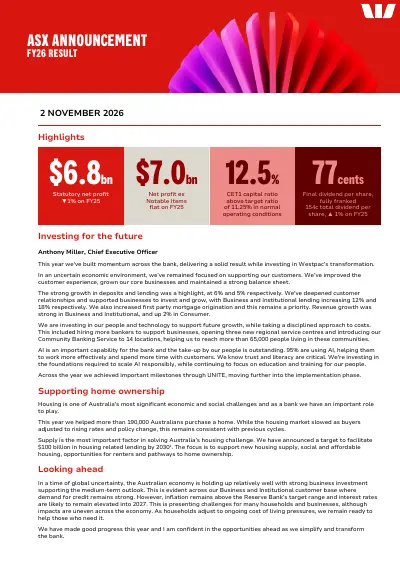
Net profit excluding notable items was steady at $7 billion, with 4% pre-provision profit growth offset by higher impairment charges. Our return on tangible equity was up 14 basis points to 11.1%.
The CET1 ratio of 12.5% was stable. The board has determined a final dividend of 77 cents per share, taking full year dividends to 154 cents fully franked.
Balance sheet momentum was solid, with growth in deposits and lending of 6% and 5% respectively. While cost growth was modest, our cost-to-income ratio of 51.9% remains too high.
I'm pleased with the momentum we're seeing across the franchise. We grew the balance sheet across all four segments while making decisive changes to how we run the bank.
We achieved pre-provision profit growth across Australia. The tilt towards business and institutional is progressing well, with pre-provision profit growth of 11% and 8% respectively.
New Zealand grew both deposits and lending against the backdrop of modest activity, with competition intense in a lower interest rate environment. We saw good traction in business banking, with lending excluding agribusiness growing above system.
We can and must do more to improve returns. We have a large, diverse, and well-balanced franchise with significant market share across consumer, business, institutional, and New Zealand.
This gives us significant scope to meet more of our customer needs. In consumer, the integrated service offering is shifting simple sales and servicing to digital, while focusing branches and assisted channels on more complex needs.
This should deliver a faster, more consistent customer experience. In business, one in five Australian businesses view us as their main bank.
Our opportunity is to do more for them. We're investing in bankers, rolled out regional service centres to strengthen service, and are aiming to deepen those relationships, particularly across working capital and transaction banking.
In institutional, we increased FX share and are building out our commodities trading and transition capabilities. As Australia's oldest bank, our performance is linked to the prosperity of our customers, our communities, and the broader economy.
I want to highlight two areas where striving to make a difference. Housing remains a national challenge.
We are supporting social, affordable, and rental housing, along with pathways to ownership, with a target to finance $100 billion in lending by 2030 across these areas. We're working hard to protect customers and get ahead of scammers.
Customer net scam losses declined 23%, and we helped prevent more than $350 million in losses. Our five priorities anchor how we deliver our strategy to drive sustainable returns for shareholders.
We're very clear about what we're going after and where we need to execute. We need to continue to prioritise balance sheet strength to grow and invest.
Better service helps us earn the right to bring more of the bank to each customer. This supports growth in deposits and proprietary lending, strengthening the economics of our franchise and supporting higher returns over time.
The significant investment underway is helping Westpac become more efficient, agile, and connected. As we deliver the transformation agenda, we'll be better placed to capture the benefits of scale, strengthen risk settings, and build a more resilient business.
Maintaining a strong balance sheet gives us the capacity to invest and grow with discipline. We are deliberate in our approach, with performance driven by supporting customers in their growth.
Our CET1 capital ratio of 12.5% is peer-leading, having improved by almost 3 percentage points over the past decade. We've also improved our funding position, with the deposit-to-loan ratio increasing to a new high of 85.5%, an improvement of 15 percentage points over 10 years.
This has supported growth while maintaining strong capital, funding, and risk settings. Housing lending grew 7%, while business and institutional lending increased 12% and 18% respectively.
Deposit growth was also solid, with household deposits up 7% and institutional deposits increasing 14%. We're investing in our people and leaders to build the workforce we need for the future.
Our workforce is highly engaged, and I've been really pleased with our AI adoption. There is a focus on strengthening their capabilities, and we're also simplifying how our people work.
We have simplified 195 processes since UNITE began. Ultimately, we want our people to have the skills, tools, and opportunities to perform at their best, serve customers better, and build long-term careers.
We're taking an enterprise-wide approach to how we build and use data, digital, and AI. Data is one of the most valuable assets we have, and we're getting much better at putting it to work for our customers.
Westpac Intelligence is putting valuable insights into the hands of our bankers to better understand and anticipate customer needs. Our initial AI use cases are showing potential, with models being built and deployed five times faster.
A combination of digital experiences and face-to-face support is helping us deepen our engagement with customers. Across Westpac, we're making it easier for customers to engage with us in a way that suits them.
Customers who are digitally engaged are four times more active with Westpac and 35% more likely to consider us their main financial institution. Since February, customers have made more than 100,000 appointments through the new Book a Banker tool, choosing a convenient time to discuss their home loan.
These service level improvements are translating into measures of advocacy. Consumer NPS reached an all-time high of +10 in July, increasing 4 points over the financial year and closing the gap to the leading major bank.
Business also made good progress, with NPS improving 4 points. We were number one for half the year, but slipped back as we worked through KYC remediation requirements.
In institutional, relationship strength improved to its highest level in more than a decade. We are in the early stages of improving our digital proposition in New Zealand to support higher customer advocacy.
We have made progress, however, there is more work for us to do. Deposits are central to our strategy, funding strength, and ambition to become the primary bank for more customers.
While the composition of deposits will ebb and flow over the course of the interest rate cycle, we have delivered improvement over time. Growth in quality deposits since September 2022 has helped to avoid the need to hold an additional $30 billion of liquid assets.
We've been able to divert that to additional lending. In consumer, we are targeting engaged customers through improved digital onboarding and propositions such as Spend & Save.
In business, we are growing the number of transaction accounts and specialist capability. In institutional, we retain a leading position in public sector deposits and will serve more client needs through Westpac One.
We must attract more transaction accounts and convert them into MFI customers. They provide more stable funding, richer customer insights, and a platform to bring more of the bank to each customer.
We are focused on getting the basics right: competitive propositions, simple digital experiences, and bankers with more time to understand and meet customer needs. The consumer segment delivered a resilient performance in a more challenging environment.
Following changes announced in the federal budget, home loan applications slowed across the industry. Proprietary lending for the Westpac brand increased to 42.4% of originations in the second half of '26, compared with 34.8% in the prior corresponding period.
The result shows what is possible when our people, processes, and technology operate in one best way on the right platform. It also reflects investment in bankers and deliberate work to strengthen consideration, improve lead quality and allocation, increase lender effectiveness, and simplify application requirements for consistent service.
There is further opportunity to improve retention and turn more customer insights into relevant lending conversations. Progress is good, but our proprietary mix remains below some peers.
Business lending momentum continued, with the book up 12% over the year, supported by growth across our major segments. Lending remained disciplined and relationship-led, with almost three in four loans written for existing customers.
Credit demand was strongest in medium and large businesses, with more work to do in small business. Other areas we are focused on is working capital and invoice finance, where our current position does not reflect our capability.
BizEdge is helping simplify business lending, reducing rework, and helping our bankers spend more time with customers. Institutional had another strong year.
Lending grew 18%, with the portfolio well-diversified and high quality. Much of that growth supported investment in infrastructure, energy, and resources.
The 81% of new lending to existing customers speaks to our established customer base and ability to serve customers as they invest and grow. We're also meeting more of their broader needs, with growth across debt capital markets and foreign exchange.
There is significantly more opportunity in transaction banking, and Westpac One is an important part of closing that gap. It brings treasury management, payments, foreign exchange, trade, and lending together, supported by richer data and a consistent digital experience.
The first pilot customer has now been onboarded. Over time, the platform will make it easier for customers to manage liquidity and cash across markets.
We want risk management to be a differentiator by enabling streamlined and better decisions that support us to deliver faster on our strategic priorities. Our credit quality remains resilient, supported by prudent underwriting and portfolio management.
We continue to simplify processes and strengthen controls across operational risk. We're also embedding the governance and oversight needed to deploy AI responsibly, and we continue to invest in cyber resilience, infrastructure, and customer protection.
UNITE remains the cornerstone of our transformation agenda. We delivered on all key FY26 milestones.
The Asgard migration to BT Panorama is complete, one commercial bank migrations are underway, and 18 legacy applications were decommissioned. The program remains on track.
We will continue to be transparent about progress and risk as delivery scales. We look forward to providing a full update in March.
We are using AI within UNITE. An example is the migration of the legacy St.George data warehouse.
The team used AI tools to speed up code conversion, testing, and documentation. This helped us complete the migration more than two years earlier at half the cost.
We expect to start booking the benefits of this from FY27. The tools, methods, and experience developed can also be reused for other migrations.
It is a good example of what can be achieved when AI capability is integrated. Catalyst is designed to improve the speed and consistency of execution.
We have moved from hundreds of annual projects to 21 delivery units and six practices with persistent teams, clear accountability, and multi-year outcomes. Catalyst is now live across the group.
While the early signs are encouraging, its success will be determined by whether it produces faster delivery, better outcomes, and a structurally lower cost base. That is what we will measure from here.
Nathan will now take you through our financial performance in more detail.
Nathan Goonan
Thanks, Anthony, and good morning, everyone. Starting with the financial performance over the year before talking in detail about the half-year trends.
My remarks will refer to the result excluding notable items, which relate to hedging and the costs associated with the RAMS sale and litigation. Net profit was flat, with higher operating income and lower operating expenses offset by higher credit impairment charges.
Revenue was up 1%, comprising a 1% increase in net interest income driven by an increase in average interest-earning assets and a 7 basis point decline in net interest margin, and a 1% increase in non-interest income. Operating expenses were 1% lower, including the restructuring charge in FY25.
Excluding the charge, expenses rose 1%. These revenue and expense outcomes resulted in a 4% increase in pre-provision profit, or a 1% increase excluding the prior year charge.
Credit impairment charges increased to 10 basis points of average gross loans, compared to 5 basis points in the prior year. Moving to the second half.
Net profit was up 1%, with higher operating income and slightly lower credit impairment charges more than offsetting higher operating expenses. The increase in operating income was supported by strong balance sheet growth.
Cost outcomes reflect seasonality of staff-related expenses, continued investment in strategic priorities, and ongoing cost discipline. These revenue and expense outcomes resulted in flat pre-provision profit.
Credit impairment charges were 9 basis points of average gross loans. Deposits grew 6% over the year, with growth evenly split between the two halves.
At a system level, the composition of deposit growth shifted in the second half beyond normal seasonal patterns. Broader macro trends, including the interest rate cycle and liquidity movements between sectors of the economy, drove divergence.
This resulted in strong market growth in government and ongoing growth in financial institutions. Household deposit growth was relatively stable, and non-financial corporate deposit growth moderated.
These trends were evident in our growth during the half. Institutional transaction and saving balances grew strongly, particularly in the third quarter, reflecting the market backdrop, continued momentum in our financial institutions strategy, and the strength of our leading government franchise.
Consumer continued to experience demand for savings products, and term deposit balances grew strongly across all segments, as term moved above savings rates for the first time in several years. This pricing dynamic subsequently reverted as we moved into the current half.
Offset balances grew, supported by both mortgage portfolio growth and customer preference. Our strategic focus remains on growing transaction banking relationships and becoming the main financial institution for more customers, with strong account sales across all segments supporting this objective.
Balance growth moderated in consumer transaction accounts in line with seasonality, while business and wealth transaction balances contracted as the system softened. Loans, after rising 4% in the first half, increased a further 3% in the second half, with growth across all segments.
Australian mortgages grew 3% in line with system. This reflected sustained improvement in our first-party proposition and continued execution of our mortgage strategy.
Activity moderated in the fourth quarter, and we expect system growth to slow to 3.8% in FY27. Australian business lending continues to show good momentum, growing 7% in the half.
While growth was diversified, it was strong across target sectors. The larger commercial, regional, and agriculture segments generated most of the growth, while SME performed well, albeit off a considerably smaller base.
Institutional lending grew by 5%. Growth was mostly investment grade and in the financial sector, including our participation in the funding structure accompanying the RAMS sale.
Lending grew by 2% in the half for New Zealand, where demand for credit improved, notwithstanding a challenging economic environment. Operating income increased 1% in the half to $11.4 billion.
Income excluding Treasury & Markets and the depreciation of the New Zealand dollar was up 2.3%, reflecting solid operating momentum across consumer, business and wealth, and institutional segments. Strong balance sheet growth more than offset a reduction in movements in core NIM.
Fee and wealth income increased, driven by lending activity and higher funds under administration. The depreciation of the New Zealand dollar had a $60 million adverse impact.
Treasury & Markets income decreased $65 million. Treasury income was $50 million lower, while markets income excluding DVA declined $44 million, as rates activity slowed in the fourth quarter.
Total Treasury & Markets income was 5% below the 5-year average. I will review the components of net interest margin in detail.
Core net interest margin decreased 3 basis points to 175. As expected, the non-repeat of timing differences following RBA rate changes in the first half added 1 basis point, and the replicating portfolio added 2 basis points across deposits and capital.
Lending margins were lower and rounded up to a 4 basis point impact. The rate of compression moderated in institutional lending, was stable in business lending and Australian mortgages, and was more pronounced in New Zealand mortgages, where competition intensified as fixed rate lending increased.
Deposits contracted 1 basis point, as benefits from the replicating portfolio, higher rates, and term deposit spreads were more than offset by higher qualifying rates on savings products and mix. The 2 basis points of mix impact comprised 1 basis point from divisional mix as higher rate institutional deposits grew faster than other segments, and 1 basis point from product mix as customers shifted to higher rate term deposits.
The total mix impact and the impact of higher qualifying into savings products were both more pronounced in the fourth quarter. As foreshadowed at the third quarter, liquid assets moved from a benefit to a drag in the fourth quarter, reflecting stronger than originally expected deposit growth at the time of the RAMS divestment.
Overall, liquids were neutral in the half. The Treasury & Markets contribution of 11 basis points was stable.
Looking ahead to the first half of 2027. The replicating portfolio is expected to be a benefit of 2 basis points.
Liquid assets should provide a 2 basis point benefit as they are expected to grow slower than lending assets. We expect a 1 basis point benefit from the September RBA rate rise on unhedged deposits.
We expect overall lending margins to edge lower as competition persists. However, next period, this will be partially offset by mix benefits from the sale of RAMS and the repricing of credit cards.
Deposit mix is expected to be less of a drag as institutional deposit balances contracted in the fourth quarter and are expected to grow in line with the book moving forward. We expect customers to continue to be attracted to higher-yielding products and qualification rates to remain high.
We have also provided sensitivities to potentially higher interest rates. This slide provides important context to our cost position.
We are sustaining investment to grow and simplify the bank, while maintaining discipline over the broader cost base. Cash investment spend is 9.4% of revenue, reflecting the scale of the transformation underway.
A greater proportion of our investment is also expensed, which increases reported costs today relative to peers. We understand the critical importance of executing UNITE and more broadly delivering improved benefits from this spend.
Catalyst provides an important structural opportunity for us. At the same time, productivity delivery is accelerating.
We delivered $581 million of structural savings in FY26 and are targeting more than $600 million in FY27. This productivity provides an important shield to inflation and presents opportunities to reinvest in our strategy.
Our commitment to strong cost discipline and structurally lowering our cost base over time remain unchanged. In this context, expenses increased 1% to $11.8 billion in FY26.
The rise in employment costs reflected higher wages, continued investment in bankers, and the build-out of our DDAI function. The moderation in technology costs, notwithstanding ongoing inflation, reflected a shift in some spend into the investments category in the second half, combined with disciplined vendor and volume management.
The slight rise in volume and other reflected a GST benefit and sizeable unit cost savings from the team's ability to absorb higher volumes. Higher structural productivity savings included the benefit of a simpler operating model, reductions in branch spaces, and the initial benefits of UNITE.
Investments were up significantly. Drivers include higher cash spend, the recategorisation of some spend from technology, and lower capitalisation rates.
The latter was a result of higher proportion of UNITE investment. Overall, we are managing costs well.
The underlying cost trajectory is improving, and we are pleased with the execution of our full year plans. As we enter the new financial year, we expect similar cost growth to FY26, and there are several items to consider.
Employee costs will rise as the impact of the enterprise bargaining agreement flows through. We continue to reinvest productivity savings in bankers and data, digital, and AI talent.
There will be less benefit from prior year restructuring costs. Technology expenses are expected to accelerate as we invest more in AI, strengthen cybersecurity, and absorb ongoing vendor inflation.
Amortisation will become a tailwind as our amortisation expense peaked in the first half of '26. Finally, the New Zealand dollar FX benefits are unlikely to repeat.
Moving to investments. We spent approximately $2.1 billion in FY26, with UNITE accounting for 44% of that spend.
This was slightly higher than previously guided, reflecting a shift of some technology costs into investments and slightly more spend on UNITE. The proportion of investment spend that was expensed increased to 68%, with UNITE the main driver, expensed at 75%.
Looking to FY27, we expect spend to be relatively stable. UNITE is projected to be between $850 million and $950 million.
We expect spend on growth and productivity to increase as we invest in our strategy across DDAI, BizEdge, Westpac One, alongside the end-to-end productivity opportunities we see in our major product lines. Overall, credit quality metrics remain sound.
Businesses continue to show resilience, and while consumer spend has slowed marginally, is at a reasonable rate of growth by historical standards, and unemployment remains low. Stressed exposures to total committed exposures increased 1 basis point.
Households have been resilient in the face of higher interest rates and cost of living pressures. Mortgage delinquencies are flat over the year and edged up 5 basis points in the half.
Hardship balances rose 3 basis points. In New Zealand, mortgage arrears decreased by 8 basis points.
We are cautious of the impacts of the ongoing Middle East conflict and higher rate environment, with the balance sheet provisions well-placed for potential deterioration. The unemployment rate will continue to be the major determinant of mortgage asset quality.
Total credit provisions were flat at $5.2 billion, $2 billion above our base case. Total provisions to gross loans was stable at 58 basis points.
Collective provisions decreased slightly due to the RAMS sale. Excluding RAMS, collective provisions increased by $129 million, reflecting a combination of modelled outcomes and management judgment.
As a result, collective assessed provisions to credit risk-weighted assets decreased 2 basis points to 127. The movement in provisions comprised an increase reflecting the modest deterioration of 90-day-plus delinquencies in the mortgage portfolio and the impact of declining house prices, new overlays related to energy-intensive and discretionary spending sectors, management updates to the downside severity methodology, and a release from updated economics forecasts, largely reflecting an improved GDP outcome.
Individually provisions increased $48 million. New and increased individually assessed exposures were $497 million, up $34 million on first half '26, largely driven by single names in the utilities, agriculture, and transport sectors.
A strong balance sheet is critical to our strategy and a consistent focus of ours. It supports growth and value creation over time.
That strength is reflected in our liquidity and funding position, underpinned by high-quality customer deposit growth. We raised $40 billion of long-term funding during the year.
Most of this was issued during the first three quarters. Strong deposit growth together with the RAMS sale narrowed our funding gap.
The deposit-to-loan ratio increased half a percentage point to 85.5%, a new high for our bank. Our liquidity and funding metrics remain comfortably above regulatory minimums.
We believe that is appropriate given the market backdrop. The average LCR of 137% was elevated in the last quarter, with strong deposit flows coinciding with the proceeds of the RAMS sale.
Subsequent actions through limited issuance and the expiry of both short- and long-term wholesale funding has reduced the spot LCR to the high 120s as we begin the new financial year. Our capital position provides us flexibilities and opportunities over the medium term.
The CET1 capital ratio ended the year at 12.5%. Net profit added 74 basis points, while the payment of the interim dividend reduced capital by 57 basis points.
Risk-weighted assets detracted 28 basis points, with higher lending balances more than offsetting data refinements. Asset quality movements consumed 2 basis points.
IRRBB detracted 5 basis points, with higher swap rates driven embedded losses in the fourth quarter more than offsetting an initial benefit in the third quarter. The level of embedded loss and execution of our standardised optimisation program mean the capital floor is not currently binding.
We received a 23 basis point benefit from the completion of the RAMS sale. Looking forward to the first half of 2027, there are several considerations.
The completion of the share buyback would subtract 22 basis points. Risk-weighted assets were $4.5 billion above the standardised floor as we start the year.
Standardised risk-weighted asset optimisation initiatives and regulatory changes are expected to provide benefits. Movements in IRRBB risk weights will ultimately impact whether the floor becomes binding.
To provide a sense of potential asset quality impacts that could arise, the sensitivity to a one-notch downgrade to exposures in energy-intensive sectors is an increase in risk-weighted assets of approximately $5 billion. Our capital position is strong, and our principles for managing this position remain the same.
We have not changed any of our capital management settings this half. We have $1 billion of the previously announced buyback outstanding.
We continue to see value in the flexibility provided by this form of capital management. We have approximately $2.9 billion of capital above our CET1 target, adjusted for the declared dividend of 77 cents per share.
The payout ratio excluding notable items was 75%, which is at the top of our target range of 65% to 75%. Our priority is to maintain a strong balance sheet, invest to improve earnings quality, and pay fully franked dividends sustainably.
With that, I'll hand back to Anthony.
Anthony Miller
We continue to measure progress through service excellence, one best way, and performance. While we have made progress, the scorecard outcomes against targets are mixed.
Advocacy is moving in the right direction, yet customer primacy remains below our ambition. We met the key UNITE milestones.
We're currently at peak spend and are approaching the halfway mark of projected total investment. Employee engagement improved, but more progress is required to reach top decile.
We remain confident in achieving our return targets relative to peers. Australia remains one of the most attractive destinations in the world for capital and talent.
We have significant opportunities in infrastructure, energy, resources, technology, and housing. Realising that potential will require improved productivity and higher levels of investment.
Banks have a role to play. Our job is to support customers through periods of uncertainty while directing capital towards investment that drives growth, creates jobs, and lifts living standards over the long term.
We are optimistic on Australia's outlook, although we have positioned the balance sheet to withstand a more challenging environment. Growth in private investment is significant and should support broader economic activity.
We expect system credit growth for business to be in the range of 6% to 7% in both FY27 and FY28. The outlook for housing is more subdued.
While all cycles have their nuances, with the shape of this cycle influenced by policy changes, we expect turnover and credit growth outcomes to be comparable with other cycles that we've seen since the GFC. We anticipate a peak-to-trough decline in house prices to be 11% before recovering in the second half of next year, and for housing credit growth to slow to below 4% in FY27.
Westpac has a quality franchise, deep expertise, a strong balance sheet, and engaged people. Our task is to convert them into better outcomes for customers and shareholders.
We're clear on our agenda for FY27, the focus of which will be executing UNITE, keeping a tight grip on costs, lifting customer advocacy, growing deposits and proprietary lending, and sustaining momentum in business and institutional. We know what we need to do, and we're focused on executing with discipline.
Thank you.
Justin McCarthy
Thanks, Anthony. We'll move to Q&A now.
There's quite a few of you online and listed, if you could limit your questions to one per person, that would be appreciated. Our first question comes from Jonathan Mott from Barrenjoey.
Jonathan? Oh,
Jonathan Mott
thank you. Question for Nathan, if I could.
It's on the margin of the core NIM in the fourth quarter. It looks like it was down very sharply, by about 6 basis points or that 172.
If you look at that, you've called out movements in deposits, as sound like government and financial institution deposits. Could you comment on the impact of those on the margin in the fourth quarter?
Was this kind of a one-off increase in liquidity that has moved that number? Should we use that 172 as a starting point, or is that just a bad quarter given this liquidity movement?
Nathan Goonan
Yeah. Good morning, John.
Happy to try and sort of unpack that a little bit for you. I sort of call third quarter at 173, but we're sort of splitting hairs.
I do think, as we've been speaking about, there's a lot of rounding and a lot of moving parts in NIM, and so it's a little bit more where you start at the start of the quarter and a little bit as to the trends underlying. If I just talk about the fourth quarter, it's probably just a story of some of the things that we talked about for the half being a little bit more pronounced.
Maybe just starting with liquids. Liquids were flat over the half, but they were a 3 basis point benefit in the 3 basis point detractor in the fourth quarter.
I've said in my pre-prepared, we expect liquids to be a 2 basis point benefit in the first half, I do expect that to be one of the trends in the fourth quarter that well and truly unwinds. The point of that is, I also said this, just as it relates to LCR, we did, as we came into the RAMS sale, we had positioned the balance sheet with quite a lot of liquidity in and around that.
Then the government deposits in particular were quite strong in the third quarter in the system, and we've got the leading share there, and we caught our fair share of that. We did end up with LCR probably in the mid-140s there for a little while.
We exit the year with LCR back down in the high 120s, I expect, as I said, flat in the half, 3 basis point impact in the fourth quarter, and 2 basis points if you look forward to the first half. Then on deposits is probably the other big swing factor, they were 1 basis point for the half, but 4 basis points in the fourth quarter.
Just to unpack that a little bit, we had on the slide there that TDs was a 1 basis point benefit for the half on TD pricing. That was neutral in the fourth quarter after being a benefit in the third quarter, and I'd expect that that will be neutral as we go into the first half.
Then the mix impacts, which is what you were sort of talking about, that was much more pronounced in the fourth quarter. I called out in my pre-prepareds that that impact was a 1 basis point impact in the half, that was most pronounced in the fourth quarter, and I don't expect that that will repeat as we go into the first half.
Then just to say, qualifying rates were higher in the fourth quarter, and shift to higher rate products were higher in the fourth quarter. I'd probably expect those trends to be present as we go into the first half.
Hopefully a bit of detail there that just helps understand some of the moving bits.
Justin McCarthy
Thanks, Jonathan. Our next question comes from Brendan Sproules from Goldman Sachs.
Brendan?
Brendan Sproules
Good morning. I just got a question on costs.
You've called out today a step up in productivity next year. Last year you took a restructuring charge.
Is there likely to be a restructuring charge associated with this next year's productivity?
Nathan Goonan
Thanks, Brendan. It's actually one of the things I called out there maybe subtly in the pre-prepareds.
No, we don't expect that. I think we're trying to build muscle here where we can deliver the productivity, but do that with restructuring that rebuilds during the FY27 year.
That we don't expect to have to do the one-offs again.
Brendan Sproules
Thank you.
Justin McCarthy
Thanks, Brendan. Our next question comes from Tom Strong from Citi.
Tom?
Tom Strong
Thanks. Thanks very much for taking my question.
Perhaps a question for you, Anthony. When you've been talking thematically, I guess around the shift from public demand to private investment, including infrastructure and data centres, I was just interested if you could provide some context for how significant you think data centres have been in terms of loan book growth, either directly or indirectly in the book.
Anthony Miller
Certainly not significant in terms of the growth that we've realized over the last 12 months in the institutional business. There's a lot of commentary, there's a lot of hyperbole, I suppose, Tom, around what's going on with data centres.
The way we look at it and where we've been particularly focused is there's a whole suite of customers we currently have who have very large, well-diversified businesses, and it makes natural sense for them to be a little bit more active in, call it storage of data, or potentially compute capacity for the AI theme. We're very focused on banking existing customers who have very diversified businesses who are now able to prosecute an agenda in the data centre space.
The growth we think in the next year, there's some very interesting opportunities, but we're coming at it very thoughtfully because I think there is a little bit too much hype, and it's really about those you partner with, and as I said, we're sticking with our existing customers on that one.
Justin McCarthy
Thanks, Tom.
Tom Strong
Great. Thank you.
Justin McCarthy
Our next question comes from Andrew Lyons from Jefferies. Andrew?
Andrew Lyons
Thanks, and good morning. Nathan, maybe a question for you.
You're in the midst of a pretty dramatic shift in your loan book mix towards non-mortgage lending, which tends to be more risk-intensive than mortgages. In light of this, it's interesting to note that while your CP coverage of credit risk-weighted assets fell only marginally in the half, about a basis point, compared to non-housing loans, it actually fell more 10 basis points in the half.
Why are we not seeing more provision build, or more provision coverage, as you shift the book's loan mix, as you have in the last two halves?
Nathan Goonan
Thanks, Andrew. Good morning.
I think one of the interesting dynamics probably for us in the half, Andrew, was that while we had an increase and we had sort of new and impaireds come through and we did have about a $45, I think, million increase in individually assessed provisions, which was largely in that non-retail space, what we did see was overall stress in, in particular, in business and wealth got better. We've been sort of one of those interesting periods where the actual experience hasn't really been coming through in the way that you would expect.
We've got a small uptick in impaired, the tougher end of that maybe got a little bit tougher. Actually, on things like 90 days arrears in the business bank, they actually improved during the period.
The modelled outcomes were just giving us that outcome. I guess in response to that, and it's probably a more broader question about provisioning, we do think in light of modelled outcomes giving us a release, we have taken management actions just to try and make sure we're holding on to that coverage, whether it be overlays, which are particularly focused in those energy-intensive sectors or the non-retail sectors exposed to discretionary spend, and then changing some of the ways that the downside scenarios impacting the modelling.
We've sort of been able to counteract that and hold on to provisions. It's just a mass, and I think as you get through the detail, you'll see, maybe despite a lot of what people could have expected, our business and wealth portfolio showed some improving trends in the half.
Andrew Lyons
Thank you.
Justin McCarthy
Thanks, Andrew. Our next question comes from Matthew Wilson from Jarden.
Matthew?
Matthew Wilson
Good morning, Matthew Wilson, Jarden. Perhaps coming from Andrew Lyons's question from a different angle.
If we look at your risk grade profile for the non-housing loan book over the last 3 years, this is something you disclose on slide 98, AAA's actually fallen from 26% to 24%, or the A's rather, and then all the B's have gone from 21% to 25%. The book looks a lot riskier.
Then when you try and square that with your margin performance across Insto and business banking, Insto NIMs are down 23 basis points, business banking NIMs are down 74 basis points over that same period, are you getting rewarded for the higher-risk positions you're taking, and what does that mean given it looks as we're going to have a credit cycle next year?
Nathan Goonan
Maybe I'll just start with just something on the margins, and then Anthony might want to comment on quality of the book, and we can come back to it. Good morning and, I should have said hi to start, so.
Just to say on the margins, it is important just to read through a little bit on divisional margins, because at the divisional level, you're bringing in the movement and the relative movement between deposits and lending. I think we've got in the slides, we've tried to provide a little bit more disclosure this time just on lending revenue that we're generating in those businesses and then lending margins.
I'd say, if you just took the half, and I know we're isolating in on the half, I think institutional lending deposits have been pretty stable. They might be, there or thereabouts, a basis point movement, and lending revenues been very strong, and we had that in some of the slides.
Equally, in business bank, we've had very strong lending revenue growth alongside that balance sheet growth. The thing that's impacting the divisions is more of mix shift around the deposits and lending, rather than necessarily the competitive pressures in lending.
They're there. I'm not here to tell you that we're not seeing margin compression on the lending side, but it's proportionally, it's just important to get the right read on it.
Then on credit, maybe Anthony might want to have a comment on just as we've diversified the book, that naturally means that you go away from some of the very high-grade, FI stuff in the ...
Anthony Miller
Equally, good morning, Matt. Certainly, the whole focus has been on growing with existing customers in particular, and the book is one which has a lot of very high-quality, high-graded customers.
What we've seen with that group of customers is very much getting behind a certain set of thematics which are really sort of encouraging in terms of, first of all, the size and the momentum, and secondly, the credit quality. The defence ecosystem build-out is ultimately underpinned by a set of AAA obligations reflecting the federal government or the United States government, for that matter, in terms of their activity and how we're supporting them, for example, with accommodation in Australia.
Likewise, you go through the infrastructure, again, high-quality, underlying credit exposure, and it's all with existing customers which have that exposure to either AAA or a version of AAA risk. To the extent that some of it has moved a little bit away from AAA, it's at the margins, candidly.
When we think about this stuff, and we look at the pricing of it, it's about, yes, there's a margin we've got to manage, but also we've got to look at the return on tangible equity, and we are very drawn to the attractive returns we can generate in that space on the return on tangible equity metric. Then more importantly, much of what you then do with those better credit credits is take it into the capital markets, and we've seen that then cycle into a much more significant increase in activity in the DCM business over the last year.
I hear you about sort of some of that sort of Matt, you've called out, but we're quite confident about the existing customer base, the existing set of, if you will, credit exposures that they have, and the opportunity to bank those thematics that I called out.
Matthew Wilson
Thank you.
Justin McCarthy
Thanks, Matt. Our next question comes from Ed Henning from CLSA.
Ed?
Ed Henning
Hi, thanks for taking my question. Could you just go back on on what you're hearing a little bit more on both the lending and the deposit side of the competition?
I know you've called out stable margins in the institutional book, but if you could touch on how you're seeing the outlook across the board, including New Zealand, and are you still happy to be aggressive and grow market share in this environment?
Anthony Miller
Can I make a couple of comments, and Nathan, please jump in. I wouldn't describe our posture as aggressively growing market share.
What we're very focused on is banking our existing customers, and so it's to the extent that they see opportunities and those opportunities align with their strategy, and align with the opportunity that we think's available in the marketplace, then we're very, very focused on very actively, perhaps aggressively, supporting them. We're not sort of postured to just simply grow for the sake of growth.
I just want to sort of really call out that 80% of what we're doing in Insto is with existing customers. It's very selective in terms of customers otherwise.
Likewise in business bank, we're seeing the same, 74% or so is existing customers, and it's very selective in terms of where we go in terms of adding customers. That's the same posture that we see in New Zealand again, which is it's all about banking our existing customers, and the whole opportunity that's ahead of us is with the balance sheet we have, the capital and balance sheet we have now, we have an opportunity to navigate this reasonably interesting environment, and most importantly, be there for our customers and help them take those opportunities when they present.
It's not an aggressive grow market share posture, it's about banking our customers.
Nathan Goonan
Maybe Good morning, Ed. Maybe just to add.
I think don't take us that we're saying that there's not margin compression in these books as well. I don't want that to be the takeaway.
I think if you just if you looked at the business and wealth and say business lending margins in particular, and you focused in on that, if you took three halves in a row, we might have been down something like 7 or 8 basis points on lending margin, then we're down 6 basis points on lending margin. This half, we've been down about 3.
Our comments are more a stabilising compression there. I think if you look at some of the underlying on this, and there's always lots of commentary about who's pricing where in the market, and it is very competitive.
We know that we've got a whole market that are focused on these because of the returns that are able to be generated there. I think we look at our win-to-loss ratios, we've still got very high levels of retention in our business and wealth business, and then on new to bank, it's been pretty stable.
We've been sort of winning about 60%, 65% on the on the new to bank, and then we've been improving first-party mix. They're signs that we're sort of participating in the market well.
We feel like we've got lots of opportunities to continue to grow and improve the mix in there. I think, we're just seeing it as it comes.
There will still be margin compression there, but we're saying it's a bit more moderate. Then in New Zealand, it's been particularly pronounced on fixed rate lending, Ed.
There's been both a mix shift into fixed rate lending, and you, as a keen watcher of that, will know that variable rate mortgages in New Zealand are much higher margin than fixed rate lending. We've seen a but like we might have been 88% fixed, and we've moved to 90.
That has a very big impact in a relative sense in New Zealand, and then it's been particularly aggressive on those fixed rate mortgages. Where we've been sort of sitting out a little bit on that in terms of market share, but we're hoping that that'll normalise a little bit as we see a little bit of rate increases in New Zealand over the next little while.
Justin McCarthy
Thank you, Ed. Our next question comes from Andrew Triggs from JP Morgan.
Andrew?
Andrew Triggs
Oh, thanks, Justin. Just a question for Nathan, please.
Nathan, appreciate your comments earlier in response to John's question on the liquids impact on the fourth quarter NIM. Maybe just sort of set aside NIM and just look at core NII.
Did you see any growth in Q4 in core NII? Very rough calcs suggest that it was, well, maybe flat to slightly down despite a bit of a day count benefit in Q4.
Nathan Goonan
Oh, to be honest, Andrew, I'd have to actually check it to be really precise on that. I think the dynamics that we called out are the dynamics.
I'd probably have to take it offline and just check exactly whether we had core NII growth. Certainly, as I said to you, I think that the big impacts in the fourth quarter were most pronounced: liquids, flat and then 3 basis point impact in the fourth quarter, and deposits 1 basis point for the half, and then 4, and then I sort of try and unpack those bits that won't flow forward into the first half.
That's what I'd say. Lending, I didn't cover earlier, was probably a little bit better in the fourth quarter than the third quarter, and as I said in my pre-prepareds, we will get the benefit both of a little bit of mix benefit from RAMS in the first half and then, interchange changes coming through, should have an impact on NIM, although, overall, we're compensating for loss of non-interest income there.
Andrew Triggs
That's fair. Nathan, just broadly, your comfort on just converting the really strong surplus capital position you have into profitable growth in the midst of a pretty tough competition backdrop?
Nathan Goonan
Yeah. Oh, no, I think, look, we put a slide in there, Andrew, just to try and show some of the underlying momentum, and I think in whether it be the slide up front from Andrew, or I think in my pre-prepareds, I just tried to show underlying, we had revenue growth of 2.3%.
I think we certainly don't want to be a management team that's sort of explaining away different things that are moving against you. I think, whether it be some of the transitory impacts on a revenue sense, some of the transitory impact of asset sales year-on-year, whether it then be returning Treasury back to, like, 5-year averages, getting markets moving again, and then more broadly, I think we've got good opportunities both within all of our business lines to be able to generate underlying revenue growth.
We're really confident we can do that, both in the core lines that we've got, and then, as we've got a crusade here to do more with our existing customer base, and we still feel like we're very significantly underpenetrated in a lot of lines, whether it's working capital, FX, etc. Green shoots, but a long way to go.
Justin McCarthy
Thanks, Andrew.
Andrew Triggs
Yeah. Thank you.
Justin McCarthy
Our next question comes from Victor German from Macquarie. Victor?
Victor German
Thank you, Justin. Another question on margins, but maybe just a little bit more focus on deposit cost outlook.
Looking at deposit mix, I was just wondering if you could maybe separate between strong I think, Matthew, you talked about strong institutional deposit growth having an impact on that mix, versus what you're experiencing with migration within the retail and SME books towards higher-rate products that are increasingly prevalent. I guess also toward what proportion of savings balances now earn bonus interest.
You've called out 2 basis point headwind. Where do you think it's going to go into 2027?
I guess, to what extent would it be reasonable for us to assume that deposit headwinds will moderate from here going into 2027, or is it still an area of likely headwinds for us to consider? Thank you.
Nathan Goonan
Thanks, Victor. Good morning.
You want to take that? I think the way I would answer that, Victor, is just to say, break that down a little bit.
I think that the mix impact we called out was 2 basis points in the half. 1 basis point of that was about the institutional relative growth relative to the rest of the book, and 1 basis point of that was about the mix shift in products, as you said.
Higher term deposit growth and higher savings growth in consumer. Then if you look forward, we would expect that the mix of products, term and savings, that 1 basis point to continue, but we don't expect the institutional mix basis point to continue into '27.
That was more accelerated growth in the third quarter. It did moderate in the fourth quarter, and we don't expect that that is a feature as we go forward.
Hopefully that answers that part of the question. Savings qualifying rates ...
About 1 basis point Sorry, and
Victor German
about 1 basis point impact per half is is a reasonable starting point?
Nathan Goonan
Then
Victor German
from that? Yeah.
Nathan Goonan
Yes, that's right. On the mix shift from TDs to savings.
The high growth in those, yeah. It was a 2 basis point for the half, 1 basis point Insto, 1 from that, and I would expect the 1 underlying you could continue.
Then when you get to qualifying rates, I think we said it was 2 basis point impact in the half. We've got a slide there, I think in the back.
It's in the 70s, I think it might be page 74. It does have the qualifying rates there, we ended up at 87 for the second half.
It was probably a touch higher than that in the fourth quarter. Maybe Anthony will talk about this.
We're really pleased with how we're going in this savings product. Now, it does come with some margin impacts when you look at it on a period-on-period basis, but the team are using these qualifying products to, one, generate main financial institution customers that we so desperately are after, but then, two, to target certain portions of the customer base that we really want to grow.
I think there's a stat there that our young adult new to bank customers was something like 44% of our flow in the half was young adults, that's versus a 22% stock number. The team are using these qualifying rates to target some of the segments that I know Carolyn outlined in her update and going after.
I think we're pleased with what we're doing there. We're getting more digitally engaged customers who are more likely to be main financial institutions, and the blended margin of that is still better than a TD.
Oh,
Anthony Miller
look, it's very deliberate, Victor. I think we wanted to very much make sure that customers understood what was needed to qualify for the bonus rate, and so we had push notifications, and we went after it, and customers picked it up.
In some respects, they reacted faster and more comprehensively than maybe anyone expected, but we're pleased with that, because the focus has got to be anchored around: let's get that customer engaged, let's have that customer feeling like they are looked after and they can trust this institution, and more importantly, then recognise us as their main financial institution. Then of course, the longevity and the depth that they then bring is how we drive a better return over time.
Sort of make no apologies for that focus on this is the right way to engage, attract, retain these customers. Importantly, we've seen NPS scores just exceptional improvement off the back of that level of engagement that we've now generated.
Secondly, when they stay with us, they do put more savings with us. They then start to incrementally increase what they'll do with us, and then more importantly, they start to do other things with us, which diversify and improve our returns.
It's all about how do we use this as a technique and as a discipline to ensure we're thinking whole of customer, and it's about longevity and depth with that customer.
Justin McCarthy
Thanks, Victor, and well done at getting five into one. Richard Wiles is the next question, and he's from Morgan Stanley.
Richard?
Richard Wiles
Good morning, everyone. Slide 33 shows the stress exposures by industry sector.
Can you explain to us how the stress in the construction industry went down in the past 6 months? Is that due to the changes in categories that you refer to in the footnote, or is it a real trend?
Could you also comment on what trends you're seeing in retail trade and transport and storage, please?
Nathan Goonan
I'm happy to start on the numbers, and then maybe you can do a bit on the trend. Good morning, Richard.
How you going? I think one of the things here that we've seen in construction, and maybe if you flipped, and apologies to do it, but I think right in the back, we have a little bit more of a breakdown of that exact chart that you're looking at, but underneath it, we put the stressed exposures and the individually assessed movements in it.
In construction, you've probably had a bit of a barbell here, where we've had an increase in individually assessed, you had some things that have moved out of, call it, stressed into individually assessed. Sorry, individually assessed is part of stressed, we've seen the migration down into individually stressed.
Then we've seen some improvement, we had some upgrades in that sector that moved them into performing. Like I said before, we have had an improvement in 90-day past due across a number of sectors in business and wealth, and so we've just seen, while we've seen some downgrades in that sector, we've also seen some upgrades, and that's what's driven it.
Anthony Miller
Yeah. Just in construction, sort of feels like it's a tale of two there, Richard, in the sense that at the larger end, the sizable end of the market, they are, if you will, navigating and are able to accommodate cost inputs: labour, materials, et cetera.
They're also, arguably, in more of that setting where contracts can be varied, and so there seems to be a better outlook. That's not to say that it's that much more positive, but it's certainly a better position.
What's interesting is the smaller end in the construction space, and it's been much harder. They cannot pass on cost variations and are finding it more difficult.
In the smaller end, there's a sort of economic snapshot we released last Friday, which sort of highlights in the construction in SME and smaller enterprises, their costs were up in 12 months 17%, and it's very hard for that builder, for that developer, that construction entity to pass those costs on, and so that's why we're seeing some stress there. Therefore, when it is trending in a better direction as an average, it belies that actually larger end is going better, smaller end is not going as well.
Richard Wiles
The retail sector, guys?
Anthony Miller
On the retail sector, again, a couple of sort of interesting aspects. The larger entities can and are able to navigate the environment, and this is the thing that I think stands out to us most consistently, and the fact that we've grown in the larger end of the business bank and obviously the institutional business is because those businesses do have opportunity and they are able to navigate this environment better than others.
In the smaller end, again, it comes down to the fact that can they pass on those costs, can they absorb those costs, and we're seeing that in the smaller end of retail, in particular, it's a little harder, but in the larger end, they are able to. The fact that if you look at the consumer spending data, discretionary spending is still up, notwithstanding what's occurred over the last year, but the cost to run the business and provide that product or service to the customers are up.
The larger end has been able to navigate that, the smaller end has not, and that's sort of part of the tale of the tape here as well.
Nathan Goonan
It would be the same dynamics on the mass, Richard. You'd just have a small number of single-name exposures moving between the buckets.
Richard Wiles
Okay. Thank you.
Justin McCarthy
Thanks, Richard. Our next question comes from Matt Dunger from Bank of America Securities.
Matt?
Matt Dunger
Yes, thank you, Justin. I wanted if I could ask about the capital leadership.
You've called out some tailwinds from the data refinements. I believe there's more to come, wondering if you can quantify that.
Also, given the share price weakness this year, at what point does reactivating buying back on market become attractive, noting you've still got that outstanding?
Nathan Goonan
Thanks, Matt. Why don't I just kick off, and then Anthony can chip in.
I think, on the data refinement, I think it's an interesting one. We had about, if you think risk-weighted assets, I think data refinement was about $3.5 billion for the half, about $7 billion for the year.
That's coming off numbers where we've been doing sort of, call it, $10 billion a year for maybe 3 or 4 years in a row. It's a slightly lower year, but still good opportunities, and I think, as we've spoken about before, that's not new models, it's all data clean-up.
I think what's been more pronounced for us and focus for us this year has been on the standardised optimisation, and so it doesn't show up necessarily in the walks because it's all hidden still having some headroom to the standardised floor. We've done a significant amount of standardised risk-weighted asset clean-up, and that's been a big focus.
That number, I think, is in excess of $15 billion of standardised risk-weighted asset benefits that we generated during the year, and we've got a really good pipeline of those again to be able to continue to go after. They're in that same vein of better data clean-up, better understanding of what the underlying's doing, and so really good hygiene work there.
Then on the standardised side, we'll continue to get some benefits. We had on the slide there, we get the RBNZ changes come through.
That's about $5 billion of benefits that came in on the standardised side from 1 October, and then we're obviously in consultation with APRA about some changes to standardised, which could be a similar size again, maybe even a shade higher. That'll give us some cushion on the standardised side, and the optimisation program there should mean that we can get through the year without going into the standardised floor, albeit movements in IRRBB is going to be the really big thing there.
Just we're at elevated levels, as you know. We've got our core NRS model still yet to be approved, we're holding a little bit of excess there, and then wherever swap rates go on the embedded loss will be the big determiner whether we end up in the floor or not.
Hopefully that answers the question on that, Matt.
Anthony Miller
The only thing I'd add is the exam question for us as a leadership team, set by the board, is to allocate capital with the best return for the shareholder. We continue to balance that decision every day, and it's also an environment where I just think a slightly conservative posture, because let's see how this uncertainty plays out.
Importantly, that uncertainty is going to potentially create some challenges for our customers, we want to be there and be supportive. Then equally, there could be some very interesting opportunities that will emerge as well.
It's about just being patient and knowing that we can go in the direction we need to go, always on the basis of what's the best outcome for our shareholder.
Justin McCarthy
Thank you, Matt. Our next question comes from Brian Johnson from MST.
Brian?
Brian Johnson
Thank you very much, and congratulations on the share price reaction today as opposed to the initial commentary from the street. Just on Project UNITE, we can see that next year you're going to spend $850 to $950, and I apologise, you probably just don't really want to talk about this at the moment, but this was initially slated to be a $3.5 billion project.
I'd just like to understand, to the extent we can, is if you're talking $850 to $950, is this telling us that it's going to cost more than the $3.5 billion, or the expense side that will be completed earlier?
Anthony Miller
I'll jump in, and Nathan, you can correct me. We just describe it as $850 to $950, Brian.
The absolute focus is it will not be above $3.5 billion, and we are on track at this point in time. The second thing in terms of describing $850 to $950 is, and a percentage, if you will, of our investment envelope, it's more because if we can get more done and do it safely and to the standard we need to, we will do it.
We've got to make sure we don't overreach in terms of the costs that we have set for that year for obviously our financial return for the year. It's just a balancing of if we think we can get more done and we will bring it forward, then we will bring it forward.
It's as much because the whole project is quite a sequential one, and you have to do things one before the other. It's not as if we could just throw more bodies and then push everything through.
We do have to get things done, and if we can push through work and get more done, then we'll bring more forward. That's why you'd see that range that we've set out for you there.
The discipline is: it's $3.5 billion, that's what we're focused on; secondly is, at this point, we're on track; thirdly, you're absolutely right, the next 12, 18 months, that's going to be the tough 18 months for us as a company.
Brian Johnson
Is it incorrect to assume, based on all that commentary, that it kind of sounds like it'll be completed before FY28?
Anthony Miller
I can't see, even with the fantastic sort of work done and going faster, that it'll be done before the end of FY28, but that's our plan is to deliver it at the end of FY28, and so we're decommissioning and you start to see all those positives from it through the course of FY29.
Brian Johnson
Thank you.
Anthony Miller
Thanks, Brian.
Justin McCarthy
Thank you, Brian. Our next question comes from John Storey from UBS.
John?
John Storey
Thanks, Justin. Morning, Anthony.
Morning, Nathan. Anthony, I wanted to just ask you about the capital solutions strategy and Westpac's strategy trying to increase balance sheet velocity.
Appreciate it's early days in terms of the new hire starting, but wanted to just get an update on how that is progressing and then just what this potentially could mean for the group's ROE.
Anthony Miller
Oh, good to connect, John. Thanks for the question.
Certainly, what we want to do is to have the ability to move risk and manage our balance sheet more dynamically. We've been delighted that we've been able to attract a talent of the nature of Rob, who's now leading that effort for us.
I think we proved to ourselves and to the market what's available with the execution of the RAMS transaction and prior to that, the auto book. Therefore, what we want to do and must do is find more ways to shift the balance sheet and move the balance sheet in ways that suit us, because it's the case that we want to focus on our customers, we want to deliver for our customers, but we want to be able to do that in a sustainable way.
There'll be instances where we've got too much exposure to a particular sector or a particular customer, how do we make sure that we can still be there for the customer and we have to move that risk accordingly? That's the thinking behind and that's the discipline behind how we're going about it.
What I would say is that there's been good partnership, and the regulator has been constructive in allowing us opportunities to find ways to syndicate that risk more effectively. Secondly, there's clearly a very significant pool of demand, not just in this country, but around the world, looking for alternative exposures, and obviously what we have in our loan book is one that is in many ways unique and quite distinctive and diversifying, and so therefore, giving those capital pools access to that in our mind is also a really good business opportunity for us, where all of a sudden, we're not just managing the balance sheet to optimise the outcome, but we're also managing and creating solutions that investors need, particularly pension-style funds in the future.
I think about where the superannuation complex is in Australia and it's moved from accumulation to pension phase, having more assets that are aligned with that pension-style program, this is the kind of thing that we think can help solve for that. Therefore, it's managing our balance sheet and also a business opportunity going forward.
Justin McCarthy
Thanks, John. We'll move to questions from the media now.
If anyone else in the media that's waiting to ask a question. Our first question comes from Richard Henderson from Bloomberg News.
Richard?
Richard Henderson
Hey, guys, thanks so much for taking the call. Just for Anthony, just two super brief.
One on your salary. Are you worried that the increase will have a on morale, a key focus for you guys?
Just secondly on the AI spend. It looks like the cost savings potentially on UNITE have sort of papered over potentially some increases on AI spending.
Could you just sort of talk us through how you're thinking about AI tokens, etc.?
Anthony Miller
On the salary, I was fortunate that incentives granted over 4 years ago qualified, and so it doesn't in and of itself reflect perhaps work or performance over the last 12 months, but really effort and commitment and work over the last 4 or 5 years. I feel very lucky that that has been realized, but it is reflective of work and performance of the company over a 4-year period.
In terms of AI, the focus for us is that this is this exceptional opportunity to create an environment and equip our people with a tool that allows them to do better work, more enjoyable work, and an opportunity to be so much more effective and, if you will, productive. We're very focused on how this tool is utilised by everyone in the company.
We definitely are also thinking, and do have disciplines around, well, to the extent that we're adopting that utilisation of AI and we're going to now start to use this particular model and draw on this particular inference token level, we set budgets, and we expect to see prudence and discipline in this expenditure of those budgets. Most importantly, we expect value and outcomes from it.
What we are doing is making sure that everyone understands that responsibility they have in using this tool, like every other tool, must come with outcomes that make sense. We think at this point, we're getting that balance right.
We've significantly increased the amount we're spending on AI, but equally, the spend on AI is matched by making sure that it's not an incremental net ask of us financially, that in fact we're finding savings and we're justifying the value that we're incurring with outcomes elsewhere across the company.
Justin McCarthy
Thanks, Richard. Our next question comes from James Eyers from the AFR.
James?
James Eyers
Good morning, everyone. My question, Anthony, is on interest rate forecasts and the flow-through to credit quality in the mortgage book.
Your economics team's pointing to one more rate rise, seems likely we'll sort of see that tomorrow, and then holding, and then two cuts in the second half of 2027. We are seeing core inflation running at 3.7%.
Just sort of wonder what sort of chance you might ascribe to getting more than one more hike from here, and how are you thinking about household buffers to sort of absorb one or more hikes? We have kind of seen banks bouncing along the bottom of very low bad debts for many years now.
You've sort of pointed to a 5-bit increase in mortgage delinquencies. Sort of just on that number, how much, if anything, you're thinking that'll tick up from here?
Anthony Miller
Look, I'll make a few comments, Nathan, please jump in. Look, I think there's a very clear and unequivocal forecast that rates will likely go up tomorrow by 25 basis points.
I think in this environment in which we operate, it's complicated, it's nuanced, and so therefore, talking with absolute certainty that there will be another or there won't be another from here is a little bit sort of distracting. I think there's a chance there's another rate rise based on where things are at, because there are some very interesting sort of thematics in front of us at the moment, James, where sentiment is very much down, yet spending activity doesn't reflect that.
We've seen the fact that over the last 12 months, the balance and number of accounts which are ahead on their payments in our mortgage book has increased. In the context of four interest rate increases, cost of living challenges, fuel challenges, we've seen more prepaid or more offset in the context of our mortgage book.
It sort of highlights that to talk with certainty about where things move from here is, as I said, a little bit distracting. What we've also I would say around hardship is this: is that it has picked up a little bit, and that's clearly what we've shared with you today.
It feels incredibly proportionate and appropriate in the context of what has gone on, which is if you think about it, last year we had three rate cuts in '25, a very enthusiastic, buoyant market leading into the end of '25 and into '26, and then in the space of 6 months, we've seen four rate rises, likely a fifth. We've had Hormuz, oil, Middle East conflict, cost of living challenges, et cetera.
It does make sense that there'd be a shift in hardship, and those rates therefore feel quite proportionate. The one thing I'd just call out when we look at hardship, very interesting in my mind, is why do people go into hardship?
The reasons are inevitably separation or divorce, injury, death, income has fallen away due to circumstance not planned for, or overcommitment. The only one that has increased in terms of reasons why people have entered hardship in the last 12 months is overcommitment.
Then what that tells you is what's driving that is just how fast things have moved: three rate cuts, and then the next 12 months later, four rate rises. That's what's, I suppose, going on here is the speed at which things have moved.
Importantly, what's also, I suppose, both encouraging and why we'd challenge people, please come and see us early, come in if you need help, we will help. It is quite significant the number of people who come into the hardship program and exit within 90 days.
That inevitably highlights again just that resilience and that resolve that you see across the Australian market at the moment.
Nathan Goonan
Yeah. Maybe, James, it's Nathan here.
Just to add one thing, I think we should be just prepared that the 5 basis points, we'll continue to see it, and there's a slide in the back, and you wouldn't have had the opportunity to do it, but I would encourage just have a look at slide 111. You only have to go back 18 months ago, and we had 90 days past due in our mortgage book that was about 20 or 25 basis points higher than where we've currently got it.
It does feel like we're in a sort of generational, tough point, but you only have to go back to '23, '24, and we had numbers that were significantly higher than where we are today.
Justin McCarthy
Thanks, James. Our last question comes from Jack Derwin, also from the AFR.
Jack?
Jack Derwin
Good morning, Anthony and Nathan, and thanks for taking questions. The bank is targeting better-than-peers cost-to-income ratio by FY29.
More recently, we've seen Westpac trim staff numbers around Catalyst, while rivals announce larger redundancy rounds. My question is how much does Westpac expect it will need to reduce headcount to hit its cost targets, and is that work largely held back until the UNITE project completes?
Anthony Miller
No, no. We've got very clear plans to reduce the cost to run and change the bank so that we are able to meet that cost-to-income ratio target that we've set.
We're executing on those plans. To the extent that there's people arriving at the company and leaving the company is the state of play, Jack, in the sense that there are people leaving the company, but equally there are people joining the company.
Again, I just sort of call out that it's not focused on headcount out to get cost. It's about how we run the bank: the processes, the infrastructure, the technology, all of what we do in terms of delivering, how do we make those more efficient?
What is going to be the consequence of that, if you will, change or that investment is the different roles that we will need. So 4,500 people joined the company last year, and 5,050 left the company.
We hired a lot more bankers to speak to customers, because our processes contemplated that they could do that without it choking up and slowing down the execution of all of what has to be done in delivering a loan or opening an account for our customer. Then of course, there were some roles which were doing that particular work, and so there's no need for that resource allocation as we go forward.
What you'll see is that we'll just be constantly calibrating our workforce to ensure we deliver what we want to deliver for our customers. As I say, I don't think it's about headcount out to get cost down.
It's about running it more efficiently and having a different shape of workforce to deliver the outcome for our customers, and to deliver it in a cost-effective way.
Justin McCarthy
Thank you, Jack. That was our last question.
Thanks for joining, everyone.
Nathan Goonan
Thank you.