Triple Flag Precious Metals Corp.
Q3 FY2026 · Earnings Call TranscriptNovember 4, 2026
Operator
Hello everyone. Thank you for joining us, and welcome to the Triple Flag Precious Metals Third Quarter 2026 Conference Call.
After today's prepared remarks, we will host a question-and-answer session. If you would like to ask a question, please press star one to raise your hand.
To withdraw your question, press star one again. I will now hand the conference over to Sheldon Vanderkooy, CEO.
Sheldon, please go ahead.
Sheldon Vanderkooy
Thank you, Cam. Good morning, everyone.
I'm Sheldon Vanderkooy, CEO of Triple Flag. Thank you for joining us to discuss Triple Flag's third quarter 2026 results.
With me on the call this morning are Eban Bari, our Chief Financial Officer, and James Dendle, our Chief Operating Officer. Q3 was another strong quarter of cash flow per share growth for Triple Flag.
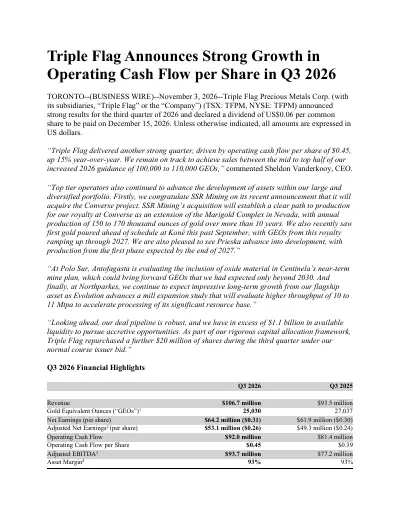
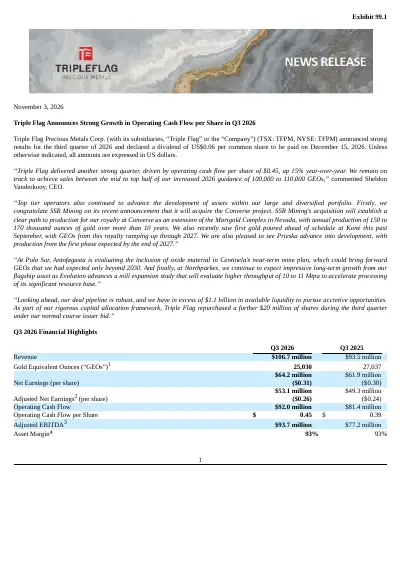
Our business delivered 25,000 GEOs in Q3, which keeps us on track to deliver in the top half of our increased guidance range of 100 to 110,000 GEOs. Operating cash flow per share is the metric that most directly compounds to shareholders over time.
We are pleased to announce Q3 cash flow per share of 45 cents, representing growth of 15% from 39 cents in Q3 of last year. This quarter demonstrates how Triple Flag creates value over time.
From our founding, our approach has been to use rigorous due diligence to identify high-quality assets early, often when they are in the hands of junior or mid-cap operators, and before the value is obvious. We then benefit as that quality is surfaced over time.
The success of this approach has been demonstrated by our investing track record. We acquired our Northparkes stream in 2020.
At that time, Northparkes was a 7.5 million ton per annum mine operated by CMOC. Northparkes was not well-known or understood by the market at that time, and the scale of the resource base was not well-appreciated.
Now Northparkes is operated by Evolution, with a much higher profile in the market. Evolution is now studying an expansion to 10 to 11 million tons per annum to unlock further value from its large 630 ton 630 million ton resource base.
The potential that we identified in 2020 is now becoming apparent to the market. Another example is our royalty on the Koné mine.
We acquired this royalty as part of the Maverix acquisition in 2023 at a very low value. The market ascribed de minimis value to this royalty on acquisition.
Koné poured first gold in September, ahead of schedule, and is on track to achieve commercial production in Q4 this year. This is an asset that will benefit our shareholders for years to come.
Another Maverix asset is our Hope Bay royalty. When we acquired the Hope Bay royalty in 2023, the value of that land package was not well-appreciated by the market, but we had been tracking that asset for years and were very pleased to gain this exposure.
Agnico is now constructing Hope Bay and calling for first production in 2030. This is a cornerstone district-scale royalty that will benefit our shareholders for years to come.
Another example is Polo Sur. We acquired our Polo Sur royalty in 2021 for less than $10 million.
We liked the large resource that was owned by Antofagasta, and the proximity to the Centinela operation. Antofagasta is now evaluating the inclusion of Polo Sur oxide material in the near-term mine plan at its Centinela operation in Chile, as we anticipated back in 2021.
The value is now being surfaced. My final example is our exposure to the Marigold complex in Nevada.
We own two royalties on Buffalo Valley, totaling 3.35%, and a 5% royalty on the Converse property. We acquired our initial interest in Buffalo Valley in 2021, and we acquired our initial Converse interest in 2023, each at very low valuations.
James will discuss in more detail, but SSR Mining's acquisition of the Converse project and incorporation of Buffalo Valley and Converse into the Marigold mine plan catalyzes the value we identified years ago. Finally, an important part of our capital allocation strategy remains returns to shareholders.
The strong underlying portfolio performance is not reflected in the market price for our shares, and we see clear value in buying back our shares on the market. In Q3, we repurchased a further $20 million of shares during the quarter, on top of the $20 million repurchased in Q2.
I will now turn it over to Eban to discuss our financial results for Q3 2026.
Eban Bari
Thank you, Sheldon. As Sheldon has highlighted, Q3 was another strong quarter, with the portfolio delivering 25,000 GEOs.
Revenue of $107 million was up 14% year-over-year. Adjusted EBITDA of $94 million was up 22%.
Most importantly, operating cash flow per share of 45 cents was up 15%. Triple Flag remains focused on top-tier precious metals assets, with revenue that is more than 80% sourced from mining-friendly jurisdictions in both Australia and the Americas.
Our revenue mix is strongly diversified, with Northparkes and Cerro Lindo serving as two largest contributors in Q3, and Ravenswood, in its first full quarter of deliveries, already at 6%. Triple Flag's sales mix remains nearly fully derived from precious metals, with two-thirds from gold, and we do not expect this to materially change going forward as we exit 2026 and enter 2027.
On capital allocation, we view a progressively growing dividend, sustainable across all metal prices, as a core part of our shareholder return strategy. We have increased our dividend every year since our IPO.
On buybacks, we continue to act on the discounted value of our shares, repurchasing a further $20 million in open market during the quarter. Our NCIB remains an active part of our shareholder return strategy, and we will continue to be opportunistic.
Lastly, I'd like to comment on our balance sheet. During the quarter, we repaid $50 million of drawings on our revolving credit facility, exiting the quarter with $185 million drawn, $20 million worth of cash, and over $1.1 billion of available liquidity.
We're on track with our expectation to repay this facility during 2027 at current metal prices. Overall, a strong balance sheet, robust operating cash flows, and total liquidity over $1.1 billion gives us the capital to continue deploying dollars into accretive opportunities to drive future growth for the benefit of our shareholders.
With that, I will turn it over to James to walk you through Northparkes and the Marigold complex.
James Dendle
Thanks, Eban. Starting with Northparkes, which is both our largest asset and our largest growth asset, four distinct positive developments are underway.
First, the E48 sub-level cave is ramping up through 2026 and 2027, supporting near-term growth. Second, development of the E22 block cave has commenced.
This deposit will be a long-life, low-cost, bulk underground operation, with production expected in 2030. E22, together with a new decline and upgrades to the material handling infrastructure, will support an underground mining capacity of 11 million tons per annum, representing a greater than 50% increase from the current capacity.
Third, the E44 deposit continues to advance, a gold-dominant deposit that was not part of the original mine plan. Minimum guaranteed deliveries to Triple Flag will commence in 2030, which should increase substantially by 2031 and beyond.
A study for this deposit is expected to be completed by the end of June 2027. Fourth, Evolution is advancing a mill expansion study to 10 to 11 million tons per annum to unlock and accelerate processing of Northparkes' total resource base of more than 630 million tons, including inferred sources.
This mill expansion study is also expected to be completed by mid-2027. It's worth remembering where this asset was when we acquired our gold and silver stream in 2020, with a nameplate of 7.5 million tons per annum.
Investment by Evolution as the new operator is now surfacing the value of the substantial resource base to the direct benefit of Triple Flag shareholders. Turning to the Marigold complex in Nevada, we are exceptionally pleased to see SSR lay out a clear path to production from the Buffalo Valley and Converse royalty assets in our portfolio.
At Buffalo Valley, we hold a combined 3.35% NSR, while at Converse, we hold a 5% NSR. Both of these assets will be advanced as extensions of the Marigold heap leach complex in Nevada, which has operated continuously since 1989 and has produced over 5 million ounces of gold.
In October, two things happened. SSR published an updated technical report for Marigold, which set out a 20-year life-of-mine plan with an increased 4.6 million ounce reserve, including a maiden mine plan for Buffalo Valley as a standalone heap leach.
First production from Buffalo Valley is expected in 2029, with reserves of 0.67 million ounces supporting the initial five-year operation. Concurrently, SSR announced an all-cash agreement to acquire Roxmore Resources, whose flagship asset is the Converse gold project.
Converse hosts over 2 million ounces of indicated resource, 3 million ounces of inferred resource, and is closely located at only 6 kilometers from the Marigold complex. SSR has cited additional growth and conversion potential through future resource development and exploration drilling.
Converse will now benefit from SSR's proven development and operating expertise, and follows Buffalo Valley in SSR's development sequence at Marigold. First gold is expected in 2033, with annual production of 150 to 170,000 ounces of gold over more than 10 years.
These are royalties that were acquired at a very modest valuation, and today sit with proven, long-running Nevada heap leach complex, with a committed senior operator and a published path to production at no incremental cost to Triple Flag. That is free carried optionality of the royalty model that is core to our value proposition: identify quality assets early through rigorous diligence, and allow the value to be progressively surfaced at no additional cost.
I'll now pass back to Sheldon.
Sheldon Vanderkooy
Thank you, James. In my opening remarks, I highlighted several examples where Triple Flag identified value early and is now reaping the rewards.
This is ultimately reflected in the returns we realize over time. Scotiabank recently published research comparing what companies in our sector paid for their streams and royalties against what those investments are worth today.
The results are set out in the slide. At the time we announced our investments, the Street ascribed an average IRR of 9 of 4.9%.
Now, with the benefit of hindsight, Scotiabank ascribes a realized IRR of 12.8%. This 12.8% IRR leads our peer group, which is a testament to our team's ability to deploy capital to the benefit of Triple Flag shareholders.
We achieve this through an exceptionally disciplined process. Our underwriting is built on rigorous technical due diligence, the bedrock of the Triple Flag approach.
We identify high-quality assets early to create a tier-one portfolio at a reasonable price, and the returns then compound to the benefit of shareholders as that quality and potential is revealed over time. In closing, the Triple Flag model will not change.
Our portfolio is performing very well. We are on track for the top half of our 2026 guidance.
Our 2030 outlook of 150 to 160,000 GEOs represents peer-leading growth of approximately 50%. Our growth beyond 2030 is meaningful, anchored by Northparkes, Hope Bay, Kemess, and [Altar?]
, all great assets in tier-one jurisdictions. Our growth profile now also features Buffalo Valley, Converse, and Polo Sur, assets operated by tier-one operators and located in Nevada and Chile.
This is exactly the type of royalty exposure that we want to build shareholder value on. Going forward, we will continue to drive growing cash flow per share and growing NAV per share for the benefit of Triple Flag shareholders.
That concludes our prepared remarks. Operator, please open the floor to questions.
Operator
We will now begin the question-and-answer session. If you would like to ask a question, please press star one to raise your hand.
To withdraw your question, press star one again. We ask that you pick up your handset when asking a question to allow for optimum sound quality.
If you were muted locally, please remember to unmute your device. Please stand by while we compile the Q&A roster.
Our first question is from Delvin Shi with Scotiabank. Dalvin, please go ahead.
Delvin Xie
Good morning Sheldon, Eban, James. Congrats on the good quarter, and no, thank you for taking the questions.
First will be G&A, and what would you expect to be the run rate of G&A per quarter? It seems to be lower than we expect, we just want to know will the Q3 be the reasonable run rate?
Eban Bari
No. Thanks.
I'll take that question, Dalvin. Our G&A is largely driven by volatility of our share price on stock-based compensation.
You would have seen in 2025, as share price increased, our G&A increased in the same frame time. In 2026, with share price performance, we saw decreasing or flat G&A profile.
We actually can't do is predict what our share price will be in Q4. We left our G&A guidance unchanged.
At the same time, we expect G&A to increase as share price performs over the back half of the quarter.
Delvin Xie
Thank you. Then the NCIB, I believe it's expiring pretty soon, I assume you renew your NCIB.
Would you favor buyback over dividends, or one over the another now?
Sheldon Vanderkooy
I'll take that, Delvin. It's Sheldon here.
The NCIB, we've always renewed that, you can expect that to be renewed kind of in the ordinary course, no surprises there. In terms of NCIB versus dividends, we've been very clear.
Our dividend increases every year, we just increased it recently, so that's what we do. Then we're much more opportunistic on the NCIB, but you'll see that we've been much more aggressive on NCIB repurchases this year.
Delvin Xie
Right, absolutely. Thank you.
Turned to Q4, if I back out the number from your mid to high end of guidance versus nine months, Q4 will be similar to Q3, and no, is that reasonable assumption? Cost of sales just somewhat lower or similar to this quarter, like Q3?
Sheldon Vanderkooy
Could you repeat your question, please? I'm not sure I followed.
Delvin Xie
Roughly the Q4 expectation will be similar to Q3 if I back out the number, like the GEOs?
David Lee
It's Eban on the line. If you're asking for Q4 GEOs, I think our guidance for the year is to be in the midst of the top half of our increased guidance range, between 105 to 110,000 GEOs.
I would look to have a forecast within that range for Q4. Cost of sales, I think you mentioned, would follow that GEO forecast that you're going to assume for that period, noting that a large part of our cost of sales can be impacted by the non-cash component, and that will fluctuate with the metal price.
It should be tied to your metal price assumptions for that quarter as well.
Delvin Xie
Right, absolutely. Thank you.
Last one for me, the deal environment. It's $100 to $500 mil deal still the primary range, and I assume pretty much predominant will be precious metals focus?
James Dendle
I can address that, it's James. Yes, there's certainly a decent number of deals in that range.
There's also some compelling opportunities that are both larger and smaller, and it's fair to say that almost all of the transactions we're looking at are either gold or silver. In the past, we've seen opportunities outside gold and silver, but it's very active on the precious side at the moment.
Delvin Xie
Right, I see. That's all for me.
Thank you so much.
James Dendle
Thanks, Delvin.
Operator
Your next question comes from the line of Jack Baxter with Bloomberg Intelligence. Jack, please go ahead.
Jack Baxter
Good morning, team. If I just start on Northparkes, and so it appears the capacity upgrades and additional ore sources that you cited in these slides, they're moving closer to reality.
I just wanted to get some clarification on which of those catalysts are embedded in the 2030 growth outlook, if any, or perhaps they're post-2030. Can you give any more detail on that, please?
James Dendle
Jack, it's James. I can address that.
Evolution's been quite clear with their stated intent for developing Northparkes, and there's additional capital projects, which is not quite as material, but is related to the processing plant, debottlenecking, getting to 8 million tons, and installing coarse particle flotation and regrind. We are strongly of the view that each of the projects mentioned will go ahead at Northparkes, and then, of course, they all have their own timing profile.
As we mentioned, E22 starting in 2030, then, of course, it's ramped up to that. We reflect all of them, but, of course, not all of them are within the 2030 timeline.
This material increase in peak E22, that will be post-2030.
Jack Baxter
Understood. Thank you.
On Ravenswood, as we shift into a full quarter of contribution and then towards steady state for production at that asset, what would you regard as a reasonable normalized run rate for deliveries for Triple Flag heading into '27?
James Dendle
Jack, we're not going to provide asset-by-asset guidance. We never do, and we're also not going to provide 2027 guidance in November 2026.
The ramp-up to plus 200,000 ounces a year will take a couple of years at Ravenswood, which is what we've discussed previously, we'll reflect that in our 2027 guidance when we put it out next year.
Jack Baxter
Sure. Thank you.
It was worth a shot. Maybe finally on deals, how are you comparing the prospective return on new streams and royalties against buying back your own stock?
Just curious as to whether the hurdle rate on new transactions has moved higher with pricing?
Sheldon Vanderkooy
Hi, Jack. Sheldon, I'll take that.
The best use of shareholder capital always, and what's always driven the most value, is when we find good royalty and streaming opportunities, we're always looking for that. I'm really pleased with what we've done this past year.
We deployed $550 million and we're active on several files, we're certainly not sitting on our hands. Last year, we did $350 million, and that was a good year as well.
With regards to the buyback, we have the financial capacity to take advantage of that opportunity, and so we come in, of course, when we see just really clear value on where the shares are in the market. We're not in a situation right now where we have the either/or.
We're finding good opportunities to deploy capital, and then we're also finding there's available capital to do some buybacks as well. This is all in the context of what the cash flow generation is, which is robust, and the debt levels of the company, which are modest.
Jack Baxter
Nothing's changed in terms of how you're assessing these deals. You're not chasing a higher IRR, it's all steady course?
Sheldon Vanderkooy
No, we tend to be very consistent in what we do, and that's measured over years if not a full decade.
Jack Baxter
Got you. Thank you very much, team.
Sheldon Vanderkooy
Thanks, Jack.
Operator
Your next question comes from the line of Fahad Tariq with Jefferies. Fahad, please go ahead.
Fahad Tariq
Hi, thanks for taking my question. On the 2030 guidance, which I know hasn't changed, can you maybe talk about any assets that you think between now and then could provide upside or incremental production that is not captured in that guidance?
Thanks.
Sheldon Vanderkooy
Fahad, what I'd say is this is Sheldon that 2030 number, we are highly confident in, and there's certainly upside there. I'm actually not going to go asset-by-asset, but there is certainly, if you go through the public disclosure of all the operators of our portfolio, you get to a figure quite a bit higher than what's in our 2030 figure that we've put out, but that is a number that we just feel very, very confident in.
There is certainly upside there, but I'm just not going to flag individual assets. What I want to do is, like mining projects, it's easier for them to be a little slower than a little quicker, and we just want to have a high degree of credibility with the market that they see that coming on.
As one of the other questions alluded to, too, there's a lot of growth in the portfolio even beyond 2030, our growth profile is really good.
Fahad Tariq
Great. Then just one more for me.
In terms of the liquidity that's available, it's quite substantial now, and the balance sheet is in a really good position. Do you anticipate that Triple Flag would participate in some of these larger transactions that are being, I guess, expected in the industry, like discussions of maybe a billion-dollar royalty or stream, one per year for the next five years?
These are the types of transaction deal pipelines that some of your larger peers are talking about. Is that something that Triple Flag would look to participate in, or is that not the right kind of size?
Thanks.
Sheldon Vanderkooy
We are looking for any opportunity to drive shareholder value, and so we would look at larger transactions as well. We're always going to be prudent when we look at leverage levels, but we would look at larger transactions as well as mid-sized ones, and the pipeline is very robust.
I know our peers are talking about that same pipeline. It's both larger transactions, mid-sized transactions, and smaller transactions.
Really the criteria is what drives value for Triple Flag.
Fahad Tariq
Great. Thank you so much.
Sheldon Vanderkooy
Thank you.
Operator
Your next question comes from the line of Lawson Winder with Bank of America. Lawson, please go ahead.
Lawson Winder
Thank you very much, operator. Good morning, Sheldon and team.
Great quarter. I understand your reluctance to go asset-by-asset, sort of off the cuff, but maybe I'll just do that a little bit myself and ask some specific questions about some more important assets.
With Northparkes, could you just clarify for us what exactly is built into that long-term 2030 assumption in terms of the processing capacity in terms of million tons per annum?
James Dendle
Lawson, I can address that. The capital projects set out in the presentation in addition to the coarse particle flotation and regrind are all included.
The big one, though, is Evolution has discussed a range of processing scales. Our current working assumption that is reflected in the 2030 is that they take it up to the 10 to 11 million ton range.
Of course, that's been well-telegraphed to the market, so that's what's in the 2030 outlook.
Lawson Winder
Okay. Thank you very much for that, James.
Then just thinking about some of the other assets, Polo Sur, my understanding is that that probably wouldn't be included in 2030. Can you confirm that that would be upside should Antofagasta go ahead and incorporate oxides into the circuit?
James Dendle
That would be a benefit to us. Then
Lawson Winder
the other asset that I guess I'd be curious about is Prieska. The upper phase is now financed towards production, but Triple Flag has the option to exercise the $80 million stream.
What you're thinking on that currently, or what are your trigger points to either move forward with that or decline?
James Dendle
A good question. Thanks, Lawson.
I'd just clarify that Glencore's financing actually provides for not only the development of the upper part of the mine, which is first project, but also much of the early works on the Deeps, which is our main economic interest. The Glencore financing is now available to Orion.
They're in the process of drawing that, and we'll start the works required to develop the upper levels. Our stream has the right, but not obligation, for the $80 million, and the triggering point on that is upon satisfactory completion of details, feasibility studies properly engineered, and a capital program that's fully financed, inclusive of our stream.
We'd expect to be making that decision late in 2027, with drawdowns in 2028, is the current schedule that we've been provided by Orion, the operator.
Lawson Winder
Perfect. Thank you.
Then just on the M&A pipeline, I think it's an interesting discussion point given your enormous gross margins, and theoretical capability of this business to take on substantial debt in the short term in order to complete larger transactions. Sheldon, I appreciate the comments about wanting to be conservative with the balance sheet, but can you give us a range of trailing net leverage multiples with which the company might be comfortable on a short-term basis in order to complete a larger transaction?
Sheldon Vanderkooy
Sure, Lawson. I think if you're at 2 times EBITDA, you're in a zone of safety there, and I think the market is comfortable with that.
Quite frankly, with the cash flow generation of a portfolio like this, that could be fine. When you start to run those numbers, that actually allows us to look for quite large transactions that really move the needle for a company of Triple Flag's size, and add even more growth to the embedded organic growth engine in the firm.
Again, we'll be looking for ways to add shareholder value. That's really the criteria.
Lawson Winder
That's very sensible. Then just one maybe final question on capital allocation.
You've indicated a preference to be I think opportunistic with the buyback, but nevertheless, the last three quarters have indicated a bit of a stable buyback implementation despite some significant share price volatility. I just want to put a finer point on this.
Do you mean to say that the buyback approach could change heading into Q4 and into 2027, or should we expect something in the range of what we've now seen for a couple of quarters?
Sheldon Vanderkooy
Really, I'd expect probably steady course as opposed to any change. There's never really been any change to our approach where we just when we see dislocation in value, and it gets to a certain point, we step in a little bit more aggressively, and we've done that the last couple quarters.
Part of it is just the value we're seeing generated by the portfolio organically, like we just highlighted a number of projects that are I think a little bit below the market's radar screen, and there's real value being created there and being surfaced there.
Lawson Winder
Yeah. Taken.
Thank you, guys, very much.
Sheldon Vanderkooy
Thank you, Lawson.
Operator
Your next question comes from the line of Fanming Zeng with Stifel. Fanming, please go ahead.
Fanming Zeng
Morning. Thanks for taking my question, and congrats on the quarter.
I know this might be preliminary, but when you roll forward the five-year outlook, Hope Bay, Kemess, and E44 are going to come into the window. How does the updated outlook kind of look like in terms of direction and which assets matter the most and how comfortable you are on the development timeline of the key assets?
Sheldon Vanderkooy
Thanks for the question. As I stated earlier, we're very comfortable with our stated 2030 outlook range, and when we come into February, of course, we'll give 2027 guidance, and we'll also update that five-year view, and so we'll give a 2031 view.
That's a process we're going to go through. Obviously, we'll make sure it's something we're 100% comfortable with.
Directionally, it would be higher than what we have for 2030. Again, we'll put out that 2031 outlook in February, and I don't want to start gun jumping on going asset-by-asset what the deltas are.
Portfolio doesn't stop at 2030, and it continues to build.
Fanming Zeng
Great. Thanks for answering my question.
Operator
There are no further questions at this time. I will now turn the call back to Sheldon Vanderkooy for closing remarks.
Sheldon Vanderkooy
Thank you, Cam. Thanks everyone for joining the call.
Have a great rest of your day. Bye.
Operator
This concludes today's call. Thank you for attending.
You may now disconnect.