Superior Plus Corp
Q3 FY2026 · Earnings Call TranscriptNovember 11, 2026
Operator
Good day, and thank you for standing by. Welcome to the Superior Plus 2026 third quarter results conference call.
At this time, all participants are in a listen-only mode. After the speakers' presentation, there will be a question and answer session.
To ask a question during the session, you will need to press *11 on your telephone. You will then hear an automated message advising your hand is raised.
To withdraw your question, please press *11 again. Please be advised that today's conference is being recorded.
I would now like to hand the conference over to your speaker today, Chris Lichtenheldt, Vice President of Investor Relations. Please go ahead.
Chris Lichtenheldt
Thank you. Good morning, everyone, and welcome to Superior Plus's conference call and webcast to review our 2026 third quarter results.
On the call today, we have Allan MacDonald, President and CEO; Grier Colter, Executive Vice President and Chief Financial Officer; and Dale Winger, President of Certarus. For this morning's call, Allan and Grier will begin with their prepared remarks, and then we'll open the call for questions.
Listeners are reminded that some of the comments made today may be forward-looking in nature, and information provided may refer to non-GAAP measures. Please refer to our continuous disclosure documents available on SEDAR+ and our website.
Also, the dollar amounts discussed on today's call are expressed in US dollars, unless otherwise noted. I'll now turn the call over to Allan.
Allan MacDonald
Thanks, Chris. Good morning, everyone.
Thanks for joining us today. Before we begin, I want to recognize that today is Remembrance Day in Canada and Veterans Day in the United States.
We here at Superior want to extend our sincere thanks to all those who have served and continue to serve in our armed forces. We are grateful for their service and their sacrifice.
I also want to recognize our teams across North America. Their dedication to working safely, and serving customers, and keeping operations running reliably is what makes our success possible.
In propane, we're preparing for the upcoming heating season, and at Certarus, we're supporting a growing customer base. Our employees across both businesses continue to step up and deliver.
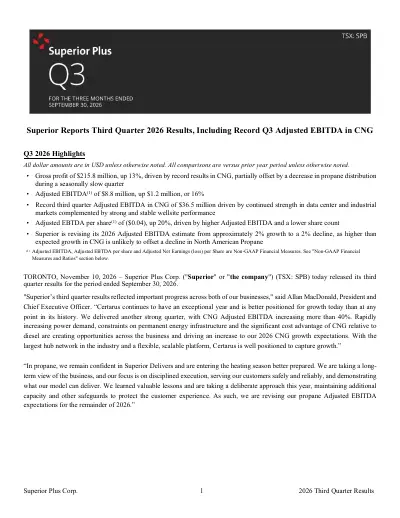
That dedication was reflected in our performance this quarter. In Q3, Superior generated EBITDA of $8.8 million, compared with $7.6 million in the prior-year period, representing a year-over-year increase of 16%.
Adjusted EBITDA per share was -$0.04, compared with -$0.05 last year. Certarus delivered record third quarter EBITDA on record volumes in both well-site and industrial applications.
Propane results were again muted during the seasonally slower period, as we continue to advance winter readiness efforts. Grier will take us through the financials here shortly.
Now at Certarus, our strategy is to defend our leadership position in the well-site and be a market leader by taking CNG into new geographies and verticals. In propane, Superior Delivers has been central to our progress.
We've made meaningful changes to how we manage supply, plan and execute deliveries, and serve our customers. We're well prepared, and our attention is now on disciplined execution.
I'll walk through our progress in both businesses here, beginning with Certarus. As the mobile gas solutions leader, the value proposition at Certarus is simple: we safely deliver reliable mobile natural gas where and when our customers need it.
We have built a platform that combines supply, compression, transportation, storage, and on-site solutions. We use that same platform across oil and gas, industrial, data centers, and transportation.
Our scale and flexibility allows us to enter new markets quickly as CNG demand grows. Now starting with well-site, our business remains strong following record volumes in the first half of the year.
Q3 well-site volumes were 6.8 million MMBtu, up 21% year-over-year. Pricing also remained stable for a fifth consecutive quarter.
Margins and returns continue to be robust, and the outlook is favorable as oil and gas operators are as motivated as ever to displace diesel with the attractive economics of natural gas in both drilling rigs and completion operations. Safety, reliability, and cost leadership underpin our competitive position.
Our year-to-date recordable incident rate is lower than each of the three previous years. These strengths continue to differentiate Certarus and support long-term customer relationships with leading operators.
In our industrial business, Q3 volumes increased 62% year-over-year, driven by new projects coming online, increased activity from existing customers, and project extensions. There's an important part of the story that we don't often talk about just enough here, and that's our industrial business base has become increasingly stable and predictable.
We're building a larger base of contracted revenue with greater visibility. Looking ahead, we expect industrial and data center applications to represent approximately 60% of our CNG business within the next 24 months.
The progress we've made in Q3 reinforces our confidence in that mix shift and the stability of our base business. Now data centers remain an important part of that growth as well.
We continue to believe behind-the-meter power is one of the most compelling growth opportunities in North American energy. Forecasts suggest nearly 30 GW of behind-the-meter natural gas generation will be deployed by 2030, primarily supporting high-return AI data center projects.
The investment case is AI is driving the demand for compute, compute requires reliable power, North America possesses an abundant, low-cost natural gas resource base, and that creates significant CNG demand. Certarus is the market leader with unrivaled scale and geographic reach.
Our hub network is 5 times larger than our nearest competitor. Where permanent infrastructure is unavailable or cannot be built within the required timeframe, speed and scale become critical, and our mobile platform is designed to address both.
Our hub network is a key part of that advantage. Each new location expands the addressable market for our existing fleet with modest incremental capital and lowers the cost of entering the next geography or serving the next vertical.
With the addition of Florida, Utah, Houston, and our newest hub announced in Bakersfield, California, we're now within approximately 250 miles of 50% of the North American population. At our current pace, we expect to be within approximately 80% of the population by the end of 2028.
Our new California hub will be Certarus's first supply point in the state. It's expected to begin flowing gas in Q1 2027 and will allow us to serve customers from Southern California through the Bay Area.
This hub is also an example of how we intend to build markets rather than simply waiting for them to develop. We're also seeing strong interest in the mobile CNG fleet fueling service we launched in the last quarter.
We bring fuel directly to our customers' facilities, allowing fleets to refuel behind the fence without pipeline connectivity, permanent station construction, or upfront capital. We've built a funnel of opportunities and are engaged with some of the largest and most sophisticated fleet operators.
Our first location in Houston is now operational, serving approximately 100 Class 8 natural gas trucks. Today, we announced our next step in California.
Certarus signed an MOU with Gazelle Transportation, California's largest crude hauler, to deploy mobile CNG fleet fueling at its facility. Stepping back and looking at the landscape, we believe compressed natural gas is better positioned today than ever before.
While CNG has always been at a substantial economic advantage when compared with diesel, that advantage is even now more pronounced. Today's diesel price is more than $6 US in many markets, where our delivered price for CNG on a diesel equivalent is often less than half that.
Lower fuel costs, greater price stability, and a practical solution to refueling makes the long-term case for CNG very compelling. We've spent the last 2 years deliberately positioning Certarus for these opportunities.
Today, we have the scale, the network, and the market position to capitalize on them, and we're confident in the growth ahead. Turning to propane, we're well prepared for the season ahead.
Q3 is our seasonally quietest quarter, but it's an important operating period because much of the work that determines winter performance happens before the cold weather. Superior Delivers has been central to that work.
We have strengthened forecasting and delivery planning, improved workforce readiness, and created better coordination between field operations, supply, and customer service. Our new delivery tracker gives our operations and customer experience teams a common view of upcoming and in-progress deliveries.
That allows us to identify issues earlier, act quickly, and provide customers with clear and more proactive information about their deliveries. We're already seeing encouraging results.
Route adherence has improved over the summer, as have deliveries per route. We're also entering the winter with a strong supply position.
We continue to build our capabilities in the US, creating additional opportunities to optimize supply and procurement across North America. There's been a tremendous amount of work done to prepare, and our teams feel good about where we are heading into the winter.
Our immediate priority is to serve customers safely and reliably, communicate clearly, and demonstrate that the changes we have made through Superior Delivers are helping us provide a more consistent customer experience that will, ultimately, drive retention, growth, and better operating performance. On capital allocation, we continue to invest in CNG growth, including mobile storage units and equipment supporting signed contracts, funded entirely from cash the business generates.
We're investing where we see durable returns, not simply where we see growth. Over time, we expect the growth generated by these investments will support deleveraging, which remains a key element of our strategy.
In terms of our outlook for 2026, as we were revising our adjusted EBITDA outlook from 2% growth to a 2% contraction. That reflects lower than previously expected propane EBITDA, partially offset by strong growth at Certarus.
In propane, we've made a deliberate decision to invest in additional capacity this winter to ensure we can provide the highest level of service our customers expect. Customer attrition was also tracking slightly above our prior estimates following last season.
We continue to expect adjusted EBITDA growth of 5% in 2027, driven primarily by growth in CNG. Thank you, and with that, I'll turn the call over to Grier for some comments on our financial performance.
Grier Colter
Thank you, Allan, and good morning. Superior generated year-over-year EBITDA growth during a seasonally slow period, driven by strong performance in CNG, partially offset by propane.
I'll start by recapping our financial results for the third quarter. Consolidated adjusted EBITDA was $8.8 million in Q3, compared with $7.6 million in the prior-year quarter, representing a year-over-year increase of 16%.
Adjusted EBITDA per share was a loss of $0.04, compared with a loss of $0.05 in Q3 2025. The improvement was driven by higher adjusted EBITDA, partially offset by the 3% reduction in weighted average shares outstanding as a result of our share repurchases over the past 12 months.
Adjusted net loss per share was $0.37, compared with a loss of $0.41 in the prior-year period. The improvement reflects a lower adjusted net loss, partially offset by the lower share count.
Free cash flow in Q3, a seasonally low cash flow quarter, was -$100.4 million, compared with -$70.9 million in Q3 2025, reflecting higher growth capex at Certarus, which is expected to generate very strong returns in the coming years. We anticipate elevated capex through the middle of 2027, followed by a return to higher cash flow by Q4 2027, when the EBITDA associated with our CNG investments ramps up.
Turning now to the businesses. US Propane reported an adjusted EBITDA loss of $22.2 million in Q3, compared with a loss of $14 million a year ago, a decline of $8.2 million.
The decline was driven in part by temporarily elevated attrition following last winter, higher operating costs, and lower service activity. This was partly offset by higher wholesale volumes driven by continued growth in wholesale customers.
Canadian Propane generated adjusted EBITDA of $2.2 million, compared with $2.5 million in Q3 2025. This was mainly due to weaker market differentials and a stronger US dollar, partially offset by procurement savings from Superior Delivers initiatives.
Superior Delivers, our propane transformation initiative, contributed approximately $3 million of incremental adjusted EBITDA in the quarter and $20 million year-to-date. The contribution in the quarter was largely from margin optimization in our customer growth pillar and from more sophisticated supply management in our wholesale advantage pillar.
We now expect a full-year contribution from Superior Delivers of approximately $30 million, as we are investing in extra capacity to ensure an optimal customer experience over the upcoming heating season. Certarus generated adjusted EBITDA of $36.5 million in Q3, compared with $25.7 million in the prior-year quarter, which was an increase of 42%.
The increase was driven by volume growth across our well-site and industrial and data center segments, partially offset by higher operating costs. Volumes increased 23% to 8.7 million MMBtu, and operating costs per MMBtu increased 9%, as we temporarily rely more heavily on third-party drivers to keep up with the demand while we expand our internal driving capabilities.
Corporate operating costs were $7.7 million in Q3, compared with $6.6 million in the prior-year quarter. The increase is mostly due to the timing of expenses and higher incentive plan costs due to the fluctuations in the share price.
Consolidated capital expenditures were $81.9 million in Q3, compared with $33 million in the prior-year quarter, mainly due to increased investment in CNG to support contracted growth opportunities that will begin contributing EBITDA next year. Overall, capex is tracking in line with our 2026 expectation of $230 million.
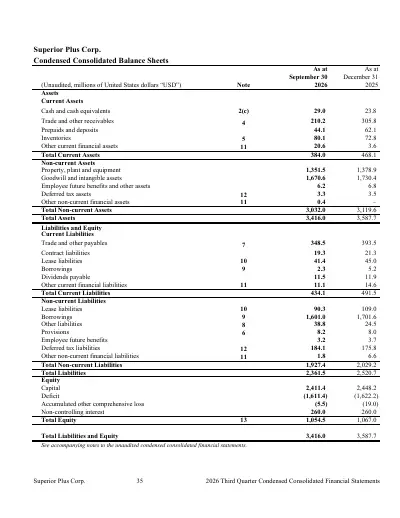
Our leverage at the end of Q3 was 3.8 times, down one-tenth from a year ago, driven by lower net debt levels and higher adjusted EBITDA. Sequentially, leverage was up two-tenths of a turn from the second quarter, reflecting the normal seasonality of our propane business.
Shares outstanding at September 30, 2026, were 214.6 million, which is down 4% from the prior year as a result of share repurchases made in the previous periods. We did not repurchase shares during the quarter as we continue to prioritize investment in CNG.
As Allan mentioned, we are revising our 2026 adjusted EBITDA guidance from growth of approximately 2% to a decline of approximately 2%. We now expect Certarus to grow approximately 5% in 2026, driven by strong performance across the business, particularly in our industrial and data center segment.
We previously expected Certarus EBITDA to be down between 4% and 9% in 2026. However, the growth in CNG is expected to be more than offset by lower propane results.
As Allan mentioned, we are investing in winter readiness, which is reducing the contribution from Superior Delivers during 2026. We also experienced elevated customer attrition due to our delivery challenges last season, but expect that to return to normal levels with our additional investment in capacity this winter.
Despite lower expected EBITDA in 2026, we expect to exit the year with leverage of approximately 3.9 times, as the lower EBITDA is expected to be offset by favorable working capital movements. Given the high degree of visibility we have on CNG EBITDA for 2027, we continue to expect EBITDA to grow by approximately 5% in 2027, albeit now off a lower 2026 EBITDA base compared with prior expectations.
We will update our 2027 capex budget in February of next year, but at this point, we continue to expect capital expenditures to remain at levels similar to 2026. With that, I'll turn the call back to the operator for Q&A.
Operator
Thank you. As a reminder, to ask a question, please press *11 on your telephone and wait for your name to be announced.
To withdraw your question, please press *11 again. Our first question comes from the line of Ben Isaacson with Scotiabank.
Your line is now open.
Ben Isaacson
Thank you very much, and good morning, everyone. I have two questions.
The first question is, can you talk about customer attrition in propane? Maybe there's three points to make on that.
Can you talk about the industry versus Superior, Canada versus the US, and what is controllable versus non-controllable for you?
Allan MacDonald
Hey, Ben, it's Allan. I'm just making notes about that controllable.
Okay. Sure can.
Thanks for your question. Let me give you a couple of tidbits here, and then you can guide me if I'm not answering your question.
The industry is really really kind of all over the place because you've got a couple 3,000 small independents, and then the majors. We're competitive with the majors when it comes to attrition, but our aspiration, obviously, is to have a pretty substantial reduction over time.
Canada versus the US, or let me get to controllable versus uncontrollable. There's kind of different types of attrition.
You have what we call change of ownership. That's where someone sells their house.
That becomes a sale opportunity, and that's going to account for a percent, maybe in some markets 2%, of your annual attrition every year. It's just the normal course of houses moving, and I'm talking on the residential side here, of course.
Then you've got displacement, where a house is demolished and a new house is put in and different type of heating or energy is put into place or you're displaced by heat pumps or whatever the case may be. Then the third part is controllable, where they're leaving us for another competitor.
We've got strategies for two of the three of those. Displacement is kind of not much you can do about that.
Canada versus the US is an interesting one. The maturity in Canada of our brand and our process means that our retention efforts took hold, and we're really encouraged by the results.
By the same token, building that maturity in the US means we had some more work to do, and that's what we worked really hard at over the last three quarters to make sure we minimized any of the impact. What I would say in general is we went through a really hard winter.
That's going to impact people's propensity to churn, obviously. I think we responded incredibly well.
It's always hard to forecast with a degree of specificity exactly what the churn number is going to be. We were close, but you don't see churn happening in an instant.
It's not like a customer gets a delivery and then calls to terminate. They've got to work through the fuel that's in their tank, it took us a couple of quarters to really quantify that.
It could have been a lot worse than it was, and I think the team did an incredible job of the response they had after the really tough quarter we had. I don't know, Grier, if you had anything you wanted to add to that.
Grier Colter
The only thing maybe is just the attrition from year to year, it's not the same, obviously. Weather patterns are not the same.
If I just look at last winter, in the West as an example, in Canada, it was easier to serve customers just given the weather patterns there, a little less extreme out there, right? If you look at kind of what you had seen in terms of attrition in Western Canada, part of that is because of how you operate the business, but it's obviously inextricably linked to the weather patterns.
On the East Coast, if you look at the US business, which as you know is largely residential, the Northeast, the weather was really tricky, right? A lot of the changes that we were making from a transformation standpoint were kind of more directed at that business.
A combination of those things probably last year drove a little bit more in that area. It changes around, right?
It's not like, hey, that's always a thing. The patterns, as change around day to day, and so that's what I'd say a little bit about last year.
Ben Isaacson
Great. Thank you.
Oh, sorry. The second question is, look, the stock has been under significant pressure since the midterms, and I guess the question is, in your minds, has the outlook for Certarus changed since then because of possible increases to NIMBYism as it relates to AI data center growth?
Thank you.
Allan MacDonald
It's always hard to tell, especially when we're talking such a short term. I think Dale Winger is sitting to my right, and Dale might have a comment about what we're seeing in data centers.
Whenever you have the short-term volatility, it causes one to go back to your core thesis. I'll talk about it strategically, and then I'll hand the mic over to Dale.
For me, CNG as an energy source, we're seeing the adoption increase rapidly. You can see that in the numbers and the comments I made.
We're really confident, and we're excited about expanding across North America and bringing it to new markets. As we do, I think you're going to see widespread adoption.
Propane, for me, there is not a day that goes by that I have any doubt in terms of the direction we're heading in. Having a scalable operating model that allows you to really take advantage of scale and make it a strength, not a weakness, is absolutely paramount.
Although transformation's difficult, the moves that we've made and the decisions we've made, while they may have cost us in the short term, are absolutely the right thing to do for the business. Despite the short-term volatility, we're sticking to our guns in terms of our strategy.
More specifically with regard to data centers, Dale, you probably have some thoughts.
Dale Winger
Ben, thanks for the question. We've got a clear runway to continued earnings growth post-election.
Of course, it's too early to know what all of the impacts are going to be, but generally view the impact of elections as secondary to the underlying infrastructure constraints driving demand. We know the direction of travel is towards more compute, and we know the vacancy rate for data centers is less than 1%, and so the growth of increased compute is creating demand for data centers and power.
Projects that are under construction and in motion are continuing ahead. Could there be some changes in terms of the cost of projects or the timeline on projects that delay the build-out?
Sure there could be, and some of that had already started even before the elections. There was an increasing bipartisan consensus on paying for your own power, which, by the way, helps us in terms of a behind-the-meter market opportunity to go after.
The most important thing here is just that the pace of compute demand is moving faster than permanent infrastructure can be built. Certarus has got a very unique platform to bridge that gap.
Of course, we don't need every project in the marketplace to move forward, and a big part of our strategy has been increasing our qualification process to understand those projects that have tenants, those projects that have financing, those projects that have contracts awarded. In many cases a faster permitting environment, accelerated energy infrastructure development, more investment in domestic energy supply could actually increase the number of projects over time.
We've got a clear runway, and we do not have a diminished outlook.
Ben Isaacson
That's helpful. Thanks so much.
Appreciate it.
Allan MacDonald
Thanks, Ben.
Operator
Our next question comes from the line of Nelson Ng with RBC Capital Markets. Your line is now open.
Nelson Ng
Great, thanks, and good morning, everyone. My first question just relates to your propane guidance of it being about down 5% this year.
Can you just comment on whether your expectation of El Niño had anything to do with your guidance, or whether you factored anything into that -5% guidance?
Allan MacDonald
Grier will give you the numbers, but weather's hard to predict, which is one of the reasons why we've done what we've done in terms of making sure that we have a strong contingent of staff going into the year. Had we gotten off to a snow and frost all across North America in September and October, we probably would have a different outlook.
We're using sort of five-year normalized weather, which all of this factors into your decision. You've kind of raised the point that forecasting a business a year in advance, not knowing the weather patterns, is always difficult, and we're not forecasting a tremendously low winter, but had we seen signs of a really strong one, we probably would have made a different decision.
Grier, you may have clarifying comments.
Grier Colter
Hi, Nelson. Nothing much to add, really.
I think Allan said it. For the fourth quarter in our revised number, we've assumed five-year average weather for the fourth quarter.
Who knows? As Allan said, predicting weather's pretty tricky.
We can read the same reports, and who knows whether there's going to be one of these patterns, but at this stage, it's pretty difficult. As even what you see in October, as you get into November and December, obviously, the intensity accelerates, and so making a call at this point would be premature.
We've just used average weather, to the extent that it's warmer or cooler, obviously, there'll be an impact.
Nelson Ng
Got it. Then you guys mentioned that you're making some winter readiness investments.
Can you just give a bit more color on those investments, whether it's more like operating costs, or whether it's capex, or just a bit more color there?
Allan MacDonald
Said real simply, we see capacity in our model going into the winter that we've been hesitant to monetize based on what we learned last year. What's my confidence going into the winter that we're ready?
It's 100%. We're going to take that capacity out after the model's been proven, as opposed to in advance, because the most precious thing we have as a company is our relationship with our customers, and we're not going to jeopardize that.
It means that we're putting a little bit more investment in drivers, and call center agents, and service technicians, and trucks going into the winter that in all likelihood, will adjust through the winter or coming out. We're trying to be cautious and responsible here with our most precious asset.
Grier Colter
Again, nothing much to add here. It's opex, Nelson, for sure.
Nelson Ng
Got it. Okay.
Then, well, last one on propane. With the -5% guidance, can you bridge some of the items relative to 2025?
If we start with 2025, and we add, I think Superior Delivers would be on a standalone basis would be growing EBITDA by 4% relative to 2025. Is there a way to kind of highlight the main factors that's causing it to go from call it +4%, if you include Superior Delivers, to -5%?
Is it margins? Is it volumes?
I think you mentioned higher opex that you're kind of factoring into this winter. How would you rank some of the key factors?
Grier Colter
Nelson, just to make sure I understand the question, you're trying to bridge the propane EBITDA from 2025 to our revised number for 2026?
Nelson Ng
Correct. First, I'm just taking 2025, adding the 4% from Superior Delivers.
You're kind of starting off at +4%, but your guidance is -5%.
Grier Colter
Yeah. Okay.
If you look at the, I'm probably going to get the numbers off a little bit, but I'll be directionally close. If I look at what the total propane business did in 2025, I think around the number's around 345.
If you look at how we've reguided, I think that the number comes in around 330. We're talking about a $15 million delta, I think, is what you're trying to bridge.
The way I would look at the Superior Delivers number, and I can't remember exactly what we said coming out of last year, but the additional value added relative to our run rate kind of coming out of last year, I guess we'd be looking at the total year, not the run rate, but it's a pretty small number on additional Superior Delivers. I think the number's probably about $10 million.
I can't remember the exact number that was in 2025, but I think it was between 15 and $20 million. Let's say that's $10 million.
On the other side of it, yes, it's probably call it circa $5 million of expense increase, and then the rest would be volume. Whatever that works out to be, $10, $15 million in volume or something like that.
That's probably how I would bridge it, if that makes any sense, Nelson.
Nelson Ng
No, that makes sense. Then just a one quick question on the CNG business for Certarus.
In terms of the improved outlook, was it mostly due to the well-site business, industrial, or data center? What changed this year?
Obviously, oil prices are pretty high right now, and I presume well-site activity is strong. I know that the MD&A indicates that volume growth is mainly due to the well-site.
Is that the key driver for the change in outlook for this year?
Dale Winger
Hi, Nelson. Thanks for the question.
As you recall, we came out of the first quarter down $17 million, and we knew that based on some utility support work that wasn't part of the 2026 mix. As we have gone through 2026, second quarter and third quarter are traditionally seasonally lower, but as you've seen, we've shown a lot of strength in the business, and we've now kind of closed that $17 million gap that we started the year in, and we're even, and we continue to have momentum.
In terms of where it's coming from, the growth we're experiencing is broad-based and durable. It's data centers, but it's also other industrial markets, such as mining and power generation.
The well-site business is doing really well right now. We've built an advantaged mobile energy infrastructure network that's very difficult to replicate.
As we've expanded our new hub strategy and created more exposure to more end markets, it's increased the value of the platform and delivered a lot of growth overall, because we're in position with new supply points and new end-use customers to meet their energy needs. That's really the second and third quarter performance, as well as the ongoing momentum and outlook, is the driver there.
Nelson Ng
Great. Thanks.
Thanks, Dale. I'll leave it there.
Dale Winger
Thanks, Nelson.
Operator
Our next question comes from the line of Gary Ho with Desjardins. Your line is now open.
Gary Ho
Hey, good morning. Maybe the first question for Dale.
Sorry, I jumped on the call late, but sorry if this was already asked. Can you maybe just talk about the data center pipeline for potential new wins?
What are you hearing from potential customers, and expectations for the next 6 to 12 months?
Dale Winger
Thank you for the question, Gary. We continue to see a healthy and growing opportunity pipeline.
We continue to meet new people and make new friends in this space, as behind-the-meter power was not really a significant part of data centers a couple years ago, and now it's an increasing part of the data center opportunity set. We continue to progress, we continue to make new friends, explain how our solutions work.
One of our big pieces of the strategy when we started doing data center work was to deliver a great customer experience, so that we could have reference cases with world-class hyperscalers and earn repeat business. Our team has done a fantastic job with that, being very customer-centric, being very responsive and problem-solving in nature, being safety-centric, and just having the applications expertise and the scale to be able to mobilize and to provide the solution at the speed the customer needs the energy.
We have a good outlook headed into fourth quarter and into 2027. When natural gas is the critical missing piece, we have exactly what they need.
Sometimes projects are delayed for other reasons, whether it be permitting or financing or other constraints to be solved, but we are very focused on converting high-quality opportunities into attractive returns for the business, and have a good outlook on that.
Gary Ho
Great. Thanks for that.
My second question, maybe a follow-on to Nelson's question, just on your 2027 guidance. You've held your 5% growth for '27 on a lower '26 base, which, by our math, implies roughly US $477 million of EBITDA or $19 million delta versus your old numbers.
Is that all propane, or could it be Certarus being more positive versus your prior outlook, and propane even down more than $19 million? Just wondering if you can help us bridge that gap too.
Grier Colter
Hi Gary, it's Grier. What I will say, yeah, you're right.
I think that's implying a 477 number. Obviously, when we produce our Q4 results, we'll give you a bunch more detail on the guidance, as we normally do.
What I would say is the movement from a guide which calculates roughly $453, say, that movement from 453 to what the implied 5% 477, most of that growth would come from CNG growth, but there is also some propane growth in that. If I'm trying to kind of compose that delta of $20, $23 million, that will be made up slightly more of CNG growth, but there is a bit of propane growth in there.
They're both positive numbers.
Gary Ho
Got it. That's helpful, thanks.
Grier, while I have you, just on the leverage target that's moved up for 2027, can you again, I think part of it is just the lower EBITDA perhaps, but maybe just talk through that a little bit more? Then how should we think about the prefs that's due, or potentially redeemable, mid-2027?
What are your thinking around that?
Grier Colter
For sure. Let me take a try at this, Gary.
If I miss, just ask me again. I'd say that if you look at the leverage will be in this zone.
Let's talk about the prefs separately, but the leverage will be in this zone, high 3s or 4-ish, as we make this capital spend here with these investments that we're making in CNG to what we think produce really really good returns for our shareholders. That investment goes really through to kind of halfway through 2027, and then the capex will come off quite markedly at that point.
Then as we get into the tail end, a lot of those projects start ramping up, and they generate EBITDA and cash flow. If you look at the profile, it's going to be in this zone probably for the next four quarters, maybe five quarters, and then what happens is it comes off quite aggressively as we generate a bunch of EBITDA and cash flow.
We'll give more guide, but that's really where you see it come back significantly. In terms of the pref, as it's redeemable, I think July 13th is the date.
It would be about a half a turn of impact. We've not made a decision on this.
I would say that the current thinking, it has maybe evolved a little bit just given that the rate environment has changed quite a lot. When you look at the cost of high-yield debt relative to what the coupon would be on or the yield would be on this instrument, even with the step-up, it's not that different.
Now the tax deductibility is different, and that's a consideration. The utility of that instrument has increased for us.
Particularly when looking at the leverage and the flexibility that might give us through the period that I just talked about, getting through into kind of late 2027, early 2028, and giving ourselves a little bit of room on leverage that may provide some help to us. I think it was different when you look at it back a quarter to when high-yield debt for us might have been 100 or 150 basis points away, but it's much tighter now.
As I say, the utility of that instrument's changed. That's kind of the way I think about it.
Hopefully, that answers the question, but if not, just go again.
Gary Ho
Nope, absolutely. Those are my questions.
Thank you.
Allan MacDonald
Thanks, Gary.
Operator
Our next question comes from the line of Patrick Kenny with National Bank Capital Markets. Your line is now open.
Patrick Kenny
Good morning. Just wanted to follow up on those comments, Grier, around the leverage and you talked about the flexibility around the preferred shares.
I guess just given the downside exposure that you alluded to on towards the El Niño trends this winter, any thoughts on perhaps prioritizing non-core asset sales over the next, say, 12 to 15 months just to ensure you do stay below that 4 times mark and, I guess, start to make some meaningful progress towards that 3 times target?
Grier Colter
It's a good question. I think, generally, I would say the team here, we're always open to trying to create shareholder value.
If there's something smart for us to do, we'll always look at that. I don't think that we've got some preconceived notion of whether we're going to do something like that or whether we're not.
I think we're just trying to run the business really well. I think if there were really compelling opportunities, we're always going to look at that.
We would have said that exact same thing every quarter certainly since I've been here. Look, we'll see.
I think right now we're focused on making the best capital allocation decisions that we can, and try to make these businesses more valuable. Obviously, we're going through the next four to five quarters with elevated leverage.
I think these were active decisions that we made at the time when we had these opportunities in the CNG business to make these significant investments for what we think will be very good long-term value for our shareholders. This is kind of part of that, and was always kind of known.
Look, I think it is also our objective, as we're trying to balance a bunch of things. The leverage piece of this is really important.
If you look at our capital allocation priorities, it's right up there at the top. We're just Yeah, I would say we're open to it.
Obviously, we would love to bring the leverage down, but it would need to be something that's smart and adds overall value. Not sure whether I can handicap that or not, but other than just say, a long-winded way of saying, yeah, we would be open to it, but it's not really something that we're super focused on.
Patrick Kenny
Got it. I guess you mentioned the plan is to invest in Certarus next year at similar levels to this year.
Just curious how much flexibility you see in that capital plan next year. I know you'll come out with a budget in a few months, but just wanted to get a sense of where the goalposts might be and what some of the gating items might factor into the decision, either on the low end or the high end of that potential capex range.
Allan MacDonald
Hey, Pat. It's Allan.
Just wanted to add a clarifying comment. The investment that we've made in Certarus is not one that's sort of an ongoing, opportunistic kind of build it and they will come, which I think but it's worth clarifying.
The investments we're making were for real, in most cases, contracted opportunities that we saw as game-changing for Certarus. It's an important kind of distinction that it's not a matter of a strategy of continuing to put capital to work purely for speculative market expansion.
These were real opportunities that, frankly, we thought were going to be game-changing in terms of the trajectory of the company. They were important for us to make, and it's really winding through those, as opposed to sort of more continuous capital investment.
Grier Colter
For sure, 100%. The only thing I would add to what Allan said is just the the timing of it.
The elevated nature of this, and look, we'll continue to to run the business. Opportunities are going to come at us, and we'll have to make decisions, and so take all that as well.
That's right. Like this elevated capital was, what we thought were very good value contracts.
We shifted the capital allocation away from share repurchases to make these investments in capital. The the elevated capital the way that it sits, there's it's for contracted revenue that will kind of start tail end of 2027 and run right into 2030.
That that intense capital spend is really the the second half of 2026 and the first half of 2027. The way that I would think about it is, we're we've signed up for that.
We're committed. It's it's good because we've got the committed revenue on the other side of it.
That capex ramp, it's not like it's even all the way through the year. It comes off quite quite significantly kind of halfway through 2027.
As I say, like that combined with the cash flow generation from the business as it really ramps up in Q4 will give us that's really the decision point, I think, like if all other things being equal. Like not talking about divestitures and acquisitions and those kind of thing, or additional significant new business.
All other things equal, I think that's when you have the point about, okay, the cash flow generation really changes. The capex comes way down, the cash flow generation from the business comes way up, and you've got a decision about where that comes from.
I think, the natural point for us would be to shift that to pretty heavy debt redux at that point, but that's that's kind of, just this where it it's not just the full year and the full year 2026 is the same as full year 2027. The timing's really important.
As I said, it's kind of back half back-half weighted for 2026, and it's front-half weighted for 2027.
Allan MacDonald
It's just important for anyone not to make the assumption that you just straight line that capital and think that's just our go-forward plan. This was very specific and very deliberate capital investment.
Patrick Kenny
That makes sense. I appreciate that color.
Then I guess just given the opportunity-rich environment, especially given the spike in diesel prices, as you mentioned, and I know that supports the longer-term structural outlook for CNG, but just wondering if there might be any incremental near-term engine switching opportunities, let's say, for your customers that you might be looking at, or perhaps comments around where you might be looking to set up additional fuel stations in addition to Texas and California?
Dale Winger
Thanks for the question, Patrick. It's an ongoing exercise.
Allan mentioned with these new hubs coming online, we're now within 50 per- we're within 250 miles of 50% of North America's population. The value proposition is stronger when we have a nearby delivery point, and we've got 5 times as many hubs as our next closest competitor.
It's a bit of a proprietary process in terms of identifying the opportunities in the market in terms of the switching cost and the overall demand, as well as our own capital considerations. We want to find something that is capital-light and fairly quick to establish, as we did in California.
There's additional markets. We'll have more to share in 2027, but as Allan mentioned, we continue to open three to four new hubs per year.
Within a couple years, we will be within 250 miles of 80% of the North America population. Whether that is serving power generation needs, serving other types of industrial needs in that market, serving mobile fleets in those markets, having or providing support to the local gas utilities in that market, those are all opportunities that get opened up with by having a local supply point.
We are taking a look at those markets that we're not in today that would help us significantly move the needle towards that 80% objective, and you can expect some more from us on that in coming quarters.
Allan MacDonald
One of the things I'd add to that, Dale and his team have done a great job in creating capital-light solutions for opening new hubs, we're able to do this within our current capital window. As we're looking at the growth in industrials, when you enter a new market, you have a catalyst for it in some cases.
Sometimes it's you try to move to the market, like a California, or sometimes it's because you have a big opportunity, like some of our data center work. It opens up the market to a latent sort of CNG demand.
When it comes to fleet refueling, for example, there's a bit of chicken and egg, and now that the CNG engines are more fit for purpose, the sort of the last big hurdle was the fleet fueling solution. As we enter new markets and we provide reliable services and are turnkey, it's really opening up that potential to a lot of fleet management companies, along with other industrial applications.
The last point I'll make on this is we got our start, obviously, in the well-site business, but when you move out to these other opportunities in the industrials, they're similar in the application, but where they're different is the contract duration tends to be longer, they're less seasonal, and when you get into fleet fueling, those are permanent year-round solutions. The economics of adopting CNG, I think, are really difficult to argue, and the validity of the solution that Certarus is bringing to the table is really compelling.
We love our well-site business, but we're really excited about the expansion into industrials, and we see a lot of opportunity there.
Patrick Kenny
That's great. Appreciate all the comments, guys.
I'll leave it there.
Allan MacDonald
Thanks, Pat.
Operator
Our next question comes from the line of Robert Catellier with CIBC Capital Markets. Your line is now open.
Robert Catellier
Hey, good morning, everyone. You've answered most of my questions, but maybe just a follow-up on the leverage a little bit.
One of the things that would be helpful is quantification of the data center EBITDA impact from the Certarus initiatives. I know you've been reluctant to provide that in the past, but I'd love to give you another opportunity now.
Maybe one way to walk through it, I think, Grier, you said leverage will be reduced aggressively once the EBITDA impact for those contracts kicks in, in light of the relative lack of capital spending at that time. Maybe the way to address it is you've taken the leverage up and for the end of '27 by, I think, it's 0.3 multiple turns.
What rate of change do you expect in 2028 to your leverage once you get those data center contracts kicking in? Is it a similar pace of deleveraging, or something else?
Grier Colter
Wait, Rob, you're just asking the 0.3 increase or are we expecting in 2028 to have a decrease in the similar type range?
Robert Catellier
Yeah.
Grier Colter
I'd say at least.
Robert Catellier
Okay. Then I was hopeful you could give us a bridge on the change in your expected 2026 contribution from Superior Delivers going to 30 from 50.
Can you bridge that $20 million reduction in terms of what the source is?
Grier Colter
For sure. I think as you can probably appreciate, there's a number of pieces kind of moving around in that.
The main item is that we want to make sure, double, triple sure that we have everything we need to serve our customers. If you look at kind of what happened last winter, we made changes to our delivery methodology, and we were more aggressive probably counting on those things coming to fruition.
You have ultimately a little bit less capacity in the system. Then we had, obviously, pretty cold weather, and so it puts a lot of strain on the system.
The, as you can probably appreciate, testing your delivery methodology in the summer is not a full real scenario. You kind of have to get into the winter to fully realize what's going on.
Obviously, it would be ideal to have that testing in all scenarios and all that kind of thing. This winter, we made an active decision to, obviously, continue to develop the delivery methodology, as Allan said, we've got a high confidence in that working out, and that creates extra capacity.
In addition to that, we left extra capacity, and we're planning to have more labor, more trucking capacity, more service capability. The reality is we'll probably have too much.
It's really an insurance policy. It's, as I say, to make sure absolutely that we provide a great customer experience.
Allan MacDonald
Can I add one comment on that? If that seems at all strange, the one thing that just remind everyone is we don't know where the weather's going to come.
Why would you put it across the whole system? You go, well, because this year, we may have an unusually difficult weather pattern in Western Canada, or in the southern Southeastern US, or in California.
I wouldn't say it's overkill, but our capacity isn't as mobile, so that you can just move it around. You have to be where the weather is.
I think it's unlikely that we're going to have the kind of the same weather patterns for sustained period that we had last year. Under an abundance of caution, we just want to make sure, like I said, we don't jeopardize our most important resource, or asset rather, that's our customers.
Grier Colter
For sure. Rob, the biggest part of that delta, just to answer the question simply, is this extra resiliency in this winter readiness program.
As we prove that out, we've achieved that through the improved delivery methodology. That 20 will be there.
We just have to take the capacity back out, or not build it back in in the following winter. As it's seasonal, and we built up for the winter, you just wouldn't do that, because you'd have the confidence that you don't need that.
Then there's the run-rate aspect to that, because the majority of that 20 that was sitting in fourth quarter, and so there's a run-rate aspect to that, it's a slightly larger kind of annualized value. That's why we're able to continue to remain confident in this $75 million.
There's other initiatives that we plan to execute for 2027 that have not changed, but that's really the biggest delta. As I say, there's a bunch of things kind of moving around, plus or minus, kind of small amounts, but that is the big thing, and the big decision that we've made.
As I say, the work is still in the same place. As Allan said, we're highly confident in this working, but it was adding another layer of insurance, and that has a cost, and that's really what that is.
The work still progresses. It's just we're paying an insurance premium to make sure that we provide an amazing experience.
Robert Catellier
That's very helpful. Thank you.
Allan MacDonald
Thanks, Rob.
Operator
Thank you. Our next question comes from the line of Daryl Young with Stifel.
Your line is now open.
Daryl Young
Hey, good morning, everyone. I wanted to touch on the El Niño discussion again, and maybe some of the stress-case scenarios you might be planning for.
I'm thinking about previous El Niño years, like 2015, 2016, the industry actually performed reasonably well because price was used as a bigger lever to offset volume decline. I guess I'm wondering how you're thinking about the ability to use price, I know it runs contrary to what you're trying to achieve in Superior Delivers, but as a way to sort of hedge a weak volume environment this winter.
Then also what your downside scenario might look like for where leverage might get to if we have a really bad winter, or really good winter for me.
Allan MacDonald
Hey Daryl, Allan. I'll let Grier speak to the leverage.
In terms of pricing, what's commonly understood is we're focused on building a sustainable organization here, and not making short-term decisions that are going to provide cover in a quarter, but jeopardize the long-term sustainability and effectiveness of the operating model we're putting in place. The long story short is we're going to set pricing to optimize for maximum returns and to keep our eye focused on customer retention.
We're not going to price our customers such that you overshoot, create a bunch of retention, but it's not visible in the short term. By the same token, we're not going to leave any money on the table.
Dina and her team are working really hard to make sure that we're always maximizing our pricing opportunities, but at the same time, thinking about our customers too, and protecting that lifetime value.
Grier Colter
For sure. The quantification, as you can probably appreciate, Daryl, is pretty tricky, right?
How many standard deviations of weather are we talking about, and the pricing tool is pretty complicated thing to give an absolute number, I probably don't want to go there. I think generally I would say that you're right, there is a bit of a hedge aspect to this.
There are tools that we have to be able to mitigate it. I think the impact of weather, certainly from my standpoint, is probably overblown, it doesn't impact that much.
I don't see it having a material impact on leverage if it's a good winter or a bad winter. Maybe I'll leave it at that.
Daryl Young
Okay. Then just looking at the bridge for Superior Delivers to get to the $75 million, which I think is still in play as the upside opportunity, most of the cost, I believe, has already been identified and/or taken out of the system, and so the last leg of this relates to customer growth and organic growth.
Has your view on how you are going to win those customers changed at all? Is it still really a price-focused mandate, or has anything changed in terms of the ease with which you think you can take market share going forward?
Allan MacDonald
We've learned a lot, and I'd say yeah, things have changed. I think we've learned that the impact of our customer experience is as important as price, which is one of the reasons that we're doing what we're doing going into the winter season.
We've learned the power of our brand. When you have a national brand like Superior Propane in Canada, it makes it a little more impactful for your acquisition campaigns than a family of brands, we're doing a lot of work on that.
We've learned a lot about the effectiveness and what's really important in generating leads and converting those leads when it comes time to interact with customers. It's a great question, and the short answer is yes, and our confidence is increasing.
We've got way more tools in our chest right now, and we're putting them all to work.
Daryl Young
Got it. That's all for me.
I'll leave it there. Thanks.
Allan MacDonald
Thanks, Daryl.
Operator
Thank you. This concludes the question and answer session.
I would now like to hand the call back over to Allan MacDonald, President and CEO, for closing remarks.
Allan MacDonald
Thanks, operator, and thanks, everyone. In closing, Q3 was another quarter of continued progress.
Certarus is having an exceptional year. It's protecting its leadership position in the well-site business, while expanding into attractive industrial markets, and we believe Certarus is better positioned today than any point in its history.
In propane, we remain confident in Superior Delivers, and we're entering the heating season well prepared, with better visibility, more consistent processes, improved customer communications, and more flexibility than ever before. Across Superior, our focus remains on operating safely, serving our customers well, and creating long-term shareholder value.
With that, I want to wish you all a good day, and thank you very much for attending the call today.
Operator
This concludes today's conference. Thank you for your participation.
You may now disconnect.