Maple Leaf Foods Inc.
Q3 FY2026 · Earnings Call TranscriptNovember 4, 2026
Operator
Morning, everyone. Welcome to Maple Leaf Foods' Third Quarter 2026 Financial Results Conference Call.
As a reminder, this conference call is being webcast and recorded. Please note that there will be a question-and-answer session following the formal remarks.
Instructions for participating in the Q&A will be provided following the conclusion of the formal presentation. I would now like to turn the conference over to Omar Javed, Vice President of Investor Relations at Maple Leaf Foods.
Please go ahead, Mr. Javed.
Omar Javed
Thank you, and good morning, everyone. Before we begin, I would like to remind you that some statements made on today's call may constitute forward-looking information.
This information is based on management's current estimates and assumptions, and is subject to risks and uncertainties that could cause actual results to differ materially. Please refer to our third quarter 2026 MD&A and financial statements, and other information on our website for a broader description of operations, and the risks, uncertainties, and assumptions that could affect the company's performance.
We've also uploaded our third quarter 2026 investor presentation to our website. As always, the Investor Relations team will be available after the call for any follow-up questions you may have.
With that, I'll turn the call over to our President and CEO, Curtis Frank.
Curtis Frank
Thank you, Omar, and good morning, everyone. Joining me on our call today is our Chief Financial Officer, David Smales.
I'll begin with the key messages from the quarter, discuss our updated outlook for the year, and highlight the commercial and operating priorities that we are advancing. David will then review the financial results, cash flow, and balance sheet in more detail, and I will return after his remarks with a few closing thoughts before we open the line to your questions.
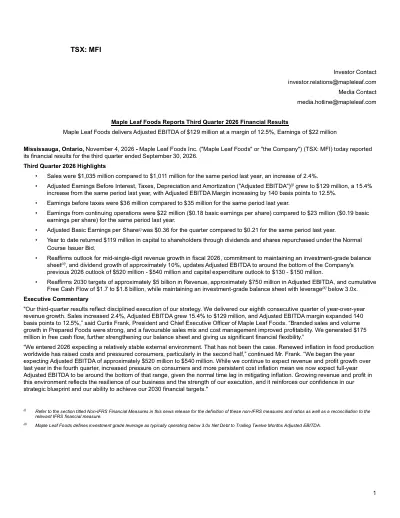
The headline today is straightforward: disciplined execution delivered strong third quarter earnings growth and cash generation, and our results show that the Maple Leaf blueprint is working and that our business continues to strengthen. Sales increased 2.4% to $1.03 billion, marking our eighth consecutive quarter of year-over-year growth.
Adjusted EBITDA grew 15.4% to $129 million, and adjusted EBITDA margin expanded 140 basis points to 12.5%. We also generated $175 million in free cash flow and ended the quarter with leverage of 1.9 times, well within our targeted range.
Beyond the headline numbers, the quality of growth was particularly encouraging. Sales grew in both operating units, and our branded portfolio continued to gain momentum.
Across the company, branded revenue increased 4.5%. In prepared foods, branded sales growth was over 6%, supported by branded volume growth that was over 4%.
We delivered double-digit growth in branded sustainable meats, increased Canadian branded market share, grew plant protein sales following the relaunch of the Yves brand in Canada, and our protein snacking platform also continued to develop. Mighty Protein expanded into approximately 3,500 gas, convenience, and dollar locations, while extending club distribution and improving velocities.
Greenfield protein kits have added approximately 30,000 U.S. points of distribution and secured its first national U.S.
club channel launch. Together with our Maple Leaf Natural Selections protein kits, Mighty Protein and Greenfield products are bringing our brands into more convenient, protein-rich eating occasions that are meeting real consumer needs.
Poultry also delivered a solid quarter. Sales increased 4.3%, led by improved channel mix and pricing.
Prime Raised Without Antibiotics delivered double-digit growth, Canadian branded market share increased, and London Poultry continued to support a more favorable mix while protecting our ability to grow well into the future. This commercial progress translated into stronger profitability within the quarter, where favorable sales mix along with improved operating efficiencies and disciplined cost management drove a 15% increase in adjusted EBITDA.
Fuel for growth is also becoming increasingly tangible. Our plants are delivering the benefits attached to our operational excellence program that are ahead of target in downtime, yield, and labor costs.
We remain on track to unlock more than 4 million kilograms of annual capacity in constrained categories, and we continued to advance our playbook in automation and AI, including the installation of our eighth cobot at our Heritage facility and the launch of our planner coach AI system that will reduce the cost of food waste while advancing our vision to be the most sustainable protein company on earth. Through the first nine months of this year, revenue has now increased 3.3% to just over $3 billion, and adjusted EBITDA has grown 8.4%, more than twice the rate of sales growth, reaching $388 million.
On a comparable continuing operations basis, year-to-date free cash flow has increased 57% to $293 million, and we have returned $119 million to shareholders through dividends and share repurchases. This combination of earnings growth, cash generation, and an investment-grade balance sheet gives us significant financial flexibility.
It allows us to invest behind our brands, advance our strategic and growth priorities, while continuing to allocate capital with discipline. Let me now turn to the outlook.
We entered 2026 expecting a relatively stable external environment. That has certainly not been the case.
Renewed inflation in food production worldwide has raised costs and pressured consumers, particularly in the second half, where cost pressures have intensified across energy, freight, feed, packaging, and ingredients, along with several protein inputs, such as beef, turkey, and chicken, offsetting any benefit of favorable pork markets. At the same time, consumers remain under pressure, and promotional intensity has increased to optimize both our volume and market share performance in the near term.
In poultry, for example, which accounts for approximately 40% of our overall sales, this inflation is translating directly into higher costs in real time. These higher costs are passed on from farmers to processors like Maple Leaf Foods through the Canadian supply management system, where effective October 18th, live bird costs have increased by approximately 3% sequentially in Q4 from Q3 and 8% year-over-year with very short advance notice.
We do expect to mitigate those costs through the combination of disciplined cost management, fully justified price changes, and other commercial actions, but the normal implementation lag means we will absorb the pressure in Q4 before realizing the benefits of those actions within Q1. Overall, we are responding with the same playbook that has served us well.
We are managing pricing and trade programs carefully, optimizing promotions, driving productivity across the network, and maintaining tight control of our own costs. We're also making the deliberate choice to continue to invest behind our brands, as we will not optimize a single quarter at the expense of the long-term health and relevance of our leading brands.
While we continue to expect revenue and profit growth over last year in the fourth quarter, these conditions mean that we now expect full-year adjusted EBITDA to be around the bottom of our previous outlook range of approximately $520 to $540 million. For fiscal '26, this means we expect: mid-single-digit revenue growth, unchanged from our previous outlook; full-year adjusted EBITDA around the bottom of our previous outlook range of approximately $520 to $540 million; capital investment of $130 to $150 million compared with our previous range of $160 to $180 million, reflecting the timing of projects and the discipline in our approach; a net debt-to-adjusted EBITDA below 3 times, consistent with an investment-grade balance sheet posture; and a quarterly dividend growth of approximately 10%.
Our confidence in mid-single-digit revenue growth is supported by the progress through the first nine months, continued momentum in our poultry and our prepared foods branded portfolio, and an additional week of shipping within Q4. We're also continuing to make the structural changes in our business that are needed to achieve our longer-term ambitions.
For example, in September, we announced the consolidation of our U.S. plant protein manufacturing network into a single center of excellence in Indianapolis.
The transition is expected to be completed in the fourth quarter of 2027, with benefits beginning in 2028. In addition to this, we are advancing a multi-year finance modernization program to simplify processes and upgrade our systems, including the phased transition of selected transactional activities to an external partner beginning this month.
Both initiatives require careful execution, and we are managing the impact on affected teammates with care and respect, consistent with our values. The expected costs, capital requirements, and benefits of these initiatives are reflected in our 2030 outlook.
Our confidence in our 2030 financial targets remains unchanged. We continue to target approximately $5 billion in revenue, approximately $750 million in adjusted EBITDA, cumulative free cash flow of approximately $1.7 to $1.8 billion from 2026 through 2030, and an investment-grade balance sheet.
The third quarter shows that the Maple Leaf blueprint is translating into stronger and growing brands, better mix, improved efficiency, and greater cash generation. We are managing the near-term environment with discipline, while continuing to make the right choices for the long-term health of the business.
With that, I'll turn it over to David to walk through the financial results in a little bit more detail. David?
David Smales
Thank you, Curtis, and good morning, everyone. Today I'll comment on results for the third quarter before turning to cash flow and balance sheet.
Sales in the quarter were $1.03 billion, an increase of 2.4% compared to last year. Sales growth was driven by both poultry and prepared foods, which increased by 4.3% and 1.3%, respectively.
In poultry, sales increased due to improved channel mix and pricing. These factors were partially offset by the impact of lower volume, with growth in food service and retail volumes more than offset by a decline in lower-value industrial volume.
Prepared foods sales increased due to improved product mix and related party revenue, which were partially offset by the impact of lower volume and higher trade promotion spending. Adjusted EBITDA of $128.9 million increased by 15.4% versus the third quarter of last year, with an adjusted EBITDA margin of 12.5%, improving 140 basis points over the same quarter last year.
Improved profitability was driven by favorable mix in both prepared foods and poultry, as well as improved operating efficiency and lower SG&A expenses. SG&A expense was $96 million in the quarter compared to $101.5 million last year.
The decrease was driven by lower variable compensation and the timing of advertising and promotional expenses. SG&A as a percentage of sales improved by 70 basis points to 9.3%.
Earnings from continuing operations were $22.3 million for the quarter, or 18 cents per basic share, compared to $23.3 million, or 19 cents per basic share, last year. Adjusted earnings were $44.9 million, or 36 cents per basic share, compared to $26.8 million, or 21 cents per basic share, last year.
The increase in adjusted earnings was driven by higher gross profit and lower SG&A and interest expense, which were partially offset by higher income tax expense. Capital expenditures were $30.4 million in the quarter compared to $27.8 million in the same period last year.
Year-to-date capital expenditures were $75 million compared to $77.7 million last year. The decrease reflects 2025 spending related to Canada Packers prior to the spinoff, which was largely offset by an increase in maintenance capital projects this year in continuing operations.
Looking ahead, as noted in our updated 2026 guidance, we expect capital investments for the full year to be in the range of $130 to $150 million, down from previous expectations, mainly due to timing of projects. Free cash flow in the quarter was an inflow of $175 million compared to $46 million last year.
Removing the impact of discontinued operations, which contributed $29 million of cash inflow in the third quarter of last year, the increase in continuing operations of $157 million was largely a result of the timing of investment in working capital and was partially offset by higher income tax payments and maintenance capital expenditures. In line with our stated capital allocation priorities, our leverage ratio remains well within an investment-grade range.
Net debt-to-trailing-twelve-month adjusted EBITDA ratio was 1.9 times at the end of the quarter, compared with 2 times a year ago and 2.2 times at the end of the second quarter. Strong free cash flow in the quarter, together with our underlying annual cash generation and investment-grade balance sheet, provides flexibility to execute a balanced approach to capital allocation.
On November the 3rd, the Board of Directors declared the regular quarterly dividend of 21 cents per share, consistent with our commitment to a growing and sustainable dividend. Year-to-date to the end of the third quarter, we returned $119 million in capital to shareholders through a combination of our quarterly dividend, which increased by 10.5% from the prior year, and the repurchase of approximately 1.4 million shares under the NCIB.
We intend to remain active under the NCIB, at a minimum offsetting dilution from our stock-based compensation plan. I will now turn the call back to Curtis.
Curtis Frank
Thank you, Dave. I'd like to close here this morning with three thoughts.
First, our third quarter results were strong and broad-based. We delivered our eighth consecutive quarter of year-over-year revenue growth.
Both operating units grew, branded volume and sales increased, margins expanded, and earnings translated into significant cash generation. Second, the external environment has certainly become more challenging than we anticipated at the beginning of the year and even one quarter ago, and we are responding with discipline and communicating with transparency.
In the face of this environment, it's important to take away that we do continue to expect revenue growth and profit growth over last year in Q4, and we expect full-year adjusted EBITDA to be around the bottom of our original range. Third, it has now been one full year since we completed the separation of our pork business and began operating Maple Leaf Foods as the purpose-driven, protein-focused, and brand-led CPG company that we set out to create.
Over those last 12 months, revenue has grown by more than 4%, adjusted EBITDA has grown by more than 8% or almost $40 million, and our adjusted EBITDA margin has expanded. At the same time, we have strengthened the balance sheet to 1.9 times, giving us meaningful financial flexibility to invest in our future and execute our strategic blueprint and capital allocation priorities.
While we can be proud of what we've accomplished in this first year, not every external condition has gone our way, which makes the progress even more meaningful. The Maple Leaf blueprint is working.
We're building demand behind our leading brands, improving commercial mix, operating our assets more efficiently, and translating those gains into stronger earnings and cash flow. We remain confident in our strategy, our assets, and our people, and the opportunity to build a larger, more profitable, and more cash-generative Maple Leaf Foods is intact, and our confidence in our 2030 financial targets remains unchanged.
I want to thank the entire Maple Leaf Foods team for their continued execution, commitment to living our leadership values, and dedication to serving our customers and consumers every day. Thank you.
Operator, we can now open the line for questions, please.
Operator
Thank you. Should you have a question, please press * followed by 1 on your touchtone phone.
You will hear a prompt that your hand has been raised. Should you wish to remove your hand from the queue, please press * followed by 2.
If you are using a speakerphone, please lift the handset before pressing any keys. Just a moment for your first question.
Your first question comes from Irene Nattel with RBC Capital Markets. Please go ahead.
Irene Nattel
Thanks, and good morning, everyone. If we could just focus for a moment on the sort of the updated 2026 guidance.
I guess first question is, excluding the extra week, are you anticipating that underlying Q4 revenue growth would kind of look more like the year-to-date number?
Curtis Frank
Good morning, Irene. How are you today?
Irene Nattel
Good, thanks. Thank you.
Curtis Frank
Good. I'm glad to hear that.
Yes, excluding the external week, I don't think we give you specific guidance on the quarter, but approximately in that range, I think, would be a reasonable expectation. The way we've provided an updated outlook for the year in terms of both revenue and adjusted EBITDA, by that nature, kind of allows you to calculate more directly an outlook for the last quarter, which I think would give you a pretty good indication of that.
It's pretty much, reasonably just math from there. In and around that range,
Irene Nattel
Irene. Thank you.
Then just thinking about the level and the response to sort of trade promotional activity, can you talk about what you're seeing and then how preliminarily we should be thinking about that framing 2027 if we assume that the macro backdrop doesn't change meaningfully?
Curtis Frank
Look, it's a competitive and challenging environment from a consumer perspective, as we noted in our opening comments, and we've continued to see throughout the year. I would point out to start, the relative performance of our business as compared to other consumer packaged goods companies in North America is a source of pride for us.
There isn't a lot of CPGs out there today that have had eight consecutive quarters of revenue growth, are delivering 4% branded growth in the quarter like we did last quarter, and are delivering 15% improvements in EBITDA in any given quarter. We're not dissatisfied in the context of the environment with the results last quarter.
In fact, we view them as quite solid. At the same time, you're right to point out that the consumer environment's quite challenged.
I think what probably gives us the most confidence in our operating outcomes today is the fact that the branded portfolio performed so strongly last quarter in the face of that consumer environment. The headlines that we would point out to you are 6% sales growth in prepared foods from a branded perspective and 4% volume growth from a branded perspective.
Even in that challenging environment, and we're gaining market share. Even in that challenging consumer environment, we would view that as very strong performance.
We're having to invest more from a promotional intensity perspective than certainly we had anticipated at the onset of this year to get outcomes, and we're certainly seeing more inflation as is the consumer. That's kind of what we're experiencing in the quarter today.
The most positive outcome of that is the uptick in the branded volume following the last inflationary pricing we took earlier this year. That's a positive perspective.
When it comes to 2027, I think there's a little more to play out yet. Our typical and historical pattern in terms of releasing an outlook for next year and providing guidance comes early in the year next year in the first quarter, we'll give you a little bit more color on 2027 and what that means at that time.
Irene Nattel
That's great. Thanks.
Curtis Frank
Thank you.
Operator
Your next question comes from Derek Lessard with TD Cowen. Please go ahead.
Derek Lessard
Good morning, Curtis and David. Congrats.
Solid quarter.
Curtis Frank
Morning.
Derek Lessard
Curtis, in your prepared remarks, you noted strong channel penetration and some key milestones in C-stores and club. Maybe could you just talk about the runway you've got there and how should we distinguish from early distribution gains from a platform that's scaling versus a material longer-term contributor?
Curtis Frank
Sure. Happy to, Derek.
Thanks. The one unique competitive advantage that we talk about from a Maple Leaf Foods perspective is the leadership we have in protein more broadly.
In today's environment, including a rapid adoption of GLP-1s, I think it's really important to have that protein position. The reason I start there is because there are two places that we would point to to say competitively differentiate us.
One is in the poultry business, in particular, which drives a clear line of sight to the benefit of healthy protein for consumers. The other is in protein snacking.
The ability to expand our distribution of protein snacking really in two ways: in protein kits, which you would have seen in our materials, we have the largest kidding manufacturing facility in the Canadian market, and brand leadership in that category; and what we've done with meat sticks, not just with Mighty Protein, but with the Schneiders brand, are two great examples of that. Traditionally, our distribution focus has been in the retail channel, but expanding to gas and convenience, dollar, and continuing to build penetration in the club channel have been really helpful to us.
Not only are we growing there today and adding points of distribution that we highlighted, but really, a few products have paved the way for more products. To answer your question more directly, we continue to be of the view that we'll have lots of legs and lots of opportunity for growth as we build stronger relationships and bring more products to that channel.
Derek Lessard
Super helpful. Then maybe just one last one for me.
Just on the reduction in the CapEx guide, I think you guys pointed primarily to project timing. Just wondering if you can maybe add some meat to that bones and whether there's been any change in investment priorities?
Curtis Frank
Sure. David, you can help with that one
David Smales
maybe. No change in priorities, Derek.
It's really just a timing and phasing of some of the projects that are underway and when we expect that spending to materialize. No, no change in strategic priorities.
Derek Lessard
I guess we could tack that on into 2027 then?
David Smales
Obviously we'll look at 2027 capital guidance in line with the timing Curtis talked about earlier. As we put together our capital plans for 2027, we'll take some of that into account.
It won't necessarily be a straight add-on. There's lots of moving pieces as we think about 2027.
Some of that timing will move into next year for sure.
Derek Lessard
Okay. Thanks, David.
Thanks, Curtis. Solid quarter.
Congrats.
David Smales
Thank you.
Operator
Your next question comes from Tamy Chen with BMO Capital Markets. Please go ahead.
Tamy Chen
Hi, good morning, Curtis and David. Thanks for the question.
I want to go back to the description you have for your inflation you're seeing. How did that trend, I guess, so far in the second half this year versus the first half relative to your expectations?
Is it a significant acceleration? Can you just touch on exactly the main components that have really accelerated?
I'm wondering if you can also talk about in Q1 what exactly it is that you intend to do to mitigate that. I don't know if you can still pass through price with your retail customers right now.
Curtis Frank
Great. Thanks, Tamy, and good morning.
The question on what's changing in the business, I think, is an important one, obviously. I would highlight what's changed most materially is the environment, not kind of the underlying direction of our execution.
There are three things that I think are important that I would point you to in terms of the moving parts, probably from the start of the year till today and certainly from Q3 moving into Q4. The first is, we've seen more inflation enter the business than we have expected.
That's accelerating. They're really, to answer your question, two areas, I think, that are the most pronounced.
The first comes in fuel and fuel surcharges. When we were last together for our Q2 earnings call, up until today, fuel surcharges have increased about 17%.
Pretty material change, and our pricing that we've implemented is not yet caught up to that. That's one material component.
The most important one comes in our poultry business. Poultry, as is supply-managed, the costs are regulated, and we've seen the cost of live poultry, our direct raw material input, increase about 3% from quarter three to quarter four, effective October 18th, which is 8% year-over-year, which is a pretty material move in the poultry business.
Those two things combined, the continued impact of broader-based inflation tied to a global conflicts and specifically fuel and energy combined with the changes in poultry, are really what's driving the inflationary components. That's the first component of what's changed: inflation.
The second is the consumer environment continues to be stressed, and probably more so than we would have expected at the onset of this year: more sustained food inflation, more broad-based inflation overall, interest rates moving higher, and a real demand for value. The consumer environment would be the second.
There's a smaller timing effect in Q4, just the timing of selling through higher-cost inventory. That's probably the smaller thing.
When I reflect on execution, the only other color I would add for you is, we've clearly got a little less private label volume actually in our business than we would have expected at this point in the year, and that's an area of focus for us. Very, very pleased with the branded performance from an execution perspective.
It was certainly my expectation that we would have had a little stronger of volumes in private label. There are reasons for that, and we'll get those resolved.
That's really how I would sum up kind of where we are today and what's changed kind of from the onset of the year and even what we expect Q3 to Q4. With respect to the mitigating actions, there are a few of them that I think are really important.
The first is that we control our costs in a very disciplined way. You saw that in the third quarter: SG&A, operating efficiencies, the work we're doing in fuel for growth.
In this consumer environment, managing those costs is hugely important. The second is the work we do to optimize in our revenue management function, the promotional offer to the consumer, working away at that.
We saw very positive outcome in Q3: volume and market share outcomes across the branded portfolio. The third is obviously, after we've exhausted those levers, making changes to our pricing architecture.
We do have plans to adjust our prices in Q1. There's still a time window to do that within the quarter.
We haven't yet announced those changes to our customers, it would be premature to comment on them. It's important to us that we have an opportunity to work through those changes directly with our customer partners, but we are expecting to make adjustments in the first quarter.
Tamy Chen
Thank you. My follow-up is, specifically in poultry for Q3, was curious how it performed versus your expectations.
Can you talk about the broader category in retail if you're saying the consumer is perhaps a bit more stressed lately? How is your poultry segment doing in the quarter?
I think you mentioned, Curtis, total company branded volume growth was up 4.5% and prepared foods was up 6%. It sounds like your branded volume in poultry was lower than that.
Am I thinking about that correctly? Thanks.
Curtis Frank
We were super pleased with the poultry outcome in the quarter. You might look at the top line number of 4.3-ish percent growth and maybe arrive at a different conclusion.
I was still obviously pleased with that, but there are a few things, Tamy, that are important inside of that to unpack. The first is in Q3 last year, we grew the poultry business 16%, 16%, we were comping a very big quarter, and we had 4% revenue growth on top of that.
That's not the real story in the poultry business. What's really important is that we had very solid growth in both the retail and food service channel, accompanied by double-digit declines in the industrial channel.
We got to 4% growth by really solid growth in retail and food service and double-digit declines in the industrial channel. That's a very good thing for our business in terms of the mix profile of the revenue that we generated, because the industrial channel obviously tends to have the lowest profitability.
That's very purposeful in terms of strategy execution. Something important to highlight would be our Maple Leaf Prime Raised Without Antibiotics brand had double-digit growth within the quarter, just as an example inside of that.
Our market share obviously, as we noted, was up. We were really happy with the poultry growth and, more importantly, how it materialized in the mix outcomes that came alongside that.
Tamy Chen
Thanks.
Operator
Your next question comes from Chris Li with Desjardins. Please go ahead.
Chris Li
Good morning, everyone. Thanks for all the comments so far.
It's very helpful. For prepared foods, can you talk about how the volume progressed through the quarter as consumer adjusted to the price increases, and how did it exit the quarter?
Did it start to trend higher overall? Thank you.
Curtis Frank
It wasn't necessarily higher exiting the quarter. I would view, Chris, the 4% volume growth that we had was fairly consistent throughout Q3.
It did ramp up a little bit, obviously, following the back end of the inflation-justified pricing that we had taken into the market. It was fairly consistent through the quarter, which again is why we would characterize it as a solid quarter.
In terms of Q4, I'm kind of going to resist getting into week-by-week kind of outlook in terms of how the branded volumes materializing. I continue to expect branded strength in our performance overall, I think would be the way to characterize it, as we close out the year.
Most important is, we always say in consumer packaged goods, the category leaders move with pace when there's justified inflation in the market. There's typically a period of volume adjustment, which we saw in the second quarter.
We were very pleased with the recovery here in Q3 and kind of expect to continue that momentum looking forward.
Chris Li
No, that's helpful. Maybe also on prepared foods again.
Sorry if I missed you answered. You noted that branded sales were up strong, more than 6% in the quarter, but total sales were up 1.3%.
Is the difference mostly the private label that you mentioned earlier where you're seeing some of the declines?
Curtis Frank
It is, Chris. That's exactly it.
It's in private label, and it's in the Canadian market and the U.S. market.
We had the roll-off of certain private label businesses that again we expect from a capacity utilization to replace in time, but that's really what's driving the difference that you're pointing out rightfully.
Chris Li
Great. My last question, just I think your updated guidance for EBITDA still implies some EBITDA margin rate improvement in Q4.
Is that correct? Then, do you have good visibility on achieving the bottom end of your EBITDA guide of 520?
Is there a risk of falling below that?
Curtis Frank
A couple of things on that. Less so on the rate side, but I think what's important is we still expect both revenue growth and EBITDA growth year-over-year in Q4.
I think that's a positive. The rate quarter-to-quarter, I think you can be kind of back into from a math perspective.
We still do expect to deliver a revenue and adjusted EBITDA growth in Q4, which you view as positive. Sorry, there was a second part to your question, I might have missed.
Chris Li
Oh, yeah, no, I was just wondering that the 520, I guess, you got guiding down to the bottom end, is that 520 you have good visibility on that?
Curtis Frank
There's still eight works we eight weeks left in the year. We're not perfectly precise, and no one want to leave you with that impression or illusion in our business.
We guided to around the lower end of our $520 range, the lower part of our $520 to $540 range. I think that word 'around,' plus or minus, is exactly where we would view the business.
We've fronted the outlook with full transparency in terms of how we're looking at the balance of the year playing out, based on everything we know today. We consider that tightening the range, and I think that was appropriate.
Chris Li
That's great. Thanks and all the best.
Curtis Frank
Thank you.
Operator
Your next question comes from Vishal Shreedhar with National Bank. Please go ahead.
Vishal Shreedhar
Hi, thank you for taking my questions. I was hoping you could give me your thoughts on EBITDA getting at the lower end of the range, and maybe give me the puts and takes.
It sounded like there was many positives in the year. Mix was seemingly very strong for you, and that's helpful, but inflation, more so than expected, consumer is a little bit tougher than you thought, poultry inflation in Q4 is a little bit acute there.
Hopefully you can give me a little bridge of what the positives and the negatives are that cause you to revise that to the lower end.
Curtis Frank
Sure, Vishal. Good morning.
I tried to cover some of that earlier, but happy to put a little bit more color around. The biggest thing was the sustained inflation in the market.
We entered this year expecting a little bit more stability in the year. We expected to take a cost change early in the year and kind of have that be it for the balance of the year.
You'll remember we were forced to move with a second one as well as a second increase, as well as a change in fuel pricing as well. Those were pretty material changes from where we started the year to where we are today.
The inflationary backdrop, I think, first and foremost, is the most significant one and was the most difficult, obviously, to predict given kind of what's happening from a global conflict perspective, and what's happening even geopolitically and with trade. That would be the larger and the heavy hitter.
The consumer environment in response is not something we directly control, but we have had to respond to. I think the second area would be more promotional investment than expected to get the volume and market share outcomes that were proudly delivering today would be the second most important area, because the consumers ultimately felt the brunt of that inflation.
The third would be the comments I made around the private label volumes not materializing in a way that we expected at the onset of this year. Those would be the kind of the things that changed maybe from a working against us perspective.
I'd go back to pointing out, first and foremost, the branded growth that we're getting in the business, really positive in response to that, particularly this past quarter, a very positive volume and sales growth. As I said at the onset of the call, the fact that we're performing the way we are relative to the broader CPG industry—eight consecutive quarters, 15% improvement in EBITDA last quarter, and revenue growth eight quarters in a row—I think is a source of pride inside of that environment, notwithstanding other areas obviously that we could have been better.
Some out of our control, some we certainly could have been better: private label volumes, in particular, would be one area I would point to.
Vishal Shreedhar
Thank you for that color. I was hoping to also get your context on growth in the U.S.
market and acquisitions given the backdrop and any updated thoughts on that.
Curtis Frank
Growth in the U.S., the the, we had about $5 million of growth we reported in the U.S. last quarter.
Um, it's a mixed outcome, to be to be candid. On the branded, growth side, very, very happy with, the quarter in the United States, within Q3, so that was a that was a positive view from my perspective.
Pardon me, our our Greenfield brand delivered somewhere around 40% growth in the quarter, which is a, pretty exceptional quarter, on the back of expanding distribution, a our first, national club channel launch, and, and some improvement in velocity. Those those things are a very positive from a branded perspective.
Part of that private label shortfall comes from directly the U.S. market, so, that that would have been one of the challenges that we've experienced.
We still continue to view, the U.S. as an attractive market for growth.
I think the penetration the band brand is making today, in Greenfield Natural Meat Company is just is indicative of that. From an M&A perspective, be consistent with our comments last quarter, I think David would be appropriate, that nothing's eminent on in the horizon, but geographic expansion is certainly an opportunity for us.
We have obviously the balance sheet strength and health to, consider strategic alternatives. Our focus continues not to be on our focus continues to be on bolt-on sized, M&A, and, we're advancing our playbook in that regard.
There's there's no new news to report. David, any color that you would add, that you think is important?
David Smales
No, I think, as we talked about earlier in the year, we're doing the work to be very clear on what the opportunities are in the U.S. and where we want to focus our efforts.
That work continues, but nothing imminent at this point.
Vishal Shreedhar
Thank you.
Curtis Frank
Thanks, Vishal.
Operator
Your next question comes from Martin Landry with Stifel. Please go ahead.
Martin Landry
Hi, good morning. I was wondering if we could continue the discussion with your branded business.
Maybe a basic question, what is driving the growth in your branded business? I think you've talked about double-digit growth in Maple Leaf Prime.
I assume that implies good market share gains. It was just like to understand a little bit what you think explains the success you're having with Maple Leaf Prime.
Curtis Frank
Well, there there we're seeing branded growth within both our poultry business and our prepared foods business. I'll I'll unpack them, maybe one at a time.
Starting with your question, Martin, on on the poultry side, the Maple Leaf Prime brand continues, to deliver strong growth in the market. The, the one strategic advantage we have is the investment, that we made in London Poultry, several years ago, and that's allowing us, that was the investment thesis at the time, and it's it's playing out, I think, wonderfully today, which is the fact that London Poultry continues to allow us to get to capture more value-added sales.
We're able to take the meat that's being allocated, in terms of increase year-over-year and get it directly into a branded package of product because we can convert it at London Poultry from a from a capacity and growth perspective. That's that's number one: the asset, that we've built continues to be a wonderful asset.
Replacement value has increased dramatically, as you can imagine, from an inflationary perspective from the time it was built, and and we view that as a as a strategic advantage, and and that, benefit is playing out in the markets today. We have the, the, the leading brand in the category in in Maple Leaf Prime, as you've noted, our market share is growing.
The most important point that I think should land for all of us is the growing consumer demand for protein and how well poultry is positioned inside of that. We've recently adjusted even our packaging on Maple Leaf Prime, as an example, to make it clear to consumers, to clearly convey the message of how protein-rich, and nutrient-dense, Maple Leaf Prime poultry is:, 51 grams of protein in the average chicken breast, which sometimes isn't naturally intuitive, to all consumers.
We made it clear and direct to them, right in the center of our package. I think combination of a great asset, a leading brand, and, good brand marketing, along with, really strong support from our customer, partners, which we, which we also appreciate.
Martin Landry
That's helpful. I assume you've had good market share gains.
I assume you're growing faster than the market. I understand there's a shift and poultry is the protein of choice right now, but is it fair to say that you're gaining share in the
Curtis Frank
category? We gained share last quarter.
Yep. Yep, we gained share last quarter.
Yep.
Martin Landry
Okay.
Curtis Frank
Then,
Martin Landry
shifting gears on your costs, I'm trying to understand a little bit the mismatch right now. You've called out that you had a short-notice increases with poultry.
Is that really the only mismatch right now heading into Q3 Q4, or are you still catching up with fuel costs and passing that through to your customers? Just trying to understand a little bit, aside from poultry, where are the mismatch between costs and prices?
Curtis Frank
Yeah. No, it's not limited to just poultry, although that's a material driver, which is why I focused some of my commentary in that area.
Fuel, we're also lagging in, Martin, today. The kind of the moving parts are: some level of favorability in pork raw material inputs; surging costs in poultry with short notice that we can't pass prices on as quickly as the costs materialize; surging prices in fuel, freight, and distribution; and general inflation in damn near everything else: labor, packaging, and ingredients, the balance of our inputs in the prepared foods and poultry business.
When you lump all those together, there's just more overhanging general inflation than we would have expected at this point in the year, and we're going to have to address that early in the year next year.
Martin Landry
Understood. Thank you for the color, and best of luck.
Curtis Frank
Thank you.
Operator
Your next question comes from Ty Collin with CIBC. Please go ahead.
Ty Collin
Hey, good morning, everyone. Thanks for taking my questions.
You talked about optimizing your promotional strategy in a bit more of a challenging consumer environment. Can you provide a little more detail on what that looks like, how you're sort of evolving your approach, and how you're thinking about balancing market share and margins moving forward?
Curtis Frank
That's a great question, Ty. Thank you for that.
Our priority, and I think you're seeing it show up in our business, particularly again on a relative performance perspective as compared to our broader protein peer set in North America, priority number one is to protect the margins. We've worked hard, largely through capital investment, to build the margin structure that we have in the business.
We're committed and working hard to protect that margin structure. I think that's critical in this environment.
We also, at the same time, are balancing the need to keep our manufacturing facilities as full as we can, grow the volume to do that, and protect the market share. The art and science of revenue management is really focused on all the levers within the skill set to do that: regular price, feature price, pack size architecture, promotional frequency, depth, just a classic playbook in revenue management.
I think our team broadly is doing a really great job in that area. It's not an easy pursuit to get the value equation, quote-unquote, 'right' to the consumer today, given the demands that they have on their wallet.
I think our team is doing a fine job in that. Again, poultry positioned as, food is not discretionary.
We're fortunate to be in the food business. We should not take that for granted.
We're fortunate to be in the poultry business, because it's clearly a staple at a time where protein demand is very strong. In our prepared foods business, the combination of innovation and the work we're doing in revenue management is, I think, paying really good dividends today.
Ty Collin
Got it. Thanks.
Then maybe a bit of a higher-level question. I'd say there's some parallels between the situation you're in closing out this year compared to last year, specifically having to manage and digest some cost inflation while facing down a consumer that's turning increasingly cautious.
Any sort of learnings from how you navigated that process last year, how you saw the consumer respond, that you're going to be taking into consideration over the coming quarters?
Curtis Frank
Oh, for sure. Anytime you deal with some level of strain, there's learnings that come with that.
I think that's important that every good management team takes those away. We've banked a number of those learnings.
The good news is the recovery from the last price changes that we've taken has materialized as planned, we can take some good, positive learnings out of that. I didn't feel last year that our pace in response to the inflation that we saw was adequate.
I thought we were too slow, and it essentially affected two quarters in the back half of the year. I'm not unhappy, to be clear, with the performance in Q3.
In fact, in the context of the total environment, I think it's performance we can be proud of. We're going to feel the effects of more inflation in Q4.
I don't think there's a whole bunch we could have done to get materially ahead of that at this stage. It's all about moving with pace for the early parts of the year to adjust to that.
We've definitely onboarded the learnings from a year ago. We're protecting the margin profile in the business to the best of our ability in the context of the environment.
Far, it's a Q4 story, but again I would point you: in Q4, we expect that we're going to have revenue and EBITDA growth versus last year, and that's a different outcome maybe than what we experienced. All in all, we're continuing to make progress.
I don't think the industry itself is in a state of perfection, but inside of that, we're performing in a way that we're pleased with.
Ty Collin
Appreciate those thoughts. All the best.
Curtis Frank
Thank you.
Operator
Your next question comes from Bahamin Abdolpanah with Ventum Financial. Please go ahead.
Bahamin Abdolpanah
Good morning, everyone. Thanks you for squeezing me in.
My question is about the snacking business. Branded revenue grew about 6%.
How much of that came from protein snacking? How that growth is coming from: new doors or higher sales in stores that you are already in?
Curtis Frank
We don't break out protein snacking as a category separately or the performance inside of that. It was a contributor in the quarter, but it was a positive contributor because the new innovation is net incremental, obviously.
From that perspective, it was a positive contributor, but it's a part of our growth. I don't think you'll see us split it out separately from a category perspective.
I'm not certain it would be entirely helpful. I think what's most important is the combination of the way we're positioning our products in the market, the great work we're doing from a brand marketing point of view, and the innovation platforms that we have.
We always say we have five core growth strategies, and the fact that we can balance the five of them together is really what's driving, I think, our growth success here in the last little while. It's the combination of them working all together, not one in and of itself in any one quarter.
Bahamin Abdolpanah
Thanks. Staying on the snacking, there is a shift among big CPG companies moving into the category.
I was wondering how would you characterize how we are differentiated in terms of: is it in terms of innovations, we have a head start, or it's just a big category that has room for everyone to grow?
Curtis Frank
That's a very good question. It is a large category.
There are different parts of the category that I would point to. There's the center of the store, which you'll see more traditional and multinational CPGs continuing to participate in and maybe even elevating their participation in.
We tend to be focused on the cold supply chain around the perimeter of the grocery store, which is where we have unique competitive advantages. That's an important part that differentiates us from the broader consumer packaged goods set.
We are a protein company, I like to be in protein snacking as a protein company, all to say I believe we're credible and have 100 years of brand experience in that part of the store. There's no question it is more competitive today, and that's not always a bad thing.
Bringing consumer awareness to the benefits of protein snacking is not necessarily a bad thing. Our reflections are, we're naturally competitively advantaged, but as is always the case in innovation, we need to go faster.
That's our center of gravity right now.
Bahamin Abdolpanah
Thanks. Very helpful.
Maybe shifting gears to plant protein. Last time we spoke on this investor day, we were on breakeven.
The aspiration was to get to the portfolio average. I was wondering, with the consolidation that we have, first, where do we stand now?
Then, with the consolidation that we have, do we get there, or do we still need volume in order to get to the portfolio average?
Curtis Frank
That's an important question. We talked about the plant protein business structurally where we were at as compared to earning kind of average margins in the portfolio.
The three heavy hitters essentially that are required to accomplish that task are: the large one is in capacity utilization, and obviously on that day, we couldn't share the full extent of our details, but we did communicate those plans in the last short little while here: closing two facilities in the United States and consolidating them into one center of excellence in Indianapolis. That move alone gets us, kind of well into the profitability range.
That part on its own, which is obviously a positive and the most important step forward, just getting the capacity utilization in the business right and matched to demand today. The second was getting to some level of normalized growth in food in the, call it 2% or 3%, to be simple, in the plant protein business.
I'm encouraged by the last quarter. We actually had 5% growth.
I'm encouraged by that, but we need to find stability in the base. I think, or maybe I'm optimistic, that we're largely there.
The third is in, kind of pricing and promotion and getting those things right. Some level of innovation will obviously be required over time, but that can come as that playbook evolves.
It's really around getting the work done to consolidate the assets, which is the biggest and most material component of that plan.
Bahamin Abdolpanah
Thank you very much. Best of luck.
Curtis Frank
Thank you. Thank you.
Operator
Your next question comes from Luke Hannan with Canaccord Genuity. Please go ahead.
Luke Hannan
Thanks. Good morning, and thanks for squeezing me in.
I want to go back to, Curtis, you talked about the inflation in bird costs that you're seeing right now. Can you just unpack where specifically, I guess, that farmers are seeing inflation?
Is it also due to higher fuel prices, or is it due to higher feed costs? To the extent that it's either one of those and presumably if there's relief in either of those areas, then bird costs should come down, and then that should, in turn, lead to lower product costs, I would imagine, for you going forward.
Can you just share, I guess, what's really driving the inflation there?
Curtis Frank
You nailed it exactly. It's predominantly feed and fuel.
Those are the two primary inputs. It's quite formulaic, over time, if there's relief, we would expect to capture the benefit of that relief, or at least be able to pass it on to consumers in a responsible way.
Those costs would come down if the inputs came down in a material way. There's a bit of time lag to that, obviously, but they would come down.
Those are really the two components: feed and fuel, and just inflation in agricultural commodities that are a direct implication of what we've seen from a conflict situation in the world.
Luke Hannan
Thanks for that. My follow-up, I guess, to that as well as you talked about that being implemented as of October 18th or seeing those higher bird costs as of October 18th.
I know that there's the pricing moratorium that kicks in, beginning in November, and I think it carries through to the end of January as well. Absent that moratorium, I guess it's a longer way of asking a question of if that moratorium wasn't necessarily in place, would you have still been able to take price in time such that maybe the revision to guidance wasn't as necessary?
Curtis Frank
Not really. I think the honest answer to that is not really.
We get a very small number of weeks in notice of the price moving up, and we're really in the 8- to 12-ish week lag time to get that implemented with customers. I think it's always important to point out that's normal in consumer packaged goods to have that type of lead time.
I don't think we would have been able to move them materially faster. We do have a handful of products that are formula-based, Luke, where it moves a little bit quicker, but on balance, I don't think we would have moved it much faster than the type of notice we're seeing today.
Luke Hannan
Got it. Thanks.
Curtis Frank
A normal lag.
Operator
Your next question comes from John Zamparo with Scotiabank. Please go ahead.
John Zamparo
Thank you. Good morning.
I'm trying to better understand the performance on branded versus private label and the state of consumer spending. Branded growth being above private label is probably not what we'd expect when we think about a challenged consumer spending environment.
I wonder if you can elaborate a bit on that, and why consumers seemingly they're trading down, but are choosing branded more often than not? Do you chalk it up to income cohorts?
Is it that trade-down is evident, but it's from beef into branded pork and branded poultry? Or is there something within your private label portfolio that you think you could do better in the coming months or years?
Any more color there would be helpful.
Curtis Frank
The changes, John, in our private label portfolio are all about managing the portfolio and have very little to do with the consumer. They're more about customer decisions on who their supplier of private label is or what type of private label offering they're going to have in the market, sustainable meats or otherwise.
They're more about market-based choices than they are a direct result of the consumer environment. I respect it's a little harder to tease those two insights apart.
Consumer environment's tough. Our branded performance inside of that: really, really strong.
We actually gained market share, which means we're performing well relative to private label broadly across the market. Within Maple Leaf Foods, our own private label business has saw pressure this year, mostly because of changes to the portfolio, meaning who we supply.
As I said earlier, we will remedy that, but it will take a little bit of time.
John Zamparo
That's helpful. Thank you.
Then one more, and coming back to the CapEx subject, there were some deferred projects last year as well that were pushed into '26, and now we're seeing some moved into '27. Is that all growth spending that's moving, or is some of it maintenance?
Is it intentional because you don't need these projects to be completed yet to achieve your growth aspirations, or is it construction projects that are more complicated? I wonder if you can elaborate there.
David Smales
It's primarily a mix of both. Last year, it was mainly maintenance moving into '26.
This year, I would say it's a mix of both. It's nothing more than just some of the finalization of the engineering and design and those kind of things that isn't quite in line with what we expected when we put out the guidance.
It's a mix of both, and, as I said earlier, some of that will obviously impact our outlook for CapEx for next year. It's not really a change in strategy or a change in any of the projects we're undertaking.
It's just the timing of some of that spend coming through.
John Zamparo
Got it. Thank you.
Operator
There are no further questions at this time. I would like to turn the call back over to Mr.
Frank for closing remarks.
Curtis Frank
Thank you, everyone, and very much appreciate you joining us today. I think the headline is we're one full year after the completion of the spinoff of what's ultimately become Canada Packers, and Maple Leaf as a protein-focused, a brand-led consumer packaged goods company.
Over those 12 months, we're pleased with the progress that we've made: over 4% growth in revenue, essentially 8% growth in EBITDA or $40 million, and expanding in margins. Q3 was solid.
We've given you a good perspective on how we see the balance of the year playing out, and we very much look forward to coming together with you at the closure of Q4 in our year and providing a further update with respect to our overall progress and performance. Thank you, and wish you all a great day.
Operator
This concludes today's conference call and webcast. Thank you for your participation.
You may now disconnect.