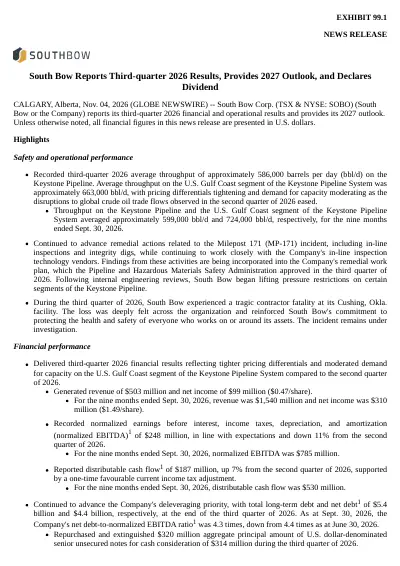
South Bow Corp
Q3 FY2026 · Earnings Call TranscriptNovember 5, 2026
Operator
Good day, ladies and gentlemen, thank you for standing by. Welcome to South Bow third-quarter 2026 results conference call and webcast.
At this time, all participants are in a listen-only mode. After the speakers' presentation, there will be a question-and-answer session.
To ask a question during the session, you will need to press star one one on your telephone, and you will then hear an automated message advising your hand is raised. To withdraw your question, please press star one one again.
Please be advised that today's conference is being recorded. I would like now to turn the conference over to Martha Wilmot, Director of Investor Relations.
Please go ahead.
Martha Wilmot
Thank you, Michelle, and good morning, everyone. Welcome to South Bow's third quarter 2026 earnings call.
With me today are Bevin Wirzba, President and Chief Executive Officer; Van Dafoe, Senior Vice President and Chief Financial Officer; and Richard Prior, Senior Vice President and Chief Commercial Officer. Before I turn it over to Bevin, I'd like to remind listeners that today's remarks include forward-looking information and statements that are subject to the risks and uncertainties addressed in our public disclosure documents, available under South Bow's SEDAR+ profile and in South Bow's filings with the SEC.
Today's discussion will also include non-GAAP financial measures and ratios that may not be comparable to those presented by other entities. With that, I'll turn it over to Bevin.
Bevin Wirzba
Good morning, everyone. We appreciate you joining us today.
South Bow delivered another solid quarter, reflecting the continued strength of our base business. Results were in line with expectations, while we strengthened our financial position and advanced our growth portfolio.
At the same time, the outlook for the Western Canadian Sedimentary Basin continues to strengthen. Production is growing and, importantly, our conversations with customers are becoming increasingly focused on how we can support those growth and expansion plans.
We see the potential for a broader set of opportunities across our corridor, from additional connectivity and expansions to our existing infrastructure, to larger-scale projects that can support the next meaningful phase of resource development in Western Canada. That momentum reinforces what we heard through the Prairie Connector open season.
As our customers look to grow production at scale, they need additional egress to established markets. They need inter-basin solutions, and they will need solutions that can be executed in the near term.
Prairie Connector is an important part of how we can support that growth, and we continue to advance the project toward a targeted mid-2027 final investment decision. Alongside our partner, our teams are advancing a number of activities, including permitting and land acquisitions, stakeholder engagement, execution planning, cost refinement, and financing arrangements.
In parallel, we are working toward the regulatory certainty and permit durability needed to support an investment decision. As we said on our second quarter call, projects of this scale involve a number of interconnected workstreams, and we are making good progress across each of them.
Some of that work involves complex and sensitive discussions that we are not in a position to address publicly at this stage. What I would emphasize is that our approach and investment discipline remain unchanged.
We are executing the plan we laid out following our successful open season, while continuing to evaluate the opportunity against the same criteria we apply to all our investments. With that, I'll hand it over to Richard to provide more detail on our integrity activities and operational performance.
Richard Prior
Thanks, Bevin. I'll start with pipeline integrity and the continued progress we're making on the remedial work associated with Milepost 171.
During the quarter, PHMSA approved our remedial work plan, and we continue to advance our in-line inspection program using phased array ultrasonic technology, which is being validated through field integrity digs. Following internal engineering reviews, we've begun lifting pressure restrictions on certain segments of the Keystone pipeline.
We're encouraged by the continued progress, and consistent with what we've shared previously, we expect pressure restrictions to continue being lifted in phases through the end of this year and into 2027. Turning to operations, the third quarter played out largely as expected.
As indicated on our last call, we anticipated activity on our U.S. Gulf Coast segment would be moderated from the strong levels we experienced in the second quarter, as tighter pricing differentials and low Cushing inventories weighed on demand for capacity on Marketlink.
We also completed significant in-line inspection work during the quarter in support of the Milepost 171 remedial work plan. This reduced available capacity, but advanced the work required to remove pressure restrictions.
As we move into the fourth quarter, transportation differentials have since widened from third quarter levels, supporting stronger demand for capacity to finish the year. Looking further ahead, we continue to see a constructive setup for our corridor.
Western Canadian crude oil production is growing, and while supply remains below total pipeline egress capacity today, we expect production growth to begin outpacing incremental egress additions later in 2027. Over time, that should support stronger demand for uncommitted capacity on our Keystone system.
With that, I'll turn it over to Van to discuss our financial performance and outlook for 2027.
Van Dafoe
Thanks, Richard. Our third quarter financial results were in line with our expectations and continue to demonstrate the strong cash generation of our business.
We reported normalized EBITDA of $248 million and distributable cash flow of $187 million, with distributable cash flow up 7% from the second quarter, supported by a one-time favorable tax adjustment. Given our strong performance so far this year, we're increasing our 2026 distributable cash flow guidance by 4% to approximately $690 million.
Our normalized EBITDA outlook of approximately $1.04 billion remains unchanged. That performance continues to support our deleveraging priority.
We exited the quarter with net debt of approximately $4.4 billion and leverage of 4.3 times normalized EBITDA. During the quarter, we also reduced absolute debt by repurchasing and extinguishing $320 million of senior unsecured notes with cash on hand.
Turning to 2027, we expect the underlying strength and stability of our business to continue. We are guiding to normalized EBITDA of approximately $1.07 billion within a range of 2%.
A key driver of the year-over-year increase will be Blackrod, as cash flows associated with the project continue to ramp up and make a more meaningful contribution to South Bow's results. Approximately 70% of the contribution will come from the oil lateral and will be recorded as normalized EBITDA, while the remaining 30% will come from the natural gas lateral and will be recorded as interest income.
The remainder of our outlook reflects the stability of our highly contracted base business, while the range around the normalized EBITDA captures variability in price differentials and the associated demand for uncommitted capacity. We expect to generate distributable cash flow of approximately $630 million in 2027, within a range of 4%.
The year-over-year decrease primarily reflects higher expected current income taxes, following the significant tax savings South Bow realized in 2026. For capital spending, we expect approximately $40 million of maintenance capital, plus or minus $10 million, and approximately $65 million of growth capital for pre-FID activities on Prairie Connector and Liberty Bridge.
We will evaluate accelerating certain pre-FID development spending as greater regulatory certainty and permit durability are achieved. At the same time, we expect to continue strengthening our financial position, with net debt to normalized EBITDA declining modestly over the course of the year.
Finally, our board of directors have approved our quarterly dividend of 50 cents per share. With that, I'll turn it back to Bevin for closing remarks.
Bevin Wirzba
Thanks, Van, and thanks, Richard. Before we open the line for questions, I want to come back to the broader picture.
South Bow's business is performing very well. We are strengthening our financial position, and the fundamentals supporting our corridor continue to move in the positive direction.
Western Canadian production is growing, and our customers are increasingly looking toward the next phase of growth. That is creating opportunities across our corridor, from our existing footprint to the large-scale projects we are advancing.
Prairie Connector remains an important part of that opportunity set. We have strong customer and stakeholder support, and we are making good progress across the work needed for a targeted mid-2027 final investment decision, while remaining focused on achieving the conditions necessary to allocate capital with confidence.
As we pursue these opportunities, our priorities remain unchanged. We will operate safely and responsibly, strengthen our balance sheet, and remain disciplined in how and where we invest shareholder capital.
That combination of a resilient base business and a growing opportunity set positions South Bow well for 2027 and beyond. Before we open the line for questions, I'd like to welcome Heather Chrislock, our new Chief Operating Officer, who recently joined South Bow.
We're very pleased to have Heather on board. With that, I'll turn it back to the operator for Q&A, with Van and Richard joining me for questions.
Operator
Thank you. As a reminder, to ask a question, please press star one one on your telephone and wait for your name to be announced.
To withdraw your question, please press star one one again. The first question comes from Robert Hope with Scotiabank.
Your line is open. Good
Robert Hope
morning, everyone. Good to see the Prairie Connector continue to track to the mid-2027 FID.
Can you add a little bit more color on what progress was made there over the last quarter, as well as kind of what goalposts the investment community should be looking for over the next couple quarters to ensure that you're tracking towards that FID?
Bevin Wirzba
Thank you, Rob. We're progressing, as I mentioned in my remarks, on multiple fronts, and so from permitting and land acquisitions, securing kind of more regulatory certainty as we go with discussions in both Canada and the United States, refining our execution plans, long-lead equipment strategies, all of that is moving forward in what you would normally anticipate.
We're really feeling good about the progress we've made. We've established the team, all of those kind of arrangements are moving forward great.
Then in terms of kind of milestones, obviously the permitting processes are multi-quarter type activities that advance, securing all the land, that will be a milestone to look towards. Then obviously, some form of certainty around permit durability is what we're really really focused on.
That's what we need to see before we'll allocate any more meaningful capital towards the project.
Robert Hope
Appreciate that. Then maybe diving a little bit deeper, if possible, on that concept of permit durability.
How are the conversations with stakeholders both north and south of the border ongoing? Are they understanding of what conditions are required for South Bow to invest capital?
Are they willing to accommodate that? Can you maybe just give us a little bit of incremental color on how those discussions are going?
Bevin Wirzba
Rob. Stepping back, what's fundamental, and I meant in my comments saying that the fundamentals remain strong, and I think the fundamentals around energy security in both Canada and the U.S.
are very aligned. Because of that alignment, we're seeing from stakeholders that they understand that we need that certainty to move forward.
I've said pretty clearly that those conversations are pretty complex, and they're very sensitive. We're not going to be able to share any specific details around how we're advancing on that front, but I can say that I think we're pretty aligned on what we need, and governments understand what we're looking for in order to allocate capital.
This is a project that is very meaningful for both countries, and we're hopeful that we can move that forward here in the next few quarters.
Robert Hope
All right. Appreciate that.
Thank you.
Operator
Thank you. Our next question is going to come from Sam Burwell with Jefferies.
Your line is open.
Sam Burwell
Hey, guys. Good morning.
I guess shifting away from that a little bit, of the organic opportunities that you guys are evaluating, you put that in the press release, could those be things that are tied fairly closely to Prairie, or would this maybe be a desire to diversify a little bit away from that and go after projects maybe elsewhere along the system?
Bevin Wirzba
Sam. Since our Investor Day, just over a year ago, we said we'd be advancing organic opportunities across our system, and we're very encouraged to see that portfolio of opportunities is maturing.
We're maturing opportunities that are south of the border that are clearly not connected to Prairie Connector. Then with the increased growth that we're seeing intra-Alberta, it's directly tied to our existing corridors, which is also part of the strategy.
Our second capital allocation priority was to leverage the pre-invested capital that we already have in our corridors, and that includes our intra-Alberta assets. Quite a number of things maturing, and hope we can share some more on that over the next few quarters as well as these projects advance.
Sam Burwell
Great. Obviously understand that you guys reiterated the mid-2027 FID target, and Van mentioned that you'd probably want some more certainty around the permit durability before more capital gets budgeted pre-FID.
What I'm curious about is, do you need certainty on permit durability in the form of a backstop or what not, a certain time before that mid-2027 FID target, such that you can make firm orders for long-lead items and things like that, or is there maybe some underrated flexibility within that framework?
Bevin Wirzba
Sam. I'd say we're evaluating a number of alternatives of how to move the project forward.
Clearly to take FID, we need the certainty around permit durability. We need permits in place and the like.
The timing of achieving that permit durability just basically alters the path forward of what time frame we move it forward. If we get earlier acknowledgement or earlier definition of what that looks like, that might allow us to expose a bit more capital ahead of an FID.
At this point, we're just remaining very firm on our discipline around capital allocation, and not going to expose capital that has risks that we wouldn't want our shareholders to take.
Sam Burwell
Got it. Thank you, Bevin.
Operator
Thank you. The next question will come from Maurice Choy with RBC Capital.
Your line is open.
Maurice Choy
Thank you, and good morning, everyone. I just want to dive deeper into this exact same topic about major projects, speaking more pointedly about the U.S.
election. What do you think the results mean for your projects?
I assume the path to delivering the projects remain open, but does a Democrat-controlled Congress change your available options for permit durability?
Bevin Wirzba
Maurice, stepping back from the election results themselves, the fundamentals that underpin our business haven't changed. Canadian production is at record levels and continues to grow.
A lot of quarters just got released, and our customers are suggesting that growth is continuing. They're in very strong financial positions with their balance sheets.
The demand from the refining markets really hasn't changed either. They remain very strong.
There was even an announcement of an idled refinery being brought back into service, strengthening the demand fundamentals in the Gulf Coast. We've always maintained, I think through South Bow and even legacy previous to that, that we build our business agnostic to the administrations that are in place in states and provinces and federally.
The results of the midterms will obviously have some effects broadly, but they don't really affect our strategy and they don't affect the plans that we have going forward.
Maurice Choy
That's crystal clear. Thank you very much.
Maybe just a quick one on the outlook. Obviously, Richard mentioned that the diffs have widened in Q4, sort of underpins some possibly good results for Q4.
For 2027, could you comment on assumptions you have on diffs as well as volumes for both the base Keystone and Marketlink?
Bevin Wirzba
I'll start, Maurice, but I'll pass it over to Richard. We just took to our board our budget for next year, and a lot of things that we had to contemplate in it is obviously the supply growth that we're seeing from our customers, egress optionality, some of our peers have added some capacity, impacting takeaway and egress out of the basin.
The macro with the Iran war and volumes building up in the Gulf have impacted our outlook, and I'll turn it over to Richard to give you some kind of high-level observations of what we're looking for next year in terms of volumes.
Richard Prior
Sure, yeah. Maybe I'd just start by, we're only talking about a small portion of our business.
90% plus of our throughput is contracted, and that will continue to flow. We expect that'll show up day-to-day.
When you look at the outlook for next year, we're looking at the overall pricing dynamics and fundamentals, we don't forecast based on events or outliers. I'd say that we have some tailwinds.
We see growing production in Alberta. We expect sometime in 2027 that's going to firm up, and production will probably outstrip even some of the incremental egress capacity that's coming on, so that will create demand for the Keystone.
I think we're going to see inventories start to be replaced at some point in the future, whether that be at the Cushing hub or in the Gulf Coast with the SPR, starting to draw back in some of the inventories that were utilized over the past year. Then some of these shipping dynamics, vessel transportation rates that we're seeing in the Gulf Coast, I think at some point, those will normalize.
When we see those normalize, that will, I think, return to more exports coming out of the Gulf, and that will also continue to help pull more barrels through our corridor. That's generally how we frame our outlook for next year.
Maurice Choy
Understood. Thank you very much, and my congratulations to you, Richard, and obviously to Heather as well on the new appointments.
Bevin Wirzba
Thank you.
Operator
Thank you. The next question will come from Robert Catellier with CIBC.
Your line is open.
Robert Catellier
Good morning. You're getting pretty close to your intended leverage target, in light of that, how are you viewing capital allocation?
For example, as you approach that leverage target, you also have some potentially significant projects ahead of you. Are you likely to wait for those to materialize before deciding what to do next?
Similar to that, do you have any plans for further debt repurchases?
Bevin Wirzba
Robert. I'll start, but Van's really the owner of our balance sheet.
At the high level, our capital allocation principles remain intact. We believe and continue to believe that reaching our leverage target is very important irrespective of how we move the business forward.
It's also accretive to the equity investor to have lower interest payments, and we've had some debt prepayments already. Second, on capital allocation, per my answer to a previous question, we've been maturing a number of opportunities in the background organically that are going well.
We've built up our capacity now with Blackrod coming on of being able to allocate north of $175 million per year of free cash flow after paying our interest and dividends to allocate that to growth capex, and so we've built a nice balance on the balance sheet. Over to you, Van, in terms of more on the capital structure and debt repayment.
Van Dafoe
Sure. When we spun, we came out at 5 times debt to EBITDA, and we talked about getting down to 4, kind of in the 2028-2029 time frame.
That has accelerated. If you look at your assumptions in your model with the $65 million of growth capital, you're probably getting there by the end of the year.
Obviously, that $65 million is just pre-FID Prairie Connector, a lot can change. Once we get to FID, then we'll see where our debt will obviously not end up at the 4 times.
As we get to FID, we will think about how we were going to finance Prairie Connector. With debt, other debt repurchases, we have a note coming due in August of '27 of $600 million.
We have just over $500 million of cash on hand, again, we likely won't purchase more debt and we'll look to refinance or pay down that August note, depending again what happens with Prairie Connector.
Robert Catellier
That makes sense. Then just last one for me.
I'm just curious on what you think PHMSA needs to see in order to lift the pressure restrictions.
Richard Prior
It's Richard. PHMSA approved our remedial work plan, and we've been in very close dialogue with PHMSA over the last year.
I think we've got a very good idea. We have a plan A submitted and approved, that involves the use of in-line inspection technology.
This is the ultrasonics, paired with field verifications and correlations. Far, that work is going very well, and we're optimistic that we'll get through that sometime in 2027.
I think we've got a pretty clear approach currently with PHMSA. Maybe, just while I'm on the topic, I would say that we are really pleased with what we're seeing and what we're finding with this new tool technology.
The results are correlating very well between what the tool is showing and what we're seeing in the field. This is only just improving our confidence and our understanding of what we have in terms of our pipeline system and our ability to maintain integrity and to continue safe operations in the future.
Robert Catellier
That's great. Thank you.
Operator
Thank you. The next question will come from Aaron MacNeil with TD Cowen.
Your line is open.
Aaron MacNeil
Hey, morning, all. Thanks for taking my questions.
Bevin, or maybe Van, not sure, Prairie Connector was showcased at the Canada Investment Summit in September. Was there anything interesting that came out of that process in terms of potential financing structures or ways to fund the project?
Bevin Wirzba
Aaron, we submitted the information on our project and I would say we didn't really need that much advertising with respect to our plans on Prairie Connector, just given the history and the scale of the initiative. We've been in active dialogue across the capital markets with infrastructure sponsors, strategics, and others.
We're happy to be a part of it, but really that was just part of our broader set of conversations that we're already engaged with. Nothing in particular came out of it other than just reinforcing our key messages on the project.
Aaron MacNeil
Fair enough. Then just following up on the sort of organic opportunities you mentioned that are maturing across all your existing corridors, could you potentially have a competing use of capital by the time you get to a potential Prairie Connector FID in mid-2027, and how would that sort of factor into the investment decision for the big one?
Bevin Wirzba
Absolutely. At the outset of spin, we indicated that we believed we could generate organic opportunities across our portfolio, and we have a certain amount of free cash flow to fund those.
We will not turn away accretive opportunities for our shareholders that we believe we can execute within our risk preferences. Van and team have evaluated, and I think we pointed out in our Investor Day last year, all the different colors of the rainbow of different financing choices that we have, notably first is cash on our balance sheet, which we've been growing.
As projects compete, we'll look at that full capital structure to make sure that we can advance all of what we think meet the criteria against our capital allocation priorities.
Aaron MacNeil
Great. Thanks, everybody.
I'll turn it back.
Operator
Thank you. Our next question will come from A.J.
O'Donnell with TPH Research. Your line is open.
AJ O'Donnell
Hey, morning, everyone. Just one for me today, as most of my other questions were kind of already asked.
Just thinking about the deadline for the MOU kind of quickly approaching, if that agreement does get signed and there's some more clarity kind of around Western Canada growth over the next few years, how are you thinking about a potential upsize in Prairie Connector? Is there potential to see maybe an additional open season unlocked before the official FID, or is that way further down the path?
Bevin Wirzba
A.J., the MOU discussions, I know from talking with our customers, those are very active dialogues. You could imagine, they're extremely complex and there's a lot going on.
They're trying to develop certainty around their own growth projects. I would say that we would not contemplate an open season ahead of FID, and we wouldn't anticipate that there'd be demand for us to do that ahead of FID from our customers as even with a settled MOU, it's going to take time for our customers to develop their long-term plans with respect to growth.
They're all well aware of the optionality that we have to expand, and we've pre-wired conditions for that to occur. Our job is to work towards the conditions to get to an FID, and that's our first priority.
AJ O'Donnell
Great. Thanks, Bevin.
I'll turn it back.
Operator
Thank you. Our next question will come from Benjamin Pham with BMO.
Your line is open.
Benjamin Pham
Hi, thanks. Good morning.
I wanted to start off a more detailed question, the 2027 growth capex, the $65 million appears to be largely pre-FID spending for Prairie Connector. Can you confirm that $65 million, is that mostly stakeholder costs or spending?
Is there deposits you're putting on steel in that? Then the other question I had too is, as you think about the capital spend for Prairie Connector post-FID, how should we think about the scale of that?
Is it really ramp up quite quickly in the second half of 2027, and then also quite high in 2028?
Bevin Wirzba
Thank you, Ben. With the $65 million, I mentioned in an earlier response that we have multiple pathways that we're pursuing on the project, and subject to when we can achieve permit durability and how that looks, that will adjust that time frame.
The $65 million is primarily around the activities that I highlighted that we've been advancing really on the permitting and the land acquisition side, things to continue to move the project forward. We're ensuring that we can advance the project in a very timely fashion.
Once we secure permit durability, or the conditions around that, then that number largely will expand. The profile to your second part of the question in terms of how does it look in '27, '28, I would say it's a fairly steady ramp-up.
Obviously, the first things to spend would be the long-lead equipment orders, as you point out. No, we have not made any steel purchases to date.
We're looking at all of the kind of critical-path items that we would need to acquire. Really early spend is on the equipment orders, and then it ramps into kind of field execution and is kind of a steady increase all the way through to completion, and then post-construction reclamation costs in the old post.
Our team, Van Van and team have been looking at the financing strategy around that on the balance post-FID, and once we achieve FID, we'll provide real clarity to shareholders in terms of our cost estimate outlook, our schedule, strategy, and execution plan. Those details will all be revealed at an FID time
Benjamin Pham
frame. Got it.
Thank you. That's very helpful.
Maybe a broader question on the project economics. You've highlighted the attractive build multiple on all your opportunities before.
Can you comment directly, has that changed at all for the better or for worse? How do you think about organic growth returns in organic and also adding Prairie Connector in there as well?
Bevin Wirzba
Ben, we're remaining disciplined on our capital allocation. The costs, I mentioned one of that key activities that we're doing is just refining our costs, and cost refinement really comes from your execution strategy, just thinking through different ways to do the project more efficiently going forward.
We haven't seen any material change to our ability to deliver within our stated kind of investment requirements of that 6 to 8 times. We've seen different, for example, the AI and data center build-out has put a higher emphasis on things that are electrical have become more critical in terms of accelerating or making sure that we have the right supply chain strategy to secure those elements.
There's been some ebbs and flows, but nothing that would change that. I think the thing that our underwriting case really is strong is that we've been able to commercialize 465,000 barrels a day.
That allows us to lift the project, and then we have a tremendous opportunity to expand all the way through to a million barrels a day with low capital and very capital-efficient pump station additions in the future.
Benjamin Pham
Got it. Thank you.
That's very helpful.
Operator
Thank you. Our next question will come from John Mackay with Goldman Sachs.
Your line is open.
John Mackay
Hey, team. Thank you for the time.
My two questions might be maybe clarifications of earlier ones, but just on the first one, going back to the broader conversation around basin egress, when you're thinking about opportunities on the intra-Alberta side, the next Blackrod, etc., are you hearing from your customers that they are waiting to get clarity there before they're moving forward, or do you think we could see some more lateral-type projects announced before we know exactly what the egress will look like?
Bevin Wirzba
John, I'd say it's a mix. Certainly, when we became open for business as a liquids pipeline and we flagged Blackrod, that already precipitated a lot of different discussions from other operators looking to get service intra-Alberta.
We developed the Prairie Connector project actually really targeted at the optimization of the basin without the need of an MOU with our customers indicating that they had the ability to expand with new solvent technology, with well-pair design, with different thermal activities, that they could grow their positions by 10%. That, if you look at about a 4-million-barrel-a-day base oil sands business today expanding by 10% just happens to be what Prairie Connector looks like, 465,000 barrels a day.
Our base strategy going forward is to address that near-term production growth that we're seeing and see very direct line of sight to, that doesn't need any other further kind of regulatory or other conditions to advance. Then we're set up really well for the long-term kind of growth projects that will emerge post kind of MOU for greenfield production.
John Mackay
No, that makes sense. Thank you for that.
Second one for me, Bevin, just going back to your comments earlier around kind of evaluating different options to move Prairie Connector forward, I guess I just wanted to clarify. Does that include changes in scope or route, or anything on that kind of physical side, or were your comments more on permitting process, general process towards FID, etc.?
Just to clarify. Thanks.
Bevin Wirzba
Thanks for the clarifying question. We chose the Prairie Connector route and strategy with our partner, Bridger, on the three projects to leverage the existing corridors that we have in those three projects.
We're not making any changes with respect to the execution strategy around routing, etc. There's some very key advantages in each of the three projects that would continue to encourage us to pursue the path that we've taken.
I would say that the broader strategies that we're looking to in terms of securing the development going forward, we're in a constant dialogue of what are the available programs and things that we can take advantage of to find that security we need to allocate capital at an FID, and those are things that we just can't talk to at this point in time because of the nature of those conversations.
John Mackay
No, understood. That makes sense.
Thank you.
Bevin Wirzba
Thanks, John.
Operator
Thank you. The next question will come from Sumantra Banerjee with UBS.
Your line is open.
Sumantra Banerjee
Hi, good morning, and thanks for taking the question. Just curious, as you're evaluating your next organic growth opportunities, if there's any high-level takeaways or learnings from getting Blackrod completed that you could apply to the next project?
Bevin Wirzba
I'll start, and I don't know, Richard, if you have any direct comments. I guess my highest-level learning is, and I mentioned it I think in my previous responses, that we're open for business.
Listening to what our customers want, and providing them the solution that works for them, we can be competitive and we've proved we can be competitive. Richard...
No,
Richard Prior
I'd just say that what we were able to utilize on Blackrod that made that a successful first commercial venture is just where we can utilize existing capacity or existing corridors, places where we have existing permits, that puts us in position where we could compete and have successfully been able to secure some business. When I look going forward, I think that's the type of opportunity that we're highly focused on developing.
Sumantra Banerjee
Got it. That makes sense.
Thank you so much. I'll turn it over.
Operator
Thank you. The next question is going to come from Theresa Chen with Barclays.
Your line is open.
Theresa Chen
Hi there. Thank you for taking my questions, and also like to echo congratulations to Richard and Heather on their new roles.
When we look at 2027, with refinery turnaround activity likely to be higher next year, both planned and potentially unplanned, given how highly utilized the system has been this year, is that fully reflected in the volume assumptions underpinning your 2027 EBITDA outlook? How do you think about implications to volumes in light of this?
Richard Prior
Good question. It's Richard.
Hard to say exactly what refinery turnarounds are going to look like. The refinery utilizations have been extremely high this year, and I think as long as crack spreads continue to be wide, refineries are going to continue to want to look ways to optimize that and produce products.
If you have refineries that are having turnarounds, whether they be planned or unplanned, there's also been a lot of inventories drawn down. Our view is that 2027, you're going to see production coming online that is at some point, we think, likely going to outpace the egress, and so that is going to drive widening of the differentials and incent the barrels to move.
I think there's going to be opportunities that people are going to want to take of to start returning barrels into storage as well. I'd say our base case is high utilization of our assets next year.
Theresa Chen
That's helpful. Thank you.
Operator
Thank you. I am showing no further questions at this time.
I will now turn the call back over to Bevin for closing remarks.
Bevin Wirzba
Thank you, Michelle. Thank you all for joining us today and for your continued interest in South Bow.
I hope everyone has a great day.
Operator
This concludes today's conference call. Thank you for participating, and you may now disconnect.