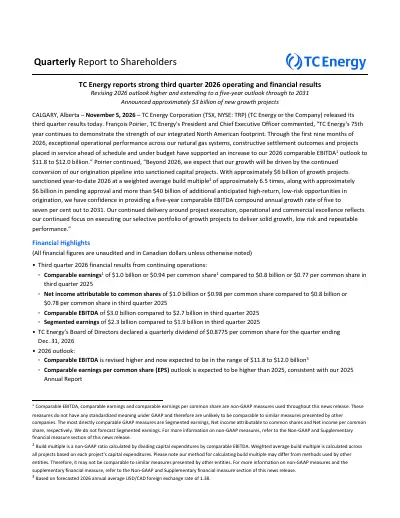
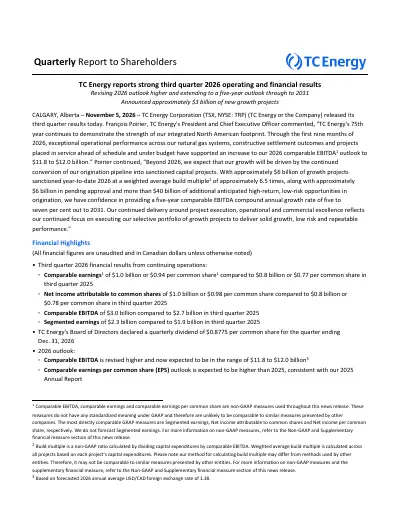
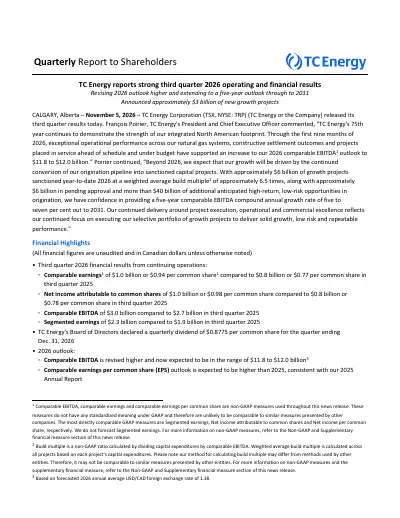
TC Energy Corporation
Q3 FY2026 · Earnings Call TranscriptNovember 5, 2026
Operator
Welcome to the TC Energy Third Quarter 2026 Results Conference Call. As a reminder, all participants are in listen-only mode, and the conference is being recorded.
After the presentation, there will be an opportunity to ask questions. To participate, please press star then one on your telephone keypad.
If you should need assistance during the call, please signal an operator by pressing star then zero. I would now like to turn the conference over to Gavin [unclear], Vice President, Investor Relations.
Please go ahead.
Gavin Wylie
Thanks very much, and good morning. I'd like to welcome you to TC Energy's third quarter 2026 conference call.
Joining me are François Poirier, President and Chief Executive Officer; Tina Faraca, Executive Vice President and Chief Operating Officer, Natural Gas Pipelines; Greg Grant, Executive Vice President and President, Power and Energy Solutions; and Sean O'Donnell, Executive Vice President and Chief Financial Officer. François will start today with our strategic update, including our extended long-term growth outlook.
Tina and Greg will then walk you through the growth drivers in each of our businesses in more detail. Sean will wrap up with our quarterly results and financial outlook, with a few closing remarks by François before we move to Q&A.
A copy of the slide presentation is available on our website under the Investor section. Following remarks, we will take questions from the investment community.
Please limit yourself to two questions. If you're a member of the media, please reach out to our media team.
Today's remarks will include forward-looking statements that are subject to important risks and uncertainties. These include statements about our comparable EBITDA outlook, our growth projections, and long-term financial targets.
For more information, please see the reports filed by TC Energy with Canadian securities regulators and the U.S. Securities and Exchange Commission.
Finally, we'll refer to certain non-GAAP measures that may not be comparable to similar measures presented by other entities. A reconciliation is contained in the appendix of this presentation.
Before I pass to François, I'd like to start with a quick video celebrating 75 years of TC Energy.
An energy-connected powerhouse across North America, that's who we are today. We didn't get here by chance, we got here through intention, bold investments, and decades of progress.
A story shaped over generations. For 75 years, TC Energy has been part of North America's energy landscape.
We are a natural gas and power company operating the most extensive energy network on the continent. Ours is a story of connection, of scale, and of possibility.
For 75 years, we've powered possibility, adapting to change, learning from experience, and building for what comes next. Today, we continue to connect nations, to create pathways for growth, and we will continue this legacy for generations to come.
François Poirier
Thanks, Gavin, and what a great video that was. This year, we celebrate 75 years of delivering essential infrastructure.
While markets, technology, and policy have evolved over time, three things have remained constant for TC Energy. First, our unrivaled geographic diversification, where we're the only midstream company operating at scale in Canada, the U.S., and Mexico.
Second, our focus on natural gas pipelines, reliably and affordably delivering the fuel North America relies on to meet growing energy demand. Finally, our extensive footprint, which is uniquely positioned at the intersection of natural gas and power, creating a differentiated platform to capture the next wave of energy demand.
Our portfolio is one of one. We own and operate the most extensive natural gas network in North America, with over 94,000 km of pipeline infrastructure, moving more than 30% of the natural gas consumed across the continent, complemented by more than 4,600 MW of power generation, anchored by our equity interest in Bruce Power.
We connect prolific low-cost natural gas supply with major demand markets across Canada, the U.S., and Mexico, giving us deep incumbency, significant diversification, and infrastructure that is increasingly difficult to replicate. It's this incumbency that creates opportunity, but it is our culture that is the foundation of our ongoing performance.
Our consistent focus on safety, personal accountability, one team, and active learning underpins how we operate and execute. It enables us to maximize the value of our assets, execute on our portfolio of growth projects, and ensure financial strength and agility.
The result is what we've committed to deliver for our investors: solid growth, low risk, and repeatable performance. In 2023, we committed to strengthen our financial position, simplify our business, and execute our clear set of strategic priorities.
We have continued to deliver on each. We've focused on enhancing capital discipline and driving EBITDA outperformance, and we now expect our debt-to-EBITDA to exit 2026 at 4.55 to 4.6 times, providing ample headroom to our long-term target of 4.75 times.
We became a pure-play natural gas and power company following the spinoff of South Bow, focusing on accretive, repeatable, in-corridor, assembly-line-style growth. We've structurally integrated our natural gas business across our technical, safety, and project groups, transforming project execution into a competitive advantage.
That progress has translated into meaningful value for our shareholders, delivering a total shareholder return of 118%. Over the last few quarters, we've discussed our readiness to increase our annual capital spending above our previous $6 billion to $7 billion range, contingent on financial capacity, continuation of attractive returns on new growth projects, and the team's execution capacity to deliver projects on time and on budget or better.
First, we have built significant financial capacity by growing comparable EBITDA at a compound annual rate of 9% since 2022, while performing at the low end of our annual CapEx outlook. I'll remind you that every 10 basis points of headroom to our 4.75 leverage ratio gives us around $1 billion of incremental investment capacity to fund growth as we look out to 2031, which Sean will discuss in more detail.
Second, the quality of our growth opportunities continues to offer generational returns, increasing from roughly 8% in 2020 to over 12% today, while maintaining our low-risk preferences. Finally, we have demonstrated execution excellence and have the organizational capacity to do more.
95% of our projects in development and construction are on or ahead of schedule, and projects from 2025 to today have been delivered in aggregate at more than 10% under budget. We're building on that capability through AI and innovation, giving our teams new tools to improve productivity and create more value from our assets.
With that in mind, we are on track to achieving our $100 million goal of run-rate AI and innovation-driven comparable EBITDA in 2026, with a target of an incremental $100 million in 2027. Combined, these factors are what drive our confidence to responsibly scale our capital program and deliver the next phase of growth.
U.S. LNG, LDC reliability, and supply access have been the important drivers of our demand outlook over the past several years and remain foundational to the 51 Bcf per day of North American demand growth we see through 2035.
More recently, that outlook has expanded further, driven by accelerating power demand, and growing momentum behind Canadian LNG, and a greater focus on infrastructure development to diversify supply access in critical markets. In Canada, Bill C-39 has proposed significant permitting reform that could offer greater certainty and reduce project timelines by one to two years, while also offering improved cost efficiency and without compromising the rigor of the process.
More broadly, all three jurisdictions are prioritizing policies that advance energy projects and support the rising demand for reliable and affordable power. That alignment matters.
It gives customers confidence and greater confidence to make the long-term commitments needed to underpin new infrastructure, creating more opportunities for us to invest at attractive risk-adjusted returns. Power and global electrification are major drivers behind the increase in our demand forecast compared to last year.
Gas-fired generation in North America is forecast to grow 83% between 2015 and 2035, as natural gas provides both the baseload and the fast-ramping generation needed to keep the grid reliable. About 70% of the forecasted gas power demand growth over the next decade is in the U.S.
Heartland, Alberta, and Mexico combined, and we already are the incumbent in those markets. New generation there will need firm transportation to secure its supply.
In Ontario, 18 GW of new nuclear capacity is required by 2050, roughly doubling installed nuclear capacity. That speaks directly to Bruce Power.
The power opportunities we're advancing demonstrate how we can capture growth where molecules and electrons intersect. Now this next slide is one of my favorite, as it tangibly represents the future of TC Energy and the opportunity we have in front of us.
With today's announcement of $3 billion of new projects, we now have $30 billion of sanctioned and pending approval project spend through 2031, primarily served through the continued conversion of our backlog into low-risk in-corridor natural gas transmission projects. Looking to our projects in origination, we've increased our opportunity set to more than $40 billion, reflecting the strength of rising power demand across both natural gas pipelines and power businesses.
We've been deliberate in advancing our Canadian power and energy solutions opportunity set. You've heard us over the past few quarters speak to the evolving customer needs and willingness to enter into commercial agreements that now align with our risk-return preferences.
We've taken the time to high-grade that portfolio, giving us confidence to now present more than $15 billion of opportunities currently in commercial discussion. Greg will discuss this in more detail shortly.
Taken together across our natural gas and power businesses, over two-thirds of our capital opportunities are tied to growing power demand. This demonstrates, once again, that regardless of the demand driver, the strength of our footprint and the ability to provide complementary, reliable solutions with speed to market positions us to capture and monetize this opportunity set.
We continue to make meaningful progress converting this opportunity set into high-quality growth that drives our financial outlook. On the project execution side year to date, we've placed $2.5 billion of assets into service on time and under budget and expect to get to $3.4 billion by year end.
Including today's announcements, so far this year we've sanctioned $6 billion of growth projects, already achieving the low end of our $6 billion to $8 billion expectation for the entire year, at returns that are consistent with what we are seeing today. Looking ahead to 2027, we're targeting an incremental $8 billion of project announcements, informed by both our $6 billion of pending approval projects and over $40 billion in origination.
These projects will continue to fill our unallocated capital capacity that will deliver our long-term growth outlook with IRRs consistent with 12%. This year, we are extending our outlook to 2031 and expect comparable EBITDA to grow at 5% to 7% annually over the next five years.
Importantly, we can deliver solid, low-risk, repeatable growth across this range while adhering to our debt-to-EBITDA target of 4.75 times and growing our common share dividend at an annual rate of 3% to 5%. We also have significant visibility to that growth, with our sanctioned and pending approval projects, along with optimization of our base business, underpinning the low end of the range.
What drives us to the upper end of the range is additional conversion of projects in origination to sanctioned capital. We have 75-year history of delivering results, and I am confident in our team's ability to continue that trend, as the opportunity ahead of us is now even bigger.
With that, I'll turn it over to Tina to walk through our natural gas business and how it's capturing its share of growth.
Tina Faraca
Our natural gas pipeline businesses continue to deliver exceptional results, with record EBITDA and 10 new flow records set so far in 2026, all while operating safely and reliably. This performance is a direct result of our commitment to safety and execution excellence, with our commercial, regulatory, project execution, and operations teams working together across borders and disciplines.
Our commercial strategy is working. We have reached eight consecutive win-win settlements with our customers and regulators since 2024, providing greater revenue certainty while preserving opportunities to outperform.
In Canada, our extended incentive-based mainline settlement allows us to share in upside with our customers, driving strong discretionary revenue. In the U.S., our teams continue to capture value through new and amended contracts and operating efficiencies across the network.
In Mexico, our assets deliver strong availability, operating discipline, and stable, contracted earnings. Underlying all of this are our long-standing customer relationships, providing insights into evolving market needs and positioning us to deliver growth opportunities across our footprint.
Our network forms a strong platform for the next wave of demand, linking low-cost supply basins with growing markets. By 2035, more than 60% of North American production is expected to come from basins connected to our system.
What sets us apart is our ability to connect that supply to market. First, we provide supply diversity at scale.
Our footprint links four of the continent's most prolific supply basins directly to the Midwest, one of our fastest-growing markets. Second, we are built for reliability.
Whether it is our Crossroads project announced today or our 532 Bcf of integrated U.S. storage, we can provide flexibility across our network, helping us meet peak demand when our customers need it the most.
That is a competitive advantage. Third, we have the reach to serve growing demand and reliability needs in constrained markets, creating opportunities to grow within our footprint and expand into new markets.
Our Columbia Gas strategic corridor shows our strategy and competitive advantage in action. The Appalachian Basin has over 1,100 Tcf of proven natural gas reserves, representing over 80 years of long-term supply.
Our Columbia Gas system alone moves roughly 20% of that production, which is forecasted to grow by 10 Bcf per day by 2035, supporting demand growth across 10 states. Columbia's Teco Pool provides a key trading hub for that region, leveraging supply liquidity and storage assets to support growth across its footprint.
The Appalachia supply project we sanctioned earlier this year, which is expandable through capital-efficient facilities, demonstrates how we can leverage these advantages into growth. Ohio demand is forecasted to grow by up to 40% by 2035, and our Columbia system delivers more gas to the state than any other operator, and our mainline corridors, laterals, and storage provide a distinct advantage over single-line competitors.
In the Mid-Atlantic, growing power demand is creating an increasing need for supply diversity, with data centers, electrification, and coal-to-gas conversions forecast to drive natural gas demand up 45% by 2035. As we look toward the Gulf Coast and Midwest corridors, we see opportunities to extend and connect our unmatched supply access to growing markets across our broader network.
Crossroads is a great example, extending the reach of Appalachian supply through greater connectivity across our Midwest systems, including ANR and Northern Border. In the Midwest corridor, natural gas demand is expected to grow by more than 20% by 2035, led by power generation in MISO.
As the region becomes increasingly constrained, we see a significant opportunity to extend our reach, leveraging our U.S. and Canadian pipeline networks, storage, and customer relationships to help meet that growing demand.
Importantly, peak demand can almost double average demand in this region, among the highest in the country. Chicago cash prices have reached over $10 per MMBtu in five of the last six winters.
This volatility increases the value of firm capacity that can reliably deliver gas when customers need it most. Together, those fundamentals create opportunities to provide greater supply diversity, reliability, and peak-day deliverability while deepening our reach in a core market.
Let's dive a bit deeper into the natural gas projects we've announced today. Crossroads is a U.S.
$1.8 billion project that adds 1.4 Bcf per day of capacity, connecting the supply diversity strength of our network directly to growing Midwest demand. This project supports power generation, LDC reliability, and supply diversity and access.
It is a proof point for our corridor strategy. Crossroads creates another downstream extension opportunity through the American Midwest project, linking our diversified supply access directly to growing Midwest demand.
The American Midwest project modifies existing facility and adds compression to enable up to 1 Bcf per day of east-to-west capacity across Northern Border, with a total project cost of approximately U.S. $400 million and TC Energy's proportionate equity contribution of approximately U.S.
$100 million. Both projects are underpinned by 20-year take-or-pay contracts, primarily anchored by investment-grade utilities, with a build multiple of approximately six times and an expected in-service date in 2030.
Switching gears to Canada and our LNG connectivity, in September, we announced our investment in Coastal GasLink Phase 2, which advances our strategy to help meet growing global LNG demand. The expansion leverages existing infrastructure, adding five compressor stations and upgrading existing facilities.
As the WCSB continues to look for additional egress opportunities and export market access, Phase 2 will nearly double the capacity of the pipeline, supplying LNG Canada to approximately 4.5 Bcf per day. At an estimated total project cost of $4.9 billion, Phase 2 represents a capital-efficient expansion, with TC Energy's committed equity contribution of up to $250 million.
LNG Canada will lead execution, while CGL provides technical advisory support, with defined limits on capital and schedule risk. Importantly, CGL will remain the owner, operator, and permit holder, maintaining the relationships we've built over many years with Indigenous and local communities, governments, regulators, landowners, and other stakeholders.
This project demonstrates our ability to grow alongside our customers while staying firmly within our risk preferences. As we look to convert the significant opportunity set in front of us, our approach is deliberate and disciplined.
We work with customers early to rightsize and often upsize projects. We remain focused on our risk-return preferences: long-term contracts with quality counterparties, and returns that fit within our 5 to 7 times build multiple range.
We engage early with communities, Indigenous groups, and regulators to derisk delivery. That work is creating tangible value.
Approximately 80% of the natural gas capital we've sanctioned this year has been upsized through the development phase. The same discipline is translating into strong project execution across our portfolio.
Our projects in development are tracking approximately 5% under budget, with over 95% on or ahead of schedule. That's an exceptional result and a credit to our project teams.
What we are seeing today gives me confidence that our development queue will continue to grow with high-quality, low-risk, and executable projects. Finally, active learning is how we continue to get better, and AI is now embedded in how our teams work every day.
One of the clearest examples is the decision our gas control and commercial teams make every morning: how much pipeline capacity can we sell that day? Let me show you what that looks like in practice.
In two hours,
Tina Faraca
the gas day closes. Our gas control and commercial teams must decide: how much remaining pipeline capacity can we make available?
Hold too much back, and capacity goes unused. Overcommit, and our operations could be impacted.
Safety, physics, and regulations set the boundaries. Compressors move gas through the pipeline.
Pressure limits and delivery requirements determine what it can safely carry. That capacity changes as conditions change.
Every decision balances reliability, customer commitments, fuel, emissions, and commercial value. Our teams once faced a mountain of information: yesterday's reports, countless spreadsheets, conditions shifting by the hour, and had to decipher it, analyze it, and predict from it, largely manually against the clock.
Years of connecting operating and commercial data have created one trusted live view. We've transformed what once lived as manual datasets into cloud-based intelligence available 24/7 to enable better decisions and continuous learning.
A hydraulic model calculates how gas will flow using actual system pressures. Machine learning forecasts a range of outcomes for the gas day.
Engineering limits and established safety and risk tolerances frame the recommendations. AI agents bring those insights together with other factors affecting the decision: a cold front, a holiday weekend, an outage.
Modeled on our gas controllers, marketers, reliability engineers, and other specialists, 13 lead agents weigh the facts and recommend a course of action. They test competing alternatives so our teams can see the tradeoffs, not just one answer.
Our people always make the final decision. This changes the work: less time assembling information, more time for operations and commercial teams to assess options and act together.
We started on Northern Border Pipeline. Our teams found capacity to protect customer deliveries during outages and support additional sales.
That capacity can also give customers greater flexibility to temporarily store or borrow gas and manage imbalances, while maximizing the value of this asset for our shareholders. We are expanding this cutting-edge capability across our 30,800-mile U.S.
natural gas pipeline network. On the Canadian Mainline, similar thinking is helping teams identify opportunities to offer additional winter capacity and optimize flows, creating greater value for our customers and shareholders.
In Mexico, we're identifying where AI can deliver operational and commercial value. New pipeline takes years to build.
Better decisions help us unlock more value from our existing, irreplaceable North American network, serving customers safely, reliably, and efficiently. Year to date, across our U.S.
and Canada pipeline systems, AI-enabled capacity management initiatives have generated approximately $65 million of incremental EBITDA, demonstrating how we can unlock additional value from our existing assets. That's just one of many levers.
Across asset and market optimization, we are also using AI to enhance reliability and integrity, improve supply chain efficiency, and strengthen safety and enterprise effectiveness. This brings us back to where I started.
Our incumbency gives us an advantaged asset base, but how we operate and optimize our assets is what drives outperformance. AI is giving our teams another tool to unlock that value.
Ultimately, it's about continuously finding new ways to get more from the network we already have and translating opportunities into sustainable earnings growth. With that, I'll pass it to Greg to update you on our power and energy solutions business.
Greg Grant
Thanks, Tina, and good morning. The opportunity in power and energy solutions starts with our existing footprint and the strong operating capabilities of our team.
For decades, we have owned and operated multiple generation technologies, including natural gas, solar, wind, hydro, and, of course, nuclear. We've consistently delivered high availability, low forced outage rates that demonstrate our ability to build and operate these assets safely and reliably.
That experience provides a solid foundation as we evaluate the opportunities ahead. Right now, we have an enormous opportunity with an unparalleled position across Canada, with over 4,600 MW of power, gas storage, and an incumbent natural gas footprint that create the ability to offer a breadth of energy solutions to our customers.
This creates a unique opportunity to leverage our natural gas footprint to develop and build the critical, reliable power generation that our customers demand. That combination of operating experience, infrastructure, market presence positions us to serve one of the fastest-evolving power markets we've seen in decades.
Now customers are looking for reliable power, speed to market, and long-term certainty. This aligns with what TC Energy has been doing for 75 years.
Canadian electricity demand is expected to double through 2050, requiring substantial new investment in generation and the supporting infrastructure. While data centers have been the talk in all the headlines, the significant growth we're seeing actually is quite broad-based across electrification, transportation, industrial, and residential load.
We're focused on opportunities that leverage our capabilities across our gas and our power footprints, with strong counterparties that provide contracted cash flows with a return on and of our capital. Given our footprint, the depth of opportunities and our complementary capabilities allow us to be selective and pursue only those that meet our risk-return threshold and still provide meaningful growth.
Bruce Power provides a clear example of how operating expertise, innovation, repeatability translate into increased cash flow and earnings. We've talked previously about the MCR program and our team's ability to execute.
What is particularly exciting is how technological innovation is creating the benefits that can compound for many years. At our Bruce teach-in earlier this year, we highlighted the robotic tooling pioneered on Unit 3, which helped the team return the unit seven months ahead of the original ISO schedule.
It was a great session led by our Bruce Power CEO, Eric Chassard, and is available on our website if you haven't had a chance to see it. We're already seeing those learnings carry forward.
As an example, on Unit 4, the team delivered the calandria tube install 25 days faster than Unit 3. Better execution has a direct financial benefit.
In fact, now we expect to see Unit 4 back online by the end of 2027, almost four months ahead of the ISO plan. As the MCR program progresses, equity income and distributions from Bruce Power are expected to increase materially in the 2030s.
That growing stream of cash flow expands our ability to fund future growth while remaining within our debt-to-EBITDA target. By the early 2030s, we expect Bruce Power free cash flow to unlock an additional $2 billion to $3 billion of annual investment capacity for TC Energy, providing greater capacity to pursue attractive opportunities both across natural gas and our power footprint.
The value of execution at Bruce extends well beyond the MCR program. We learn, we innovate, and we carry these improvements forward that ultimately expand cash flow and earnings back to TC Energy.
Now we have multiple pathways to capture meaningful growth, with a growing suite of power development opportunities located strategically along our natural gas footprint allow us to leverage our complementary natural gas and power capabilities. We have spent the last couple of years evaluating these opportunities and building a clear view of where our capabilities can create the most value.
Our customers' need for certainty, reliability, and speed to market has created a unique value proposition for us and, given the breadth of our footprint and our ability to tailor solutions to customer demand. This portfolio now includes over $15 billion of projects in origination, representing almost 4 GW of capacity.
Importantly, these are relatively short cycle, with more than 80% currently expected to begin contributing EBITDA within our outlook period to 2031. Of these projects, we are already seeing significant traction and progress, with potential announcements by the end of the year representing $500 [million] to a billion dollars of incremental investment.
This portfolio represents a diverse set of projects in multiple markets that adhere with our risk-return preferences and the ability to contribute near-term EBITDA. I look forward to discussing this portfolio in more detail as it develops and sharing additional project announcements through 2027.
At Bruce Power, our in-flight, longer-term growth opportunities continue to progress. Project 2030 remains a capital-efficient, low-risk set of projects that will increase our output to approximately 7,000 MW, effectively adding the equivalent of a ninth reactor.
Bruce C provides longer-term optionality for up to 4,800 MW of potential new nuclear capacity. The execution we're seeing through the MCR program provides an experienced workforce, supply chain, operating expertise, and the project capabilities that give us the confidence to build Canada's next nuclear facility.
Taken together, we have multiple pathways for growth in power: maximizing the value of our existing assets, developing new contracted generation that can serve the growing power demand, and continuing to advance our opportunities at Bruce Power, all within the same disciplined risk-return framework. This provides TC Energy with another pillar of low-risk, repeatable growth for decades to come.
Thank you. I'll now pass it to Sean to walk you through the financials.
Sean O'Donnell
Thanks, Greg. As you've heard this morning, strong execution and operating performance continue to translate directly into strong financial results.
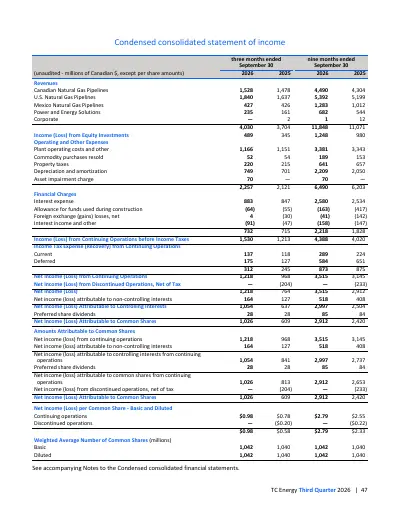
We've delivered over $3 billion in third quarter comparable EBITDA, up 13% year over year, and comparable earnings per share of 94 cents, up 22%. Year to date, comparable EBITDA is now $9 billion, up 13% versus the first nine months of 2025.
Each of our four business segments was higher year over year. Our natural gas pipeline business continued to perform exceptionally well, with our U.S.
natural gas pipeline comparable quarterly EBITDA up 17% versus last year, benefiting from $2 billion of assets placed into service, commercial settlements, and innovative contract sales. Bruce Power achieved 97% overall availability and a full quarter of contributions from Unit 3 after the early completion of its MCR, driving our power and energy solutions EBITDA up 35%.
Together, these results put us in a strong position as we move through the balance of the year and give us confidence in the outlook ahead. The strength of our operating and commercial performance year to date gives us the confidence to raise our 2026 comparable EBITDA outlook to $11.8 [billion] to $12 billion.
As you see on the left-hand chart, our revised guidance represents a $200 million increase versus our previous 2026 range and more than $500 million above our 2023 Investor Day outlook. On the right-hand side, our strong performance is carrying forward into 2027.
We now expect comparable 2027 EBITDA of $12.3 [billion] to $12.5 billion, compared with the $11.7 [billion] to $11.9 billion outlook we provided at our 2024 Investor Day. Our ability to consistently deliver outstanding performance will be driven by a number of factors, including continued high asset availability, innovative AI and commercial marketing gains, and continued scaling of our proven project delivery capabilities.
Turning to our capital program that underwrites this growth outlook, we continue to develop stronger and better visibility on our business development projects into the early 2030s. As you move across the chart, in-origination opportunities will convert into secured projects over time, providing a clear path to growing our capital program.
The backbone of that program continues to be our natural gas pipelines, representing more than 80% of our $30 billion sanctioned and pending approval project pipeline, all underpinned by long-term take-or-pay contracts or cost-of-service frameworks. An increasing part of our opportunity beyond that is coming from our power and energy solutions business, as Greg mentioned, where we are developing a multidecade growth platform, with many of these proposed projects having shorter development and construction timelines, allowing us to move more quickly from announcement to capital investment and, ultimately, to cash flow and EBITDA contribution.
The timing and composition of our annual capital spending will evolve. As projects continue to develop, we'll look to optimize spend to smooth the capital curve over time.
What won't change is our underwriting discipline. Incremental investment must continue to deliver compelling risk-adjusted returns, strong cost and schedule execution profiles, and consistency with our commitment to maintaining debt-to-EBITDA at or below 4.75 times.
As François mentioned, we are updating our long-term outlook to five years through 2031, where we are expecting to deliver comparable EBITDA growth of 5% to 7% over the new outlook period. Importantly, the low end of our range of approximately 5% is underpinned by sanctioned and pending approval projects and continued optimization efforts across our base businesses.
Our five-year outlook includes a portion of unallocated capital as we continue to high-grade our project backlog and increase our balance sheet's investment capacity to underwrite this EBITDA growth. As you can see from the new waterfall format, delivering the EBITDA midpoint assumes approximately $8 billion to $9 billion of annual net capital spending from 2029 through 2031.
As a rule of thumb, $8 billion to $9 billion of annual CapEx implies we achieve approximately a 15% conversion ratio of our more than $40 billion origination pipeline that François presented. A higher conversion rate would support a run rate of net capital investment of more than $9 billion per year.
That scenario would create a path to the upper end of the EBITDA range with the continued support of our commercial, operational, technological, and AI innovations that you've heard a lot about today. Finally, it's important to reflect on the tagline that TC will continue to adhere to our debt-to-EBITDA target of 4.75 times as we deliver this updated plan.
Turning next to the funding plan that supports our updated path to growth, we want to explain how the business is positioned to fund the investment opportunities across the five-year plan. New capital being placed into service, strong operating performance, improved build multiples, and capital efficiency over the past few years have built significant financial capacity on the balance sheet today.
As François noted, we expect leverage to exit this year in the 4.55 to 4.6 times range, well below our 4.75 long-term target. We've also taken further steps to bolster our financial capital available for growth projects through high-value capital rotation, like our recently announced sale of our mature Guadalajara pipeline asset in Mexico.
I'll reiterate that our top priority is to continue to prudently grow EBITDA and additional balance sheet capacity ahead of the increased investment opportunities we see coming in the next few years. We will do this through commercial and operational optimization, AI and technological innovation.
We will maximize our capital efficiency on new investments and our return on invested capital across our existing asset base. As Greg highlighted, looking ahead to the early 2030s, growing free cash flow from Bruce Power is expected to unlock an additional $2 billion to $3 billion of investment capacity every year, which provides a substantial source of funding for our power and pipeline growth programs.
I want to wrap up on this slide by highlighting the differentiated combination of solid growth, low risk, and exposure to some of the strongest energy fundamentals in North America that our portfolio uniquely provides. 98% of our comparable EBITDA is from rate-regulated or long-term take-or-pay arrangements, while we continue to grow our dividend in the 3% to 5% range.
We have compelling investment opportunities across our natural gas and power footprints, two areas where we see significant long-term demand growth, supported by a strong balance sheet and BBB+ credit rating. Importantly, we have demonstrated our ability to translate those advantages into tangible shareholder value over the past few years, and we are confident in our ability to deliver on that same unique value proposition with the growth opportunities now ahead of us.
With that, I'll turn it back to François.
François Poirier
Thanks, Sean. I'd sum up the case for TC Energy in four words.
Number one: stable. 98% of our cash flows are rate-regulated or take-or-pay.
We've got investment-grade customers in every jurisdiction, and 26 consecutive years of dividend growth. Number two: visible.
We expect 5% to 7% comparable EBITDA growth through 2031, supported by nearly $6 billion of projects pending approval and more than $40 billion in origination. Number three: proven.
We placed over $8 billion of assets into service in 2025 and expect another $3.4 billion in 2026 at an aggregate of 10% under budget. Finally, number four: we are ready.
With over $40 billion of opportunities in origination, where policy is incrementally supportive, fundamentals continue to improve, and our teams have been built up to ensure safety, commercial, and project execution excellence, we are ready to deliver the next wave of shareholder value. With that, operator, we are now ready for questions.
Operator
We will now begin the question-and-answer session. To join the question queue, you may press star then one on your telephone keypad.
You will hear a tone acknowledging your request. Please limit your questions to two, and if you should have additional questions, please re-enter the queue.
If you are using a speakerphone, please pick up your handset before pressing any keys. To withdraw your question, please press star then two.
The first question comes from Rob Hope with Scotiabank. Please go ahead.
Rob Hope
Morning, everyone. Appreciate all the incremental details here.
Want to dive a little bit deeper in the 5% to 7% EBITDA growth outlook through 2031. You do note that the low end supported by sanction and projects pending approval, plus the optimization.
When we think about the upper end of that growth outlook, with new pipeline investments like Crossroads taking four to five years to get in service, does this imply that we could see incremental or higher power investment as those are shorter-duration projects to get you towards that upper end of the band, as it seems like pipeline investments may be beyond 2031?
Sean O'Donnell
Good morning, Rob. Thanks for the question.
It's Sean. I'll take that one.
You're exactly right. Let me just repeat back the question for you.
Our 5% end of the range is completely underpinned by sanctioned and pending projects. That's more or less our $6 billion a year run rate that you've seen.
To the midpoint and high end of the range, what we're working off of is this $8 [billion] to $10 billion of incremental capital from '29 to '31. That could be another $6 [billion] to $12 billion on top of our sanctioned and pending, and that $6 [billion] to $12 billion that we're looking for to get to the high end of that range, we're working off of a $40 billion backlog to get to that 6 or 12 to kind of understand where the high end of the range might come from.
Between Tina and Greg's business, there's a lot of mixed opportunity across gas and pipe and power. There's $15 billion of that that is in power, I think it's highly likely that you could see a meaningful component in the back end of the decade that power begins to deliver into the capital and the EBITDA forecast.
Rob Hope
All right. Thanks for that.
A little echoey, but maybe moving over to the second question. How are you thinking about kind of the risk-reward framework for incremental power and energy solution investments?
If you are targeting 10- to 25-year contracts, are you looking to ensure that you get the full return of capital in the contract period, or are you willing to take some recontracting risk depending on where you are seeing the fundamentals?
François Poirier
I'll start, Rob, and then I'll ask Greg to provide some comments. Overall from a macro perspective, what we've seen, particularly in Canada, is an increased willingness to enter into longer-term contracts.
In every circumstance we're looking at here, and what's in the $15 billion of backlog, we earn a return on and of our capital entirely in the contract period. Some instances, the contracts are as short as 10 years, but in those instances, we do still check that box.
Greg?
Greg Grant
Sure, and happy to add, Rob. As I mentioned in the opening remarks, we've been taking a couple of years looking at the market.
We spend a lot of time looking through numerous opportunities. You can imagine the number of opportunities we see across our footprint, given the need for that reliable backstop power, which gas is the natural solution for that.
We have a very diverse group of projects, and we're being extremely selective. We have to hit the risk-return preferences.
Tina's team continues to deliver great projects, and I want to deliver the same thing.
Rob Hope
Thank you.
Operator
Thank you. Your next question comes from Praneeth Satish with Wells Fargo.
Please go ahead.
Praneeth Satish
Thanks. Good morning.
There's a bit of an echo when you guys speak, I'm not sure if some of what I'm saying has been covered, but maybe just on the early-stage origination funnel, so that doubled from $20 billion last quarter to $40 billion this quarter. Can you just unpack, I guess, what's driving that step-up?
Is it a few large opportunities, or the power projects in there? Then you gave the percentage of projects that are natural gas, but can you comment on what percentage of the $40 billion are specifically U.S.
gas projects?
François Poirier
Maybe I'll start, Praneeth, give you a little bit of a breakdown. Of that $40 billion funnel, it's roughly broken down 50/50 between the U.S.
and Canada. From a natural gas pipeline perspective versus power, it is $25 billion for the gas business and 15 for power.
All of our power and energy solutions projects in the origination bucket are in Canada.
Praneeth Satish
That's helpful. Sorry, go ahead.
François Poirier
Nope, I didn't have anything to add. Thanks, Praneeth.
Praneeth Satish
Okay. Maybe just on the power opportunity, the 3.5 GW, $15 billion, I guess I was a little surprised to see the contract duration as short as 10 years.
I know it's a range there, but what types of projects or risk profiles would make you comfortable accepting a shorter-duration contract? Then on the technology for these projects, are you looking at combined cycle gas turbines or simple cycle gas turbines, and are you expecting these to be grid-connected or fully off-grid?
Greg Grant
Great. Thanks.
It's Greg. I'll take that one.
Just reinforcing François's previous comments, even if it is shorter-dated contracts, we are looking for return of capital, risk and return on capital. When we talk about 10 years, we are not being exposed to terminal value risk in those situations.
You will see a multitude of duration just given some of the customer mix that we have, and it will all be counterparty creditworthy, of course. In terms of technology, the opportunity set that we have is actually quite diverse.
It could be all of the above that you've mentioned, whether it's combined cycle, simple, receps, or otherwise. What we are looking to do is provide a very unique customer solution for different customers.
Some of those might be behind the meter, some of those will be grid-connected. As I mentioned in my opening remarks, we're seeing demand not only for data centers, but in industrialization, electrification, or otherwise.
We do have a diverse set of opportunities across Canada, which is why I'm so excited and why I believe that we'll be able to accelerate some of these opportunities.
François Poirier
If I might, Praneeth, I'll just add that you've heard us talk in the past about how deliberate and strategic we are around creating strategic relationships and alliances with our supply chain. For example, for turbines for compressor stations and the like, we've taken the same approach on the power side.
Despite the fact that these are quick to cash flow projects, we have a high degree of confidence in being able to secure all of the required equipment and the various technologies to deliver on these projects in the near term, as we've been working on this for quite some time.
Praneeth Satish
Got it. Thank you.
Operator
Thank you. Your next question comes from Ben Pham with BMO Capital Markets.
Please go ahead.
Ben Pham
Hi. Thanks.
Good morning. I wanted to start with the Canadian business.
The existing NGTL framework supports up to $3.3 billion of capital. You've only announced $1.2 billion that's received FID.
Do you have updates on discussions on a broader resting framework beyond our current program and whether these Canadian projects tend to be more consistent with the U.S. side of things?
François Poirier
Thanks for the question, Ben. I'll start, and I'll pass it over to Tina to provide a little bit more detail.
NGTL is foundational to this company's business profile, its business mix, and its growth. I would say that discussions with our customers are progressing.
We have over 300 customers on NGTL versus less than 100 on the Mainline, it's proven to take a bit more time. I want to be clear that we intend to build.
We simply need to land on an appropriate risk-return framework. You alluded to the multiyear growth program and our original estimate of over $3 billion in capital being required to meet our commitments of egress in excess of 1 Bcf a day.
We've actually outperformed, and we've found a way to exceed that 1 Bcf per day commitment with far less capital than was originally estimated. That's a win-win because it keeps the tolls down for our customers.
The new investment framework, though, I'll remind you, we have a settlement until 2029. This is about capital allocation from 2029 forward.
We are prepared to take on more risk on the cost and revenue side of the equation in order to have the opportunity to earn a higher return. As I said, we are starting to see some progress with our customers.
Over to Tina to give you a little bit of color on that.
Tina Faraca
Thanks, François. As you mentioned, we are working really closely with our customers to develop a win-win solution.
We really care about the health of the basin. As a proof point, our NGTL rate base has more than tripled over the last decade.
We've invested between 2020 2015 and 2025, we've increased from $6.1 billion to about $18.7 billion. Just over the last five years, we've invested about $6.5 billion of growth capital, along with almost $2 billion of maintenance capital as well.
To advance the investment framework, we are in the market and with service offerings that have recently closed, and we're seeing a strong uptake on the 1 Bcf of offerings that we've put out into the market, again continuing to reflect the customer engagement and the need for capacity on the system. Couple of interesting tailwinds: Bill C-39 could be a really important opportunity for us to more efficiently build out the system and build it out in a shorter time frame, we're looking at that as a very positive tailwind for us to support the basin and support our customers.
We're really proud of the track record we've had on previous settlements and are confident we can get to a settlement. Our timeline for this is we're targeting a settlement by the end of Q1 of 2027 so that we can ensure we can advance the capital necessary to support that growth.
At that time if we have not achieved a settlement, then we would need to look at alternative routes to get that capacity moving forward, including working with the regulator to advance those projects.
Ben Pham
Got it. Thank you.
Maybe to switch over to Bruce Power, you've mentioned again that $2 [billion] to $3 billion of annual investment capacity that could get unlocked in early 2030s. Can you confirm whether or not a portion of that amount is baked in that $8 [billion] to $10 billion that capacity you mentioned today?
Can you also clarify how much do you think of that $2 [billion] to $3 billion will be tied up in the MCR program versus being available for that broad opportunity?
Sean O'Donnell
Hey, Ben. It's Sean.
Thanks for the question. To the first part of your question, how much of Bruce is in that capital program, of course, the MCR program, right, some of the first and best dollars that we spend, so that is obviously in our base case program.
To your second question about the post-2030 Bruce contribution, in my opening remarks, the comment was Bruce unlocks $2 [billion] to $3 billion of investment capacity that we will bring back into Gasco and PES beginning in the early 2030s. That is a gross number, to answer your question specifically, when the Bruce C decision is ultimately made, designing that program to ensure that Bruce can self-fund Bruce C and still bring capital back so that we can continue to fund what you've heard about this morning between Tina and Greg's businesses and that growth outlook, that is the plan as it stands today, that we will bring money back from Bruce independent of Bruce C to fund the 2030 version of the programs you've heard today.
Ben Pham
Sean, just to double confirm the numbers in the path ahead, you're moving from $6 [billion] to $7 [billion] capacity to $8 [billion] to $10 [billion]. As you get to 2030-plus, does that go to $10 [billion] to $13 [billion] then, or is that some of that Bruce?
What I was trying to get at is, some of that Bruce capacity is in that at $8 [billion] to $10 [billion]?
Sean O'Donnell
That's a question we have a lot of fun with, Ben. The answer is we'll see, right?
We're talking today about an incredible new opportunity in PES, right? We've got to deliver on that to be able to make decisions about capital allocation into the 2030s.
In the same kind of two-year window, we're going to know a lot more about Bruce C. Look, fundamentally, there's a tremendous amount of optionality in terms of capital availability and opportunity in the 2030-plus time frame, and that's really what we're so excited about.
The best projects are going to win at the end of the day.
François Poirier
I might add to that, Ben. I think you're asking how big could this get, and remember, we have two guideposts we'll never lose sight of, and the most important one is our human capacity.
When you think about the fact that we are now ready to step up above the $6 [billion] to $7 billion range in an annual cadence in that $8 [billion] to $10 [billion] area, once the MCR program at Bruce is done, that frees up a whole bunch of capacity within Bruce Power. The numbers could get very large.
We could actually be in excess of $10 billion a year in a scenario where Bruce Power is proceeding with Bruce C. To see us within the TC family on the pipeline and non-Bruce Power side go above 10, we're going to take this a step at a time and just make sure that we're always executing with excellence.
Again, we're going to leverage the capacity of the Bruce management team to every extent possible, and if that gives us growth well above the top end of the range in the '30s, that's great.
Ben Pham
Super helpful. Thank you.
Operator
Thank you. Your next question comes from Jeremy Tonet with J.P.
Morgan. Please go ahead.
Jeremy Tonet
Hi, good morning.
François Poirier
Good morning, Jeremy.
Jeremy Tonet
We've seen a lot of Appalachian production growth create opportunities for TC, be it moving gas around in-basin in Ohio or moving it over to Chicago with some of the newer projects here. Just wondering if you could speak a bit more to the opportunity set as you see it.
Could some of this Appalachian production, more of it, make its way down to the Gulf Coast or hit other markets, and what opportunities could this present for TC here?
Tina Faraca
Jeremy, thanks for the question. We're advantaged in our Appalachian position, specifically on our Columbia Gas system.
We are the number one operator in that region. We transport about 20% just on Columbia Gas of all the Appalachia supply.
We can move that gas to more than 10 states and beyond. We see a lot of liquidity in that region.
With our Teco Pool, we have over 285 Bcf of storage in that region, our footprint's highly advantaged to bring that supply to market. A great example of that is our Crossroads project, where we are now connecting the Midwest corridor through Crossroads, Columbia, ANR, Crossroads, Northern Border, where now we have a greater reach of that production and that supply.
We're really excited about how we're able to now create more of a header system across the Midwest that can advantage us even further with our incumbency. As far as getting that gas to the Gulf Coast, we're certainly stand ready to do that given our Columbia Gas and our Columbia Gulf assets.
Right now the growth where we're focused on is in the Midwest region, but with our Columbia Gulf system, there's opportunities to expand that service further when the market's ready for that.
François Poirier
Just to add to that, Jeremy, what you've seen us do this year with Appalachia supply and Crossroads is we've built two major arteries of egress out of the Appalachian Basin into markets that we have not had really tremendous access to in the past. We've talked about the growth potential and upside potential on the Appalachia system.
You can see us bringing in additional volumes on Crossroads and through that whole path here over the course of the next years as well.
Jeremy Tonet
Great. Thank you for that.
It was a little bit choppy on my side. I didn't quite catch all of it.
Maybe just pivoting to Mexico, if you might be able to just provide an update there on those assets and whether any monetization could make sense in the future?
Tina Faraca
Jeremy, I'll start on the opportunity set, and then we'll pivot to the other part of the question. As we continue to support CFE in their build-out of generation infrastructure and supporting Plan Mexico, we're continuing to advance opportunities to connect our existing assets through say small-scale laterals or very capital-efficient projects to ensure we can get that gas to the generation market.
You'll see us looking to leverage our base system, not building new systems, but optimizing what we have and ensuring that we're able to support the government's objectives and grow our systems alongside that.
Sean O'Donnell
Jeremy, it's Sean. I'll take the second part.
Jeremy, Sean, I'll take the second part of your question about capital rotation. Obviously, you saw our announcement on the mature Guadalajara asset, very high value for mature assets.
I'll say look generically, this isn't specific to Mexico, generically, we look at those opportunities across our entire system. Sell for high-value multiples against a really competitive lower-build multiple that always makes sense when the market is there.
Importantly, look, the plan that we just put out, our 5% to 7% with $30 [billion] to $42 billion of capital, that does not, as currently laid out, require any capital rotation or M&A of any type. Of course, we always are on the look for kind of high-value rotation opportunities where they exist.
Jeremy Tonet
Appreciate the color there. Thank you.
Sean O'Donnell
You bet.
Operator
Thank you. Your next question comes from Robert Catellier with CIBC.
Please go ahead.
Robert Catellier
Hey, good morning. Just want to check a couple of things on the power side first.
You may have touched on this, but there was a bit of an echo. My understanding what you're saying in terms of the large increase in the origination part of the portfolio is really the markets sort of adjusted to your risk preferences rather than a change in strategy there.
I think you touched on this a little bit, but can you just walk us through your confidence in having access to equipment and quality construction crews in order to execute on that plan?
François Poirier
I'll start, Robert, and then ask Greg to provide some context on sort of the diversity of customers we're looking at and then also on the supply chain side. You're right, our risk preferences have not changed.
What's happened is that the markets' appetite and willingness to enter into the type of long-term contracts that fit now within our risk preferences has evolved. Part of that is because the various states, provinces, and utility commissions are coming out with very clear criteria on what a data center needs to provide in order to get approved.
One of them, in various terminologies, is bring your own power. Less of a reliance on eventually connecting to the grid and just signing a shorter-term contract with an independent power provider, and more that is the permanent solution.
On that basis, they're willing to sign longer-term contracts, and so the risk profile of the market has gravitated towards our fairway.
Greg Grant
If I can add, François, we touched a little bit on it, but really what we offer is that speed to market and reliable backstop. I think that's really where the market is going.
When you think about the footprint that we have and where we're able to offer that gas and power solution is creating those very selective opportunities where we can get the returns with the contracted cash flows. I think that that's important, Rob.
Then as we think about the capability, the capacity of the organization, remember we've been in power for 30 years. We have a large projects team, supply chain.
We're one of the largest purchasers of equipment across North America. We've been working on this for a couple of years, highly confident in how we're thinking about approaching the market and in being able to execute against that pipeline.
Robert Catellier
That makes a lot of sense. Then you sort of partly answered this next one, but with the midterm elections done now, what is your initial take on the practical implications for project execution on the ground level?
Obviously, both chambers of Congress have switched over to Democrat. I think just as importantly, there's some new Democratic governors.
How do you see that impacting the way forward in terms of specifically power, but also on the pipeline side?
François Poirier
Thanks for that, Robert. It shouldn't surprise you that one of the first things we assess as we look to evaluate a capital investment opportunity is permitting risk.
It's a core competency of ours. It's something that is of a very high priority in our very early triage of projects.
When you look at where we are supporting utilities in the United States, with pipeline projects, we are in states where the PUCs have been very proactive in establishing very large customer rate categories, where there is support for data centers. We've stayed away from some other states like Texas, for example, where there's been a little bit more of a variance.
Our first look at where we have new elected officials, whether it's within the Senate or the House of Representatives or at the governor level, we see in every instance, actually, where we've chosen to participate, pretty constructive points of view. In fact, in some cases where the Democrat candidate prevailed, he or she had a more constructive view towards data centers than their Republican counterpart.
All told, we've been very deliberate about where we actually want to allocate capital and focus a great deal on permitability, and we still feel very good about the portfolio that we're developing.
Robert Catellier
That's good context. Thank you.
Operator
Thank you. Your next question comes from Aaron MacNeil with TD Cowen.
Please go ahead.
Aaron MacNeil
Hey, morning, all. Thanks for taking my question.
Sean, you framed the midpoint as requiring, I think, 15% conversion of that $40 billion origination portfolio. Should investors view growth in the pending approval bucket as the sort of key leading indicator that you're tracking towards 7%, or is there a better metric we should watch?
When would that need to become visible to support the upper end by 2031?
Sean O'Donnell
That's a great question, Aaron. Look, in our pending bucket, you heard Greg today say look, he's got between 500 and a billion dollars of power projects that could sanction very quickly, right?
I'd tell you that's probably leading indicator number one. The rest of pending is by and large in the Gasco business.
I think it's a little bit of both. That pending bucket is at 6 billion is a really important kind of first step in 2027 for us.
Then I think just to put a little bit of pressure on Greg, it's one or two announcements here in the next couple of quarters, I think that's really the litmus test for whether that $15 billion business development opportunity has the speed and acceleration and size that we hope it does.
Aaron MacNeil
Great. Maybe that's a good segue over to Greg.
Just following up on this power discussion, you've talked about behind the meter increasingly becoming a permanent solution. How much of that, almost 4 GW is specific to Alberta?
Are you actively pursuing sort of dedicated behind-the-meter generation for Alberta data centers? If so, how advanced are those discussions commercially?
Greg Grant
Thanks. Happy to provide a bit more support around that.
Obviously Alberta is a big market for us given the complementary solutions we have around gas storage, we already have a power portfolio there, we're quite ingrained in the market. We see a lot of opportunities.
That's not our only market. We do have multiple projects across Canada.
As I mentioned, some are grid-connected, some will be behind the meter. We get comfortable behind the meter, where we do have the contractual protections and the offtaker where we're comfortable in doing that.
The importance of that is the speed to market. I think that's what we're seeing is customers that require the speed to market, and it's an opportunity where we can really step in.
Not to provide percentages on where we are in Alberta versus the rest of Canada, but I would just leave you with we have a very diverse pipeline, which to Sean's challenge, I'm very comfortable that we'll see some of those announcements coming through this quarter and into next year.
François Poirier
If I might add, Aaron, as I said before, we've been very strategic in forming alliances with various supply chain providers, and as we announce our projects over the ensuing quarters, we'll be able to shed more light on that work. I think it's work that you will find very accretive to value for our shareholders.
Aaron MacNeil
Great. Thanks, everyone.
Appreciate the time.
Operator
Thank you. Your next question comes from Theresa Chen with Barclays.
Please go ahead.
Theresa Chen
Morning. I'd like to touch on today's FID of the American Midwest expansion on Northern Border, which follows the FID of the separate Bakken residue egress expansion to enter service later this decade.
In light of these developments, can you shed some more color on how you expect these expansions to alter regional flow dynamics, including the share of AECO versus Bakken residue gas on Northern Border?
Tina Faraca
Thanks, Theresa. I'll add some color on that.
As I mentioned with our Crossroads projects, we have another project, the American Midwest project, that allows us to bring gas into the Northern Border system, move that from an east-to-west perspective. It's going to provide another supply solution for that part of the system, and where we see a significant utility growth needs in those states there.
As we look at Northern Border long-term and even many of our systems, we could see header system type of projects where you can get gas from either end of the system. For example, on Northern Border, we've got Bakken egress, we've got WCSB egress, we'll now have Appalachia supply coming into Northern Border off of the Crossroads project.
I think it's going to provide our customers with a lot of optionality on how to source supply. The great news is we have the incumbency position there where we've connected all these systems, to make sure we're able to optimize and execute efficiently in order to meet the customers' needs.
Theresa Chen
Thank you. Going back to your growth outlook, when we think about the $40 billion-plus of projects in origination stage, how much potential upside do you see relative to your base case 15% conversion ratio?
Given the momentum, if commercialization efforts ultimately progress at an accelerated pace, do you foresee a need to tap into alternate funding sources, including external options?
Sean O'Donnell
Hey, Theresa. It's Sean.
I'll take that one. Look, in the $40 billion bucket, as Greg mentioned, we have looked at a lot in power, right?
That $15 billion is a very well-informed number relative to the market opportunity. What I'll tell you about that plan is it is designed to be internally funded with internal cash flow, even at the high end.
That's an important consideration. This is an internally funded plan: no equity, no M&A, no capital rotation needed to achieve this plan if we can deliver as expected.
Look, what could drive external funding? In the scenario where our conversion ratio is 25%, 30%, 50%, and it accelerates forward, if Greg's business, the speed-to-market value and the opportunity capture allows us to capture better economic opportunity faster, we will do that.
It's a very simple calculation for us is least cost funding, dollar-per-share accretion. That's really the difference of what the next five years is going to be about is is opportunity drives capital strategy, and it's not capital constraining anything at any point, all within, as François said, our 4.75.
It's a really exciting framework, and we'll keep a close eye on that. You should keep a close eye on the FIDs here over the next year, because that'll really tell you that the next kind of two or three years really going to define the answer to your question.
Theresa Chen
Thank you so much.
Operator
Thank you. Your next question comes from Maurice Choy with RBC Capital Markets.
Please go ahead.
Maurice Choy
Thank you, and good morning, everyone. Just want to follow up on that last comment, and thank you, Sean, for confirming that the high-end $10 billion is all internally funded.
Can I just quickly ask: how much of this $8 [billion] to $10 billion is effectively locked in already? What assumptions have you made to get to the $10 billion, be that AI or otherwise?
Sean O'Donnell
Sure. Of the $8 [billion] to $10 billion, how much is locked in already, to be fair, what is locked in is sanctioned, what is highly likely is our $6 billion of pending, call it $30 billion, for all intents and purposes, locked in.
That $40 billion is we're constantly moving and high-grading these projects. Like I said, Greg's got to be on upwards of a billion that are in pending, but really high likelihood.
Tina, of course, has much more than that in origination that is, I think, we would call highly confident. It's a huge opportunity set at $40 billion to draw the best projects forward into a couple of billion dollars per year to get to the 8 to 10.
I'm sorry, I'm going to ask you to repeat the second part of your question just so I get it right.
Maurice Choy
Sorry, just so I clarify. What I meant was, if you delivered the $30 billion, does that mean $8 [billion] or $9 billion of your funding capacity is locked in?
Assuming that's true, the bridge to $10 billion, is that all AI initiatives?
Sean O'Donnell
Okay. Sorry.
The second part of your question, let me start with look, as we're building investment capacity, the way we think about this is, look, we're looking at nearly $12.5 billion of EBITDA next year. Really, what I would encourage you to look at is look at our secured capital table.
As we are putting capital into service every year, and page 15 of our disclosure shows you exactly kind of what we have every year, it's a very steady cadence of capital going into service every year from now through 2031, and a couple of particularly strong years. That drives the balance sheet capacity.
That drives our ability to then reinvest kind of in the growth, all of that. That's the major driver.
Now you are hearing about other elements of, we've got, as Tina mentioned on the pipeline business, the capacity optimization, the AI optimization. Those are real numbers, right?
You heard François in his comments today, it was $100 million realized this year, and we're going to double that next year. We expect that to continue to be, look, an important, but not nearly as large as the in-service capital.
We will scale all of those programs over the next five years to deliver that investment capacity.
Maurice Choy
Understood. If I could finish off with a more big picture question on the growth drivers that you have.
Be that two years ago when you had Investor Day or even last year, LNG was the biggest driver of North America's natural gas demand through to 2035. Today, you've shared that two-thirds of your project funnel are tied to serving power demand.
How would you characterize your LNG connectivity as a growth driver for you moving forward relative to your power demand opportunity set?
Tina Faraca
Thanks, Maurice. As you take a step back over the last several years from 2022 to 2026, we've placed in service about $17 billion of projects to support LNG growth, about 8.8 Bcf per day.
We've been very active in supporting the LNG export market. Additionally, we have a project that went into service just November 1st, our Gillis Access extension project, again supporting LNG access to the Gulf Coast.
We have our Cedar project off of our Coastal GasLink project that's under construction right now and will be supporting more West Coast LNG export. We just announced Phase 2, which will be doubling the capacity of the pipeline to support LNG Canada.
We are very active in supporting that demand. As we look forward, we'll continue to optimize our systems to, given the connectivity that we have there and the infrastructure to support LNG demand, but we also see a very large opportunity set in front of us on the power side.
Maurice Choy
Understood. Thank you very much.
Operator
Thank you. Your next question comes from Keith Stanley with Wolfe Research.
Please go ahead.
Keith Stanley
Hi, good morning. On the new power opportunities, can you say are you looking more at combined cycles or smaller-size turbines that you can maybe build a little more quickly?
What's the bigger piece of the mix, and how soon could you theoretically have the first power project come online from a supply chain perspective?
François Poirier
Keith, it's François. I'll take this one, just to remove some pressure on Greg.
Look, that's commercially sensitive information. We've got a very interesting supply chain strategy and strategic alliances that we have formed.
We believe it is a significant competitive advantage. I appreciate the question very much, but we're going to keep our supply chain strategy to ourselves until we're ready to announce the projects.
As Greg said, we could potentially be announcing one or two projects in excess of $1 billion as early as before the end of 2026.
Keith Stanley
Great. Then on the mix piece, is that something that's maybe less sensitive on combined cycle versus smaller scale, what you're looking at?
François Poirier
That's correct.
Keith Stanley
Okay. Second one on Crossroads.
You're at 1.4 Bcf a day. Is there, with the current project configuration and diameter, is there potential to upsize that project further if you found incremental demand, or is it pretty fully baked at 1.4?
Tina Faraca
Hi, Keith. Yes, there is definitely opportunity to upsize that system, and with very limited capital and capital efficiency opportunities, we could increase the capacity of that project from 1.4 Bcf per day to over 2 Bcf per day.
Over and above that, we can obviously continue to do things like looping and other, more specific, targeted efforts. Additionally, when you think about Crossroads, it has market attached to it as well as market that's downstream.
The more market that comes on the Crossroads system, we could actually have even more efficiencies and how we could support that. We have a great opportunity to upsize that project as the market transpires.
Keith Stanley
Thank you.
Operator
Thank you, Keith. Ladies and gentlemen, this concludes the question-and-answer session.
If there are any further questions, please contact Investor Relations at TC Energy. I will now turn the call over to François Poirier for any closing remarks.
François Poirier
Thank you for your thoughtful questions today and for joining us. Please reach out to our Investor Relations team if you have any further questions, and we really look forward to continuing our conversation and updating you on our progress.
With the opportunities in front of us, I've never been more confident and excited about our future. Thanks, and have a great day.
Operator
This brings to a close today's conference call. You may disconnect your lines.
Thank you for participating, and have a pleasant day.