HF Foods Group Inc.
NNASDAQ:HFFGQ3 FY2026 · Earnings Call TranscriptNovember 9, 2026
Operator
Please note this conference is being recorded. I will now turn the conference over to Anna Kate Heller, ICR.
Thank you, Anna Kate. You may begin.
Moderator
Hello, everyone. Welcome to HF Foods Group's third quarter 2026 earnings conference call.
Joining me on today's call are Felix Lin, the company's president and chief executive officer, and Paul McGarry, the company's chief financial officer. Before we begin, let me remind everyone that today's discussion contains forward-looking statements based on management's current beliefs and expectations about future events, which are subject to a number of known and unknown risks and uncertainties, including statements regarding our recently completed acquisition of Seacore Foods, Inc., the integration of that business, and the anticipated benefits of the transaction.
If you refer to HF Foods' earnings release, as well as the company's most recent SEC filings, you will see a discussion of factors that could cause the company's actual results to differ materially from those expressed or implied by these forward-looking statements. The company undertakes no obligation to update or revise these forward-looking statements in the future.
In these remarks, the company will make several references to non-GAAP financial measures, including adjusted EBITDA and non-GAAP diluted earnings per share. We believe that these measures provide investors with a useful perspective on the underlying growth trends of the business and have included in the earnings release a full reconciliation of non-GAAP financial measures to the most comparable GAAP measures.
Now, I will turn the call over to Felix.
Felix Lin
Thank you, Anna Kate, and good afternoon, everyone. I'll start with a business update, and Paul will speak to our third quarter financial results.
Then we'll open up the line for Q&A. Our third quarter delivered solid top-line growth.
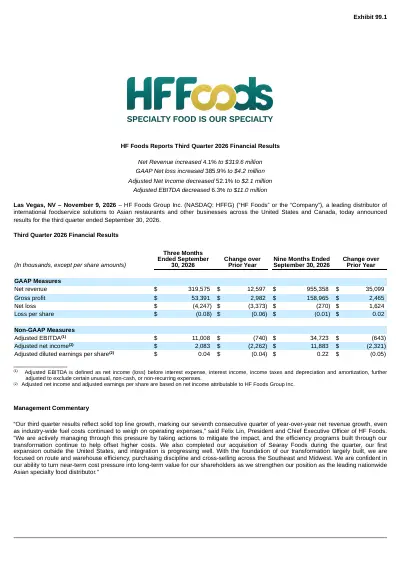
Net revenue increased 4.1% year-over-year to $319.6 million, making our seventh consecutive quarter of year-over-year net revenue growth, driven primarily by volume growth in seafood along with pricing improvement in produce and commodity. Gross profit increased 5.9% to $53.4 million, and gross margin expanded to 16.7% from 16.4%.
Adjusted EBITDA was $11 million compared to $11.7 million in the prior year. Our bottom line was held back this quarter primarily by fuel.
Industry-wide fuel price inflation caused a significant year-over-year increase in our auto and truck expense. We partially offset that with operating efficiencies from our transformation work, and we have implemented fuel surcharges across our customer base to share a portion of this burden with our customers.
The foundation of our transformation program is now largely built, with investments made in our sales operations, digital infrastructure, and facilities. Now our focus has shifted from implementation to optimization, including route and warehouse efficiency, purchasing discipline.
Cross-selling across the Southeast and Midwest remains an important opportunity, but is one we're building out over the next three to five years, paced by the capacity and capital we put behind it. We remain confident these investments are building a stronger foundation for sustainable, profitable growth, even as we continue to navigate some near-term pressure from elevated fuel costs.
Regarding facilities, our Charlotte location is largely ready, but we're still awaiting final permitting from local authorities. That process has taken longer than we anticipated and is largely outside of our control.
We anticipate resolution of this process by the end of this calendar year. The biggest milestone of the quarter was closing our acquisition of Seacore Foods on August 31, a leading Canadian importer and distributor of ethnic and specialty frozen seafood based in Richmond, British Columbia.
It's our first acquisition outside the United States and extends our proven M&A playbook into a new geography. Seacore brings six proprietary brands, including Seacore Foods, Thai Best, Pano's Best, Smart Fish, Diamond Shrimp, and Gold Label into our seafood category, which already makes up about 35% of our net revenue.
It has been just over two months since we closed, and we're approaching this integration deliberately. Our first priority was continuity, and on that point, the transition has been smooth.
Seacore's management team, led by Derek [Ng?] , continues to run the business day-to-day.
Customers and suppliers have stayed with us, and Seacore's results are now part of our reporting. We will share more specific milestones as we hit them.
In its first month under our ownership, Seacore contributed $4.2 million of net revenue and $0.6 million of adjusted EBITDA. That is an adjusted EBITDA margin in the mid-teens, consistent with the profile we described in the announcement and well above our consolidated margin.
The fourth quarter will be our first full quarter with Seacore. With Seacore closed, M&A remains a core pillar of our growth strategy.
You have heard us describe HF Foods as the only scaled food service provider in the Asian specialty market in the United States. As an acquirer of choice in our space, Seacore is that strategy in action, a higher-margin business that chose to join our platform for the scale and operating expertise we bring.
Our criteria have not changed. We look to expand our footprint in high-potential markets, capture operational synergies, broaden our customer base, and enhance our product and service capabilities.
Just as important, our first priority now is integrating Seacore well. We will pursue additional opportunities only at the right price, with the right fit, and when we have the capacity to integrate them.
Within that discipline, we'll continue to evaluate opportunities in 2027 and beyond. Seacore also changes the landscape of our opportunity.
It gives us our first platform outside the United States, in a Canadian market where Seacore has spent 25 years building its brand and relationships. It adds proprietary brands and a higher-margin business to our seafood category, and it brings retail and wholesale customers alongside our core restaurant base.
At over $1.2 billion in annual net revenue, we're now the largest and leading player in the Asian specialty space, and Seacore gives us new avenues to build on that position. No one, whether larger or smaller competitors, is better positioned than HF Foods to capture this opportunity in the coming years.
With that, I'll turn the call over to Paul to walk you through our financial performance for the quarter in more detail.
Paul McGarry
Thanks, Felix. I will now review our results for the quarter ended September 30, 2026, versus the same period in 2025.
Let me start with the bottom line, because that is where the quarter fell short. We grew net revenue for the seventh consecutive quarter, expanded gross margin, and generated strong cash flow from operations, but our profitability was not where we wanted it to be.
Two things drove that: fuel, and a concentration of nonrecurring costs tied to the refinancing of our credit facility and the Seacore acquisition. I'll walk through both, along with what we are doing about them.
Net revenue for the quarter increased 4.1%, or $12.6 million, to $319.6 million from $307 million in the prior-year quarter. The increase was primarily due to volume growth in seafood and pricing improvement in produce and commodity, partially offset by price deflation in meat and poultry, specifically chicken.
Net revenue also included $4.2 million from Seacore, reflecting one month of contribution following the close of the acquisition on August 31st. Gross profit increased $3 million, or 5.9%, to $53.4 million for the quarter, compared to $50.4 million in the prior-year quarter.
Gross profit margin increased to 16.7% for the quarter, compared to 16.4% in the prior-year quarter. The increase was primarily driven by volume growth in seafood and the higher-margin contribution from Seacore, both of which we expect to carry forward, as well as tariff refunds received during the quarter.
Distribution, selling, and administrative expenses, or DS&A, increased $5.9 million, or 11.9%, to $55.2 million for the quarter and were 17.3% of net revenue compared to 16.1% in the prior-year quarter. I'd split that increase into two pieces.
More than half of it was professional fees tied to nonrecurring events: the amendment and upsizing of our revolving credit facility, the refinancing of our property portfolio, the Seacore acquisition, and other legal matters. Those costs are excluded from adjusted EBITDA, and the transaction-related portion is largely behind us.
The rest was primarily due to auto and truck expense, reflecting elevated fuel costs and higher truck lease expense, partially offset by lower repair and maintenance costs from the investments we made into newer fleet. Felix touched on our fuel surcharge program.
Like much of the industry, we've responded to higher fuel costs with a surcharge across our customer base. It's a partial recovery by design, and we'll continue to manage it actively as diesel prices move, so that it helps offset fuel costs over time while keeping our pricing competitive.
Adjusted EBITDA decreased 6.3% to $11 million for the quarter, compared to $11.7 million in the prior-year quarter, and included $0.6 million from one month of contribution from Seacore. Adjusted EBITDA margin was 3.4% compared to 3.8% in the prior-year quarter.
For the first nine months, adjusted EBITDA was $34.7 million, down less than 2% from last year despite the fuel headwind. Fuel headwinds in the quarter and year-to-date were approximately $1.4 million and $3.2 million, respectively.
Total interest expense was $3.4 million for the quarter compared to $2.9 million in the prior-year quarter. The increase reflects the higher term loan balance following our July refinancing, partially offset by the mortgage debt we repaid as part of that transaction.
Net loss attributable to HF Foods was $4.2 million for the quarter compared to $1.1 million in the prior-year quarter. The increase of $3.1 million was primarily driven by $2.9 million decrease in income from operations and a $0.9 million unfavorable change in income taxes, partially offset by a $0.9 million favorable year-over-year change in the fair value of our interest rate swaps.
Adjusted net income attributable to HF Foods was $2.1 million for the quarter compared to $4.3 million in the prior-year quarter. Loss per share was 8 cents for the quarter compared to a loss of 2 cents per share in the prior-year quarter.
Adjusted net income per share was 4 cents per quarter compared to 8 cents in the prior-year quarter. Now, on capex, we spent approximately $22.3 million for the nine months ended September 30, 2026.
The largest item remains the purchase of our previously leased Chicago distribution center, which we discussed last quarter, along with investments in solar and capacity expansion. With the Chicago purchase behind us, spending slowed meaningfully in the third quarter.
On the solar investment, we expect to benefit from a one-time investment tax credit that will reduce our overall solar investment by approximately 40%. Separately, our fleet renewal is already paying off in lower repair and maintenance costs, and we expect this to continue.
Turning to the balance sheet, as we discussed on last quarter's earnings call, we refinanced and upsized our credit facility in July. That gave us liquidity to close the Seacore acquisition while continuing to invest in our facilities.
Cash provided by operating activities was $23.6 million for the first nine months of 2026, more than five times the $4.5 million in the prior-year period, driven mainly by a smaller inventory build than last year, when we purchased ahead of tariff increases, along with the timing of working capital. As of September 30, 2026, after closing Seacore, we had cash of $16.4 million and access to approximately $49.1 million in additional funds through our $140 million line of credit, subject to a borrowing base calculation.
Turning to Seacore, we owned it for one month of the quarter, this is an early read, but it is an encouraging one. As Felix mentioned, Seacore's first month came in at the mid-teens adjusted EBITDA margin, more than four times our consolidated margin this quarter, on a business we acquired at approximately five times its 2025 adjusted EBITDA.
That makes Seacore accretive to our consolidated margin from its first month, and a tailwind towards the 4.5% to 5%-plus consolidated adjusted EBITDA margin target we have laid out. The fourth quarter will be our first full quarter with Seacore in our results, and we like what we have seen so far.
Let me close by putting the quarter into a broader context. The top line and cash flow were strong.
Profitability was not, and we understand why. A meaningful part of this quarter's cost pressure came from one-time costs of transactions we chose to undertake, and both of those transactions leave us in a stronger position.
Fuel is the piece we do not control, and we have acted on it. Underneath that, this is our seventh consecutive quarter of year-over-year net revenue growth, and for the first nine months of 2026, net revenue is up 3.8% to $955.4 million.
Seacore now adds a higher-margin growth engine on top of that base. We head into the fourth quarter with three things working for us.
First, the fourth quarter will be our first full quarter with Seacore at a margin several times that of our total consolidated margins. Second, the fuel surcharge program is now in place.
Third, the nonrecurring transaction costs that weighed in on this quarter are largely behind us. We took on debt this year to buy our Chicago facility and Seacore.
Both add earnings capacity, and our refinancing facility gives us the runway, with maturities out to 2031 and 2036, to grow into that leverage. We will stay disciplined on the capital deployment and selective on the tuck-in opportunities that strengthen the platform.
The balance sheet capacity we created is there to support that, and as noted before, Seacore is the first demonstration of what we intend to do with it. With that, I'll turn the call back to Felix.
Felix Lin
Thanks, Paul. Before we move to Q&A, I want to come back to why Seacore is such a significant milestone for us.
We have talked for a long time about extending our platform beyond the United States, and Seacore is a first step in that long-stated strategy. Seacore has spent 25 years building its business in Canada, and we're proud to welcome the team to HF Foods.
Just as Seacore gives us a platform to grow in Canada, we believe its recently established US operations, including a planned direct import operation in Los Angeles, can be accelerated by our distribution network, sourcing scale, and West Coast infrastructure. Seacore also brings a customer base that includes retail, wholesale, and restaurants.
Now our focus is on executing well, completing a smooth integration with the Seacore team, and capturing the cross-selling and supply chain synergies between our two businesses. Alongside that, we'll keep managing through fuel cost pressure, driving efficiencies across our network, and staying disciplined as we evaluate further opportunities that strengthen the platform.
Thank you for your continued support. We look forward to updating you on our progress next quarter.
I'll now turn it over to the operator for Q&A.
Operator
Thank you. We will now be conducting a question-and-answer session.
If you would like to ask a question, please press star one on your telephone keypad. A confirmation tone will indicate your line is in the question queue.
You may press star two if you would like to remove your question from the queue. For participants using speaker equipment, it may be necessary to pick up your handset before pressing the star keys.
One moment, please, while we poll for questions. Our first question is from Aaron Grey with Alliance Global Partners.
Please proceed with your question.
Aaron Grey
Hi, good evening, and thank you very much for the questions. First question for me, just want to get an update in terms of where you stand on some of your cross-selling initiatives.
I think you mentioned last call, some might be able to be starting the end of 2026. Any update there?
Then, how we should think about the timing of some of the cross-selling opportunities as part of the top-line synergies with the Seacore acquisition? Thanks.
Felix Lin
Hi, Aaron. If you look at Q3 specifically, most of the growth has been driven by seafood volume, and I think that's part of our cross-selling strategy specifically in the East, in the Southeast kind of kicking in.
I'd say that is still very much in the front end of that. I think we expect in 2027 there's perhaps going to be a little bit larger cross-selling piece to the growth strategy, especially where investments are going in in Chicago as well, where we're trying to get into non-frozen seafood business.
Again, overall we're still in the early stages of that. When we quantify the overall cross-selling opportunity, several hundred million dollars of organic growth opportunity, that's really over a three- to five-year period.
We do expect that in the subsequent years that number is going to grow from here. Then from Seacore's standpoint, I think we're still in the very beginning phase of that.
I think the focus right now is how do we integrate the business in fully from a systems and data and all that standpoint. We expect over the next few months that's going to be the priority before we get into kind of a full cross-selling or synergy exploration.
Aaron Grey
Great. Thanks for that, Felix.
Second question for me, just on the Seacore acquisition. Right, so, can appreciate it's still early days of having closed it.
Just maybe initial indications in terms of how it's been relative to your expectations. I know it had been a while since you had a larger acquisition.
Just the team's ability to integrate it, how's that been relative to your expectations and how that could impact how much more you could take on potentially with another acquisition as you continue to evaluate? Thank you.
Felix Lin
From a integration readiness standpoint, we've been spending the last 12, 18 months really a big part of our transformation plan, the end result of that is not only trying to gain efficiency throughout our own core business, it's also to make sure we have a ready-to-go M&A integration playbook. I think what we're seeing, especially through the first month and a couple months of owning Seacore, we're seeing that M&A playbook come into play here.
Things have been going fairly smooth, and there haven't been really any surprises in terms of the Seacore business. Again, I think we're trying to do this as efficiently as we can, but also making sure that, again, we're taking the steps, a necessary step, to make sure there's no issues that are coming out of it.
From a capacity standpoint, again, we're always going to be very opportunistic. 12, 18 months ago, we talked about Seacore wasn't necessarily on the radar screen.
Because we are the acquirer of choice, not only is it in the US market, but now we've proven the fact that we're in the Canadian market as well. The pipeline is still very much vibrant, and we're just going to be evaluating these as they come in.
We do expect that M&A will continue to be a core part of our growth strategy here on a go-forward basis.
Aaron Grey
Great. Thanks for the color.
I'll jump back in the queue.
Operator
Our next question is from Daniel Harriman with Sidoti & Company, LLC. Please proceed with your question.
Daniel Harriman
Felix, Paul, good afternoon. Thanks for taking my questions.
I just have two quick ones today. Obviously, understand that DS&A was up in the quarter with fuel, but trying to get a sense of how much of that was just one-time deal and financing cost, and where you think it'll settle in subsequent quarters.
Then, obviously, the contribution from Seacore was strong for the one month that it was there. Do you think that that's a decent run rate, what they did that one month, to kind of use moving forward as we think about the end of 2026 and beyond?
Paul McGarry
Yeah. Hey, Daniel.
This is Paul. I think for the Seacore one month, that's probably good to use going forward.
It's early, but that's what we're kind of looking at right now. The DS&A, the breakdown of those, I think you're looking at more than half was related to one-time charges related to the acquisition and the upsizing of the ABL and the property portfolio.
Then the rest was mainly fuel. There's some uptick in our lease expense, but mainly fuel.
Obviously, with the fuel as it is, we're not sure when that's going to end, but we put some programs in place to try to offset that or mitigate some of those costs. The one-time costs, we see falling off here.
There's some drag for the quarter, a little bit, but nothing major that we see going forward.
Daniel Harriman
Very helpful. Thanks, Paul.
Yep.
Operator
Our next question is from Bill Kirk with Roth Capital Partners. Please proceed with your question.
Bill Kirk
Hey, everybody. Thank you for taking the questions here.
I guess understanding that there's no explicit guidance, I was hoping you could help us think about in what ways 2027 might look different than 2026, and in what ways would it maybe look similar to what we've seen so far in 2026?
Felix Lin
Hi, Bill. Thanks for the question.
Look, overall, there's a lot of changes here in 2026, right? If we just isolate to Q3 for a second, even within Q3, if you look at from a macro standpoint, fuel, the national average diesel price, how much that have changed.
For the month of July, I think that index was roughly about 31% higher year-over-year. August was 45%, and then September was roughly about 64% higher.
That changes quite a bit of dynamic in terms of the things that we're facing, which impacts both the input inventory cost, pricing, and certainly DS&A, outbound delivery charges. Now with Seacore acquisition coming into play.
I think overall next year the focus will be how do we manage some of these fuel challenges that continue to kind of drag down the overall industry? Is this going to be a short term where we will see a little bit of a retreat on the diesel price over the next 3, 6 months?
That will have a material implication in terms of how 2027 is going to go. Then certainly, for Seacore, we're going to try to fully integrate that in, and then from there expand a high-margin business here, try to grow that business significantly in 2027.
I think it's too early to tell, but we're certainly going through that process now as part of our annual budgeting process here for 2027.
Bill Kirk
That's great. Then, Felix, you called the M&A environment, I think you used the word "vibrant."
When you look out there, do you see other of these Seacore-type deals, meaning like 5 times EV to EBITDA for 15% EBITDA margins? Are there other things out there like that?
Or when we think about your M&A strategy, is Seacore kind of unique in that regard of what's available and out there?
Felix Lin
I think going through the whole Seacore acquisition process certainly opened up a whole new kind of a market for us. If you look at the Canadian market, granted it's a much smaller market compared to the US, it's 40 million people versus 300-plus million here state side.
I think there are a lot of opportunities there. We do see there potential other target that it has similar financial profiles compared to Seacore.
Again, if you look at from a M&A standpoint, there's all these different criteria that we look at. Some of it could be an in-market play where there's margin expansion opportunity for existing businesses.
Some of it might be some of the synergies that we can leverage. Again, we have a pretty significant pipeline, and all these different targets fit into different builds of it.
I think we've just got to evaluate them as they come up, and certainly we're trying to be patient and exercise this with a little bit of caution. Again, I think 2027, we do expect ourselves to continue to be active here on the M&A front.
Bill Kirk
Thank you. Appreciate all that context, Felix.
Operator
We have now reached the end of the question-and-answer session. I would like to turn the floor back over to Felix Lin for closing comments.
Felix Lin
Again, I want to thank everyone for paying attention and continued support HF Foods. Going through Q3, even though we have seen some pretty challenging macro factors that have impacted the overall industry and the business, again, I think the agility and the flexibility of HF, how we have conducted our business over the last 20, 25, 30 years, continue to set us apart versus some of our competition.
We expect, again, over the next several quarters, hopefully the factors that have been impacting us subside, but the future still remains very bright for the company, and we look forward to continue to execute on our plan. I look forward to updating you guys on our progress here in the next quarter.
Thank you.
Operator
This concludes today's teleconference. Please disconnect your lines, and have a good day.