Hilton Grand Vacations Inc.
Q3 FY2026 · Earnings Call TranscriptOctober 29, 2026
Operator
Good morning, and welcome to the Hilton Grand Vacations Third Quarter 2026 Earnings Conference Call. At this time, all participants have been placed in a listen-only mode, and the floor will be open for your questions following the presentation.
If you would like to ask a question, please press *1 on your telephone to enter the queue. If at any point your question has been answered, you may remove yourself from the queue by pressing *2.
If you should require operator assistance, please press *0. If using a speakerphone, please lift your handset to allow the signal to reach our equipment.
Please limit yourself to one question and one follow-up to allow the opportunity for everyone to ask questions. You may then re-enter the queue to ask additional questions.
I would now like to turn the call over to Mark Melnyk, Senior Vice President of Investor Relations. Please go ahead, sir.
Mark Melnyk
Thank you, operator, and welcome to the Hilton Grand Vacations Third Quarter 2026 earnings call. Our discussions this morning will include forward-looking statements.
Actual results could differ materially from those indicated by these forward-looking statements, and these statements are effective only as of today. We undertake no obligation to publicly update or revise these statements.
For a discussion of some of the factors that could cause actual results to differ, please see the Risk Factors section of our SEC filings. Our reported results for all periods reflect accounting rules under ASC 606, which we adopted in 2018.
Under ASC 606, we're required to defer certain revenues and expenses related to sales made in the period when a project is under construction, and then hold off on recognizing those revenues and expenses until the period when construction is completed. The aggregate of these potentially overlapping deferrals and recognitions from various projects in any given period are known as net deferrals and recognitions.
Please note that in our prepared remarks today, we'll only be referring to metrics that remove the impact of net deferrals and recognitions, which more accurately reflects the cash flow dynamics of our financial performance during the period. To simplify our discussion today, we've uploaded slides to our Investor Relations site showing these metrics, which we'll be referring to on today's call.
I'd urge you to view these slides on our website at investors.hgv.com. During the third quarter of 2026, we obtained a certificate of occupancy for our Ka Haku project.
The receipt of that certificate triggered the recognition of previously deferred revenues and direct expenses associated with prior sales of the project's inventory, resulting in a net recognition for the period. On slide 2 of these materials, you can see the recognition-adjusted metrics that we'll be referring to on today's call.
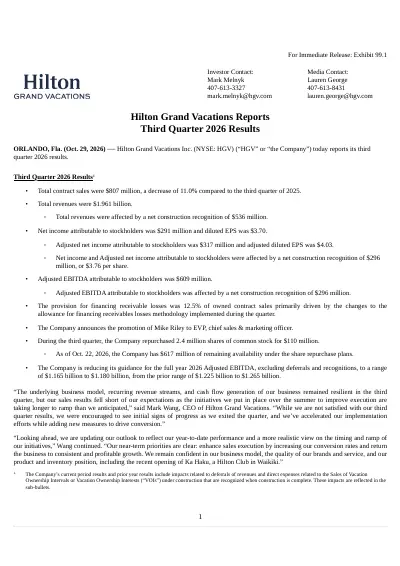
Reported results for this quarter reflect $536 million of net contract sales recognitions under ASC 606, which had the effect of increasing reported GAAP revenue. Also shown on slide 2, we recognized a net $240 million of direct expenses associated with these revenues.
Adjusting for both of these items would decrease the adjusted EBITDA to shareholders reported in our press release by a net of $296 million to $313 million. With that, let me turn the call over to our CEO, Mark Wang.
Mark?
Mark Wang
Morning, everyone, and thank you for joining our third quarter earnings call. This was a challenging quarter for us, and our results in Q3 fell short of our expectations and the outlook provided on our last call.
Although the underlying business model, recurring revenue streams, and cash flow generation of the business remain resilient, the 11% reduction in contract sales was below our forecast for a mid-single-digit decline. While we implemented a series of initiatives at the end of Q2 to address sales execution, primarily at our Bluegreen locations, and we expected those efforts would take time to drive significant improvement, trends at both our legacy and Bluegreen brands weakened further in August before gaining traction across the business late in the quarter.
To be clear, we're not satisfied with this outcome, and we're moving with an increased sense of urgency to return to sales growth and deliver long-term shareholder value. The contract sales decline in the quarter was driven by sales execution challenges, particularly our closing rates.
We've identified key drivers of that conversion rate softness, namely, the need for incentive alignment to drive higher transactions, along with a more dynamic headcount environment in certain markets requiring enhanced recruiting and retention programs. While they have taken longer to ramp, our initiatives are designed to address those underlying drivers.
From a macro perspective, while travel intentions remain resilient, we believe that sustained elevated pressure on the consumer are having marginally more impact on the purchase decisions versus a quarter ago. We also faced final difficult comparisons of 17% from our successful Bluegreen Max launch period this quarter, although those were headwinds that we anticipated and not an incremental driver of softness.
Importantly, we don't see this as an issue of willingness to travel. Tour flow for the quarter was consistent with our expectations, as it's been all year, and our arrivals on the books, occupancy levels, and package pipelines remain favorable.
We didn't convert those tours into transactions at the level we should have. We continue to have the strongest value proposition, product, and inventory that we've ever had, and we need to execute more consistently across the system to take advantage of those strengths.
That said, in light of our Q3 results, we're reducing our guidance to reflect a more realistic view on the timing and ramp of the near-term sales and EBITDA growth. Last quarter, we discussed targeted initiatives around incentive alignment, training, and recruiting, along with organizational initiatives with the goal of improving our execution and conversion rates.
Here are some of the direct actions we took. In Bluegreen Orlando property, we put a new leader in place, rebuilt the team, and returned to growth in September.
In Bluegreen's Myrtle Beach property, we also made leadership changes that stabilized the business, and while it will take time to ramp, we're encouraged by their progress. We tested updated incentive plans that generated a positive outcome, and we're in the process of delivering them to other key markets based on these early results.
As I mentioned earlier, the cadence of the quarter demonstrated some early signs of positive traction from those initiatives. August marked the low point for sales, and in September we narrowed the gap considerably, with several of our key sales centers returning to positive growth for the month, demonstrating a trend of measured improvement that continued into October.
Controlling for the effect of those tougher year-over-year comparisons, contract sales growth trends improved materially in each month of the quarter on a two-year stack basis. While the monthly trends give us confidence that we're on the right track, our results make it clear that we still have more work to do.
As a result, we're expediting our pace of roll out across our brands. We made further incentive changes to enhance alignment across the business, ensuring we're positioned competitively in key markets.
We brought additional sales talent into the organization through productive recruiting efforts, including a mix of former HGV team members and new employees. We've seen further improvements in October as a result.
In a separate release this morning, we announced a change to our sales leadership. Mike has a track record of driving growth throughout his career, including 15 years of consistent execution at HGV across multiple markets and brands, and I'm confident he's the right leader to renew our sales momentum and oversee our next phase of growth.
In addition, we have an opportunity to dedicate additional energy toward improving conversions in our new-buyer channel, which is critical to the long-term value creation in our industry. First, our robust tour flow and diversity of lead channels provides us with the opportunity to further focus our resources on channels with the highest profitability, as well as the customers with the highest propensity to close.
By improving our channel efficiencies, we'll generate higher transactions and higher profit contribution from a smaller set of tours. Second, we've identified areas where we have the ability to provide additional value and enhance accessibility to certain segments of our customer base with new products and price tiers, further improving our value proposition and driving transactions, which will enable us to continue to adapt our product and our approach to meet the customers where they are and with a product that fits their needs, while preserving their future upgrade path as owners.
These additional actions are about making every tour count, driving improved conversion rates, and increasing the transactions that are critical to growing embedded value, as the majority of a member's lifetime value is generated within the first 5 to 10 years of ownership. That embedded value extends beyond our real estate business, fueling our recurring club and resort and financing business that represents well over half of our segment profit.
For the quarter, our financing business revenues grew 16% while expanding margins, and our club and resort business continues to demonstrate consistent growth while producing our highest margins. That performance has been aided by the 20% growth of our HGV Max member base, which has now surpassed 300,000 members.
These are high-margin, predictable earnings streams, anchored by our Max membership base, and they have supported EBITDA and cash flow generation despite the pressure on contract sales. They demonstrate the resilience of our operating model as a whole, supporting our robust cash flow generation and capital returns.
This quarter, we repurchased another 2.4 million shares for $110 million as part of our ongoing commitment to returning excess cash flow to shareholders, and we continue to expect to meet our target of returning $600 million for the full year. In summary, we're taking an honest assessment of our performance, and we're determined to improve our execution.
While we're optimistic about early signs of progress from our initiatives, today's guidance reset presents a more conservative and achievable view of how quickly these changes will translate into improved results. Our confidence in the business model, products, inventory position, and the quality of our brand and level of service remains unwavering.
Our current priorities are clear: improve our sales execution by increasing our conversion rates, and return the business to consistent and profitable growth. With that, I'll turn it to Dan for more details on the numbers.
Dan?
Dan Mathewes
Thank you, Mark, and good morning, everyone. As Mark mentioned, our sales performance this quarter fell short of the outlook provided on our last call, and we're not satisfied with the results.
The corrective actions taken in the summer produced some improvement in results late in the quarter, but the pace of that progress was slower than expected. Despite a meaningful benefit of our provision for bad debt stemming from an accounting methodology change, and the continuation of our cost of product at the low end of our long-term range, the contract sales performance during the summer months ultimately led us to reduce our guidance for the year.
Turning to our results for the quarter, total revenues before cost reimbursements was flat with the prior year at $1.3 billion. Adjusted EBITDA to shareholders grew 4% to $313 million, with margins excluding reimbursements of 25%, up 80 basis points over the prior year.
I'd note that EBITDA for the period includes the benefit from a lower provision of 12.5%, which I will address shortly. Within our real estate business, contract sales at $807 million were down 11% from the prior year and below the mid-single-digit decline we anticipated on our last call.
The declines were driven by VPG and were felt across the system. Bluegreen saw the steepest decline owing to the difficult comparisons from our HGV Max launch, while our legacy business experienced inconsistent performance, particularly in the month of August.
New-buyer contract sales represented 28% of total volume, up 30 basis points against the prior period, driven by continued growth in new-buyer transactions. Tours in the period grew 2% to 236,000, consistent with the growth expectations laid out on our prior call and driven by continued growth in our new-buyer channel.
VPG declined 12% to approximately $3,400 in the quarter, reflecting continued execution challenges. Looking at the makeup of the quarter, we did see sequential improvements in the year-over-year VPG growth as we progressed through the quarter, but the initiatives were slower to take hold than originally anticipated.
Our provision in the quarter was 12.5% of owned contract sales, compared to 16.8% in the prior year. The quarter benefited from both improving credit performance driven by the underwriting actions we implemented last year, particularly at Bluegreen, and a consolidation of our allowance methodology resulting from the continued integration of our acquired businesses.
The consolidation of our allowance methodology led to a $55 million change in estimate to our allowance for our originated portfolio. The methodology update reflects the meaningful improvement in our credit performance that we've been highlighting for over a year now, and our view that future owner performance will be representative of the combined portfolio, and resulted in a prospective reduction in our loan loss allowance and provision expense.
As a result, the reported provision rate was below our long-term target range. Although the provision will continue to fluctuate based on financing propensity, owner/new-buyer mix, and other underwriting factors, the combination of the consolidation in our provision methodology as well as the continuation of the strong credit performance gives us increased confidence in our expectation that our provision will center around the mid-teens going forward.
Cost of product in the period was 9.4%, owing to a higher mix of trust product sales of recaptured deeded inventory. Real estate sales and marketing expense for the quarter was $408 million, or 51% of contract sales, 440 basis points higher than the prior year, substantially driven by operating deleverage from lower contract sales.
Real estate profit for the quarter grew 2% to $182 million, with margins expanding 150 basis points to 28%, as the provision benefit more than offset the sales deleverage. In our financing business, revenue grew 16% to $149 million, and profit was $94 million.
Excluding the amortization items associated with our acquired receivables portfolios, financing margins were 64%, up 300 basis points from the prior year. Looking at our portfolio metrics, our weighted average interest rate for our originated loans was 14.2%.
Combined gross receivables for the quarter were $5 billion. Our total allowance for bad debt was $1.37 billion on that $5 billion receivable balance, or 27.2% of the portfolio.
The portfolio remains in great shape overall, with delinquencies stable to last quarter and down from year-end. As of last week, our 31- to 60-day delinquency trends remain stable for all three portfolios, most notably for Diamond and Bluegreen.
In fact, in early October, Bluegreen 31- to 60-day delinquencies were at 2022 levels, and Diamond remains at a five-year low. In our resort and club business, our consolidated member count was 716,000 as we continue to add new HGV Max members, balanced by additional inventory recapture.
Revenue grew 2% to $196 million for the quarter, and profit was $136 million with margins of 69%. Rental and ancillary revenues were up 4% versus the prior year to $194 million.
Revenue growth for the quarter was driven by growth in RevPAR, offset by slightly lower available rental room nights versus the prior year. Developer maintenance fees continue to remain the largest driver of our rental and ancillary business profitability trends and drove the $7 million loss in the period.
This was the first full quarter following the close of our disposition transaction, and we continue to expect that it will reduce the fee burden on our EBITDA by $10 million to $12 million on a run-rate basis, although with minimal contribution this year. Bridging the gap between segment adjusted EBITDA and total adjusted EBITDA, JV EBITDA was $1 million, license fees were $57 million, and EBITDA attributable to non-controlling interest was $8 million.
Corporate G&A was $42 million and remained steady at 3% of pre-reimbursement revenue. Our adjusted free cash flow in the quarter was $63 million, a conversion rate from EBITDA of 20%.
This includes inventory spending of $53 million in the quarter. I'd also highlight we now expect spend of approximately $285 million on inventory this year, which is $90 million lower than our prior estimate.
Despite our reduced outlook, we continue to expect our conversion rate for this year will remain in the lower half of our long-term target range of 55% to 65%, demonstrating the resilience of our cash flow in different operating environments. During the quarter, the company repurchased 2.4 million shares of common stock for $110 million.
This was below our targeted run rate of $150 million per quarter, although as Mark mentioned, we fully intend to meet our annual goal of repurchasing $600 million worth of shares. As of October 22nd, we had $617 million of remaining availability under our consolidated share repurchase plans.
Turning to our outlook, as you saw in today's release, we are reducing our EBITDA guidance for the year to $1,165 to $1,180 million, from our prior $1,225 to $1,265 million. As I mentioned, the driver of today's guidance reduction is our weaker-than-expected sales performance, coupled with the slower ramp of our initiatives to improve our execution.
As we look at our components for our sales for the year, we continue to expect that tours will be in a positive low-to-mid-single digits for the year, despite the channel efficiency initiatives Mark mentioned. That initiatives will focus on driving lower overall volume of tours that are ultimately more profitable, particularly as we look to 2027.
Regarding VPG, we now expect VPG for the year to decline in the high single digits. In the fourth quarter specifically, we now expect VPG to decline in the mid-single digits.
As a result, we now expect contract sales for the year to be down in the mid-single digits, which implies fourth quarter sales down in the low-to-mid-single digits. Moving to our liquidity, as of September 30th, our liquidity position was $684 million, consisting of $227 million of unrestricted cash and $457 million in availability under our revolving credit facility.
Our debt balance at the quarter was comprised of corporate debt of $4.9 billion and a non-recourse debt balance of approximately $2.9 billion. At quarter-end, we had $450 million of remaining capacity on our $1 billion warehouse facility.
We also had $1.3 billion of notes that were current on payments, but unsecuritized. Of that figure, approximately $851 million could be monetized through the combination of a warehouse borrowing and securitization.
We anticipate another $383 million will become available following certain customary milestones, such as first payment, deeding, and recording. Turning to our credit metrics, at the end of the quarter, the company's total net leverage on a pro forma TTM basis was 3.87 times.
We'll now turn the call over to the operator for your questions. Operator?
Operator
Thank you. If you would like to ask a question, please press *1 on your touch-tone phone to enter the queue.
If at any point your question has been answered, you may remove yourself from the queue by pressing *2. As a reminder, please limit yourself to one question and one follow-up to allow the opportunity for everyone to ask questions.
Our first question will hear from David Katz with Jefferies. Please proceed with your question.
David Katz
Thanks, and good morning, everyone. Dan, I heard the commentary with respect to the change in provision, and I apologize for sort of leading off with a very specific question, but if we could have just a bit more historical context for where the provision sort of sits today, and again, I heard your comment about looking for a mid-teens target level over time.
Just a little more, maybe backward-looking on that would be helpful, please.
Dan Mathewes
Hey, David, yeah, no, it's an important question. When you look at our static pools that have been driving our provision rate for a long time now, we've been running three disparate static pools, starting with the acquisition of Diamond and subsequently with Bluegreen.
Each static pool operated off of a different lookback period. Only one of those static pools took into consideration FICO scores and actual equity down at the table.
We've been making changes over the course of the past few years in the back of house from a collections perspective, and also from a consolidation of the underwriting methodology. The most recent and material change that we made was, as we've talked about I think a limited times now, last year where we eliminated the no incremental down payment for upgrades on the Bluegreen side.
Now that that has been in excess of a year old, we had a lot more data points, and we took the opportunity to consolidate the methodology. What we did was now we have one static pool with a 10-year lookback period across all of the products that we sell, and they all take into consideration FICO and equity.
Now, there's a number of variables that are going to come into play that impact the ultimate provision, the least of which is not the propensity to borrow or the equity down. This change better underwrites the risk that we are taking as we issue loans.
Going forward, we do believe it's going to center around mid-teens. It could be as low as 14%, it could be as high as 18%.
Again, propensity to borrow has a meaningful impact on that. The good news is if the propensity to borrow goes up, that means long-term we'll recognize interest income, greater interest income than we originally expected, but you take the provision up front.
If you were to look at this item, we talked about a $55 million number being the change from a provision perspective, but if you were to apply the new methodology to this quarter in particular, the rate would have been just under 18%. If you just adjust for the $55 million, you'll get to a provision rate of 20%, and that just underscores the fact that we were not getting credit for the additional equity that we were taking down.
Now, that's at the higher end of what we would expect the range to be, but that is also underscored by some financing promotions that we ran during the quarter that drove a sequential increase in the propensity to borrow by over 400 basis points in the quarter. There's a lot of variables that come into play, but ultimately the end game is on a prospective basis, we expect to be centered around that mid-teens range, and we are better provisioning for the actual risk that we are underwriting as we issue loans to the consumer.
Hopefully that's helpful. I know that's a lot of data points.
David Katz
It is. Thank you very much.
Operator
Next we'll move to Patrick Scholes with Truist Securities.
Patrick Scholes
Hi. Good morning.
Mark, can you talk a little bit more with granularity about what specifically are these initiatives you've put in place over the summer to improve execution? With the change in the sales leadership, what improvements would you hope to see come out of that?
Thank you.
Mark Wang
Patrick, I think number one, we've been actively investing back into our sales organization, which means we've taken action to ensure that we're competitive in the market. We've improved incentives to meet market norm.
At the same time, we've been taking actions to find costs in other areas of business to offset that. Net-net, we're better off now, and staffing levels are in a much better position than they were when we started the quarter.
Just to give you a few data points here, we brought in over 430 new sales people over the last 4 months, all experienced. We had additional 350 that came in that had real estate experience, and of those, 165 were HGV, previous HGV sales representatives.
Importantly, we have really done a great job ramping up our recruiting. Our teams have done a really good job with that.
Look, at the end of the day, tour flow matters in this business. Sales people move where the tour flow is.
We're generating significant tour flow. We've talked about this before, and I talked about it on the last call, in any given quarter, there's a certain amount of turnover within a sales organization.
We experienced turnover levels that were above the historical norm. The good news is the trend is stabilized as we exited the third quarter, and we started seeing material improvements in our execution as we went through September, and we're also seeing that in October.
Patrick Scholes
Thank you. Then just a follow-up, can you remind us when you're taking in new sales staff, is it fair to think it'll take 3 to 6 months to get them up to, with training and just familiarity with product and whatnot, 3 to 6 months to get them to a level that you would think where they're, I guess, fully operational?
Mark Wang
No. Look, the good news is, as I said, over 160 of these were experienced in HGV.
You're right. When you bring in a new sales professional, and you invest in them, it does take some time to ramp up.
There was a lot of movement during the quarter, a lot of disruption that we experienced. The good news is those people are settling in, a lot of training going on involved, and we've made some I think really good moves from a retention and compensation standpoint that I think gets us in a much more competitive position now.
Patrick Scholes
Okay. Thank you.
Operator
Next we'll move on to Michael Hirsh with JP Morgan.
Michael Hirsh
Hi there, and thank you for taking my questions. In the third quarter, your free cash flow conversion, I believe, was 20%.
I guess, could you speak through the building blocks in the fourth quarter that could allow you to reach your target for the year, which is around 55%, I believe?
Dan Mathewes
Yes. No, that's a great question.
It's a function of a couple of things from a building block perspective. Predominantly, it's timing of securitizations.
We anticipate closing two transactions in Q4 that'll materially drive that up. In addition, you probably recall during my prepared remarks, our inventory spend for the year, we originally had estimated it would be in the range of $375 million, and we've modified those plans and we're going to be close to $90 million lower than that.
All of those benefits are rolling through Q4. Two securitization deals.
We've been talking about our second one in Japan, we anticipate that closing in Q4, and then we'll do another domestic deal of a material size, between $450 and $500 million in Q4.
Michael Hirsh
Thank you. Then for my follow-up, on capital allocation, given where your stock is currently trading, how do you rank buybacks against M&A, debt paydown, and maybe any other uses of capital?
Dan Mathewes
No, it's also a great question. We've been fairly vocal for some time now that we were not going to simply lever up the balance sheet in order to buy back shares.
At the same time, we've also been very vocal about the use of capital from a capital allocation strategy. No real M&A out there for us.
We feel the best use of capital is buying back our shares, and that was at prices that obviously have decreased over the past 90 days. Do we think it's a good investment?
Absolutely. We're very cognizant of the leverage level, and as you'll note, in Q3, we bought less than our programmatic $150 million that we've been buying for about 18 months.
We still expect to hit $600 million for the full year. We did decelerate those share repurchases as we saw the performance in contract sales in July and August underperform our expectations.
Given where we see the year playing out, even with the materially decreased outlook for the balance of the year, we feel that we're in a good spot to still execute on $600 million in share repurchases. No M&A in our line of sight, and we feel the best use of capital right now is still repurchasing of shares.
Michael Hirsh
Thank you.
Operator
Next we'll move on to Chris Woronka with Deutsche Bank.
Chris Woronka
Hey, guys. Morning.
Thanks for taking the questions. I guess, guys, if we could drill back a little bit on the sales center, things that are going on there.
It's a kind of a two-part question. One is, are there any initiatives you have to kind of make sure that these folks, assuming they deliver as you expect them to, to retain them?
Because I think we hear about a lot of kind of back and forth with some other operators. Then the second part of it is, is this new, I guess, incentive structure at the sales centers, does that have any implications longer term for your overall margins?
Then I have a follow-up. Thanks.
Mark Wang
Look, I think we're, what, about 30% of the industry, we have a significantly large sales and marketing organization, right? I think we've taken the actions required to, number one, attract and retain the talent that we're looking for.
We're going to continue. This is an ongoing process, right?
We've talked about there's always movement with talent across the industry, and I think we've done a good job with what we've done around our retention program. We've strengthened our recruiting incentives, and we significantly increased the recruiting efforts across the company, including adding staffing in our recruiting side.
We feel comfortable that we're in a much better place. When you think about the cost, the changes to the comp plans, yeah, there'll be some pressure on our sales and marketing costs, but we're also confident that we're going to be able to offset the impact with savings in other parts of the business,
Dan Mathewes
so. Chris, just to jump in there and just to underscore Mark's last point.
In the short term, clearly it has an impact on our sales and marketing rate. As you saw in Q3, our sales and marketing rate year over year was up almost 400 basis points.
I envision that rate to be fairly consistent in Q4, given the fact that we've lowered our contract sales. There's no longer a ramp that we anticipated in Q4.
In the short term, yes, it will have a rate impact. On the longer term, we believe there's going to be benefits on the contract sales side, this will help drive volume, and as Mark just alluded to, we will be more than offsetting any cost pressures associated with the investment in sales and marketing with cost savings across the balance of the business.
Chris Woronka
Okay. Super helpful.
Thanks, guys. Just as a follow-up, I know it's kind of difficult to look at a specific point in time, but what does the pipeline maybe look like for additional inventory recapture?
Have those recaptured trends been in line with greater or less than you maybe thought at the beginning of the year? Is there anything to kind of inform your thinking as to how recaptures will play out over '27?
Thanks.
Mark Wang
Recapture obviously has become a much bigger piece of our inventory sourcing strategy, right? Especially since we did these acquisitions.
I think as systems mature, as people are aging out, they're traveling less, and it really gives us more opportunities on the recapture side. It's really a natural part of the system's evolution, and it's I think a real advantage for our model going forward, especially from a ability to recapture that inventory at a good rate.
It's good for our long-term free cash flow in that we don't have to go out and necessarily build inventory at the same rate we have in the past. Anyways, I think there's opportunity to cycle that inventory, and our focus continues to be driving new members and creating new lifetime value creation, and using that inventory to create that lifetime value creation,
Dan Mathewes
so. Just to jump in there as well, we are truly capitalizing on the recapture of inventory.
If you were to look at HGV prior to any of the acquisitions, our cost of product is between 25% and 30%. After the acquisition of Diamond, we expected that cost of product to be in the low 20s.
After a few years of owning Diamond and fine-tuning that recapture program, it dropped into the high teens. With the acquisition of Bluegreen, we've bolstered that even more.
Immediately following Bluegreen, we were in the mid-teens, and now we think that longer-range view is in the low single digits to low teens, mix obviously come into play, but in that 10% to 12%, maybe 13% range, which is meaningful. It clearly will have an impact, as Mark just stated, with inventory spend patterns.
We talked about just a few minutes ago about inventory spend patterns this year going from an original expectation at $375, then reducing that by $90 million to $285. We've also talked previously about the long-term run rate being closer to $300.
Now that $90 million deceleration this year is not simply getting pushed into next year. We still anticipate being below $300 next year in that inventory spend.
That is just underscoring what Mark was just talking about with that recaptured inventory process.
Chris Woronka
Great. Thanks for all the color, guys.
Appreciate it.
Operator
Next we'll move on to Trey Bowers with Wells Fargo. Please go ahead.
Nick Weichel
Hi, this is Nick Weichel on for Trey. Thanks for taking our question.
I know you guys are undergoing a lot of different initiatives right now, but I was curious if you had any early thoughts on what 2027 might look like, and just any color would be great.
Mark Wang
I'd say number one, I think when you think about our long-term algorithm, we think that, getting past this year, getting past these very difficult comps that we had from last year, that our long-term algorithm is achievable as we go into next year. Then we've shown that EBITDA and cash flow are resilient in the face of softer sales trends.
As we look on a go-forward basis, we think we're going to be able to balance VPG and tour costs and drive consistent EBITDA growth. We're not looking at double-digit tour flow growth to drive our business.
It's really about more of a low-to-mid-single-digit tour flow growth with a low-to-single-digit VPG growth. Anyways, I think we're moving to a pattern of consistent growth on a go-forward basis, and it's very aligned with our thinking around our long-term algorithm.
Nick Weichel
Got it. Thank you.
Operator
We'll move on to Stephen Grambling with Morgan Stanley.
Stephen Grambling
Hi, thanks. I may have missed this in some of the opening commentary, but just given the interest rate environment, are you seeing any changes as you're having conversations around the securitization market or your borrowing costs in the financing segment?
How would you generally think about approaching if rates were to move higher, trying to pass that on to the consumer versus maybe using it as a sales tool? Thanks.
Dan Mathewes
It's a bit of a balancing act when it comes to interest rates. We constantly debate that internally.
What I would tell you, with pressure on interest rates just given the dynamics of what the Fed is doing, will we always match what the Fed does? No, absolutely not.
Will we move the needle where we can? Definitely.
We do balance that with sales table initiatives, though, so, like I said, it's not going to be a one-for-one. A bit of a balancing act there.
From a benchmark perspective, that clearly works against us when we go and execute on a securitization. We, much like others in the industry, are trying to be a very very robust issuer of securitizations.
We try to make sure that we meet the commitments to those bondholders, they know what they're walking into, to have a high level of liquidity in those notes, and help us drive the best pricing we possibly can. We've been very successful in that in the past.
We're also looking at different avenues to capitalize on that. Clearly, we've talked about our Japan initiative, where we've been able to securitize receivables for the first time last year in Japan that had a rate that was sub-1.5%.
We will do a second deal this year. The rates in Japan, as you've probably seen, have also gone up, but they're going to be materially lower than the recent securitization in timeshare market that you saw from one of our competitors recently.
Japan markets would still have a 2 handle on it, which is substantially better than what you've seen in the US. Ultimately, I've said this before, we're changing the collateral mix in the securitization that we do in Japan.
Ultimately, we're looking to be a more robust issuer even in the Japanese market, which should help us mitigate the pressure that you see on rates in the US, and at the very least, it allows for a competitive environment.
Stephen Grambling
Thanks. That's a lot of helpful detail.
One unrelated follow-up. There's been a bit of a spike here in airfare.
Are you seeing that impact specific markets at this point? Are there tools or things that you're seeing that might help alleviate that if you are seeing any kind of change in travel behavior from either your owners or prospective owners?
Thanks.
Mark Wang
We really haven't seen a lot of pressure as it relates to airfare movement and costs of moving around or flying. Obviously, fuel costs are high, much higher than they have been with all the Middle East activity that's going on right now.
Despite all of that, people continue to travel. People continue to move their discretionary spend toward leisure travel.
It's remained very resilient. Our demand indicators remain very positive.
Arrivals for Q4 and through the first half of next year are positive year over year. Occupancy levels are steady.
We maintain a very strong package pipeline. Importantly, our new-buyer transactions continue to grow, and, while our main pressure this year has been Bluegreen owner comps, we did have 18% higher new-buyer transactions in Bluegreen last quarter.
I think that's a really good signal that our product continues to resonate with these new buyers that are coming through the door. Right.
Not to be remotely dismissive of higher fuel prices, because that's obviously adding pressure to the consumer, but it's one of the benefits of the acquisitions over the course of the past 5 years is the fact that in excess of 90% of our owners do live within a four-hour drive of one of our resorts. Even if you do see pressure from a flight perspective, we have a number of options to accommodate a tougher environment for the consumer.
Stephen Grambling
Great. Thank you so much.
Operator
Patrick Scholes with Truist Securities will have our next question.
Patrick Scholes
Hi. Follow-up question here.
Thank you. Mark, I may have missed it earlier.
With the new methodology for the provision coming in at 12.5%, what would an apples-to-apples provision result under the prior methodology have been? Just so we can compare it to what we were expecting.
Thank you.
Dan Mathewes
No, absolutely. Absolutely.
If we had not changed the methodology, simply adding the $55 million back to the provision would have gotten you a provision rate of roughly 20%. That is a function of a couple of factors, most notably mix, higher mix of trust and higher loan loss provisions associated with some deeded product, coupled with a sequential increase in propensity to borrow by, I think I mentioned this, north of 400 basis points.
Adjusting for that, those two items alone accounted for over 150, 200 basis points of that move. It would have been at the higher end of that longer-term range, but that would be under the previous methodology.
If we would have adopted the new methodology, you probably already heard me say this, it would have been at just under 18%, but again, the propensity to borrow drives that up by about 100 basis points.
Patrick Scholes
Okay. Lastly here, would you be so kind to give us a bit of a guidance walk here for the rest of the year?
Thank you.
Mark Wang
Let me maybe take the first part of that, and then I'll let Dan give you a little bit more color on it. Look, first, we realize that comps get easier in November and December, right?
The reality is, and we talked about this, we made a major leadership change to address the execution. While we're very confident in Mike Reilly and what he's going to do to lead our sales organization, there's always some risk involved in that.
We know it's best for the long-term interest of the business. As you think about the rest of the quarter, we expect sales to really be in that kind of low-to-mid-single digits, in line with what we saw in October.
I think, Patrick, though just to do more of a walk,
Dan Mathewes
clearly we're very disappointed with the ultimate performance, but there are some things to take into consideration, just the underlying resiliency of a number of factors in the business. We see that continuing.
The rental business, we believe, will be in line with last year, which is very consistent with our previous expectations for the year. Our resort and club business will continue to benefit from a strong seasonal Q4, again in line with prior year, probably slightly a hair up, and also consistent with our previous expectations.
On the financing business, despite contraction in contract sales, that's still performing and in line with our previous expectations. When you look at the walk, it's really geared around the real estate segment.
Mark has talked ad nauseam about the compression in contract sales, but what does that translate to the bottom line? There are some good guys.
Bad debt year over year, as you may recall, last year was at an elevated level given the upgrade into HGV Max scenario, there should be some benefits on the bad debt side. That's going to be more than offset in the investment that we're making in the sales and marketing team.
That is going to be driving your SM&A rate, which is going to be the detriment, which is causing the contraction in margins that we're projecting in our EBITDA walk. Now, again, we believe that increase in sales and marketing rate should be short-lived, it's short term, and as we progress forward, we should be able to capitalize by increasing contract sales, and also ultimately lowering costs in other areas of the business to more than offset that pressure.
Patrick Scholes
Thank you. Then just lastly, well, I have to be a microphone here.
Can you just confirm that the licensing fee percentage for next year should be at or about 5% for modeling purposes? Then related to that, remind us after that, it seems that that is stepped up to sort of its ongoing run rate for let's say 2028 modeling, is that correct, that 5%?
Just want to clear the air on that. Thank you.
Dan Mathewes
Remember the 5%, different elements of the business pay a different license fee, it's not just a flat 5%. To your point, the ramp-up, we've just passed the last ramp of Diamond.
Bluegreen still has one more ramp that happens on January 1st, we will be at a normalized run rate starting January 1st. Outside of rebranding some of the properties, because as you would expect, we do not pay a licensing fee if the property does not bear the Hilton name.
Patrick Scholes
Outside
Dan Mathewes
of that. The rate averages 5%.
Patrick Scholes
Okay. Thank you.
I know investors had some questions on those, I appreciate you just clarifying everything. I'm all set.
Thank you.
Dan Mathewes
Yeah.
Operator
There are no further questions at this time. I would like to turn the floor back to Mark Wang for closing remarks.
Mark Wang
All right. Thank you again for joining the call today.
To our members and our team members around the globe, thank you for making HGV a part of your story, and we look forward to updating you on our next call. Have a great day.
Operator
Thank you. This does conclude today's teleconference.
We thank you for your participation. You may now disconnect your lines at this time.