WH Group Ltd. (HK)
Q3 FY2026 · Earnings Call TranscriptOctober 26, 2026
Lijun Guo
Good evening, everyone. And welcome to WH Group's Third Quarter 2026 Results Conference Call.
This is Guo Lijun, Executive Director and Chief Executive Officer of WH Group. Joining us today are members of the management teams of WH Group and our subsidiaries, Shuanghui Development, Smithfield Foods and Morliny Foods.
They include Mr. Wan Long, Chairman and Executive Director of WH Group; Mr.
Wang Hongwei, Deputy Chairman of WH Group and the Chairman of Shuanghui Development; Mr. Ma Xiangjie, Executive Director of WH Group and President of Shuanghui Development; Mr.
Liu Songtao, Executive Vice President and Chief Financial Officer of Shuanghui Development; Mr. Shane Smith, President and CEO of Smithfield Foods; Mr.
Mark Hall, Chief Financial Officer of Smithfield; Mr. Luis Cerdan, Chief Executive Officer of Morliny Food; Ms.
Joanna Yan, Chief Financial Officer of WH Group; and Mr. Zhou Xiaoming, Vice President of WH Group.
Today's call consists of 2 parts: we will first review the company's financial and operating performance for the first 9 months of 2026, followed by a Q&A session. Now we're going to walk you through the company's performance in the first 9 months.
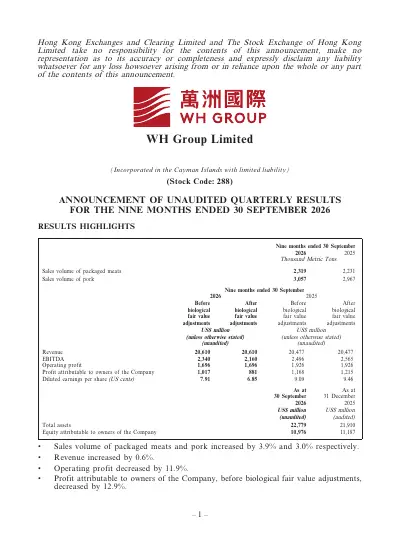
In the first 9 months, total packaged meats sold was 2.32 million metric tons, 3.9% higher than last year. Pork sold is 3.057 million metric tons, 3% higher than last year.
Revenue, USD 20.6 billion, 0.6% higher than last year. EBITDA, USD 2.34 billion, 6.3% lower than last year.
Operating profit, USD 1.969 billion (sic) [ USD 1.696 billion ], 11.9% lower than last year. Profit attributable to owners of the Company USD 1.017 billion, 12.9% lower than last year.
Earnings per share, USD 0.0791. Packaged meat business is our core business, which contributed to 52% of our revenue and 97.6% of our operating profit.
Pork business is 38.2% of revenue and 6.5% of operating profit. The Others is 9.8% of revenue and a loss of USD 71 million, which primarily consists of corporate expenses.
U.S. business is 51.6% of our business and 47.3% of our operating profit.
China business is 31.6% of revenue and 43.1% of operating profit. Morliny Foods is 16.8% of revenue and 9.6% of operating profit.
In the first 3 quarters of 2026, China hog prices remained at historically low levels due to abundant supply of hogs. In the U.S.
market due to insufficient demand, hog prices decreased year-over-year. In Europe, subdued demand and regional oversupply of hogs led to a significant year-over-year price decline.
In the first 9 months, the number of slaughtered hogs in China increased by 1.4% year-over-year to 537.39 million heads and average hog price was RMB 11.25 per kg, down 25.5% year-over-year. The number of slaughtered hogs in the U.S.
decreased by 1% to 93.7 million heads. Average hog price was USD 1.5 per kg, down 6.3% year-over-year.
In Europe, the average hog price was EUR 1.21 per head -- per kilogram, down 20.4% year-over-year. So the supply is increasing and the prices are declining.
In the first 3 quarters, the average cutoff value in the U.S. was USD 0.0213 (sic) [ USD 2.13 ].
It's a decrease of 7% year-over-year, which is faster than the decrease in hog prices. So that's resulted in a narrowing of the market spreads.
In China, the operating profit in the first 3 quarters is USD 730 million, 1% higher than last year. Packaged Meats business contributes to USD 728 million, which is 5.7% higher than last year, and the Pork business was a loss of USD 4 million.
In North America, operating profit is USD 803 million, which is 18.1% lower than last year. Packaged Meats business is USD 776 million, 2.5% lower than last year.
Pork business was USD 131 million, 52.4% lower than last year. In Europe, the operating profit was USD 163 million, 26.2% lower than last year.
Packaged meats was USD 152 million, 36.9% higher than last year. Pork was a loss of USD 16 million.
In terms of strategies, we will continue to consolidate our global resources, leverage synergies, adhere to the business philosophy of improve mix, adjust the price and control costs and the strategy of industrialization, diversification, globalization and digitalization to enhance our leading position in global meat industry. We'll focus on number one, further enhance the pork business, optimize cost structure, improve hog production performance, grow fresh pork business and strengthen competitiveness.
For packaged meats business, we will further optimize the product portfolio, expand the customer network and maintain steady growth in scale and profits. We will also continuously optimize the pork value chain, steadily promote meat diversification, enhance global footprint, and strengthen overall competitiveness.
Number four, we will promote automation and artificial intelligence across the organization, drive digitalization upgrades to improve quality, cost and efficiency. So that concludes the review.
Unknown Executive
[Foreign Language]
Chen Luo
[Foreign Language]
Xiaoming Zhou
[Interpreted] So the 2 questions both related to WH Group. First, the question from Luo Chen of BofA Securities.
First relates to the dividend policy. So in the past, the WH Group has a dividend policy of no less than 50% of net profit.
But in practice, the absolute amount of the dividend has been stable or increasing year-over-year in the last few years. This year, the business is under a lot of pressure, particularly in the fourth quarter in the U.S.
Is the company able to provide more specific guidance on whether it is able to continue to maintain stable and growing dividend per share. Last year, the full year dividend was HKD 0.61.
And will the company be able to maintain at least this amount of full year dividends? The second question relates to the recent speculation about a lot of Chinese entrepreneurs overseas trust, whether WH Group controlling shareholder also had similar issues and whether there is any likelihood of reducing the stakes to meet the tax obligations.
Unknown Executive
[Foreign Language]
Xiaoming Zhou
[Interpreted] To answer the first question, as you mentioned, WH Group's dividend policy is no less than 50% of the net profit. So there has been no change in the dividend policy of WH Group or any of its subsidiaries.
And you also mentioned that in the past, even though the policy is no less than 50% in practice, to the extent we can, we always pay more than the dividend policy and we will continue to stick to that principle and to focus on shareholder returns. Shuanghui did not pay interim dividend this year.
We also explained this to the market earlier that, that was due to the working capital tied up for the buildup of some inventories for the raw materials to take advantage of the very depressed hog price in China in the first half. And the dividend policy of Shuanghui has also not changed.
Unknown Executive
[Foreign Language]
Xiaoming Zhou
[Interpreted] The second question relates to the overseas trust. Indeed, this is a relatively material new regulations and Chairman has already fulfilled his -- completed the relevant tax filings and the relevant tax obligations, and there is no plan to reduce the stakes in WH Group.
Unknown Executive
[Foreign Language]
Yang Zhou
[Foreign Language]
Xiaoming Zhou
[Interpreted] So this is Valerie of Goldman Sachs, Research. The question relates to the U.S.
business. In the third quarter, we have seen pressure on the business, which seems to be carried forward into the fourth quarter and which is reflected in the company's revised guidance.
So what are the key assumptions that we're making under the new guidance? Are some of the assumptions based on a conservative -- are conservative that could potentially provide more upside.
Shane, Mark, do you guys want to take this one?
Unknown Executive
Thanks, Xiaoming. I'd start by saying that the third quarter results were within the range that we provided in our September update and as indicated, the pressure is really confined to the upstream businesses.
What we see typically in the second and third quarter is that those are the low points for fresh pork for the year. And you see support beginning to build in the third quarter heading into what is typically a seasonally strong fourth quarter.
In the third quarter of this year, however, fresh pork spreads and product values and the hog price outlook weakened further. So on a sequential basis, the industry processing spread narrowed by about 28%.
Now it's down 35% versus the prior year, and that's well below the level needed to cover our processing costs. So our updated fourth quarter fresh pork view really reflects that deterioration without assuming a seasonal improvement.
So I'd say that along with softer domestic demand and increased global pork availability has created a more competitive environment for U.S. pork in Mexico and into Asia, which is impacting volume and sales margins.
So depressed pork values have also led to a reduced hog price outlook in the fourth quarter, which is further pressuring what is traditionally a loss-making quarter in hog production. But I'll highlight at the same time that the packaged meats business continues to perform exceptionally well.
It's a very resilient business, demonstrating volume, profit and margin expansion in the third quarter as we head into our seasonally strongest fourth quarter. So I'd say that the updated outlook reflects the current market conditions upstream, but it doesn't change our strategy or our capital allocation policies or the long-term earnings dollar of the business.
Xiaoming Zhou
[Foreign Language]
Yang Zhou
[Foreign Language]
Xiaoming Zhou
[Interpreted] The second question relates to the China business. We noticed that in the third quarter, the China packaged meats business delivered a stable growth, but profit per ton was under pressure.
Management has explained earlier that the company has been investing in the channels, investing in staffing to improve the sales network. So what progress has been made and what is the outlook for the fourth quarter and the 2027 volume and profit per ton?
Unknown Executive
[Foreign Language]
Xiaoming Zhou
[Interpreted] So indeed, we have a lower profit per ton this year. That's primarily driven by 2 factors.
First is the product mix. This year, we have been developing both premium products as well as more value for money products and the mix of the lower priced -- lower profit products has increased this year, which resulted in lower profit per ton compared to last year.
Secondly, we also stepped up investment in the market, which also impacted our profit per ton. Starting from the second quarter, we have performed more optimizations in all these areas.
And we believe that in the fourth quarter, the negative impact from the product mix will be relatively small. And from a marketing expense perspective, we are also optimizing our investment strategies.
We will cut some spendings with respect to the distributors, but step up the spending in the retail point of sales. But overall, we believe the negative impact from higher expenses will also be small in the fourth quarter.
So overall, we expect the fourth quarter profit per ton will be relatively lower compared to last year, but volume will increase. Overall, the profit will be stable compared to last year.
Unknown Executive
UBS, Veronica.
Ting Song
[Foreign Language]
Xiaoming Zhou
[Interpreted] So 2 questions from Veronica of UBS, both relate to the outlook for the market. First relates to U.S.
market. In the last 2 years, we have had a relatively favorable hog price.
But this year, we are seeing downward trends in the hog prices. What's the management's view for hog and pork price next year?
Is this a temporary correction for 1 or 2 quarters? Or is this more likely the beginning of a new downward cycle.
And in China -- the second question relates to China, what's the outlook for hog and pork prices in the fourth quarter next year?
Unknown Executive
Yes, I'll take the first question. So Veronica, there's no question that we're seeing pressure in the upstream business, and this pressure is really broad-based.
In the U.S. market, demand is down.
We know that our consumers are stretched. And then when you look at the business globally, key export markets do remain very challenged and all of those things going back to pressure in the fresh pork business, which ultimately leads to pressure in hog prices.
And Veronica, you can look across the future strip and see that as hogs are being priced across 2027, they do show that they're down. But I would caution you that this time of the year, that's typically the case, no matter what the year is that we're looking at.
Now I'm not ready to say this is a cycle yet. I am willing to say we do see some pressure.
And so the way we're offsetting that here at Smithfield is a couple of things. First, the strategies that we've been using really since before the IPO, our strategy is that we continue to set us up for any challenges and I would say better today than in the past.
So again, focusing on our packaged meats business. This will be the fifth consecutive year of operating profits over $1 billion in fresh pork.
We'll continue to optimize the value of the hogs that come through. We'll continue to optimize our harvest levels to meet our internal needs, and then we'll grow in things like value-added marinated case-ready food service and growth in e-commerce.
And then in hog production, we'll continue to take hogs out of production. You saw the announcement this morning where we formed another agreement to take an additional 900,000 hogs out of our internal production, moved those to external production.
So we'll continue to focus on the things that will improve our overall business and strength the vertically integrated model.
Xiaoming Zhou
[Foreign Language]
Unknown Executive
[Foreign Language]
Xiaoming Zhou
[Interpreted] So for the China market outlook, with respect to the fourth quarter, we continue to see relatively depressed hog price in China. So we believe the hog price in November and October will remain at a low level.
And in December, it may recover somewhat. But on average, the fourth quarter hog price is still possible to be lower than the third quarter.
So this updated outlook is slightly different than what we had projected at the beginning of the year. That's because in the second half, even though the sow herd is smaller, but the productivity of the sows has improved.
And so the supply of the hog is very abundant. And also the fourth quarter, the consumption continued to be relatively weak.
So that has driven by -- so that has resulted in the likelihood that the fourth quarter average hog price will be lower than the third quarter.
Unknown Executive
[Foreign Language]
Xiaoming Zhou
[Interpreted] With respect to outlook for next year, because since March this year, the hog price has been very depressed in China and has hit the bottom for a couple of times. So most of the farmers with the hog production business are loss-making.
So the small-scale hog farmers may be exiting their capacities, whereas larger scale hog producing companies may also reduce their capacities. So that will result in a moderate recovery of hog price next year to a degree of magnitude of roughly RMB 1 per kilogram.
And also because of the -- considering the pace of the capacity reduction, it is likely that the supply in the second half will be lower than the first half, and the demand seasonably is stronger in the second half. So the price will be lower in the first half and relatively higher in the second half.
Unknown Executive
[ Charlotte, MS ].
Unknown Analyst
[Foreign Language]
Xiaoming Zhou
[Interpreted] So 2 questions from [ Charlotte ], Morgan Stanley, both related to the China packaged meats business. In the third quarter, we have seen stable performance of packaged meats business in terms of volumes, but the new channels are contributing to higher growth.
So what's the -- what -- and the traditional channels continue to be pressured. So what's the latest outlook for the volume of performance in the traditional channels?
Is it possible to achieve positive growth in next year? And also what will the likely split of emerging versus traditional channel be after the channel evolution stabilizes?
And the -- what will be the -- and the company has been investing -- second question is that the company has been investing in the market since the first half of this year. And how much volume growth will that investment achieve for next year?
And what is next year's profit per ton outlook?
Unknown Executive
[Foreign Language]
Xiaoming Zhou
[Interpreted] First, on the different channels. Indeed, the traditional channel has been under pressure because the overall traditional channel in the China industry is under pressure as a lot of the supermarkets are really struggling or even exiting from the market.
But we have been taking a lot of initiatives to reform our sales channel to improve our sales activities. Though the effect has not been as good as we had expected.
But we believe the trend is positive, and we believe it is probable that we will have achieved positive growth in the traditional channel next year. On the other hand, emerging channels is indeed delivering very strong growth, particularly the membership-based stores, the snack retailers, these kind of channels are growing very fast.
So for the first 3 quarters, the growth from the traditional channels is more than 40% year-over-year. For the first 3 quarters, the emerging channels represent 25% of our sales.
And for the full year, we believe the number will increase to 26%. And secondly, with respect to the market and the staffing spendings, we have been increasing the sales force this year gradually to have more specialized sales teams.
And we believe that the effect of this team buildup and upgrades will also be gradually delivering positive impact to us. So we are quite confident about the growth prospect for next year, and we are confident about a very strong growth in volumes for packaged meats next year.
Tiffany Feng
[Foreign Language]
Xiaoming Zhou
[Interpreted] So 2 questions from Tiffany of Citi. First relates to -- both relate to Shuanghui.
As we have seen that recently the food safety incident investigation has concluded and the company has been -- has started to take a lot of measures to improve the food safety protocols and how much expense or cost will those measures impact the company in fourth quarter and 2027. And what is the company's latest outlook for the operating profit in the fourth quarter?
And secondly, with respect to the strong dividend policy, as the management mentioned earlier, there is no change in dividend policy. In the past, Shuanghui's dividend payout ratio is very close to 100% of the net profit.
Can -- is the company able to reiterate this dividend policy?
Unknown Executive
[Foreign Language]
Xiaoming Zhou
[Interpreted] So the first question on the food safety rectification measures. Indeed, since the incident, we have been taking a lot of measures to enhance our food safety protocols.
But only 2 of those measures have a financial impact. One is that we have increased dozens of staffing related to quality control.
And secondly is we added -- we have procured more testing equipment. But financially, these investment or expenses are immaterial for us.
The majority of the rectification measures are more related to the improvement in the process and practice. So overall, the financial impact of this food safety-related new measures are not significant.
Xiangjie Ma
[Foreign Language]
Xiaoming Zhou
[Interpreted] In the fourth quarter, because the hog price and the chicken price are at low level and are lower than last year, we will plan to take advantage of this favorable condition to expand our volumes. So we believe the fourth quarter volume will achieve stable growth and the profits, will also achieve positive growth, but the revenue may decline driven by lower market price.
Unknown Executive
[Foreign Language]
Xiaoming Zhou
[Interpreted] With respect to dividend policy, as Mr. Guo mentioned earlier, in the first half because of the frozen product inventories, raw material inventories and frozen meat inventories, we have not paid interim dividend as a prudent management practice.
And we -- for the full year, we will continue to adopt the shareholder return strategy based on cash dividends, and we'll continue to maintain moderate and high payout ratios.
Kin Shun Ling
[Foreign Language]
Xiaoming Zhou
[Interpreted] So 2 questions, both related to Shuanghui from Anne of Jefferies. First is on the Mr.
Ma's comments earlier that we will take advantage of the lower hog price in the fourth quarter to expand our volumes. Does that mean that we will grow our volumes at the expense of margins?
Will our profit per ton decrease and what's the latest guidance on profit per ton? And secondly, with respect to the frozen meat, in the first half, Shuanghui has accumulated more frozen meat inventories.
But given the low hog price outlook in the fourth quarter, is there a risk of further inventory write-downs.
Unknown Executive
[Foreign Language]
Xiaoming Zhou
[Interpreted] So on the fourth quarter margin, the comments earlier on growing volume at low hog price is more related to the fresh pork business because for fresh pork business, when the hog price is lower, it is more -- it's easier for fresh pork business to make more margins. And it's not -- it is different for the packaged meats business where selling prices are stable.
So the lower raw material costs will be favorable for us. So we believe in the fourth quarter, our profit per ton compared to last year will have a slight decrease and will be higher compared to the third quarter.
And for the full year, the profit per ton will be lower than last year, but it's still at a very high level, if we look at the history.
Unknown Executive
[Foreign Language]
Xiaoming Zhou
[Interpreted] For the frozen meat, we currently have a relatively higher inventories and -- but most of the inventories were built when the hog price was around RMB 10 per kilogram at the first half of the year. And the -- we have already made all the necessary provisions and right -- impairments.
The outlook of the hog price or pork prices is stable. So we do not believe there will be further impairment.
But on the other hand, given the stable hog price, it is also unlikely to contribute to significant profit.
Wendan Wang
[Foreign Language]
Xiaoming Zhou
[Interpreted] So the question from CICC is the outlook of hog price in Europe next year and the business outlook for Europe next year. So Luis, do you want to take this one?
Luis Cerdan
Yes. We are expecting the price for next year of the -- pork price for next year to be moderately higher than this year.
The main reason is we are in historically low prices. Farmers, especially in the north of Europe, are having over EUR 40 per head, and we start to see some liquidation, especially in Germany, Denmark, Holland that will mean that the actual oversupply will be corrected and we expect increase in prices, especially in the probably second to third quarter of next year, but it will be moderate because still there is the demand like before we were listening about China and U.S.A.
still good and the market demand is not as strong.
Xiaoming Zhou
[Foreign Language]
Luis Cerdan
I only did hear the outlook of the pork price. Was there any other question, Xiaoming?
Xiaoming Zhou
I think she was also asking about the overall outlook for the business next year.
Luis Cerdan
Well, the overall outlook, like we see in the results this year, fresh pork cycle was down and our results were down mainly for the upstream of the business. I mean that with the improvement of the upstream part of our business, we expect better results than this year.
I mean especially the change, the turnaround of the -- from negative to positive in the upstream of the business. This is the key change in what we see for next year.
Xiaoming Zhou
[Foreign Language]
Unknown Executive
We see our packaged meat business is strong and the poultry business performing in the similar levels to this year that is historical performance for our business in Europe.
Xiaoming Zhou
[Foreign Language]
Linda Huang
[Foreign Language]
Xiaoming Zhou
So the question from Macquarie on Shuanghui. As Mr.
Ma commented earlier, the hog prices will likely to be low in the fourth quarter and first half next year and will be higher in the second half next year. So in this market environment, we'll strongly consider opportunistically taking more inventories in the fourth quarter and the first quarter for the frozen meat.
If that's the case, will that impact Shuanghui's ability to pay full year dividend? And with respect to the dividend policy, the management commented earlier that Shuanghui will maintain high payout ratios.
But in the past, actually, there has been some fluctuations in the actual payout ratios. Will the payout ratio maintain at the kind of 95% to 100% level will be or will be lower than that level?
Unknown Executive
[Foreign Language]
Xiaoming Zhou
[Interpreted] So even though we expect the hog price to recover in the second half next year, but we believe the recovery will be relatively moderate, which means there's limited opportunity to benefit or taking profit from frozen meat inventories. In this -- under this assumption, we will not take in more frozen meat inventories, but rather we will limit the inventory building and we will actually decrease our inventories.
So this will not impact our dividend for the full year.
Unknown Executive
[Foreign Language]
Xiaoming Zhou
[Interpreted] Yes. So our dividend policy has always been consistent, is to maintain a moderate and high payout ratios and there has been no change.
And -- but we're not able to comment on the exact payout ratio at this point, which will only be determined later.
Unknown Executive
[Foreign Language]
Xiaoming Zhou
And now we can conclude today's earnings conference, and thank you all for participating.