BeOne Medicines Ltd. Class A
Q3 FY2026 · Earnings Call TranscriptNovember 5, 2026
Operator
Day, everyone. Welcome to BeiGene's Q3 2026 earnings call webcast.
All lines have been placed on mute to prevent any background noise. After the speakers' remarks, there will be a question-and-answer session.
At this time, I would like to turn the call over to the company.
Dan Maller
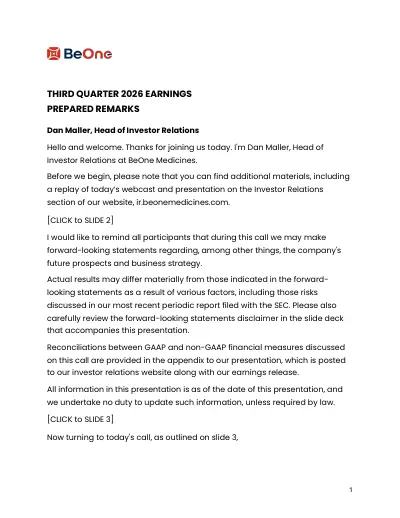
Hello and welcome. Thanks for joining us today.
I'm Dan Maller, Head of Investor Relations at BeiGene. Before we begin, please note that you can find additional materials, including a replay of today's webcast and presentation, on the Investor Relations section of our website, ir.beigene.com.
I would like to remind all participants that during this call, we may make forward-looking statements regarding, among other things, the company's future prospects and business strategy. Actual results may differ materially from those indicated in the forward-looking statements as a result of various factors, including those risks discussed in our most recent periodic reports filed with the SEC.
Please also carefully review the forward-looking statements disclaimer in the slide deck that accompanies this presentation. Reconciliations between GAAP and non-GAAP financial measures discussed on this call are provided in the appendix to our presentation, which is posted to our Investor Relations website along with our earnings release.
All information in this presentation is as of the date of presentation, and we undertake no duty to update such information unless required by law. Now turning to today's call, as outlined on slide 3, John Oyler, our Co-Founder, Chairman, and CEO, will provide a business update; Aaron Rosenberg, our CFO, will provide an update on our third-quarter financial results and 2026 financial guidance; and Lai Wang, President and Global Head of R&D, will discuss our R&D and pipeline progress.
We will then open the call to questions. Joining the team for the Q&A portion of the call will be Xiaobin Wu, President and Chief Operating Officer; Matt Shaulis, our General Manager of North America; Mark Lanasa, Chief Medical Officer for Solid Tumors; and Amit Agarwal, Chief Medical Officer for Hematology.
I'll now pass the call over to John. John?
John Oyler
Thank you, Dan, and welcome. I'm pleased to present our Q3 results today across every dimension of the business.
BeiGene is executing at the very highest level in our history. The results speak for themselves.
Financially, we continue to deliver rapid growth and strong earnings. Aaron will take you through that shortly.
In hematology, BRUKINSA's powerful and sustained BTK inhibition continues to translate into clinical and real-world differentiation. Building on BRUKINSA, BGB-16673 and sonrotoclax are expanding our leadership and extending it well into the future.
In solid tumors, we're living up to our promise that 2026 would be an inflection year. Last week, we shared data for three of our most promising programs at ESMO.
We have now shared differentiated data for five pivotal late-stage solid tumor programs. We've reached a level of productivity that I think is very rare in our industry, and the model we have worked so hard to build is already delivering very tangible results, and we've only just begun to scratch the surface of what's possible.
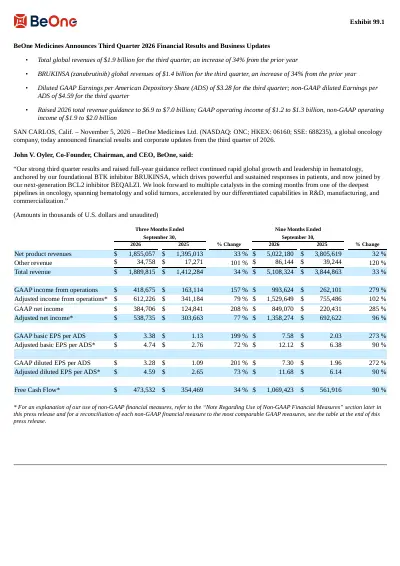
Here, we see BRUKINSA's performance for the quarter. Sales totaled $1.4 billion, growing 34% year-over-year, with U.S.
sales exceeding $1 billion for the quarter for the first time. The underlying fundamentals continue to be very strong.
BRUKINSA is not just a leader in CLL; it's a powerful treatment option across four other B-cell malignancies. We are far from done.
BRUKINSA, both as a single agent and in combination, continues to generate the most Phase 3 data across the BTKI class. We often talk about BRUKINSA's clinical differentiation.
It was designed for complete and sustained BTK inhibition, and it remains the only CLL therapy to show PFS superiority over ibrutinib in a head-to-head trial. The results we see in the clinical trial data for BRUKINSA are increasingly reinforced in the real world, and the picture is remarkably consistent.
This slide brings together six independent datasets in CLL representing tens of thousands of patients across three endpoints: overall survival, time to discontinuation, and time to next treatment. Across all of it, the answer is the same: all 21 hazard ratios favor BRUKINSA.
At overall survival versus acalabrutinib, the four large U.S. claims datasets, including Medicare, range from 16% to 25% lower risk of death.
Versus ibrutinib, the reduction was 27% to 36%. Taken together across U.S.
and European patients, claims and health records, survival and treatment durability, and versus both acalabrutinib and ibrutinib, the real-world evidence consistently favors BRUKINSA. BRUKINSA's established a strong foundation in hematology, but it's only the beginning of what we believe our heme franchise can achieve.
With BRUKINSA, BGB-16673, and sonrotoclax, we're the only company with potentially best-in-class medicines across the three key mechanisms of action in B-cell malignancies. Whether a patient wants continuous or fixed-duration therapy or requires an option after progression, we will be able to meet the need with the right medicine, alone or in combination.
No other company is positioned to do that. This isn't hypothetical.
In the pivotal trials for the regimens on this slide, they're already reading out, and the data will be coming fast and furious over the next three years. Behind these three promising medicines, the next wave of heme assets from our prolific discovery engine is entering the clinic, and this includes small molecules, multispecific antibodies, and novel cell therapies.
Now turning to solid tumors. Over the past several months, we've shared differentiated data for five programs: our GPC3x4-1BB bispecific antibody; our brain-penetrant PRMT5 inhibitor; our CEA ADC; our CDK4 inhibitor; and our B7-H4 ADC.
Most companies have just one exciting asset; some have two. From just the first wave of our solid tumor pipeline, we have five, all advancing towards registration-enabling development in roughly the same time.
These programs target some of the most common and deadly cancers in the world, including lung, breast, liver, gastric, and ovarian cancer. Together, they affect millions of patients every year and account for millions of cancer deaths worldwide.
When we started this company 16 years ago, the goal was simple: to fight cancer and to fight for life, and also to dramatically change how things were done in our industry by building a company that could sustain that purpose. Today, that's no longer a vision; it's a reality.
How are we doing this? This slide reiterates something fundamentally different about BeiGene.
For years, we've talked about our goal to build a lasting oncology company, one that generates higher returns for each dollar of R&D investment by leveraging our global development superhighway. Today, we're seeing the results.
Over the last three years, we've brought more new oncology medicines into the clinic than any other company in our industry. We are moving them through the clinic with exceptional speed behind the power of our global development superhighway.
Our CDK4 inhibitor and B7-H4 ADC programs show what this looks like in practice. Both moved from first-in-human to pivotal development in just two and a half years, allowing us to rapidly close the gap with the competition.
Now we're seeing that pipeline advance into registrational trials, which puts BeiGene in an exceptionally select group of oncology innovators. If you look back at any 18-month period in oncology since 2010, very few companies have ever seen this level of late-stage productivity.
Our peers on this list are the largest, most accomplished pharma companies in the world, with R&D budgets many times ours. Yet, there we are, among the top.
Our scientists are generating more high-quality shots on goal, we're advancing them faster, and importantly, we're converting them into late-stage programs. Really, we're just getting started.
At BeiGene, we believe we've created something truly special. I just want to thank the team again for doing this.
After these years of sustained investment and hard work, we've certainly built a model that's unique in the industry and is extremely difficult to replicate. It's built on four competitive advantages: rigorous and prolific internal research, our global development superhighway, global commercial presence, and an entrepreneurial culture driven by a deep sense of urgency because cancer patients just can't wait.
These advantages create a self-reinforcing feedback loop. Together, they enable us to drive industry-leading R&D returns at scale, turn that innovation into profitable growth, and fund a growing level of investment in next-generation medicines.
Each turn of the cycle strengthens the next. That compounding effect is BeiGene's greatest long-term competitive advantage, and the best way to maximize long-term value is to keep investing behind it.
As Aaron will discuss later, we think it's important to retain the financial flexibility to fully fund the opportunities we see in the business. We believe this is the right approach to bring more transformative medicines to patients and to achieve our goal of building the world's leading oncology company.
With that, I'll turn it over to Aaron to discuss our financial performance. Aaron?
Aaron Rosenberg
Thanks, John. Our third-quarter results demonstrate continued strong execution across the business, with broad-based revenue growth, expanding operating income, and strong cash generation.
Starting with our commercial performance, we delivered another strong quarter across the portfolio, with product revenue growing 33% year-over-year to approximately $1.9 billion. BRUKINSA global revenues reached approximately $1.4 billion, representing 34% sustained global leadership and growth in all regions.
U.S. BRUKINSA sales exceeded $1 billion in the quarter, representing growth of 36%.
Growth was driven by continued strong demand, with trends consistent with those that I discussed last quarter. These include sustained high level of new patient starts, meaningful growth from all approved indications, improved patient adherence, and duration of treatment compared to relative historical benchmarks.
U.S. BRUKINSA sales did have an approximate $50 million tailwind due to order timing, inclusive of an extra shipping day in the quarter.
TEVIMBRA generated approximately $243 million, growing 28% year-over-year. We maintained our leadership position in China and saw launches in other markets increasingly contributing to growth.
Since the August U.S. approval and launch of the Horizon regimen, we have seen encouraging early prescriber reception, reflecting the strength of the triplet's differentiated profile in first-line HER2-positive GEA.
Our Amgen in-licensed portfolio generated approximately $167 million, growing 26% year-over-year. Overall, we are pleased with the breadth of performance across the portfolio and the continued strength of the underlying commercial business.
Let's turn to the geographic composition of our business. Growth remains broad-based across every region.
The U.S. generated approximately $1 billion in product revenue and remains our largest market.
BGB-16673 launched in the U.S. in the relapsed/refractory MCL, and we are excited for this innovative medicine to be available for patients in this setting.
Given the size of the approved indication and the timing of launch, we do not expect BGB-16673 to be a meaningful revenue driver this year. China contributed approximately $527 million, growing 21% in its seasonally high third quarter.
Growth was seen across our commercial portfolio, with continued market leadership for both TEVIMBRA and BRUKINSA, and launch contributions from BGB-16673 and ZANIDATAMAB. Note that foreign exchange contributed 7% of reported growth given year-over-year RMB strengthening.
While our Amgen portfolio delivered 26% growth in Q3, we are beginning to see some impact from biosimilars for XGEVA that was highlighted earlier in the year. This competition, along with potential VBP inclusion risks for XGEVA and KYPROLIS, will likely lead to revenue pressure for these brands beyond 2026.
Europe generated approximately $234 million, growing 41%, driven by demand growth for BRUKINSA and launch uptake for TEVIMBRA. Our rest of world markets contributed approximately $80 million, representing 58% growth.
Key markets such as Japan and Brazil are making contributions that are increasingly meaningful at the enterprise level. Turning to the GAAP P&L, total revenue was $1.9 billion compared with $1.4 billion in the prior year.
Gross margin was approximately 88%. This includes a non-cash intangible asset impairment charge of $22 million associated with the company's decision to revert promotional rights for Pobevcy.
Operating expenses totaled approximately $1.25 billion, representing 19% growth as we continue to invest behind the advancement of our pipeline and commercial growth. Moving down the P&L, we continue to demonstrate substantial scalability in the model, with income from operations growing 157% to $419 million, even as we continue to increase investment behind the tremendous opportunity of our late-stage pipeline.
Finally, net income totaled $385 million. GAAP diluted earnings per ADS were $3.28 compared with $1.09 in the prior period.
Now turning to our adjusted results, with a full reconciliation provided in the appendix of our results presentation. Adjusted income from operations increased to $612 million, representing growth of more than 79%.
Adjusted net income increased to $539 million, while adjusted diluted earnings per ADS increased to $4.59 compared with $2.65 a year ago. Cash generation continues to build momentum, with free cash flow of 34% from the prior year to $474 million.
Turning to our updated full-year outlook. Given our strong performance through the third quarter and our expectations for the remainder of the year, we are raising and narrowing our 2026 guidance.
We now expect total revenue of $6.9 billion to $7 billion compared with our prior range of $6.6 billion to $6.8 billion. We continue to see a modest net pricing benefit in the U.S.
for BRUKINSA for the balance of the year. Looking ahead to 2027, we expect relatively stable net pricing.
Note that the increase in our Medicare Part D manufacturer liability will likely pivot the modest tailwind we've seen in 2026 to a flat to modest headwind next year. This is a statutory increase associated with our specified small manufacturer designation for BRUKINSA.
Our gross margin outlook remains unchanged in the high 80% range. We now expect operating expenses of $4.9 billion to $5 billion, a narrowing of the prior range of $4.8 billion to $5 billion.
We expect GAAP operating income of $1.2 billion to $1.3 billion, an increase of $200 million across the range. Finally, we expect non-GAAP operating income of $1.9 billion to $2 billion, also an increase of $200 million across the range.
Moving to income taxes, I'd like to provide an update on the income tax valuation allowance that I spoke about earlier this year. As background, we have historically been in a valuation allowance whereby the accumulated deferred tax assets we have have a reserve against them.
Given our recent history of earnings, we believe there will be sufficient positive evidence to recognize a portion of these assets. We continue to evaluate and assess the magnitude, but the current expectation is that the reversal will occur in the fourth quarter and that it will result in a material tax benefit to the income tax provision and, correspondingly, to our full-year GAAP net income.
In reporting periods after the reversal occurs, we will reflect deferred tax assets in our financial statements, and our effective tax rate will become a more meaningful and predictable metric, although it might take several years to normalize. We plan on providing additional commentary for this in our fourth-quarter call.
As we look beyond 2026, I'd like to make one broader point on the trajectory of operating margins. The business is performing really well, and our underlying earnings power has continued to increase, as you see in our guidance updates over the course of the year.
This profitability has translated into free cash flow and an increasingly strong balance sheet, which provides us with increased financial and strategic flexibility. Moving forward, we now have multiple differentiated assets advancing into pivotal development across some of oncology's largest indications.
Given the quality of these opportunities and those that will come from the next wave of our model, as well as potential business development, we intend to continue investing with discipline to maximize our impact for patients and value for shareholders. As I said last quarter, we anticipate 2027 operating expense growth to be at least consistent with where we have been over the past several years, given the size of our pipeline opportunity.
As a result, while we expect operating income to continue to grow meaningfully, the pace of margin expansion is likely to be modest as compared to 2025 and 2026 as we balance near-term margin percentage gains with investment in future growth. With that, I'll turn the presentation over to Lai.
Lai Wang
Thank you, Aaron. We continue to make strong progress across our pipeline this quarter in both hematology and solid tumors.
Today, I will highlight several important clinical and development updates, including the new solid tumor data we recently presented at ESMO. Let me start with a few highlights across the portfolio.
For BRUKINSA, in treatment-naive mantle cell lymphoma, we have completed submissions in the U.S., Europe, and China, and the FDA has granted a priority review. The MANGROVE results will also be featured in a plenary presentation at ASH.
For BGB-16673, CELESTIAL-304 remains on track to complete enrollment before year-end. For sonrotoclax, the Phase 2 portion of Cadence-101 met its primary endpoints, and following discussion with the FDA, we are planning for a potential submission in mid-2027.
I will come back to sonrotoclax in more details shortly. In solid tumors, we continue to accelerate our late-stage programs.
For our CDK4 inhibitor, we are increasing the sample size of the Phase 3 CANDELA-302 study. Importantly, we're doing this to bring the study readout earlier.
We have achieved first subject enrolled for our B7-H4 ADC STARSTONE-301 Phase 3 study. This marks the second start of a Phase 3 study in our solid tumor franchise this year.
We are also advancing our GPC3x4-1BB bispecific into pivotal development, while development of our PRMT5 inhibitor and the CEA ADC continues to advance following the data presented at ESMO. Stepping back, this progress reflects our deliberate R&D strategy.
We are building depth in disease areas where we believe we can establish leadership rather than developing individual assets in isolation. We do this across small molecules, degraders, ADCs, and multispecifics, matching modality to biology and, increasingly, building combinations from within our portfolio.
Our goal is not simply to generate more molecules; it is to create the next treatment paradigm that can meaningfully improve outcomes for patients. Now let me come back to sonrotoclax.
The Phase 2 study in relapsed/refractory CLL achieved its primary ORR endpoints, with encouraging duration of response, PFS, and safety. We're targeting a potential FDA submission in mid-2027.
Our growing confidence in Cadence-304 is also allowing us to optimize the broader development program. We're increasing enrollment numbers in 304 study from 500 to 600 patients to accelerate the readout, while remaining on track to complete enrollment in early 2027.
Given our increased confidence in 304 outcome, we're converting Cadence-302 to a Phase 2 study. Importantly, we continue to expand the program.
Our Phase 3 study of sonrotoclax plus zanubrutinib in relapsed/refractory CLL is on track to begin enrollment in the first half of 2027. The right-hand panel highlights what we believe differentiates sonrotoclax: excellent selectivity in kinome and protein degradation assays.
Primarily a BTK degrader, sonrotoclax also provides a distinct secondary BTK inhibitory function that may increase the barrier to resistance and potentially extend response duration. We will share additional data at ASH.
Turning to solid tumors, I will start with our GPC3x4-1BB bispecific. HCC remains an area of significant unmet medical need.
In the U.S., liver cancer ranks sixth in cancer mortality. Its incidence is similar to that of multiple myeloma and triple-negative breast cancer, and higher than that of small cell lung cancer and the EGFR-mutant non-small cell lung cancer.
Despite this burden, there have been only two global Phase 3 HCC studies since 2021, far fewer than any of the other tumor types shown on this slide. At ESMO, B2033 monotherapy demonstrated a 36% confirmed response rate in heavily pretreated second-line-plus HCC, with strong durability and a favorable safety profile without CRS.
This compares favorably with historical TKI response rates of approximately 5% to 10% in this setting. We are moving quickly into registrational development.
The potential pivotal third-line-plus cohort for China and Korea is fully enrolled. Before year-end, we expect to initiate both a second-line-plus single-arm study supporting a potential U.S.
accelerated approval pathway and a second-line-plus Phase 3 confirmatory trial. We're also very encouraged by the progress of our first-line combination with TEVIMBRA and Avastin, supporting our plan to initiate a global Phase 3 study in first-line HCC in the first half of 2027.
Let me first highlight the differentiated safety profile. The treatment-related adverse events shown here are predominantly low grade, with very few grade 3 or higher events among the most frequently reported adverse events.
Importantly, we have not observed CRS. Now turning to efficacy, in addition to the high response rate, I really want to emphasize the durability of the responses.
Among the 27 confirmed responders, the 6-month duration of response rate was approximately 79%. The long-lasting responses we're seeing are reminiscent of the durability that has been a hallmark of immunotherapies.
Our second major ESMO dataset was BGB-5A067, our brain-penetrant PRMT5 inhibitor. We have observed objective responses across multiple MTAP-deficient tumor types.
In previously treated MTAP-deficient EGFR wild-type non-small cell lung cancer, the confirmed response rate was 38.5%, with median PFS of 8.1 months. We also observed intracranial responses in patients with brain metastasis.
The potential opportunity extends beyond non-small cell lung cancer. MTAP deletion occurs across a number of tumor types, and our development strategy includes pancreatic cancer, GBM, and potentially other tumors.
In non-small cell lung cancer, we are already evaluating combination with PD-1 and chemotherapy in first-line setting. In pancreatic cancer, we plan to begin evaluating combinations with the RAS inhibitors from our Revolution Medicines collaboration before year-end.
Here again, our strategy is to take an encouraging early signal and rapidly build a broader development program around the differentiated properties of the molecule. Looking more closely at the efficacy, I first want to highlight the durability we're seeing.
Responses have been durable, and we're also seeing patients with prolonged stable disease. This is encouraging because the benefit appears to extend beyond patients who achieve an objective response.
Then another important feature of 5A067 is brain penetrance. Among non-small cell lung cancer patients with active brain metastasis, the confirmed intracranial response rate was 30.8%.
What I found particularly interesting is the low intracranial progression rate of 16%. This is substantially lower than what has been reported for Dato-DXd and docetaxel, and is more in the range of what we see with CNS-penetrant target therapies such as osimertinib.
Let me turn next to BGC477, our CEA ADC. At ESMO, we presented initial proof-of-concept data in heavily pretreated CEA non-small cell lung cancer.
The confirmed response rate was 60%, with a 6-month DOR rate of 73% in Phase 1a dataset. We also observed a favorable safety profile, including no grade 3 or higher ILD or ocular events in the dataset presented.
Approximately one-third non-small cell lung cancer tumors are estimated to have high CEA expression. Based on these early results, we're developing C477 across the non-small cell lung cancer treatment spectrum.
A global Phase 3 study in second-line non-small cell lung cancer is in planning. A first-line combination cohort with PD-1 is ongoing.
We're also evaluating opportunity in earlier-stage disease. Looking more closely at the efficacy, we're seeing broad activity across both squamous and non-squamous non-small cell lung cancer and across EGFR status.
Within the non-squamous disease, the response rate was numerically higher in EGFR wild-type than in EGFR-mutant patients. We're also encouraged by the durability.
The 6-month PFS rate was 76.2%, and median PFS has not been reached at the data cutoff. Now let's turn to ASH.
We have 45 accepted abstracts and five oral presentations across BRUKINSA, BGB-16673, and sonrotoclax, including MANGROVE in treatment-naive mantle cell lymphoma at the ASH plenary. We believe MANGROVE supports the potential for BRUKINSA to establish a new chemo-free standard of care in treatment-naive mantle cell lymphoma.
In CLL, our seven-year overall survival data show life expectancy matching the general population, moving us closer to our cure zone ambition. As John discussed, real-world evidence continues to report a survival advantage for BRUKINSA.
For BGB-16673, the frontline combination with BRUKINSA showed 100% three-year PFS rate, while the ramp-up data highlight convenience advantages over venetoclax. For sonrotoclax, longer clinical follow-up and differentiated mechanistic data continue to support its potential as the first and best-in-class BTK degrader, including a distinct design that may address resistance mutations and high selectivity among BTK degraders in the clinically relevant whole blood assays.
We'll have much more to discuss at our ASH investor event on December 14th. Let me close with this overview of our upcoming milestones.
As you can see, we have already addressed the vast majority of this today, reflecting the significant momentum across both hematology and the solid tumor portfolios. We will provide additional updates on our 2027 milestones at J.P.
Morgan. With that, I will turn it back to John.
John Oyler
Thanks, Lai. We will now open the call to Q&A.
Please limit the number of questions that you have so we can ensure that we have time to hear from as many attendees as possible. Operator, please go ahead.
Operator
If you would like to ask a question, please use the raise hand icon, which can be found at the bottom of the webinar application. When you're called upon, please unmute your line and ask your question.
We will now take a minute for the queue to assemble. We have our first question from Jessica Fye from J.P.
Morgan. If you would like to unmute yourself, please, Jessica.
Jessica Fye
Hey, good morning, guys. Thanks for taking my question.
A couple on the pipeline. Can you just expand a little bit on what's behind the timing shift on the filing for sonrotoclax for relapsed/refractory CLL?
Then for the GPC3x4-1BB bispecific, I guess for Mark or Lai, I think BioNTech had some interesting liver cancer data for their PD-1/VEGF bispecific combined with the B7-H3 ADC in liver cancer. Can you talk about where you think your GPC3x4-1BB bispecific might have advantages over that regimen?
Thank you.
John Oyler
Thanks, Jessica. Hope you're well.
I guess we can start with Amit and then move to Mark.
Amit Agarwal
Thank you, John. Let me provide a little bit of color on the sonrotoclax update.
First off, we're pleased to report the positive readout of the Phase 2 trial. As Lai mentioned in his prepared remarks, the study met its primary endpoint of ORR.
In terms of other endpoints like duration of response, progression-free survival, and safety, the data is very strong and reinforces our confidence in the program. We did recently have discussions with the FDA on our potential accelerated approval submission.
Based on those discussions, the FDA requested some additional follow-up. As a result of this, we are now planning to file for accelerated approval in mid-2027.
What I'll say is this is not an unusual request from the FDA, especially for a first approval of a new molecular entity. Again, overall we remain confident in the program.
As Lai also provided an update, what we're doing for this Cadence-304 trial, which is our head-to-head trial versus pirtobrutinib, we are increasing the size of that trial, and we think this will accelerate the timing of that interim readout and allow us to keep the enrollment timelines matched. Really looking forward to all of these updates in 2027.
With that, I'll turn it over to Mark.
Mark Lanasa
Thank you, Amit, and thanks, Jess, for the question. We are very excited about the potential of our GPC3 by 4-1BB targeting bispecific and have increasing confidence that this will be a transformative molecule for patients with hepatocellular carcinoma.
As you heard from Lai, at ESMO, we recently reported a monotherapy response rate in later-line, extensively pretreated patients of 36%. These responses were durable, with a 6-month duration of response rate of 79%.
Now, critically, we're delivering that efficacy with a highly favorable safety profile. Now, hepatocellular carcinoma is somewhat unique among solid tumors in that cytotoxic chemotherapy is really not a part of the standard of care, and that's because these patients have compromised liver function and associated comorbidities.
Therefore, while ADCs do have a meaningful response rate in this patient population, tolerability is a major challenge, and therefore durability becomes difficult. With our favorable safety profile and very favorable efficacy profile, we have already been combining, as you heard from Lai, with TEVIMBRA plus bevacizumab in a frontline patient population.
We've enrolled over 70 patients. We think that we have clear line of sight not only in a later-line patient segment where we've shared compelling data, but also in earlier lines of therapy where our favorable safety profile will enable higher-order combinations to maximize patient benefit.
John Oyler
Thank you, Mark. Next question, please.
Operator
We have our next question from Yigal Nochomovitz, and they are from Citi Group. You can ask your question, please.
Yigal Nochomovitz
Hi, hope you can hear me. Thanks for taking the questions and for the strong quarter.
I just had three quick ones. John, you mentioned, of course, the fast and furious data coming for the next three years for the CLL franchise.
I'm wondering if at this point you are able to provide a little bit more granular timing with respect to the first PFS readouts for the fixed-duration studies, the two that you're running, versus AV and versus VO. Second, maybe for Lai or Mark, with regard to the PRMT5 and the RevMed combination, do you expect or not expect to see a DDI with RMC as of course we've seen with some competing PRMT5s?
Third, on the CEA, anything to read into with respect to the differential efficacy on the mutants versus the wild types? Thank you.
John Oyler
I think maybe we can start with Lai, and Lai, if you want to pass off to your team, please go ahead.
Lai Wang
Happy to. I will just comment on the DDI question related to PRMT5 with the RevMed assets.
We have done preclinical modeling, and the so far data suggests there's no significant concern around the potential DDI. Certainly, this need to be validated in the clinical setting.
Maybe I pass this on to Mark to comment on the CEA ADC.
Mark Lanasa
Thank you, Lai. Thank you, Yigal.
This is something that we noted in the early emerging data. However, I would caution that the number of patients included, particularly in the EGFR-mutant analysis, is relatively small.
We are very excited about what we're seeing in terms of the response rate across all patients with non-small cell lung cancer. Importantly, durability is strong across these patients as well.
We are currently in our dose optimization and expansion phase, and we'll be able to share larger datasets in the near future.
Lai Wang
Amit, any comment?
Amit Agarwal
Yeah. Thank you for the question, Yigal.
On the two Phase 3 studies, the CELESTIAL-301 study, where we're comparing CS to BR, and the CELESTIAL-304 study, where we're comparing CS to AV, again, as both of those are event-based endpoints. We haven't shared yet the approximate timelines, but we're hoping to do that in 2027.
Overall, that I would say, things are going really well with the CS program. We will have updates at ASH from the 101 study, we'll share some updates in 2027.
John Oyler
Thank you so
Yigal Nochomovitz
much.
John Oyler
Next question, please.
Operator
Our next question comes from Sean Laaman from Morgan Stanley.
Sean Laaman
Good morning, John and team. Congratulations on the results, and hope everyone's well.
I have two questions. The first one relates to the RevMed collaboration.
You're funding and conducting the Phase 3 RESONATE-312 CRC study. What does that responsibility indicate about your long-term ambitions in precision oncology is the first question.
The second one, maybe one for Aaron, is just the commentary on margin. I think you said expect a more moderate pace in margin expansion versus this year and last year.
Are you expecting margin to keep increasing from here given the significant R&D investment BeiGene has going on? Thank you.
John Oyler
Sure. I think we'll start with Lai and then move over to Aaron.
Thank you.
Lai Wang
Thank you so much for the question. This is the major reason I think the RevMed want to do this collaboration with BeiGene because they believe in our development superhighway.
We're conducting the 312 study, which is the frontline study in the CRC, which is testing the daraxon in combination with the standard of care. We're very excited about this opportunity, and hopefully this will help RevMed to really fulfill their ambition about be the leader in the RAS space.
Certainly, this will also give us opportunity to potentially combining our pipeline assets with their molecules even further. As I think we mentioned in the press release, in addition to combining the PRMT5 with the RevMed assets, we're also combining our EGFR MET MET tri-specific with RevMed asset.
As you can imagine, a combination with zolodong in the CRC will be one of the lead indication for us to explore.
Aaron Rosenberg
Thanks for the question, Sean. First, let me just start by saying we are in an incredibly strong position financially, and we're really proud of what we've accomplished in our profile.
The business is performing really well, and the setup continues to support growth, albeit at a larger base of business as we look forward. Since 2024, we've shifted, as to a profit-making business, with operating margins that are set to expand by more than 10% in '26 alone based on the midpoint of our current guidance.
That's something we're really proud of, and candidly, as you see in our guidance updates this year, it's at a pace ahead of where we thought we'd be at this time. Moving forward, our key message is that we're building a company to last, as supported by increasing financial flexibility.
We have tremendous opportunity with our pipeline and our repeatable innovation model, and we're going to invest to realize that full potential. As a result, we anticipate operating expenses to grow at a similar rate, as I said last quarter, to what we've seen over the last couple of years, and taken together, we do expect that we will be able to fund our future ambitions while driving meaningful growth in profits, although the pace of growth in profit margin percentage will be modest as compared to what you've seen in recent years.
Thanks for the question. Really appreciate it.
Sean Laaman
Thank you. All right.
Operator
Our next question comes from Andrew Berens from Leerink. If you would like to ask your question, please.
Andrew Berens
Hi. Thanks and congrats on all the progress, guys.
Definitely pipeline is expanding very rapidly. I guess two for me.
One, as we go into ASH, how you are seeing the CDAC BTK agents fitting into the evolving treatment paradigms, especially with pirtobrutinib seemingly moving more forward. Then another one on the PRMT5 program that we saw at ESMO.
How do you think your collaboration with RevMed positions this program relative to companies that have a head start in combos, like Tango and Prelude and then Bristol and Lundbeck?
John Oyler
Thanks for the question. Why don't we start with Amit and then move to Mark?
Amit Agarwal
Thank you for that question. In terms of the sonrotoclax program, I think, again, we're very excited about the program as a whole and what we're presenting at ASH.
Lai alluded to this a little bit. I think one of the interesting sort of preclinical presentations that we will have at ASH is really sort of this idea of having a secondary inhibitory function.
Really how we think this is going to translate into the clinic is particularly on the durability side of things. Beyond this, I think we're very well positioned to execute on that broad development plan for sonrotoclax.
You heard a little bit of an update on our head-to-head study versus pirtobrutinib, which is designed to show that sonrotoclax is clearly superior to pirtobrutinib, and so as pirtobrutinib moves in earlier lines, I think having this particular dataset is going to be particularly important. Beyond this, we're also initiating a study of sonrotoclax plus zanubrutinib in the relapsed CLL space, which we believe will be our best fixed-duration treatment for that patient group, regardless of what type of treatments that they've received in the frontline treatment paradigm.
Beyond this, we also see major challenges with the triplet regimen that pirtobrutinib just released on with the pirtobrutinib ven rituximab dataset, because the CD20 antibody really might be adding more toxicity there than providing clinical benefit. Overall, we're very confident in the program and really looking forward to some of these new studies with sonrotoclax.
John Oyler
Thank you. Now maybe we take over to Mark.
Mark Lanasa
Thank you, Amit, and thank you, Andy, for the question. We're very excited about the opportunity to combine our CNS-penetrant PRMT5 inhibitor with the RevMed RAS-ON molecules.
In addition to the clinical data that has been disclosed for that combination, we also have strongly supportive preclinical evidence that we've generated in-house for that combination. I would highlight that in the recent disclosure that we had at ESMO, there were really a large number of patients treated across a broad number of solid tumors, we have a substantial global footprint in our Phase 1 study.
The amendment for the RevMed molecules has already gone through. It's posted on clinicaltrials.gov.
We anticipate that enrollment will begin imminently. There's very high investigator enthusiasm, and therefore we believe that our development superhighway again can close any time gap.
As you heard from Lai, we're also not expecting a drug-drug interaction, and therefore we think that we have all the ingredients in place with a best-in-class PRMT5 inhibitor plus the development superhighway that we can meaningfully close the gap and ultimately be leaders in this space.
Andrew Berens
Thank you.
John Oyler
All right. What's the next question, please?
Operator
Our next question comes from Gregory Renza from Truist Securities. Gregory, just checking if you can hear us.
If not, we will move on to the next question.
Gregory Renza
Yes, I can. Thank you.
Good morning, John and team. Let me add my congratulations on the progress and the results.
Maybe just a question to follow up on the sonrotoclax updates. Good to see your increased confidence, and maybe just to talk a little bit about just confirming your confidence about accelerated approval filing once you've implemented the changes that you're highlighting today.
Maybe just talk a little bit about how you see that peak opportunity perhaps evolving due to the updates and that confidence perhaps help to alter or maybe inform the longer-term positioning. Just lastly, if I may, just seeing the mention of the CSU trial and just broadening in the I&I, maybe talk a little bit about that potential expansion and how intact that is.
Thanks so much.
John Oyler
Great. Thanks for the question.
It's always hard to answer regulatory questions, but Amit, please share what you can.
Amit Agarwal
Thank you, John, and thank you for that question, Greg. What I would say is, again, I think right now we're very happy with the results we've seen from the Phase 2 trial, and particularly when it comes to accelerated approvals, we certainly want to make sure that we respect that regulatory process.
Without getting too ahead of ourselves, we remain confident in what the dataset shows and the unmet need in that particular population, and look forward to continuing the engagement with the FDA. Now, ultimately, I think the accelerated approval opportunity is still a smaller opportunity in the broader context of the program, and particularly the trials that we're outlining now, whether it's the head-to-head versus pirtobrutinib or even the combination trials and future development that we have planned for sonrotoclax as a whole, we think that those are more meaningful opportunities, and certainly as that head-to-head study reads out, it will open up the possibilities for a broader group of CLL patients to benefit from sonrotoclax.
We certainly think that the opportunity is much more beyond the accelerated approval opportunity. Perhaps I'll ask Lai to comment on the CSU part of things.
Lai Wang
We have took a little bit time to really contemplating our I&I strategy for our BTK CDAC. We do believe with this extremely long half-life, we have a potential advantage for this molecule.
We're on pass to initiate the CSU trial early 2027.
John Oyler
All right. Thanks.
Next question, please.
Operator
Our next question comes from Kalpit Patel from Wolfe Research.
Hi, this is Nikiya on for Kalpit. Thank you for taking our question, and congrats on the results.
We wanted to ask on the 1L breast cancer study. We noticed that the trial increased in size.
Given that this is an event-driven study, can you help us understand how adding more patients gets you to the readout sooner? Are you keeping the required number of events changed, or have this some of the same statistical assumptions?
Thank you.
John Oyler
Thanks. I'll pass that to Mark.
Mark Lanasa
Great. Thank you for the question.
The CANDELA-302 study is progressing very well. We're actually recruiting slightly ahead of our internal projections, and we've had very strong investigator feedback to date on the study design and the early experiences in the trial.
Now, in that context, upsizing the study has a number of statistical benefits that are conveyed by increasing the power of this study, and it is our belief that we will be able to enroll this somewhat larger study, approximately 10% larger study, in the same period of time we were originally projecting for the originally sized study of a little over 1,000 patients, now 1,200 patients. Without changing the assumptions in terms of the overall event rates, that actually pulls in our timeline somewhat because we have increased our statistical power.
Again, if the period of enrollment is fixed, then we will get to that readout earlier.
John Oyler
Thanks, Mark. Next question?
Operator
We have our next question from Yaron Werber, who is from TD Cowen.
Yaron Werber
Great. Thanks so much.
Congrats on all the progress. Maybe just two quick questions.
On sonrotoclax, the push-up sort of to mid-next year, is that had to do with looking at more durability data? Are you thinking about filing for a broad label, essentially including both BTK inhibitors, covalent, non-covalent, and a BCL-2?
Then secondly, for the RAS-ON Q frontline CRC study, I just wanted to catch, in combination with chemo, is that Phase 3 starting by year-end this year or is it early next year? Thank you.
John Oyler
Thanks so much. Hope you're well, and I guess we're going back to Amit and Mark.
Amit Agarwal
Thank you, John, and thank you for that question. In terms of the population for the Phase 2 study, certainly this was a mix of patients who had a covalent BTK inhibitor and a BCL-2 inhibitor, as well as patients who've had a covalent, a non-covalent, and BCL-2 inhibitor.
We've seen encouraging results across those populations. To your question about the sort of shift, it is related to the follow-up that we see, and certainly, this is something that we can expect given that new molecular entity, typically the FDA can ask for more data in terms of both the safety as well as the durability data.
That's where we are with that one. Then I think the other question was for Mark.
John Oyler
For Mark, yeah.
Lai Wang
I can take the other question, which is related to the 312 study for RevMed. We are initiating this study.
We're working very closely with RevMed. At this moment, we won't be able to comment on exactly the time of the first patient to be dosed.
John Oyler
Thanks so much. Next question, please.
Operator
We have our next question from Ziyi Chen, who is from Goldman Sachs.
Ziyi Chen
Good morning. Thank you for taking my questions.
Congrats on another beat and raise. First is going to be on BRUKINSA.
BRUKINSA has been the BTK leader for years now, and we have not seen a slowing down in the market share gain trend. What has been the drivers in the past few quarters behind that acceleration?
Also under this context, how do you see the impact of the new pirtobrutinib updated data for the BRUIN CLL-313 trial in the first line with a much longer median follow-up period? That's my first question.
Second, we are really a big fan of GPC3x4-1BB, excited about the data at ESMO. Given the safety profile that looks very good, we kind of are curious about the plan for 4-1BB-based pipeline expansion.
What will be the next big thing coming from 4-1BB-based bispecifics that we could be seeing and also prove the 4-1BB-based bispecific design is expandable to broad pipeline? Thank you.
John Oyler
Sure. I think that we'll start with Matt, jump to Amit, and then go back to Lai, because Mark may be getting tired today.
Matt Shaulis
Thanks, John. We're very pleased with the momentum in BRUKINSA.
In terms of drivers, we continue to be a new patient start share leader across our indication settings. This is driven by very strong long-term data across CLL patient types and physician experience that's leading to preference.
We've also, as you heard Aaron comment, have been very pleased to see our duration of therapy and a more mature view on that, with claims and real-world evidence that's more mature and allowed us to get a good read on what we believe is a pretty substantial duration of therapy. Then we've also seen growth come from indications beyond CLL in our other B-cell malignancies, particularly with some strength in Waldenstrom's.
Now, with regard to pirtobrutinib, happy to comment on that as well. We of course note that this was studied in a limited patient population, has limited data in elderly patients, no long-term data, and really limited differentiation on safety, like infections, cytopenias, and discontinuation rates.
I think the most important factor is that these resistance mechanisms to pirtobrutinib confer resistance to covalent BTK inhibitors. As a result, physicians don't want to burn a line of therapy, and thus far, we've really seen uptake contained to the later lines of therapy.
I'll hand it over to Amit to make some further commentary on that.
Amit Agarwal
Thank you, Matt. I think in terms of really the frontline setting, we continue to believe BRUKINSA is the gold standard when it comes to the data that's been presented so far.
When you look at especially the long-term outcomes with the 6-year PFS of 74% with the COVID adjustment of 77% and an overall survival of 84%, really I don't think that the data stacks up for pirtobrutinib just yet. Obviously, the approval for pirtobrutinib in the frontline was based on the BRUIN-313 study, where pirtobrutinib was being compared to BR, which really in the U.S.
is an obsolete control arm. The initial results were presented with a very short follow-up.
Now, the biggest problem with the study besides the control arm is really the demographic skew of that study. The study enrolled really young patients, and when you look at the safety data there, it really needs to be evaluated in the light of that patient demographics.
As Matt alluded to this, when you look at the BRUIN-314 data, there's very little differentiation between pirtobrutinib and ibrutinib. On efficacy, there are two events that separate pirtobrutinib and ibrutinib the last time this data was presented.
Basically, you're talking about 48 versus 50 PFS events. On the safety side, pirtobrutinib just did not show a significant difference versus ibrutinib in terms of infections, cytopenias, and discontinuation rates.
Even the a-fib rate, when you age-match it, it really is very comparable to what we've seen on SEQUOIA. In addition to this, as Matt highlighted, when we talk to thought leaders in CLL, the idea of effectively giving pirtobrutinib ahead of a covalent BTK inhibitor and potentially burning a line of treatment, if you would, really is not appealing, and so we're not surprised that there is very limited uptake for pirtobrutinib in the frontline.
With that, I'll hand it to Mark.
Lai Wang
Maybe I can jump in to take this question. Thank you, Ziyi.
This is a really very good question. [laughs] I love to answer it.
I want to mention beside the great safety profile, what we have observed with GPC3x4-1BB, this immune-mediated MOA is really validated by the clinical data. If you look at the spider plot, we actually have a patient who not only the response is durable, we actually have some patient begin to show up the response very late.
There was one patient become a responder at a week 36. 4-1BB isn't the strongest kind of the T-cell activator.
When you combine this potentially in the first line with some other agent which can help to control disease, which we believe this drug could perhaps will perform even better. Over the years, we have built this really strong feedback loop between the preclinical to the clinical.
Once our preclinical hypothesis about GPC3x4-1BB was validated in the clinical setting, we begin to really think about how can we maximize the value of our proprietary 4-1BB platform. We're working on two things.
One is really leveraging this unique binder, as well as the testing system to set up a whole set of the TA 4-1BB pipelines. I can assure you, there are many programs we are working on at this moment.
In addition to that, we're also working on next generation. We believe there are further room to improve on the current 4-1BB T-cell activator.
That is also coming. Starting from next year, you'll begin to see new molecules coming from our 4-1BB platform.
This will be one of the important technology platform we will leverage to build our pipeline.
John Oyler
Thanks, Lai. Can we get another question, please?
Operator
Our next question comes from Michael Schmidt from Guggenheim. If you'd like to unmute yourself and ask your question, please.
Michael Schmidt
Hey, guys, thanks for taking my questions. I just had a housekeeping question on guidance.
It looks like the updated guidance suggests flat to down revenue in the fourth quarter sequentially. Just wondering if that is just seasonality, conservatism, or if there's anything else going on towards the end of the year.
Then just regarding the MANGROVE plenary at ASH, just remind us of the opportunity in that particular setting for the BRUKINSA franchise. Thanks so much.
John Oyler
Sure. Thanks, Michael, for the question.
We'll start with Aaron and then move on to Amit.
Aaron Rosenberg
Great. Thanks for the question.
Obviously, we're very pleased with our performance through the first three quarters of the year. We're doing $5.1 billion of revenue, 33% growth.
I mentioned when you account for the $50 million in timing that I noted, sequential and year-over-year growth are largely consistent where we've tracked through the first three quarters of the year. Similarly, expenses reflect typical seasonality that you see in the industry, as well as the increasing investments from our late-stage R&D programs.
The guide, therefore, reflects a fairly consistent investment growth relative to what you've seen over the past 2 years, and that will continue into 2027, as I've said before. Thank you.
Amit Agarwal
Thank you, Aaron. In terms of MANGROVE, again, I think this is really exciting in terms of just what this means for frontline MCL patients.
As we've indicated before, MANGROVE is the first and only chemo-free regimen for these patients that has shown superiority over a chemo regimen. The data and the fact that this has been accepted as a plenary presentation really speaks to the broader excitement that the oncology and hematology community are seeing with this particular regimen.
Similarly, I think the priority review, we're hoping that this will come to the patients very soon. I'll turn it over to Matt to talk a little bit about the commercial opportunity here.
Matt Shaulis
Thanks, Amit. Just to put it into context, mantle cell's about 4,000 U.S.
patients a year compared to right around 20,000 CLL patients a year. That gives you a sense of the size.
As you heard from Amit, there's a really important unmet need for effective treatment options in frontline mantle cell that are supported by robust clinical evidence, particularly in the setting where MANGROVE was studied. This opportunity with a chemo-free option in previously untreated mantle cell with the strong efficacy and safety data that will be bringing to the market, we think, when approved, will lead to extending the overall BTK class share within the space, and then, of course, we believe that we'll take brand share within that class and really drive some growth here.
Xiaobin Wu
We also submitted the application in Europe and China. This also first-line mantle cell patient in China and Europe so 3,000 and 4,000 each.
That's provide additional opportunity for us.
John Oyler
Terrific. All right, if there's no
Operator
Then.
John Oyler
Are there further questions?
Operator
There are no further questions. I will now turn the call over to John Oyler for closing remarks.
Thank you.
John Oyler
Thanks so much. In closing, we've never been better positioned.
Our commercial business is delivering, our pipeline's deeper than ever, and our model's proving repeatable. The work ahead is significant, but so is the opportunity.
I really want to thank the patients and the families that we serve, our physicians, our partners, and our more than 12,000 colleagues around the world whose focus and urgency make our progress possible. Thank you all so much for joining us today, and have a wonderful week.