Horizon Kinetics Holding Corporation
OOTC:HKHCQ4 FY2025 · Earnings Call TranscriptMarch 17, 2026
Mark Herndon
Good afternoon, everyone. Thank you for joining us for this call.
My name is Mark Herndon, Chief Financial Officer of Horizon Kinetics. We are pleased to have you join us for our call that will cover our results for the fourth quarter and full year of 2025.
First, a reminder that today's presentation may include forward-looking statements. Reliance on forward-looking statements involves certain risks and uncertainties, including, but not limited to, uncertainty about the future security valuations or our performance.
During the course of today's call, words such as expect, anticipate, believe, intend, may be used in our discussion of our goals or events in the future. Management cannot provide any assurance that future results will be as described in our forward-looking statements.
Furthermore, the statements made on this call apply only as of today. The information on this call should not be construed to be a recommendation to purchase or sell any particular security or investment fund.
The opinions referenced on this call today are not intended to be a forecast of future events or a guarantee of future event results. It should not be assumed that any of the security transactions referenced today have been or will be proved to be profitable, or that future investment decisions will be profitable, or will equal or exceed the past performance of the investments.
We encourage you to read our filings with the SEC on our Form 10-K, as well as our other filings, which describe the risks and uncertainties associated with managing our business. The company does not assume any obligation to fund any forward-looking statements made today.
These filings can be found at the OTC Markets website, and our press releases or other information is at our corporate website at www.hkholdingco.com. Today's discussion will be led by Murray Stahl, Horizon Kinetics Chairman and Chief Executive Officer.
I will also be available to answer applicable questions and will moderate the questions. If you would like to ask a question, you will need to be logged into the GoToMeeting platform.
Those of you on the telephone connection will be in listen-only mode. Again, if you are on the GoToMeeting platform, you can submit the questions via the chat function, please direct those questions to the presenters, and I will summarize and relay as best I can so that we can address as many questions as possible.
I'd also like to provide a reminder to you that our Form 10-Q, our Form 10-K continues the required GAAP presentation that includes certain proprietary funds as consolidated entities. Our press release continues to include a non-GAAP presentation supplement that presents our financial statements excluding those funds.
We refer to that presentation as the advisor-only presentation. Consistent with what we have previously reported, this is a presentational matter that does not impact the company's earnings available to HKHC shareholders or the shareholders' equity of HKHC.
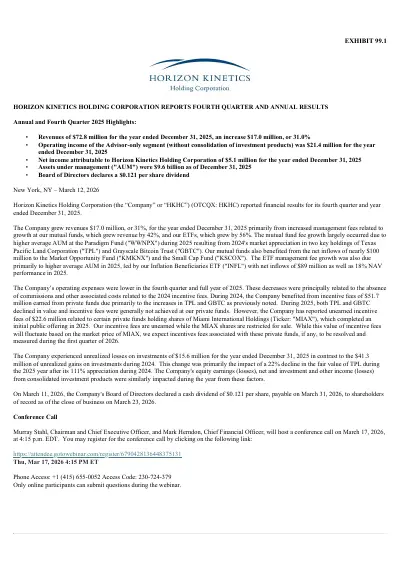
Now, just as a brief backdrop to our discussion, the company continues to perform favorably for our HKHC shareholders. The company recorded revenues of $17 million for the quarter and $72.8 million for the fourth for the full year of 2025.
These results represented a 6. 6% decrease for the quarter and a 30.5% increase for the full year.
These results continued the company's revenue growth it experienced throughout 2025 based on higher overall average AUM during the period. Our mutual fund portfolio led the revenue growth, particularly at the Paradigm Fund, the Market Opportunity Fund, and the Small Cap Fund.
At the advisor-only level, as presented in our supplemental table with the press release, operating income was $5.3 million for the fourth quarter and $21.4 million for the full year. These results are lower than 2024 as we did not have the benefit of the 2024 incentive fee, which was $51.7 million, which impacts the comparability between the two years.
Overall, the company recorded a net loss of 78 cents per share for the quarter and net income of 28 cents per share for the 2025 annual period. The quarter's net loss was the result of a negative swing in our investment results, particularly related to Bitcoin-linked investments.
I should emphasize again that our net income or loss will often be impacted by swings in unrealized gains or losses associated with these investments, including digital assets. For example, our fourth quarter included an aggregate of $29 million of unrealized losses related to investment securities and equity holdings in our proprietary funds.
Those unrealized losses compare to the fourth quarter of 2024, which had unrealized gains aggregating $50.9 million. This is just an illustration of what we have previously noted for you, and that we may continue to see volatility from quarter to quarter.
From a balance sheet perspective, the company continues to have substantial cash and investments, including amounts outside of the consolidated investment products. We have no third-party debt.
Our long-term liabilities are limited to the various long-term office space leases. Lastly, I'll comment on dividends.
The company paid a total of 39.5 cents per share in dividends during 2025, and the company's board recently declared a 12.1 cents per share dividend to be paid in the first quarter 2026. That dividend will be paid on March 31st for shareholders of record as of March 23rd.
With that as backdrop, I will turn it over to Murray for some opening comments.
Murray Stahl
Okay. Thank you, Mark, and thanks, everybody, for joining us.
With that backdrop, you'll see with the consolidation, it makes it difficult to understand what's going on. I'll try to break it down very simply into a couple of components to make it easier to understand.
Let's start in the year 2025. We have $21.4 million of operating income.
That operating income represents the business in a normalized basis excluding performance fees. That $21.4 million has a value, and you can put any multiple you like on it.
There's also another piece of cash flow: interest and dividends. That was $2.3 million because we have substantial liquidity in this company.
So, $21.4 million of operating income, $2.3 million of interest and dividend income, apply whatever you think the tax rate is, that's the base business. There's a second component.
Second component is the assets that we have, almost all of which are liquid. They could be turned into cash very quickly.
We have $36 million in cash in the balance sheet. At year-end, we had $76 million of what we call fair value investments, meaning mark-to-market.
There were $220 million of what's called in the balance sheet other investments. They're basically investments in our various funds, most of which are pecuniary interest funds.
It's a fancy way for saying they charge performance fees. We had at least $12.5 million worth of digital assets.
Those are cryptocurrencies, primarily Bitcoin. That has a value.
It's fairly straightforward. You can add those numbers up.
Now, what's happening in the businesses? There is, in addition to normal business, there are some new businesses, one of which is the ETF business.
You might have observed in the last several years, we've been launching ETFs, largest of which is the Inflation ETF. We launched a couple years ago a Blockchain Development ETF that has on to a lot of exchanges.
We have a Texas ETF that we launched at the end of 2000 of January of this year, 2026. There's a Japan ETF, there's an Energy Development ETF, there's ETF that invested in SPACs, SPACs are SPAQ, special purpose acquisition companies.
All together, the ETF business has, and I didn't list all the ETFs, we have over $1.5 billion worth of AUM. We're very, very interested in growing that business.
Then, something that's relatively new, we've established private funds, and there are two dimensions to the private funds. I'm going to read some names.
We have funds that are single purpose funds that invest in a certain security, they're private. Then these securities, the private ones, will also find their way into various Horizon proprietary funds.
To mention some names, we have a fund that invests in a company called Sandbox AQ. It's involved in computationally intensive mathematical models.
We have a fund that invested in Bolt Technology. Bolt Technology company is the company that joint-ventured with Texas Pacific to build data centers in the Permian Basin.
There is the Canadian Security Exchange, which is the second securities exchange in Canada, has all the rights and privileges of Toronto Stock Exchange, and it's growing fairly nicely. There's something called Tetra Trust.
Tetra Trust is a custodian of cryptocurrencies that has launched a stablecoin in Canadian dollars. It'll be the first Canadian dollar stablecoin.
At the moment, stablecoin market, which is growing very rapidly in the world, is dollar-denominated. To the best of my knowledge, there is no Canadian dollar stablecoin.
If there is one, its size is fairly de minimis. Tetra is partnering with some very large institutions, I'm very hopeful that's going to be a success.
We have a fund that invests in private royalties, although it has some public securities as well, it's a mix. I count that in among the private funds.
Then there's MIAX. MIAX is the outgrowth of some private investments we made years ago.
We invested in MIAX directly, and we also invested in the Minneapolis Grain Exchange, of which we are the largest holder for a number of years, and we invested in Bermuda Stock Exchange, private exchange, in which we were the largest holder for a number of years. Those two exchanges merged with MIAX, and we ended up with MIAX shares.
MIAX, in August of 2025, became a publicly traded company. We are entitled to a performance fee that we did not recognize in the fourth quarter of 2025, but we're highly likely to recognize in the first quarter of 2026.
There is some verbiage in the 10-K about it. It's not easy to see, which is another way of saying it's very easy to miss.
In round numbers, the best estimate I can give you is $22 million of performance fees. You can see this performance fee is the size, more or less, of the operating income for the entirety of 2025.
Now you can see why the private investments are so important, and you can also see it in the 2024 performance fees, except 2024 performance fees were made by publicly traded securities. We can still make those fees in 2026, but 2000 the difference between the private funds and the public funds are, the public funds fluctuate, and we can attain a high-water mark, but we might not stay at that high-water mark every year, and therefore, we might episodically miss a year or two in performance fees.
In the world of private equity, the predominant practice is you leave the investment at cost until you have a reason to change it, either positively or negatively. If it's positive, you accrue a performance fee.
If there is a realization event, you collect the performance fee. That's the way it is.
The potential to collect performance fees is greater than anytime in our history. One other thing I'd like to mention is a private investment, not in any fund, just made for ourselves.
We own the company called HashMaster, sometimes we refer to as HM Tech. It was involved in mining Bitcoin, and we merged that with another private company called Syntec, SYNTEQ, and now we are a proud investor of this company, Syntec, and we've received a fair amount of compensation for that, largely in Syntec equity.
We're carrying that at its cost value, meaning the value that we collected at the time, and we have high hopes for that as well. There's a lot of asset power in this company, a lot of potential earnings power in this company, and a tremendous line of liquidity in this company.
That gives you an overview of what we're up to, and I think now is a great time to go to questions. If there are any questions, I'd be delighted to answer them.
Mark Herndon
Okay. We don't have much, but I'll start with one about recent developments in the Middle East.
The question is, have your long-term forecasts for commodity prices or inflation in general changed in any meaningful way?
Murray Stahl
It's not for me to comment on the Middle East, I'll just give you some numbers, and maybe that'll answer all your questions. You might not know it, and you might not believe it, but there is a Tehran, Tehran is capital of Iran, there is a Tehran Stock Exchange, and you might not know it, and you might not believe it, but there actually is a Tehran Stock Exchange Index.
By the way, there are index funds and ETFs in Tehran, it shows you how far things have gone. With all war talk and everything else, and before the war, there was all the civil unrest, and what have you.
The civil unrest, you might recall, started in the summer. I personally would date it in August.
On August 19th, 2025, the Tehran Stock Exchange Index traded an index price. Now, this is not the way we calculate the Dow Jones, they have a different way of doing it, it's actually calculated in the millions, but the index value, such as it was on that day, was I'm going to read this so I don't want to get it wrong.
Let's see if I can get this. Here we go.
Bear with me just one minute. I'll get the value right.
The index value on August August 19th. Can't get August 19th.
Maybe the market was closed that day. Anyway, I'm going to have to give you August 10th.
In any event, August 10th, 2025, the index value was 2,562,000. August 10th, 2025.
The most recent index value I have is February 24th, 2026. The reason the most recent index value that I have is for reasons that I'm sure you will regard as self-evident.
The Tehran Stock Exchange has not traded since February 24th, 2026, in any event, on that day, because there's no electric power and there's no internet and a lot of other things for reasons that are self-evident. In the event, the index value on February 24th, 2026, was 3,652,000.
Obviously a much higher number. At least the investment community of Iran, such as it is, they think things are going to get a lot better.
What a lot better means to the investors in the Tehran Stock Exchange, I leave it to your sensible judgment, but I think all of this is going to have a favorable outcome. I don't look for a runaway in oil prices.
I think matters will be resolved fairly shortly. I don't think it's going to be resolved tomorrow, but I think it's going to be resolved fairly shortly, and it's not a major factor in my investment considerations.
If they weren't resolved that way, if we ended up with a permanent oil crisis, obviously, given our investments, that would be a positive element for us, even though it would be a negative development for other people. I don't expect a prolonged high oil price.
I hope that answers your question.
Mark Herndon
Great. Another question, different topic, is about AI agents that are scaling, and do you have a view on how this technology could be affecting the themes of blockchain, exchanges, and natural resource royalty companies?
Murray Stahl
I think the question is, you're saying AI, meaning artificial intelligence, did I hear that properly?
Mark Herndon
The questioner used the term AI agents, but you could extend that to bots or anything.
Murray Stahl
Okay. As far as natural resources go, minimal to no effect.
The reason is the easier to extract natural resources have been extracted. As a generalization, even though there are exceptions and even with improvements in technology, the natural resources are getting progressively more difficult to extract, and therefore, as a generalization, becoming more expensive to extract.
That's not the primary consideration. I'll ask you to turn your attention to gold.
Depends on the company, but I would say, as a generalization, most companies, on an all-in sustaining cost basis, can extract gold let's say somewhere between $1,500 an ounce and $1,600 an ounce. Gold is over $5,000 an ounce.
That differential, the cost of extraction relative to price, that profit margin has never, as far as I have been able to see, as far as data is published, ever been this big. Why is that big?
In other words, let me rephrase my own question: why is it not the case that the profit margin being so big, the companies, whether using artificial intelligence or not, want to just increase production? The answer is the critical variable is not technology.
Critical variable is getting the permission of governments to extract natural resources. In most places in the world, that permission is being denied.
Being denied because if you ever visited a gold mine or saw pictures of a gold mine, as an example, it does not make the environment any better, let's put it that way. It causes a host of environmental issues, which takes a lot of money and a lot of years to mitigate, and some cases, can't really be entirely mitigated.
Demand for the gold rises, but the production doesn't increase. As a matter of fact, the second largest gold company in the world, this might shock you, you might want to check this, but I assure you these numbers are accurate, the second largest gold company in the world, Barrick, with all the increases in the price of gold, Barrick is not only this year going to experience decreased production, but this is going to be the sixth year of decreasing production.
Supply is actually falling, and that's becoming more and more true of many commodities. It's just getting very, very difficult.
There are many constraints. One constraint is water.
It's a constraint on developing electric vehicles. I wrote about this many times.
You really can't extract lithium from the earth without extracting groundwater. That lowers the water table, which most countries won't tolerate.
Therefore, you can never extract enough lithium at a reasonable enough price to have a worldwide fleet of electric vehicles. There are many other reasons to go with it, but I won't bore you with it.
There are constraints in extracting things. I don't think artificial intelligence is going to do much to resolve any of that.
Then one more thing, which I don't think you asked in your question, but I'll add it just as my own commentary. A lot of people talk about the coming job replacements and all the people are going to be made redundant because of artificial intelligence.
I really, personally, take great issue with that. I don't think it's true.
I don't think it's going to happen. It's a very lengthy discussion, and I'd be glad to discuss it with people.
As a piece of evidence, I ask you to turn your attention to the year 1900 and think about how many jobs were available in 1900 that are, A, not particularly skilled jobs, and, B, skilled or unskilled, don't even exist today because they've been automated. Nevertheless, the worldwide demand for unskilled labor is the highest it's ever been.
If it weren't high, you wouldn't have a problem with immigration all over the world. People want to immigrate, a lot of them are either low skilled laborers or non-skilled laborers, and they want to move countries, and there is demand for their labor.
I'm not making any commentary on the pluses or minuses of immigration, I'm just talking about there's demand for unskilled labor that's obviously unfulfilled. It's greater than anytime in history, which is one of the reasons why the migrations are greater than anytime in history, as for all the machinery, and the computers, and the automation, and everything else.
The higher the standard of living of a nation is, the more low skilled and unskilled labor demand there is. I invite you to consider any country in the world.
It very much doesn't matter. I don't think artificial intelligence is going to change that in any meaningful degree.
Hope that's a fulsome answer to your question.
Mark Herndon
Okay. Thank you.
A handful of other questions have come in. I'm going to try to combine a couple of these.
On the topic of TPL, one person has noted, or is asking about TPL's proportion as part of our overall AUM, and while we haven't substantially changed, I guess, our aggregate exposure or investments in TPL dramatically, the mix as a percentage of AUM could change from period to period, as other investments may go up or down in value. More specific than that, a commenter has noted that TPL is up in 2026, and just for those that are listening, it's up about 75% so far year to date.
Wanted us to elaborate on how that would flow through to the company via management fees and earnings. Obviously a positive development.
Murray Stahl
Okay. What it does is, since we're not really trading it, the market value is higher, and therefore, all things being constant, which they usually are not, but in this case, our assets under management are higher, our expenses are more or less the same, not exactly the same, but more or less the same, and it's more revenue on more or less the same expense base.
Here and there, an expense goes up, and here and there, we trimmed an expense, but the expenses are not radically different in any degree. The revenue is higher, so that makes for higher operating income.
That's the simplistic answer to it.
Mark Herndon
Yep. Again, obviously a positive development for the company.
Another couple of questions are related to the trading of HKHC stock in particular, if we have any update or thoughts about the float of the company or the liquidity of the shares themselves in the open market.
Murray Stahl
Okay. I get this question a lot.
Approximately half of Horizon Kinetics shares is owned by a private company called Horizon Common. That company is not selling any stock, so that's half right there.
Various people that work in the company, of whom one is me, I'm a big holder of Horizon Common as well, I'm a buyer of the stock. Last time there was an open window, I bought some shares.
Horizon Common bought shares. FRMO Corporation bought some shares.
A fund that the principals of Horizon hold jointly called HK Hard Assets bought some shares. The only way the float is going to go up meaningfully if the other shareholders sell some shares.
The other shareholders are not disposed to sell very many shares. Now, some people think that's a horrifically bad thing if the float isn't high enough, because higher float, some people associate that with a more robust share price.
In order to get there, you have to have people who would like to sell the company, and I think it's a pretty good thing that the shareholders don't want to sell the company, and they want to hang on to it. In any event, the only other way we can do it is we would have to issue stock to shareholders that would be inclined to sell it.
What do we get in exchange for that is we get cash. We reviewed the balance sheet, we reviewed our liquidity, we don't really need more cash for any pressing need.
We could do a offering and get ourselves a primary listing if we were so inclined, but then we'd be diluting everybody. The question is, is it worth it to issue some shares and put some more cash on the balance sheet with a view to making the stock more liquid?
Those are the only two ways it can happen. Now, some of the shareholders are older, and I suspect, for estate planning purposes, other reasons, they will sell some shares.
As a matter of fact, I'm aware of one estate that's in the process of being settled that will probably want to sell some shares at some point in time, but that time is not going to be tomorrow. What day is going to be, I don't have the slightest idea.
Eventually, some shares will come out. I myself, as I said last time, I myself was a buyer of shares.
In open windows, my history has been I've been a buyer. Beyond that, there's no other information to relate.
I hope that's an adequate answer to your question. If everybody wanted to do a stock offering for the purpose of liquidity and they had a good reason, and we had a good use of proceeds, I would consider it.
Right now, I just don't have a good use of proceeds. Anyway, that's the best answer I can give.
Mark Herndon
Okay. We've had another one come in, and we're going to go back to the topic of TPL and Bolt.
The questioner has indicated that TPL stated it acquired approximately one-third of Bolt, and that we've also disclosed an ownership position in Bolt through certain funds. The questioner is asking approximately how much exposure to Bolt does HK have across its funds, and can you share any thoughts just in general about the Bolt opportunity?
Murray Stahl
Yeah. This is a round number, I don't have the exact number in front of me, but in round numbers, we own about 10% in Bolt.
That's in various funds, and, of course, HK is an investor in the funds, we get that. It's roughly 10%.
What I can tell you about Bolt is that it's making great progress, and in due course, Bolt itself will make some announcements, and, just in opinion, I think you'll be very favorably impressed with how it's coming along. I really don't want to speak for Bolt.
I think Bolt should speak for Bolt. I personally am very impressed with what Bolt is doing, but beyond that, I'm going to leave it for Bolt to talk about Bolt, which I suspect they will do in the not too distant future.
Mark Herndon
Okay. That brings us to a close of questions.
I have no other questions in the queue, and I'll just turn it back over to you if you want to say anything in closing, and we can call it a short call.
Murray Stahl
Okay. As when we have these calls, I'm available to answer questions.
It sometimes happens that a question occurs to one after the call has concluded. If that happens, and it's happened very frequently, don't hesitate to contact us, and we will get you an answer.
We don't really have any great secrets at Horizon itself. We're involved with other companies, and we don't like to speak for our investments other than to say that we're very impressed with the progress they're making, but we think our investments, or the managements of our investments, should speak for themselves.
If there are questions we can answer about Horizon or anything that's of interest that's permissible to talk about, be delighted to answer it, don't hesitate to contact us. Of course, normally I say we're going to reprise this in about 90 days, but I think in this particular case, given the date, I think we're going to reprise this in less than 90 days.
Is that accurate, Mark?
Mark Herndon
That is correct,
Murray Stahl
Murray. Or
Mark Herndon
it'll be the early to mid-May that investors should expect to see our 10-Q and this call. Okay.
Murray Stahl
At that time, we're going to have a 10-Q, and shortly thereafter, we're going to have Q&A. I hope to see all of you then, and I'll be delighted to answer any questions in the interim.
Failing that, I'll be available on the next call. Thanks for your interest, and thanks for attending, and I'm going to sign off and just say good afternoon.
Thanks again.