Houlihan Lokey, Inc.
Q2 FY2027 · Earnings Call TranscriptOctober 28, 2026
Operator
Good day, ladies and gentlemen, and thank you for standing by. Welcome to Houlihan Lokey's Second Quarter Fiscal Year 2027 Earnings Conference Call.
At this time, all participants are in a listen-only mode. A question-and-answer session will follow the formal presentation.
Please note that this conference call is being recorded today, October 28th, 2026. I will now turn the call over to the company.
Sipi Bhandari
Thank you, operator, and hello, everyone. By now, everyone should have access to our second quarter fiscal year 2027 earnings release, which can be found on the Houlihan Lokey website at www.hl.com in the Investor Relations section.
Please note that the discussion today will include forward-looking statements. These forward-looking statements, which are usually identified by use of words such as indicate, suggest, see, will, expect, believe, or other words or phrases of similar meaning, are not guarantees of future performance.
These statements are subject to numerous risks and uncertainties that could cause actual results to differ materially from what we expect, and therefore, you should exercise caution when interpreting and relying on them. We refer you to our recent SEC filings for a more detailed discussion of the risks that could impact our future operating results and financial condition.
Except as required by applicable securities laws, Houlihan Lokey is under no obligation to update any forward-looking statements if circumstances or management's estimates or opinions should change. We encourage investors to review our regulatory filings, including our Form 10-Q for the quarter ended September 30th, 2026, when it is filed with the SEC.
During today's call, we will discuss non-GAAP financial measures. These non-GAAP measures are not intended to be considered in isolation from, as a substitute for, or as more important than the financial information prepared and presented in accordance with GAAP.
In addition, these non-GAAP measures have limitations in that they do not reflect all the items associated with the company's results of operations as determined in accordance with GAAP. A reconciliation of these measures to the most directly comparable GAAP measures is available in our earnings release and our investor presentation, which can be found on the hl.com website.
Hosting the call today, we have Scott Adelson, Houlihan Lokey's Chief Executive Officer, and Lindsey Alley, Chief Financial Officer. They will provide some opening remarks, and then we will open the call to questions.
With that, I'll turn the call over to Scott.
Scott Adelson
Thank you, Sipi. Welcome, everyone, to our second quarter fiscal 2027 earnings call.
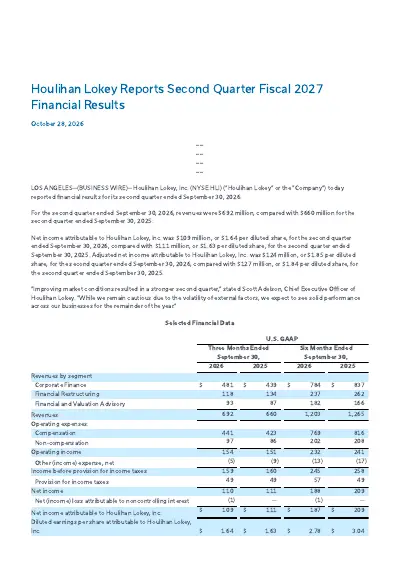
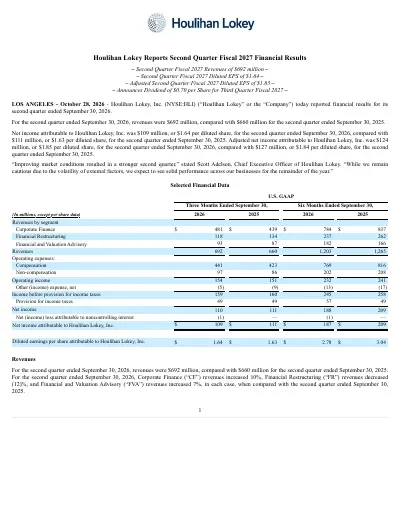
We ended the quarter with revenues of $692 million and adjusted earnings per share of $1.85. Revenues were up 5%, and adjusted earnings per share were flat compared to the same period last year.
Our results for the quarter reflect a normalizing market environment, which continued into October. Key metrics indicate solid performance for the remainder of the year across all three of our businesses, and we have seen a return to growth in both Europe and the US, and across our industry groups except technology and healthcare.
We do, however, remain cautious given the volatility of the macro environment. We continue to see headwinds from interest rates, ongoing geopolitical instability, and dislocation in the software sector.
Our Corporate Finance business produced $481 million in revenue for the quarter, driven by higher average transaction fees. Heading into the third quarter, our backlog and activity levels suggest growth for the balance of the year, even as we remain mindful of the macro volatility.
Despite the higher interest rate environment of the last few months, transactions continue to move through the pipeline to closing, which tells us that the stronger economic fundamentals are outweighing macro uncertainty. Financial Restructuring produced $118 million in revenues for the second quarter, performing in line with our expectations.
Based on our current backlog and new deal activity levels over the last several months, we see a stronger second half of the year and elevated restructuring revenues through fiscal 2028. Our reputation and experience in the software space has led to significant wins in the sector, and we expect these engagements to begin contributing to revenues in calendar 2027.
Financial Valuation and Advisory produced $93 million of revenues for the second quarter. Growth was primarily driven by our portfolio valuation business.
We added 12 new managing directors in the second quarter, including eight who joined us through our acquisition of Intrepid Financial Partners, which closed in September. We're excited to welcome our new partners to Houlihan Lokey.
Also in the second quarter, we welcomed our new Chief Legal Officer, Sipi Bhandari, who you heard from earlier on the call. We are all delighted to have Sipi on board.
I would like to extend my sincere gratitude to Christopher Crain, who served as our General Counsel and a member of our executive team for 22 years, and who fortunately will remain a senior advisor. In terms of acquisitions, our pipeline remains strong, and we are confident that our combination of organic growth and strategic acquisitions will continue to deepen and expand and strengthen our talent base around the world.
I want to thank our shareholders for their support, especially during a volatile first half of the fiscal year. We continue to execute our long-term business plan, and believe that we are the best positioned investment banking advisory firm to capitalize on our industry trends over the next decade.
With that, I'll turn it over to Lindsey.
Lindsey Alley
Thank you, Scott. Revenues in Corporate Finance were $481 million for the quarter, up 10% compared to the same period last year.
We closed 142 transactions this quarter, down from 171 for the same period last year. However, our average transaction fee on closed deals increased, as there was a disproportionate number of higher fee transactions relative to lower fee transactions for the quarter, the reverse of what we saw last quarter.
Financial Restructuring revenues were $118 million for the quarter, down 12% compared to the same period last year. We closed 27 transactions this quarter, down 27% from the same quarter last year, but our average transaction fee on closed deals increased.
We expect to see higher revenues for the second half of the year, and we approach calendar 2027 with record backlog and strong activity levels. For Financial and Valuation Advisory, revenues were $93 million for the quarter, a 7% increase from the same period last year.
The number of fee events remained relatively flat at 1,071 during the quarter, compared to 1,075 in the same period last year. Turning to expenses, our adjusted compensation expense ratio for the second quarter in both fiscal 2027 and 2026 remained constant at 61.5%.
We expect to maintain our long-term target of 61.5% for our adjusted compensation expense ratio for fiscal 2027. Our adjusted non-compensation expenses grew 11% to $91 million for the quarter, compared to $83 million for the same period last year.
Our adjusted non-compensation expense ratio for the second quarter was 13.3%, compared to 12.5% in the same period last year. Our other income and expense produced income of approximately $5 million versus income of approximately $9 million in the same period last year.
The decrease was primarily driven by lower cash balances for the quarter and lower return on our investment securities. Our adjusted effective tax rate for the quarter was 30%, remaining flat compared to the same quarter last year.
We expect to see a fiscal 2027 full-year adjusted effective tax rate of between 26% and 28%. Turning to the balance sheet, we ended the quarter with approximately $888 million of unrestricted cash and investment securities.
As a reminder, we will pay our deferred cash bonuses related to fiscal 2026 in November, which will reduce our balance sheet cash. Also in our second quarter, we repurchased approximately 397,000 shares as part of our share repurchase program for a total of approximately $50 million.
We will continue to evaluate balance sheet flexibility for acquisitions versus excess cash for share repurchases. With that, operator, we can open the line for questions.
Operator
We will now begin the question-and-answer session. To ask a question, you may press star, then one on your telephone keypad.
If you're using a speakerphone, please pick up your handset before pressing the keys. If at any time your question has been addressed and you would like to withdraw a question, please press star, then two.
At this time, we will pause just momentarily to assemble our roster. Our first question here will come from Brennan Hawken with BMO Capital Markets.
Please go ahead.
Brennan Hawken
Hey, good afternoon, Scott. Good afternoon, Lindsey.
Hope you guys are well.
Lindsey Alley
Hey, Brennan.
Brennan Hawken
Hey, Brennan. Hey there.
Nice to see the recovery in corporate finance revenues this quarter. Scott, your comments sounded a little mixed, although maybe just recognizing some volatility in the marketplace.
Should we expect to be able to build on the results that you put up here this quarter? We've seen rates back up.
Has there been any impact on the higher rates in the dialogue that you've seen?
Scott Adelson
As always, thanks. Good question.
The rate question, really not. As we've talked about before, rates in the mid-cap space really, unless they're accelerating greatly, don't have a dramatic impact.
Things aren't priced quite to the same perfection that they are in large-cap world, so as long as capital is available, which it is very plentiful today, that is really not an issue. I would say the geopolitical shocks have been more important from our perspective and I think our hesitation is we just never know what's around the corner, but based upon everything we're seeing from our dialogues, from our metrics, we're feeling good about the back half of the year.
Brennan Hawken
Excellent. You had spoken previously about restructuring and those pipelines rebuilding.
Are you continuing to see that and what additional color could you give us about how that outlook is shaping up? Thanks.
Scott Adelson
Yeah. That is, as we've talked about, I think when we originally started the year, we were actually a little concerned about the growth in restructuring.
That has really turned around, particularly with the fallout from software is a significant driver of that. It's certainly not the only one.
Higher interest rates help as well. Some of the geopolitical dislocation helps.
All of that has helped restructuring and where at the margin it has hurt corporate finance, exactly the way the model's supposed to work. At this point, we feel much better than we did at the beginning or the end of last year about restructuring this year, but even more importantly, probably next year.
Lindsey Alley
Our confidence in restructuring is at or better than it was last quarter. Oh,
Brennan Hawken
excellent. It's continued to improve.
Great. Thanks so much.
Yep. Yeah.
Lindsey Alley
Sure thing. Thanks, Brennan.
Operator
Our next question will come from Nathan Stein with Deutsche Bank. Please go ahead.
Nathan Stein
Hey. How's it going?
Could you just unpack a little more—
Lindsey Alley
Hey, Nate.
Nathan Stein
Hey. Would you just unpack a little more what caused the drop in transactions versus a year ago in both the Corporate Finance and the Financial Restructuring business?
I just feel like there's a big difference between the higher revenues and the lower number of deals.
Lindsey Alley
There is, and we figured we would get this question. Restructuring, I think we've seen this before.
It is a lumpy business, and you do see that disconnect between transaction volume and revenues occur a lot more often than you do in Corporate Finance. That is not an unusual set of circumstances for us.
With respect to Corporate Finance, it is unusual. If you look at the year-to-date, it's a better indication of the reality.
Year-to-date, our revenue is down roughly 6%, and our number of transactions closed is down roughly 9%. They tend to follow each other on a year-to-date basis.
It was a very unique first quarter and a unique second quarter in this regard. If you remember first quarter, I think we were down 25% in revenues and we had a flat number of transactions.
It really is just, I think, the timing and the unusual circumstances in Q1 that sort of drove the disconnect in Q2. I wouldn't read into it any further than that.
Having said that, and Scott has said this in the past, we are much more intentional in the types of transactions that we will take on, which has resulted in us, generally speaking, taking on larger transactions with, generally speaking, higher fees. You may not in the future see quite as strong a correlation between transaction volume and revenues.
Not saying that you won't see it for the foreseeable future, but that you might start to see that as we continue to—
Scott Adelson
To be clear, all still squarely in the middle
Lindsey Alley
market.
Scott Adelson
This is not by the companies that you guys are following. When we say larger, it's not that kind of scale.
It's still squarely in our marketplace.
Nathan Stein
I guess just following up on that, it sounds like a tonal shift in how you guys have talked about deal size that you like to target in the past. What drove the decision to start leaning more into bigger deals, even within your target?
Scott Adelson
No, no, no. I thought I was being clear.
I was a little concerned you were going to take that away from Lindsey's statement. That is not at all what that means.
This is all squarely within the middle market, all squarely sub-couple-billion dollars, mostly in the kind of few-hundred-million-dollar range. A few less deals that we think are more speculative in nature in that size range than those that we think have a higher probability of closing.
Just as we've always talked about using our data to our advantage, we are able to analyze things better than we ever have. We have enormous amounts of information about really what closes and what doesn't close.
Therefore, we're being smarter, if you will, about that. That is a long-term trend.
That is not something that is just this quarter. There's no decision to move away from our mid-market focus.
There's no decision to do bigger deals, none of that.
Nathan Stein
Okay. That's good.
I appreciate the clarification. That
Scott Adelson
a little clearer than where Lindsey left you off?
Nathan Stein
Yeah. No, thank you so much for taking the questions.
Lindsey Alley
Sure. Thanks, Nate.
Operator
Our next question will come from Devin Ryan with Citizens Bank. Please go ahead.
Devin Ryan
Hey, Scott. Hey, Lindsey.
How are you?
Lindsey Alley
Good. How are you, Devin?
Devin Ryan
Good to see the Corporate Finance get back to kind of, as you said, more normal levels of activity, and the outlook is well there. It still sounds like the tech space, maybe software specifically, remains challenging.
I'm just curious, is it just not as challenging as it was last quarter, or are there other sectors that are just maybe picking up more and carrying more of the weight here for the overall business? Just trying to think about the mix, maybe some sector dynamics as well.
Scott Adelson
I think that we called out both software and or tech, but it's mostly software, and healthcare in the written remarks. I think that healthcare is realistically just a timing issue.
Software is down. That is just a reality.
It is not as bad as it was. From a market standpoint, it is continuing to improve.
They are beginning to realize there are good software companies and bad software companies. I do believe it will come back.
Having said that, there is no world where I envision us doing the same amount of software revenue this year that we did last year.
Devin Ryan
Yep. Of course, makes sense.
Thanks, Scott. Then as a follow-up, on just the kind of non-M&A advisory elements of Corporate Finance, like Capital Solutions or Private Capital, can you just give a sense of the baseline for those businesses?
Are they flat? Are they accelerating?
Just a little bit more flavor for what you're seeing there and the outlook as well?
Lindsey Alley
I think the expectations are that Capital Solutions and sort of what are called the non-M&A businesses will perform similarly by the end of the year. We're not necessarily differentiating between the two in terms of how those businesses look for the balance of the year.
Similar to our comments last quarter about Europe, I think we had some concerns about growth in Europe. We started to see that come back, and now expectations Europe and the US by the end of the year look about the same.
I'd say, yeah, we don't see a divergence between M&A and non-M&A businesses through fiscal 2027. Yeah.
All right, good. Appreciate it, and good to see the results.
Great. Thanks, Devin.
Operator
Our next question will come from Gabriel Angelini with Bank of America. Please go ahead.
Gabriel Angelini
Hi. Good afternoon.
The second half tends to be stronger than the first half from a revenue perspective, and obviously, first half was a little bit weaker this year just because of the first quarter. With conditions improving, should we expect a little bit stronger than normal seasonality in the second half of this year, or should we interpret the caution to suggest that it's something closer to a typical year in terms of seasonality?
Lindsey Alley
The answers based on all the metrics and all the things Scott suggested, yeah, we should see an unseasonably higher seasonality in our second half. Again, we need cooperation in the markets.
We do expect a good, solid second half that's better than normal for us, but we need the cooperation.
Gabriel Angelini
Got it. Maybe just given the disruption we're seeing across the industry right now, I imagine software is putting pressure on a lot of smaller boutiques.
Is now the right time to lean in on acquisitions, and maybe are there any sectors that you're particularly focused on?
Lindsey Alley
It's safe to say, and we've talked about it before, we have a very robust process to go after acquisitions, and it isn't honestly time-sensitive. We are in the market constantly.
I wish I could do a better job of predicting when things are going to close, but it is safe to say that as I said in my remarks, we are feeling good about what that pipeline looks like and more to come. It's not just because software is difficult or anything like that.
We've constantly talked about it. It needs to be a good cultural fit for us.
Operator
Our next question will come from Ryan Kenny with Morgan Stanley. Please go ahead.
Ryan Kenny
Hey, thanks for taking my question. On the restructuring side, sounds like you're a little bit more positive with higher interest rates.
Any sectors in particular driving the bigger pipeline there? Is it more speculative where conversations are increasing, or actual mandates increasing?
Lindsey Alley
It is both. What I would call verbally mandated, actively mandated, both, and software is clearly one of the driving sectors.
Not the only sector, but typically when we have an increasing restructuring cycle, it is driven by an industry or another, and right now it is software.
Ryan Kenny
Got it. Then just to be very clear on the earlier discussion about transaction size, you would still stay within below $2 billion in value, and is that right?
Then does that number move up over time as the market inflates?
Lindsey Alley
Yes. 100%, we have not moved our strategy one bit.
This is not a strategic focus. This is about being better utilizing our information to make more calculated decisions within our market that we play in.
Ryan Kenny
Does that number move up over time as the economy grows, or no?
Lindsey Alley
Yeah. It's moved up over time historically.
Just on average, it's not about the economy. We went from average transaction sizes of $100 million many, many, many years ago, and now we're closer to $200 to $300 million, and we expect that number over time to continue to go up, but in baby steps.
I think the only other comment I want to make is on the restructuring question. I think that we're seeing some of that this year.
We believe we will see more of that in fiscal '28, just because it takes time for those deals to work their way through the pipeline.
Ryan Kenny
Was the $481 million in revenues a good base to grow off of, or was it positively impacted by that timing that you mentioned that resulted in higher fees per deal? No,
Lindsey Alley
I would say it's a good, solid base to grow off of.
Ryan Kenny
All right, great. Thank you.
Operator
Our next question will come from Alex Bond with KBW. Please go ahead.
Alex Bond
Hey, good afternoon, guys. Thanks for taking the question.
Maybe just want to follow up again on the larger deals that did get across the line this quarter. Maybe if you could just comment if you're seeing more willingness from clients to push through some of the macro and geopolitical volatility that may have deterred some of the activity earlier in the year.
I think you had mentioned some elongated deal timelines for those deals again in the earlier portion of the year. Are clients more willing to sort of look through that, what's going on on the macro and geopolitical fronts there?
Scott Adelson
I think we've talked about it before. When these things happen, they have created speed bumps or traffic jams, whatever you want to call it, that have slowed things down.
Then it is settled in and people go, "Okay, the sky is not going to fall," to mix my metaphors, and then they keep on with the deals. That is what we are seeing.
Right now, we are seeing a willingness to do deals. I was just in a meeting with somebody, they were commenting on, we're getting to a point where people are like, "Look, I just want to get this done."
That is a good sign when the people start saying that for things just moving through the pipeline.
Alex Bond
Got it. Understood.
I'll jump back in the queue. Thank you both.
Thanks.
Scott Adelson
Thanks.
Operator
Our next question will come from James Yaro with Goldman Sachs. Please go ahead.
James Yaro
Hey, good afternoon, and thanks for taking the question. I was hoping you might be able to expand a little bit on your comment— Hey, James.
Hey, guys. Just hoping you might be to expand a little bit on the FVA business outlook from here.
Perhaps if you could just comment on the cyclical versus non-cyclical parts of the business, and then also if you could just comment on some of the newer initiatives in that business that you've been working on the past few quarters and years.
Scott Adelson
Great. Thanks, James.
The growth, as I mentioned in my comments, is really largely, not exclusively, but largely coming from our portfolio valuation business, and that is a non-cyclical business and has been growing very strongly at this point for a very long time. Some of those new initiatives that we are pushing into are in that arena as well, and we feel very good about where that business is heading and like that a lot.
Our other two businesses, our opinion business and our advisory business, are more cyclical and more tied to the M&A environment, not exclusively, but are more tied to that. While they are up, they haven't been driving the growth quite as much.
James Yaro
Great. Thank you.
I was hoping perhaps you could just touch a little bit on the non-comp expense trajectory. Obviously, I thought very well managed non-comps this quarter, I was hoping you might be able to just update us on how you're thinking about the trajectory for that going forward.
Scott Adelson
I think, James, for now, we're kind of where we were at last quarter. I still think last year's annual growth is a decent proxy.
We had a good first quarter relative to that. Second quarter is kind of right on track.
Second half of the year may sort of make up for the better first quarter a little bit, but I think you can expect non-comp to grow similarly to last year by the time we reach the end of the fiscal year.
James Yaro
That's very helpful. Thank you.
Operator
Again, if you have a question, you may press star then one to join the queue. Our next question will come from Mike Brown with UBS.
Please go ahead.
Mike Brown
Great. Good afternoon, guys.
Scott Adelson
Hey, Mike. Hey,
Mike Brown
Mike. I guess if I use your analogy from last quarter, I think you called it a bit of a rain delay.
The middle market activity has clearly rebounded. Maybe just narrow in on the sponsor space specifically.
Obviously, that's a big cohort within the middle market. Saw some life coming back kind of later in the summer.
Sounds like things are continuing to progress for your business there. If you could just talk a little bit about that cohort though specifically, is the conviction levels that you kind of referenced previously, is that also apply here for this group?
Are LPs starting to kind of drive more of that urgency to act? Is that been a bit of a catalyst for activity recently?
Scott Adelson
Given the importance of that cohort for us, it absolutely is part of it. That is the largest part of our client base as tend to be sponsor-driven, it absolutely is driving that return.
Yes, we are seeing a growing willingness to do transactions in the sponsor community, and that has been ramping. Again, whether you get another rain delay, we hopefully don't.
We don't know, but it is all headed in that correct direction.
Lindsey Alley
The limited partner pressure has been in place for years. It hasn't changed.
Scott Adelson
I don't think that all of a sudden they're succumbing to that. That has been around for quite a while.
They're just ready to get on.
Lindsey Alley
Yeah.
Mike Brown
Okay. Yep, understood.
Then maybe just to double-click on the financial restructuring side of the business, you talked about a lot of strengths you're seeing there and some growth potential that can come through. Could you just talk a little bit about some of the opportunities outside of the US and maybe specifically Europe?
Then on the software restructuring opportunity, you talked about that's been driving activity. I guess when can that really move the needle?
Is that going to be a 2027 story, or is that going to be more like a '28 story? Then how would you maybe size the quantum of opportunity there in a base case maybe compared to prior restructuring cycles?
Lindsey Alley
I think, look, we think we are extraordinarily well-positioned in restructuring in Europe. It is a very attractive environment in Europe in restructuring today.
We're, I think, quite bullish on both the US and the European restructuring market really over the next couple of years as we see these debt maturity walls approach us. With respect to software, I don't want to size it, but it is going to be a huge opportunity for those who are in software restructuring.
It's not just going to be Houlihan Lokey. Your best proxy is if you go back to the oil and gas dislocation that occurred in our fiscal 2017 and got a sense of how that impacted our restructuring business in a single year, software is much larger than that.
That's not a bad way to think about it. We don't think that probably starts for us from a revenue standpoint until calendar '27, but we think that is calendar '27 and calendar '28 that you're going to see revenues from software activity that we're seeing today really start to translate into closed transactions.
Mike Brown
Great. Thanks for the color.
Operator
This concludes our question-and-answer session. I'd like to turn the conference back over to management for any closing remarks.
Scott Adelson
I want to thank you all for participating in our second quarter fiscal 2027 earnings call. We look forward to updating everyone on our progress when we discuss our third quarter results for fiscal 2027 this winter.
Thank you.