Holley Inc.
Q3 FY2026 · Earnings Call TranscriptNovember 5, 2026
Operator
Good morning, ladies and gentlemen, and welcome to the conference call to discuss Holley's third quarter 2026 earnings results. At this time, all participants are in a listen-only mode.
Later, we will conduct a question-and-answer session, and instructions for asking questions will be provided at that time. We ask that participants limit themselves to one question and one related follow-up during the Q&A period.
Please be advised that reproduction of this call, in whole or in part, is not permitted without written authorization of Holley. As a reminder, this call is being recorded and will be made available for future playback.
I would now like to introduce your host for today's call, Sloan Bohlen, with Investor Relations. Please go ahead.
Sloan Bohlen
Good morning, and welcome to Holley's third quarter 2026 earnings conference call. On the call with me today are President and Chief Executive Officer Matthew Stevenson and Chief Financial Officer Jesse Weaver.
This webcast and the presentation materials, including non-GAAP reconciliations, are available on our Investor Relations website. Our discussion today includes forward-looking statements that are based on our best view of the world and of our businesses as we see them today and are subject to risks and uncertainties, including the ones described in our SEC filings.
This morning, we will review our financial results of the third quarter 2026. At the conclusion of the prepared remarks, we will open the call up for questions.
With that, I'll turn over the call to our CEO, Matthew Stevenson.
Matthew Stevenson
Thank you, Sloan, and good morning, everyone. On our second quarter results call, we outlined our expectation that the business would build momentum in the second half of the year, along with five specific drivers we believed would support that view.
This morning, I'd like to report back against those commitments. In short, the third quarter largely played out as we anticipated.
I'll also speak to the areas where we see opportunity for further improvement and the steps we are taking to address them. Three themes define the third quarter.
First, our growth broadened. Our core business grew for the sixth time in the last seven quarters, and that growth accelerated from the second quarter.
Most notably, American Performance, our largest division, returned to growth after working through elevated channel inventory earlier in the year. Second, profitability improved.
After a period in which tariffs weighed on our margins, both gross margin and adjusted EBITDA margin expanded year-over-year, reflecting the simplification and cost savings work we've done across the business. Third, we strengthened both our balance sheet and our platform.
We brought leverage down to our year-end target a full quarter early, and we took two important steps intended to extend Holley's reach: the acquisition of Six Element and a new strategic collaboration with Amotiv. I'll walk through each of these themes, and I'll close out with how we're approaching the fourth quarter in light of the current consumer environment.
Let's turn to slide 5. Slide 5 puts numbers behind those themes.
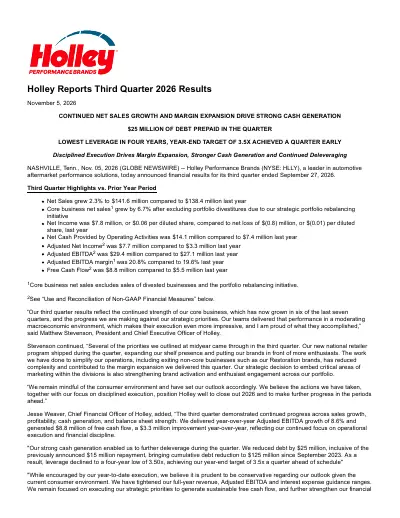
Net sales increased 2.3% to $141.6 million. Core net sales, which exclude the brands we've exited through portfolio rebalancing, grew approximately 6.7%, up from 4.9% in the second quarter.
27 brands delivered growth across our D2C and B2B channels, matching the breadth we saw last quarter, which tells us this growth isn't riding on one or two product lines. On profitability, adjusted EBITDA margin expanded 120 basis points to 20.8%, above our long-term target of more than 20%.
On a GAAP basis, we reported net income of $7.8 million, compared to a net loss in the prior period, and we generated $8.8 million of free cash flow, a roughly 60% improvement over the third quarter of last year. On the balance sheet, we went beyond the $15 million voluntary debt prepayment we announced on our last call and repaid an additional $10 million during the quarter.
That brings our total debt reduction since September 2023 to $125 million. Our leverage ratio fell to 3.5 times, the lowest level since 2022, putting us at our year-end target of 3.5 times a full quarter ahead of schedule.
Reducing debt remains our top capital allocation priority, and the progress we've made gives us more flexibility as we evaluate the opportunities in front of us. On strategic progress, our long-term strategic initiatives generated $18.6 million in revenue, up from the $13.4 million in the second quarter, and delivered $6.1 million in cost savings.
I'll break those down on slide 10, and I'll cover the Six Element and Amotiv in more detail in my remarks. Slide 6 takes a closer look at the quarter's results and the commercial work behind them.
Gross margin reached 44%, up 73 basis points from last year. Together with the adjusted EBITDA margin expansion I mentioned, that improvement reflects the benefit of exiting lower-margin businesses, the sourcing and cost actions we've taken over the past several quarters, and disciplined spending with SG&A down year-over-year.
Both measures are now above our long-term targets of approximately 40% gross margin and more than 20% adjusted EBITDA margin. New products continue to reach the market in every division.
In American Performance, we introduced new Holley EFI intake manifold kits for small- and big-block Chevys, small-block Fords, and LS and LT engines, making it simpler for enthusiasts to complete a fuel injection upgrade with components engineered to work together. In European Import, Dinan launched its M Hunter performance packages for BMW, built around a simple idea: a daily driver that's also a track weapon.
In Safety and Racing, HRX expanded its line of driver gear with new gloves, shoes, and race suits. In Modern Truck & Off-Road, Range launched its full-time V8 module with throttle control, building on the momentum of the Range products we discussed last quarter.
On the operational side, we delivered $3.8 million in savings from completed and implemented purchasing and tariff reduction projects and another $2.3 million from operational improvements, for a total $6.1 million in the quarter. The bottom of the slide shows what our division-led marketing model looks like in practice.
Last quarter, I told you we had embedded marketing teams directly inside each division. The recent Edge CTS4 launch in Modern Truck & Off-Road shows what that structure makes possible.
Instead of a single launch-day announcement, the team ran a campaign that built over several weeks: pre-launch teasers to create anticipation, pre-order activity to capture early demand, a reveal at a major trade show, launch-day activities, and influencer content that multiplied our reach well beyond our own channels. That's the speed and coordination we were after when we restructured marketing.
We're now taking that playbook across our brands. Slide 7 shows our performance by division.
Three of our four divisions delivered core growth in the quarter. I'll start with American Performance because it's the story of the quarter.
Core sales grew 9%, following the declines of 9.7% in the first quarter and 2.1% in the second, a swing of nearly 19 points since the start of the year. All year, we've explained that this business was working through elevated channel inventory and that we had deliberately moved key programs into the second half.
Both played out as we expected. We believe that channel inventories have normalized.
We expanded our national retailer placement, and our marketing calendar was aligned with products enthusiasts buy in late summer and fall: Holley, MSD, and Cataclean were all key contributors. Modern Truck & Off-Road grew 8.2%, on top of 15.7% growth in the second quarter.
Range, Baer, and Flowmaster led the way, and the division's direct-to-consumer e-commerce business grew approximately 65% year-over-year. Safety and Racing grew 2.5%, with contributions from HRX, RaceQuip, Simpson, and HANS.
Growth moderated from the double-digit pace we saw in the first half, which benefited from strong demand tied to the Snell 2025 helmet certification cycle. Growth in the quarter was also affected by the timing of certain new Snell 2025 products in our Simpson motorsport line, which were delayed and are now expected to be available in the fourth quarter.
This remains one of our most innovative divisions in our portfolio and a leader in motorsport safety. European Import declined 12.2%, and I want to be direct about why.
Two factors drove the decline, and both were within our control. First, changes to our marketing calendar moved certain marketing activities out of the third quarter.
Second, in-stock rates on key products were lower than they should have been, which kept us from fully meeting demand. Neither reflects a change in our view of the health of the European enthusiast market or the strength of brands like APR and Dinan.
The team is focused on restoring in-stock levels and has adjusted the marketing calendar for the fourth quarter. Taken together, these results show something we've been working toward for some time.
Our largest business is growing again, and the growth is coming from more than one part of the portfolio. That is a healthier balance than we had at the start of the year.
Slide 8 is our long-term strategic framework. You've seen this before, I'll keep this brief.
Our eight pillars—Great Place to Work, Premier Consumer Journey, Trailblazing Trusted Partner, Product Innovation and Portfolio Management, Global Expansion into New Markets, Transformational M&A, Fund the Growth, and Deliver Results—continue to guide what we prioritize, where we invest, and how we measure ourselves. What I'd point out this quarter is the breadth of this framework is also a source of resilience.
With initiatives underway across all eight pillars, we have many levers available to us, which we believe gives us the flexibility to navigate a range of macroeconomic factors while continuing to move this business forward. Slide 9 shows select examples of the 2026 initiatives that sit underneath those pillars.
They range from Amazon and third-party marketplaces, B2B partnerships, and national retailers to powersports, OEM, bailment, and chemical expansion, along with purchasing, manufacturing, ERP, and warehouse management that helps work fund it all. Our initial targets for the year were more than 4% net sales growth and more than $15 million in cost savings from these top priority initiatives.
Through the first three quarters, we have already exceeded our $15 million cost savings target. The next slide shows how each pillar performed in the third quarter.
The Strategic Initiative Tracker shows where the $18.6 million of initiative revenue came from this quarter. Trailblazing Trusted Partner was the largest contributor at $6.6 million, up from $1.5 million last quarter.
That growth was led by our national retailer channel, where expanded placement at a large national retailer was central to our third quarter performance. This is the program we highlighted on our last call, and it shipped as planned.
Product Innovation contributed approximately $6.4 million, making the third consecutive quarter growth in innovation revenue, again led by Safety and Racing and Modern Truck & Off-Road. Premier Consumer Journey contributed $3.4 million.
Our D2C e-commerce channel benefited from the strong Modern Truck & Off-Road performance I mentioned earlier, and third-party marketplaces grew roughly 8%, supported by strength across multiple divisions and increased paid media investment. Transformational M&A contributed $2.4 million, reflecting HRX's contribution in the quarter.
Global Expansion into New Markets was essentially flat, at negative $200,000. Canada and Australia continued to perform well, but that was offset by regional softness in some other international markets.
Powersports also declined slightly, which we attribute to the timing of shipments rather than underlying demand. Fund the Growth delivered $6.1 million in purchasing, tariff, and operational savings I covered on slide 6.
Revenue from these initiatives grew nearly 40% from the second quarter. Just as important, the tracker does what it's designed to do: it shows you and us where we're winning and where there's more work to do.
Slide 11 revisits the portfolio rebalancing cycle we introduced earlier this year. It has four steps.
First, rationalize brands with low or no growth, minimal EBITDA contribution, or weak strategic fit. Second, release the costs and capital tied up in them through facility consolidation, inventory reduction, and SG&A optimization.
Third, reinvest that capital with discipline. Fourth, compound the value by scaling EBITDA, generating free cash flow, and paying down debt.
Then we repeat the cycle. We spent much of the year on the first two steps, including the exit of our restoration brands, and now you're seeing the benefit in our margins and cash flow.
Of the five businesses originally identified in the program, only one remains. It's a smaller business, and it's currently under a letter of intent, which we expect to close by the end of the year.
This quarter, I want to spend a moment on the third step, disciplined reinvestment, because that is where more of our focus is now turning. Our target acquisition profile looks a lot like HRX: roughly $5 to $10 million of revenue, $1 to $2 million in EBITDA, and double-digit revenue growth.
These are bolt-on businesses with passionate customers and strong product positions that we believe can plug into our platform, including our engineering, distribution, retail relationships, and marketing, and grow faster as part of Holley than they could on their own. As we announced a few quarters ago, our intent is to complete 5 to 10 acquisitions that fit this profile over a 24-month period, and that work is underway.
We intend to continue pursuing these acquisitions in a way that is consistent with our commitment to continued deleveraging. Six Element is the latest example of that strategy in action.
Let's turn to slide 12. Six Element was founded in 2014 and is based in Spartanburg, South Carolina.
The company designs performance parts for Toyota trucks and SUVs, focused on forced induction and airflow, along with off-road exhaust and recovery products. It's an engineering-led business.
Products are designed in-house using CAD and 3D scanning and are road- and dyno-tested before they go to market. Customers have noticed: Six carries a 4.8 out of 5 rating across more than 2,700 reviews.
Two things make Six especially attractive to us. The first is the platforms.
Six focuses on Toyota's newest generation of trucks and SUVs, which are among the most in-demand vehicles in the market. The Tacoma and Tundra together sold more than 420,000 units in the US in 2025, and the sales of the redesigned 4Runner and Land Cruiser are surging.
These are young vehicles with long ownership runways ahead of them, and they're owned by exactly the kind of enthusiasts who modify what they drive. The second is the business model.
Roughly 90% of Six's sales are direct-to-consumer. Its core products, including cold air intakes, front mount intercoolers, charge pipe kits, turbo inlets, and catch cans, carry average selling prices of roughly $250 to $580.
Many of them fit across the 2024 and newer Tacoma, the '25 and newer 4Runner and Land Cruiser, engineering investment can serve several platforms. Most importantly, there is an amazing team leading Six that positions us to grow this business around a strong nucleus of leadership, innovation, and passion for customer service.
Six will join our Modern Truck & Off-Road division. We believe Holley's scale, retail relationships, and marketing capabilities can help the brand reach many more Toyota owners, while Six strengthens our portfolio on platforms where we have historically been underrepresented.
Slide 13 covers the strategic collaboration with Amotiv that we recently announced. Amotiv is a publicly traded company listed on the Australian Securities Exchange and owns more than 50 aftermarket brands, including Ryco, DBA, and Xclutch.
It has more than 1,900 team members in over 40 locations around the world, organized into three divisions: 4WD Accessories and Trailering, Lighting, Power & Electrical, and Powertrain & Undercar. Its roots go back more than 85 years to making chemicals and filters.
This is a collaboration between two enthusiast-focused companies with complementary strengths and geographical footprints, and it has four elements. The first is already underway: Flowmaster high-performance oil filters, engineered by Ryco.
This will take one of our most recognized brands into a new category, filtration, backed by the engineering of a company that has been making filters for decades. It's a good example of extending a powerful brand into an adjacent, repeat-purchase category.
Beginning in 2027, we expect to build on that in three ways: bringing Amotiv's DBA brakes and Xclutch brands to new customers through Holley's North American channels; having Amotiv lead sales and distribution of select Holley products in Australia and New Zealand; and collaborating operationally across select warehousing, distribution, technical support, and supply chain opportunities. For Holley, we believe that this collaboration advances our Global Expansion pillar in a capital-efficient way.
Australia and New Zealand have deep enthusiast cultures and are already among our stronger international markets. We believe that partnering with a company that has an established presence there will allow us to expand our reach without having to build that infrastructure ourselves.
Slide 14 brings us back to where I started. On our last call, we gave you five reasons we were confident in the second half.
Here's how they played out in the third quarter. Simplifying operations delivered, and it's visible in this quarter's margin expansion.
Favorable retail placement delivered; our largest national retailer program shipped in the third quarter as planned. Brand marketing delivered; our division-led marketing model is now in place and contributing to our direct-to-consumer results.
HRX delivered; HRX continues to contribute to both growth and earnings. Product innovation is the one area we mark with caution.
Innovation continues to contribute meaningfully, as you saw on the tracker. That said, we've experienced some minor delays in a few product launches, which shifts the timing of a portion of the innovation contribution we had expected in the second half.
Looking ahead, strong execution continues in the fourth quarter. At the same time, tariffs, freight rates, minor product launch delays, and evolving macroeconomic conditions lead us to keep our outlook measured.
None of these factors changes our view of the long-term opportunity. With the third quarter complete and greater visibility into the remainder of the year, we have tightened our full-year net sales and adjusted EBITDA guidance ranges, while remaining mindful of a more cautious consumer.
Jesse will walk through the details. Before I hand it over to him, I want to thank our team members around the world.
The progress you heard about this morning is a direct result of their focus and execution in an opaque consumer environment. I'm grateful for their work.
I'm proud of what they've accomplished. With that, I'll turn the call over to Jesse to review our financial results and outlook in more detail.
Jesse?
Jesse Weaver
Thank you, Matt, and good morning, everyone. Matt described three things this quarter: broader growth, better profitability, and a stronger balance sheet.
I'll show you how each of those came through in the numbers and why, together, they give us confidence in how we finish the year. Let's start on slide 16.
At the beginning of '26, we set three financial priorities: drive profitability through operational efficiency, optimize working capital, and delever the balance sheet. With a quarter still to go, we are at or ahead of our targets on all three.
First, profitability. Our operational efficiency program has delivered approximately $8.3 million of savings through the first nine months, including $2.3 million in the third quarter, the same operational savings Matt mentioned on slide 6.
Last quarter, we said we expected to finish the year at or above the top end of our $5 to $7 million target. We have already passed it.
These savings come from leaner staffing models, manufacturing and distribution efficiencies, facility consolidation, and cost actions across our network. They are a big part of why our margins expanded this quarter, and we continue to look for more savings opportunities.
Second, working capital. Excluding the effect of portfolio rebalancing, our inventory initiatives have reduced inventory by approximately $10 million this year.
That puts us within our full-year target range of 10 to 15. Third, the balance sheet.
We ended the quarter at a leverage ratio of 3.5 times, reaching our year-end target a full quarter early. What these three results have in common is that they come from actions within our control.
None of this progress has depended on a strong consumer, and it's in an environment like this where it matters. Now turning to slide 17 and our third quarter results.
Net sales were $141.6 million, up 2.3% from $138.4 million a year ago. Three things drove that change: price added approximately $5 million, HRX added approximately $2.4, and lower volume took away approximately $4.2, primarily from the brands we exited through portfolio rebalancing.
Volume in our core business grew. Excluding these exits, core net sales grew approximately 6.7%, accelerating from 4.9% in the second quarter.
Gross profit grew 4% to $62.3 million. Gross margin was 44%, up 73 basis points from 43.2% a year ago.
Two things drove that improvement: higher productivity across our operations and the exit of lower-margin businesses. We've delivered it while absorbing inflation in our input costs.
SG&A, including R&D, decreased 4.6% to $36.4 million, $1.7 million lower than last year. As a percentage of net sales, it fell to 25.7% from 27.6%.
We did that even as net sales grew and HRX added to our SG&A cost base. Lower salaries and wages, consulting fees, and legal fees drove the decrease, partially offset by higher freight and administrative costs associated with HRX.
Put together, operating income grew 23.3% to $19.6 million. Below the operating line, interest expense declined 14.6% to $9.6 million, primarily because of our interest rate collar and lower debt balances.
Net income was $7.8 million, or $0.06 per diluted share, compared with a loss of $800,000, or a loss of $0.01 per diluted share, last year. Adjusted net income more than doubled to $7.7 million, or $0.06 per diluted share, from $3.3 million, or $0.03 per diluted share, last year.
Adjusted EBITDA grew 8.6% to $29.4 million, and adjusted EBITDA margin expanded 120 basis points to 20.8%. Free cash flow was $8.8 million, up from $5.5 million a year ago, driven by higher earnings and disciplined working capital management.
Turning to slide 18, the portfolio and cost actions on this slide are the same ones we walked through last quarter. What is new is that you can now see them in our results.
On the portfolio side, exiting our restoration brands and other non-core businesses allowed us to reduce our footprint by two facilities, clear approximately 95,000 square feet of warehouse space, and remove approximately 7,000 low-margin SKUs, or about 16% of the portfolio. It also reduced our workforce by more than 5%.
On operating costs, we consolidated two manufacturing sites, reduced more than 150 team member and contractor positions through productivity improvements, trimmed non-value-added SG&A, and took production and distribution days out of seasonally slower periods. Together, we expect these two work streams to generate more than $12 million of one-time net cash, and on an annualized basis, we also expect them to deliver 150 to 200 basis points of EBITDA expansion, an additional $3 to $5 million of annualized benefit, 0.2 to 0.3 turns of deleverage acceleration, and roughly 5% improvement in inventory turns.
You can see the results in the third quarter: a simpler, more focused portfolio with higher margins, better free cash flow, and a faster path to deleveraging. Turning to capital allocation on slide 19, our framework has three parts: disciplined acquisitions, reducing leverage, and returning capital to shareholders, all supported by continued investment in our core business.
As Matt said, reducing debt remains our top priority, and the third quarter shows that. We reduced debt by $25 million in the quarter, including the $15 million we announced on our last call, plus an additional 10.
That brings our total debt reduction since September of '23 to $125 million. After quarter-end, we closed the acquisition of Six Element.
We funded it with cash on hand, and it does not change our deleveraging trajectory. We believe that Six fits the model we proved with HRX, and our M&A pipeline is growing.
We will continue to hold every opportunity to our original return thresholds, and we will pace our activity so that we keep reducing leverage. We did not repurchase shares in the third quarter.
That was a sequencing decision, not a view on valuation. We chose to reduce debt first and to fund acquisitions like Six.
We continue to believe our share price does not reflect the value of the business or the progress we are making. Slide 20 shows the progress on leverage.
Our total leverage ratio has come down from a high of 5.67 times at the beginning of '23, to 3.91 times a year ago, to 3.74 times last quarter, and to 3.5 times at the end of the third quarter. That is our lowest level in four years.
Looking ahead, we continue to expect to end the year with leverage below 3.5 times, including the impact of the Six acquisition. We remain focused on our long-term target of approximately 3 times.
We ended the quarter with approximately $50 million of cash and total liquidity of approximately $147 million. Now turning to our full-year outlook on slide 21.
We have tightened our net sales and adjusted EBITDA ranges by adjusting the top end and keeping the bottom end unchanged. We now expect net sales of $610 to $625 million, with core business growth of approximately 2% to 5%, and adjusted EBITDA of $127 to $132 million.
We have also lowered our interest expense outlook to be between $40 million and $44 million. Capital expenditures of $15 to $20 million and D&A of $24 to $26 million are unchanged.
As Matt said, execution remains strong heading into the fourth quarter, but higher fuel prices and broader uncertainty tied to the conflict in the Middle East continue to weigh on consumer sentiment, and we think it is prudent to plan for a more cautious consumer through year-end. That, together with the timing of the few product launches Matt described, is why we adjusted the top end of our net sales and adjusted EBITDA ranges.
The margin profile of the business has not changed. At the midpoint, our outlook implies a full-year adjusted EBITDA margin of approximately 21%.
That is essentially unchanged from our prior guidance, above our long-term target of more than 20%, and it already reflects tariffs and freight. Our outlook does imply a step-up in fourth quarter margin from the third quarter, let me be specific about what drives it.
First, the pricing actions we took late in the second quarter to offset cost increases flow through more fully in the fourth quarter than they did in the third. Second, more of the run-rate benefit of our operational savings and the exit of lower-margin brands lands in the fourth quarter.
To sum it up, the third quarter shows our work coming through in the numbers: core growth improved, margins expanded, free cash flow got stronger, and leverage reached its lowest level in four years. We expect to exit '26 as a more streamlined business with higher margins, a stronger balance sheet, and the flexibility to invest in growth, both organically and through disciplined acquisitions, while we continue to reduce debt.
With that, operator, I'd like to open up the line for questions.
Operator
Thank you. We will now be conducting a question-and-answer session.
If you would like to ask a question, please press star one on your telephone keypad. A confirmation tone will indicate your line is in the question queue.
You may press star two to remove yourself from the queue. For participants using speaker equipment, it may be necessary to pick up the handset before pressing the star keys.
Again, we ask that participants limit themselves to one question and one follow-up. Our first question comes from the line of Joe Feldman with Telsey Advisory Group.
Please proceed with your question.
Joe Feldman
Hey, good morning, guys. Thank you for taking the question.
I wanted to drill down on the cost savings a bit. You guys continue to do a really good job there, obviously coming out ahead.
I think Jesse, you alluded to maybe getting higher and seeing more opportunity. I'm wondering if there's a lot more opportunity there or just we've done the heavy lift at this point.
Jesse Weaver
Good question, Joe. Appreciate it.
I would say that the team on the operations side has done a great job obviously of setting targets every year to find savings to offset inflation. Obviously this year they've been able to exceed that a bit.
I think it's the combination of those initiatives plus the work that we did with the portfolio rebalancing that you're really starting to see the combined efforts of those and really drive the margin in this quarter. The work that the ops team is doing, we kind of put that target out annually, would be something they go after every single year.
There'll be more there, but think of it as more to offset inflationary pressure.
Joe Feldman
Got it. That's very helpful, thanks.
Then, Matt, I want to follow up on the Euro and import side of the business. You mentioned a couple of drivers that should turn the business around.
Have you seen that improvement early fourth quarter so far? Or are there other actions you can take?
I'm just curious if you could share a little more color on that and how to drive that part of the business.
Matthew Stevenson
Joe, and it really got back to on the two specific drivers I mentioned in my prepared remarks. In-stock rates, the team just took their eye off the ball on that, and we've been working hard to recover that.
If you recall, in the previous two quarters, demand was quite robust for Euro, and ultimately, the replenishment rates in the forward forecasting didn't take into account as much the previous two quarters and how robust that demand was and just got caught up with us. Also, there were some changes in the marketing calendar.
The team moved out into Q4 from Q3. The combination of those two things impacted the quarter.
The team's worked really hard to improve the in-stock rates. We've seen already material improvements going into the fourth quarter.
For us, a big calendar event kicks off here the middle of November, Holley Days, and then runs through the end of the year. We're doing everything we can to get the in-stock rates not only in Euro, but in all the divisions in the best possible position to make sure we secure as much demand as possible.
Joe Feldman
That's great. Thanks for that, and good luck with this quarter, guys.
Thanks, Joe.
Matthew Stevenson
Thank you.
Operator
Thank you. Again, as a reminder, if anyone has any questions, you may press star one on your telephone keypad to join the queue.
We have reached the end of the question-and-answer session, and I'll turn the call back over to Matthew Stevenson for closing remarks.
Matthew Stevenson
Okay. Thank you, [unclear].
Slide 23 summarizes the investment case we see for Holley Performance Brands. Our market is driven by automotive enthusiasts, and for our customers, this is far more than a hobby.
It's a passion and a way of life. That passion supports a US market of approximately $40 billion with decades of uninterrupted growth.
Holley leads it with a portfolio of iconic brands known for their legacy of innovation. We have also built a proven acquisition platform.
HRX has shown how a well-chosen bolt-on can contribute to growth and earnings. Six Element is our latest addition, and we continue to make progress toward our goal of 5 to 10 acquisitions that fit our target profile.
At the same time, our digital and direct-to-consumer capabilities, together with an omnichannel distribution network that now includes expanded national retail placement and new international partnerships like Amotiv, continue to transform how enthusiasts and distribution partners engage with our brands. Our long-term financial framework remains unchanged: mid-single-digit organic top-line growth, a gross margin target of approximately 40%, an adjusted EBITDA margin target of more than 20%, sustainable free cash flow, and strategic acquisitions that build on our platform.
This quarter, we operated above both our margin targets, generated free cash flow, and continued to reduce debt, which we believe demonstrates the earning power of a simpler, more focused Holley. We believe the combination of a passionate enthusiast marketplace, Holley's portfolio of leading brands, a flexible operating model, and an experienced team with a track record of execution presents a compelling long-term investment opportunity.
In closing, I want to express my sincere appreciation to our team members for their dedication to serving our customers every day, to enthusiasts who support our brands, and to our distribution partners, many of whom have been integral to our success for decades. I want to thank you for joining the call today, and have a great rest of the morning.
Operator
Thank you. This concludes today's conference, and you may disconnect your lines at this time.
We thank you for your participation.