New Horizon Aircraft Ltd.
NNASDAQ:HOVRQ1 FY2027 · Earnings Call TranscriptOctober 9, 2026
Operator
Ladies and gentlemen, thank you for standing by. Welcome to the New Horizon Aircraft fiscal first quarter 2027 earnings conference call.
All participants are present in a listen-only mode. Following management's prepared remarks, instructions will be given for the question-and-answer session.
For operator assistance during the conference, please press star zero. As a reminder, this conference is being recorded and will be available for replay on the company's website at www.horizonaircraft.com later today.
I would now like to turn the call over to Matt Chesler. Matt, please go ahead.
Matt Chesler
Thank you, operator, and good morning, everyone. Joining me on the call today are Horizon Aircraft's CEO, Brandon Robinson, and the company's CFO, Brian Merker.
I would like to remind you that we will be making forward-looking statements during today's call. These statements involve risks and uncertainties that may cause actual results to differ materially.
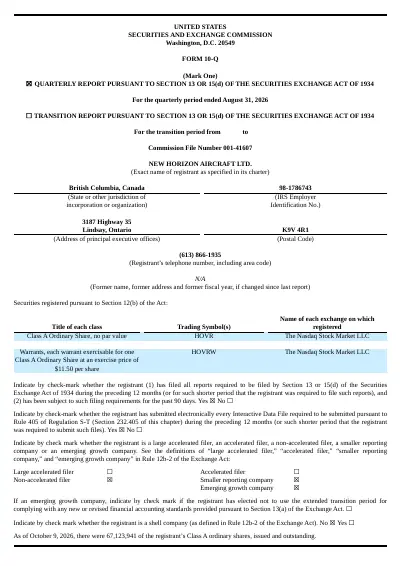
For more information about these risks and uncertainties, please refer to the Risk Factors section of our annual report on Form 10-K for the fiscal year ended May 31st, 2026, filed on July 16th, 2026, with the Securities and Exchange Commission under the company's profile and on the company's profile on SEDAR+ in Canada. Any forward-looking statements we make are based on assumptions as of today.
We undertake no obligation to update these statements as a result of new information or future events. Now, I'd like to turn the call over to our CEO, Brandon Robinson, for his prepared remarks.
Brandon, please go ahead.
Brandon Robinson
Thank you, Matt, and good morning, everyone. Thanks for joining us.
We entered our fiscal 2027 with clear priority to turn the X7's validated design into a full-scale aircraft ready to begin its formal test program by the spring of calendar 2027. Over the last several months, it has been really exciting.
We have advanced the work on the structure, the flight controls, and other systems that will define the X7 demonstrator. The X7 is designed to combine the flexibility of vertical takeoff and landing with the speed, range, and efficiency of conventional wing-borne flight.
It is a hybrid electric aircraft that does not require any ground charging infrastructure whatsoever. With a faster speed, a longer range, more energy reserves, and an all-weather capability, it will excel in a number of missions, such as regional transport, emergency response, cargo, and, of course, a number of interesting military operational missions.
At Horizon Aircraft, we are currently building our full-scale Cavorite X7 demonstrator aircraft. That means that we are in detailed design and production of all major systems, including forward and vertical propulsion, flight controls, high- and low-voltage electrical systems, avionics, landing gear, and primary and secondary structures.
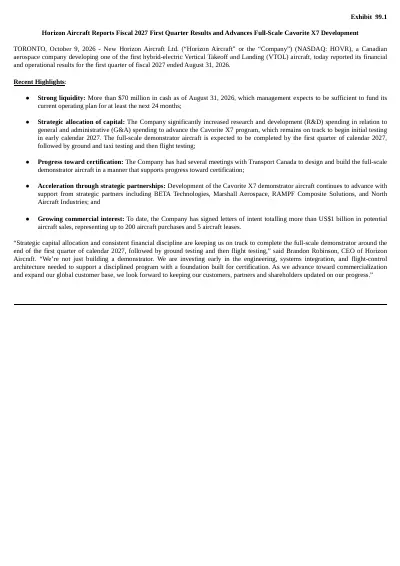
As Brian will explain later, that work has translated into significant increase in research and development spending this quarter, and we expect to maintain a continued focus on engineering and design activity moving forward. Also exciting, our team has grown from 30 people a year ago to over 65 today, and more than 85 FTEs, including external contractors.
This growth continues to fuel very significant progress across all major activities. We continue to invest in systems and engineering resources needed for an aircraft designed with certification in mind.
The full-scale demonstrator aircraft is intended to do more than simply achieve first flight. It is being designed and built with a level of sophistication that I'm very proud of, and that is meant to facilitate certification.
Plainly stated, by spending a little more attention up front, we are investing in a much shorter and more efficient certification process later. A good example is BETA Technologies' collaboration.
We selected BETA's flight control computers and customized fly-by-wire software for the X7. Flight controls are critical for safety, handling, and, of course, certification.
BETA brings a platform built specifically for modern eVTOL aircraft, and one that has flown in an aircraft for over 200,000 miles. This is a more efficient way to deploy capital, of course, than developing every major system ourselves.
We are also applying the flight dynamics and control model completed by Marshall Aerospace to the aircraft's development. That work helps us predict its response to pilot input, fine control strategies, and prepare for a disciplined test campaign.
All of our collaborations with proven aerospace partners have distinct roles, but they will be collectively serve the critical objective of producing a safe, capable, and certifiable X7. Our current target is to complete the demonstrator around the end of the first calendar quarter of 2027, and begin testing shortly thereafter.
That initial phase will include ground runs, taxi work, and progressively higher speed taxi testing. The planned flight test sequence will begin with conventional takeoff and landing before we advance forward to vertical operations.
Each step will be governed by test data and safety reviews, and we will continue to report progress against those specific milestones as the exciting progress continues. We are also progressing all-weather utility for the X7.
In this sector, this is a very unique technological capability that will dramatically increase its operational utility and underlying economics. We intend to pursue IFR capability, the ability to fly in clouds, something nearly all helicopters strictly avoid, and a capability that will challenge modern eVTOL aircraft.
We also intend to pursue certification for flight into known icing conditions, a capability that only a handful of even helicopter types in the world actually possess. For operators that need to serve remote communities, respond to emergencies in bad or cold weather, or maintain dependable schedule, all-weather capability is critical for profitable operations.
In July, wind tunnel testing began on small samples, incorporating ice protection technologies developed by the University of Toronto as a part of our $10.4 million INSAT project. This is an important initial step, and considerable testing and regulatory work remain.
Our certification work with Transport Canada continues alongside the engineering program. We expect to advance to the next steps in that process over the winter, with focus on completing our certification basis and means of compliance.
Moving away from our technical progress and roadmap, in July, we announced a non-binding letter of intent with Verti-Star Powered Lift Aviation, an Australian operator with experience in emergency services, covering up to 100 aircraft for the potential value of approximately $600 million. The intended application for the X7 at Verti-Star is quite appealing to us.
This operator is focused on medical response and regional missions, and sees value in an aircraft intended to travel further and faster than conventional helicopters, while also retaining the ability to serve locations without runway or any sort of charging infrastructure. In a country as vast as Australia with large regions of uninhabited area, the technical attributes and advantages of the X7 are quite potent, to say the least.
To date, our signed LOIs across all customers account for potential purchases of up to 200 X7s, including options with more than $1 billion in indicated potential sales value. Additionally, we have an LOI for the potential lease of five additional X7 aircraft, and that's only the beginning.
We also recently signed an LOI with an Ontario-based Great Lakes Helicopters to support future X7 operations through maintenance, repair, and overhaul services, as well as pilot training. This LOI also contemplates potential additional aircraft purchases by Great Lakes Helicopters.
We continue to speak with prospective operators and potential industry and manufacturing partners across a range of missions. Our near-term focus is on earning those relationships through technical progress.
A full-scale demonstrator aircraft and flight test data should give potential customers and manufacturing partners a much more tangible and defined basis for discussing potential orders. From a more generic point of view, the broader eVTOL industry is becoming more tangible and realistic with each passing week and month.
The FAA's eVTOL integrated pilot program, EIPP, is putting new aircraft and mission concepts into real-world demonstrations to gather information to inform future rules and governance. While that alone does not confer type certification on the X7 or guarantee its commercial authorization for Horizon, it does show that regulators and public partners are engaging the industry with practical questions about how advanced air mobility will operate.
We also see an exciting and growing focus on regional connectivity, emergency response, and runway-independent capabilities in public and defense discussions. The X7's combination of conventional and vertical operations, targeted range, and on-board power is relevant to those needs.
Defense applications for eVTOL aircraft are becoming more topical, and while we are not announcing any defense procurement program today, we are, of course, building an aircraft whose utility we believe can address both civil and government military missions. Over the coming quarters, we expect to share meaningful engineering progress, additional supplier relationships as they are formalized, and certification-related developments.
The central measure of execution remains the aircraft itself, completing the full-scale demonstrator aircraft and progressing through ground and flight testing in a responsible sequence. Now, I would like to pass the call over to our CFO, Brian Merker, to discuss the financial results and our capital position in more detail.
Brian, take it away.
Brian Merker
Thank you, Brandon, and good morning, everyone. All financial figures are presented in Canadian dollars unless noted otherwise.
Our results this morning for the first quarter represent an obvious expansion and effort toward the aircraft development work that Brandon just described. Research and development expenses were $7.4 million, up from $2.7 million a year ago.
The increase was concentrated in engineering and development work on the full-scale aircraft, including prototype manufacturing, flight software, and analysis. Engineering costs within R&D rose to approximately $5.3 million, up from $0.3 million in the comparable quarter a year ago.
This spending relates to building the full-scale aircraft's fuselage, wings, and flight controls. We do expect development spending to remain elevated at these levels as design activity, engineering milestones, and testing activities continue to progress.
General and administrative expenses moved in the other direction, declining to $1.7 million from $3.2 million a year ago, primarily because stock-based compensation costs were lower. We anticipate a similar mix of R&D versus G&A expenses on a prospective basis as well, as we commit ourselves to being efficient with our needs for administrative requirements.
This mix is important. A larger share of our spending is dedicated to advancing the X7, and this compares quite favorably to many of our peers that carry significant administrative burdens.
In respect to liquidity, during the quarter, net cash used in operations was $7.2 million, compared with $2.4 million in the same period last year. We used another $0.7 million for investing activities, which principally related to equipment and tooling, while financing activities were limited in the quarter, with $0.6 million coming in via the ATM program.
This represents an average rate of $2.81, or USD $2.04. We finished the quarter with more than $70 million in cash.
This remains a very strong liquidity position for the company at this stage of development and reflects an industry-leading ratio of liquidity to operating cash usage. As many of our peers are fundraising as needs arise, we continue to be patient and efficient with our spending, leveraging non-dilutive sources and bringing in capital when market conditions are favorable.
For the period, we reported a net loss of $4.1 million, or 6 cents per share, compared with a net loss of $10.9 million, or 29 cents per share, in the prior period. The decrease in net loss does include a $3.8 million non-cash gain from the change in fair value of our warrant liabilities, and this compares with a $5.1 million non-cash expense in the prior period.
As we plan the next phases of the development, we're managing expenditures against engineering milestones and the resources needed for integration and testing. We also continue to seek significant non-dilutive sources.
Under our INSAT-supported project, we've already received close to half a million of reimbursed project costs, and those reimbursable project costs are anticipated to reach more than a million throughout the fiscal year. The SR&ED program here in Canada is expected to yield similar results.
There are many other developing non-dilutive opportunities in the sphere of defense and R&D that we're pursuing as well, recognizing the significant increase in federal government defense spending requirements beginning this year. To summarize, as it is today, we have a healthy balance sheet, a disciplined development and certification strategy, and a team focused on putting resources into the work that moves the X7 forward.
Brandon, back to you.
Brandon Robinson
Thank you, Brian. This quarter brought progress where it matters most: the full-scale aircraft, the flight control architecture, the engineering work needed to test it, and significant demand tied to a clear operating use case.
We also began evaluating ice protection technology for all-weather capability that will unlock operational capability across a broad spectrum of civil and military missions. We appreciate your interest in Horizon Aircraft and look forward to updating you as we reach the next milestones.
That concludes our prepared remarks. Operator, please open the call for questions.
Operator
Certainly. Ladies and gentlemen, the floor is now open for questions.
If you would like to join the queue to ask a question at this time, please press star one on your telephone keypad. We do ask if listening on speakerphone this morning that you pick up your handset while asking your question to provide optimal sound quality.
Once again, please press star one on your telephone keypad at this time. If you wish to join the queue to ask a question, please hold a moment while we poll for questions.
Your first question this morning is coming from Josh Sullivan from JonesTrading. Josh, your line is live.
Please go ahead.
Josh Sullivan
Hey, good morning.
Brandon Robinson
Morning, Josh.
Josh Sullivan
Just as we look at the Great Lakes relationship, can we just touch on pilot training and the MRO ecosystem? I guess with pilot training, can you just outline some of the thoughts on requirements and the pool that you're kind of thinking about?
Brandon Robinson
Great question. I think it's easy to get focused just on producing the machine.
We're really focused on building out an entire ecosystem, so that includes maintenance, repair, and overhaul, supporting the fleet that eventually is growing across the world, figuring out how to train pilots efficiently and effectively, and partnering with folks that have expertise in both of those areas. That's Great Lakes Helicopters.
They train pilots, they have a lot of maintenance, repair, and overhaul activities. As it relates to pilot training specifically, the X7 is going to be a fly-by-wire aircraft.
We'll get into that a little bit later. It is going to be one of the easiest airplanes possibly to fly in vertical mode.
We have kids come in and 10-year-old is able to land it on an aircraft carrier first try. That's with all the dynamics that we believe are going to comprise the full-scale aircraft.
That being said, the idea is most likely we'll take a commercial fixed-wing sort of pilot, we'll bring them in, we'll get them type-rated on the X7, they'll get an endorsement is a possible way that that could work forward, and again working with partners to come up with that construct. Once they're rated on type, then they'll be able to go and do commercial operations.
Pretty exciting times, like I said, with an airplane that's going to be this easy to fly, unlike a traditional helicopter, which they're pretty squirrely. You take your hands off the flight controls and this thing will sit rock-steady, which is pretty cool.
A lot of advantages for pilot training with the way we've set this aircraft.
Josh Sullivan
Order interest.
Brandon Robinson
Our partners, yeah.
Josh Sullivan
Got it. Sorry.
Then maybe if you look at your order interest, be it Great Lakes or the Australian partner, what are the defining characteristics of the early interest from customers at this point? I guess how do you expect that to evolve as you get further along in development and get brand out there?
Brandon Robinson
We're pretty proud of the way we started it. People have heard me say this before, but we distilled specifications from deep understanding of operators.
The first thing that the operators like are the specifications: so the speed, the range, and specifically the all-weather capability. When we make that happen, that is going to be huge.
A lot of helicopter operators and most of the modern all-electric eVTOL companies will struggle and do struggle to operate in any sort of cloud conditions, which confines their operations to good weather only. Being able to fly in clouds and in clouds with potential icing, that is going to be absolutely huge for the X7.
The speed, the range, the operational utility, the bad-weather operations, and, of course, we don't need any charging infrastructure whatsoever. Operators are not going to be limited from going to vertiport to vertiport with these high-voltage charging stations that are required.
The X7 can literally land anywhere that there's fuel and it can recharge itself, right, which is pretty fantastic. All of that combined with an underpinning economic piece: so between 60% and 75% cheaper to operate per unit mile than a traditional, very expensive helicopter is, once you have those specifications from an operational utility perspective and then you underpin it with some serious economic advantages, that is a real winning combination for a lot of the operators out there, and lessors.
Got it.
Josh Sullivan
Thank you for the time.
Brandon Robinson
Thanks, Josh. Great questions.
Operator
Thank you. Your next question is from Sam Dufault from Oak Ridge Financial.
Sam, your line is live. Please go ahead.
Sam Dufault
Hey guys, congrats on the quarter and for the progress towards the full-scale development. My question also goes off the Great Lakes relationship.
Now you guys have LOIs from India, Chile, Australia, and Canada. Are you guys going to see similar requirements for MROs and flight programs in these international countries as well?
Brandon Robinson
We're selective with whom we partner. There's been lots of opportunities and continue to be a lot of opportunities globally.
Like I said earlier, it's definitely something we have to think about, and we have been approached by quite a few different organizations. The key there is picking the geographies that we want to branch out into, understanding them in very much detail so we're not surface-level folks, and, of course, partnering with very high-quality companies.
Those discussions are ongoing, and like I said, we're going to really focus on building out that ecosystem to support the fleet across the globe. That does mean MRO and training, and some production in different places, too.
Sam Dufault
No, that makes sense. Kind of on that same LOI front, what's kind of the feeling you're getting from the United States market, and what's kind of the preliminary wants or needs?
Is it more on the civilian side or the government defense side?
Brandon Robinson
The demand signals from the US are huge, right? There is really nothing in the category of our range and speed in this space.
On the civilian side, NASA has a good study out there. There's 5,000 underutilized regional airports now, and the reason they're underutilized, they have too short of runways most of the time for the bigger, progressively bigger and bigger aircraft to get in and out of.
Something like this on the civilian side, the X7 will be able to land pretty much anywhere that there's a chunk of pavement that's 40 by 40. All of these regional airports now become nodes for pretty exciting sort of old-school transportation network and a much better experience for a lot of travelers.
That's on the civilian side, and, of course, a number of different missions: emergency medical services, yeah, currently getting something to the hospital in half the time, whether it's an injured person or it's an organ or radioactive cancer isotope for research. On the EMS side, it's huge.
Any sort of critical cargo you need to get somewhere, that's huge across the entire United States. The Southern US gets hit by hurricanes all the time, and power grids go out.
Being able to deploy an X7 to the middle of somewhere that has no power whatsoever and start saving lives right away, maybe it's plugging in a mobile medical station into the aircraft itself because it can generate so much power, we're really excited about some of those missions as well. You move over to the military side, of course.
We've essentially built a helicopter capability that's twice as fast almost, and at comparable economics and is going to be much more robust in terms of its operational cadence. On the military side, of course, the major defense primes and US DoD quite interested in the machine once it gets out there and gets flying and we get some test data from it.
A lot of people watching us right now. Great question.
Thanks, Sam.
Sam Dufault
Appreciate it, and congrats on the progress again.
Brandon Robinson
Thank you.
Operator
Thank you. Your next question is coming from Brian Lantier from Zacks Small-Cap.
Brian, your line is live. Please go ahead.
Brian Lantier
Great. Thanks, guys.
I was wondering if you could talk a little bit about, as you're ramping up in the engineering, how is the integration of all of your suppliers progressing, and anything that's positively surprised you or been a bit of a hiccup so far?
Brandon Robinson
It's going really well. On the positive side, I'll bring BETA up again.
Kyle Clark has built an amazing tech company. Their flight control system takes what would have been a very difficult in-house sort of development progress, or finding something and trying to work with one of the big OEMs like Honeywell or someone and try to spend a lot of money and try to change their system into something that will work for us.
The BETA system is perfect, and like I said, it's out there, it's being tested. From that perspective, when we've been looking at different suppliers, we've been pleasantly surprised at companies like BETA and the company they're using for their actuation system as well.
That's been really good. Having a little bit later start in this game, if that makes sense, like a eVTOL 2.0 company, we've been able to take advantage of some of the tech that, quite frankly, some of the larger companies have developed, as well as some of the progress recently in battery technology as well alongside electric motor technology.
Everything keeps progressing nicely. Having started a little bit later gives us some advantages from a supply chain perspective specifically when designing a hybrid electric eVTOL.
Brian Lantier
That makes sense. Given the progress you've made in the last 15 months or so, what was the feedback like at Farnborough?
Oh,
Brandon Robinson
the feedback was great. I think we caught some folks by surprise in terms of us saying we're going to do something and then sticking for the most part to that timeline.
I think people were surprised to see the progress on the full-scale X7, in-house testing of the vertical propulsion systems. We have the main propulsion system in-house as well.
The iron birds coming together really well, the main structures like I said being put together right now, and so we'll have an aircraft that looks like an aircraft fairly shortly. I think again, there's been a lot of promises in the sector, and a company that can deliver on what it says it's going to do, that was pretty exciting to see the response.
Brian Lantier
That's great to hear. Thanks.
I'll catch up with Brian later.
Brandon Robinson
Great. Thanks, Brian.
Operator
Thank you. Your next question is coming from Scott Buck from Titan Partners.
Scott, your line is live. Please go ahead.
Scott Buck
Hi, good morning, guys. Thanks for the time.
I have a question on LOI conversion. What has to happen for some of these LOIs to become binding orders?
Is first flight a trigger, or maybe just what is a reasonable expectation in terms of timeline during the process to see some of these converted to real purchase orders?
Brandon Robinson
I think I can speak generally. I can't speak to the terms and conditions of each one for obvious reasons, but generally speaking, it makes sense that these companies want to see that aircraft fly, right?
It's going to be really exciting when we roll the aircraft out of the hangar, begin ground testing, begin flight testing. When this aircraft flies and flies well and gets a certain portion through some of the flight testing, then things get a lot more serious for a lot of those folks that are quite interested in getting in at the beginning of our production.
Right, we're a little bit different from some of the other major OEMs in this space insofar as we're not claiming we're going to build 10,000 per year sort of thing, right? We're going to build in very normal fashion, 200 to 300 a year at full rate from one of our facilities, and that's still very profitable, but that's not a lot of airplanes initially, right?
People want to get in early, and that's driven a bit more, I would say, serious demand, if that makes any sense.
Scott Buck
Yeah. No, that's very helpful.
My second question: just given the military and emergency services and government pipeline, are there grants or defense development contracts that could potentially offset burn before certification in Canada or other allies?
Brandon Robinson
Absolutely. On the military and civilian side, in Canada, we have to spend on defense, right?
There are a number of different, really exciting constructs are being put together to give access for companies like us in the aerospace and defense sector to non-dilutive financing. Brian can fill in any gaps here if I miss something, but a good example is Initiative for Sustainable Aviation Technology.
That's a $350 million bucket for sustainable aviation companies and innovative aerospace companies like ours. We've already been successful with one, and we can apply multiple times for different programs, which we plan on doing.
No promises that we will win any more, but it looks pretty good for us. On the defense side, again, a lot of non-dilutive financing is being put together for aerospace and defense companies in Canada.
In the US, obviously, they're very competitive, and we're excited. We've already won a US grant a couple years ago for development of our smaller scale X5.
There's precedent for us winning even south of the border as well. It is really exciting.
A lot of opportunities these days is what I'll say.
Scott Buck
Perfect. I appreciate the added color, guys.
Thank you very much for the time.
Brandon Robinson
Thanks, Scott.
Operator
Thank you. We would now like to turn the call over to Matt Chesler from Investor Relations to answer questions from investors that were submitted in advance or via the webcast chat feature.
Matt Chesler
Firstly, we'd like to thank all of our shareholders for taking the time and showing the interest in submitting questions to us in advance and today, and we'll do our best to answer as many of them as possible during today's program, and if not, we'll follow up with you after the earnings call. The first call is from Sergio Heber, and he's asking: are you in active discussions with a potential production or manufacturing partner today, and is a decision tied to the prototype rollout independent of it?
Brandon Robinson
The prototype rollout is independent of any discussions. Of course, folks are interested in partnering with us to be able to produce the aircraft.
Again, as a more traditional aerospace company, we don't need some high-volume 10,000 units, 100,000 units per year automotive manufacturing expertise. Quite frankly, the certified production standards for aircraft at that scale don't exist yet anyway.
We're taking a more traditional approach and talking to some more traditional aircraft manufacturing folks. For the prototypes, we build them in-house.
We have assemblies come in, we have wings come in, we put everything together, test it ourselves, and so we're not tied to any major announcements. The full-scale prototypes will start rolling out of the hangar fairly shortly, and don't require any sort of production support.
Matt Chesler
He does have a follow-up question.
Brandon Robinson
Yep, go ahead. It's:
Matt Chesler
are you in active discussions with specific defense agencies or military branches, and what's the earliest realistic date for a military contract?
Brandon Robinson
On the military side, it's really exciting. Just to remind folks, certification on the civilian side takes a while, that's fine, very high standards for carrying civilians around.
On the military side, they have a different risk tolerance for machines and extreme capabilities like the one we're about to deliver with the X7. They have a separate certification framework on the military side.
It's often quicker, and again, accepts a little more risk to get that capability saving troops' lives and accomplishing missions around the world. That is really exciting.
Of course, if you build a helicopter capability that's twice as fast, a lot quieter, and a lot more reliable than a typical helicopter, you imagine getting personnel from beyond enemy lines back over to good guy land in a lot more efficient fashion, maybe it's to rescue casualties or resupply of forward operating base, maybe it's special forces infiltration, exfiltration type of missions, anti-submarine warfare, logistics on the marine side and on the Navy side, there's an incredible amount of missions that this capability would be good at. Of course, I can't speak to anything that we haven't announced yet, but if you're a major defense prime contractor in the US, you'd be quite interested in keeping an eye on whether this thing will actually work the way it's supposed to or not.
I've been on record saying this before: one of them said, listen, we designed the same capability, the same sort of concept, you just beat us to the patents and all the testing, etc. Yes, of course, we're talking to a bunch of folks around the world, actually, and it's an exciting time for us right now.
Matt Chesler
With that, there's an additional question around manufacturing design that's come in from one of our investors on the Reddit channel, and it says: will you be building one or two full-scale prototypes for testing?
Brandon Robinson
Two initially, and, of course, if you look at any of the major OEMs, they even have more than two aircraft to get through a flight test program, which is pretty cool. We'll start with two initially.
I've been on record saying we'll do a CTOL variant first, follow up with a VTOL variant shortly thereafter for the VTOL testing. It's pretty cool because you can test the CTOL, the conventional takeoff and landing version, down the runway, rotate, fly it at higher, higher speeds, and build out the envelope from a high-speed perspective while you're simultaneously flying the VTOL variants, getting through the hover testing and then accelerating towards transition from the lower speed region.
A pretty efficient way to test, and that's what we're going to do. Great question.
Matt Chesler
Shifting gears, there's a question from Reddit I think, Brian, I'd like for you to answer if you wouldn't mind. It is: what's your current financing strategy for the next few years?
Brian Merker
You guys are going easy on me this morning. I'd probably answer that with a couple of points.
The first thing I'd say is that we're committed to being capital-efficient, and we talked about it earlier. We've demonstrated this over the last 2 to 3 years.
We're a pure-play OEM with a hybrid propulsion system. We avoid a lot of the material infrastructure and operating costs that many of our peers are incurring, and we're not going to have to spend nearly the amounts that we're observing in the broader industry.
The second thing I would say is that, and we've talked about it, relentless pursuit of non-dilutive sources. We talked about INSAT, I mentioned SR&ED earlier, and there are many more.
As a Canadian aerospace and defense company with sustainable energy system, we're seeing a lot of opportunities in this area. Then finally, with $70 million on the balance sheet, at our current run rate, our projected needs, we can be patient.
We can be patient with any third-party capital. If we look out to 2028 and 2029, any financing needs would be influenced by a number of factors, including the non-dilutive sources I mentioned, potential partners on the defense side, the manufacturing side, and also cash deposits on aircraft, which could come in as well.
Matt Chesler
Thanks, Brian. Back to certification and testing, there's a question from Reddit from SkyHigh, thank you, that asks: given the change from half-scale to full-scale for the current X7 build, what aspects are you most excited to test or to validate, Brandon?
Brandon Robinson
Great question. We're excited about a lot of stuff.
For those who haven't seen it, on YouTube, we have a pretty cool video of the aircraft, the X5, the smaller version, transitioning from vertical flight to forward flight and then back for landing. That was really, really cool to see.
The systems that support that on the X7, I've been really exciting to test. First is the vertical propulsion system.
We have fans with final sort of designs spinning up, producing enough thrust. We're seeing thermals that make sense.
We're developing battery packs. Our simulations for transition on the X7 are really exciting as well.
People will note that the transition for the X5, the smaller one, was as boring as it could possibly be. We've designed this aircraft to be as safe as possible, and in aerospace, boring is absolutely safe, and that means potentially quicker route through certification.
All the X7 simulations, and we'll see that in the real aircraft when we roll it out and start doing flight testing shortly, are really positive around transition. There's a lot of other things I could talk about.
The flight controls are going to be exciting. We have flight control computers, we're wiring everything together.
It is absolutely leading-edge aerospace equipment that BETA's produced, and we're really excited to get going and working on that on the flight control system. We just had a major engineering review on the flight controls that went quite well.
A lot of things to be excited about. I could go on and on, but those are some of the top ones.
Of course, I'll finally say, bringing the aerostructure in, having wing structure and fuselage structure here in the next several months and seeing an aircraft that looks like an aircraft, you can't get much better than that.
Matt Chesler
The next question is from Arnab, and it does relate to a thread that I saw online, I'm happy to have you answer it here. He's looking for your thoughts on potential brownout, whiteout, debris, and strong ground-level outwash when operating from unprepared surfaces, especially military medevac or remote ops.
Brandon Robinson
This is a really complicated topic. I currently have put together a 14-page report on the engineering that goes behind this and has entrainment, particle size, all that sort of good stuff, our possible flow fields.
For any VTOL operator, any helicopter operator and any traditional eVTOL OEM, anything that takes off vertically and has to push against the ground, if anyone tells you that there's no potential for brownout or whiteout, yeah, they're basically lying to you, right? Now, the X7, some advantages: with stronger downwash from each of the smaller vertical propulsion units, you have some unique flow fields that actually push a lot of the stuff away from the cockpit before it starts flying up, if that makes any sense.
It creates a little more visibility is what we're seeing in some of the simulations in front of the aircraft, which is nice. What we're seeing is a lot less sort of outwash along the lateral axis, if that makes any sense.
Brownout and whiteout is a thing. It's different in our aircraft, and there's some technical advantages that we can get into if there's more questions later.
We also have a lot of synthetic vision stuff that we're planning, right? Whether that's a LiDAR-based system to aid in landing, EO/IR system to help at night, there's a lot of modern equipment now that is possible to really provide a lot of pilot aid during that difficult period of landing.
Like I said, and it's pretty exciting to solve some of these problems, and again, deliver an operational product that has all of these advantages stacked up to make it a lot more safe than some of the other machines. Great question.
Matt Chesler
We have several more great questions, I think, that are all in the topic of certification and testing, which I think makes a lot of sense, given where we're at in the evolution. Let me start with a question that came in through Reddit, which was: what do you see as the biggest hurdle in getting certification from Transport Canada for the X7?
Brandon Robinson
I'll start with what I think are some of the advantages. Like I said, we're kind of a eVTOL 2.0 company.
We got started just a little bit later, and a huge advantage for that was having a lot of the regulatory structures in place. The major OEMs, they did an amazing job: Joby, Archer, BETA, kind of blazing the way, but it took a while to get 21.17(b) from the FAA, the structure that allows certification of powered-lift in the US, and in Europe, the SC-VTOL regulations that are really well written.
We had the advantage of putting the concept together when we had visibility on a lot of those regulations, so that helps us have a significant advantage. We get to read both of those excellent piece of literature and take a look at what is going to be required.
Now, there's several steps, right? We have to develop our means of compliance, so that's the first hurdle.
We're working on that right now: certification basis, of course, and then means of compliance for that basis. Like I said, we have a lot of work that we can copy, if that makes any sense.
Then, of course, just getting through certification flight testing. With the hybrid electric system, our flights can be a lot longer.
We get a lot more data per flight, so that's exciting. Of course, then it's just flying the aircraft enough, getting the data back, and working through each means of compliance.
Great question.
Matt Chesler
There's a separate question from Reddit talking about timeline for certification, asking when Horizon will have approved certification with Transport Canada.
Brandon Robinson
We can't promise a date, and any company that promises a date is just guessing, but our goal, and again, we have Dr. John Maris on our board, he's built a company called Certification Center Canada that has expertise in doing this exact same thing, certifying new aircraft designs and modifications to existing commercial aircraft as well.
With them and their help and some other experts in the field, we built out a timeline and we hope to have the first aircraft certified in early 2030. Like I said, that's our current goal.
We have a plan to get there at that time, and that's the plan right now. Okay.
Matt Chesler
The next certification-related question is from Paul O'Brien via email. It's about how are you going to do it.
Will the first flights of the X7 be piloted or fly-by-wire as with the X5 flights, and if piloted, by who?
Brandon Robinson
Piloted or fly-by-wire? Both is the answer.
The initial flights will have a pilot in it. Taking a bit more of a traditional approach, there's a lot of advantage to having a pilot in the aircraft for initial flight testing.
There's still a bit of old school where you pull back on the stick and you feel how the aircraft reacts, and there's a lot of qualitative feedback and stability feedback, you notice vibrations that you might not pick up with just an instrumented aircraft that has no pilot in it. There are a lot of advantages of putting a pilot in it to begin with.
It is a fly-by-wire aircraft, which is really cool, it'll have the additional stability of a fly-by-wire aircraft and all the feedback to help tune it properly. Just taking a bit more of a traditional approach for a bunch of reasons.
Very fortunate to know a lot of military test pilots. One of the people on our board of directors has taken Unity to space, one of the most preeminent test pilots in North America.
We have one of our flight test pilots now has flown, has worked through the X-35B, the military jet that can take off and hover and transition to forward flight. We're pretty stacked from that perspective.
Hopefully that answers it. There will be a pilot in it initially for flight testing, but we do have a fly-by-wire system on board.
Matt Chesler
Terrific. Let's move on to another question here.
This is for Brian. Does the recent share price decline adversely affect your ATM strategy?
Brian Merker
I don't think so, and I say that because we have a healthy balance sheet, we've talked about it, $70 million. We're not spending as much as many of our peers, we can be patient.
We use the ATM very carefully, we wait for favorable market conditions. You can look at what we did last year when there was healthy liquidity, when there were tailwinds in the sector, that's when we think about it.
It doesn't change our strategy, which is essentially being patient and careful. It is an efficient way to bring capital in, but based on where we're at today, there's no urgent requirement.
The strategy is being patient and waiting for the right market conditions.
Matt Chesler
Thank you. Then the next and likely final question is from Dave Levine from Trickle Research, which covers HOVR shares, and it's probably for Brandon and Brian.
You have laid out a lot of progress, a lot of great progress here, very impressive. Tell us what keeps you up at night.
Thanks, Dave.
Brandon Robinson
I'll go first. The first thing that keeps me up at night is just the excitement of getting this aircraft put together and getting the flight testing going on this airplane.
The industry is faced some headwinds recently, and there's been some delayed timelines. I'm worried about something happening in another company and it potentially affecting us.
In many ways, we're quite differentiated. For the folks that haven't looked at our specifications, right, we're not really a competitor to a lot of these folks.
We're very much a complementary aircraft. The Joby S4, the BETA's ALIA, Archer's Midnight, they'll do some great work over shorter distances sort of within cities, and we can in a complementary way take things between cities and move things around a lot quicker and, in many ways, a lot more efficiently over those longer ranges.
If something happens during testing with one of those major OEMs, that's something that we can't control. That keeps me up at night.
I think more and more the market is seeing us as quite, like I said, differentiated, and so we're less and less coupled to the entire advanced air mobility space, and as a unique OEM with some pretty special technology. That's one thing.
Brian, I guess you could probably jump in with something as well.
Brian Merker
I do sleep pretty well, so that's good. When I think about the biggest concern I might have is just as we grow, and I've seen this before, we have to remain disciplined as it relates to governance, safety, and I'm seeing it and we're keeping our eyes on it, and we're going to have to continue to do that.
It's tough as companies grow, but we have the right crew to do it. These are people very experienced.
You've heard Brandon's history, we have many others on the executive team that have been through this before. I am confident that we're going to see success here, but it is a challenge for any growing company that has the potential and the promise that we do.
You need to remain disciplined and just careful about governance and safety, and I'm seeing it so far.
Matt Chesler
Great answer. Terrific.
Great answer for both of you. Really appreciate taking the questions from our investor community.
There are no more at this time, and I'm going to turn the call back to Brandon for concluding remarks.
Brandon Robinson
Thank you for joining us today. We really appreciate all your questions and continued interest, and we look forward to speaking with you again as the X7 program advances.
Thank you all. Appreciate it.
Operator
Thank you. This does conclude today's call.
You may disconnect at this time and have a wonderful day. Thank you once again for your participation.