Hudson Pacific Properties, Inc.
Q2 FY2026 · Earnings Call TranscriptAugust 5, 2026
Operator
Hello everyone. Thank you for joining us, and welcome to the Hudson Pacific Properties second quarter 2026 earnings call.
After today's prepared remarks, we will host a question and answer session. If you would like to ask a question, please press star one to raise your hand.
To withdraw your question, press star one again. I will now hand the conference over to Laura Campbell, Executive Vice President, Investor Relations and Marketing.
Laura, please go ahead.
Laura Campbell
Good afternoon, everyone. Thanks for joining us.
With me on the call today are Victor Coleman, Chairman and CEO; Mark Lammas, President; Harout Diramerian, CFO; and Art Suazo, EVP of Leasing. This morning, we filed our earnings release and supplemental on an 8-K with the SEC, and both are now available on our website, along with an audio webcast of this call for replay.
Some of the information we'll share on the call today is forward-looking in nature. Please reference our earnings release and supplemental for statements regarding forward-looking information, as well as the reconciliation of non-GAAP financial measures used on this call.
Today, Victor will discuss our second quarter results and current market trends, Mark will provide detail on our office and studio operations, and Harout will review our financial results and 2026 outlook. Thereafter, we'll be happy to take your questions.
Victor?
Victor Coleman
Thanks, Laura. Hello everyone, and welcome to our second quarter call.
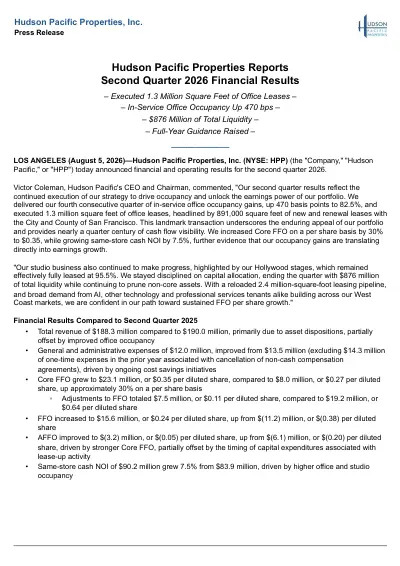
This was both a record leasing and highly productive quarter for Hudson Pacific. We signed 1.3 million square feet of new and renewal office leases, headlined by a landmark 891,000 square foot, 24-year lease with the City and County of San Francisco at 1455 Market, which locks in nearly a quarter of a century of cash flow visibility.
Occupancy increased 470 basis points, our fourth consecutive quarter of gains, and improved performance across our office and studio portfolios drove same-store NOI up 7.5%. Together, with continued cost reductions and Quixote restructuring, we nearly tripled core FFO and achieved a 30% increase on a per-share basis.
We also stayed disciplined on capital, maintaining total liquidity of $876 million while continuing to execute our asset disposition plan. Importantly, as we look ahead, we reloaded our leasing pipeline to 2.4 million square feet.
That leasing strength is playing out against a constructive venture and IPO backdrop. US venture investment totaled $145 billion in the second quarter, its second largest and strongest quarter ever, with funding broadening beyond large language models into defense tech, AI infrastructure, robotics, and space tech.
This all points to a wider, more diverse tenant base rather than a single-sector bet, which will benefit our portfolio over time. The IPO market is improving too, with pending listings signaling further office demand as newly public companies and the ecosystem around them continue to grow.
Across nearly every market in our portfolio, demand is broadening along virtually no new construction, and that dynamic is strengthening fundamentals, though at different rates across our markets. San Francisco posted its seventh consecutive quarter of positive absorption and its largest year-over-year rent increase since 2020.
We're seeing strength at the submarket levels across Peninsula and the Valley, led by strong year-to-date positive absorption in Foster City and Redwood City, Redwood Shores, along with multiple headline leases in Santa Clara. In Los Angeles, our leasing efforts are focused on West Los Angeles, which commands the market's most robust activity and highest rents, even as the broader markets remain challenged overall.
The Puget Sound extended its recovery for its third consecutive quarter led by downtown Seattle, which leases came from Anthropic, DocuSign, and Stripe helped drive the first improvement in CBD vacancy in six years. Downtown Vancouver continues to stand out on fundamentals, with vacancy just over 12%, the tightest in our portfolio, with positive net absorption both for the quarter and year-to-date.
Regarding studios, our prime location studios continue to outperform as the production landscape remains mixed. New York show counts improved, and Los Angeles was relatively stable as California's production pipeline continues to work through a meaningful backlog of tax credit approval projects not yet in production.
Importantly, with SAG-AFTRA, WGA, and DGA all ratifying new four-year AMPTP agreements, the labor risk that drove much of the industry's recent volatility is now off the table. Our strategy remains unchanged: restructure Quixote while optimizing performance at our best-in-class assets.
Finally, turning to dispositions, we continue to make good progress against our $200 million target, having sold 2001 Gateway after quarter end, with three additional Bay Area office assets currently in contract or negotiation alongside our 10950 Washington residential development site. Buyer demand for Bay Area office assets has picked up meaningfully this year, allowing us to execute this program on our timeline and redeploy capital toward our broader strategic priorities.
Now with that, I'm going to turn it over to Mark, who's going to talk about leasing and operations.
Mark Lammas
Thanks, Victor. As you noted, we signed 1.3 million square feet of office leases in the quarter: 61% new and 39% renewal.
On top of the City and County of San Francisco lease for 891,000 square feet, we executed an additional 402,000 square feet of leases, 71% of which were new and 29% renewal. Our occupancy increased 470 basis points sequentially to 82.5%, and our lease rate climbed 440 basis points sequentially to 82.8%.
Our portfolio occupancy and leased percentages improved everywhere except the already strong Palo Alto and Vancouver submarkets, both of which ended the quarter effectively 94% leased. Rent spreads grew 17.2% on a GAAP basis and decreased 11.4% on a cash basis.
Excluding the City and County lease, GAAP rents were off 3.3% and cash rents were down 9.9%, due primarily to mid-sized deals in Palo Alto rolling off of pre-pandemic peak market rents. However, these rents are still quite healthy and north of $80 per square foot.
Net effective rent strengthened this quarter, rising 22% sequentially and 9% year-over-year, benefiting significantly from the City and County lease. Trailing 12-month net effective rents were up 7% sequentially and 1% year-over-year.
Tours rose nearly 20% year-over-year. Even with strong second quarter leasing, we reloaded the pipeline to 2.4 million square feet, nearly 70% new leases with an average requirement size north of 20,000 square feet.
Excluding 2001 Gateway, which we sold earlier in the third quarter, and 875 Howard, where we now have line of sight on a potential sale, we have just over 50% coverage on approximately 400,000 square feet of leases set to expire through the remainder of the year. This includes 80% coverage on the PayPal lease at Fourth & Traxion.
At Washington 1000, we now have coverage for approximately 65% of the building, up from 60% last quarter, with active negotiations across nine tenants, including requirements of up to 125,000 square feet. We're seeing strong traction on our newly delivered move-in ready suites, with eight tenants in the last 30 days touring or scheduling tours.
Tour activity building-wide has also increased, driven primarily by new-to-market tech, AI, and professional services firms. Turning to studios, we continue to see strong interest from leading showrunners and major studios for our prime production space.
Our in-service stages were 74.6% leased during the second quarter, up 180 basis points sequentially, driven by an improved lease rate at Sunset Pier 94 up 40 percentage points to 78.5%. Our Hollywood stages, inclusive of Sunset Las Palmas, remain well leased at 95.5%.
As part of our Quixote restructuring, we have designated as non-core with plans to exit its leased sound stage facilities and Atlanta area operations, as well as Quixote's pro supplies and stage ancillary businesses, including lighting and grip. Going forward, we will speak to our studio NOI on a core basis, which in the second quarter reflects Sunset Studios and Quixote's fleet operations in Los Angeles and New York.
Core studio NOI was up $3.1 million sequentially and $7 million year-over-year to $4.6 million, with HPP's share turning positive for the first time in two years at $2.2 million. Putting a finer point on the Quixote restructuring to date, Quixote generated negative cash NOI of $18.6 million in 2024.
Since then, our restructuring efforts have improved annualized run rate cash NOI by approximately $14.3 million, bringing the fleet business to just over $4 million of negative annualized cash NOI at current demand levels, closing roughly three quarters of the gap to our break-even objective. Turning to value creation optionality across the portfolio, we continue to make progress on our re-entitlement and adaptive reuse, an area where our team's expertise is a real differentiator.
At 901 Market in San Francisco, we filed our office-to-residential re-entitlement application, with entitlements expected before year end. We're also advancing construction drawings in parallel so we can quickly move once approved.
Essentially the same playbook we're running at 10950 Washington. We also recently amended the CC&Rs at Metro Center in Foster City and across our Redwood Shores assets to permit residential use, giving us the flexibility to explore residential and mixed-use development.
This isn't a reaction to soft leasing demand, as we're seeing healthy interest in these locations, rather a proactive step to unlock value by tapping into strong residential demand independent of where the office leasing cycle stands. In short, these entitlement efforts will create development options to enhance our current portfolio value.
Now, Harout will take you through our financial results and outlook.
Harout Diramerian
Thanks, Mark. Total revenues were $188.3 million compared to $190 million in the prior year, primarily due to asset dispositions, most significantly the sale of Element LA, almost entirely offset by improved office occupancy.
As a result of ongoing cost-saving initiatives, G&A improved 11% to $12 million compared to $13.5 million in the prior year, the latter adjusted to exclude the prior year expense associated with the one-time cancellation of non-cash compensation agreements. We nearly tripled core FFO to $23.1 million, up from $8 million in the prior year, while core FFO on a per diluted share basis increased 30% to 35 cents, up from 27 cents in the prior year.
Adjustments to core FFO, including non-core Quixote lines of business, totaled $7.5 million or 11 cents per diluted share compared to $19.2 million or 64 cents per diluted share in the prior year. We grew same-store cash NOI 7.5% to $90.2 million compared to $83.9 million in the prior year, driven by higher office and studio occupancy.
Turning to our balance sheet, total liquidity of $876 million includes $81 million of cash and full availability of $795 million on our credit facility. Interest expense was 20% lower year-over-year, representing $9.7 million of savings, and all of our debt is fixed or capped.
Regarding the Hollywood Media portfolio loan, subsequent to quarter end, the loan transferred to the special servicer ahead of its third quarter maturity. The borrower and the special servicer have since agreed on terms for a longer-term extension, along with a 30-day extension to finalize documentation.
Wrapping up our 2026 outlook, we are raising our full year core FFO to a range of $1.12 to $1.20 per diluted share, up from the prior range of $1.10 to $1.18 per diluted share. This updated range reflects, at the midpoint, approximately one penny of outperformance in the second quarter compared to our initial expectations, as well as approximately one penny attributable to improved expectations for the second half of the year.
As we have previously noted, even with the first and second quarter outperformance, we anticipate third quarter expirations will impact occupancy and earnings results, with a rebound in the fourth quarter. As a reminder, this updated range excludes the previously announced closures of Quixote's stage and Atlanta operations and the associated stage ancillary and pro supplies segments from core FFO.
As always, our outlook excludes potential dispositions, acquisitions, or capital markets activity. With that, I'll turn the call back to Victor for closing remarks.
Victor Coleman
Thanks, Harout. Simply put, the second quarter reflects exactly the execution we said we'd deliver: record leasing, our fourth consecutive quarter of occupancy growth, a transformative long-term agreement with the City and County of San Francisco, and a Quixote restructuring that's now yielding measurable earnings benefits.
We still have work ahead of us, but each of these actions reinforces the same outcome: a clear and credible path to sustained FFO per share growth. Operator, now I'd like to turn it back to you for questions.
Operator
Thank you. We will now begin the question and answer session.
If you would like to ask a question, please press star one to raise your hand. To withdraw your question, press star one again.
We ask that you pick up your handset when asking a question to allow for optimum sound quality. If you are muted locally, please remember to unmute your device.
Your first question comes from the line of Jamie Feldman with Wells Fargo. Jamie, your line is open.
Please go ahead.
Jamie Feldman
Great. Thanks for taking the question.
I'm sitting in for Blaine today, who's off. Oldie but
Victor Coleman
goodie. Oldie
Jamie Feldman
but goody, yeah. We're back.
Don't call it a comeback. I had some line like that I was going to use, but I don't know, couldn't come up with anything good.
West LA you're talking about a recovery, and then you still have decent upside to get to stabilization in North San Jose, Denny Triangle. Can you just talk more about those markets, but especially West LA?
Is there a real inflection point happening, or how we should think about what's to come?
Victor Coleman
West LA, you guys cover other of our peers, you're seeing it's a bifurcated marketplace, right? You've got Brentwood and Century City and Beverly Hills doing exceptionally well.
I think Westwood and Santa Monica are a little slower, Olympic Corridor is a little slower. Again, there is zero construction in the near future for new product, and so good space is pretty much leased up or spoken for and being expanded upon.
I think you're seeing that momentum potentially drive into some of the other marketplaces like Santa Monica, and hopefully in Westwood and overall the west side. Culver City's been strong all the way through, but there's very little product there, and everything that's being built in that marketplace is already pre-leased.
Jamie Feldman
I guess more on the demand side, what's changing?
Victor Coleman
Listen, we've talked about the FIRE tenants being massively impactful in West LA, majority of which is led by law firms. The streaming/entertainment companies have taken sort of homes in specific marketplaces like Apple in Culver, Sony in Culver, Netflix in Hollywood, and Amazon spread themselves between, obviously, Santa Monica and Culver, Lionsgate Beverly Hills.
Entertainment companies, WME, the same, are all in those marketplaces, and then their ancillary guys are growing. Implications around AI is just not that strong here yet.
There's small growth tenants, but I do think it's entertainment and FIRE, and that's sort of the nucleus. Art, you want to comment on that?
Art Suazo
I think the demand drivers, Jamie, are positive, they're modestly improving. There was an improvement in net absorption.
Gross leasing was up slightly. Things like that that we're monitoring very closely.
That's coming from the small to mid-sized tenants in the market. As all this talk about West LA improving, West LA has been driving the LA market for several years, and it will continue to do so as the demand drivers continue to increase.
Okay. Then,
Jamie Feldman
if I can ask another, just the studio loan, can you just talk about how you're including that in guidance, or anything you can say about expectations of what that could look like for numbers, or how we should be modeling it?
Harout Diramerian
We can't get into any specifics because we're still finalizing documentation, but what we can say is in our guidance we've kept things the same, and that is our expectation.
Jamie Feldman
Just kept same interest expense that you've got now? Don't change anything?
Harout Diramerian
Correct.
Jamie Feldman
Okay. All right, thank you.
Victor Coleman
Thanks, Jamie. Welcome back.
Jamie Feldman
Good to be back.
Operator
Your next question comes from the line of Jana Galan with Bank of America. Jana, your line is open.
Please go ahead.
Jana Galan
Thank you. Good morning, and congrats on the strong office leasing and the improvements at Quixote.
I guess maybe first question on the guidance. The main change seems to be the outperformance in second quarter G&A.
Are there any other kind of puts and takes that are driving the FFO guidance increase given the strong leasing outlook?
Harout Diramerian
Hi there. Just around guidance, yes, our second quarter was very strong, but not that strong compared to our own expectations.
We beat our own expectations by about a penny, and our projections are higher by about a penny. The leasing expectations that we've experienced in the second quarter and the projections are in line with our previous guidance.
Nothing's really changed from that expectation, which is why you're not seeing a massive increase in our projections in our guidance.
Jana Galan
Thank you. Then maybe just on the transaction market, given the asset sale post quarter and just a few more that may come, if you can just kind of comment on what you're seeing the kind of demand and depth of buyers like?
Victor Coleman
As I mentioned in my prepared remarks, San Francisco is seeing an influx of interest levels. We have closed one deal as we mentioned, and we've got three others, two of which are in contract, and one is eminently going to be in contract, that sort of show indicative interest level of the demand in the marketplace for our asset quality.
We're comfortable with our pricing. I think we've exceeded our expectations in three out of the four assets that we are selling.
There is one asset that potentially could be an owner-user, and so that pricing is going to be dependent on timeline and occupancy for the owner-user. Overall, the demand drivers right now for the disposition market from our standpoint are very strong.
Jana Galan
Great. Thank you, Victor.
Thanks, Harout.
Victor Coleman
Thanks.
Operator
Your next question comes from the line of Alexander Goldfarb with Piper Sandler. Alexander, your line is open.
Please go ahead.
Alexander Goldfarb
Hey, thank you, and good morning out there. Two questions.
First, Harout, on the updated guidance, you guys say it excludes the Quixote restructuring. That would be a positive to guidance, would it not?
If you were to include that, guidance would increase? I just want to make sure I'm thinking about it right.
Harout Diramerian
No, it would not increase. We, just like last quarter and the guidance provided last quarter, we've removed the impact of the Quixote restructuring, it's not impacting the numbers that we have shared.
Just like our core FFO doesn't include that in our results, neither does our guidance.
Alexander Goldfarb
Isn't that a drag on earnings, and once that drag is away, you're streamlining the portfolio and there's less cost going forward? I understand in between there's a negative, but wouldn't that be a positive longer term?
Mark Lammas
Alex, you're precisely right. It is a drag, so that is to say it operates at a loss, the removal of it improves core FFO, right?
Harout Diramerian
Our net income is dragged by it, but our core FFO is not.
Alexander Goldfarb
Okay. Now I'm thinking about it right.
Second question is, Art, on Seattle, as we think about the interplay between the east side and CBD, we want to get really enthusiastic and say, "Hey, Seattle could turn quickly and things are going well." At the same time, office moves slower than we all think.
As we think about the CBD rebound, do you think this is a later this year, '27 event, or you think it takes longer than that just based on how office always, as I say, seems to take longer than we'd like?
Art Suazo
The good news is the word rebound is being used. We're already seeing green shoots, Alex.
We've been talking about the greater Puget Sound with three quarters of positive absorption. We saw, for the first time in six years, the CBD this quarter had positive absorption.
We're seeing demand drivers continue to increase across downtown Seattle, and specific to our portfolio, specific to our pipeline, Seattle for the last two quarters has the most deals in negotiation than any submarket that we have, including the Valley, including San Francisco. To us, that's a tremendous sign of what's to come, and it's really being driven by not just the larger tenants that have come back in the market that we've talked about for the last two or three quarters, it's really the 10,000 to 30,000 square foot tenants and the expansion of those tenants in the market, which by the way is predominantly driven by growth in the professional service firms, the FIRE sector, and governmental firms that are there.
We're seeing it real time, and it's demonstrated by the fact that this last quarter there were three larger deals done in downtown Seattle. Again, that demonstrates that the larger tenant demand is broadening beyond just Bellevue, as people had thought before.
Alexander Goldfarb
Okay. Thank you.
Victor Coleman
Thanks, Alex.
Operator
Your next question comes from the line of Caitlin Burrows with Goldman Sachs. Caitlin, your line is open.
Please go ahead.
Caitlin Burrows
Hi, just to follow up then on Seattle, wondering if you can talk about how what you're seeing in the Seattle market is or is not impacting activity at Washington 1000 and kind of leasing potential there?
Art Suazo
Hi. No, it absolutely is.
In fact, we're seeing, as I'd mentioned to Alex, we have more activity in our pipeline, which is active deals in negotiation, in Seattle than any other market. It's over 600,000 square feet for the market.
Washington 1000, we talked about nine deals we have in negotiation represents over half of that, it's 300, about 350,000 square feet of deals in different stages that have been impacted, and we feel like we've had more momentum than we ever had. Even as we speak, kind of the last 30 days, tour activity has increased, kind of in the dead of summer, tour activity has increased tremendously.
Caitlin Burrows
Got it. Then, just on the maybe same-store NOI side, it looks like guidance suggests a deceleration in the second half.
I think you guys mentioned earlier that there could be lease expirations or lower retention in the second half. Wondering if you could talk about that a little bit and the expectation for yeah, I guess occupancy in the back half.
Harout Diramerian
Sure. As far as the guidance goes, what I specifically said, not the second half, but primarily the third quarter.
We have two large expirations that are impacting our numbers in the third quarter that we previously spoken about. This is not the first time we brought it up, and we expect a rebound again in the fourth quarter.
Let me answer on that.
Mark Lammas
On the occupancy question, if you're waiting on that answer, we've maintained that midpoint that 81%. When we initially launched that guidance, we had indicated that if you kind of run the math from the beginning to the end of the year, it suggests that we should end the year towards the kind of mid-80ish range, and that remains intact.
Caitlin Burrows
Thank you.
Operator
Your next question comes from the line of Dylan Burzinski with Green Street. Dylan, your line is open.
Please go ahead.
Dylan Burzinski
Hi guys, thanks for taking the question. Just maybe continuing with that mid-80% occupancy year end and maybe looking at sort of the 2.4 million square foot leasing pipeline, is there any sort of large leases that are needed or required to hit that mid-80% occupancy range?
Then maybe just sort of diving into that 2.4 million square feet a little bit more, you mentioned an average size over 20,000 square foot, but are there any sort of leases or potential leases that are well over that 100,000 square foot range?
Victor Coleman
Hey, Dylan. We have a series of leases that are the average size that we're talking about, and that's the majority of the portfolio.
There are a couple of deals that are multi-tenant floors and leases that are large. We're still banking on our bread and butter, which is the 20,000 to 30,000 footers that are out there right now, and that seems to be the consistent aspect of where our properties are lined up.
Not to say, as Art had mentioned, in Seattle as an example, there have been now a handful of deals either closed or about to close over 100,000 feet. I think there's more for sure in that marketplace behind it.
There is clearly more in the city that are larger tenants. Specific to our portfolio, we do have our fair share, but what we're really talking about on the 2.4 million square feet is the average size tenants between 20,000 and 30,000 footers.
Dylan Burzinski
That's helpful. Then maybe just touching on sort of capital markets, obviously mentioned confident in hitting that $200 million target this year, but as you sort of think about beyond '26, is there any desire to sort of continue bringing assets to market to potentially help deleverage the balance sheet given the strength that you've seen in capital markets, and hopefully that continues?
Victor Coleman
Dylan, as you've covered us for a long time, we've increased our optionality for the ability for us to lower our debt metrics and the likes of that. That will continue.
Working on these dispositions right now, confident that they're all going to go through and we're going to exceed that $200 million number that we talked about at the beginning of the year. We have other options that are out there with assets that could either be put on the marketplace given the activity in the market, or we have options on refinancing certain assets or just financing assets that are unencumbered as well.
We've got other alternatives. The nice thing is we do have some time.
We're acutely aware of what our needs are and what the demand market is at the end of the day, and I think we're comfortable with our ability to execute on all fronts.
Dylan Burzinski
Great. Thanks, Victor.
Victor Coleman
See you, buddy.
Operator
Your next question comes from the line of Seth Bergey with Citi. Seth, your line is open.
Please go ahead.
Seth Bergey
Hey, thanks for taking my question. I guess just start, you kind of talked on the increased activity with the transaction market, and the depth of the buyer pool, but just what type of money is out there that's interested in office product?
Is it core money? Is it opportunistic money?
Just how are you seeing that kind of evolve?
Victor Coleman
I think there's three buckets, Seth, that you're looking at. There is a revamped core money that is out there that is looking for the high-end, high-quality.
It was more driven around WALT, and it still sort of relies on that aspect. The opportunistic dollars are absolutely at the forefront for office looking for value-add, which is usually lease-up or repositioning.
Then you still have your owner-user dollars that are out there that we've seen a fair amount that is either owner-user from an occupancy standpoint or conversion standpoint. We did comment in our prepared remarks we have some options on some assets, just like we did at 10950.
It's not been our core game plan to convert assets to residential, but we are in the process of a couple of assets in the portfolio right now that we're entitling, and the activity's very strong on that as well, given the demand for residential. I think there are three buckets.
They're consistent. I believe that the trade dollars, we haven't seen much of trade dollars, albeit we did do a deal with a 1031 exchange just recently.
That was our most recent deal. The markets are pretty much even across the board for activity and interest levels.
Seth Bergey
Great, thanks. Then just maybe as leasing activity continues to accelerate, are you seeing any changes in kind of the timing of the conversion from when tenants are touring assets to signing leases?
Victor Coleman
I think at the end of the day, it's competitive driven, right? High-quality stuff, if there's one or two tenants looking at it, the decisions are being made quicker, brokers are more aware.
I'll let Art comment, but and Ken's in the room as well for the Bay Area, but I think what you're finding now is high-quality space is getting grabbed quickly, and as a result of that, a tenant is only looking at when they had maybe four or five options that were clear and identified, now if it's one or two, they're moving quicker on one and two versus, "Hey, I have four different options, I can take my time."
Art Suazo
No question. It's demand driven.
We're seeing in the markets where actually we are well leased, 94% in Palo Alto and in Vancouver and so forth, West LA. Decisions have to be made quicker by necessity, and so as you start to see that pendulum swing on leverage, dare I say leverage, you're going to get a truncated deal cycle time, and we're certainly seeing more and more of that.
Victor Coleman
Let's not mistake in this to be a landlord's market, though.
Art Suazo
I want to make sure
Victor Coleman
we're clear on that. Right, yeah.
Art Suazo
That's why I said "dare I say."
Victor Coleman
Doors are always open for us to make deals.
Seth Bergey
Great. Thank you, guys.
Operator
Your next question comes from the line of John Kim with BMO Capital Markets. John, your line is open.
Please go ahead.
John Kim
Thank you. I wanted to ask for more color on your 2.4 million square foot leasing pipeline.
I think last quarter you gave some information on how much of that was tech versus AI. If you could provide some of that, and how much of the pipeline will be addressing either near-term expirations or currently vacant space?
Art Suazo
Hey John, it's Art. We grew the pipeline, right?
We were about 2.3 even after the large quarter. The team's done an excellent job of increasing the number.
It's interesting over the last 12 to 18 months, there's been a lot of attention paid to, for good reason, to tech and the AI ecosystem. What we're finding now in our active deals in negotiation pipeline is it's evenly distributed.
It's about 50/50 AI ecosystem/tech versus non-tech, which is professional service firms, FIRE sector, and now kind of governmental agencies taking more space. We have a broader depth of tenants that are looking for space, which is great, and they're all, not just the tech and the AI ecosystem, they're all looking for some level of expansion down the road.
We feel even better than we did before this last quarter.
John Kim
How much of it is new versus renewal? 70
Art Suazo
Right now in our active pipeline, it's 70/30: 70 new, 30 30 renewal.
John Kim
Okay. Now that your Hollywood Media CMBS has gotten a short-term extension, but it's in special servicing, is your expectation that this will ultimately be refinanced, or is a possibility that you'd walk away from these assets?
Assuming it's the former, do you expect any paydown as part of that extension, or do you expect pricing to change even though it's not officially in your guidance?
Victor Coleman
John, I want to be clear. We've commented on it.
We're not going to talk about what's the paydown, we're not going to talk about the terms until they're finalized, okay? Your assumption is that, which is wrong, that it's a short-term extension.
That's your assumption, okay? I want to just make sure you're clear on that.
In terms of us walking away from the assets or dealing with a refinancing, we'll address that publicly when we get the renewal completed.
John Kim
If it's not short-term, how long is the extension for?
Victor Coleman
John, as I said, you'll get full terms and conditions on the extension when we announce it. You're not going to get it in advance of anybody else.
John Kim
Okay. Thank you.
Operator
Your next question comes from the line of Ronald Kamdem with Morgan Stanley. Ronald, your line is open.
Please go ahead.
Ronald Kamdem
Great, thanks so much. Just commentary just on the AFFO.
Obviously, a lot of the leasing has come through nicely. How do you guys think about the CapEx trailing off and sort of the prospects for that AFFO to start kicking into gear as well?
Thanks.
Harout Diramerian
Sure. Hey there, Ronald.
The AFFO, I think we've previously stated this, that we're still working through the leasing spend. There's a lot of leasing that Art has mentioned that's still coming.
The spend usually comes in a little later than we've experienced in the past. We expect AFFO to be up and down over the next few quarters until all the spend is happening and the cash flow starts coming through from all those leasings.
Even though we've done a lot of good leasing, there's still some CapEx to be spent and that leasing still hasn't generated cash flow yet, full cash flow.
Ronald Kamdem
Helpful. Then, just on the studio recovery and so forth, now that, obviously the Quixote services in Atlanta is out, how do you guys think about sort of the ramp and the ultimate sort of NOI opportunity now with that studio business?
Any color there would be helpful. Thank you.
Mark Lammas
Maybe just to make sure expectations are in line. Our first goal is to get this thing to break even.
If you look at our results, I assume you're talking about the Quixote business, because that's really where the opportunity sits is, if you look at our second quarter results, you'll see that we're now generating somewhere in the neighborhood of, call it, negative $4 million annualized cash NOI. That is with a backdrop of about 70 shows.
We think through all that cost cutting efforts, we've managed to lower the threshold to get to break even in terms of show count. If shows can improve very, very modestly, say from the current 70 level to 80, we think we're at break even.
When we started the cost cutting endeavor, shows were around 90. Had they stuck at that level, we would be in positive territory already.
Which is to say, if we were at 90 shows, we should be running at in a positive $4 million, $5 million, we think, of positive NOI and cash for Quixote. We're not trying to project where we think show counts are trending.
We are just going to continue to focus on costs. We're going to continue to reach for that break-even point.
We think we're getting increasingly close to that, as the numbers show. We'll see where things go from there.
Right now we're in summer. Summer is historically a slow period.
We'll see if shows pick up as we get closer to fall, and hopefully if they do, we'll start to see positive NOI in Quixote.
Ronald Kamdem
Thank you.
Operator
Your next question comes from the line of Richard Anderson with Cantor Fitzgerald. Richard, your line is open.
Please go ahead.
Richard Anderson
Hey, thanks. I'm going to draft off that last question for you, Mark.
Do you still approach the Quixote unwind as if it's 70 shows, you're not counting on 80 or 90, and so the process continues? I just want to make sure I understand that.
Mark Lammas
That's right. Maybe to put even finer point on it, if you look at our guidance, we are assuming no improvement in show count.
Richard Anderson
Okay. That's what I figured, I just wanted to confirm.
Now, what does the Quixote platform look like as a long-term hold in terms of leased stages and so on? What and what should we expect to be the sort of the ultimate landing point?
Mark Lammas
Yeah. Once the announced wind-downs are done, it will consist of a fleet of various types of vehicles of about a little bit more than 1,000 vehicles, largely located in Los Angeles with some in New York.
That will be the remaining going concern, if you will. Victor can comment on where we go from there, because the first goal, priority is to get that wind-down done and give ourselves a chance at profitability.
Then where we go from there, I think we'll have to explore.
Victor Coleman
Rich, just in line with that, let's not let the numbers get skewed a little bit here or there. We still have market share in the range of 70% in that business.
It's not that we're servicing just our portfolio, we're servicing the industry itself. As the industry evolves and if it lays out to where it is right now, which we underwrote it at, as Mark said, we'll break even relatively shortly.
If it ends up expanding, then there's options for us to look at that industry and that business around Quixote and look at our alternatives.
Richard Anderson
It's a fleet business at the end of the day. Would you be out of the leased studios as well entirely?
Victor Coleman
That's the goal.
Richard Anderson
Okay.
Mark Lammas
On the Quixote side, to be clear, right?
Victor Coleman
On the Quixote side, totally.
Richard Anderson
On the Quixote side,
Victor Coleman
yeah.
Richard Anderson
Understood. Then my last question is that's a nice change from $18.6 million loss in 2024 to $4 million currently run rate today.
Would you describe yourself as ahead of the game versus when you started to talk about the unwind process?
Mark Lammas
I would in that even as we've lost demand, that is to say show counts have gone down over the timeframe that we've been cutting costs, the fact that we are approaching break-even even in that kind of declining demand environment, I think is a good indicator that our plan is working, and because we would be in positive territory, as I indicated, had demand held up.
Richard Anderson
Okay. Then just real quickly, will the studio side of Quixote will that extend into 2027 in terms of the unwind?
Year end this year will you still be in some studios, or I again, I apologize for
Mark Lammas
not... We're in the process.
We've got, call it, 10 We started with 10 leases of mostly stage leases. We were out of five of them and we are in negotiation on the remaining five.
Richard Anderson
Okay. All right, great.
Thanks for the color.
Victor Coleman
Thanks, Rich.
Operator
Your final question comes from Jamie Feldman with Wells Fargo. Jamie, your line is open.
Please go ahead.
Jamie Feldman
Great. Thanks for taking the follow-up.
I guess just sticking with the studios, can you just talk about the potential show pipeline? I think you had commented on, now that there's more stability or visibility on labor, maybe you feel better about what's out there.
Can you just give us some more color of what you think could come to the studios?
Victor Coleman
Jamie, listen, as Mark said, it is a quiet time right now. I think the labor calm is absolutely apparent that there are no foreseeable hurdles on that basis.
As we're seeing, New York has picked up dramatically, it's taken some business away from Los Angeles. Our core portfolio is performing extremely well and very well leased in terms of what we own.
The show counts have been varied, and I think candidly, the state credits have been disappointing in that they haven't really expedited a lot of filming. We'll have to see what happens in fall.
There is banter around some federal aid on that basis, and we're in the middle of it as we sit. We'll see what happens on that side.
Los Angeles isn't going anywhere from a production standpoint, and what we have seen is the other ancillary markets are in a much worse situation, being Atlanta, New Orleans, Michigan, and Toronto. The three core markets really that have held up are New York, Los Angeles, and Vancouver.
By fall, when we get through what we're working on right now and seeing the new shows that are launched in fall, I think we'll have a clearer picture of where those numbers are going to shake out on a consistent basis.
Jamie Feldman
Okay. Is there anything you can say about Netflix or the Netflix lease, or is that off...
Victor Coleman
All we can say is that our relationship and conversations are completely ongoing, to the contrary of what other people are talking about.
Jamie Feldman
Okay. All right, great.
Thank you.
Victor Coleman
Thanks. With that, I'd like to thank everybody for participating in this quarter's call, and we look forward to updating you through the next quarter and speaking next quarter.
Thank you.
Operator
This concludes today's call. Thank you for attending.
You may now disconnect.