Hertz Global Holdings, Inc
Q3 FY2026 · Earnings Call TranscriptNovember 5, 2026
Operator
Welcome to Hertz Global Holdings Third Quarter 2026 Earnings Call. Currently, all lines are in a listen-only mode.
Following management's commentary, we will conduct a question-and-answer session. I would like to remind you that this morning's call is being recorded by the company.
I would now like to turn the call over to Robert LaFleur, Vice President of Investor Relations. Please go ahead.
Robert LaFleur
Good morning, everyone, and thank you for joining us today. I'm pleased to be hosting my first earnings call since joining the company last month.
With me on the call this morning are Gil West, our Chief Executive Officer; Sandeep Dube, our Chief Commercial Officer; and Scott Haralson, our Chief Financial Officer. By now, you should have our earnings press release and associated financial information.
We've also provided slides to accompany our conference call, and these can be accessed through the Investor Relations section of our website. I want to remind you that certain statements made on this call contain forward-looking information.
Forward-looking statements are not a guarantee of performance and by their nature are subject to inherent risks and uncertainties. Actual results may differ materially.
Any forward-looking information relayed on this call speaks only as of today's date, and the company undertakes no obligation to update that information to reflect changed circumstances. Additional information concerning these statements, including factors that could cause our actual results to differ, is contained in our earnings press release, earnings presentation, and in the risk factors and forward-looking statement section in the filings that we make with the Securities and Exchange Commission.
Our filings are available on the SEC's website and the Investor Relations section of the Hertz website. Today we'll use certain non-GAAP financial measures, which are reconciled with GAAP numbers in our earnings press release and earnings presentation available on our website.
We believe that these non-GAAP measures provide additional useful information about our operations, allowing better evaluation of our profitability and performance. Unless otherwise noted, our discussion today focuses on our global business.
Additionally, unless otherwise stated, all comparisons discussed today for the third quarter of 2026 are against the same period a year ago. I'll now turn the call over to Gil.
Gil West
Thanks, Bob, and it's great to have you on the team. Good morning, everyone, and thank you for joining us.
I want to begin by thanking the Hertz team. This was a busy summer, and they kept delivering for our customers.
That is what keeps this transformation moving forward. Let me start with the bigger picture and the progress we're making.
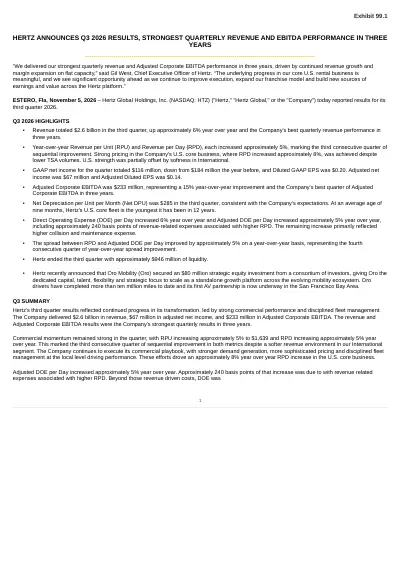
Adjusted corporate EBITDA was $233 million, up 15% from a year ago. This is our best quarterly EBITDA result in three years and our fourth consecutive quarter of year-over-year EBITDA growth.
We continue to drive revenue growth and margin expansion on flat capacity, and this quarter we saw particular strength in our underlying U.S. core business.
The transformation is working. From the beginning, we anchored our strategy on three priorities: revenue optimization, disciplined fleet management, and rigorous cost control.
We've made real progress on the first two: revenue and fleet. We rebuilt our commercial approach from demand generation to pricing.
In our core U.S. business, that gave us steady demand and pricing strength all quarter.
Our accelerated fleet rotation and end-to-end fleet management strategy turned our fleet from a headwind to a tailwind for the business. However, the third area, cost control, is where most of the work remains.
Elevated costs alongside softness in international are what led us to our adjusted corporate EBITDA shortfall this quarter. We knew this transformation wouldn't be linear, and this quarter showed that.
It does not change our approach. We stayed focused on what we can control, and Scott will go deeper into the financial impact and our expectations.
That is the bigger picture. We know where the execution needs to improve, and we are diligently actioning it.
The longer I'm in this industry, the more convinced I am that this is fundamentally a local business. We can build better fleet systems, pricing tools, and commercial capability centrally, but ultimately each market must get supply, demand, price, and cost right every day.
That is why we're pushing accountability closer to the customer, why we're increasingly focused on profitability at the location level, and why we believe franchising can become a much larger part of Hertz over time. Hertz's future also extends beyond our core rental business.
We see multiple opportunities to build on Hertz's capabilities and create new sources of growth across our platform. The recent investment in Oro Mobility is a proof point of the value our strategy can create.
Today I want to focus on both sides of the work ahead: improving execution today and building the right foundation for tomorrow. Turning to our third quarter performance, we continue to see the ongoing benefits of our commercial and fleet management strategies.
We are generating more revenue from our fleet, and our end-to-end buy right, hold right, and sell right approach to fleet management continues to deliver stability and depreciation. We're also making meaningful progress in customer experience.
In September, Net Promoter Score results in Europe and APAC were up nearly 11%. We achieved our highest Net Promoter Scores of the year at our North America airports, and that momentum is continuing into Q4, with October posting the highest global Net Promoter Scores in over six years.
Our investment in the brand and our product, coupled with an improved revenue management approach, is translating into quality demand generation and improved yield management and accelerating our commercial performance. Global revenue growth was driven by a 5.4% increase in RPD, with U.S.
RPD increasing 8%. We achieved this despite the macro environment, and even though TSA volumes were down 2.8% in Q3, underscoring the strength of demand for our brands.
As our transformation evolves, how we measure progress is evolving, too. Revenue growth matters, but ultimately it's about margin.
That is why we are focused on increasing the spread between RPD and DOE per day, which is our best measure of operating efficiency and drives margin expansion. Our spread increased by more than 5% this quarter.
Going forward, we are focused on more effectively offsetting operating and inflationary pressures and greater efficiency across the business and fleet. Our fleet management strategy is working as planned.
We're sitting on one of our youngest fleets in a dozen years. More than three quarters of our fleet is less than a year old, and these younger vehicles continue to outperform the broader used car market.
With the broader Manheim used vehicle value index was down 50 basis points in September, the rental value index was up 420 basis points, driven by improved values for younger vehicles. We remain disciplined on our model year '27 buys to ensure that unit economics, mix, and volumes continue to support our end-to-end strategy of maintaining consistent DPU while giving our customers more choice and a better experience.
We also continue to improve the efficiency of our vehicle disposition process by selling and monetizing faster, which reduces vehicle carrying cost and maximizes net proceeds through optimized channel mix. We also need to continue managing our fleet to produce the lowest economic cost.
That's best represented by DPU, which is below $300 this quarter, and we believe we can bring that number down even more next year. To address the last piece of the profitability equation, we need to better leverage our corporate overhead costs, which are currently elevated given the multiple initiatives that are underway as part of our transformation.
It is also critical this margin expansion philosophy down to the location level. For the company to improve overall margins, every location needs to focus on running its operations more efficiently and driving margin improvement.
This obviously connects to our strategy to drive a broader, enhanced franchise network. A local level focus is required in this business, and our franchisees do that very well.
We are already making good progress in this area. Last week we signed an agreement with our existing Baltic franchise partner to transition our company-owned locations in the Czech Republic and Slovakia to their management under a new franchise agreement.
That's just the start. We expect 2027 to produce a lot more progress across the globe in franchise expansion.
In October, we revitalized our Americas franchise conference, reaffirming our commitment to stronger relationships with our franchisees. These are quality operators who know their markets and who bring an entrepreneurial mindset to running profitable businesses.
It was great to see the positive energy in the room around our desire to have more of our locations run by outstanding operators like them. While our core rental business remains the economic foundation of Hertz, expanding margins is our first priority.
Hertz has capabilities that extend well beyond just renting cars. We increasingly see opportunities across all four areas of our platform: rental, fleet, service, and mobility.
We are putting dedicated leadership and accountability around each while allowing them to leverage Hertz's scale, infrastructure, and expertise. Over time, that creates the opportunity for multiple earnings and value streams while keeping our capital allocation disciplined.
Mobility is a great example of the value our platform can create. Six months ago, we introduced Oro, built around capabilities Hertz has developed over decades: buying, financing, maintaining, and operating vehicles at scale.
Today Oro is a standalone growth platform that just secured an $80 million investment. This investment gives Oro dedicated capital and greater flexibility to grow across its three business lines: driver-led fleet management, autonomous vehicle fleet management, and our rideshare rental business, which will transition to operating under the Oro brand.
Oro operates approximately 45,000 vehicles across its three business lines in every major U.S. mobility market, and Oro's employed drivers have logged over 10 million miles to date, up from 6 million miles in Q2.
In Q3, Oro officially launched its partnership with Uber's robotaxi program. AV depot operations are now underway in the San Francisco Bay Area, supporting Uber's fleet of Lucid vehicles equipped with Nuro autonomous technology.
Oro is still on track to deliver approximately $600 million in total revenue this year. The new capital will support investment in its fleet, operating infrastructure, technology, and people, as well as the expansion of its strategic partnerships.
Autonomous mobility develops and scales into what could be a multi-trillion dollar market, Oro is well-positioned to play an important role in that evolving ecosystem. Our focus is now continuing to build partnerships and capabilities that position Oro to capture that opportunity over time.
Oro's investment gives it the autonomy and agility of a standalone company, along with access to its own capital to pursue opportunities in the fast-moving mobility sector. Hertz will remain actively involved in Oro's fleet and corporate services provider, allowing them to continue leveraging our expertise and scale to support their growth.
Our majority economic interest in Oro ensures Hertz shareholders will share in any future success. In fleet, as one of the largest used car dealers in the country, we're advancing our Hertz Car Sales retail strategy to prioritize higher yielding digital channels and build on the scale of our used car operation and rental locations.
We recently launched Test Drive Plus, an enhanced iteration of our high-conversion Rent2Buy program at our neighborhood rental locations, built for a more modern customer experience. We're expanding our use of AI in lead management, customer communications, and reporting to improve efficiency and conversion to make buying a car simpler.
We're also building deeper strategic relationships with a select group of the nation's largest used car retailers. They buy in volume, which speeds up our sales, structurally lowers our cost of sale.
The aim is simple: sell cars faster, spend less to sell each one, and earn more on every vehicle. In service, we're starting to leverage the skills and capabilities that power our rental business to create new revenue streams and additional growth opportunities.
This includes areas like Hertz Logistics, our vehicle transportation service, where we have more than 5,000 drivers and 2,000 partner carriers moving vehicles each day to support our rental operations. We're now monetizing that capability with third-party customers by transporting vehicles for dealerships, fleet management companies, and retail customers, with approximately 50,000 third-party vehicle moves expected this year.
As we also make progress on our part-out initiative to leverage salvage vehicles not only for internal part consumption to lower costs, but also to sell used parts into the marketplace. There are a lot of positive initiatives underway at Hertz.
The team is focused and aligned on delivering. Our first priority remains improving execution and expanding margins in our core rental business.
At the same time, we're building a more capital-efficient company with greater local ownership, a larger franchise network, and new ways to put Hertz's capabilities to work. We won't get everything right every quarter, but the direction is clear, and we're making tangible progress on it.
With that, I'll turn it over to Sandeep to walk through our commercial performance.
Sandeep Dube
Thanks, Gil, and good morning, everyone. Our strong commercial performance continued in Q3, with global revenue, RPU, and RPD each growing approximately 5% for the third consecutive quarter.
Importantly, we expect this momentum to continue into Q4. In Q3, we delivered revenue of $2.6 billion, up 5.6%, and operational RPU up 4.7% to $1,639, and continued RPD strength.
RPD increased by 5.4%. That performance was driven by meaningful gains in our core U.S.
business, especially at U.S. airports, with RPD in each increasing approximately 8% despite lower TSA demand.
These gains were partially offset by the softer revenue environment in international. The improvement in our core U.S.
business was primarily a result of our work done in prior quarters to increase quality, durable demand. Improved pricing sophistication was a secondary factor, too.
Q3 is a peak seasonal travel quarter, and we saw expected strength around key summer holidays. That said, our Q3 performance wasn't driven by a single outsized weekend or temporary demand surge.
We saw consistent demand and pricing strength for our brands through July, August, and September. Combining that demand strength with fleet size restraint at the local level enabled us to deliver strong revenue performance.
In fact, we have now posted over 300 consecutive days of year-over-year RPD growth. This consistency demonstrates the strength of our commercial strategy and execution as we focus on those actions that are within our control.
International results were below our expectations due to the conflict in the Middle East and the resulting impact on inbound and intra-Europe travel. The team took early action on what we could control, thereby delivering an outcome with revenue up 1% and RPD down 60 basis points.
The key actions we took were repositioning our fleet to the right locations, combined with deploying demand-build tactics with customers and channels where we have more control, including growth in online direct revenue, small business customer segments, and multi-month rentals. On pricing and product, we have simplified car groups for better monetization and enhanced pricing for premium groups.
Globally, we also continue our customer-first focus, investing in a more consistent, convenient, and caring experience. We saw strong Net Promoter Scores in September in Europe, APAC, and our North American airports.
Looking ahead, we expect the revenue trajectory to strengthen from here, with expected year-over-year growth improving sequentially in Q4 after moderating somewhat in Q3. We are seeing encouraging early trends for the holiday season this year, with advance bookings up 7% for the Christmas-New Year's period and 16% for Thanksgiving.
Demand for our brands is healthy, and our commercial engine continues to strengthen. The momentum in customer experience continues to build as we make it golden for our customers and our employees.
We are seeing results from several initiatives we highlighted last quarter, with October Net Promoter Score improvements in every region and business segment across the globe. Looking ahead to 2027 and 2028, our commercial roadmap is already positioning us to drive meaningful gains.
After spending much of 2025 and 2026 catching up with the industry on commercial innovation, our roadmap is now designed to innovate faster and move beyond current industry capabilities in pricing sophistication, customer experience, and new products. Our objective is to build on our revenue momentum quarter after quarter and grow RPU faster than inflation, which will be critical to driving sustained margin expansion.
Today I want to focus on one of the key levers we are shaping to capture more value: product innovations that help shape customer behavior. Car rental customers have always been able to make cost-free ch—
Operator
Ladies and gentlemen, we are currently experiencing technical difficulties. Please stand by as we resolve the issue.
Thank you for your patience. We will now continue the call.
Management team, when you're ready, you may begin.
Sandeep Dube
Over the next several quarters, we intend to introduce new products built around this concept. This is just one example of how we are reworking our commercial economic engine to capture greater value, improve margins, and create a stronger growth trajectory for the business, while delivering greater value to our customers.
To summarize, demand for our brands is strong, and the industry pricing environment is supportive. Our actions, which include managing capacity locally with restraint, combined with our strong pipeline of commercial innovation initiatives, are within our control.
We believe we are on track to deliver a full year RPU above $1,500, and we expect to exit the year with an even higher annual run rate as our commercial roadmap positions us to build on this progress in 2027 and 2028. Our objective is to make commercial performance a significant driver of margin expansion by delivering RPU gains above cost inflation, largely powered by RPD improvements.
Now I'll hand it over to Scott to walk through our financial performance.
Scott Haralson
Thanks, Sandeep. Sounds like we had a bit of a technological issue there, but hopefully everybody is still on board.
Good morning, everyone. As Gil mentioned, there's been a lot happening at Hertz, and many of the initiatives we've been working on are accelerating in the second half of 2026.
We are simultaneously managing a business turnaround, a strategic transformation, and a complex balance sheet. We are making progress, but doing all three at once creates additional costs and puts additional demands on the organization that can obscure some of the underlying improvements in the core business.
We entered the second half expecting continued improvement in the core rental business, and we've seen that, particularly in the U.S., with strong RPD and stable residual values. At the same time, international demand and residual values have been softer, and certain costs across the business have run higher than we expected.
Some of the pressures we're experiencing are external, but others are ours to address. There is also economic friction inherent in transforming a company at this scale that isn't captured in a discrete adjustment to our reported results.
We're not going to create an adjusted number for that, but neither do we believe today's cost structure represents the steady-state economics of the business we are building. At the same time, this transformation cannot come at the expense of operating discipline.
It has to result in a simpler, more efficient, and more profitable Hertz, and that is the goal. Importantly, these initiatives build on one another.
Improving the core rental business, moving more of the network toward a capital-light franchise model, building value in mobility, generating free cash flow, and addressing our capital structure are all components of the same economic plan: the plan that creates a higher margin, more cash generative, and less capital-intensive Hertz, with multiple avenues for earnings and value creation and a stronger balance sheet. For decades, the rental car industry has largely been a single-engine business: deploy capital into a fleet, rent vehicles, and earn a return on that capital.
Over time, we are evolving into a business with multiple earnings and value streams. Core rental will remain the foundation, but we see meaningful opportunities to generate more capital-efficient earnings through franchise revenue, mobility, licensing, and strategic partnerships.
Oro is an example of that strategy in practice. The recently announced joint venture provides Oro with dedicated capital to pursue its growth opportunities, while Hertz retains the majority economic ownership.
The Oro joint venture will continue to be part of our consolidated financials, and beginning in Q4, we will add a minority interest line to our income statement. With that, let me walk you through the third quarter in more detail and then discuss the Q4 outlook and liquidity for the near term.
For Q3, we generated revenue of $2.6 billion, up 5.6%, driven by continued commercial momentum in the U.S. GAAP net income for the quarter was $116 million, and diluted GAAP EPS was 20 cents.
Adjusted net income was $67 million, and adjusted diluted earnings per share was 14 cents. Adjusted corporate EBITDA was $233 million, up $30 million year-over-year, and was our best quarterly result in three years.
It was also more than $40 million below the low end of our guidance. Let me walk you through the major drivers.
Global RPD increased 5.4%, with transaction days roughly flat. U.S.
RPD increased more than 8%. More importantly, we believe the RPD increase reflects more than the current pricing environment.
The demand generation initiatives we've put in place, together with changes to our pricing algorithms and segment and location-level optimization, are producing results that we believe have additional runway. We expect these trends to continue into Q4 and to remain an important contributor to the improvement in 2027.
While our U.S. business continues to improve, given continued lower TSA volumes, we're adjusting our U.S.
fleet capacity lower. At the same time, the international macro environment has weakened.
International RPD declined approximately 60 basis points year-over-year, and we are also experiencing softer international residual values, which increased global net DPU by approximately $5. All in, international results were approximately $30 million below our original expectations.
Much of that pressure appears macroeconomic, and ultimately we expect those markets to recover. We're not planning the business around the timing of that recovery.
We're actively reducing capacity across Europe and taking location-level actions to optimize profitability in the environment we have today. On the cost side, adjusted DOE per day increased approximately 5.5% year-over-year.
Approximately 240 basis points of that increase is due to more revenue-related expenses associated with higher RPD and was contemplated in our guidance. The largest incremental pressure came from collision and maintenance expenses, which ran approximately $15 million to $20 million above our expectations for the quarter.
We have experienced both higher collision frequency as well as impact from vehicle repair costs that have meaningfully increased, particularly for parts and repairs on newer vehicles. Given what we're seeing across fleet types and geographies, we are planning for repair costs to remain elevated.
That makes the work we're doing to manage the costs within our control even more important. On repairs, we're focused on reducing costs through better repair planning, greater use of internal capabilities, more effective sourcing and parts utilization, and improved work scope management.
In addition, in partnership with Samsara, we're investing in a unified maintenance system that will provide a more comprehensive view of fleet location and health, helping us better predict maintenance needs and optimize fleet planning and inventory parts management. Implementation is underway, and we expect to begin seeing results next year.
We're also continuing to drive labor productivity and vehicle utilization through a number of initiatives that includes increased automation through skip-the-counter and AI tools, enhanced labor planning, greater use of flex staffing, and process and technology improvements enabled by Daytona, our technology developed in partnership with Palantir to improve vehicle turn throughput and productivity that is beginning to deliver results. The other side of that equation is damage recovery.
While the vast majority of vehicles are returned undamaged, we incur roughly $200 million annually in unrecovered damage expense. We see a meaningful opportunity to improve that by collecting better insurance information, improved damage documentation, and creating a more effective recovery process, as well as pricing our insurance product offerings more effectively, all while maintaining a transparent and fair customer experience.
From an accounting perspective, an improvement in damage collections would generally be an increase to revenue, with gross repair expenses showing up in DOE. This is also why we increasingly look at the spread between RPD and DOE per day, rather than either metric in isolation.
Ultimately, what matters is our ability to grow the revenue generated from each rental day faster than the operating costs required to produce it. In Q3, the RPD to adjusted DOE per day spread improved by $1.36 globally, or 5.4% year-over-year.
In the U.S., the improvement was more than $2.50. That's progress, although candidly, we were pushing for more.
The underlying U.S. improvement was meaningful, but some of that benefit was offset by the pressures in international and the other cost areas I just described.
Net DPU for the quarter was $285 per month, consistent with our previous views. We continue to see reasonable pricing in our model year 2027 fleet purchases, although total volumes remain somewhat uncertain.
Our fleet remains young, which gives us flexibility as we progress through the 2027 fleet buying cycle. SG&A increased $15 million, primarily due to higher sales and marketing expenses.
As a percentage of revenue, SG&A was 9.8%, nearly flat year-over-year. On capacity, our fleet and transaction days were both roughly flat year-over-year, and recall activity improved year-over-year in line with our expectations, albeit still elevated versus normal levels.
We ended the quarter with $946 million of liquidity, including cash and cash equivalents and available capacity under our revolving credit facility. Looking ahead, another key area of opportunity is driving profitability at the location and transaction level.
We need to be diligent that the rentals we accept and the locations we manage all justify the capital it takes to operate them. We're becoming more aggressive about strategically reallocating fleet towards markets, channels, and customers where we can generate attractive returns, and thus reducing unprofitable volume and underperforming locations.
While that approach could result in a smaller fleet and fewer transaction days in Q4 and into 2027, we're comfortable with that trade if it produces better margins and stronger returns on capital. We will continue to consider the value of the overall network, but ultimately every location and part of the business has to earn an appropriate return.
The same capital discipline we're applying to Hertz at the enterprise level needs to exist at the local level. We're not trying to maximize fleet size or rental days.
We're trying to maximize profitable rental days and the return we generate on the capital deployed to produce them. Turning to Q4, we expect the core U.S.
business to remain strong, while international markets are likely to remain pressured. Global RPD is expected to increase mid-single digits.
In total, we expect adjusted corporate EBITDA to be in the -$50 million to -$100 million range. This is lower than our prior expectations due to the previously mentioned softness in international markets, lower TSA volumes, as well as elevated collision and maintenance costs.
The midpoint is more than $100 million better year-over-year. Net DPU is also expected to be slightly higher than our previous expectations, but should be in the $290 to $300 range for the quarter.
The higher range is due to losses on the higher volume of vehicles we expect to sell in the quarter. Also, as we scale Oro, we're evaluating its fleet strategy to ensure its fleet is best aligned with needs and economics of the business going forward.
That work remains ongoing, and we are still evaluating the timing and potential impact. We continue to believe Oro will be an important contributor to our growth over time, and getting the fleet right will be an important part of realizing that opportunity.
Now looking ahead to 2027, despite the near-term pressures we're describing, our view of the earnings opportunity remains significant. We expect adjusted corporate EBITDA to be in the range of $500 million to $800 million for next year.
The middle of this range is similar to our prior views of 2027 being at least cash flow break-even. The major drivers of the year-over-year improvement for 2027 are straightforward: it's about widening the spread between RPD and DOE per day, lowering DPU as we improve total fleet economics, and leveraging SG&A as the business streamlines.
Those are the key levers that will allow us to convert capacity discipline into higher margins and stronger returns. We also expect to make meaningful progress toward a larger franchise mix that should enhance the capital efficiency and liquidity profile of the business.
However, the timing and transaction details of individual franchise transactions can make the EBITDA as well as the liquidity impact difficult to forecast precisely. As a result, our current 2027 adjusted corporate EBITDA outlook does not assume any impact from additional franchise conversions or expansion.
However, we expect to see the liquidity benefits of our franchise conversions likely beginning in late Q1 or early Q2. More importantly, we do believe that we could potentially see more than $500 million of proceeds in the year from these conversions.
Now let me back up and spend a minute on liquidity, primarily Q4 and the early part of 2027, because I know that's an important topic. Given our expected EBITDA performance in the second half of 2026, we now expect to finish the year with approximately $800 million of liquidity, compared to our previous view of approximately $1 billion.
This again does not include any strategic transactions. Importantly, this outlook continues to include the repayment of the $200 million of bonds maturing in early December.
We remain committed to the ongoing actions to manage liquidity, including sale-leasebacks of certain owned properties and operating a somewhat smaller fleet. Plus, we are also evaluating opportunities to manage fleet investments more evenly throughout the year, which could reduce the seasonal pressure on liquidity while simplifying fleet and rental operations.
Taking these factors together, we believe we have sufficient liquidity to operate the business while continuing to execute our strategic priorities. Lastly, as we discussed last quarter, we remain focused on increasing flexibility in our capital structure and upcoming debt maturities.
While we don't have any additional updates to share with you today, we hope to have additional information to share with you on or before our next earnings call. Stepping back, we know there is more work to do, but we should also recognize the progress we've made.
We've accomplished a lot in a relatively short period of time, and many of the changes we've made are still early in their impact. I believe the value of that work will become increasingly evident as we move forward.
We have real momentum, and I'm excited about the opportunity ahead. Back to you, Gil.
Gil West
Thanks, Scott. We shared over the last few quarters, we're building Hertz for the long term: strengthening the core today while innovating for the future.
We have a strong foundation heading into 2027, and the underlying momentum in the business continues to build. We continue to reap the compounding benefits of our multi-year transformation strategy.
There's still work to do as we move forward and seize the opportunities in front of us. Stepping back, the trajectory is clear, the business is improving, and we remain confident in the path ahead.
With that, I'd like to open it up for questions.
Operator
We will now begin the question-and-answer session. Please limit yourself to one question and one follow-up.
If you would like to ask a question, please press star one to raise your hand. To withdraw your question, press star one again.
We ask that you pick up your handset when asking a question to allow for optimum sound quality. If you are muted locally, please remember to unmute your device.
Please stand by while we compile the Q&A roster. Your first question comes from Chris Woronka with Deutsche Bank.
Chris, your line is open. Please go ahead.
Chris Woronka
Thanks, and hey, good morning, guys. Appreciate all the details so far.
You covered a lot of ground. First question is kind of I guess on your outlook, and appreciate that initial EBITDA guidance for '27.
Could you maybe give us a bridge from '26 and maybe some thoughts on how aggressive or conservative you are to get to the high end or the low end? I guess, what would you consider to be some of the risks and opportunities to that guidance?
Then I'll have a follow-up. Thanks.
Gil West
Okay. I'll start, but thanks, Chris.
Appreciate the question. I'm sure Scott will want to dive in here.
Where I would first start is look, I just want to reaffirm we see a path to a billion dollars plus of EBITDA, and we're aggressively pursuing that. We've said it before, but say it again: a billion dollars is not uncharted waters.
We've been there in the past. Certainly others in the industry have achieved that level of performance.
It's clearly achievable. We view it not as a matter if we can get there or not; it's really when we get there.
The path we see is continuing to build on our fleet and commercial momentum that we've talked about, increasing the RPD-DOE spread, managing SG&A, and then there's upside as we see it from the platforms we have like Oro. To kind of think about the '27 estimate and that bridge you mentioned, and again, I'm sure Scott will want to comment, but I think, one, we're reflecting the reality of a smaller fleet and then kind of some continued headwinds in there with the international macro and some inflationary cost pressures.
In terms of the building blocks and to kind of hit the margins we're after, achieve the targets, there's some really big levers left that I would just highlight. First, I would call it core turnaround, but there's compounding benefits of the underlying momentum that we have in the core business, and not just the commercial and fleet momentum.
Our year-to-date results, if you think about it, we've carried headwinds throughout the years on a variety of things, recalls, but they're bad debt, tolling, collections, and collisions, and the list can go on. Those headwinds are in our numbers, but we've continued to execute and action those things throughout the year.
We've got better near-term run rates. Let me say it that way.
We believe our core run rates already closer to our '27 targets. Second big lever is commercial, right, the commercial RPU momentum and growth through stronger pricing and stronger utilization.
Sandeep did a nice job talking about the commercial strategies. I would just point out we're still in the early innings of seeing the results from executing the commercial strategies.
Third thing we talked about is the RPD-DOE expansion, right, continued pricing increases and DOE reduction. There's a long long runway of cost initiatives we continue to action.
Again, Scott said it earlier, and I'll just reaffirm it, we see a significant opportunity in manage our business better locally to optimize the supply, demand, pricing, and ultimately just get those microeconomics right at a market level. Then of course, fleet, we talked about we've still got a number of levers on fleet.
We'll exit the remainder of our older vehicles, which carry a much higher DPU. We'll monetize the younger fleet we have.
The model year '25 and '26 vehicles been performing very well in the market. Our model year '27 buys, the unit economics have landed.
The bottom line is the end-to-end strategy that we've talked about—buy right, hold right, sell right—it's working, but we continue to refine that, right? It's certainly not perfect, and there's plenty of opportunities to keep actioning that.
Then last but not least on the fleet is kind of selling through more lucrative sales channels. We've talked a lot about that in the past, but we really think it gives us more net, but also equally important is it reduces the sales vehicles' work in process, right?
These are vehicles held out for sale. As we attack both those, it's big leverage.
SG&A, Scott pointed out previously. Then finally, we just see upside from our platform.
Oro is an example. Scott, I know I rambled, but I'm sure you want to touch on some things.
Scott Haralson
No, I think you covered all that, Gil. Look, I think in summary, it's not just a cost story, even though we're focused on cost.
There's movement in RPD, DOE per day. We think there's real progress on DPU, although that's been a bright spot, there's still more room to run.
I think we're going to see margin expansion in all of the categories. I think we're excited about it.
Honestly, I think that Gil pointed to local-level profitability, but it also centers around simplifying the business. We've been doing a lot, we mentioned that casually in the comments, but we've created probably operational complexity doing so much.
Part of what we have to do as a management team is make sure we simplify the business and make it easy for the operators to execute on a lot of initiatives, trying to make sure we simplify and calm down the chaos. We left some efficiency on the table, probably in the year, and we're working towards making sure we capture all that as we go forward.
A lot of good opportunity. We're excited about where the business is going, but thanks, Chris.
Chris Woronka
Sure. Thanks, guys, for the color.
As a follow-up, was hoping we could spend a minute on kind of the debt, the capital stack, and upcoming maturities. It sounds like, maybe based on your prepared comments, you guys might be kind of limited on what you could say.
Is there anything you can share about upcoming maturities, and if not, when we might be able to reasonably expect some kind of update? Thanks.
Scott Haralson
Thanks, Chris. I know that's an important topic.
As I mentioned in the prepared remarks, we don't have any updates to share with you yet today on the upcoming bond maturities. Again, we do remain focused on it, obviously, and we hope to discuss more on the topic on or before our next earnings call.
I hope you give us a little leeway there.
Chris Woronka
Thanks. Yep.
Operator
Your next question comes from the line of Rajat Gupta with JPMorgan Chase. Rajat, your line is open.
Please go ahead.
Rajat Gupta
Great. Thanks for taking the questions.
I was curious, had a more broader question on just AI and agentic AI. I'm curious how you're adjusting your business and your processes as we see more and more agentic-driven shopping and price comparisons.
I'm curious if you see any risk to pricing in the industry as that proliferates, and how do you plan to navigate that or change some of your strategies, maybe including cancellation fees, etc.? I have a quick follow-up.
Sandeep Dube
Rajat, this is Sandeep here. Great question.
Just overall commercially, we've moved from a stage where, instead of being maybe on the back foot of innovation, and we've been on the front foot now, and broad scale are moving more into cutting edge, right? Just overarching across commercial strategies.
When it comes specific to AI and agentic-based, especially I'm going to use the term demand generation, right, across the board, that's something that we've been working on and focused on, I'd say, since Q4 of last year, right? It's been almost a year's worth of work on that.
Again, very early innings, right? When we look at actual reservations that are coming through in the industry overall, it's a small percentage of what's coming through right now.
That being said, there's more than likely going to be a hockey stick moment in terms of that demand picking up. Keeping that in mind, we are I'm going to use the term aggressively and actively partnering with all the various agentic partners out there and building close relationships and making sure that we have all the right first of all relationships, that's super critical and important, but also our tech team is very clearly tied in on that to ensure that we keep being on the forefront of that.
Now you brought up a very important point, which is, okay, what's the implication on pricing, especially around cancellation? I think the industry is ripe overall, and we are on the front foot.
We're going to be on the front foot of that in terms of taking a look at essentially the overall cancellation policy, right? I referred a little bit to it in my prepared remarks where we talked about the airline industry and compared and contrasted it with what's happening in the rental car industry, right?
There's a component where there's maybe too much flexibility in our products today. I think that's going to be a focus of ours.
We've been working on it over the past few quarters. You'll see some progression from us on that bit.
I think that's going to be good not just when it comes to business from an agentic perspective in future, but broad scale for the business. I think there's a lot of value leakage that's happening, and we'll create the right balance in terms of flexibility for the customer versus the economics of the business.
I think, yeah, but we're excited about the progress here.
Rajat Gupta
Understood, yeah. Thanks for all that color.
Just to follow up on just the 2027 puts and takes, if I heard correctly, I think you were suggesting transaction days could likely be down, you're reducing your fleet. I'm curious how do you manage opex in that scenario given some of the potential deleveraging that could come with that?
Are there going to be some more aggressive cost actions? Does some of that get resolved with the franchise agreements?
Hoping to just double-click on that. Thanks.
Scott Haralson
Hey, Rajat. I'll start, and maybe Sandeep and Gil both want to chime in here.
Look, I think it's about optimizing our capacity and going after rental days that are profitable for the business. That might mean we actually think through culling of specific days, locations even, and all that is actually intended to drive operational efficiency.
As I mentioned before, we do some things that might create complexities for the business, and some of these things will calm things down a bit for us. We do expect our ability to plan the business better, think about demand at a different level.
All of those things should drive efficiency in the business. We don't view it as necessarily a scale problem, which it kind of implies you were kind of getting at that issue around as we reduce days.
We actually think it will drive margin for us as we think about the spread, the RPD to DOE per day spread, ultimately it enhances that particular metric for us.
Gil West
I would just add, yeah, I think we also attack costs on both levers, right? The traditional DOE expenses, inflationary pressures we've been talking about, there's a whole subset of actions around those things.
There are also levers that the team has done a nice job driving productivity, as an example, but there's still tremendous opportunities there. The more traditional costs, supply chain actions, all these things, we've got a variety of initiatives around.
Your point's fair about scale, right? Scale certainly helps you on a unit rate basis.
We'll keep pushing UTE, by the way, and to get additional days with smaller fleet. The other side of the equation just to recognize is revenue-related costs, right?
It's certainly been a headwind for us. We're not victims in that, though.
There's opportunities to reduce revenue-related costs, and we look for ways to do that. We see we've got levers.
We know we got work to do on the cost standpoint. We'd experience inflation, and we've got to pull the levers to offset that.
Ultimately it's about increasing the spread in the margin, pricing's another way to do that.
Rajat Gupta
Understood. Thanks for all the color, and good luck.
Gil West
Thank you.
Rajat Gupta
Thank you.
Operator
Your last question comes from the line of Stephanie Moore with Jefferies. Stephanie, your line is open.
Please go ahead. As a reminder, please unmute your device locally.
Your next question, and last question. There are no more time for questions.
Thank you so much. This concludes today's call.
Thank you for attending. You may now disconnect.