Huntsman Corporation
Q3 FY2026 · Earnings Call TranscriptNovember 3, 2026
Operator
Greetings, and welcome to the Huntsman third quarter 2026 earnings call. At this time, all participants are in a listen-only mode.
A question-and-answer session will follow the formal presentation. If anyone should require operator assistance during the teleconference, please press star zero on your telephone keypad.
Please note, this conference is being recorded. I will now turn the conference over to Ivan Marcuse, Vice President of Investor Relations and Corporate Development at Huntsman.
Thank you. Ivan, you may begin.
Ivan Marcuse
Thank you, Jasmyn, and good morning, everyone. Welcome to Huntsman's third quarter 2026 earnings call.
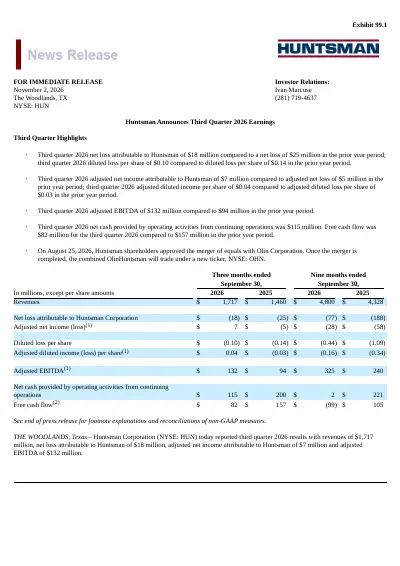
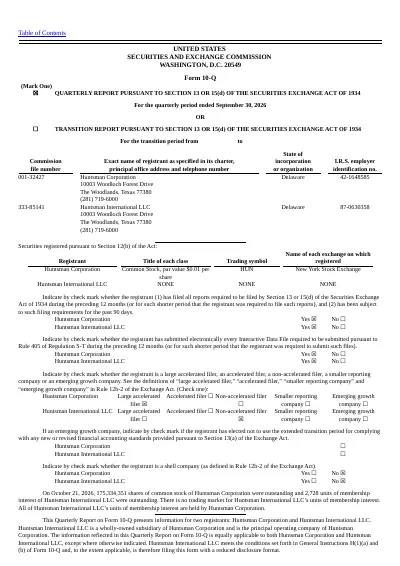
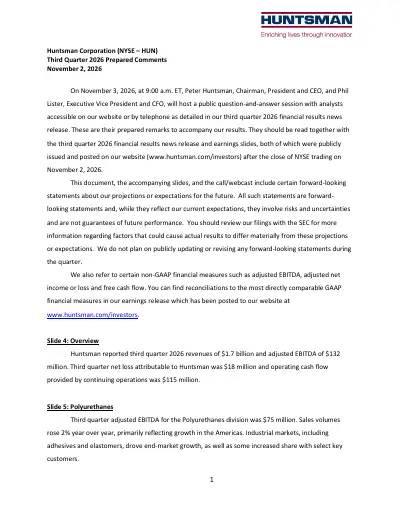
Joining us on the call today are Peter Huntsman, Chairman, CEO, and President; and Phil Lister, Executive Vice President and CFO. Yesterday, November 2nd, 2026, we released our earnings for the third quarter 2026 via press release and posted it on our website at huntsman.com.
We also posted a set of slides and detailed commentary discussing the third quarter 2026 on our website. Peter Huntsman will provide some opening comments shortly, and we will then move into question-and-answer session for the remainder of the call.
During the call, let me remind you that we may make statements about our projections or expectations for the future. All such statements are forward-looking statements, and while they reflect current expectations, they involve risks and uncertainties and are not guarantees of future performance.
You should review our filings with the SEC for more information regarding the factors that could cause actual results to differ materially from these projections or expectations. We do not plan on publicly updating or revising any forward-looking statements during the call.
We will also refer to non-GAAP financial measures, such as adjusted EBITDA, adjusted net income or loss, and free cash flow. You can find reconciliations to the most directly comparable GAAP financial measures in our earnings release, which has been posted to our website at huntsman.com.
I'll now turn the call over to Peter Huntsman.
Peter Huntsman
Ivan, thank you very much. I'd like to take a few minutes and discuss some of the observations as we come to the end of 2026 and prepare to enter 2027.
For each of the past four years, whether a war in Ukraine, Liberation Day, trade disputes, or Middle East conflicts, it seems that something happens that sinks consumer confidence and slows housing starts. This year was no different.
Between higher energy prices and interest and mortgage rates, housing starts had a very rough year. While hope springs eternal, especially this next spring, we continue to be concerned about the potential impact of higher mortgage rates over the next few months.
China seems to be overly reliant on exports as consumer spending and confidence continues to show little growth. Europe continues to be hit with near record high energy prices due to disastrous energy policies, higher interest costs on their national debts, and civil unrest as the effects of long-term deindustrialization and social instability take their toll.
The global chemical industry is certainly feeling the impact, in varying degrees, from all these macroeconomic forces. I'm proud, though, that in spite of all these challenges, our focus on cost, pricing, and operating discipline are paying off, as we will see better than $100 million of improvement in our 2026 EBITDA versus our 2025 performance.
We need to be able to do more than simply wait around for times to get better, as we may well be in this for another year or so of challenging headwinds. For this purpose, I'm heartened to see that we will soon be able to complete our merger of equals with Olin Corporation and derive the benefits that will improve both of our companies should these challenges persist for another year.
Through 2027 and the years that follow, Olin Huntsman will be in a unique position to focus on three broad areas that will create greater value together than if we were apart. Together, we will soon be rapidly executing synergies of $300 million, with an additional $100 million coming as chlorine contracts expire.
Our teams have been actively engaged and are ready to start. Second, we will have a much broader base of assets that will allow us to aggressively review a larger portfolio.
This will give us greater flexibility to manage our balance sheet and pursue areas of growth within our combined businesses. Thirdly, greater integration and supply chains that stretch from salt to aerospace to electronics will give us a better cost base to compete globally.
Our stronger and larger footprint in North America positions us where energy costs and raw materials are most competitive. In Europe, we will continue to build out areas where we see growth and strong margins, such as aerospace, EV battery materials, and power grid applications.
Where we are struggling in Europe, we will have greater leverage to source raw materials and access to markets. We have a multi-billion-dollar business in Asia that is very profitable and will continue to provide new avenues for growth in the combined company.
In short, regardless of where market conditions take us this next year, we will be in a position to prosper and improve value that had we remained on our own, we would not have been able to achieve. When the inevitable return happens in housing and durable goods in North America, the combined company is set to create enormous value as a market leader in multiple fields.
This is an opportune time for consolidation and synergies to take place. We anticipate closing this merger early next year.
When we do, we will be creating a new, larger, and fast-changing industry leader and look forward to the opportunities that will be before us. Operator, at this time, why don't we open the line up for any questions?
Operator
Thank you. We will now be conducting a question-and-answer session.
We ask that you please limit yourself to one question and one follow-up. If you would like to ask a question, please press star one on your telephone keypad.
A confirmation tone will indicate your line is in the question queue. You may press star two if you would like to remove your question from the queue.
For participants using speaker equipment, it may be necessary to pick up your handset before pressing the star keys. One moment, please, while we poll for questions.
Our first question is from Frank Mitsch with Fermium Research. Please proceed with your question.
Frank Mitsch
Thank you, and good morning. Peter, if this happens to be the last Huntsman conference call, which very well may be depending on when you close the transaction, just wanted to say I appreciated the commentaries over the years with respect to the chemical industry and for Huntsman.
Also, I must say I did find your historical factoids very educational when you were explaining the 1794 Whiskey Rebellion, etc. I did want to offer my thanks publicly for all that.
In terms of what's going on, listen, in the prepared commentary, there was a comment regarding the impact of new MDI capacity on the US market. I was wondering if you could characterize the current market and the near and midterm outlook for MDI, particularly here in the US.
Peter Huntsman
Frank, thank you very much for those kind words. I'm still hoping to be able to find an ancestor that participated in the Whiskey Rebellion and hopefully was on the front lines of the fast-changing technology to bourbon, but who knows?
Great question. I think that we have basically three or four issues that we're facing right now, and I don't want to put too much on additional capacity.
I do think the single biggest issue we'll be seeing in the fourth quarter in North America, unlike Europe where it'll be headwinds on raw material pricing, will be just a typical seasonality. We are shocked every year in December when this phenomenon occurs called Christmas that seems to slow everything down.
Having said that, I think with higher costs of raw material, we're not seeing it yet, but we may well see that people are anxious to cut inventories because of the high costs of raw materials, and we may see the impact of that. Fourth quarter seasonality is going to be an issue.
One other area is we are seeing a cutback over the last year of less imports coming into North America. I think that will probably be a good tailwind should that continue for North American producers.
Of course, look, when you don't have a lot of industrial growth because of the sluggish housing market, the last thing the industry needs is new capacity being dumped into it. That's something that we have to put up with usually somewhere around the world at any given point.
We can hardly use that as an excuse. We need to continue to be focused on generating cash, on getting margins to expand, and looking for technological opportunities, and are going to be the three main focuses of Huntsman in the fourth quarter.
Frank Mitsch
That's very helpful. Much appreciated.
Then listen, I know the transaction hasn't closed yet, but in terms of the conversations that Olin and Huntsman have had pre-integration, I'm wondering if there have been any positive or negative surprises, and particularly looking to see the thoughts on the near-term $300 million of synergies, and then, obviously, the $100 million coming in 2030. Any comments that you could provide there?
Peter Huntsman
No, look, I believe that, as this isn't our first attempt at an MOE, that it is much easier to do it where you have cultural overlaps and similarities. In this case, one has an office in Spring, Texas, the other in The Woodlands, and I think the communications and the cooperation between the two have been outstanding.
I would say that when we first came up with the $300 million number, I felt pretty good about it, but I wouldn't say that there was a lot of data that went behind it. We were throwing out a lot of broader estimates and numbers.
Since that time, I feel very, very confident about it. Initially, I think it was more of a target as an objective.
Right now, we have very clear lines of responsibility, areas of execution, timing, group leadership, and so forth, and I would dare say that there's not a day that goes by where we don't have multiple people engage where we can legally engage at this point to further discuss that and look for additional synergies. I feel very good about where we are right now.
Operator
Our next question is from Patrick Cunningham with Citi. Please proceed with your question.
Patrick Cunningham
Hi, good morning. Maybe just on European polyurethanes, you talked about it being EBITDA positive for the quarter, obviously still a very challenging environment.
You've done a lot of restructuring work in that business, but how do you position that business if we have another sluggish demand environment, volatile variable cost structure? Is there more to be done there from a cost takeout perspective, or is this just a function of price discipline and where you source raw materials from going forward?
Peter Huntsman
I think that we need to continue to look at all of the opportunities that are before us, and we need to make sure that we calibrate the business around the market needs and expectations. Certainly with the Olin Huntsman merger that is coming, I think that we're going to be in a better opportunity from raw materials to be able to access perhaps better raw materials, better economics, and so forth.
We need to, at the end of the day, remain focused on growth. Where do we have new opportunities?
We saw growth in Europe this last year over the prior year of greater than 10% in our automotive applications. That's not because they're building 10% greater number of cars, it's because we're finding new applications in automobiles.
When we talk about growth, we need to continue to look at our fixed cost and make sure that our customers are either paying for the services that we're giving them or we're going to have to cut those services further, and we need to look at our variable costs and how do we get around those, how do we improve those. Longer term, how do we position the business, especially as contracts expire that were done four or five years ago before Europe has really fallen into this mass suicide of deindustrialization, how do we focus on those things?
Look, I know I've been an outspoken critic of Europe, and I think that they certainly have earned that criticism. There are a number of areas in Europe, when we look at aerospace, we look at building out the power grid, we look at EV vehicles, I just mentioned, here we are in MDI talking about seeing double-digit growth year-over-year in some of these applications.
There are opportunities in Europe. Europe is going to continue to innovate, it's going to continue to capitalize on lightweight materials and so forth, and we need to make sure that we're investing in the right areas and that we're focused.
At the same time, we need to exit certain areas that are going to be energy-intensive, that are going to be areas that will be leaving Europe, and so Europe still remains the world's second-largest MDI market after China, and we need to make sure we capitalize on that.
Patrick Cunningham
Very helpful. Then maybe just on advanced materials, you already talked a bit about aerospace, grid infrastructure.
I guess, given this strong level of growth, what is your sort of expectations for growth rates in 2027, what sort of operating leverage you should have there, and how sustainable are these rates without requiring additional capital
Peter Huntsman
expenditure? I think, first of all, I think that what we're seeing today really is the fruits of investments that were made two years ago, three years ago.
We did some large investments, we broadened our technology, our application, our know-how. I think that those investments, oftentimes in a more commoditized business, when you make acquisitions and when you invest in R&D, you have a tendency to see results in two or three quarters.
Advanced Materials is a little bit of a different division. Sometimes it'll take a year or two to get qualified.
Sometimes it'll take a year just to be able to get in the door to get qualified on something like aerospace. If somebody were entering today to try to displace us in aerospace, I would dare say you're waiting out five to six, seven years in some applications to even begin to compete.
What we see today, I believe, is more than just a decent quarter. It is what we've invested through acquisitions and through deployment of capital a couple of years back.
We're seeing that. I would expect through 2027 that we're going to continue to see GDP-plus sort of growth and opportunity.
Operator
Our next question is from David Begleiter with Deutsche Bank. Please proceed with your question.
David Begleiter
Thank you. Good morning.
Peter, just on the MDI capacity in North America, I know you didn't want to comment on it, but how is the industry market absorbing this new supply that we're seeing, and what do you expect to happen in 2027 as an industry, if there's no demand inflection, how the industry deals with this new supply?
Peter Huntsman
I'd say it's probably going to be a bumpy transitory time as you'll see this new supply will be replacing what has traditionally been imported materials coming in and so forth. Look, not every customer out there is just looking for necessarily a lower price.
Innovation does pay off. Good service does pay off.
Reliability does pay off. Again, I don't want to put too much emphasis on capacity utilization.
It's got to be around a focus on growth, your fixed costs, your variable costs, and how you run the business.
David Begleiter
Thank you. Just your thoughts on the industry broader.
Peter, always appreciate your thoughts here. The Olin Huntsman merger looks pretty compelling, makes a lot of sense.
Why has the industry not taking your lead given the pressures we're seeing, and seen further M&A moving forward here? What's holding back, do you think the broader industry from doing what you guys are doing right now?
Peter Huntsman
David, that's an excellent question. I will say that if I had to pick somebody in the industry that we could merge with in a merger of equals, to some degree, you do have a limited field, and you do have who is available and who is interested to do a merger of equals.
Just because we're saying, well, Company X would be a great fit for Huntsman, or Huntsman may be a great fit for Company X, doesn't mean that the timing is right, management is right, and everything else. As we look at Olin, I will just say that when we look at the integration, particularly on the supply chain integration, and Huntsman's desire to be more competitive on the upstream side, that integration into everything from caustic to chlorine, VCM, and so forth, EDC, being able to move up to that, aside from benzene, and if we were to integrate ourselves to a benzene producer, you're probably integrating yourself with a refiner, right?
In my opinion, that doesn't make a lot of sense. Olin makes the most sense from a pure molecular point of view.
When I look at it from a management and a cultural point of view, as I said earlier, I've been more than surprised at the fit, the relationship that Ken Lane and I have built, that our respective teams going down the lines have built, and that's going to be demonstrated, I think, very well once you have a closing take place. Why these things don't take place more often, it's a very good question.
We need it in this industry. As I've said in the past, we compete more against countries than we do companies.
We compete against national interests in trade policies than we do against specific products and pricing. As you start looking at the Middle East and the lack of what has been in the past a very stable region of supply, the volatility that's coming from the Middle East, you look at the trade winds and so forth that are coming from China, it's going to continue to be a tumultuous market.
I think size and geographic location is going to matter.
Operator
Our next question is from Aleksey Yefremov with Barclays. Please proceed with your question.
Aleksey Yefremov
Good morning, everyone. Peter, as I'm sure European Commission is discussing more robust trade protection measures specifically for the chemicals industry.
Do you think it will make a difference overall in and for your business in particular?
Peter Huntsman
I think in certain areas, we're going to see some opportunity perhaps, especially in epoxies coming in from Europe. Look, let's be honest, Europe needs to be protecting its chemical industry, but more than protecting its chemical industry, it costs more in tariffs and costs to go country-to-country within Europe than it does to go from Europe to the US.
Europe needs to reform Europe, and Europe needs to get an energy policy that's going to incentivize and is going to advantage the chemical, the steel, the glass, the cement, manufacturing across the board. I'm glad to see them taking a position in some of these areas where they find that there's unfair trade, but it needs a lot more than just a tariff here and there.
Aleksey Yefremov
Thank you, Peter. Maybe as a follow-up, you mentioned energy.
This could be a tough winter in Europe energy-wise. How are you managing this at Huntsman?
Could you see I don't know, asset shutdowns, as you see in some other industries, and maybe if not Huntsman, could you see your competitors shut down assets in MDI or some other products that you care about?
Peter Huntsman
We continue on a regular basis, and that's on a weekly, daily basis, to look at not just our own assets, but the assets of our suppliers and of their suppliers. We may be in a great position where we're making money in a product line, but if our suppliers are on the brink of shutting down, or their suppliers on the brink of shutting down, we need to make sure that we understand that.
We need to stay focused in those areas. We need to continue to work with our suppliers even in areas where we've got relationships and contracts with our suppliers.
We have found that some of our suppliers have been willing to give us discounts today to extend contract terms going into the future. How can we take pressure off of the issues today?
When you're talking about $34, $35 per MMBtu gas, mind you, that's 20 times, 20 times higher than what we're seeing in West Texas and along the Houston Ship Channel. That's just astronomical.
At the end of the day, we can talk as much as we want to about short-term issues. We've got to get prices up to be able to offset and to mitigate these sort of costs coming through.
At the end of the day, it's going to boil down to price discipline. We've led seven prices this past year, and we've been successful on some of those, others of them, the industry is not supportive of them, but we need to continue to push for pricing at the end of the day.
Operator
Our next question is from Jeff Zekauskas with J.P. Morgan.
Please proceed with your question.
Jeff Zekauskas
Thanks very much. For the nine months, Huntsman has delivered minimal cash flow, you're sort of cash flow breakeven.
Are you going to be able to cover your dividends and capital expenditures with operating cash flow this year?
Phil Lister
Jeff, it's Phil. Capex, we've said we expect to spend about $160 million this year.
Free cash flow was an inflow in the third quarter of $82 million. You're right where we sit today.
There will be a large working capital unwind in the fourth quarter, and our cash conversion cycle declined year-on-year, and I expect it to decline again Q3 to Q4, and Q4 versus Q4 last year. It's true that working capital has been difficult this year with an elevated pricing raw material market, but I remain confident that we'll be able to cover our dividend for the full year and have a substantial cash inflow in the fourth quarter.
Jeff Zekauskas
Interest rates, if you look at the 10-year rate, we're now at 4.9%, and maybe for the year, we've averaged 4.5%, and last year, we were at 4.2%. Given the interest rate environment, when you look at MDI volumes for 2027, if things stay where we are now, should the MDI industry grow at a slower rate in '27 than it did in '26?
How fast did it grow in '26, or how fast is it growing?
Peter Huntsman
Jeff, I think that as we look at '26 into '27, you're probably looking at I would say probably flat conditions or maybe similar to what we saw in '26, which was an industry growth rate of about 2%. Look, interest rates are up.
Mortgage rates are up. If you look at them on a 50-year basis, the average interest rate today is exactly where it has been on an average since the early 1970s.
This is about the industry not waiting for interest rates to go back to 2% or 3% or 4%, because I don't know if they will ever do that, but the industry having to adapt. Probably be building smaller homes, homes with less basements, more townhouses rather than individual homes, and we're hearing that from our construction customers, we're starting to see those sort of trends, and starter homes, they've got to come down in price if interest rates aren't going to happen.
That's not going to happen overnight, may not even happen in a year, but I think that as you start seeing where building costs start to plateau and come down, incentives start to be put into place, and so forth, I think it's more of how does the industry adapt to these interest rates and mortgage rates, which are really more normal than abnormal at this point.
Operator
Our next question is Mike Harrison with Seaport Research Partners. Please proceed with your question.
Mike Harrison
Hi, good morning. Was hoping that you could talk a little bit about what you're seeing in this spray foam insulation market given that underlying construction and renovation activity still remains soft.
I'm curious, are you still capturing your fair share of growth in spray foam, or are you seeing that there are more competitors in this space, maybe starting to impact volumes and margins?
Peter Huntsman
North America, which is our largest market, and I'm talking about both spray foam and insulation, so that's not just when you spray foam when a house is being remodeled or constructed, but also insulation panels and so forth. Look, that industry is being hit just like the rest of the construction industry.
As we look at our numbers from the prior year, we're still up low single-digit numbers from the prior year, and year-to-date, we're still up single-digit numbers. Again, longer term, until you start to see a real turnaround in housing and so forth, you're not going to see real substantial growth like we saw a couple of years ago where you're seeing pushing 10% growth.
Mike Harrison
All right. Then in the Advanced Materials business, you said you expect power to be growing through the end of the decade, and I think you mentioned the need for some targeted growth investments.
Are you guys capacity constrained anywhere today? Maybe just give us a sense of how you see the need for additional capacity playing out.
Peter Huntsman
We have got plenty of capacity, and if anybody out there wants any more product, we're willing to sell it to them.
Operator
Our next question is from Josh Spector with UBS. Please proceed with your question.
Josh Spector
Hi. Good morning.
I'd be curious where divestments stand on the priority stack as you look at Olin Huntsman next year. I imagine six, seven months ago, that was kind of optionality.
In your mind, is that a little bit more of maybe a must-do to try to delever, and just thinking how you prioritize that with the cost savings and what you're aiming to tackle as point one, two, and three once the deal closes? Thanks.
A
Peter Huntsman
very good question, and look, I think that is some things that a new board that will be formed and announced here in the coming months will be tasked to working closely with management to make sure that we're aggressively looking at the balance sheet, the needs of the company, and positioning the company, NewCo, in a position. For me to comment further on that as a shareholder of Huntsman, not Olin Huntsman, I think would be misplaced.
Josh Spector
Okay. Fair enough.
I'll leave it there. Thanks.
Peter Huntsman
Thank you. Good question, but give us some time.
Operator
Our next question is from Matthew DeYoe with Bank of America. Please proceed with your question.
Matthew DeYoe
Good morning, everyone. This question's kind of been asked a few different ways, but maybe I could just take a more direct path, right?
Obviously, I guess Peter, you had said volumes up low single digits for core polyurethanes, but as we look into 2027, right, given the macro, given rates, are there any measurable tailwinds that we can count on to drive growth year-over-year in '27 in that business? Are the bridge items, maybe the $10 million in 4Q is a reasonable add-back?
Are there any other relevant bridge items we need to be aware of, or is kind of flat profitability in '27 a reasonable scenario for PU?
Peter Huntsman
I think that as you look at the business, we've got an excellent elastomers business, and we're selling product more than just into the construction, housing, materials market. Again, I would just go back and look at 2025 versus 2026.
2025, we actually built more homes as North America than we did in 2026. We saw housing starts drop in 2026 by about 100,000 on an annualized basis over '25.
Yet the company did a $100-plus million better, will do $100-plus million better in 2026 than 2025. I don't want to get too transfixed on where's an extra percentage point or not of growth taking place.
This is a great portfolio that's going to continue to focus, yes, on traditional applications like home building and so forth, but when we look at areas of innovation, areas around automotive, of aerospace, the power grid build-out, when we look at opportunities to improve our own structure to match the demands of the market, and does that mean that we need to have a larger or a smaller footprint in certain areas of R&D as we look at everything from our elastomers business to the appliances going on down through EVs and lightweight materials and coatings and so forth? I don't want to get too transfixed because housing isn't growing as fast as we had hoped that it would, that there's nothing we can do.
As I said in my prepared remarks, worst thing we can do is sit around and wait for the markets to turn. '27 is going to be a better year than 2026.
It's going to be a better year because we have opportunities to cut cost, to build a great business, to continue to build, continue to integrate, and I would just be absolutely shocked if we're at the end of '27 and we're not looking back at a materially better year than we did in 2026.
Matthew DeYoe
This was really helpful, Peter. I appreciate it.
I'll leave it there.
Operator
Our next question is from Hassan Ahmed with Alembic Global. Please proceed with your question.
Hassan Ahmed
Morning, Peter. Peter, a question around MDI pricing.
Obviously, you've seen better pricing across all three regions, and more price hikes on the table as well, but obviously, you're expecting, as you talked about, a fairly sort of major rise sequentially in benzene pricing. Just a question around whether you feel that the price hikes you've implemented and that are on the table will be enough to offset in Q4 this benzene price hike you're expecting.
Peter Huntsman
We're in the process of putting those prices through right now, and I would say that given what we've seen in the last week or so, we need to be able to see prices continue to move up just as we're seeing raw material prices move up. I would say our biggest area that we're seeing right now of inflation expansion is in Europe, particularly on energy costs.
As we look in third quarter to fourth quarter, benzene prices are up a bit, but not nearly as much on a per-pound basis or per-ton basis than the impact of natural gas and the impact that that is having on our business. We're going to continue to see pricing will be holding up in China.
We need to see increases in Europe, and the US is going to be a mixed bag.
Hassan Ahmed
Very helpful, Peter. As a follow-up, again, just trying to sort of get a sense of the EBITDA generation for standalone Huntsman in '27, barring any cyclical recovery, what sort of EBITDA improvements should we expect from the cost-cutting, operational efficiencies, and the like that you guys have implemented, '27 versus '26?
Peter Huntsman
I think that at this point, we'll be putting together our '27 budget here in the coming months and be looking at those sort of opportunities. Much of that is going to depend on what sort of variable costs that we're going to be absorbing on energy prices and so forth.
Tariffs will continue to be a headwind or tailwind. As we look at the global economic situation, hopefully that'll be more of a tailwind than it is a headwind.
As we look at this, in Advanced Materials, we're going to continue to see growth and opportunity in places like power, industrial applications, our aerospace, in performance products. We're going to continue to see good momentum, I think, in our performance amines.
We put an expansion we started up this past year for ultra-clean amine products that will be going into chip production and cleaning solutions for the tech industry. We're starting to make a lot of traction in those areas.
I don't think, Hassan, you're going to see any one big area that will look back a year from now and say, 'Wow, that was a massive turnaround.' It's going to be just a lot of small applications, pricing discipline, cost discipline across the board, and being able to make sure that we're in the right applications to be able to accomplish those.
I don't think it's going to be any one thing. I think it's just going to be a lot of variables across the board.
Operator
Our next question is from John Roberts with Mizuho Securities. Please proceed with your question.
John Roberts
Thank you. The clean room teams have had another quarter to analyze data from both companies.
Any new learnings coming out of that additional analysis?
Peter Huntsman
I think that there are learnings that come out on a weekly basis, but I'm looking down here at our GC, and she's shaking her head that I should be talking about these things. John, I'm going to just say that we continue to listen, we continue to learn, we continue to make advancements.
John Roberts
Maybe a follow-up, then. What are you seeing currently in China, both on the MDI side and on your PO/TBA JV?
Peter Huntsman
I would think stability. As we look at the domestic economy, well, I would say that if I had to use one word, it would be stable, and the growth that we're seeing is mostly through export-driven growth.
Phil Lister
On the joint venture, John, MTBE margins have come down a little bit in the past three to four weeks. PO-alpha, propylene oxide above propylene, remain relatively strong.
They've come back a little bit. I think we've guided to the fact that 3Q was clearly above 3Q last year, and then the fourth quarter, we'd expect to be relatively similar, 4Q to 4Q last year, and relatively similar to the third quarter.
Operator
Our next question is from Abigail Eberts with Wells Fargo. Please proceed with your question.
Abigail Eberts
Thanks for taking my question. Just a quick clarifying one on Rotterdam, any other information you can provide to us as to why that happened?
Then on the $10 to $15 million, is that evenly spread between September and October, or is that more heavily weighted towards October? Thanks.
Phil Lister
Abigail, it's Phil. The split in terms of the $10 to $15 million, you should think about that as a $5 million impact in September and $10 million in October.
That's the way to think about it from a modeling perspective. The outage was initiated by a third party, but the plant is back up and running as we sit here today.
Abigail Eberts
Got it. Thank you.
Operator
Our next question is from Salvator Tiano with Bank of America. Please proceed with your question.
Salvator Tiano
Yes, thank you very much. I want to ask company-wide, I know you provide some very interesting end market commentary in your prepared remarks, but obviously, it seems like the growth driver right now is industrial end markets.
Can you help us understand a little bit Huntsman as a whole, what is exposure to more industrial end markets versus housing versus consumer markets?
Phil Lister
Sal, about 60% of our volumes, very roughly, go into construction. That's across all of infrastructure, commercial, and residential.
About 15% is into automotive. For the remaining 25%, you've got a host of different end markets, from gas treating all the way through to traditional industrial markets overall.
The industrial markets themselves, you could classify that as, say, 10% to 15% of the remaining 20 of the remaining amount. A decent-sized exposure, and one of the mortal reasons that Advanced Materials has improved year-on-year alongside aerospace and power, particularly when you look at the industrial PMIs that have come through, and one of the reasons that we've improved year-on-year in our elastomers business in polyurethanes, which, again, is going into some of those industrial markets.
Salvator Tiano
Perfect. On the regional side, Americas obviously did so much better than anything else.
I think you said 5% across the board. Can you clarify a little bit the regional performance for Advanced Materials?
That 12% volume growth, was it a little bit more equally split, or was this also much more heavily in the Americas?
Phil Lister
We saw it across all three, all three regions, and that's because you've got aerospace growing around the world from where it came in 2025, as well as the power infrastructure grid bluntly being built out in all three regions out of necessity given the electrical demands that are required around the world, and the reinvigoration of those grids. We've seen it all around the world with Advanced Materials.
Operator
Our next question is from Kevin McCarthy with Vertical Research Partners. Please proceed with your question.
Kevin McCarthy
Yes, thank you very much, and good morning. Peter, maybe six weeks ago, one of your global MDI peers announced that they're in advanced stages for a feasibility study on a new MDI plant in India, and that's, of course, after having invested a fair sum at Geismar in recent years.
My question is, are you surprised by that given how poor the industry margins have been over the last three or four years, or is it maybe less surprising because by the time this new capacity comes on towards the end of the decade, it'll be needed? Very curious to kind of hear your views on reinvestment economics and kind of the shape of the cycle and when the next peak might be.
Peter Huntsman
Kevin, it's a very good question. I haven't the foggiest idea what goes on in boardrooms when somebody decides to take a billion-dollar throw to add more capacity in just about any chemical in our industry, I won't specify MDI.
I think there's plenty of capacity to meet world demand for years to come. That's just my opinion.
I have no idea what goes on in the decision-making process, I'll just leave it at that.
Kevin McCarthy
It sounds like as a follow-up, Peter, if your balance sheet was less constrained, even if it were clean, Huntsman would not be contemplating MDI expansion at this juncture, is that fair to say?
Peter Huntsman
I think I've said in the past, Kevin, I may be wrong, but so long as I was CEO, we would never build a grassroot MDI plant anywhere around the world. I think we've done pretty good job in doing that, at least on our own, we wouldn't be doing that.
Now, partnerships and so forth, maybe that's something you want to consider, but I think there's plenty of capacity, not just in MDI, but most chemicals.
Operator
Our next question is from Arun Viswanathan with RBC Capital Markets. Please proceed with your question.
Hi, good morning. This is Adam on for Arun.
Congratulations again on getting closer to closing the transaction. Just want to echo our thanks on providing all this market detail over the years.
If we look at EU margins, I think they're up about 150 basis points year-over-year. How much would you attribute that to volumes versus price cost?
What do you think a healthy EBITDA margin is for that business long term? I know it's done 20% past.
Is it still feasible if we get volumes back or, like you said, China is leaning on more exports as their domestic growth is challenged. How do you think about those margins split in near term and at the curve?
Peter Huntsman
I think at the end of the day, it just comes down to the fundamentals of being able to price your product to the right customers, right applications, and cover your costs. As we look at the European markets, sound management has been more key than the economic growth that hasn't taken place in Europe.
As we look at our other products around the world, I think it's going to be mostly discipline on pricing, applications, and costs. You've got to have those three things in order, and if you do, you'll see benefit.
That makes sense. Just thinking about China a bit, how do you guys think about all of this export pressure, and it seems like that's really what's driving a lot of global pricing at this point.
Is this really just a function of China GDP growth? How do you think about supply/demand coming out of the region into the export markets?
Peter Huntsman
Look, exports from China certainly aren't helping the global chemical markets, but let's be honest here. 20 years ago, the US was exporting on a percentage of our GDP, and as a percentage of our production, 25 years ago, the US was exporting as much around the world as China is.
We're merely just seeing the lumps that come, and when they started the capacity that they have today that's been up and running now for the last let's just say two years, these were investments that were decided upon six, seven, eight years ago that were built over the course of the last three, four, five years and that have come online in the last year or two. In that time when a lot of those projects were contemplated, China was still going through an enormous housing boom, probably the largest housing boom in the history of Homo sapiens from the late '70s, '78, '79 up through 2020, 2019.
China put a half a billion people in vastly improved houses and so forth. I guess as you look at these macro trends, as you look at them right up close, they tend to be very chaotic.
If you step back and you look at where we were a decade or two ago, and you calibrate the business, you calibrate demand, you calibrate your strategy around these macro trends, these are cycles and movements that will always be here to some degree or another, and we just have to learn to adapt to them and to manage around them. Like I said, the worst thing you can do is just sit around waiting for things to get better.
The simple fact of the matter is we're not going to return to 2021 exact economic conditions of a post-COVID recovery, but someday we will see durables and housing come back in North America. We will see Europe finally get its act together in manufacturing to determine what are going to be the long-term growth engines for Europe.
China will absorb as they start to have an economy where the per capita GDP is somewhere just north of Uruguay. You've still got plenty of growth to take place in China.
These are great markets. They're going to continue to be great markets over the course of the next generation, and they're going to demand better than GDP growth from a great industry that's going to continue to supply their needs in housing, in appliances, in medicine, and tech.
You can't do without our industry. We'll be doing just fine.
If we're going to sit around blaming China for everything, we're on the wrong path if that's it. China's a great market, it's going to continue to be a good market, and we'll gladly be part of it.
Operator
Our next question is from Daniel Rizzo with Jefferies. Please proceed with your question.
Daniel Rizzo
Hey, thanks for fitting me in. Just with everything you've talked about in terms of taking costs, I was just wondering how we should think about incremental margins and operating leverage when, given the cost cuts you've made, things actually do ultimately return.
I would imagine that it would be considerably higher, but I was just wondering what your thoughts are.
Peter Huntsman
I would hope that as we look at areas where we do have that tailwind in pricing and so forth, yes, I would say I would hope that we ought to be able to exceed traditional margins, and we've seen this in times of past where you will see margin recovery, but you'll also see the benefits from the tough decisions we make today that not only put us in a position to compete more aggressively in the future, but also in a position to be rewarded more aggressively in the future when those pricing cycles shift.
Phil Lister
Daniel, on incremental margins, typically, as long as you're controlling your cost base, which we are in terms of the cost programs we've had in place, then usually you get incremental margins of around that 30% level. I think that's what you've seen this year as you've moved from the 2025 bottom to where we're projecting for 2026.
Daniel Rizzo
Okay. Then one thing that you mentioned was A&D, it's kind of hard to get into given that you have to qualify and it takes a couple years.
I was wondering, and you mentioned doing acquisitions in the past, I was wondering if you can do acquisitions now in this market given that it's how it's growing, or it's not something you're going to pursue at this point given everything else that's going on?
Peter Huntsman
I think that as we look at the growth that's taking place, we feel that with our manufacturing capabilities, our technical capabilities, that we're in a very strong position to be able to meet the opportunities we're seeing in power and aerospace, to be able to meet that growing market with organic growth, what we have internally, the manufacturing footprint that we have, the R&D capabilities that we have. I don't believe that we need to be buying assets today to take advantage of that growth.
With that, operator, I think we're getting up to the top of the hour, and why don't we wrap up the call here?
Operator
This concludes today's question-and-answer session. Ladies and gentlemen, thank you for your participation, and this concludes today's teleconference.
Please disconnect your lines, and have a wonderful day.