Hyliion Holdings Corp.
AAMEX:HYLNQ3 FY2026 · Earnings Call TranscriptNovember 11, 2026
Operator
Hello, everyone. Thank you for joining us, and welcome to the Hyliion Holdings third quarter 2026 earnings conference call.
After today's prepared remarks, we will host a question-and-answer session. If you would like to ask a question, please press star, one to raise your hand.
To withdraw your question, press star, one again. I will now hand the conference over to Greg Standley, Chief Accounting Officer.
Greg, please go ahead.
Greg Standley
Thank you, and good morning, everyone. Welcome to Hyliion Holdings' third quarter 2026 earnings conference call.
Joining us today are Thomas Healy, Chief Executive Officer, and Jon Panzer, Chief Financial Officer. A slide presentation accompanying today's call is available on Hyliion's investor relations website at investors.hyliion.com.
Please note that during today's call, we will be making certain forward-looking statements regarding the company's business outlook. Forward-looking statements are predictions, projections, and other statements about anticipated events that are based on current expectations and assumptions, as such, are subject to risk and uncertainties.
Many factors could cause actual results to differ materially from forward-looking statements made on this call. Factors that may cause such differences are discussed in our presentation and press release, as well as our filings with the Securities and Exchange Commission.
You are cautioned not to place undue reliance on forward-looking statements, and we undertake no duty to update this information, except as required by applicable law. With that, I'll turn the call over to Thomas.
Thomas Healy
Hello, and thank you for joining us for Hyliion's third quarter 2026 earnings call. The third quarter was a very strong one for Hyliion, and once again, we have a lot to cover on today's call.
I'll organize my remarks around three topics: early adopter deliveries and system performance, our growing base of military contracts and customer demand, and the manufacturing throughput and capacity work that is positioning us for 2027. First, a few highlights.
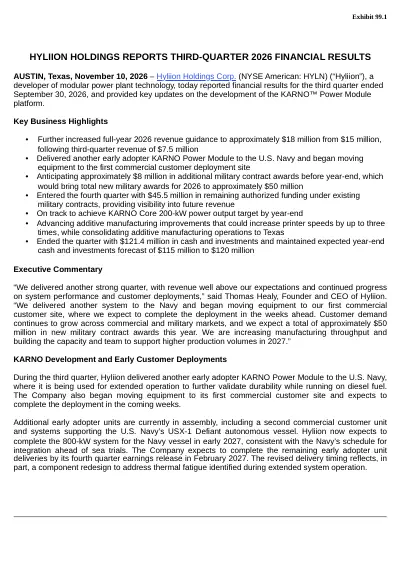
On the strength of a $7.5 million third quarter, we are once again raising our full-year revenue outlook, this time to $18 million. That compares with prior forecast for 2026 of $10 million at the start of the year and $15 million last quarter.
We are also nearing the signing of two additional military contracts that would bring our total new military awards for the year to approximately $50 million, at the high end of the range we set coming into the year. Those potential awards would be in addition to the $45.5 million of authorized funding remaining under our existing military contracts, which we plan to execute against over the coming years.
During the quarter, we delivered another early adopter unit to the Navy and are nearing deployment of our first commercial unit to a customer site in the coming weeks, with some of the installation components having already been delivered to that site. Customer demand continues to grow across our target markets, and we are actively working to increase production throughput and expand capacity as we look ahead into 2027.
I'll walk through each of these areas, update you on our progress against the 2026 milestones we laid out at the start of the year, and then turn the call over to Jon for the financial results. Starting with our early adopter units.
During the quarter, we delivered another system to the Navy. That unit is now being used for extended duration runs to further prove out durability of the system while operating on diesel fuel.
On the commercial side, we have started moving equipment to the site of our first commercial field deployment, and we expect to complete that deployment in the coming weeks. Additional early adopter units are in assembly today.
One of those will go to a second commercial site, and the balance are Navy assets supporting the USX-1 Defiant autonomous ship. We now expect to complete the 800-kilowatt system for the Navy ship early in the first quarter of 2027, which aligns with the Navy schedule for integrating it aboard the USX-1 Defiant before sea trials.
Thus, we expect to complete delivery of all of the early adopter systems by the date of the fourth quarter earnings release in mid-February. This progress drove third quarter revenue of $7.5 million, supporting our increased full-year outlook of $18 million.
Shifting to the KARNO power module performance. We continue to be pleased with the performance of the systems we have in operation and with the valuable learnings they are providing.
As with any new technology, we continue to identify opportunities for improvement. The encouraging trend, though, is that those findings are becoming fewer in number and reflect the kind of experience that only can be gained through extended operation.
For example, we identified a printed component that was susceptible to thermal fatigue following extended high-power operation. We have temporarily reverted back to an earlier revision of that component that we believe is not susceptible to this problem, which will keep systems moving forward.
Meanwhile, we have completed a redesign of that part that we believe addresses the root cause. That issue caused some delays in the schedule, but the first redesigned components are now coming off the printers, and validation testing will soon commence.
We are also making consistent progress on manufacturing quality. Each system built is becoming easier and more precise, and much of our current learnings is centered on the quality of incoming components and ensuring they consistently meet our specifications.
On system power, we remain on track to achieve 200 kilowatts of 800-volt DC power production from the KARNO core by the end of this year. Over the past several quarters, we have implemented numerous improvements to increase system output.
One of the remaining steps is further enhancements to the regenerator, the heat exchanger that retains heat within the system throughout the power cycle. Our regenerator work earlier this year delivered a sizable power increase, and we have since identified further opportunities to improve its internal mesh density.
Those new parts are now being printed, and we anticipate they will enable the 200-kilowatt rating by year-end. Since we're talking about power output in more detail, it is worth noting how we measure power and efficiency.
The 200-kilowatt figure is a standard-day rating at sea level, a common reference condition for rating power generation equipment. Just as with other technologies such as fuel cells, we are measuring the amount of power and the efficiency the KARNO core provides to the DC bus.
Components such as fans and blowers will consume a limited amount of this power, and actual power output varies with customer configuration and ambient temperature and altitude. Rating to standard-day conditions allows customers to compare the KARNO technology on an equal basis against alternative generation sources.
Now shifting to our military contracts. In July, we announced a $41.7 million contract with the Navy to deliver two multi-megawatt KARNO power modules, and we anticipate receiving two additional contracts before the end of the year.
The first is expected to be approximately $1 million with the US Navy to evaluate KARNO technology for a new application. The second is expected to be with a new branch of the military and is anticipated to be approximately $7 million.
We're in the final stages of negotiating on each of these contracts and we'll make an announcement with additional details once the contracts are executed. We also received confirmation this past quarter that we received an additional $3 million in funding under our existing Navy contract for development of the 800-kilowatt power module that will be installed in the USX-1 Defiant early next year.
This additional funding helps support the completion of that project. Along with the $41.7 million contract we signed in July, these new awards would bring our military contracts for 2026 to a total of approximately $50 million, which is at the high end of the $40 to $50 million range we set coming into the year.
We have signed a number of contracts with the Navy over the past few years, let me give you a clearer snapshot of what that base means for our expected future revenue stream. Not counting the approximately $8 million in new contracts we expect to sign this quarter, we have existing contracts with $45.5 million of remaining authorized funding that we are executing on today.
To put that in perspective, that remaining authority alone is roughly 2.5 times our full-year 2026 revenue outlook. We expect that the bulk of that work will be executed over the next couple of years.
As we have discussed on earlier calls, we are also working to extend the pipeline of military opportunities into the future through the defense appropriations process, and we are actively seeking funding now in next year's appropriations and contracting cycle. Finally, we see military opportunities ahead that go beyond the R&D work we perform today.
As the KARNO power module is proven across the broad range of applications we are discussing with different branches of the Armed Forces, we expect those opportunities to shift increasingly toward deliveries of production power systems, not just R&D services. Turning to customers, we continue to see growing demand for the KARNO power module across both military and commercial markets.
Alongside the military opportunities I just discussed, we continue to see strong interest from data centers, commercial and industrial facilities, and numerous prime power applications. Interest in our KARNO power modules among data center customers continues to increase, despite growing concerns surrounding the rapid expansion of data center construction.
Some of our recent customers discussions have actually centered around our technology's ability to address local concerns related to power generation and its environmental impact. Local power generation helps meet growing electricity needs while reducing strain on the grid.
Low emissions and low noise levels address key considerations for customers and for the communities where they operate. KARNO technology's native 800-volt DC architecture aligns with the evolving power requirements of AI infrastructure, offering opportunities to reduce costs and improve overall power system efficiency.
Over the past quarter, we have had meaningful discussions with customers about scaling our manufacturing capabilities to support their demand, including the printer investment required to do so. These discussions build on the manufacturing investment framework we shared on our last call.
As a reminder, we anticipate reaching a point where approximately $1.5 million invested in manufacturing equipment supports 1 megawatt of annual production capacity, which, at our current pricing expectations, represents approximately $2.5 to $3 million worth of annual revenue. We also see substantial opportunities beyond AI and data centers.
We believe military demand could support a significant portion of our future production capacity. Across commercial, industrial, and other prime power applications, customers are seeking low-cost, fuel-flexible alternatives to the grid.
This breadth of interest is exactly why we are focused on increasing manufacturing throughput and expanding capacity, which brings me to our third topic. Now, switching to manufacturing.
We're making good progress on the print speed enhancements we introduced during our August call. As a reminder, we believe these enhancements could increase speed throughputs by up to 3 times.
The improvements come from a combination of advancements including taking advantage of higher laser power, software parameter changes that drive more efficient printing methods, and new hardware changes that have already begun in testing. These advancements are aided by the next-generation machine agreement we signed earlier this year with Colibrium Additive, a GE Aerospace company and the manufacturer of the printers we use at Hyliion.
Through this collaboration, we are working together on the next generation of additive manufacturing systems. As these improvements are validated, they feed directly into the capital efficiency framework I just described and into our planning for the restart of printer purchases next year.
We are also consolidating our printer and manufacturing operations to our Texas facility, moving about a half dozen additive manufacturing machines from our Ohio facility to Texas to help gear up for the volume ramp up next year. We recently completed the move of our KARNO core assembly to Austin, which frees up space in Ohio for work on our multi-megawatt systems.
Ohio will remain an R&D facility and the location where we complete the initial work on our 800-kilowatt systems. We continue to strengthen the Hyliion team and have recently filled several key leadership positions in program management, quality, and manufacturing engineering.
These additions reflect our focus on building our capabilities needed to expand manufacturing and operations, improve production consistency, and support increasing delivery volumes next year. Before handing the call over to Jon, I want to highlight our progress against the 2026 milestones we laid out at the start of this year.
We checked off another milestone this quarter by surpassing $10 million in revenue. We expect to complete our first commercial site deployment in the coming weeks, and we continue to target 200 kilowatts of power output by year-end.
By our next earnings call, we expect to have completed the 800-kilowatt Navy system and all of the remaining early adopter unit deliveries. We look forward to building on the progress as we close out the year.
With that, I'll turn the call over to Jon to walk through the financial results for the quarter.
Jon Panzer
Thank you, Thomas, and good morning, everyone. In the third quarter, we recorded revenue of $7.5 million from research and development services.
This compares with revenue of $759,000 in the third quarter of 2025 and $4.9 million in the second quarter of this year. Third quarter revenue came in well ahead of the outlook of just under $5 million we provided last quarter, primarily reflecting accelerated progress on the 800-kilowatt power module for the Office of Naval Research and the availability of approximately $3 million of additional funding for this work that we recently received from ONR on top of contract funds already allocated.
Cost of revenues was $6.9 million, resulting in gross profit of $552,000. Operating expenses for the third quarter were $13 million, down 15% compared with $15.3 million in the third quarter of 2025.
The decrease primarily reflects a continued shift in spending away from research and development work toward revenue-generating services for the Navy, with the associated cost of that work reflected in cost of revenues. R&D spending in the quarter was down 14% to $8.7 million from $10.1 million a year ago.
SG&A expenses were $4.3 million in the quarter, down approximately $900,000 or 17% compared with the third quarter of 2025. Our net loss for the third quarter was $11.1 million, a 17% improvement compared with a net loss of $13.3 million in the third quarter of 2025.
Turning to our year-to-date results, revenue for the first nine months of 2026 was $15.2 million, up significantly from $2.8 million in the first nine months of 2025. Cost of revenues was $14.1 million, resulting in gross profit of $1.1 million, compared with $96,000 in the same nine-month period of 2025.
Operating expenses for the first nine months were $42.1 million, down 17% compared with the same period of 2025, primarily reflecting the shift of spending from R&D to revenue-generating services. Our year-to-date net loss was $36.7 million, a 17% improvement compared with the $44 million net loss we recorded in the first nine months of 2025.
Turning to our cash and investment position, we spent $11 million during the third quarter, compared with $20.6 million in the third quarter of 2025. The decline in spending this year reflects primarily lower capital spending.
Capital spending was approximately $300,000 in the third quarter and $2.4 million year-to-date. This compares with $22 million in the first nine months of 2025, when we spent significantly more on additive printing machines and related investments.
We finished the third quarter with $121.4 million of cash and short and long-term investments on our balance sheet. Next, I'd like to update our outlook for the remainder of the year.
Our research and development services work with the Navy continued to ramp faster than we expected in the third quarter. Through the first nine months of the year, we have recorded $15.2 million of revenue, which already exceeds the full-year outlook we provided last quarter and is well above the approximately $10 million we projected at the start of the year.
The fourth quarter should finish about as we expected back in August, with another $3 million of revenue. The decrease in revenue in the fourth quarter, compared to what we saw in the two prior quarters, is due to the wind down of work on the 800-kilowatt system for the Navy ahead of delivery of this system in the first quarter of 2027.
As that work nears completion, we are ramping up work under the $41.7 million Navy contract we signed back in July, although most of the work under that contract is expected to be performed in 2027 and 2028. Consequently, we now expect total revenue for the year of approximately $18 million.
This compares with total revenue of $3.5 million in 2025. We expect capital spending to remain low to finish the year, as our focus continues to be on optimizing our existing printer fleet and increasing the speed and throughput of those machines.
We continue to expect to finish the year with between $115 million and $120 million of cash and investments on our balance sheet, although we may be on the low end of that range, as we no longer expect to close an equipment financing transaction this year. We previously expected to borrow between $10 and $15 million with a loan secured by part of our fleet of assets, including additive printers and CNC machines.
At this time, the market for this kind of secured debt does not look favorable to us, but we continue to see debt as an opportunity to finance future growth in production assets. We expect to offset the absence of these financing proceeds through greater revenue, lower expenses, and better working capital expectations.
Finally, we did not record any activity during the third quarter using the at-the-market equity facility that we put in place back in August. We will continue to be opportunistic about the timing and sizing of a future capital raise.
As we have said in the past, we continue to believe that the capital we have on hand today is sufficient to carry us through commercialization of the KARNO power module. At the same time, additional capital will ultimately be required to support production growth, including additional additive printing machines.
Now, I'll turn the call back over to Thomas.
Thomas Healy
To wrap up, we made progress across all three of these areas I highlighted at the beginning of the call. We delivered another early adopter unit and continued advancing towards our 200-kilowatt power target.
We're approaching $50 million in new military contract awards for the year, which would bring our total contract backlog to approximately $53.5 million. Customer interest continues to grow across data center and prime power applications, and we are investing in the manufacturing capacity and talent needed to scale production in 2027.
Revenue of $7.5 million this quarter significantly exceeded the expectations we set at the start of the year, and we have raised our full-year revenue outlook to $18 million. I'll now hand the call over to the operator to start the Q&A portion of today's call.
Operator
We will now begin the question-and-answer session. If you would like to ask a question, please press star, one to raise your hand.
To withdraw your question, press star, one again. We ask that you pick up your handset when asking a question to allow for optimum sound quality.
If you are muted locally, please remember to unmute your device. Please stand by while we compile the Q&A roster.
Your first question comes from the line of Sean Milligan with Needham. Your line is open, please go ahead.
Sean Milligan
Hey, Thomas and Jon. Thank you for taking the questions and congrats on the progress.
I guess, first off, can you talk about the reactor design and reliability? More specifically, can you quantify the scope of the thermal fatigue issues and talk about the redesign, what that resolves, and how confident you are that that fixes that without further issues?
Thomas Healy
Sure. Thanks for the question, Sean.
To lead in, it's a pretty contained issue that we saw with the components. We had a new revision of the reactor that we were running on systems and going through multiple heat cycles, start stops, and we saw that during that longer duration running, it was fatiguing.
What we actually did is we stepped back to the previous version of the reactor design. That's allowed us to continue to build systems, get units out there and run them.
It was really just a contained issue with this new reactor design. To provide a little bit more granularity there, what we were seeing is inside the reactor, there are these heat exchangers that you have your exhaust gas preheating your inlet air, your inlet fuel, and we found that within the part, we could start getting some very small cracking that allowed some of the gas to transfer from one cavity over to another.
Our system detected that. What we've actually been able to root cause it back to is it was actually an issue in the printing of the part where there was actually kind of a microcrack that was formed during printing, and then through that thermal stress, thermal fatigue, that crack was able to to grow and and and then allow gas to pass from one cavity to another within the part.
All that being said, the initial How do we solve it? is we step back to the previous revision that didn't have that component within it.
Then going forward, we've actually changed the print file to eliminate the the crack from ever even starting within the printing process.
Sean Milligan
Okay. Then on commercialization timing, with the early adopter units shifting a little bit into February 2027, is it still reasonable to expect initial commercial orders next year?
Then, once those units are out in the field, what specific operating hour, reliability, certification milestones do we think customers need to see before progressing with broader commercialization plans?
Thomas Healy
Sure. Yes.
We don't think that the slight shift of going from planning on having the the USX-1 Defiant system done by end of year, that now being planned to be done by the next earnings call, about six weeks later from initially anticipated, we don't envision that having a a material impact on next year's scale-up, ramp-up, and moving into commercialization. What customers want to see to go from kind of buying their initial systems to buying at higher volume, it varies by customers.
Some are in the couple of months to six months sort of a range, maybe nine months on the longer end. Our goal of next year is to really be seeding the market with various customers.
We think data centers are going to be a primary focus, military will be another strong focus, and then a growth into kind of commercial prime power, industrial applications as well for next year. Then that will allow us to continue to ramp up in '28 with follow-on orders and continuing to grow and scale capacity.
That's the high-level vision of of how we see it growing. This about six-week shift, we don't see it having an impact on next year.
Sean Milligan
Great. I'll turn it back over.
Thank you so much.
Operator
Your next question comes from the line of Eric Stine with Craig-Hallum Capital Group. Your line is open, please go ahead.
Eric Stine
Hi, Thomas. Hi, Jon.
Thomas Healy
Hi, Eric.
Eric Stine
Hey, good morning. I have heard you both say demand's not the issue here, and you just kind of laid out what your plans are for '27 and '28.
Just curious if you can apply that to what your printer plans might be. It sounds like you're sticking with resuming that in 2027, but is that is that something that it's too early to dial in?
It's somewhat dependent on the conversations you're having with customers in terms of manufacturing investments, or how should we think about that?
Thomas Healy
Sure. Maybe I'll break that into two buckets: so the demand and then the printer side of it.
On the demand, we've signed LOIs for about 750 units' worth of interest from customers, and even in the discussions we're having with customers, that's a just a portion of of the interest we're seeing. There's many customers that we have not signed LOIs yet with, but we're in discussions of how they want to scale from initial units to tens of megawatts then to hundreds of megawatts, and and that's kind of the the interest level we're seeing or demand we're seeing.
That kind of points back to what you mentioned of demand is not the issue, this is really how fast we're going to be able to print these components and deliver systems. On the printer side, our current installed printer capacity, we believe, with these speed improvements, once they're rolled in, we'll be able to get it to about 15 megawatts a year of production capacity.
This whole Austin, Texas, facility, as we build it out, would be capable of about 250 megawatts of yearly production capacity. That's whereas as we mentioned on today's call, in '27 we'll start buying additional printers, but it's to go directly to your question, it's too early to really lean in on how many printers we plan on adding next year and exact volumes for next year.
That is something that as we go into the next earnings call, we'll plan on sharing some more guidance for what we envision 2027 looking like.
Eric Stine
Got it. That's helpful.
Then, just turning to data center, you just detailed discussions, in-depth discussions with customers and scaling those. You step back and just look at the overall market.
Where do you feel like market awareness is of the KARNO? Maybe characterize the engagement, the types of companies or counterparties that you're talking to, anything along those lines would be helpful.
Thomas Healy
Yeah. Overall, the interest level in the product is extremely high.
People are really excited about the product attributes, the efficiency, the modularity, the low emissions, the low noise, the fuel flexibility. All these different characteristics, we're seeing it being a a strong interest from customers.
The thing that customers are wanting to do next is actually get initial systems, deploy them at their sites, and see how the system actually performs in their use case. That's that's where our whole focus, as we talked about today, is on let's get these initial systems out there to customer sites.
As we mentioned that we're nearing that. We're weeks away from that initial unit going out to a customer site, and then we have another one planned right after that.
That the focus is really proving the the product works, and then in customers' applications, and then looking to continue to grow and scale from there. In terms of the customers that we've been engaging with, it's everywhere from very large on the hyperscaler front.
We're working with multiple hyperscalers and have units planned to deliver with them to medium to smaller-sized data centers, as well as outside of the data center space, just kind of conventional applications that are looking for on-site power generation. I will say over the last six months, though, the interest level has significantly grown on the data center side, and that's where we're spending a lot of our focus right now.
Eric Stine
Thank you.
Operator
The next question comes from the line of Martin Malloy with Johnson Rice. Your line is open, please go ahead.
Martin Malloy
Good morning. The first question I have is about the the non-Navy military contract that you mentioned, approximately $7 million.
Just kind of curious if maybe you could talk about how quickly that could ramp if these other branches of the military have had access to some of the data that you all have generated through the stress testing and reliability testing of the KARNO units for the Navy, and maybe the the total addressable market when you look at these other branches of the military versus the Navy.
Thomas Healy
Sure. To start with, we've, up till now, we've been doing primarily R&D work with the Navy.
As we go forward, we do envision that shifting from R&D into just commercial sales of assets into different branches of the military. As you mentioned, in it has been a very positive thing that since the the Navy contract has been R&D, there's been a lot of data developed through that, a lot of validation, and the Navy has been sharing that.
In a lot of ways, actually been promoting the technology to other branches for them to get involved with it as well. In terms of the opportunity with the military, it's tough to say exactly how many gensets they have, but from research we've done, it's in the numerous tens of thousands of generators that are utilized across the US military.
What we're finding is different applications have different pain points that we're able to come in and solve. If you think about the Army, and think about forward operating bases, the ability to run on various types of fuel, that's a huge advantage for them because they're not then single-sourced on fuel.
The Navy, it actually all started with the low maintenance, high reliability, that was the initial focus. The product attributes lend themselves to these various pain points that are experienced within the military.
Even just this past quarter, we had a lot of discussion with one branch around the low detectability of the the genset. If you think about low noise, low heat signature, that's important as well.
That's whereas we shared today, we do see that the military can be a pretty sizable portion of the the volume going forward, even outside of the data center demand we're seeing.
Martin Malloy
Great. Just for a follow-up question, did want to ask about UL certification.
I believe you all have the UL certification for each of the key components of the KARNO generator, but there was still a final assembly or or process-type UL certification that I think you all were were aiming to obtain. Can you maybe give us an update there?
Thomas Healy
You remember correctly, we've gone through all of the non-recurring UL certification testing, we've passed that. The final step is before a system actually goes out to a customer site, we do go through an actual operation of the power module, and then from there we'll get this UL certification and then it will be able to be moved to the customer's site.
All is tracking well on that front. We even have line of sight to to be able to eliminate that need for each genset having to go through a UL test, which will be great for going forward to just streamline the manufacturing process.
Martin Malloy
Great, thank you. I'll turn it back.
Operator
The next question comes from the line of Stephen Gengaro with Stifel. Your line is open, please go ahead.
Stephen Gengaro
Thanks, good morning, everybody. I think just two for me.
First, Thomas, I think when we think about that the the medium-term opportunity on the data center side and your the applicability of your product into those markets, when you're talking to customers, what are the two or three things you think you need to really get them to sort of believe, or what hurdles do they need to get over to kind of move forward?
Thomas Healy
Yeah. The first is just showing the the product performance, which we've already Actually, I'll share an example, this past quarter, we had very large data center company spend three days on site.
We let them run the actual genset, let them collect their own data on it, see the performance of it, and that testing went very well with them, and it has allowed discussions to move to the next step. First is, the performance, and then second is a big question around how can we scale manufacturing.
That's that's where the discussions quickly go to because they want to make sure that if they invest in this type of technology, that there's opportunities for this to become a a sizable portion of their fleet and the gensets that they're buying. The guidance we shared last quarter around if we want to add a megawatt of production capacity to our facility, it will cost about $1.5 million of capital into manufacturing equipment.
That's actually been a a huge part of discussion around would customers be interested in financing that scale-up to have dedicated capacity? Would customers be open to placing orders that would then allow us to go get various financing structures in order to to build out the production capacity?
Those are those are the types of discussions we're in, but I would say that the scale-up is is becoming the current question around how do we get more than, 15 megawatts of production capacity? How do we get to that 250 and then even beyond the 250?
Stephen Gengaro
Great. Thank you.
Just the follow-up to that is, and I know we talked a little bit about this, the the ability of your of the KARNO to react to load, I think there's some positive attributes there. Maybe you could just kind of give me a little more color around that.
Thomas Healy
Absolutely. AI data centers are running into this I don't know if you'd call it an issue, but it's a new aspect where their power consumption is very spiky, and it's like the edge of a saw, right?
Where the power jumps up, jumps down, and it's not a very smooth, consistent power draw. If you look at technologies like turbines, they love smooth, consistent power draw.
They don't like peaks and valleys of power consumption. The KARNO technology handles those peaks and valleys very, very well.
Some of the discussions we've actually been having are, if you think about these very large data centers, which will likely be run off of combined cycle turbines, there is actually interest coming in where you'd want to couple that with a set of KARNO power modules alongside it so that then our technology could handle those transient loads while then keeping the the large combined cycle power plant at a steady power production. Those are some of the discussions we're engaging in, or if you look at, smaller data centers, you would just use the KARNO technology as the baseload power and the the power technology that can handle those transient loads, which really is a another unique product attribute, including the the 800-volt DC native power output, which is where data centers are heading to.
Stephen Gengaro
Great. Thank you for the details.
Operator
Your next question comes from the line of Ted Jackson with Northland. Your line is open, please go ahead.
Thomas Healy
Ted, you may be on mute.
Ted Jackson
No, I'm not on mute.
Thomas Healy
We can hear you now.
Ted Jackson
Hello. Okay.
Thomas Healy
We've
Ted Jackson
got you. Good, I was about to start swearing, I'm glad it turned on before that happened.
This call's getting crowded.
Thomas Healy
Getting busier quarter-over-quarter.
Ted Jackson
That's a good sign, that's a good that's a very good sign, Thomas. I just got a couple of questions that weren't asked, and I wanted to start out on the commercial customer.
You talked in the past with regards to some of the initial, commercial deployments, that it was not going to necessarily be something where it was installed and left with the customer, that it was going to be, brought in, put in place, run for some time to kind of proof of concept things, and then you could redeploy it. With regards to your first commercial deployment, is that what this is?
Then the same question with regards to the one that's kind of coming around behind it or are any of these ones that are that and customers just going to keep that unit, in perpetuity?
Thomas Healy
Yeah. Great question.
The initial one is just a deployment, that asset will stay there. You're exactly right that we do have this plan or strategy of we have some deployments that are just sold assets, they'll they'll live the rest of their life at that facility, others that will be more like loaner units or or field trial units where we'll bring them out, we'll operate them, and then we will move it to another customer's site.
Then, that'll allow us to let more customers actually experience the technology. We do have that plan, and we'll be doing like road shows in 2027, moving a couple of assets from, one site to another site and letting more customers experience it.
As for that second commercial one that is structured where it is going to a very large data center's AI test facility. There is still a question mark of will that remain there or will that get moved to another data center location, but we'll actually be doing kind of working with that data center provider to really prove out all those product attributes that I just mentioned of the transient load capabilities, the 800-volt DC power out, that second asset will be going into that sort of test AI data center opportunity.
I
Ted Jackson
I do want to understand, just to make sure, since we're having this public call, that I do understand that, what you're doing with that is basically being able to, because there's a limited number of units, and really just being able to showcase the KARNO and what it can do and its feature set to to drive what is actual orders. These deployments there are multiple deployments maybe with the same KARNO unit, but it would drive actual commercial orders where you're going going forward.
My my second question is just kind of going into capacity. If if you kind of do the math, you're saying that with the capacity you have in place and the improvements that you're going to make, without spending any more money, you could make, call it 75, 200-kilowatt KARNO units annually.
Is that capacity the capacity that you're in the process of putting up in Austin, or does it include what you're leaving behind in Cincinnati? Then how much of that that capacity that you've talked about is based upon the improvements that you think you can get with regards to throughput?
What would it be without that that those improvements? That's my next question, and I have one more behind that.
Thomas Healy
Perfect. That is really an Austin focus, and as we shared on today's call, we're actually moving about a half dozen printers from the Cincinnati facility to Austin.
You've seen these facilities, Ted. Austin is a much larger facility, much more square footage, footprint to really start scaling manufacturing.
We're consolidating that ramp-up under one roof. In terms of where we stand today, the printers at their existing speed improvements are in the 5 to 10 megawatts of production capacity, and then, as mentioned, we target getting that up to 15 megawatts out of that existing installed base with some hardware upgrades, some laser software parameter upgrades, things like that.
One other thing to highlight is that we are making a lot of progress on these printer speed improvements. For instance, we've taken the mixer component and, if we look at previous print speeds versus what we've been able to demonstrate, we've been able to already get that to about a 2.5x speed improvement.
We've really set out for 2027 being the back half of '26, '27 being our time to really work on getting more out of the equipment machines and faster print speeds. Just wanted to share a data point of we've already started seeing some of these speed improvements come to life, and it's really on a component-by-component basis.
Since you have to change the print files and how the laser power is structured and laser speed, things like that, we're going component-by-component, but wanted to just share an initial really positive proof point of speed improvement.
Ted Jackson
Okay. Then, my last question is really kind of a little bit more of asking you to flesh something out.
In the near term, a lot of the revenue, all your revenue really, is coming from these developmental contracts with the military. I guess what I'm curious about is maybe walk through sort of how that goes from being kind of granted, funded, rolls through your revenue.
You've got, call it let's just round it up and say $45 million worth of funding that's available to you right now. You're looking for a pick up in that as we kind of roll through this year into next year.
Is that the kind of stuff where the funding's in place, does there have to be an appropriation to it? Does the Navy come to you and say, "Okay, we're going to give you, I don't know, $5 or $10 million to do this," or do they say, "You do this, and then we'll give you $5 or $10 million?"
You see where I'm going with this? How much of it is driven by a need for appropriations and maybe that comes at a congressional level?
How much of it then is driven by kind of demands from the Navy? Then how much of that maybe comes from your ability to deliver on things and then unlock it?
Is that makes sense what I'm asking? I just want to understand how it all flows through better, because clearly for '27 for sure, it's a pretty important part of the funding for the company.
Thanks.
Jon Panzer
Hey, Ted, this is Jon. I'll take a crack at that.
We've had a number of contracts with the Navy that are really all mostly aligned with the R&D work and the delivery of the 800-kilowatt system for the USX Defiant, the autonomous ship. In that case, we're doing more and more, we're delivering more units to test the 800-kilowatt system, operating those units for durability and so forth, proving out diesel fuel.
Then we're also have line of sight to other contracts, a couple of which we mentioned on the call today, including with another branch of the military. That will be quite a bit different, but again, they're looking for power systems, and I think the way to think about it is there's a lot of different use cases.
Most of them are probably going to be around stationary power. In fact, the most recent contract that we have with the Navy transitions from this shipboard system into multi-megawatt land-based systems.
We also mentioned, I think this is an important point, that these won't always be all R&D, that there's going to be military I'll use the term commercial, but military commercial units where it's not R&D, the revenue will be more based upon delivery of actual working units. We do expect that to come.
Then, there's a line of other R&D work that we're looking at for different government agencies and different branches of the military that we think is part of that appropriations process. Most of those contracts initiate with an appropriations process.
We're very actively involved with that. We've had a lot of success with it.
Again, I think as military grows, it's going to continue to be both R&D, based on appropriations, and then ultimately, there's other buckets of money that the military has too for just buying systems. As Thomas mentioned, there's thousands of generators that the military has at bases all across the world.
Those are different buckets of money that don't directly get appropriated, but are part of ongoing budgets for each branch. Again, we think it's not just data centers.
Data centers are huge, but the military is a extremely interested in what we have and will be an enormous opportunity for us.
Ted Jackson
Okay. Those are my two questions.
I just wanted to end it, I know you had some slippage in timing and stuff, but with regards to the six weeks, but having been knocked around Hyliion for a long time, it's super super super exciting. Because I feel like you can almost really just reach out and touch it in terms of how close you are to actually having product out the door.
Seen all the work that you've done, and things have really firmed up in the last quarter or so, and it's exciting. Congratulations, guys.
Jon Panzer
Much appreciated.
Thomas Healy
Thanks, Ted.
Operator
As a friendly reminder, if you would like to ask a question, please press star, one on your telephone keypad. We have reached the end of the Q&A session.
I will now turn the call back to Thomas for closing remarks.
Thomas Healy
Thank you all for joining today's call. As noted throughout the call, we saw this as a very strong quarter for us, where we once again further increased our revenue guidance up to $18 million for the year.
We anticipate being at the high end of the amount of military contracts that we anticipate closing this year. Over the last quarter, another delivery of a system to the Navy plus initial customer site deployment here in the weeks ahead.
As Ted said very well, it's an exciting time. We're right at the cusp of really getting this technology out there and into the market and showing its product benefits and the opportunity with it.
With that, thank you all for joining, and we look forward to sharing another update again on the next earnings call.
Operator
This concludes today's call. Thank you for attending.
You may now disconnect.