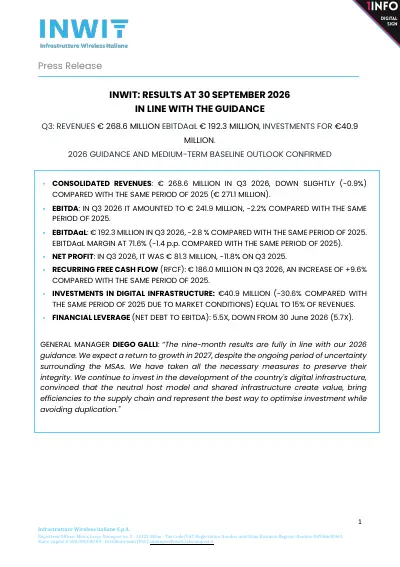
Infrastrutture Wireless Italiane S.p.A.
Q3 FY2026 · Earnings Call TranscriptNovember 11, 2026
Operator
Good morning, this is the Chorus Call conference operator. Welcome and thank you for joining the INWIT third quarter 2026 results conference call.
As a reminder, all participants are in listen-only mode, and after the presentation, there will be an opportunity to ask questions. Should anyone need assistance during the conference call, they may signal an operator by pressing * and 0 on their telephone.
At this time, I would like to turn the conference over to Mr. Luigi Minerva, Strategy, M&A and Investor Relations Director of INWIT.
Please go ahead, sir.
Luigi Minerva
Good morning, everyone, and thank you for joining us today. Here with me, I have Diego Galli, INWIT's General Manager, and Emilia Trudu, CFO.
Before we begin, please allow me to draw your attention to the safe harbor statement on page 2 of the presentation. Following a presentation of the Q3 2026 results, we will open the floor for Q&A.
Over to you, Diego.
Diego Galli
Thank you, Luigi, and good morning, everyone. Q3 2026 results are in line with our full-year 2026 guidance, which reflects the current market context.
The telco sector in Italy continues to go through a challenging phase, with low returns and minimum investments. Such market conditions are reflected in our mid-term baseline outlook.
The market cannot be stuck forever. 5G network densification is needed, even more so in the context of the ongoing frequencies renewal process.
We continue to believe that our anchors' MSA early termination notices are instrumental, and fall outside the legal framework of the MSAs, and that both MSAs are valid until 2038. INWIT runs very efficiently the best quality and largely unique network.
There are no rational alternatives to INWIT's network from a strategic, operational and financial perspective. INWIT remains committed to invest, while collaborating with customers to identify shared value for value solution on a fair and rational basis.
Moving to Q3 results. New sites and new PoPs reflect the current market context.
We continue to make progress on real estate transactions. As we anticipated, revenues on a reported basis are declining year-on-year by around 1%.
Revenues are negatively impacted by the absence of uncommitted revenues linked to discretionary projects from anchors as well as from OLOs. If we were to remove such discretionary project-based revenues from the Q3 2025 numbers, Q3 2026 revenues would show normalized annual growth of around 3%.
EBITDA after leases margins are at around 72%, confirming the efficiency of our business model. Our leverage ratio improved from 5.7 times in Q2 to 5.5 times, the midpoint of our guided 5 to 6 times leverage corridor.
At current share price, INWIT offers a dividend yield of 7.5%. I hand it over to Emilia now for a review of KPIs and financials.
Emilia Trudu
Thank you, Diego, and good morning, everyone. Operational KPIs in the quarter reflect the current challenging market context.
The deployment of 50 new towers in this quarter keeps us on track to reach our target of around 200 new towers in 2026. 310 new PoPs were added in the quarter, and we continue to aim for more than 1,500 new PoPs in 2026, targeting a year-over-year continuous growth in tenancy ratio.
IoT PoPs are in relative terms increasing, and come with incremental lower than average ARPU. We delivered 290 real estate transactions in Q3, slightly down compared to previous quarters, reflecting our continued disciplined approach.
Year-to-date, we have built 70 new dedicated DAS. We are increasing tenancies on existing locations, while growth in new locations is limited given the low level of uncommitted activity by MNOs.
The normalized 2025 total revenue base takes into account the lack of project-based non-committed revenue components, which we have developed over time with operators, capturing their discretionary spending. Such discretionary budgets have been put on hold at this stage, given the current context of subdued operator investments and stagnant commercial relationships.
Adjusting for this one-off step-down, we delivered approximately 3% normalized revenues growth in Q3 2026, driven by the following components: inflation link, based on a 2025 average index of 1.4%; anchor commitments: new towers, new PoPs, and DAS deployment in line with MSA commitments; steady OLOs growth across other MNOs and IoT; and smart infra growth, particularly in indoor DAS across premium locations and projects in the smart city vertical. Normalized growth is structural, and we expect the business to go back to growth in 2027 in line with the mid-term baseline outlook.
Moving on to our financial highlights for the quarter, Q3 revenues reached €268.6 million, up 0.6% quarter-on-quarter and down 0.9% year-on-year, representing around 3% normalized revenue growth year-on-year, as we just discussed. Revenue components included tower anchors revenues up 2.8%, supported by inflation and MSA commitment.
Conversely, OLOs and smart infra revenues were down as a result of the lack of project-based revenues, such as walk-and-studies, installation, upgrades and DAS, more than offsetting the underlying growing number of PoPs and DAS location covered. On profitability, EBITDA was up 0.5% quarter-on-quarter and down 2% year-on-year to €241.9 million, with an EBITDA margin of over 90%.
EBITDA after leases came at around €192.3 million, up 0.7% quarter-on-quarter, down 2.8% year-on-year, with a 71.6% margin, reflecting the structural operational efficiency of our business model, which allows us to support substantial investments with long-term returns. As a reminder, we closed 2025 with a return on capital employed of 8.4%.
Year-to-date, recurring free cash flow reached €486 million, about stable year-on-year, with 67% cash conversion. This was driven by structurally low recurring capex, efficient tax thanks to the goodwill tax scheme, positive net working capital, and financial charges profile that reflect phasing of interest payments.
Looking at the recurring free cash flow components in Q4, we expect it to be in line with the full-year recurring free cash flow guidance range. We expect the usual seasonality with cash tax payment, financial charges reflecting the coupon payment schedule, and we also expect a net working capital reversal in Q4.
Below the recurring free cash flow line, growth capex was just above €40 million in Q3 and €200 million year-to-date. Full-year total capex are expected to be in line with our previous indication of €270 million.
Free cash flow to equity year-to-date is about €287 million. Moving to our financial structure, leverage ratio declined to 5.5 times, the midpoint of our guided leverage range of 5 to 6.
We have an efficient debt profile: 80% fixed, 20% floating, with a current average cost of debt of approximately 3% and average bond maturity above 4 years. The first relevant maturity is the €750 million bond due in 2028.
Both Standard & Poor's and Fitch have reaffirmed their credit rating. We are investment grade with Fitch, with Credit Watch Negative, and BB+ with Standard & Poor's, with stable outlook.
I now hand it back to Diego for the guidance and the closing section.
Diego Galli
Thank you, Emilia. We reiterate our 2026 targets and medium-term baseline outlook, reflecting the current market environment.
Even in the unrealistic scenario in which the market remains stuck over the medium term, we would still be able to have a decent organic growth at around 3% for revenue and 4% for EBITDA, an attractive, stable dividend, and a solid balance sheet. The baseline outlook does not include the following potential upsides: normalization of industry dynamics, densification for both outdoor and indoor, opportunities to expand across digital infrastructure.
At the same time, the baseline outlook does not include the downside risks of MSAs early termination, as we don't believe this is a likely or realistic outcome. Moving on to the MSA and relationship with our anchors.
First, an update on the legal process, which in itself remains long and complex. The judges reviewing the injunctions have concluded that the case lacks the required level of urgency.
The next legal step is the ordinary trial initiated by Fastweb in March, where the focus will be purely on the merit of the case, in particularly on the events that led to a change of control of INWIT. Change of control did happen in August 2022, when the shareholder agreement between Telecom Italia and Vodafone Group was terminated.
At the time, INWIT properly triggered the change of control clause, with the contractual extension by 16 years to 2038. Fastweb instrumentally states that the change of control happened in 2020, when the INWIT stake was transferred between fully owned Vodafone entities.
However, in 2020, there was only an internal reorganization within the Vodafone Group, without any impact on INWIT's joint control. This has been also confirmed by recent statements from the Italian financial market regulator Consob and Vodafone Group.
Any different interpretation would have triggered mandatory tender offer in 2020, which clearly didn't happen. The MSA termination case is under the attention of the relevant authorities, including the financial market regulators and the competition authority.
In particular, the Italian financial market regulator, with regards to the assessment of transparency and completeness of information provided by Fastweb and TIM in relation to the MSA termination, and the competition authority with regards to the tower joint venture as a potential agreement with anticompetitive effects extended to the tower market. Finally, about the lawyers-assisted negotiation with TIM, it has been a useful process, even if did not lead to an agreement as we stand.
On this matter, also on the back of our engagement, the sector regulator AGCOM has initiated a conciliation process to facilitate the parties to voluntarily reach an agreement. From an industrial standpoint, the MSA disputes creates a deadlock, putting the industry fundamentals at risk.
This slide is a summary of how the different layers overlap. I would make three observations.
According to the MSA, the sites repatriation should be completed in its entirety no less than 3 years after the termination date. This is also required so that INWIT can assess the best industrial and commercial opportunities available on the market for its network as a matter of priority.
At present, for instance in case of Fastweb, there is no contractual arrangement in place that ensures Fastweb the access to INWIT's network after March 2031. This timing is not consistent with any foreseeable scenario of migration and build-up of a new network, which may last from 12 years in the optimistic case to 30 years in our realistic view.
2029 frequency renewal process. AGCOM proposal for frequency renewal in exchange for investments, leading to material network improvement with tight quality of service milestones.
This is not compatible with the termination of INWIT contract, as level of service could not be even maintained while repatriating the best network. Duplication will last decades, will delay densification, and cost billions.
Lastly, Fastweb ordinary trial will last several years, overlapping with the repatriation plan, adding additional uncertainty on the development of any plan alternative to INWIT's network. The ongoing spectrum renewal process can unlock a new cycle of investments.
We support AGCOM proposal to link the spectrum renewal to the current holders with future capex commitments to support network quality improvement and the country digitalization. Factoring in AGCOM new proposed quality of service KPIs and milestones, we estimate that the Italian market may need more than 15,000 new sites by 2035.
In the current industry structure, where there is a separation between towerCos and service companies, we believe that MNOs should undeniably prove guaranteed access to the passive towers infrastructure for the full length of the license. Furthermore, the spectrum renewal framework should discourage duplication of infrastructure and support stability and predictability to the benefit of the entire industry.
Our network of about 26,000 sites is our key strategic asset, is the result of 40 years of work from TIM, Vodafone and INWIT, where we could take the benefits of first mover advantage to build top quality sites in the best available locations. Our network is the result of the consolidation of multiple networks: best quality location, connected with fiber, close to 20% of land owned, optimized lease cost, best tenancy ratio.
About 75% of the network is made of unique locations that will be hard to replicate. INWIT is a strategic infrastructure, critical to national security and economy.
As standard in the industry, our network is available to our anchor tenants on all-or-nothing basis. The telco industry in Italy continues to go through a challenging moment.
The MSAs are structured in a way that creates value for both INWIT and its anchors, thanks to the consolidation of infrastructure and the unlocking of sharing synergies to the benefit of all parties. Neutral host players such as INWIT can help, leveraging on sharing economics to deliver investments in digitalization in the most efficient way.
We overlay our network with strong industrial capabilities: with the proven record to build and deliver new sites at scale, an experienced real estate team to optimize lease cost, project management and engineering capabilities for complex network rollout. Our pure infrastructure business model allows access to long-term capital with the benefit of an efficient cost of capital.
These are the foundations that allow us to be the best partner for MNOs and for their investments in network densification. We continue to be open to constructive conversation with our clients.
From our perspective, it's key to respect the integrity of the MSA as a long-term contract, and we are open to optimize further the terms within the current perimeter in conjunction with new investment commitments, aiming to a win-win outcome in terms of positive net present value for all parties. Concluding, Q3 results are consistent with our 2026 guidance.
We reiterate both 2026 and mid-term guidance. There is no rational case for duplicating INWIT superior infrastructure, which represents the best-in-class market assets.
To address Italy's critical need for network densification and enhanced resilience, INWIT stands out as the best option. We remain committed to ongoing investments, and open to collaborate with the anchors on fair, value-driven solution for all parties.
With this, we thank you for your attention, and we open to Q&A.
Operator
Thank you. This is Chorus Call conference operator.
We will now begin the question and answer session. Anyone who wishes to ask a question may press * and 1 on their touchtone telephone.
To remove yourself from the question queue, please press * and 2. Please pick up the receiver when asking questions.
Anyone who has a question may press * and 1 at this time. The first question is from Andrew Lee, Goldman Sachs.
Andrew Lee
Good morning, everyone. Wanted to ask some questions around the contract disputes, and just recognizing that the situation certainly isn't lacking in complexity, I'm just going to have a go at some big-picture questions.
First one, just we've now got AGCM, AGCOM, Consob, three senior authorities all getting involved in those contract disputes. The big-picture question is: how likely in your view are these efforts to accelerate a resolution of the disputes, and do you see the net inference of their involvement as positive for you?
Second question: which of the three efforts amongst the AGCM, AGCOM and Consob is the most important, do you think, in potentially driving a resolution? Then thirdly, AGCOM acting as an arbitrator or facilitator of a meeting between you and TIM, I think that can come as early as the 26th of November, maybe wrong on the date there, but just wondered if you've all agreed to attend a meeting on that day yet, and when we'd find out if you do.
Thank you.
Diego Galli
Thank you. Thank you, Andrew.
I think that the perspective is that INWIT is a critical and strategic infrastructure. The MSA dispute actually goes beyond, let me say, a simple commercial discussion, goes beyond because, as we said, we think that the industry is in a deadlock, and this is actually putting at risk the current framework as well as the needed development and densification investments.
The authorities within their remit are involved. I think that's the reason why, because we are talking about, again, a critical infrastructure with relevance on different perspectives.
We think that the involvement is positive for the industry and for INWIT. We are positive about the AGCOM involvement, the sector regulator involvement.
That's an additional avenue which can be pursued and explored to help the parties reach an agreement on conciliatory basis. The first meeting is called by the end of November.
We don't expect this to be a quick and fast process, but there could be some steps. By the end of November, we will be able also to understand better if and how the customer will join this conciliation process.
Andrew Lee
Thank you.
Diego Galli
Welcome.
Operator
The next question is from Ondrej Chechevtsov, UBS.
Ondrej Cabejsek
Hello, good morning, and thank you for the presentation. I had all sorts of questions on the MSA, please.
One is effectively you're saying, or you're highlighting the fact that the transition period or the, what do you call it, the repatriation plan is supposed to last at least 3 years as per the MSA, which I guess is the wording would be protective or would give more protection to the tenants. At the same time, you mentioned on the call that basically there is no guarantee, in the case of this MSA becoming void, of tenancies on your towers beyond 2031.
On this issue, can you just provide a bit more clarity, how, practically speaking, does this work in terms of by when does the anchor actually have to vacate all of the sites under the kind of all-or-nothing clause? Because there seems to be a bit of contradiction in some of this wording.
That's question number one, please. Question number two, again, I guess referring to the fact that you highlight the all-or-nothing clause, your customers seem to think that they will have a bit of an easier time taking sites in steps gradually away from you.
Should there be a situation of basically no active MSA, and basically kind of a free-market arrangement, if you will, year-by-year or however that would be structured? In this case, the all-or-nothing clearly doesn't necessarily apply with immediate effect, but then at the same time, the pricing mechanisms no longer apply either.
I guess the question would be: how easy is it for you, given the non-replicability that you highlight on something like 75% of your footprint, to basically make up for the potentially disappearing sites over the medium to longer term by simply raising prices on what you say is effectively monopolistic infrastructure? Thank you.
Diego Galli
Yes, thanks, Ondrej. Let me try.
Clearly, let me reiterate that we do believe that the contracts are valid until 2038 as we properly followed the triggering, and triggered the change of control clause in 2022. That's for us clearly a foundation.
However, if we talk about Fastweb, they send us a termination. They do believe something different, and are playing out scenarios following the termination we did receive, whereby the contract expires, according to them, by 2028.
If the contract expires after 2028, there is no other contract. Actually, they don't have any legal right to get access to our network.
Then, of course, being an infrastructure, there is a transition period. Transition period is defined as at least 3 years, which, also considering other standard or other contracts in the market, is quite a long...
Our point is that we need to get visibility as soon as possible, because we need, in our interest and to protect the interest of the landlord, which has received termination of the contract, to be in the condition to decide what to do with our assets. We receive the termination, the tenant has send the termination, we did receive it, we need to protect the interest of the company and to assess what are the opportunities in the market and to assess the best industrial and commercial opportunities available in the market.
Therefore, it's important that the repatriation plan is completed within 3 years, and even more important than that is that by March 2027 we got full visibility on which sites, which towers are left when within the 3 years, because we have the right to market our assets at the best terms, at the best condition, and to choose, considering that the tenant has sent the termination. Let me make an example, sorry if I keep on elaborating on this: let's take the 650 towers we have in Rome.
They have a market price, they are very valuable, after March 2028. We need to assess how and when, at what price to market those towers to any potential customer.
That's the picture we are trying to explain that, again, we do believe is the MSA last until 2038. If the other party believes that last until 2028, they need to get ready and to give us back the flexibility and the rights to market the towers.
Then, on the all-or-nothing, the all-or-nothing is a foundation of the MSA contract, in our case as well as in the industry standard, and it's relevant as a pillar of the contract. Sorry for the long answer, but I hope it did help.
Thank you.
Ondrej Cabejsek
Thank you. If you may please answer also the kind of pricing question, because, as you said, if there is no contract beyond 2028, or in that scenario, surely there is no contract also on pricing.
Again, given that you have quite unique locations, you would be able to some degree to start raising prices to compensate for some tower losses, you think?
Diego Galli
Yes, that's, again, I think is what already said. There is a vacuum there.
Clearly, there is already a template which can be easily used, which is simply extending the MSA and considering the MSA valid until 2038. That's a template which is ready to be used immediately.
Otherwise, we will have all the flexibility to market our assets as we do consider proper, to maximize the value of the company.
Ondrej Cabejsek
Thank you very much.
Diego Galli
Welcome.
Operator
The next question is from Roshan Ranjit, Deutsche Bank. Good
Roshan Ranjit
morning, everyone. Thank you for the questions.
I've got two as well, please. Thank you for the detail on the time frames and the moving parts.
Can I check what intervention can AGCOM take? Can they enforce a decision which yourself and TI have to accept?
I guess, at the back of their minds, they have the framework for the spectrum renewal, which needs to be formalized, I guess, by the end of this year. How would it work?
Are they just sitting in the room and listening to what you guys have to say, or can they dictate what you have to agree to? Secondly, can I ask on the market growth opportunity, you have raised the market growth potential, 15,000 new towers, I think before it was between 7 and 12, perhaps a few more years added, but is that driven by densification or more coverage?
What is the driver of that increase? Thank you.
Diego Galli
Thank you, Roshan. On the first question, yeah, AGCOM may conduct supervisory reviews about the industry, and within these reviews may ask information to the operators and, in case of controversy, can facilitate the conciliation between parties.
It's a conciliation process, cannot enforce. On the densification, yeah, previously, in our estimate, we did foresee the need for the industry by 2030 of a range between 7,000 to 12,000 new towers.
That's basically densification for capacity in urban areas, for coverage in suburban, and also for transport corridors. Now, honestly looking at the consultation document issued by the authority, we think that looking at the KPIs and the quality of service improvement and standards and KPIs, our estimate is about the need of additional 15,000 towers by 2035.
I think that the key message is that in Italy there has been underinvestment for a while now due to the low returns on investments which the industry has suffered, and there is a catch-up to be done. Again, we think that the approach coming from the frequency renewal makes sense, because it's supporting the opening of a new cycle of investments for the benefit of the industry and the digitalization of the country, and to catch up, then it's needed to densify the network, to complement the existing grid with additional towers and point of presence.
Roshan Ranjit
That's very helpful. Just to check, the 15,000 or greater than 15,000 new towers, you think that reconciles with the kind of milestone coverage obligations that the regulator has put out for the frequency renewal?
Is that the right way to think about it?
Diego Galli
That's the logic, yeah.
Roshan Ranjit
Got it. Thank you.
Diego Galli
Welcome.
Operator
The next question is from Abhilash Mohapatra, BNP Paribas.
Abhilash Mohapatra
Hi, morning, and thank you for taking my question. I just wanted to come back to the migration plan comments, please, just to maybe ask it slightly differently.
As you say that the MSA specifies that there is an at least 3 years migration period, is there any specific guidance on what is the upper limit for the migration period in the MSA? If not, on what basis, or effectively what is your thinking that sort of drives you to say that the 12-year transition period that Swisscom have pointed to is not realistic?
Thank you.
Diego Galli
To be specific, no, there is no upper limit. There is another limit which is related to the case when INWIT send the termination, and in that case the migration period is 6 years, in the case INWIT send the termination.
Back to the termination sent by the tenants, it's a conscious choice by the customer, by the operator. The network and the contract is available to them with automatic renewal.
If instead the customer terminates, I should assume they have an alternative plan, and I should build my alternative reaction in order to, again, optimize the commercial value of the infrastructure and to make decision in the perspective of the best industrial and commercial value and enhancement opportunities. It's INWIT right to get back the availability of the network following the termination of the party.
This, just to be clear, as we were a few days ago, there is no right from the party which sent the termination, based on their conscious choice, there is no right from their side to unilaterally determine the timing and the procedure for vacating the assets. The MSA does not allow that the repatriation period be transform in an arbitrary and indefinite or fragmented migration.
INWIT needs to have a clear plan to explain in detail how Fastweb is going to give back the towers in the 3-year framework, and this has to be agreed between parties by March 2027.
Abhilash Mohapatra
Got it. Thank you.
Diego Galli
Welcome.
Operator
The next question is from Alexander Totomanov, Green Street.
Alexander Totomanov
Good morning, and thank you for taking my question. You just mentioned that an agreement with Fastweb, assuming that the termination notice were valid, has to be agreed by March next year.
Have you started any discussion with Swisscom whatsoever, and what happens if there is no such agreement by March next year?
Diego Galli
Yes, according to the MSA, the details of the repatriation plan must be agreed by March 2027. We started the negotiation, and, though, at this stage, there is no agreement.
At this stage, yeah, there is no agreement between us and Fastweb regarding the migration. Will be, I guess, an ongoing discussion, and we will see where it does lead.
Our position is clear, and as I just stated a few minutes ago.
Operator
The next question is from Fabio Pavan, Mediobanca.
Fabio Pavan
Yes, hi, good morning, and thank you for taking my question. Actually, some follow-up, I'm afraid, again on the dispute.
I wanted to know if I understood properly what you just said. You are currently engaged in any form of conversation with the two anchors?
Second question is very quick follow-up on AGCOM. This process of calling for a conciliation is a due act or is something that they decided to try to solve this issue?
The third question I have for you is that if you think AGCOM may link this MSA dispute to the spectrum renewal? Thank you.
Diego Galli
Thanks, Fabio. With regards with the conversation with the anchors, with Fastweb, we are discussing about the migration plan.
With Telecom, we have been engaging on the legally assisted process, which, as I said, in my view, was overall helpful, but anyway, we didn't get to an agreement. I hope we will engage with the support and the facilitation role of AGCOM to move forward and to reach a win-win, reasonable agreement for all.
With regards to AGCOM, yeah, is a conciliation process. Not sure I understood 100% your question, but let me try.
It's a conciliation process, and then it will be up to the parties to enter the process and to do their best to reach an agreement. There is no specific timing for the process.
Thirdly, yeah, the frequency renewal process, as I said, we think the current framework, it's positive for the industry, giving visibility and certainty to the MNOs about the renewal, and asking for additional investments, which, again, it makes sense for the industry and would help Italy to catch up on 5G and digitalization. I think it's, again, is a positive approach, which we do support.
At the same time, we do believe that in the current industry framework, the MNOs should prove to get access to passive infrastructure as a prerequisite to get the frequency renewal, because without access to the passive infrastructure, the frequency actually do not serve the purpose. Then, the last bit I would add is that I don't think that the network quality improvement, which are required to comply with the current framework of the frequency renewal, I don't think they are achievable when being engaged with a migration plan and with a setup of a new network.
The two things are not consistent. Because clearly, actually, repatriation of the best network in Italy, building up a new one, will not even allow to maintain the current quality levels, it's clearly absolutely impossible to think about improving those.
Fabio Pavan
Understood. Thanks.
If I may, quick follow-up: would you elaborate a little bit more on the win-win outcome you just have flagged as an option? Thank you.
Diego Galli
Yes, thank you. Really appreciate the question, because actually, we have been entertaining on a sort of chess game here, and keep on talking about legal and, let me say, value-destroying scenarios, which we are forced, unfortunately, to think about.
Our approach, since the beginning and still, is about looking for win-win opportunities. Here, there is a great opportunity and need for the industry, which is the densification of 5G, to, again, support a better quality and the country digitalization in a framework of a frequency renewal process, which may support the entire industry.
I think it's a great opportunity, and we keep on willing to play our part. We are, as already discussed in the past, we are open to think about and discuss about the regulation of future inflation.
We are open to discuss on how we can optimize further the prices for new investments. We are open to discuss about the current perimeter, looking for ways to exchange values.
We are open to discuss and consider the value of a contract duration. There are many topics which may allow us to identify a solution which has a material benefit for the MNOs and benefit for INWIT as well, in a framework of a fair, constructive approach to look for a win-win solution where, again, nobody loses, and both win.
Fabio Pavan
Thank you, Diego.
Diego Galli
Welcome.
Operator
The next question is from Paul Sidney, Berenberg.
Paul Sidney
Thank you very much. Good morning, everyone.
I just had three quick questions, apologies for sort of building on the MSA dispute questions we've had already, but just a couple of follow-ups. The dispute with TIM, AGCOM intervening in this meeting on the 26th of November, 'summoning' is quite a strong word.
Does that suggest that there's growing frustration from the government and the regulator on this ongoing dispute? Is that the correct interpretation?
Has the Italian government made any comments or any comments from politicians over the past few months? Then, just looking at the recent assisted negotiations that you've had with TIM that didn't reach an agreement, can you give us any further detail on how far away the two parties are, what the main stumbling blocks were?
I appreciate it's confidential, but could you just give us a bit more idea about how those negotiations went? Then, sorry, just on a clarification on the medium-term outlook, it's incredibly complex, there's so many moving parts, so many potential outcomes over the next few years, but I just wondered, could you just give us what is the assumptions in the medium-term outlook, just give us a reminder of what your assumptions are?
Thank you.
Diego Galli
Thanks, Paul. Different topics.
On the first one, again, I think it's on the AGCOM facilitation process, I think is a welcome initiative, which may help to get out from the deadlock, and I think the logic is that it would be in the interest of everyone, in the interest of the industry. That's the logic of the intervention.
I think that overall, now time has passed, this story has started now several quarters ago, and I think it's properly time to move on, and that's why, because honestly, there are several streams, and as we try to explain, not moving on would be a deadlock for the industry and would destroy value for the industry and all parties involved. For us, duplication is really a waste of money, is a waste of capital in the moment where material capital is needed to invest in value-adding activity, and we do believe that it is much better to exploit the current infrastructure, to leverage on them instead of duplicating.
I think that this is honestly quite common sense. On the second element, on the assisted negotiation, yeah, thanks for your understanding.
You mentioned that clearly there are some commercial sensitive topics, let me say that overall, there's been some interesting point which came out also to understand better each other and the needs of the different parties, but was not enough to get to an overall agreement. On the medium-term outlook, yes, I see your point, but I think that also, on the other side, the baseline plan is a plan where actually we have assumed no discretionary investment from the MNOs and no densification.
Actually, what we assumed is the continuation of the MSA, we have assumed the commitment continuing for the next few years as contractually foreseen, and the inflation, and some development of the business with other customers. It's actually a quite balanced scenarios, which takes us, considering the inflation, which we assumed at basic 1.5%, and development of the business as I described: revenue growth of 3% and EBITDA growth of 4%.
That's, I would say, is the overall logic of the baseline plan. That's the guidance to 2030, which I think is quite clean and logic in the current context.
Then, as things will evolve, there will be the opportunity to integrate it, considering, again, the upside of densification, the upside of the normalization, the opportunity for INWIT to expand across digital infrastructure, and the resolution of the MSA dispute as well.
Paul Sidney
That's great. Thank you.
Could I just have a quick follow-up: is there any reason why Fastweb hasn't been summoned to some sort of meeting by AGCOM, or could that happen in the next few months as well?
Diego Galli
It could happen.
Paul Sidney
Okay. Perfect.
Appreciate your comments. Thank you.
Diego Galli
Thank you.
Operator
The next question is from Ben Rickett, New Street Research.
Ben Rickett
Hi, guys. Thank you.
I have two questions, please. Firstly, just following up from Paul's question earlier on your negotiations with TIM, I was interested if you've seen any change in the tone of TIM's negotiations following the Poste takeover?
Have they changed their demands, for example, or what they want from the negotiations? Then, a second question just on your leverage: so, given that interest rates have been rising recently, I'd just be interested in your latest thoughts on whether you're still comfortable sitting in the middle of your 5 to 6 times leverage range, or whether you might target a more conservative leverage going forward?
Thank you.
Diego Galli
Thanks, Ben. I think that on the negotiation with TIM, as I said before, overall, some quarters have passed, and I think it's maybe time to move on, to find a resolution, and with a long-term view in the framework of the frequency renewal process.
Compared to a few months ago, something has been changing and may go into the right direction to support an environment whereby parties may find an agreement, and we keep on working on that. The densification need means additional investments, and we can play a part of that, and can be a way to exchange value between parties.
TIM, as they declared having a more long-term view with an overall commitment to an objective to be the digital champion of the country, again, in my view, is supporting a view which may lead our customer to consider even better the strategic value of INWIT infrastructure, and the value of a strong partnership, refreshed, renewed to invest together for densification in the most efficient way from industrial and financial point of view. With regards to the leverage, I think we are fine with the current corridor.
Clearly, we are, with Emilia and the team, monitoring very strictly, and we are pleased with the reduction of the leverage compared to the previous quarter, but overall, we are fine with the corridor as defined between 5 and 6 times.
Ben Rickett
That's clear. Thank you.
Luigi Minerva
Thank you, everybody. We've run out of time for this call, but for any pending questions, we are at your disposal, please do not hesitate to get in touch with the team, and we will get back to you.
Thank you very much, and speak to you soon. Goodbye.
Operator
Thank you, ladies and gentlemen. Thank you for joining.
The conference is now over, and you may disconnect your telephones.