International General Insurance Holdings Ltd.
NNASDAQ:IGICQ3 FY2026 · Earnings Call TranscriptNovember 4, 2026
Operator
Good day, and welcome to the International General Insurance Holdings Limited third quarter 2026 financial results conference call. All participants are in listen-only mode.
Should you need assistance, please signal a conference specialist by pressing the star key followed by zero. After today's presentation, there will be an opportunity to ask questions.
To ask a question, you may press star then one on your telephone keypad. To withdraw your question, please press star then two.
Please note, this event is being recorded. I would now like to turn the conference over to Robin Sidders, Head of Corporate Relations.
Please go ahead.
Robin Sidders
Thank you, Cindy, and good morning and welcome to today's conference call. We'll be discussing financial results for the third quarter and nine months of 2026.
You will have seen our results press release, which we issued after the market close yesterday. If you'd like a copy of the press release, it is available in the Investors section of our website at igiinsure.com.
We've also posted a supplementary investor presentation, which can be found on our website in the Investors section under Presentations. On today's call are Executive Chairman of IGI, Wasef Jabsheh; President and CEO, Waleed Jabsheh; and Chief Financial Officer, Pervez Rizvi.
As always, Wasef will begin the call with some high-level comments before handing over to Waleed to talk you through the key drivers of our results for the third quarter and first nine months of 2026 and finish up with our views on the market and our outlook for the remainder of the year and into 2027. At that point, we'll open the call up for Q&A.
I'll begin with the customary safe harbor language. Our speakers' remarks may contain forward-looking statements.
Some of the forward-looking statements can be identified by the use of forward-looking words. We caution you that such forward-looking statements should not be regarded as a representation by us that the future plans, estimates, or expectations contemplated by us will in fact be achieved.
Forward-looking statements involve risks, uncertainties, and assumptions. Actual events or results may differ materially from those projected in the forward-looking statements due to a variety of factors, including the risk factors set out in the company's annual report on Form 20-F for the year ended December 31st, 2025, the company's reports on Form 6-K, and other filings with the SEC, as well as our results press release issued yesterday.
We undertake no obligation to update or revise publicly any forward-looking statements, which speak only as of the date they are made. During this call, we will use certain non-GAAP financial measures.
For a reconciliation of those non-GAAP financial measures to the nearest GAAP measure, please see our earnings release, which has been filed with the SEC and is available on our website. With that, I'll turn the call over to our Executive Chairman, Wasef Jabsheh.
Wasef Jabsheh
Thank you, Robin, and good day, everyone. Thank you for joining us on today's call.
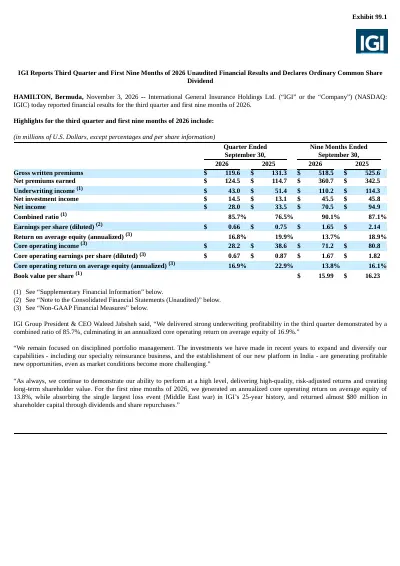
IGI generated strong profitability in both the third quarter and first nine months of 2026, culminating returns on average shareholders' equity of 16.9% and 13.8% respectively. We delivered these results while returning close to $80 million to shareholders in dividends and share buybacks.
Market conditions continue to be more challenging than a year ago, and the pace of deterioration in some areas is accelerating. More broadly speaking, we are seeking an unprecedented level of global uncertainty and instability.
At IGI, our purpose is to provide peace of mind in times of uncertainty. Our people, their experience and expertise demonstrated over almost 25 years, have built a level of resilience in IGI that will continue to serve us well in the years ahead.
Our focus remains, as always, on risk-adjusted returns and active cycle management. We have executed our strategy consistently and have built IGI into a strong and dependable partner to our clients.
We have significant diversification, which provides us plenty of optionality throughout market cycles. This is what drives the consistency in our long-term track record of high-quality financial results and shareholder value creation.
I will now hand over to Waleed to discuss the numbers in more detail and talk about our outlook, and I'll remain on the call for any questions at the end.
Waleed Jabsheh
Good morning, everyone. Thank you all for joining us, and thanks, Wasef.
Now, we're very quickly approaching the end of the year and the beginning of 2027, which, as Wasef alluded to, will be the year that we celebrate our 25th anniversary since starting operations in Jordan back in 2002. I just want to reflect for a moment on what this year has meant for us at IGI and all that we've achieved.
I'm very particularly pleased with our performance so far in 2026. We've delivered excellent results and have clearly demonstrated the the strength, the stability, and resilience of our company.
This year, we experienced the single largest loss event in our history with the war in the Middle East, and this occurred in one of our core regions where about two-thirds of our people are based across our offices in Amman and Dubai. We came together as a company, working together, supporting each other, and supporting our clients, some of whom represent the longest-standing relationships we have.
That is the culture we've fostered. Now, much has changed in 25 years, and that's not that's a good thing.
The foundation we've built at IGI ensures we're prepared to face a changing landscape. Now, these are clearly very challenging times for insurance and reinsurance markets alike, and this is only heightened by the increasing level of uncertainty and instability that we're seeing across the globe.
For IGI, our structure and our strategy are specifically designed to manage and mitigate volatility as much as possible. Navigating difficult market conditions is nothing new for us.
We've experienced soft markets and tough times both as a company and as an industry in the past. About 10 years ago, back in 2017, we were in the throes of a soft market.
In that year, we experienced one of the heaviest loss years for natural catastrophes in the industry's history. That was the year of, you'll recall, Hurricanes Harvey, Irma, and Maria.
In the same year, there was also there were also a number of other natural catastrophes. Our financial results that year were significantly impacted by by these events, and that was the one year in the past decade where we reported a combined ratio above 100%.
We came in at around 105%. Now, you may think I'm rambling on, but I I say this, I say all this, to make the distinction between IGI 10 years ago and IGI today.
We were we were less than half the size we are today in terms of gross written premium. We were a predominantly short-tail company, and we had significantly less diversification, both from a both from product and geography perspectives.
Today, we're now writing around 25 lines of business serviced from our nine offices worldwide, including our latest platform in India. For a company of our size, this is a significant and and and and quite unique level of diversification.
This is our strength. Where one line or one territory is under pressure, others may be heading in the opposite direction.
This diversification gives us the levers that we've spoken about in previous quarters to work with. Every line, every region where we're operating in has its own experts, people who are experienced, people who have been through soft market cycles, and people who understand the dynamics and their of their business and their markets.
Add to that the fact that we've tripled the size of our balance sheet over the past decade, and we've built significant strength, stability, and resilience in our company. We've achieved all this by design: slowly, methodically, and purposefully.
I'll talk a little later more about specific market conditions, opportunities we're seeing, specifically, those arising from our entry into the Indian market and also the launch of our MGA platform in in Bermuda, Cypher Underwriting. Specifically to the results for the first for the third quarter and the first nine months, let me focus on on some of the key points.
Gross written premium were came in at just under $120 million for the third quarter and just under $520 million for the first nine months of of the year, which represents an 8.9% and 1.4% decline over the same periods last year. I would note that in spite of increasingly challenging market conditions, top line is holding up relatively well.
This level of decline is not concerning at all. It just really means that we're executing our strategy as we should.
Net premiums earned were just under $125 million and $360 million for the third quarter and first first nine months respectively. That represented increases of 8.5% and 5.3% respectively over the same periods last year.
Underwriting income also holding up well at $43 million for Q3 and $110 million for the first nine months. The combined ratio of 85.7% for third quarter includes 6.9 points of cat losses.
Now, 2.6 points of that related to the war, and then 7.1 points of favorable prior year reserve development. The combined ratio of 90.1% for 90.1% for the first nine months includes 14.8 points of cat losses, again, primarily related to the war in the Middle East, and just under 11 points of favorable prior year reserve development.
Quick note, or quick point on the increase in the net policy acquisition expense ratio, which went from 15.9% to 19.4% in in Q3, because the comparison is is a bit distorted by two things: one, the lower realized foreign exchange gains, and two, higher gross commission expenses across all segments in 2026. On a on an FX-neutral basis, it would have been 18.4% for for the third quarter of 2025 versus 19.4% for the current year third quarter.
Now, this this was specific to the third quarter comparison; the nine-month periods are more in line. Just turning to our segment results, conditions, as I said, are getting tougher in our short-tail segment with with rate reductions and decreases in most lines of business.
While the top line overall is down in the segment in both Q3 and the first nine months, net earned premiums were up 2.8% and 3.7% over the same periods respectively. Now, there's quite a lot of variation in the level of adequacy from one line to another.
Underwriting income for both Q3 and the first nine months of the year was down year-over-year due to the elevated loss activity, most of which is war-related, but still came in healthy at $20.3 million for the third quarter and over $45 million for the first nine months. This is what really speaks to how we manage risk and the resilience we've built in our business.
In the reinsurance segment, underwriting income improved to $12.7 million in Q3, representing increase of over 22% over the same period in 2025. Now, we've stated before, this is a segment where we've taken a number of actions to add to our capabilities and product offering.
Now, both gross written and net earned premiums were up in the quarter versus Q3 last year. For the first nine months, both gross written and net earned premiums were down, primarily due to the non-renewal of the two sizable reinsurance programs in the first quarter of the year, which we've mentioned on previous calls.
Underwriting income in the segment was broadly stable for the first nine months when compared to the same period of last year. In the long-tail segment, gross premiums written in the third quarter were fairly steady with the same period in '25, but on a net earned basis, premiums were up almost 15%, leading to underwriting income of about $10 million.
For the first nine months, both gross written and net earned premiums were up 4.3% and 16.4% respectively, driven by new business in in in most of our lines in the segment. Underwriting income for the first nine months increased substantially to just under $33 million versus a million dollars for the same period last year.
I I would note here that the the 2025 underwriting income in this segment was quite considerably negatively impacted by the FX movements. If we want to compare on a like-for-like basis, we're talking about $32.9 million as a profit compared to 18 around $18 million last year, which is still a quite a significant improvement.
You'll also note a fairly big reduction in the level of ceded premium in this segment for both the third quarter, but especially for the first nine months. Now, that's mainly driven by the non-renewal of the large professional indemnity binder, which we spoke about last year, and the sizable quota share reinsurance program that sat behind that.
Overall, in conclusion for this segment, we we continue to be cautiously optimistic about market conditions stabilizing over here. Now, all in, we delivered net income of $28 million, or 66 cents per share, for Q3 this year versus $33.5 million, or 75 cents per share, for Q3 last year.
For the first nine months, net income was $70.5 million, or $1.65 per share, versus $94.9 million, or $2.14 per share, last year. Return on average equity was just under 17%, and core operating return on average equity was the same at 16.9%.
That's for Q3. For the first nine months, return on average equity and core operating return on average equity came in at 13.7% and 13.8% respectively, all in line with our long-term averages.
Now turning to the balance sheet, total assets $2.11 billion. Total investments and cash $1.28 billion.
Our allocation to fixed income securities, which make up 78% of our investments and cash portfolio, generated $14.2 million and $42.8 million in investment income in Q3 and the first nine months respectively, with a yield of 4.4% as at the end of Q3. We also pushed the duration out slightly to 3.7 years from 3.5 at the end of last quarter.
During the third quarter, we repurchased a little over 148,000 common shares, average price per share of $24.68. Year-to-date, we've purchased just under 900,000 shares at an average price of $24.37.
At the end of Q3, we had 3.8 million common shares remaining under our existing 5 million common share repurchase authorization. Total equity was $663 million, just over that, at at the end of Q3 compared to $710 million as the end of 2025.
Now, that includes capital returned to shareholders of just under $80 million comprised of about $58 million in dividends, including the special we distributed earlier in the year in April of $1.15, and a further roughly $22 million in share re share repurchases. Should also note that total equity was impacted by negative mark-to-market movement on the bond portfolio amounting to about $44 million for the first nine months and $29 million for the third quarter alone.
Just a reminder here again that we hold our bond portfolio to maturity. Book value per share was $15.99 at the end of Q3.
Now, that's a decline of 5.4% from 5.4% from December or end of last year, primarily due to the negative mark-to-market movements I've just mentioned. As I said at the outset, very strong fundamental results in in the third in the first nine months, especially considering the overall market softening, got the heightened level of loss activity in the first six months of the year, and more broadly, the greater level of of of economic and geopolitical uncertainty.
Now, this this provides a good point point for me to turn on to the view of our to our view of the markets and the opportunities that we're seeing. If we start with the reinsurance portfolio, treaty reinsurance portfolio, margins there are still relatively healthy, but competitive pressures, as I'm sure you're all aware, are becoming increasingly prevalent.
Pressure on property rates specifically is driving overall reinsurance pricing pressure. The opportunities in this segment more concentrated on the specialty treaty lines, such as marine, energy, PV, terror.
Now, these are areas there where there's been, there has been significant risk and and war losses. Then also, of course, cyber is another area where where we've been adding to our capabilities.
Now, on that note, just over a month ago, announced the launch of Cypher Underwriting. Now, that Cypher is a specialty treaty MGA focused on cyber.
It'll be run out of Bermuda, out of which IGI owns 60% of. Now, this is for us a very much a long-term play.
Our entry now positions us well in the market as market conditions in cyber stabilize and improve, and like everything we do, we will grow this book cautiously. Since our announcement, Cypher's secured all the necessary regulatory approvals and has begun operations.
Cypher is led by Arijit Mukherjee, who's a cyber reinsurance specialist and who's helped to set market standards on data and policy wordings. Now, the initial focus for Cypher is on addressing, the growing demand for cyber reinsurance with lead underwriting capabilities targeting high-growth emerging risks.
This is a very exciting development for IGI, and it adds to our growing special treaty capabilities and the overall diversification of our portfolio. I echo what I said earlier: we will be growing this book very cautiously.
Another avenue for treaty growth treaty growth is our new India platform in GIFT City, which we announced back in June. Now, with India being one of the fastest growing economies in the world, the opportunities here, not just in India, but the whole Indian subcontinent, are are quite abundant, especially in in specialist niche areas like cyber, surety, and liability business.
This also provides an opportunity to market a slew of other lines of business within our portfolio, including construction and engineering, which we already write there, as well as ports and terminals, marine cargo, PV, and some professional lines also. Now, we've assembled a strong local team with deep knowledge of the Indian market, strong understanding of how business is conducted.
We're expecting the team to be fully in place by the end of January, but most will be in place by November. Obviously, with recently regular- recent regulatory changes, there's a significant advantage to being on the ground here, where we'll be considered a preferred market.
Now Now, this this is very much consistent with our approach across all our markets, and that's combining IGI's technical expertise with and disciplined underwriting with local talent, cultural compatibility, and fluency. Now to the markets for short-tail lines.
We continue to see opportunities in the PV line coming out of the Middle East following the war, and we've grown our PV our PV portfolio by about 50%, though it's important to note, and I've said this before, it's coming from a relatively modest base. Now, not only has pricing significantly improved, but terms and conditions have also strengthened across the market we write, and the GCC region especially.
As we said on prior calls, it's important to note that we've adjusted our own PV gross line sizes, leading to reduced war exposure over this time period. On a positive note, we're we're we're definitely seeing more discipline in the markets there.
However, it's still somewhat disappointing that the market corrections so far have been limited to the Middle East and not the broader PV markets. We expect we may see some broader improvements to come given the rising instability in the world.
Just as an example, we've all seen what's been taking place in a number of countries in in in Europe over the last several weeks. Elsewhere, we're also seeing opportunities in in in certain marine lines, like cargo, specifically cargo war and and war on land, also as a result of the conflicts, as well as marine trades.
Now, while the opportunity isn't significant so far, we've taken advantage where appropriate. In the more specialist lines, like construction and engineering, we're seeing healthy conditions and deal flow.
We're still seeing an increase in infrastructure projects globally, some some slow down in in in in certain parts of the world, but still very positive in this regard, and contingency also continues to develop for us. Now, that leaves our two biggest lines: property and energy.
That is where we're seeing the most pressure. First, on the on commercial property side, continues to be the rates continue to be relatively adequate, even though we're seeing reductions of about 15% or so across the board.
Rates on the international property book are definitely holding up better than the US. From from both angles, it's clearly tougher now than it was a year ago.
Similarly, in the energy book, rates are coming down quite quite rapidly despite an abundance of of of of loss activity, both on the downstream side, power and renewable side, and the upstream side. Now, we've seen some, signs of of of of pushback from the market following these losses, not enough to to really get too optimistic, but but we're hopeful this could be the signs of of the tide turning.
In our long-tail segment, we continue to see new opportunities and good deal flow in professional indemnity, as well of as well as some of the more niche segments of this business, like marine liability, which we've talked about in in prior calls. Now, this is with respect to marine liability, this is very clearly an opportunity for us to capitalize on improved pricing and demand that resulted from the Baltimore Bridge loss.
We expect to continue to grow our direct marine liability book, and we've actually already tripled the size of that book so far this year. It's widely expected that renewal rates for for 2027 will remain healthy and attractive.
As far as the geography geographic regions go, we've already covered the Middle East and India. For the US, Europe, and Asia Asia, the story is similar to what we said on previous calls, and and we'll continue, as always, to leverage our presence, our expert- expertise, and our relationships for new opportunities.
Our markets are in transition, and are continuing to evolve, some in good ways and and others not in not such good ways. As we all know, this is the nature of our business, but at IGI, we will continue to do what we do best.
We have outstanding teams with deep technical expertise, we're disciplined in our risk management, we execute consistently, and we have significant portfolio diversification. Now, this high-performance culture, along with our long-standing values, principles, entrepreneurial spirit, have always guided us and continue to be central to our business and our track record of success.
I'll be very clear on this: we don't, and we won't compromise these under pressure. It's this that provides us a solid foundation for sustained, strong performance and value creation.
Over almost a quarter of a century now, we've built an impressive track record, one that clearly demonstrates the excellent earnings power of our business. We have the experience, and we've built a level of resilience in IGI that will continue to drive our success forward for the benefit of all our stakeholders.
We look forward to what's to come for what is left of 2026, and to celebrating our 25 25th anniversary year next year, and we remain steadfastly focused on protecting our existing portfolio and capitalizing on the many opportunities that our strategy provides. I'm going to pause here, and we'll turn it over for questions, please.
Operator, we're ready to take the first question.
Operator
We will now begin the question-and-answer session. To ask a question, you may press star then one on your telephone keypad.
If you are using a speakerphone, please pick up your handset before pressing the keys. To withdraw your question, please press star then two.
At this time, we will pause momentarily to assemble our roster. The first question comes from Michael Phillips of Oppenheimer.
Go ahead, please.
Michael Phillips
Thanks. Good morning.
Waleed, just a quick numbers question to make sure I heard you correctly on the pac expense ratio. Did you say 18.4 for the quarter, excluding FX impact?
Waleed Jabsheh
Yes, that's right.
Michael Phillips
For 8.4
Waleed Jabsheh
for last
Michael Phillips
third quarter last year.
Waleed Jabsheh
Yes, correct. Thank you.
Michael Phillips
Then I guess on the commission piece of that then, was there anything anomalous just to the quarter, or is that increase there more because of changing mix of the business?
Waleed Jabsheh
I think it's a bit of both, Mike, because the business mix is changing slightly, not enough to really move it that much for the quarter, but definitely the business mix will impact that. Then also, it's the market conditions as well.
As you're aware, in hard markets we can push acquisition costs down, and vice versa, in softer markets, brokers and clients will push acquisition costs up. The simple answer is it's a combination of both.
Michael Phillips
Thanks. I guess on the short-tail lines, it sounds like your comments here sort of sound like even last quarter, there's been some energy losses, I think you said downstream last quarter, but despite that, there's still not been a turn.
Maybe I guess what we've seen with the short-tail this quarter might be kind of at what we should expect to see in the near-term horizon?
Waleed Jabsheh
I think it's safe to say that in the near-term horizon that statement would be accurate. I'm talking predominantly from a top-line perspective.
I think our underwriting strategy and reinsurance purchasing strategy is modified depending on where we are in the cycle. That should mitigate some of or hopefully mitigate the impact of the deteriorating market conditions.
These are volatile lines of business, and we will manage our exposures to ensure that we mitigate that volatility as much as possible. There's no doubt that the rates have been reducing in those lines of business for a couple of years now, and we don't see the market changing its tone or tune in any meaningful way, at least not yet.
Michael Phillips
Thanks, Waleed. Maybe just one more.
It's been about a year since your upgrade, I think of almost a year ago. Because of that, are you seeing more at-bats, if you will, because of the upgrade?
If you are, does that business look any different than what you would have seen otherwise, maybe in terms of size, or mix, or returns, or anything?
Waleed Jabsheh
It's definitely helped. I'll be honest with you: it hasn't been life-changing for us, but it's definitely helped.
It's opened up opportunities for us to explore. We've capitalized on some of those opportunities, but hasn't been significant.
That said, we are working on opportunities that have arisen now as a result of our upgrade that could be much more meaningful for us in 2027 and onwards. It's definitely lifted the profile, opened up new doors, both to clients, cedents, and then obviously also to new business lines.
Michael Phillips
Thanks, Waleed. Congrats on great great results in a tough environment.
Appreciate your time.
Waleed Jabsheh
Thank you, Mike.
Operator
The next question comes from Rowland Mayor of RBC Capital Markets. Go ahead, please.
Rowland Mayor
Thank you, and good morning, or I guess good afternoon over there, Waleed. I wanted to quickly start on the PV exposure in Europe.
Should we expect some losses there in the fourth quarter, or do you not carry much mainland Europe exposure?
Waleed Jabsheh
No, we don't anticipate much, to be totally honest with you. The events in Europe are more on the strikes, riots, civil commotion side, which tend to be covered under property placements, actually, more often than not in Europe.
Our European book is predominantly a pure terrorism book. These events would not fall under that type of coverage.
No, we don't anticipate anything material coming out of it for us.
Rowland Mayor
Thank you. I guess just moving on to Cypher, could you maybe walk through how that product will be structured or positioned?
Then you gave the ownership percentage, but how much of the capacity are you providing to Cypher?
Waleed Jabsheh
With Cypher, it's a good question, Rowland. With Cypher, Arijit, who I mentioned in the call, is, just to give some background, is someone that we've known and supported for many years prior to partnering up with him.
We're familiar with his underwriting philosophy, underwriting approach, and we know what his results have been like. He's built portfolios in the past that we've supported and backed and done very well out of.
When the opportunity came to partner up with him and to do this in a more meaningful way, we jumped on the opportunity, and we're now almost ready and set to go. Now, in terms of exposures and building the portfolio and the capacity that is to be provided to Cypher, this is an exclusive relationship.
We are the sole carrier for Cypher, at least for the time being, and, conversely, Cypher will be the sole underwriter for us in these lines of business. We will be the primary carrier.
We are out there putting together a retro program to protect this portfolio. Now, the more support we can get, the more gross capacity we can deploy.
For us, it's not just simply by creating Cypher and IGI Managing, which sits under IGI Managing Agencies, we sort of segment out the fee-generating income side of the business. It's a multi-pronged approach.
First and foremost, we love the guy. We love how he underwrites.
We love his book. That's the driver behind the partnership.
Then putting it under an MGA umbrella, we generate fees from the MGA, large retro program behind it, we generate fees from the retro program as well, plus we benefit from the hopefully positive, profitable results of the underwriting portfolio. I foresee that to be the landscape for Cypher and IGI for at least the first couple of years, and then the business can develop into expanding into other lines of business, other niche areas that potentially we could bring outside capacity to get involved.
The real intention behind or big part of it is that we own the portfolio, it's written on IGI paper, and then we distribute it to others who want a piece of the action.
Rowland Mayor
That's super helpful. Thank you.
Then if I could sneak in one more big picture question: could you maybe talk about how interest rates impact your target combined ratios? Do you fully separate the margin decision from investments, or do some of the long-tail lines need to factor in the investment income component?
Waleed Jabsheh
Fully and completely separated, Rowland. I don't have an answer to that question.
Investment income is completely separate from any of our underwriting results, and we don't underwrite based on what the investment environment is or how much investment income we anticipate we can generate.
Rowland Mayor
Right. I guess just on that, do you think your peers are doing the same, and or do you think we're starting to see some cash flow underwriting return to the market with interest rates where they are?
Waleed Jabsheh
I have no idea, Rowland. Honestly, I have no idea.
Rowland Mayor
It was worth a try. Thank you for the answers, and congrats on almost 25 years.
Waleed Jabsheh
Thank you, Rowland. Thank you.
Appreciate it.
Operator
This concludes our question-and-answer session. I would like to turn the conference back over to management for any closing remarks.
Waleed Jabsheh
Just want to thank you all for joining us today, and thanks for, as always, for your continued support. If you have any additional questions, you can contact Robin, and she'll be happy to assist.
Ahead of next quarter's call, I wish you all a Merry Christmas and a Happy New Year. Look forward to speaking to you in the new year.
Have a good day.
Operator
The conference has now concluded. Thank you for attending today's presentation.
You may now disconnect.