Mowi ASA
Q3 FY2026 · Earnings Call TranscriptNovember 4, 2026
Ivan Vindheim
Good morning all, and a warm welcome to this presentation of Mowi's third quarter results of 2026 here at Salmon, our combined knowledge center for farming Atlantic salmon and fantastic fish restaurant, if I do say so myself, at Aker Brygge in the heart of Oslo. To those of you who are in the room here with me this morning, I hope you have settled in well, had something to drink and grabbed a bite to eat of some of our delicious Mowi products.
To those of you who are following the presentation online across the world, which I guess is the majority this morning, I hope you have made yourselves comfortable so you can follow along in peace and quiet. Otherwise, my name is Ivan Vindheim and I'm the CEO of Mowi, and together with our CFO, Kristian Ellingsen, I will take you through the numbers and the fundamentals this morning, and to the best of and to the best of my and our ability provide some context to them.
After the presentation, our IRO, Kim Døsvig, will lead the host the Q&A session where also you who are following the presentation online can submit your questions or comments in advance or as we go along by email. Please refer to website at mowi.com for the necessary details.
Disclaimer is still long and extensive, I think we leave it for self-study as we always do. Without further ado, I think we can move on to the highlights of the quarter.
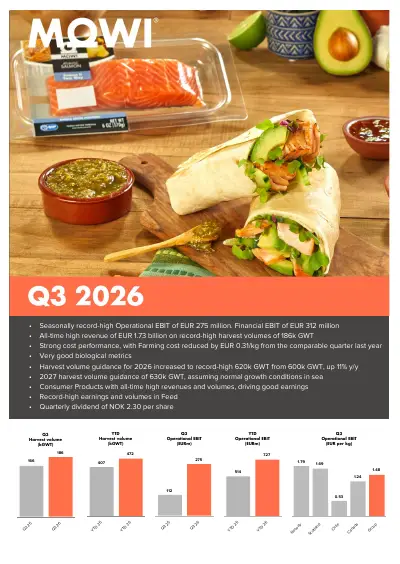
A quarter that for Mowi will go down in history first and foremost for its harvest volumes, I think is fair to say, as we harvested a whopping 186,000 tonnes in the quarter, setting new quarterly high for Mowi by a wide margin, up by 12% year-over-year from the previous quarterly high. Coupled with good realized blended production costs for our seven production countries in the quarter of €5.11 per kilo, which is slightly lower than our guidance, and reasonably good prices given seasonality, this translated into an operational profit of €275 million for the quarter, which is a good result I would say, seasonally record high and two and a half times higher than the €112 million we posted in the third quarter last year.
Thanks to better prices and, as I said, higher volumes and lower costs. The latter down by €0.31 per kilo year-over-year or €51 million in absolute terms, made possible by a falling feed price through the cycle, but also aided by good operational performance in the third quarter and the quarters leading up to the third quarter.
Higher prices and volumes also translated into the highest turnover on record for any quarter for Mowi of €1.73 billion. Otherwise, it seems like the forecasted market recovery is playing itself out, as prices were up by as much as 18% year-over-year in the third quarter, and are up by 13% so far in the fourth quarter, driven by strong demand in most markets combined with an industry supply growth which has now normalized around the low single-digit rate, as previously untapped production capacity now is more or less now is more or less fully utilized by the industry, released by very favorable growth conditions in the sea last year and this year.
These price hikes also attesting to the historical supply to demand ratio, which bodes well for the coming quarters and years despite the once again rising feed price at the moment, following weak pelagic fisheries this year. The latter, hopefully, just temporarily, as fisheries naturally fluctuate by nature.
In the meantime, higher feed prices mean, inevitably, higher realized cost in the end of the day. There is, unfortunately, no hiding from that.
Anyone saying otherwise has a too high cost in the first place, I would argue. That doesn't apply to Mowi.
For Mowi, we expect somewhat higher realized cost in the fourth quarter when compared to the third quarter, also partly driven by lower harvest volumes and, consequently, less dilution of fixed costs. When compared to the fourth quarter last year, a year-over-year comparison, we expect a relatively stable cost in the fourth quarter.
There I think you have a okay picture of of at least our cost expectations for the fourth quarter. Carrying on, when it comes to the two other divisions, Mowi Feed and Mowi Consumer Products, our downstream business, things are still going well, I would say, with new records for both divisions in the third quarter, because in Mowi Feed, we saw record high sales volumes leading to record high earnings.
In Consumer Products, we also enjoyed record high sales volumes driving strong earnings also for that division, I would say. Then last but not least, and as the last bullet point here reads, our Board of Directors has decided to distribute a quarterly dividend of NOK2.30 per share after the third quarter.
I think that covers the highlights of the quarter, then we can move on to our farming volume guidance, which we have increased for this year since last time we reported to now 620,000 tonnes, which is up from previously 600,000 tonnes due to an exceptionally good growth in the sea this year. And 620,000 tonnes correspond to a growth year-over-year of as high as 11%, most of which of course related to the acquisition of Nova Sea last year, but there is also a great deal of organic growth in that number, approximately 1/3 of it.
As for next year, we expect to harvest 630,000 tonnes assuming normal growth conditions, and not the fantastic growth we have seen this year, because we cannot expect to hit the biological jackpot three years in a row, particularly not with an El Niño coming, because then, I guess, the likelihood for that is even less than it otherwise would be. For the sharp-eyed amongst you, we have taken out our organic volume target for 2029 of at least 650,000 tonnes from this slide this time around, simply because we are almost there.
Now I guess we need a new long-term farming volume target in Mowi, and the number that naturally comes to mind, I assume, is 700,000 tonnes. It's more a question of the time frame to get there, not to mention investments and resources needed, because any growth must be profitable.
Otherwise, there is no point in growing. We do not grow for the sake of growing.
At least that's not how we do it in Mowi. The organic part of that growth will still come through increased smolt stockages and by use of post-smolt, because we have still unutilized licensed capacity in Mowi, and by use of post-smolt, we can increase the productivity on licenses already in operation, which are to be set into operation.
Mowi's farming volume growth continues steadily after a rather flatlining 2010s, and is surpassing that of the wider industry, and at least peers, by a large margin, cementing our number one position in the market for the Atlantic salmon. Here measured in whole fish equivalents by which we normally measure the market.
So 700,000 tonnes for Mowi in whole fish equivalents versus 3.3 million tonnes for the market, which yields a market share, global market share, of 21%, which is quite unique in the protein space. Then from the overall volume picture to key financial figures for the quarter.
There are a lot of numbers on this slide, I think we have to leave most of it to Kristian and his session later, and then we also avoid getting ahead of things and becoming too repetitive, which is a positive effect from that. Turnover profit, we have just been through, I think we can skip them here.
Before we move on entirely, maybe we can allow ourselves a little fun fact this morning, because these revenues and volumes make Mowi now also the largest seafood company in the world measured by revenue or turnover. Now we are the largest seafood company in the world measured by all metrics, not only the largest salmon farmer in the world.
Which is quite something, I would say, 60 years after we started out small in a closed-off bay outside the city of Bergen where we are headquartered. Carrying on, net interest-bearing debt stood at €2.89 billion at the end of the quarter, which is slightly higher than our long-term debt target of €2.70 billion.
Having said that, equity ratio was at a healthy 43% at the end of the quarter. I would argue we still have a strong balance sheet in Mowi.
It can also be mentioned that we have €140 million in proceeds coming in sometime in the fourth quarter or first quarter following our sale of our farming assets in Canada East, which is pending antitrust approval. Furthermore, underlying earnings per share were €0.33 in the quarter, whilst annualized return on capital employed was 15.8%.
Finally, in terms of regional margins through the value chain, there was quite a wide spread in the field also this time around, and we will come back to the explanation shortly when we go through the various business entities. First, further on prices in the quarter, which were, as said, up by as much as 18% year-over-year in the third quarter, and are up by 13% so far in the fourth quarter, driven by strong demand in most markets in combination with industry supply growth, which are now normalized around a low single-digit rate, as previously untapped production capacity now is more or less fully utilized by the industry.
These price hikes are also attesting to the historical supply to demand ratio, which bodes well for the coming quarters and years, because we believe in a tight supply side going forward due to regulatory and technological constraints, and the latter as a result of the the first one, and a tight supply side should lead to a tight market balance, all else being equal. This will be interesting to follow going forward.
Then our own price performance in the third quarter, which I would say was good, as it was 7% above the reference price, which is the standard we hold ourselves to internally in Mowi and against which we measure ourselves. Positively impacted this time around by a contract share of 16% and contract prices somewhat above the prevailing spot price in the quarter.
Also helped and aided by strong sales execution by our sales organization, which laid the foundation for also good spot price performance in the quarter. Credit to the sales organization for that.
With that, I think we are ready to start to drill down into the different business entities. We begin, as usual, with Mowi Norway, our largest business and farming entity by far and, consequently, also our most important one as is as it's the locomotive of our business model.
Let's take the numbers first this morning. Operational profit was €239 million for the quarter for Mowi Norway, while its margin was €1.79 per kilo.
Harvest volumes, brace yourselves, 134,000 tonnes. In another good quarter for Mowi Norway operationally, I think it's fair to say, despite the fact that autumn is the time of year when things get a bit tighter in the sea due to higher sea temperatures with all that entails biologically.
Once again, I think we can say we landed on our feet in Norway. Particularly in Northern Norway, we continued to perform extremely well, which translated into an impressive margin given the prices in the quarter of €2.07 per kilo for Region North.
Hats off for that. Region North is, as our most and largest entity, farming entity or farming region, by far in Mowi, consequently, extremely important to us with its almost 190,000 tonnes of harvest volume this year.
Also Region Mid delivered a strong margin in the third quarter of €1.94 per kilo, partly aided by good timing of harvest. For Region West, it was the other way around.
The timing was poor, but the cost level was good, actually, on par with Region Mid. Finally, when it comes to the the overall margin for Mowi Norway, €1.79 per kilo, I think we have to say we are satisfied with, all things considered, including the pricing environment in the third quarter.
Then the volume guidance for Mowi Norway, which we have increased for this year to now 395,000 tonnes, up from previously 380,000 tonnes due to, as said earlier this morning, fantastic growth in the sea. And 395,000 tonnes are equivalent to a growth of as high as 19% year-over-year, primarily of course driven by the acquisition of Nova Sea last year, but also here there is a great deal of organic growth, 24,000 tonnes or 8 percentage points to be precise.
As for next year, we expect to harvest 405,000 tonnes assuming normal growth conditions and not the exceptionally good growth we have seen this year. And 405,000 tonnes would be a major milestone for us as there's always something special about reaching and crossing new three new three-digit numbers in harvest volumes.
If we do not snail that record this year, let's see if we can nail it next year and add another section to the history books. Because it's not that long time ago since we harvested 210,000 tonnes in Mowi Norway in the aftermath of some challenging years back in the 2010s in the transition from chemical to mechanical delousing.
It's quite a journey the Norwegian farming organization has taken us on. Big credit to them for that.
Then the last slide on Mowi Norway, our sales contract portfolio. Contract share was 14% in the third quarter and was with that spot on our guidance, and these contracts delivered a small positive contribution to our earnings in the third quarter.
As for the fourth quarter, we expect our contract share to be relatively stable with relatively stable contract prices quarter-over-quarter. Finally, when it comes to next year, that we cannot, unfortunately, say much about this morning as we are negotiating as we speak, so that we will have to revert to in February at our fourth quarter release.
In the meantime, we must keep our cards close to our chest for obvious reasons. Then I think we can conclude Mowi Norway and start having a look at our six other farming countries.
We begin, as usual, with Mowi Scotland. Mowi Scotland continues to deliver good quarters biologically, I think is fair to say.
At least taking into consideration seasonality, but very low harvest volumes in Scotland this time around left their mark on our absolute earnings, which materialized into an operational profit of €20 million for Mowi Scotland in the third quarter, representing a strong margin, I would say, of €1.69 per kilo on our 11,500 tonnes of harvest volume. Then we move across the Atlantic to the Pacific and to Chile and our Chilean farming operation.
Mowi Chile also continues to deliver good quarters biologically, I think we can say, despite some issues with rickettsia in Chile, but soft prices and tariffs are still weighing on our earnings in Mowi Chile. By extension, operational profit came in at €13 million for Mowi Chile in the third quarter, reflecting a modest margin of €0.53 per kilo on our seasonally record high harvest volumes of almost 24,000 tonnes.
Consequently, there's nothing wrong with our volumes in Chile. Neither cost, I would argue, as Mowi Chile has the second lowest standing biomass cost in the group, only surpassed by Region North, which says a lot in my view.
Prices are where the shoe pinches for our Chilean salmon. Having said that, that might change when we get the outcome of the so-called 301 section investigation into excess capacity and overproduction in manufacturing categories for Norway and 15 other countries.
Because if we end up with a double tariff on Norwegian salmon into the US, that would obviously benefit Chilean salmon. Whatever scenario that plays out, I think with Mowi's farming portfolio, we are well-equipped to take to take advantage of the scenario that plays out in the end of the day.
Let's see what the future has in store for us. Then our second farming entity in the Americas, Mowi Canada.
As guided in connection with our second quarter release in August, we encountered some seasonal issues with algae in Mowi Canada in July and August, which cost us €8 million in the third quarter when everything is tallied up. Despite this, we posted a strong operational profit of €9 million in Mowi Canada in the quarter, reflecting a strong margin of €1.24 per kilo, all things considered, on our 7,500 tonnes of harvest volume.
Thanks to good prices and of course no tariffs on Canadian salmon into the US, but also good cost performance adjusted for the the algae hit. Before we move on, it can also be mentioned that the fourth quarter has developed satisfactorily at sea so far.
With that, I think we can go back to Europe again. First to Ireland and the Faroes, our two smallest farming entities.
In Ireland, we ended up roughly breakeven on our almost 2,500 tonnes of harvest volume there, whilst we in the Faroes turned a profit of €2.5 million on our almost 3,000 tonnes of harvest volume, reflecting a margin of 84 €0.84 per kilo, of which the latter was adversely impacted by 100% spot price exposure in the quarter, because biological metrics were once again good in the Faroes in the quarter, whilst they were more of a mixed bag in Ireland. Ireland is, as a more challenging place to farm Atlantic salmon due to its shallow waters and higher sea temperatures with all that entails biologically.
Then we move further out into the Atlantic to Iceland and our Icelandic farming operation, Arctic Fish. Arctic Fish recorded a small loss of €3 million in the third quarter on its 4,000 tonnes of harvest volume due to weak prices and somewhat higher costs.
On a positive note, biological metrics were once again reasonably good in Iceland, which should lay the foundation for once again positive earn earnings in Iceland when prices are fully recovered and we get back to historical levels. With that, I think we can conclude Mowi Farming and have a look at our two other divisions, Mowi Consumer Products, our downstream business, and Mowi Feed.
In Consumer Products, we can put behind us a solid quarter, I think is fair to say, despite a decline in earn decline in earnings year-over-year with an operational profit of €45 million in this quarter on quarterly record high sales volumes of 84,000 tonnes product weight, of which the latter is up by as much as 18% year-over-year, demonstrating very strong demand for our products. In terms of the decline in earnings year-over-year, that's solely a result of weaker contracts, because all other KPIs are more or less improved year-over-year for this division.
Then the last one out this morning, Mowi Feed. Mowi Feed can also look back on a strong quarter, I think we can safely say, with quarterly record high operational EBITDA of €34 million and quarterly record high sales volumes of 211,000 tonnes, up by 33% and 19% respectively in a rather challenging sourcing environment, which I think we have handled well so far.
Before I hand over to Kristian, it can also be mentioned that our recently expanded feed factory in Bjugn is running smoothly. Consequently, we reiterate our targeted sales volume goal for this year of 650,000 tonnes, corresponding to a growth year-over-year of 11%, which aligns well with our farming volume growth.
With that, Kristian, the floor is all yours, you can take us through the financial figures and the fundamentals. Thank you so far.Kristian Ellingsen (CFO):
Kristian Ellingsen
Thank you very much, Ivan. Good morning, everyone.
Hope you are doing well. As mentioned, my name is Kristian Ellingsen, and I will discuss the financial figures, and also have a look into the fundamentals, including supply and demand, and our own volume figures.
As usual, we start with the overview of profit and loss, where the top line shows all-time high revenue of €1.73 billion on record high harvest volumes. Between operational revenues and operational EBIT, we have the operational costs.
There we saw a reduction year-over-year of €0.31 or €51 million. We saw a decline in most cost items, but the largest individual decrease was in the feed cost.
The improvements in revenue and cost resulted in seasonally all-time high operational EBIT of €275 million. When it comes to the items between operational EBIT and financial EBIT, they include fair value adjustment of biomass, which was positive this time around on higher salmon prices.
Earnings translated into underlying earnings per share of €0.33. Cash flow per share was somewhat impacted by working capital tie-up and capex.
Annualized return on capital employed was good at 15.8% in Q3, and the same goes for return on equity, which was 18.6%. We then move on to the financial position, the balance sheet.
We see that the total assets have increased somewhat from year-end driven by investments in the value chain. Can also comment that the Q3 2025 figures are not that comparable, as this was before the Nova Sea acquisition.
Mowi has a strong financial position with 43% equity ratio. Net interest-bearing debt increased somewhat during the quarter, as cash flow generation was partly offset by seasonal working capital tie-up in sales and marketing, tax payments, and investment projects.
As Ivan mentioned, when it comes to group NIBD, that will benefit from approximately €140 million in proceeds from the agreed divestment of Canada East once the transaction closes pending competition clearance. When it comes to the guidance for cash flow items for this year, interest paid is increased by €10 million.
Otherwise, the cash flow guidance is unchanged. The financing we leave for self-study, as there are no changes to this slide from the last quarterly presentation.
Moving on to costs, following the reduction in feed prices in 2023 to 2025, feed prices have increased this year driven by temporary supply issues from weak pelagic fisheries. The second anchovy fishery season in Peru was cancelled this year, but a new fishery season in Peru is coming up in the spring, and we expect the situation over time will normalize.
However, the current supply disruptions have put pressure on industry feed prices, and this is expected to lead to higher realized cost in 2027. On a positive note, the Skretting Nutreco industrial partnership with Mowi is well under way, paving the way for €55 million in annualized net savings related to that, and there are also some mitigating effects from adjustments to the feed formulation.
Realized costs in Q4 2026 is expected to be at the same level as Q4 2025, i.e. somewhat up from the level seen now in the third quarter.
This is due to negative scale effects from lower volumes in addition to the already mentioned temporary inflationary effects from the feed. We in Mowi continue to work with cost-cutting measures, both operational improvements and more generic cost measures.
This is an area where Mowi has a very strong track record, high credibility. We have seen that this cost work has resulted in Mowi taking the number one or the number two position in the various regions we operate, as demonstrated in the graph here on the slide.
In addition to having the highest earnings amongst peers, Mowi also have the most stable earnings, as shown here on the graph. We also have a lower stock beta.
Consequently, cost of equity is lower versus peers. In addition to strong operational efficiency, we also have a strong utilization of our most important assets, the licenses.
In Norway, we have become as much as 42% more efficient compared with 2018, and gone from being below the industry benchmark to being above. This combination of of industry-leading margins, high license utilization, has resulted in the number one position also on EBIT per license.
Mowi is also more capex efficient than peers with a difference of NOK3 per kilo less capex or NOK1.9 billion. The strong operational efficiency, the strong asset turnover, has resulted in a return on capital employed above the 12% capital requirement.
Also, the return on equity components are strong versus peers. If we start with the interest costs, that's below peers, where the lower euro euro financing for Mowi versus NOK financing is a key driver.
The combination of lower cost of equity and lower funding cost gives a lower capital cost for Mowi. Another return on equity component is the tax component.
Also, the tax cost benefits from the most extensive value chain in the industry, which is favorable in the resource rent tax system. The final return on equity component is the equity multiplier, and Mowi has a competitive equity share compared with peers, 43%, balancing return and risk, not too high, not too low.
Much for the financials. We move on to the fundamentals, starting with industry supply.
Global market supply for the industry for salmon increased by 7% in the quarter when you adjust for inventory movements, 5% if you don't adjust for inventory movements. We see that this was driven by growth in Europe, partly offset by lower supply in Americas.
This also means that the trend from the second quarter with a normalization of supply has continued in the third quarter. Strong biological performance supported higher-than-expected harvesting in Norway and Chile during the quarter without a corresponding buildup of biomass.
The potential for further supply growth remains limited with global volumes expected to decline by approximately 3% in the fourth quarter of this year and increase by a low growth rate of around 1% in 2027. Then I'm referring to year-on-year figures.
Demand continued to be strong in the third quarter. Demand growth was as high as 18% on higher consumption at increased prices.
One and a half year of high supply growth and attractive pricing appeared to have strengthened underlying demand for salmon with the market now absorbing record high quarterly volumes at higher prices than at the same period last year. We see that consumption in Europe increased by 11% on continued strong retail demand.
We see good growth in the UK in particular, but also very positive developments in Germany, also in France. The strong supply growth in 2025 to 2026 has contributed to more attractive salmon prices relative to other comparable proteins, stimulating demand in the European markets.
Consumption in the US increased by around 1% as available volumes were temporarily impacted by less supply from Chile and Canada. Underlying demand in the US market remained good.
We see that fresh pre-packed products continue to grow strongly, and that's also reflected in Mowi's own figures. We see that our own skin-pack sales increased by 15% in the third quarter.
In Asia, we saw also an increased consumption. We see also of course that there is a more moderate growth rate in the third quarter, reflecting a higher base level.
China continued to lead the development with consumption increasing by a further 7% year-on-year. Following the 18% price increase in the third quarter, prices have have continued to grow in Q4 as a further testament to the already mentioned developments.
If we have a look at the outlook here for supply growth, these figures sum it all up. We expect limited industry supply growth ahead both in the fourth quarter and next year, and also in the coming years.
For next year, this is caused by lower number of individuals globally in sea for the industry and a tough baseline from very strong environmental conditions seen in 2026. We expect a volume contraction of 3% in Q4 and around 1% volume growth in 2027.
When it comes to our own volumes, we guide 620,000 tonnes this year, increasing to 630,000 tonnes in 2027, assuming normal growth conditions in sea. Then I hand over to Ivan for the summary, and also some comments on the outlook.Ivan Vindheim (CEO): Yeah.
Ivan Vindheim
Thank you for that, Kristian. Much appreciated and strong numbers, I have to say.
Now it's time to sum up and give some closing remarks before we wrap up with our Q&A session hosted by our IRO, Kim Døsvig. To begin with, I think it's fair to say that the third quarter turned out to be a very strong quarter again for Mowi operationally, with seasonally record high earnings, quarterly record high turnover and volumes, and once again, very competitive margins to name a few.
I think we will give our peers a run for their money also this time around. Big thank you to the organization for that.
It's, of course, much, much appreciated. Otherwise, I have to say, it's very encouraging to see that the forecasted market recovery seems to be playing itself out, as prices were up by as much as 18% year-over-year in the third quarter, and 13% so far in the fourth quarter, driven by strong demand in most markets combined with an industry supply growth which has now normalized around a low single-digit rate, as previously untapped production capacity now is more or less fully utilized by the industry, released by a fantastic growth in the sea this year, but also last year.
Which bodes well for the coming quarters and years, despite once again rising feed prices following weak pelagic fisheries this year. The latter, hopefully, just temporarily, as fisheries naturally fluctuate by nature.
In the meantime, higher feed prices mean inevitably higher realized costs in the end of the day. There is no hiding from that.
Anyone saying otherwise has a too high cost in the first place, I would argue. That doesn't apply to Mowi.
For Mowi, we expect somewhat higher realized cost in the fourth quarter when compared to the third quarter, also partly driven by lower harvest volumes and, consequently, less dilution of fixed costs. Year-over-year comparison, when compared to the fourth quarter last year, we expect relatively stable realized cost in the fourth quarter.
Then, last but not least, in terms of harvest volumes, we are in good shape, I would say, as we have just increased our guidance for this year earlier this morning to now 620,000 tonnes from previously 600,000 tonnes due to the exceptionally good growth in the sea we have seen this year. And 620,000 tonnes are equivalent to a growth of as high as 11% year-over-year, most of which, of course, related to the acquisition of Nova Sea last year, but there's also a great deal of organic growth in that number, approximately 1/3, as we said earlier this morning.
As for next year, we expect to have a 630,000 tonnes in Mowi assuming normal growth conditions, not the fantastic growth we have seen this year, because we cannot expect to hit a biological home run three years in a row, particularly not with an El Niño coming with all that entails. Then, I guess, the likelihood for that is even less than it otherwise would be.
Finally, in Norway, we are aiming for 405,000 tonnes, which would be a major milestone for us as there's always something special about reaching and crossing new three-digit numbers in harvest volumes. If we do not snail that record this year, let's see if we cannot nail it next year and add another section to the history books.
With that, Kristian and Kim, I think we are ready for the Q&A session. If you, Kristian, can please join me on the stage and help me out with some of the questions, and then you, Kim, can administer the mic and orchestrate the questions from the audience and the web.Unidentified
Wilhelm Røe
Speaker 1: [Lars Gahnström?] , Landsbank.
When it comes to El Niño in in in Chile in particular, last couple of weeks of course, temperatures really starting to deviate and government's alert. How do you see the risk for for production in the region at the moment?Ivan
Ivan Vindheim
Vindheim (CEO): The risk is obviously there after the emergency thing the government has started. We haven't seen anything in the KPIs yet, apart from higher sea temperatures.
Our mortality rate in Chile last week was actually the second lowest in the group, only only surpassed or outdone by Region North, which says a lot. That gives that doesn't give us any guarantees going forward, but at least so far, good.Unidentified Speaker 1:
Wilhelm Røe
Thank you.Ivan
Ivan Vindheim
Vindheim (CEO): Welcome.Alexander Aukner:
Alex Aukner
Hi, Alexander Aukner, DNB Carnegie. Just on the on the volume guidance.
Standing biomass is down slightly year-over-year. You say you expect slightly more normalized production in '27.
Still, particularly in Norway, you're going to grow 2.5%. Maybe help us bridge how that growth is going to materialize.
Is it acquiring capacity? Is it more smolt, or is it something else?Ivan Vindheim (CEO):
Ivan Vindheim
You're right. Year-over-year our biomass in tonnes is down, but we have 5.5 million more individuals in the sea.
I think when we come to year-end, we will not be far from where we were last year. We have the fish, we have good support in the numbers, and you know our track record record.
We we like to deliver on volume, so at least as of today, we we feel quite comfortable, we do. Let's see what the future has in store for us, but I think we have delivered on volume guidance as long as I can remember, so that's also our intention next year.
We have support in individuals, but in terms of harvest weight, you're right. There are a few months ahead of us here.Alexander Aukner:
Alex Aukner
Very good. Thanks.Ivan
Ivan Vindheim
Vindheim (CEO): Welcome.Henrik Knutsen:
Henrik Knutsen
Henrik Knutsen, Pareto Securities. Just following up on the question from Alex.
The growth in Norway into next year, is that broad-based, or is it any of the regions where you expect more of the growth to come from?Ivan Vindheim (CEO):
Ivan Vindheim
No, I think it's quite linear actually. Nothing particular stands out.Henrik
Henrik Knutsen
Knutsen: Thank you.Ivan
Ivan Vindheim
Vindheim (CEO): Yeah. Welcome.Christian Olsen Nordby:
Christian Nordby
Christian Nordby, Arctic Securities. You comment that Chilean prices are soft, yet we see in your chart that they're up 20% year-on-year, and I understand that's delivered in the US including tariffs, which are 2.5 percentage points higher and probably some jet fuel cost, but can you explain why they are soft still?Ivan Vindheim (CEO):
Ivan Vindheim
If you convert the dollar price and go for pound to kilogram, you will see that the price is lower than what we achieve for European salmon. Again Mowi Chile has the second lowest cost in the group, only sup surpassed or outdone by Region North.
The cost level in Chile is really good, and if you compare with an average farmer in Norway it's much better. The problem is price and the price you achieve in in the markets adjusted for for for tariffs.
Prices are up, so we expect better price achievement going forward, and I wouldn't rule out that we do not end up with a double tariff on Norwegian salmon into the US. Then I think there will be a comeback for the Chilean salmon, let's see how this plays out.
As you said earlier this morning, no matter what, we have a fantastic value chain in Mowi Chile sorry, in Mowi, but we also have a a very good farming portfolio. Whatever whatever happens, I think we are well equipped to to take advantage of it.
We are not so afraid of that, but of course if this scenario plays out which we find likely, then that would hit the Norwegian farmers.Christian Olsen Nordby:
Christian Nordby
Thank you.Ivan
Ivan Vindheim
Vindheim
Kim Døsvig
(CEO): Welcome.Kim Gåsøvik (VP IR): There's another question on on cost, if you can comment on the rising feed costs and how that's going to impact the cost for Mowi next year.Kristian
Kristian Ellingsen
Ellingsen (CFO): I can say that we we don't see any changes from the guidance we provided back in the second quarter presentation. We still maintain the same level there of the cost increase indicated for 2027.
We haven't seen any increases to the numbers we have actually used to calculate the the the the overall effect for Mowi for 2027.Ivan Vindheim (CEO):
Ivan Vindheim
You also have to bear in mind that we are a feed producer, so we so we get the cost hit immediately. If feed price goes down, we get it immediately immediately; if it goes up, we get it immediately.
The others, they have a lag there. They are a little bit behind the curve both ways.
As Kristian said here, our feed price is exactly the same as what we saw when we were here in August and guided for the rest of this year, nothing has changed there for our part. I assume for the rest of the industry, there is still more to come.
Hm. I do.Henrik Knutsen:
Henrik Knutsen
Henrik Knutsen, Pareto Securities. Just following up on the last comment there.
From from the Q2 presentation to the today's presentation, it seems like you have lifted the cost curve slightly on the feed prices, is that not correct?Kristian
Kristian Ellingsen
Ellingsen (CFO): Again the the prices the the effects that we have actually used when we guide, when we communicate the overall effect for Mowi, those numbers are stable. We maintain the the previous guiding.Ivan Vindheim (CEO):
Ivan Vindheim
We are working on the budget for next year these days, and and nothing has changed. We are where we are.
Feed prices are up, so so don't get us wrong, there's no doubt about that, but not more than what we talked about last time. For our part, for the others, that could be different, again.Henrik Knutsen:
Henrik Knutsen
Thank you.Ivan
Ivan Vindheim
Vindheim
Kim Døsvig
(CEO): Welcome.Kim Gåsøvik (VP IR): Thanks. That concludes the questions.Ivan
Ivan Vindheim
Vindheim (CEO): Then it only remains for me to thank everyone for the attention. We hope to see you back already in February, if not before, and in the meantime, please feel free to pay us a visit here at Salmon, our fantastic fish restaurant, if I may venture to say so.
With that, small commercial in the end here. Take care and have a great day ahead.
Thank you.