IPG Photonics Corporation
Q3 FY2026 · Earnings Call TranscriptNovember 3, 2026
Operator
Good morning and welcome to IPG Photonics' Third Quarter 2026 Conference Call. Today's call is being recorded and webcast.
At this time, I'd like to turn the call over to your host, Eugene Fedotoff, IPG Senior Director, Investor Relations, for introductions. Please go ahead with your conference.
Eugene Fedotoff
Thank you and good morning, everyone. With me today is IPG Photonics CEO Dr.
Mark Gitin and Senior Vice President and CFO Tim Mammen. On today's call, Mark will provide a summary of our third quarter results as well as the overview of demand environment, and then walk you through the progress we are making on our long-term strategy.
After that, he will turn it over to Tim to provide financial details. Let me remind you that statements made during this call that discuss our expectations or predictions of the future are forward-looking statements.
These forward-looking statements are subject to risks and uncertainties that could cause the company's actual results to differ materially from those projected in such forward-looking statements. These risks and uncertainties are detailed in our Form 10-K for the period ended December 31st, 2025 and our reports on file with the Security and Exchange Commission.
Any forward-looking statements made on this call are the company's expectations or predictions as of today, November 3rd, 2026 only, and the company assumes no obligation to publicly release any updates or revisions to any such statements. During this call, we will be referencing certain non-GAAP measures.
For more information on how we define these non-GAAP measures and the reconciliation of such measures to the most directly comparable GAAP measures, as well as additional details on our reported results, please refer to the earnings press release, earnings call presentation, and the financial data workbook posted on our Investor Relations website. We will also post these prepared remarks on our website after this call.
With that, I'll now turn the call over to Mark.
Mark Gitin
Thanks, Eugene. Good morning, everyone.
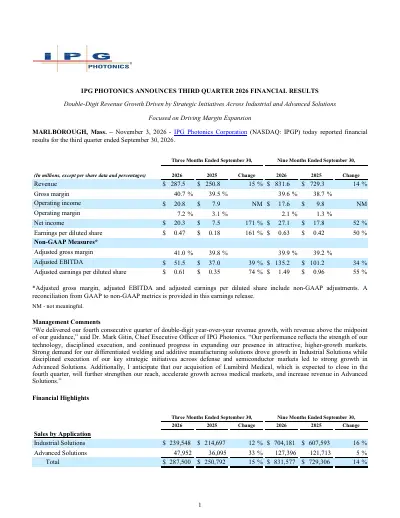
Our third quarter revenue increased 15% year-over-year, making it the fourth consecutive quarter of double-digit revenue growth, with both Industrial Solutions and Advanced Solutions contributing to the results. Our adjusted EBITDA and adjusted EPS also improved.
This reflects continued progress in executing our strategy, driving sustainable, profitable growth through technological leadership, product innovation, operational excellence, and disciplined capital allocation. Customers continue to adopt our differentiated solutions across several strategic growth markets.
We saw strong growth in our Industrial Solutions, particularly in welding applications where our laser technology, beam delivery, process monitoring, and applications expertise provide meaningful competitive advantages. We remain focused on helping customers improve productivity, quality, and manufacturing economics through advanced laser-based integrated solutions.
We've also made good progress in Advanced Solutions, driving our laser and photonics technologies into attractive high-growth markets. Let's look more closely at revenue by application and the meaningful progress we are making on our strategic growth initiatives.
Starting with Industrial Solutions, revenue increased 12% year-over-year, driven by strong growth in welding and additive manufacturing applications. Across these and other markets, we are strengthening our leadership by expanding laser adoption, displacing incumbent technologies, and moving up the value chain with differentiated subsystem and system solutions.
Our welding revenue benefited from higher demand in battery manufacturing, general industrial, and consumer electronics in the third quarter. The production of advanced batteries for electric vehicles and stationary energy storage systems involves a range of demanding welding requirements that significantly impact battery performance, safety, and manufacturing efficiency.
Our solutions are critical for high-capacity battery applications used in energy storage, supporting global electrification and growing energy infrastructure buildout, including for data centers. We are a leader in this space and are excited about the long-term trajectory for battery growth.
At the same time, we are encouraged by the strong growth in our welding solutions in other areas, such as consumer electronics and industrial markets. In additive manufacturing, we saw increasing momentum as customers continue to adopt this technology for industries such as aerospace, medical device manufacturing, and consumer electronics.
Our beam shaping and multi-beam technologies, high beam stability, and applications expertise are delivering improvements in throughput and cost per part. This quarter, we secured new business in Europe that we expect to meaningfully contribute to our additive manufacturing revenue in 2027.
Moving to Advanced Solutions, revenue improved 33% year-over-year and 15% sequentially, as we continue to expand our technology leadership into attractive high-growth markets, focusing on medical, defense, semiconductor, and micromachining. Revenue growth in semiconductor and defense applications were the major drivers behind our results this quarter.
In semiconductor applications, revenue continue to accelerate and more than doubled year-over-year. As device complexity increases and feature size decreases, semiconductor manufacturers are investing in advanced process technologies to meet growing demand for GPUs, high-performance computing, and high-bandwidth memory.
With our differentiated laser solutions, we are a critical supplier to a number of top-tier wafer equipment manufacturers where we are qualified for next-generation lithography, metrology, and inspection tools. Defense revenue was also a large contributor in the year-over-year growth in Advanced Solutions in the third quarter, as we shipped most of the Lockheed Martin order for Crossbow.
The remaining shipments will be delivered in the fourth quarter, and we are actively pursuing multiple additional opportunities. We remain encouraged by customer engagement and the growing recognition of our expanded portfolio of Crossbow directed-energy systems as an effective, ready-to-ship, and cost-efficient solution for countering evolving UAS threats.
While this market remains in its early stages and revenue can be lumpy in the short term, we believe our technology leadership, decades of directed-energy laser expertise, and commercial laser and systems manufacturing capabilities enable us to establish leading positions in these opportunities. Moving to medical, our business continue to perform well during the quarter, supported by strong customer demand, new product shipments, and ongoing adoption of our technologies across multiple applications.
We are building on our long history of medical innovation and laser expertise by expanding our leading thulium fiber laser platform with next-generation systems for urology applications. Last quarter, we announced the acquisition of Lumibird Medical, an important milestone in the execution of our strategy to expand our business in attractive high-margin medical markets.
The addition of Lumibird Medical creates a scaled medical laser platform with leading positions in ophthalmology and urology, expands our medical addressable market to more than $2 billion, enhances our Advanced Solutions portfolio, and strengthens our long-term growth and profitability profile. The acquisition is expected to close in the fourth quarter.
We are pleased with the initial integration planning and preparation, and are excited about the long-term opportunities to leverage our complementary technologies, applications expertise, commercial capabilities, and innovative culture to drive future value creation. I look forward to working with the Lumibird Medical team to accelerate growth and innovation across our medical business.
In summary, we achieved another quarter of double-digit year-over-year growth above the midpoint of our guidance range. Customer demand for our unique solutions is strengthened across most markets.
Orders also remain strong, with book-to-bill of approximately one. We continue to make meaningful progress on our strategic objectives, delivering profitable growth and creating sustained long-term shareholder value.
Finally, I'm pleased to announce that we plan to host an Investor Day on Tuesday, March 2nd, 2027 in New York City. We look forward to sharing a deeper view of our strategy and long-term financial targets.
Details will be announced soon. Please mark your calendars and plan to join us for this event.
With that, I will now turn the call over to Tim.
Tim Mammen
Thank you, Mark, and good morning, everyone. My comments will generally follow the earnings call presentation, which is available on our Investor Relations website.
I will start with revenue trends by application on slide 4. Industrial Solutions revenue increased 12% year-over-year and 1% sequentially in the third quarter, driven by growth in welding and additive manufacturing applications.
Advanced Solutions revenue increased 33% year-over-year and 15% sequentially on strong growth in defense and semiconductor applications. Sales of our emerging growth products accounted for 52% of our total revenue in the third quarter, down from 58% in the prior quarter due to product mix.
Moving to revenue performance by region on slide 5. North American revenue was up 14% sequentially due to increased sales in defense, medical, cleaning, cutting, and additive manufacturing.
Revenue increased 33% compared with last year, primarily on growth in welding and defense applications. European sales declined 1% year-over-year due to lower cutting and welding revenue, partially offset by increased revenue in additive manufacturing and semiconductor applications.
Revenue was up 4% sequentially, driven by improved cutting and welding revenue, as well as continued growth in semiconductor applications. Revenue in Asia was flat sequentially and increased 14% year-over-year, driven by growth in welding.
Moving to a detailed review of financial performance on slide 6. Total revenue was $288 million, up 15% year-over-year and 3% sequentially.
Foreign currency benefited revenue by approximately 1% this quarter compared to the same period in the prior year. GAAP gross margin was 40.7% and adjusted gross margin was 41%, above the top end of our guidance range.
We recorded a $5 million net benefit from tariff refunds that had a positive impact on gross margin of approximately 170 basis points in the quarter. Lower cost of products sold helped margins in the quarter, but was offset by lower fixed cost absorption on a year-over-year basis due to a significant build in inventory last year.
Total adjusted operating expenses were $91 million, below our guidance range. While we are focused on controlling expenses, we still expect operating expenses to increase modestly going forward due to our continued investments in multiple growth opportunities.
GAAP operating income in the quarter was $21 million, and GAAP net income was $20 million, or $0.40—47 cents per diluted share. Adjusted operating income was $27 million, and adjusted net income was $26 million, with adjusted earnings per diluted share of 61 cents.
Adjusted EBITDA was $52 million. Both adjusted EPS and adjusted EBITDA came in at the top end of our expectations, but also benefited from the $5 million in net tariff refunds.
Excluding the tariff refund, both adjusted EBITDA and adjusted EPS improved year-over-year and sequentially, and were above the midpoint of our guidance. Moving to a summary of our balance sheet and cash flow statement on slide 7.
We ended the quarter with $926 million in cash, cash equivalents, and short-term investments with no debt. Cash flow from operations continue to improve, reaching $46 million in the third quarter.
We spent $17 million on capital expenditures in the quarter, bringing year-to-date capex to $54 million. Our capex remains elevated this year due to investments in our major fiber manufacturing facility in Germany.
Excluding the German investment, we expect capex to be at about 5% of revenue going forward. Moving to our outlook on slide 8.
For the fourth quarter of 2026, we expect revenue of $265 million to $295 million. While we are seeing some moderation in battery capacity additions in China after several strong quarters, we are very pleased with demand trends across other markets and regions, which are reflected in our book-to-bill of approximately one.
Adjusted gross margin is expected to be between 37% and 40%, as we are not anticipating a meaningful benefit from tariff refunds. We estimate adjusted operating expenses in the range of $91 million to $94 million.
For the fourth quarter, we expect to deliver adjusted earnings per diluted share in the range of 30 cents to 60 cents with approximately 43 million diluted common shares outstanding. Our adjusted EBITDA is expected to be between $33 million and $50 million.
This guidance does not assume any contribution from the acquisition of Lumibird Medical. In summary, we are pleased with our third quarter results, with growth in revenue and bookings, as well as improvement in EBITDA and adjusted EPS.
We believe that we are well positioned to continue improving our performance. We're seeing solid long-term demand trends across our markets and are gaining traction on initiatives to expand margins, even as we continue to invest in the growth opportunities ahead.
I'll now turn the call back to Mark.
Mark Gitin
Thanks, Tim. We are pleased with our performance through the first three quarters of the year, driven by growth in both Industrial and Advanced Solutions.
Our recently announced acquisition of Lumibird Medical accelerates our strategic evolution and considerably expands our Advanced Solutions portfolio into higher-growth and higher-margin medical applications. We continue to execute our growth strategy, supported by operational excellence and an innovation engine that unlocks significant areas of opportunity.
As we continue along this path, I'm increasingly confident in our ability to achieve above-market growth, expand margins, and deliver lasting value for our customers and shareholders. With that, we will be happy to take your questions.
Operator
Thank you. At this time, we will be conducting a question-and-answer session.
If you would like to ask a question, please press star one on your telephone keypad. A confirmation tone will indicate your line is in the question queue.
You may press star two if you'd like to remove your question from the queue. For participants using speaker equipment, it may be necessary to pick up your handset before pressing the star keys.
One moment, please, while we poll for questions. Our first question comes from Ruben Roy with Stifel.
Your line is now live.
Ruben Roy
Oh, thank you and good morning. Tim, let's start with the comment you made on moderation in battery capacity additions in China.
You've had several strong quarters, as you mentioned. Can you start with maybe talking about welding or total revenue related to China battery today and how much of that sort of slow down is built into the midpoint for Q4?
One more on that is, would you say the book-to-bill was above one outside of the China battery moderation?
Tim Mammen
Mark gonna take that question.
Mark Gitin
I'll take that, Ruben. Good to hear from you.
After strong growth over the last several quarters, we're seeing some moderation as we mentioned in the China battery capacity additions. We see that as a near-term effect.
We're not breaking it out specifically, but we have factored this into the guidance for Q4. Longer term, we're excited about the growth opportunity, and we certainly still see a lot of capacity to be added there.
We've talked about the market drivers there before, the electric vehicles, but also stationary storage, where that drives grid electrification. Of course data centers are a key driver there, and we have a very strong competitive position there with our technology solution.
As was mentioned in the prepared remarks, overall, we're seeing strong growth across most of our markets and regions, and that's giving us still a book-to-bill of one.
Ruben Roy
Okay. Understood.
Thank you, Mark. On the Advanced Solutions, sounds like you shipped most of the Lockheed Crossbow order in Q3, you've got some coming up in Q4.
Are you expecting a little bit of a gap? I know you mentioned this is a lumpy business, obviously.
How are you thinking about defense in general for the first half of '27? I know you have other opportunities in semiconductor and medical, do you think you'll see growth in Advanced Solutions despite potentially some lumpiness post the Lockheed orders?
Mark Gitin
Yeah. As you said, we did ship much of the Lockheed order in Q3, and I want to say also we were shipping from production.
We're completing the rest of the shipments this quarter. As you mentioned and I did, it's lumpy, but very attractive longer term.
We're seeing continued strong customer engagements and pipeline there. I want to say also that if you didn't see, we did launch an extension to the product line, it's called the SE, and that has longer range and addresses larger drones as well.
We're very excited and we have very strong momentum on the customer side there and see good future there going forward. As far as the rest of the Advanced Solutions, we've talked about that, semiconductor is a very strong area for us.
Now it's smaller, but it's growing quite fast, it doubled year-over-year. We have very good engagement with tier one fab equipment players where we're being designed into their products, solving really key problems there.
That of course has the drive of data centers and AI, and that's an area I love also because the wins are sticky and they stack on each other over time. That's a key one.
Medical, we've talked about the urology platform and the growth that we're expecting there. New customer came on last year.
We have a great platform for growth there. Remember, we've talked about that business doubling over the next two to three years, medical is very strong.
Of course, we're bringing Lumibird in, finishing that acquisition, we're really excited about what that will bring, the combination of the two bringing some significant growth, and remember that Lumibird will be accretive in 2027 in that first year. There's new products that have already been announced, the first new product from Lumibird.
Lots of exciting things going on there in our advanced area. We're expecting growth in both our advanced and our industrial solutions over time.
Ruben Roy
Okay. Thanks for that detail, Mark.
I just have one more for Tim. On the gross margins, if we take out the tariff refunds in Q3, it looks like adjusted gross margins would have been around 39.3%.
Your midpoint for fourth quarter is 38.5. Can you talk about what accounts for the other 80 or so basis points lower on the gross margin?
Is that mix, absorption, etc.? Is sort of the 39% level the right starting point to think about as you get into 2027?
Thank you.
Tim Mammen
Yeah. Actually your math is very good.
So 39.3% is the adjusted excluding the tariff. That reflects revenue was $287 million, right?
At the midpoint, our revenue is $280 million, and that actually the 37 and a 38.5 ties right in with what was reported on the third quarter, Ruben. I'd say we're sort of more consistently at this kind of 39% range, and there's a tremendous amount of work that's continuing to be done in three of the areas that I've talked about, whether it's optimizing the value of the product that we're delivering, continuing to get cost reductions with our new higher-power diodes, which change in turn the form factor of the product, right?
We're starting to roll those out more meaningfully. Then there's a lot of work continuing on optimizing manufacturing, efficiency, utilization, looking at lower-cost areas to make some parts.
We want to drive improved absorption, and we still see several hundred basis points of gain that we can get from that. We're making good progress.
It's a bit slow to get there, but I think we're starting to get to the point where more meaningful gains in gross margin should materialize in 2027.
Ruben Roy
That's great. Thank you.
Operator
Our next question comes from James Ricchiuti with Needham & Company. Your line is now live.
James Ricchiuti
Hi, thanks. Morning.
You may have given it, but the medical growth in the quarter, how big a contributor was that to the overall growth in Advanced Solutions? Because as I recall, I think you're anticipating a pick up in the second half and maybe that's due to the new customer.
Tim Mammen
Medical increased slightly year-over-year, but improved significantly sequentially, which would be the pickup in the second half, and we're starting to see the ramp on some of the new product introductions and the new customer. The consumable business is also performing well, and we're expecting that obviously to continue into Q4 for both the hardware and the consumable, and then Mark said that we expect medical to be a nice growth driver for Advanced Solutions next year, Jim.
We're seeing that pick up in the second half of the year that we thought we would.
James Ricchiuti
Okay. Got it.
Just on Industrial Solutions, nice growth there, and I'm wondering the bigger part of that I think is still cutting and correct me if I'm wrong. What kind of growth did you see in cutting?
I assume modest versus what you described in welding and additive, but maybe if you could frame that a little better for us. Now
Tim Mammen
the main application is really welding these days that drives the underlying Industrial Solutions. There is still a cutting business there, but we've said before, it's I think last year less than 20% of total revenue.
It's very small in China. The other main applications that are still material would be the additive manufacturing, which globally is doing quite well.
That's both in Asia, Europe, and North America. We've had good performance out of that.
We're continuing to get good traction and make progress on cleaning applications. There is actually a marking and engraving business, which is still a reasonable size, and that can perform well when different end markets are stronger there.
Then yeah, the cutting is a smaller part of the business, and not one where we expect any meaningful growth on it, although we're actually defending our position there and have got some opportunities in '27 and '28 that could be a little bit more positive.
Mark Gitin
Just to remind you, Jim, Oh, go ahead, sorry.
James Ricchiuti
No, I was just gonna say they said the growth that you saw in China was really driven for the most part by welding and additive, and cutting, as you described, is a much smaller part of the business. That was really the driver.
You showed pretty healthy growth, it looks like, year-over-year in China.
Tim Mammen
It's primarily welding, additive manufacturing in China. Marking and engraving can be good there.
The cutting is a small part of that business, the flat sheet metal cutting is very small in China now.
James Ricchiuti
I'm sorry, Mark. Go ahead.
Mark Gitin
We covered it. All right.
James Ricchiuti
Perfect. Thank you.
Operator
Our next question comes from Scott Graham with Seaport Research Partners. Your line is now live.
Scott Graham
Hey, good morning. Kind of like 140,000 ft for you, Mark.
You got a better set of general industrial end markets, obviously certainly in the US, maybe not as much in Europe, but that's supposed to improve. I'm just wondering, with that general industrial being sort of your largest vertical, how are you approaching getting customers to trade up to fiber, right?
You talked about a couple of elements of how the market maybe starting to move up, but how are you showing a value proposition there? This is a significant run way here for you guys on this, and it's just been very slow in the coming.
How are you approaching that?
Mark Gitin
Scott, good to hear from you. We're very encouraged by the growth that we're seeing in the Industrial Solutions.
Areas that we're seeing growth, Tim mentioned some of this, certainly we're seeing growth in welding, additive manufacturing, cleaning, those are all areas that are strong and growing in the US in that industrial space. On the welding, a lot of this comes down to the applications expertise.
We are world experts in applications. We have a large number in the US and globally.
We have nearly 100 applications engineers. That piece is really critical, especially for welding, developing the key applications there, and then being able to get the solution to the customer, whether it's a laser, a subsystem, or a system, is part of our growth expertise there.
That's whether it's welding, whether it's cleaning. Then if you look at additive manufacturing, there, the customers are moving to additive manufacturing because we're helping to drive the cost per part.
If you look at additive manufacturing, we've developed lasers with special modes. You've heard us talk about a ring mode, and also with multiple outputs.
When those are incorporated into the additive manufacturing systems, it drops the cost per part and allows expansion into new areas, for where a lot of that started in areas of defense and aerospace, now that's expanding into areas of medical devices and even into consumer electronics. That application piece that we're working, and then using that in a virtuous cycle to drive the development of the lasers, subsystems, and systems, and being able to provide solutions to the customers is really what's driving our growth, and will continue to drive that at a outsized level.
Scott Graham
That's a very comprehensive answer. Thank you, Mark, for that.
Just the other one was about inflation, and maybe this is more for you, Tim. What was pricing in the quarter, what was inflation, and how are you looking at that heading into 2027 with inflation so elevated, not just on materials, but also on freight?
Tim Mammen
Yeah. On freight actually, yeah, let me step back a bit, Scott.
There's always inflationary pressures every year that you have to deal with, and you have to pay for. For example, merit increases, we do those halfway through the year, our costs actually went up a little bit in Q3 in relation to that.
20% of our revenue is on material, you have to deal with inflationary cost there. We actually have a couple of things that we look at.
We're obviously looking at how we optimize the value proposition of what we deliver to customers, right? That involves the pricing.
We are, in turn, as I mentioned, moving to higher-power diodes, so that means for each dollar of output power, we need fewer diodes. We actually can also then change the form factor of the laser.
Like a 10 kW laser today is much much smaller than a 10 kW laser was even two or three years ago, right? You got less material going into that.
Then we actually run programs internally where we call it a profit and cash program, where we're actually looking at how we can drive cost savings across different areas. Some of those are in operations, some of those are in SG&A, op-ex, and we use those to try and fund some of the inflationary impacts of the business that are kind of inevitable from each year.
Scott Graham
Thank you.
Operator
Our next question comes from Keith Housum with Northcoast Research. Your line is now live.
Keith Housum
Good morning, guys. Hey Mark, I know asking you to pick your favorites, it's kind of like asking you to pick your favorite children, but as you think about growth initiatives over the next two to three years, what do you think are the two top two, three growth initiatives that kind of are your favorite that you think will have the biggest impact on IPGP as we go forward?
Mark Gitin
Yeah. As you said, difficult to pick among the children, but let me just say that we're excited about growth opportunities in both the Industrial Solutions and the Advanced Solutions.
If I start in the advanced, of course we've talked about the medical and the great road map that we have there in urology. We picked up the new customer last year.
We have a great road map for growth, and we've talked about that doubling over the next two to three years. Remember then we're in the midst of completing the acquisition of Lumibird Medical, and Lumibird Medical is going to add to that.
That's accretive in the first year, has great growth potential on that piece, and certainly the combination of Lumibird Medical and our urology, that expands the SAM significantly, so that's above $2 billion, and gives us a great platform to grow on. The other piece, again, I'll name a couple, we've talked about defense.
We're making great progress with the Crossbow. I mentioned that we have the new product line that's addition that we have, the SE, which gives us longer range and crosses into larger drone classes as well.
We have great customer interest from that product line. Certainly have good expectations for that area.
Semiconductor, Keith, that's going well. Again, we've been embedded now in key customer programs and products now in major wafer front-end WFE players in metrology, inspection, and lithography.
We're seeing the benefits there. We've built out the capability there, not only in the technology that we've always had, but now in the quality systems and manufacturing systems to be able to drive that forward.
Excited about that area. Then micromachining.
We have great products in process there, great technology to get us into the shorter pulses and UV, and into some of the exciting areas in microelectronics and micromachining and medical devices. Those are all real key areas that we see for growth there in the advanced.
Then I don't want to forget the areas that we're driving also in the Industrial Solutions. We have great programs there, and we're seeing some of the benefits that we've talked about, not only in welding, but also in additive.
I talked about that a bit earlier. Overall see great opportunities for growth for the company going forward on these new areas that we're driving.
Great,
Keith Housum
great. I know Lumibird, the acquisition hasn't closed yet, maybe my questions are a bit premature, but how are you guys thinking about M&A from here?
Do you need to take a pause as you guys integrate Lumibird, or is this still an active process that you guys are willing to do more here quickly?
Mark Gitin
Happy to talk about that. First, let me just step back and frame it with our capital allocation strategy here.
First and foremost, it's investing in our organic programs. It's the ones that we talked about here, in both industrial and advanced, and the opportunities that we have to grow with our organic programs.
Then the inorganic piece, right, tuck-in or bolt-on acquisitions that can get us there faster or augment the markets. We've seen success with that with Cleanlaser, fantastic integration team there, and that's really paying back very well now, with great new products combining the road maps of both Cleanlaser and our laser road maps, having clean systems that are a quarter of the size and COGS.
Then Lumibird Medical, as you mentioned, we've talked about the great fit there and how that's going to allow us to grow. We've got a really strong integration team on that now, and all the integration planning there will continue to look for opportunities, but we'll be very disciplined in our approach.
We have our arms around that. Then just to complete the capital allocation, we always balance that with share repurchases.
We did $1.5 billion over the past several years, and we have another $100 million authorized. We're just excited to have such a strong balance sheet, and you see the free cash flow continues to be strong, and we've got great flexibility and optionality going forward.
Keith Housum
Thank you.
Operator
As a reminder, if you'd like to ask a question, please press star one on your telephone keypad. One moment, please, while we poll for questions.
Our next question comes from James Ricchiuti with Needham. Please proceed with your question.
James Ricchiuti
I just had a follow-up question on semi. I know it's a small part of the overall business, I'm guessing what, less than 5% or so.
As we think about the WFE market in '27, and looking out to '28, well, we're talking I guess the numbers being thrown out there of 35% or so growth in WFE in 2027. Is this a business, Mark, that you see becoming a more meaningful part of the Advanced Solutions revenue base going forward?
Mark Gitin
Jim, glad you raised that. I have to say I'm very encouraged by the progress that we're making in semi.
This is something that I really focused on when I came in, because of my experience in that area. This is an area where the technology was always there.
We have some unique technologies in the company, that the WFE players were interested in. What we've been able to do now is transition that into design wins in the programs, because we put in the other key pieces that you need there, the quality systems, the manufacturing systems, to be able to really engage and supply that market.
That's why we're seeing it. The numbers you talked about are, it is again a smaller piece, but you can see that we've now doubled that year-over-year.
We see good opportunity to continue to grow that business, both in the areas that we have design wins now, from the growth of the markets, as you talked about, driven by AI and data centers and those things. We're in those newer programs, and we continue to work with these companies on next-generation areas.
Longer term, I think this can become a more meaningful part of the business, for sure. It's a great area.
The technology is there, and we're making that cross-over.
James Ricchiuti
Maybe just on that topic of crossover that you raise. As we think of, and I don't want to front-run your Analyst Day coming up in early next year, but as you think about Crossbow, and the opportunity in defense, is there any color you can provide or maybe just broad expectations as to how we should think about that business looking out to '27 and '28, recognizing right now it's small, it's lumpy, but how should we think about the potential for Crossbow from what you've seen so far?
Obviously you're finishing the big order with Lockheed, but beyond that, how do we think about it?
Mark Gitin
Jim, I'm really optimistic about the Crossbow business. As I mentioned, we have very good engagement.
As I mentioned, we've now extended the product line, so that's the next piece of the product line with the SE product, that now gives us both longer range and crosses over into some of the larger drone classes as well. We're shipping from production, which is really key as well, because we can react quickly.
I would say that the customer engagements are very very good, and the programs that we're discussing and working with are, they're large programs, and we're excited about where that can go. The product is working.
It's been tested in multiple environments, as I talked about. Again, we're excited about where that can go.
James Ricchiuti
Thank you.
Operator
We have reached the end of the question-and-answer session. I would now like to turn the call back over to Eugene Fedotoff for closing comments.
Eugene Fedotoff
Thank you for joining us this morning and your continued interest in IPG. We will be participating in several investor events this quarter and are looking forward to speaking with you again soon.
Have a great day, everyone.
Operator
This concludes today's conference. You may disconnect your lines at this time, and we thank you for your participation.