IQVIA Holdings, Inc.
Q3 FY2026 · Earnings Call TranscriptOctober 27, 2026
Operator
Ladies and gentlemen, thank you for standing by. At this time, I would like to welcome everyone to the IQVIA Third Quarter 2026 Earnings Conference Call.
All lines have been placed on mute to prevent any background noise. After the speakers' remarks, there will be a question-and-answer session.
If you would like to ask a question during this time, simply press star followed by the number one on your telephone keypad. If you would like to withdraw your question, press star followed by the number one again.
As a reminder, this call is being recorded. Thank you.
I would now like to turn the call over to Kerri Joseph, Senior Vice President, Investor Relations. Mr.
Joseph, please begin your conference.
Kerri Joseph
Thank you, operator. Good morning, everyone.
Thank you for joining our third quarter 2026 earnings call. With me today are Ari Bousbib, Chairman and Chief Executive Officer; Mike Fedock, Executive Vice President and Chief Financial Officer; Eric Sherbet, Executive Vice President and General Counsel; Clarissa Willett, Senior Vice President, Financial Planning and Analysis; and Katie Warren, Vice President, Investor Relations.
Today we will be referencing a presentation that will be visible during this call for those of you on our webcast. This presentation will also be available following this call in the Events and Presentations section of our IQVIA Investor Relations website at ir.iqvia.com.
Before we begin, I would like to caution listeners that certain information discussed by management during this conference call will include forward-looking statements. Actual results could differ materially from those stated or implied by forward-looking statements due to risks and uncertainties associated with the company's business, which are discussed in the company's filings with the Securities and Exchange Commission, including our annual report on Form 10-K and subsequent SEC filings.
In addition, we will discuss certain non-GAAP financial measures on this call, which should be considered a supplement to and not a substitute for financial measures prepared in accordance with GAAP. A reconciliation of these non-GAAP measures to the comparable GAAP measures is included in the press release and conference call presentation.
As previously disclosed, we implemented a new segment reporting structure effective January 1, 2026. In conjunction with this change, prior period amounts have been recast to conform to this reporting structure.
I would now like to turn the call over to our Chairman and CEO, Ari Bousbib.
Ari Bousbib
Thank you, Kerri, and good morning, everyone. Thank you for joining us today to discuss our third-quarter results.
The team delivered great numbers. The market environment has continued to improve, but our performance improved even more.
Our organic growth rates year-over-year accelerated meaningfully, 2x for Commercial and nearly 3x for Clinical. Our margins expanded and free cash flow was very strong.
Our win rates were higher in the quarter, which led to our strongest clinical bookings in four years. Our differentiated AI offerings are increasingly contributing to that momentum with continued adoption of our agentic solutions.
In fact, IQVIA has now deployed 415 agents to date. Earlier this month, we brought together more than 400 attendees at TechIQ to share our latest clinical and commercial AI capabilities.
This event is our annual customer event focused on technology, which this year took place in Boston and included our technology partners: NVIDIA, Microsoft, AWS, Snowflake, and Veeva. Our AI leadership continues to earn industry recognition, including multiple industry awards for AI and technology innovation across life sciences and healthcare, while we continue to see more adoption of these capabilities across our customer base.
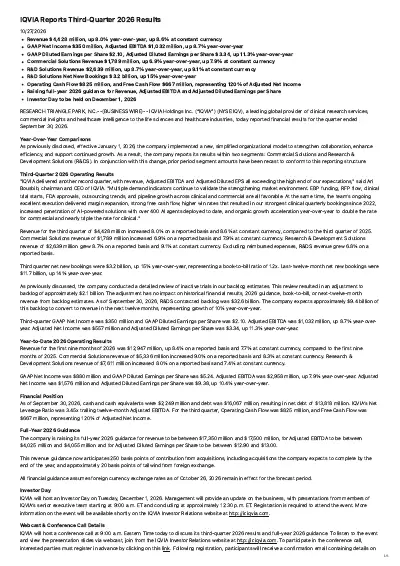
Let me spend a couple of minutes on the results for the quarter. Total revenue for the quarter exceeded the high end of our guidance range, representing year-over-year growth of 8% on a reported basis.
At constant currency, growth was even stronger at 8.6%. Organic revenue growth was approximately 6% year-over-year, well over two times the rate we delivered a year ago.
Third-quarter adjusted EBITDA was above the high end of our guidance as well, representing year-over-year growth of 8.7%. Adjusted EBITDA margin, as a result, expanded by 20 basis points, the second consecutive quarter with margin expansion this year.
Third-quarter adjusted diluted EPS also exceeded the high end of our guidance range and increased 11.3% year-over-year. The beat was driven entirely by the stronger operational performance.
Now onto segment performance. On the Clinical side, revenue grew 8.7% reported, of which almost 7% was organic year-over-year, which is nearly three times last year's organic growth rate.
We delivered $3.2 billion of net new bookings, our highest in four years, and 15% above last year, with notable strength in full service. Yes, the book-to-bill was 1.2 in the quarter.
More importantly, this is a long-cycle business, and I'd like to highlight that our last 12-month net new bookings have now increased for five consecutive quarters, reaching $11.7 billion, which is up 14% year-over-year. We think this metric is one of the best forward-looking indicators we have in support of long-term growth.
Looking ahead, demand indicators are encouraging. The EBP funding environment continues to be very strong.
Funding has reached $90 billion year-to-date, up more than 85% year-over-year and already above the total for all of last year, according to BioWorld. Similarly, clinical trial starts year-to-date are up high single digits.
RFP flow continued to grow at a healthy rate, up high single digits as well compared to last year. Our strong performance, of course, reflects an improving market environment, but we also had good operational execution with win rates that continue to tick up two, three points.
In Commercial Solutions, revenue grew 6.9%, of which 4% was organic, which is double last year's organic growth rate. We had good growth across our three sub-segments: Information offerings, which helps our clients understand the market; Analytics and Consulting offerings, which help our clients plan their go-to-market strategies; and our other Commercial Solutions that help them engage with patients, healthcare providers, payers, and channels.
We've now delivered four consecutive quarters of strong revenue growth in Commercial, and our pipelines remain at record levels. Looking forward, the demand outlook remains favorable with new drug launches up more than 40% year-to-date, our own pipelines showing healthy growth, and decision timelines continuing to shorten.
Now, I usually give you some color on the business activity in the quarter, and today I'd like to do that, but focus on examples where AI was a clear differentiator. Let's start with Clinical.
Our predictive clinical development capabilities utilize AI to help sponsors design better studies, identify risks earlier, and bring new therapies to patients faster. Here are a few examples of how this is playing out in some recent awards.
A large pharma client needed to deliver multiple phase 3 studies in the same autoimmune indication across nearly 50 countries. Here, our AI-enabled country and site modeling solution optimizes patient identification and enrollment, shortening the overall program timeline by nine months.
In another example, an EBP selected IQVIA for a phase 3 oncology program. Critical to winning this award was our AI-enabled protocol and site optimization tools, which accelerate timelines and reduce operational risk.
Finally, IQVIA was selected by an EBP for a phase 3 cardiovascular outcomes study. This is exactly where our scale and integrated AI capabilities make a big difference.
We are layering AI agents to bring together clinical delivery, laboratory services, and electronic patient assessments under one model to identify issues earlier, reduce handoffs, and proactively mitigate execution risks. Switching to examples in Commercial, we continue to evolve the way we partner with clients.
Successful adoption of our AI offerings in commercial organizations within our clients is deepening client trust in IQVIA, and as that trust grows, clients are increasingly looking to us to bring more of our AI-enabled capabilities to their organizations. For example, a top-five pharma client selected IQVIA to build and maintain an agentic platform that provides on-demand insights from complex real-world healthcare data.
This will help the client make faster market access decisions and adjust commercial models nearly real-time as prescribing patterns and patient outcomes evolve. We are also seeing AI help expand our role in patient services.
A top-10 pharma company selected IQVIA to deliver an integrated support program for its rare disease portfolio. Our AI-powered solutions adapt and shape interactions by factoring in patient mood and sentiment.
That allows, in turn, the client to automate tasks, such as benefit verification and case management. The program allows patients to gain access to their therapies, start treatment sooner, and better adhere to the treatments over time.
Another example, a large pharma client deployed our recently launched IQVIA Explorer solution. Explorer uses agentic AI workflows that integrate disparate data sources to answer complex questions spanning areas such as which cohorts of patients are taking the therapy, how therapies are being utilized in patient treatments, and help measure adherence by patient segments.
The client can now execute commercial activities in minutes compared with weeks or months previously. Let me now turn it over to Mike for more detail on our financial performance.
Mike?
Mike Fedock
Thank you, Ari, and good morning, everyone. As a reminder, we implemented a new segment reporting structure effective January 1, 2026.
In conjunction with this change, prior-period segment amounts have been recast to conform to this reporting structure. Now let's start by reviewing revenue.
Third-quarter revenue of $4,428 million grew 8% on a reported basis and 8.6% at constant currency. Organic revenue growth within the quarter was strong at approximately 6%.
Commercial Solutions revenue for the third quarter was $1,789 million, up 6.9% on a reported basis and 7.9% at constant currency. R&D Solutions third-quarter revenue was $2,639 million, up 8.7% on a reported basis and 9.1% at constant currency.
Year-to-date, total company revenue was $12,947 million, up 8.4% on a reported basis and 7.7% at constant currency. Organic revenue growth was strong at over 5%.
Commercial Solutions revenue was $5,336 million, up 9% reported and 8.3% at constant currency, and R&D Solutions revenue was $7,611 million, up 8% on a reported basis and 7.4% at constant currency. Now moving down the P&L.
Third-quarter adjusted EBITDA was $1,032 million, representing growth of 8.7% year-over-year, while year-to-date adjusted EBITDA was $2,958 million. In the quarter, adjusted EBITDA margins expanded by 20 basis points.
Third-quarter GAAP net income was $350 million, and GAAP diluted earnings per share was $2.10. Year-to-date, GAAP net income was $880 million, or $5.24 of earnings per diluted share.
Third-quarter adjusted net income was $557 million, and adjusted diluted earnings per share was $3.34, representing growth of 11.3% year-over-year. Year-to-date, adjusted net income was $1,576 million, or $9.38 per diluted share, up 10.4%.
Now looking at RDS bookings. The R&D Solutions net new bookings in the quarter were $3.2 billion, a 15% increase year-over-year, resulting in a 1.2 book-to-bill.
I should also note that cancellations remained in the historical range. As we noted during the last earnings call, the company conducted a detailed review of inactive trials in our backlog, resulting in an adjustment to backlog of approximately $2.1 billion.
This backlog adjustment has no impact on historical financial results, 2026 guidance, net new bookings, or next 12 months revenue from backlog metrics. Obviously, should any of these same trials resume, the value will be added back to backlog and will not be included in future bookings or book-to-bill metrics.
As of September 30, 2026, R&DS contracted backlog was $32.6 billion, and the next 12 months revenue from this backlog is $9.4 billion, which is up 10% versus prior year. As discussed, given the long-cycle nature of this business, it is more meaningful to focus on the longer-term booking trends.
For the quarter, the last 12-month net new bookings were $11.7 billion, an increase of 14% year-over-year. Importantly, this metric has been steadily increasing each of the past five quarters and points to continued momentum in our business.
Now, turning to the balance sheet. As of September 30, cash and cash equivalents was $2,249 million, and gross debt was $16,067 million, resulting in net debt of $13,818 million.
Our net leverage ratio ended the quarter at 3.45 times trailing 12-month adjusted EBITDA. Third-quarter cash flow from operations was $825 million, and capital expenditures were $158 million, resulting in free cash flow of $667 million, representing 120% of adjusted net income.
Let's now turn to guidance. We are raising our full-year '26 guidance for revenue, for adjusted EBITDA, and for adjusted diluted earnings per share.
We now expect revenue to be between $17,350 million and $17,500 million, representing year-over-year growth of 6.4 to 7.3%, and reflects over one point of constant-currency organic revenue growth acceleration versus prior year. This revenue guidance now assumes approximately 200 basis 250 basis points of contribution from acquisitions based on acquisitions completed to date and acquisitions we expect to have completed by the end of the year.
The guidance also assumes approximately 20 basis points of tailwind from foreign exchange, which is unchanged from our previous guidance. By the way, this implies that there is an approximately 70-basis-point headwind from foreign exchange to Q4 revenue.
We are also raising adjusted EBITDA to be between $4,025 million and $4,055 million, growing 6.3 to 7.1% year-over-year, reaffirming flat margins year-over-year at approximately 23.2%. Given the mathematical distortion pass-through revenues have to reported margins, I would also want to take this opportunity to remind everyone to focus more on the EBITDA dollars as it is a more meaningful measure of operational performance.
We are confident in our EBITDA dollar guidance irrespective of the pass-through contributions to our reported revenue. Finally, we are also raising adjusted diluted EPS to be between $12.90 and $13, up 8.2 to 9.1% versus prior year, or 8.6% at the midpoint.
As we close out '26, I'm sure you want some insights into '27 expectations. I want to take this opportunity to formally invite you to our upcoming Investor Day on December 1st where, as we normally do, we will share a broad framework of what we see shaping up for next year.
As always, we will provide detailed guidance for 2027 concurrent with the release of our full-year 2026 and fourth-quarter earnings in February 2027. In the meantime, to help you with your models, I want to share the run-rate assumptions we see exiting the fourth quarter for below-the-line items.
We expect net interest expense for the fourth quarter to be around $210 million. We expect just over $160 million in depreciation and amortization for the quarter.
We are expecting our weighted average diluted share count to be approximately 169 million shares. Just as a reminder, Q4 compares are very difficult, the implied growth rates should not be interpreted as a deceleration in our business and we are confident in the momentum that the metrics that we highlighted previously would imply for the future.
This guidance assumes that foreign currency rates as of October 26th continue for the balance of the year. To summarize, IQVIA delivered an outstanding financial results with third-quarter revenue, adjusted EBITDA, and adjusted diluted EPS exceeding the high end of our guidance.
Organic revenue growth rates accelerated year-over-year across both Commercial and Clinical segments as demand continued to rise, AI continued to be a tailwind to our business, and our win rates continue to improve. Adjusted EBITDA dollars grew 9%, and we expanded adjusted EBITDA margins 20 basis points in the quarter.
We had strong free cash flow performance representing 120% of adjusted net income. R&DS net new bookings were $3.2 billion, growing double digits year-over-year, with another quarter of very strong full-service bookings.
We raised our full-year 2026 guidance for revenue, adjusted EBITDA, and adjusted diluted earnings per share. We look forward to seeing you in person on December 1st at our Investor Day.
Now with all that, let me hand it back to the operator for Q&A.
Operator
Thank you. At this time, I would like to remind everyone, in order to ask a question, press star, then the number one on your telephone keypad.
We request that you please limit yourself to just one question so that others in the queue may participate as well. We'll pause for a moment to compile the Q&A roster.
Your first question comes from the line of Shlomo Rosenbaum with Stifel. Your line is open, please go ahead.
Shlomo Rosenbaum
Hi. Thank you very much for the question here.
Ari, I wanted to ask if you could go into a little bit more about the uniqueness of IQVIA's ability to deploy data and technology in an agentic world. You touched on some of the examples, but can you just talk about things that just other competitors just can't do because they don't have the data, and whereas IQVIA can do some of these things, and then also maybe discuss about how your clients view this and how you think about this in terms of being able to charge for this differentiation?
Ari Bousbib
Look, this [laughter] will be the subject of a very long conversation, but look, how can I put it? AI is not just another technology.
It's, from our point of view, it's a new way of doing business. It's changing the way customers engage with their own activities, and how they engage with IQVIA.
Stepping back, to successfully deploy AI, there's a premium in knowing the business. If you understand AI simply as an opportunity to do business a different way, meaning first, content is important.
You need the proprietary information that powers AI. That means you need the globally sourced, de-identified, curated, fit-for-purpose, integrated, interoperable, compliant with regulatory, privacy, etc., etc., etc., and ready-for-extraction data.
Now, we've got all of that. Second, in addition to content, you need context.
I think people are realizing that to deploy AI effectively, you need context. You need deep expertise in life sciences to understand that information.
We've got that, too. Thirdly, importantly, and I'm looking for a word starting with C, content, context, what else here?
Comprehend. You need to comprehend what you're looking at, that is you need to interpret what the information is telling you and know how to apply to make decisions faster and more accurately.
When you think about AI agents, it's not that you can use an AI tool, whether it comes from Anthropic, or OpenAI, or anywhere. AI agents are constructs that operate a workflow in lieu of humans.
We build them using all these tools. We don't have to reinvent the tools.
The tools are available. We spend money with all of these massive AI companies.
They just have generic tools that we utilize to construct agents, depending on the use case, obviously. Again, the agent is only one part.
You obviously need the content, you need the context, and you need the interpretation insight step enabling you to construct the agents and operate them. Very often, because of all the specific issues related to operating workflows in healthcare, the transparency, the traceability of the data, etc., etc., and the compliance aspect, you do need humans in the loop, as you do in many other industries, but in our industry, in particular.
By the way, we've been at this for a while, as you know. It's not that we're trying to catch up with all the headlines.
We're working with our clients, and it's slowly, but surely changing the way we do business and changing the relationship with our clients and making us even more integrated within our clients' workflows.
Shlomo Rosenbaum
Thank you.
Operator
Your next question comes from the line of Elizabeth Anderson with Evercore ISI. Your line is open, please go ahead.
Elizabeth Anderson
Hi, guys. Good morning and thanks so much for the question.
I wanted to dig in a little bit to the gross margin improvement. Obviously, that was a highlight, particularly given the higher pass-through mix.
Can you talk to us in maybe a little bit more detail about the pushes and pulls, how much is the pass-through mix sort of causing degradation of that and sort of what are the levers on the upside, we make sure we understand that trajectory properly. Thank you.
Mike Fedock
Thank you for the question, Elizabeth. Yes, you're absolutely right, and thank you for pointing out the improvement in gross margins.
Pass-throughs across the enterprise were certainly a headwind on gross margin line, probably about 70 basis points. It really highlights the underlying strength in our operational execution.
Elizabeth Anderson
Then just in terms of that, we should just think of that as broadly
Ari Bousbib
Elizabeth, Elizabeth
Elizabeth Anderson
Yeah.
Ari Bousbib
I have here in front of me the detail of the adjust, I know you asked about gross margins, but on this adjusted EBITDA margin, which expanded 20 bps. What the non-operational items, which is the 70 bps that Mike highlighted, we also had, I guess, 10 bps of currency impact.
Let's broad say 60 or so bps of net non-operational headwind to our margins was more than offset by 80 bps of operational improvements. That's again the cost containment, the AI gentification of our own processes, productivity programs, etc., everything that we do day in, day out.
That contributed, in aggregate, 80 bps of tailwind. You see that underlying our margins, if you eliminate pass-throughs, and if you theoretically were looking at our margins without the pass-throughs just on the old basis, just on the service revenues, that margin would have improved 80 bps, and adjusted EBITDA margin would have improved 80 bps.
Obviously, it's significantly higher than the delivered margin of what is it,
Mike Fedock
23.
Ari Bousbib
2%? Right?
It'd be more in the high-20s. Almost about 30%.
Elizabeth Anderson
That's super helpful. Thank you for that context.
Mike Fedock
Thank you.
Operator
Your next question comes from the line of Jailendra Singh with Truist Securities. Your line is open, please go ahead.
Jailendra Singh
Thank you and thanks for taking my questions and congrats on a strong quarter. I want to go back to bookings in the quarter.
Very strong booking trend despite the normal seasonality you generally see in 3Q. Was there anything unusual in the timing or mix of 3Q awards in 3Q, or was just broad-based market strength or your win rate improving?
Just trying to understand if we should expect a normal seasonal step-up in Q4 from bookings point of view.
Ari Bousbib
No, thank you for the question. It really was broad-based.
That earlier this year, there were all these concerns that you guys all voiced about, "Well, that's it, it's over, full service is over, everyone is going FSP, people are insourcing," and so on and so forth. We warned you that that is not the case and that the pendulum swings back and forth, but long term, the outsourcing trend is absolutely intact.
This is again the second quarter in a row that we've seen very, very strong bookings in full service. In fact, year-over-year, they were up by a lot.
I don't even want to give you the numbers because it's so big. Now, the flip side, obviously, from an optics standpoint, is full service comes with pass-throughs.
Back to the Elizabeth question, we then have the negative impact on the reported margins, and I cautioned you to make sure you look under the covers, and you understand the operational improvements there. To your question, really good strength across the board, and really that was true for large pharma, where we see continued uptick in win rates, and the consequence on all the strategic partnerships that we have structured over the past two years, which we've talked about at length in prior calls.
All of those are now starting to pay off as we continue to bid on a growing stream of RFPs and continue to win more and more of those opportunities with large pharma. Again with EBP similarly, we've talked about our strategy there, and that also is continued to grow.
The bookings in EBP were very strong. Again, if you look at, and we want you to look at our LTM net new bookings, which at the end of this past quarter was $11.7 billion, and you look at that number, each of the past five quarters, that number has continued to grow consistently, and it was up 14% year-over-year.
We think this is an excellent metric to focus on in terms of understanding sustainability of long-term growth in the business. Again, broad strength in FSO, FSP, strong outsourcing.
Any other comments, Mike, or no?
Mike Fedock
No, I think just that and no other changes expected in Q4 seasonality from a trending standpoint.
Ari Bousbib
Nothing unusual therapeutically or otherwise. Really a good, good, excellent quarter from a booking standpoint.
Thank you.
Jailendra Singh
Great. Thanks a lot.
Operator
Your next question comes from the line of Eric Coldwell with Baird. Your line is open, please go ahead.
Eric Coldwell
Thanks very much. Good morning.
I think my only concern that I've had here recently is just the below-the-line items, and you gave us a insight into your view on the fourth quarter. Should we be taking that $210 million, I think you said, and just annualizing that into 2027 at this point, or are there other parameters or dynamics to consider as we think about interest expense modeling for next year?
Then just one other quick one, I am curious if you can give us the parameters for the backlog scrub. What exactly made the cut or didn't make the cut in terms of your review when you looked at what to remove for now, if you could give us those details, would be appreciated.
Thanks very much.
Ari Bousbib
I guess, yeah, maybe I'll give that to Mike, but just the other review of the backlog, and Mike, you can add any details you want, is basically trials that have been in the backlog for a long time. We review that in detail, and long time means long time, means over 18 months plus, I think that was kind of one of the criteria, and in conversation with customers, there was no reason to assume that the work was going to resume in the near term.
For clarity and cleanliness and more accuracy in visibility, we thought it was a good idea, similar to what the competitor has done, to just simply remove it. In the past, we would have just left them there.
We know that they are inactive, we wait for a resumption possibly of this, but it kind of becomes stale, and so it's better. As I think Mike indicated in his introductory remarks, if those trials come back, which sometimes they do, by the way, even when they've been around inactive for a year plus, they come back, which is why, by the way, we looked at way more than a year, like 18 months, two years type of inactivity.
When they do come back, if they do come back, then we will simply add them back to the backlog directly. We certainly are not going to take them back as a booking.
That's the way we decided to make the adjustments. I hope that gives you more color.
Then the first question was on
Mike Fedock
just about the below-the-line items Oh,
Ari Bousbib
the D&A, yeah, Mike, go ahead.
Mike Fedock
and interest, yeah. Eric, your team actually does a pretty good job at reviewing our debt stack and looking what's coming up for next year with refinances and swaps and things like that.
I would focus mainly there. There's nothing else really below the line on depreciation or tax or anything really to call out there.
Ari Bousbib
I think the question was that kind of that run rate more or less what we expect for that, and the answer is about yes, I think
Mike Fedock
About yes, and we have some refinancings
Ari Bousbib
We have some refinancings. We don't know where the rates are going to be a year from now, but yeah.
Yeah. That's the, I think it's a good Is it, it's a good number?
Mike Fedock
Yeah. Yeah.
It's a good number to start with. Obviously, we use just whatever the publicly available forward curves are to do the projections.
Ari Bousbib
Thanks, Eric.
Eric Coldwell
Thanks, guys. Appreciate it.
Ari Bousbib
Okay. Thanks.
Thanks, Eric.
Operator
Your next question comes from the line of Luke Sergott with Barclays. Your line is open, please go ahead.
Luke Sergott
Great. Thanks for the question, guys.
Just two quick ones here, unrelated. On the Commercial Solutions, you guys have been talking about you've had record backlog and strong bookings there over the last couple of quarters.
Understand that it bounces around a little bit, but saw a little bit of a de-cel in the 3Q. Just trying to figure out when the timing of this, is the conversion still elongated and how that's shrinking, and when we could start to see this accelerate growth?
Then the second one is on the backlog and the adjustments, just a follow-up on Eric's question. I guess, as you think about what's been in the backlog, are you guys getting any more stringent on what you're deciding to include there?
Is it something that's going to start to progress within the next 12 months, and just be so you can avoid these adjustments?
Ari Bousbib
I guess everyone has two questions now that thank you, Eric, for setting the precedent. Thank you for setting the precedent.
Okay. Just because we allow Eric to have two questions, it doesn't mean we're going to allow everybody.
That's that [laughter] Okay. All right, on Commercial, yeah, look.
We don't look at backlog for Commercial. As Commercial is more of a, not short-term necessarily, but it's a shorter cycle than R&DS, looking at backlog there, that's, makes Obviously, we have performance obligations in some of the longer-term contracts that we have on commercial execution, for example, commercial outsourcing.
Even the data contracts are typically one-year renewable, evergreen-type, and so on. We don't put that in backlog.
Most of the business in our Commercial Solutions is not backlog. We don't refer to that as backlog, no conversion, none of that.
What we speak about is pipelines, that means there are projects, there are requests for proposals, and our pipelines, as I mentioned, are at record levels and our win rates are also up, and the decision timelines are shortening, which these are the kind of the main demand indicators that we look at from a forward-looking perspective, and we see those to be very strong. I also mentioned from a market standpoint that approvals Yeah.
are up 40%, you said, Yes. year-over-year.
Again, drug approvals typically are followed within six months to a year or thereabouts by product launches. Product launches are the bread and butter of what we do.
This is where we are spending a lot of time with our clients, helping them with their launch strategy, with their pricing, with their interactions with the channels, with their marketing to HCPs, with their promotional programs, multi-channel marketing programs, with their interaction with payers, providers, country access, market access, all of those activities that are the bread and butter of our Commercial business are really associated with launches. The fact that we have product approvals that are up over 40% is a strong indicator that the overall market is strong.
That bodes well for our Commercial business. You mentioned the third quarter.
No, the third quarter is up very nicely. Organically, it's double the rate that we had a year ago, the third quarter.
I wouldn't look at a sequential, especially third quarter, to be honest. Third quarter is very volatile.
It's up and down a few points versus sequentially, always, if you go back many, many years, and that's just typical of the third quarter. We have a very large business in Europe.
Not that Americans don't take any vacations in August, but the Europeans do for a long time, and typically it's a just a slower thing in Europe, and that creates more volatility, but I wouldn't read more into it. The business again is doing very well.
You had a question
Mike Fedock
about Luke about the backlog.
Ari Bousbib
Nothing changed really in
Mike Fedock
the way we Short answer is no, we're very comfortable with what we put into our backlog, and in fact, being on an as-contracted basis, we feel that that's best-in-class practice, no change there.
Ari Bousbib
Only contracted for and bookings are bookings. Otherwise, we wait for contracts to be signed.
Sometimes, between the time a customer awards something to us, that's in the R&DS business, then it could take a month, two months sometimes before all the dots and Ts are crossed, and so on and so forth, and the contract is actually signed and executed. Only at that time do we put it in our backlog, and there's nothing changed to that.
Thank you.
Luke Sergott
All right. Great.
Thanks for the questions.
Operator
Your next question comes from the line of David Windley with Jefferies. Your line is open, please go ahead.
David Windley
Good morning. Thanks for taking my question.
Ari, I wanted to ask a kind of a R&DS horizonal question, if I could. It seems like the industry has been through a couple years' worth, maybe '24 and '25 or '23 to '25, a heavy reprocurement cycle among your larger clients, and that brought on a lot of focus on FSP.
Then biotech funding was low, and so the absence of them with FSO was also painful. As we're coming back out of that, biotech funding is helping them to come back with FSO, and maybe between the reprocurements, the big pharmas are also doing some FSO.
I wonder if you agree with that. If biotech has been kind of the leader out of that trough, is pharma starting to catch up?
Are you still seeing reprocurement activity go on? Is there still opportunity, wallet share opportunity for you, and how is that playing out?
Thanks. Apologize for the multi-parter.
Ari Bousbib
No, it's a great question, but look, the answers to your question are in your question. The industry, you're one of the best observers of the industry, you hit all the correct points.
Look, we're just coming out of a two to three-year period of multiple headwinds. First, we had the post-COVID bubble deceleration both at large pharma and in terms of the EBP funding.
Second, we had the IRA, which introduced those concerns about drug pricing negotiations and so on and so forth, which kind of started slowing down large pharma, for sure, and in terms of their discretionary spend first, which we observed in our Commercial business immediately, and then sort of pausing large capital investments and new programs. Then we had the next administration's bringing up drug prices again through the MFN, and we had the tariffs, and we had all of that drama.
All of that drama created huge uncertainty. That uncertainty caused large pharma to pause their decision-making.
We saw decision timelines extend dramatically, okay? By a lot.
That kind of all of that caused significant demand constraints. Now, during that time period, pharma took the opportunity to step back and re- negotiate their strategic partnerships, reopen their strategic partnerships.
That lasted a year, a year and a half maybe, and literally every single large pharma did that. It was over not too long ago.
We feel very good about that process and what happened. We came out ahead of where we were before in terms of the scope, the number of partnerships we are in, and the scope of what those partnerships include even within the large pharmas where we were in.
I said this before, and I'll say it again, it has further segmented the CRO industry into essentially let's say three groups: the largest ones, and then the small mid-ones, and then you have a long tail of little players that are not part of this conversation. The largest one essentially emerged ahead.
We believe we emerged more ahead than the others on the back, I believe, of our broad spectrum of capabilities, AI, etc. That's being proven out in our win rates today.
Second, the smaller tier of CRO suppliers, I think lost out overall, and that is going to become apparent over the next two, three years, even if it's not today, but I know that it's going to be apparent because we know who's out, and they're all out basically. That's what has happened with large pharma.
Now, on the EBP side, much more funding. Again, 85% growth funding year-to-date year-over-year, 85% increase in funding.
It's a wild number. Again, before COVID, the annual funding in EBP funding, and this is using consistently the same source and the same exact parameters, before COVID, the annual spend was in the $50 billion range for between 2015 and 2020.
It is this year year-to-date, three quarters, $90 billion. It's almost double what the annual rate was before COVID.
This is funding an increasingly large number of opportunities. We think there are almost 17,000 EBPs around the world.
It's a vast market, it's a great market, it's a dynamic market. Certainly, as you said yourself in your question, EBP is growing at a much higher rate in terms of spending than large pharma.
We believe the long-term growth rate of R&D spending in large pharma is in the low single digits, maybe 2 to 3% underlying growth, long-term. EBP is more in the upper single digits, right, I'm thinking 8, 9%.
That's clearly driving growth in our business. As we have multiple strategies to grow that part of the business, including the expansion of our capabilities to early-phase engagement.
We've beefed up our capabilities there. We've hired a large number of ex-FDAers to engage with biotech much earlier at the regulatory stage.
We have acquired discovery capabilities. We've acquired phase 1 capabilities, and I can tell you, we continue to progressively, in that field, to increase our engagement with EBPs with a set of capabilities that are required to further penetrate that customer base.
Thank you for your question and the opportunity to lay out my view on what's going on in the industry.
David Windley
Thanks. Thanks, Ari.
Operator
Your next question comes from the line of Michael Cherny with Leerink Partners. Your line is open, please go ahead.
Ari Bousbib
Operator, this will be our last question. Thank you.
Michael Cherny
Okay. Thanks, maybe just a direct follow-up there to Dave's question regarding the market construct, in particular, the role of AI.
As you have developed your own AI capabilities, are you seeing the dynamics of contracting changes showing up, i.e., a push and pull relative to how your pharma sponsors want to charge for your work that encompasses AI? Are there any thoughts about value-based contracting and savings over time?
What do you think the role is beyond just differentiating on winning share AI will play in the way that you can essentially manage and contract to certain profit levels going forward? Thank you.
Ari Bousbib
Thank you. Look, again, [laughter] it's a big question.
On the Commercial side, AI is essentially an incremental revenue opportunity, okay? We are providing our clients with new ways of doing business that enable them to automate and reduce the amount of labor that they themselves use in their operations to conduct business.
It's a great opportunity for our clients to improve their productivity and improve their profit contributions. For us, we essentially providing additional services and subscriptions to our agents or licenses.
That's on the Commercial side. This obviously should be at good margins.
On the R&D side, I would differentiate between large pharma and EBP. EBP, as is fully outsourced.
It usually requires a lot more handholding from the beginning, the relationship is different. We will be using AI here to optimize timelines, to speed up processes to ensure that clients get to market, the product gets to market a lot faster and to patients a lot faster.
I mentioned an example was with a large pharma where we going to cut nine months out of the trial. Nine months is huge in this business.
If you just take a look at what one month of sales at a very, very high margin represent for a pharma company, and so nine months is huge. In comparison, the cost of the clinical trial is nothing.
Now, that doesn't mean that large pharma is not negotiating contracts. Large pharma essentially has negotiated in the process I described earlier, in reviewing and renewing partnerships, the rates.
Okay? That is essentially done.
Now, obviously, when we compete for a specific trial, there always are negotiations at the end with procurement, and so on and so forth. Does AI play a role?
No, AI is essentially an enabler of faster timelines, more accuracy, better visibility and transparency in the process of conducting the trial. Really, believe me, this is what the conversations around AI are.
Is it going to have an impact on our productivity for us internally? Yes.
We mentioned that. We are deploying agents at our clients' operations, and we are also deploying agents at our operations.
There's no question about it. From finance to HR to a variety of other overhead activities and automated tasks that we used to standardize and perform in offshore centers, a lot of them, whether it's software development, whether it's software testing, all of that, yes.
Over time, that will certainly help with our own margin expansion plans and productivity programs. Thank you.
Operator
Thank you. Mr.
Joseph, I turn the call back over to you.
Kerri Joseph
Thank you, operator. Thank you everyone for taking the time to join us today.
We look forward to speaking with you again on our fourth-quarter 2026 earnings call. The team will be available the rest of the day to take any follow-up questions you might have.
Thank you, and have a good day.
Operator
This concludes today's call. Thank you for attending.
You may now disconnect.